And speaking of animals

I suddenly realized that when I was proposing the going-away party for the boy — clothes, but possibly also food, because he must be really hungry by now — I didn’t mention the frog.

That was an oversight. So here’s the plan.

First, the frog would be freed.

Second, he would be given a large pile of small- and medium-sized rocks to throw at the boy.

Third, he would be given a hundred things his heart might desire, from the unlisted phone numbers of Charles Ray (sculptor) and Francois Pinault (collector), to his own private estate with tennis court and helipad in the Great Moss Swamp, to a date with every winner of the Miss Humanity of the Netherlands pageant.  And a huge party at the Waldorf-Astoria for freed dolphins, liberated dancing bears, wounded hedgehogs, rehabilitated slow lorises, and birds whose owners accidentally left their cages open.  He’ll also have his own smorgasbord with all the beetles, grasshoppers, spiders, and Purina Frog Chow he’ll ever want.  And a trampoline.  And a pony.
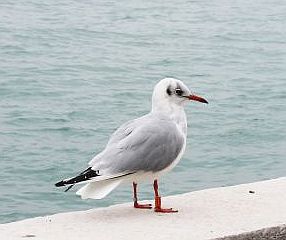
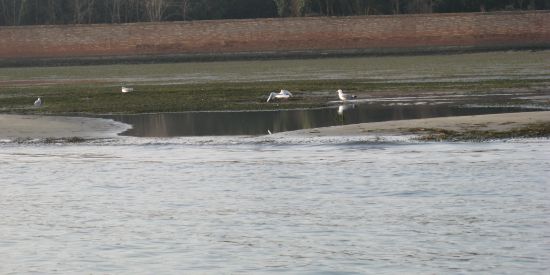
Lino spotted this gull because of his little identification anklet. Maybe he’s in the bird atlas by now, with a number if not a name.

While we’re on the subject of animals, here’s something you might find interesting.  More than 240 species of birds spend at least some, if not all, of their time in the Venetian lagoon and immediate vicinity.

An article in the Gazzettino announced this fact along with the notice of the publication of a new atlas of birds, the result of five years of data-gathering. For the record, the title is “Uccelli di laguna e di citta’ – L’atlante ornitologico del comune di Venezia 2006-2011,” written by Mauro Bon and Emanuele Stival, ornithologists of the Museum of Natural History, published by Marsilio.

Of these birds, 142 species come only for the winter, 115 come to nest, and about 60 are migrating. If you stop and read that over again, I think you’ll be respectfully amazed.  In fact, the lagoon is at a crucial point on a major north-south flyway, and is one of the largest lagoons left in Europe. It’s far from being just scenery.

Even though I’ve never seen them, I now have learned that there is a Hungarian royal seagull which arrives in the fall, and spends the winter in the Giardini Reali between the Piazza San Marco and the lagoon. And there is an extremely rare black-legged kittiwake that comes from England.
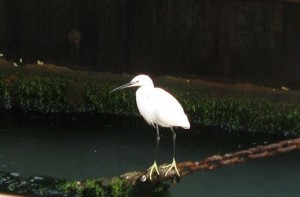
The Little Egret, which is abundant in the lagoon, doesn’t mind looking for a bite wherever the chances seem good, though they seem to be happier pecking through the shallows when the tide is low. There is a tree near the Vignole which at twilight in the summer is almost completely white with the egrets who’ve come to perch there for the night.

I was already interested in birds because rowing around the lagoon at all hours and in all seasons means that you see plenty of them.  For one thing, they’re everywhere.  For another, they’re generally easier to see than fish.

Some of the birds I’ve come to recognize are as much as part of Venice as canals and tourists. The svasso (grebe) and tuffetto (little grebe), only appear in the winter. The cormorants, mallards, seagulls, egrets and herons are here all year. I’ve already gone on too long about my passion for blackbirds (a few months per year), and I’ve never bothered to mention pigeons because there’s nothing worth saying about them.  They are the roaches of the avian world; they’ll be here pecking around and crooning after the last nuclear device explodes. I am prepared for hostile letters from pigeon-feeders.

There is one kingfisher who I watch for as we row behind the Vignole; all you can see is a flash of iridescent blue-green flitting through the trees and over the water. I wish he’d hold still somewhere just for a minute, but he’s not interested in being admired.

In the plush summer nights we almost always hear a solitary owl called a soleta (civetta in Italian), somewhere high in the trees in the Public Gardens.  He or she makes a soft one-tone hoot, repeated pensively at perfectly regular intervals.  It’s like a metronome, far away. It goes on for hours.  It’s very comforting.
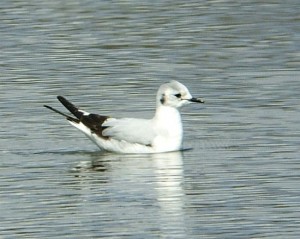
A young Little Gull, photographed in Northumberland. Maybe he’s thinking about his Venetian vacation.

For two days not long ago we were startled to see a fluffy young gull we’d never seen before, standing on the fondamenta gazing out at the lagoon. Determined research revealed that it is a Little Gull. We haven’t seen it since.

And one magical winter day a trio of swans flew over us.  You hardly ever see the wild swans, but here were three, flying so low that I could see their long necks undulating slightly and hear a curious murmur from their throats.

Many of these birds depend on organisms and elements in the lagoon wetlands which exist because of, or are replenished by, acqua alta.  If so many people who never leave the city didn’t get so worked up about having to put on boots, the water could continue to provide for lots of creatures who like being here too.  Maybe your tourist or trinket-seller doesn’t care about the birds, but the birds probably don’t care about the Doge’s Palace and Harry’s Bar. Just saying.
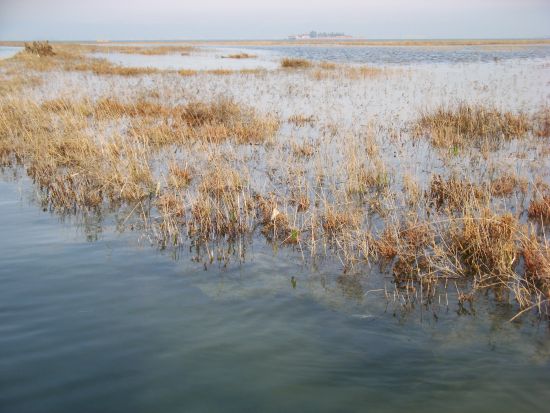
A luscious look at acqua alta in the lagoon. A soaking marshy islet looks even better to a bird than it does to me.
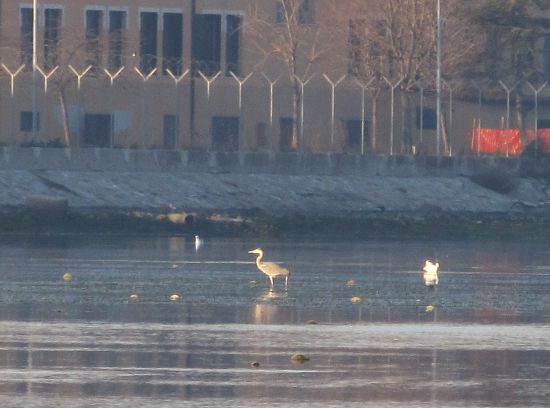
This is the single grey heron I’ve seen here, always fishing between Sant’ Andrea and Sant’ Erasmo.
And of course the indefatigable seagulls. They look more attractive out here than plodding along the fondamentas ripping open plastic bags and strewing the garbage all around. Lino says nobody ever saw gulls in the canals, much less on the streets, when he was a boy. The same with cormorants, who we sometimes see fishing in our canal.

Continue Reading

The next small thing

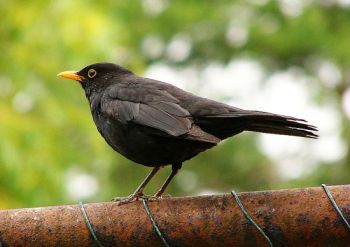
I love this bird. (Photo: w:User:SonNy cZ)

As I have undoubtedly mentioned at some point, there are many moments throughout the year which I await with all the focus of a hunter watching for the tiniest tracks of his prey. Or something like that.

This morning, to my astonishment, I heard the first blackbird of the year.  This is great news, because the few months in which blackbirds sing the sun up are a very big deal to me. Not because of the sun, because of the birds.

The freezingest days of January/February (which have yet to log in, though they’re apparently en route from Siberia) are known as the “giorni della merla” (days of the female blackbird), so considering the curiously mild weather, it does seem a bit early.

No matter.  I heard one distant cadenza this morning. It was brief, it was beautiful, and it was the first.  I’m happy.

Continue Reading

Not lost, just smelted

I see that more time than usual has passed since I posted anything about the most-beautiful-city-in-the-world, and I apologize.

I suppose I could just stop there, but if I had a note from my mother to present to the teacher it would say:

“Please excuse Erla from not writing anything on her blog.  She and all of Italy have been suffering from an extreme heat wave which has destroyed her will to live, which flickered out only slightly before her will to write.  The heat wave comes from North Africa and is called ‘Charon’ (“Caronte,” in Italian), the name of the mythological man who ferried the deceased across the rivers  Styx and Acheron to the world of the dead.  Unfortunately, he seems very happy in Italy, what with the pasta and gelato and art and all, so he’s showing no signs of wanting to go elsewhere. I don’t know what he’s done with the dead people.  She’ll be back as soon as she escapes.”

I would gladly send a post from Lapland, or Baffin Bay, or Queen Maud Land.  But I’m stuck here.

More on other topics when I can manage it.  Sorry.

Continue Reading

Disaster strikes

A tornado crossed part of the lagoon yesterday morning, and part of Sant’ Elena was in its way,  And all of our boat club.

The office is gone, the two buildings and sheds where our boats were kept are gone.  And the boats are pretty much gone, too.  I don’t mean “gone” as in lifted to heaven in the rapture, I mean it in the sense of smashed to various bits.  Because we were in a phase of demolishing the old clubhouse in anticipation of a new facility and all our 34 boats were outside.

The man who operates the winch to put the boats in and out of the water was in the metal container that served as his temporary shelter at the water’s edge.  The tornado rolled it over a couple of times with him in it, and two men managed to get him out.  He was rushed to the emergency room with a gash in his head and two broken ribs, but at least the container wasn’t tornado’d into the water with him in it.

Trees snapped and uprooted, but no further victims, as far as I know, unlike the previous tornado in 1970.

When the tornado struck, we were at the Rialto market where our attention was mostly dedicated to the price of cherries.  It rained, but we had not even the slightest hint that devastation was being wrought just over the way. We had a blast of rain, but there wasn’t anything about it that made you think of anything worse than your wet feet.

We got the news from a friend who was at San Marco, and who had seen it.  Then the phone calls began to spread the word.  At that point I was on Murano  with a friend, so I wasn’t able to go help with the first load of work, But Lino was there all afternoon, along with almost every club member who was available.

I’m still trying to get a grip on all this.  Because this morning has dawned cool, clear, and dazzling with cloudless sunshine.  Translation: The perfect day to go out in a boat.

The website of the Remiera Casteo has photographs and film of what the tornado left behind.

YouTube has a number of clips of this event but here is one of the best. If the video isn’t shown, here is the link: http://youtu.be/KFCaI_L_K4s

Continue Reading
1 4 5 6 7 8 17