Motondoso: Suck it up

The dynamics of waves aren’t so hard to understand — anybody who’s ever gone to the beach remembers the thump of the wave that has just arrived.   (Am I the only person who’s ever noticed how much that sound resembles the slamming of the car doors as your  family arrives for a visit?).

We don’t really notice what the thump does to the sand because an infinite series of  them has  already created the sand.   It’s not a bad idea, though,  to recall that the sand was once a hefty piece of mountain.

What isn’t so obvious, and maybe is even less obviously disturbing, is the hissing sound the wave makes as it departs.   It is caused by a force called “risucchio,” (ree-SOOK-yo)  which literally means “re-sucking,”  though I suppose “undertow” is close enough for Anglophones.   And it’s the force that tears asunder what was once clearly put together by God, man, or whatever’s in between.
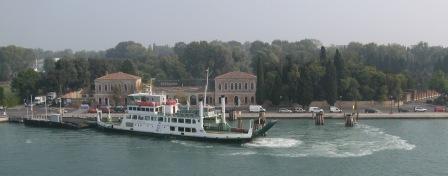
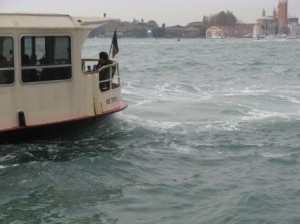
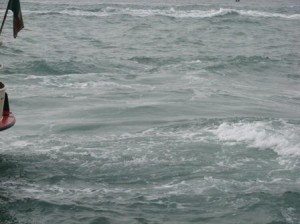
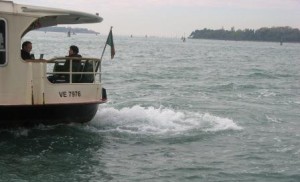
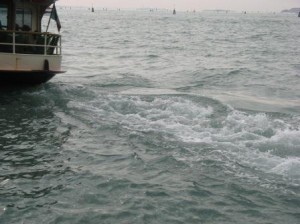
This is the ferryboat which carries wheeled vehicles to and from the Lido.  When it approaches the landing stage, the captain throws the engines into reverse to slow and stop the boat, then keeps the engines grinding in reverse in order to maintain tension on the lines.  This is considered necessary for safety.  The result is an impressive vortex of spinning water..
This is the ferryboat which carries wheeled vehicles to and from the Lido. When it approaches the landing stage, the captain throws the engines into reverse to slow and stop the boat, then keeps the engines grinding in reverse in order to maintain tension on the lines. This is considered necessary for safety. The result is an impressive vortex of spinning water..
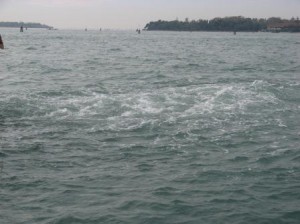
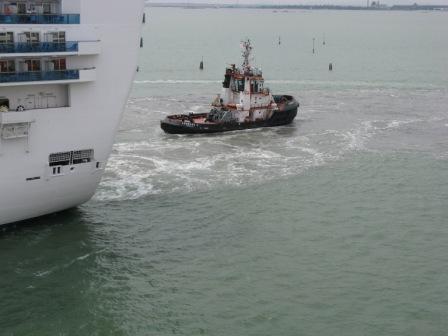
Cruise ships create the same effect when they are maneuvering out of their berth.  Here, the TK Princess is on its way.  In high season there can be as many as seven cruise ships in the Maritime Zone; although they don't create waves, the force of their engines here has gouged a crater TK feet deep.
Cruise ships create the same effect when they are maneuvering out of their berth. Here, the "Ruby Princess" is on its way out. In high season there can be as many as seven cruise ships in the Maritime Zone.

Even natural waves caused by the wind, aided and abetted by the retreating tide, will do some of this work of demolition.   But then there are the big public boats — and I’m thinking specifically of waterbuses.   They come in several versions here, but the highest number are the vaporettos.
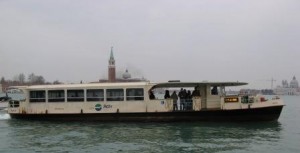
A standard vaporetto.

The vaporetto is a specific type of boat, and the public-transport company, which goes by its acronym ACTV, operates 52 of them.   Sometimes called “battello,” the vaporetto  has a regularly scheduled cousin correctly called a “motoscafo,” though it gets called “vaporetto” too for convenience.   It sits lower in the water and carries fewer people, though you might not believe it if you try to get on one at rush hour.
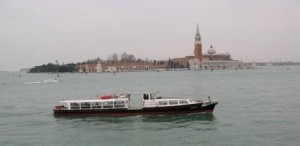
A motoscafo.
A motoscafo.

At this moment, the ACTV website informs us that the company operates “about 152” waterborne vehicles.   (“About”?   You mean you don’t know?)   They break it down  thus: 52 vaporettos, 55 motoscafos, 10 “single agent motoscafos,” which I can’t interpret for you just now, 16 bigger  vaporettos that travel the lagoon  (“vaporetti foranei”), 9 motonavi, and  8 ferryboats.
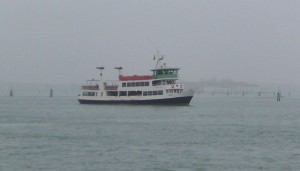
A motonave.
A motonave.

Naturally all of these  vehicles cause waves, but what compounds the effect is the undertow they create when they stop at one of the 100 or so bus stops (city and lagoon) to drop and pick up passengers.

It’s pretty simple.   Here is an illustration of what  happens every time one of these craft comes and goes:
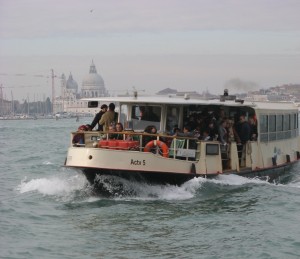
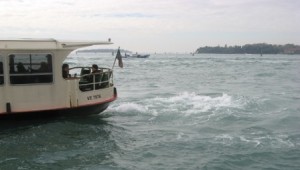
The vaporetto approaches the next stop.  The captain may not have noticed whether is going with or against the tide; if he's going with it, he'll probably arrive faster than he meant to and have to hit the reverse really hard to break the momentum and get back into position to tie up.
The vaporetto approaches the next stop. The captain may not have noticed whether he is going with or against the tide; if he's going with it, he'll probably arrive faster than he meant to and have to hit the reverse really hard to break the momentum and get back into position to tie up.
He reverses the engines to stop the boat; the mariner throws a rope and ties the boat to the dock.
The captain revs the engine in order to bring the boat parallel to the dock.  The water shows the effect of the earlier reverse and the momentary forward.
The captain revs the engine in order to bring the boat parallel to the dock. The water shows the effect of the earlier reverse and the subsequent forward.
To keep tension on the line while loading and unloading passengers, the captain keeps the engines at a very high rate of rpm's.
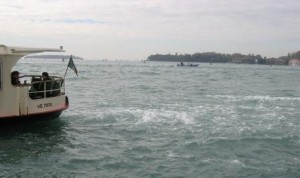
Everybody aboard; the mariner unties the boat and the captain begins to reverse again.  This will give him the necessary momentum to get moving forward again.  Sounds strange, but that's how it works.  So: Back we go again.
Everybody's aboard; the mariner unties the boat and the captain begins to reverse again. This maneuver enables him to turn the boat slightly to starboard, which puts him the ideal position to throw the gears into "forward" and move on to the next stop. So: Back in reverse we go.
And wham!  We're starting to move forward again.
And wham! We're starting to move forward again.
And off we go. On to the next stop, where the same sequence of maneuvers will be repeated. If this looks even slightly disturbing out here in the open water, imagine it happening virtually constantly all along the Grand Canal. All day.
Trailing clouds of glory in our wake.

On September 15, 1881, the first vaporetto (“Regina Margherita”) began regular service in the Grand Canal.   The imminent arrival of this creation caused tremendous distress and revolt among the gondoliers, who foresaw their doom.   Their turmoil is the focus of a marvelous film, “Canal Grande” (1943), starring several then-well-known Venetian actors, such as Cesco Baseggio, plus a number of real gondoliers.   Too bad it’s all in Italian.

The first vaporetto was soon followed by  a fleet of eight, run by a French company, the “Compagnie des bateaux Omnibus.”   Nothing against that noble nation, I merely note that Napoleon Bonaparte, who conquered and devastated Venice in 1797, was also French.

In 1890 the Societa’ Veneta Lagunare began service between Venice and assorted lagoon locations.   And so it has gone.

Lino remembers when there were still very few vaporetto stops  in the Grand Canal; they were at San Marco, Accademia, San Toma’, Rialto, the railway station, and probably Piazzale Roma, though he won’t swear to it.   In what was still a flourishing local culture, the Venetians could find almost everything needed for daily life in their own little neighborhoods.
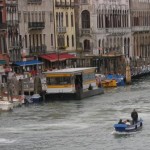
This is a bus stop, essentially a dock called a "pontile," to which the vaporetto is tied while exchanging passengers.

There are now 17 stops on the Grand Canal.   They were not installed as something useful to the residents, as noted above, but for the transport of tourists.   Shops have begun to close (I don’t lay this fact at the feet of the wave-and-sucking-causing public transport), so as the population has dropped, and the number of tourists has risen, the locals have had to range further afield to find forage, so to speak, and at the same time have had to use public transport which is usually overstuffed with tourists and their luggage.   During Carnival, most Venetians do their utmost to stay the hell at home.

The city recognizes that  there aren’t enough vaporettos most of the year; during the summer (and Carnival) extra routes and supplementary vehicles are laid on.   But eventually some crisis point will be reached where the number of bodies requiring to be moved and the available space in which to do it will collide.   To use a term which nobody in the navigation business wants to hear.

Zwingle’s Fifth Law states that “You can get used to anything.”   You may quibble, but I can attest that you can definitely get used to this roiling and churning and sucking of many waters.   This isn’t good, but neither can you travel all day in a constant state of rage and anguish.

You can give yourself an interlude of relief by going for a little stroll.   Ignoring the roaring of motors and the shattering of waves, you can really relax in the city which is extolled for having no cars.   I think people who say that must  merely mean  “no traffic.”
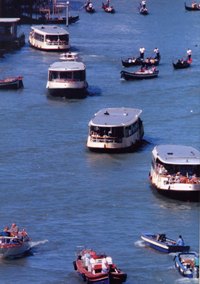
Before too much longer, the Grand Canal is going to resemble Runway 3 at O'Hare.
Before too much longer, the Grand Canal is going to resemble Runway 3 at O'Hare. At the moment, it's only like I-95 from Washington to Richmond.
Continue Reading

Snow Day

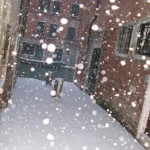
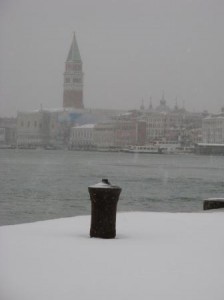
We got snow!   While I realize that our little meterological adventure was nothing compared to what the East Coast of the US has gone through, not to mention northern Europe (stories of the trains trapped under the Channel inspire a special kind of shudder), it still was  enough to jolt us out of our midwinter torpor.

This was our wake-up call.

Even here, flights were cancelled, or delayed, and I have no doubt that stories of catastrophes on the mainland will be coming in.

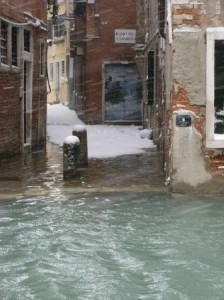
But for us, the situation was more beautiful than distressing, if you don’t count our miscalculation on getting home before the acqua alta was high enough to mostly cover our feet.   (Yes, we were warned: two tones on the sirens.   But I didn’t take it seriously.)   Sorry about my Timberland hiking boots; hope I can salvage something from the effects of salt water.

We usually get at least one severe cold snap each winter, though it seems to want to wait till just after Christmas.   So this year we got it early.   For the past few days it’s been at or below freezing and Saturday morning we woke to the double-whammy of snow and acqua alta.  

Two hours later, the scene had changed.  One good thing about acqua alta is that at least it removes the snow.
Two hours later, the scene had changed. One good thing about acqua alta is that at least it removes the snow.

When  Lino was a lad, as soon as the flakes began  to fall, men would present themselves at the central office of the Vigili (a sort of local police) to pick up a shovel and make some extra money cleaning the streets and bridges.   He says you could hear them out on the street, talking, as early as 4:00 AM,  waiting to get to work. Intensely  intelligent and also effective and probably didn’t cost the city all that much.   All good reasons why they don’t do it anymore.

Our faithful trash collectors  were scarce to invisible this morning.   Any tiny deviation from the norm throws the squad into total disarray.   No snow shoveled, no garbage collected — I can’t believe that every sanitation worker in the city had to be in the Piazza San Marco to set up the high-water walkways.   Perhaps they were all clustered in a doorway (more likely it was a warm bar somewhere) drawing straws to determine who’d be the one who had to go out and actually work.

I have some happy, if highly eccentric, memories of a real cold snap here.   One winter morning a number of years ago, when the cold had come down from Siberia like the wolf on the fold, we went out rowing.   Yes, of course we’re mentally unstable.    

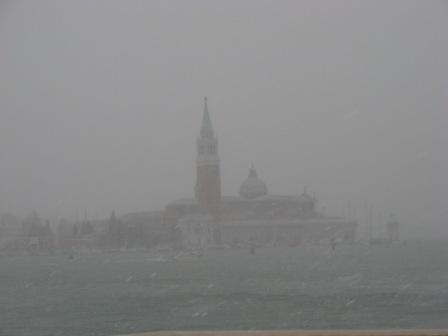
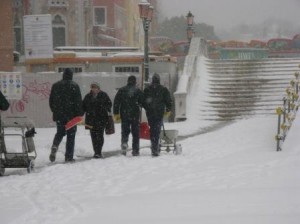
This time it wasn't fog that made the city look like this.  Blowing snow is also pretty effective for blurring the scenery.
This time it wasn't fog that made the city look like this. Blowing snow is also pretty effective for blurring the scenery.

Here’s what I remember:   Rowing down a canal and our oars slicing neatly (once in, once out) through the forming ice.   What a fun little crunching sound it made.   What wasn’t quite so fun was the wind blowing so hard that the spray from the waves froze in the bottom of the boat.   I spent the entire time we were rowing back  imagining that my shoes were nailed in place, because it was like standing on a skating rink.   If I’d slipped just once, I’d never have gotten my footing back.   I took my mind off this problem by trying to imagine if it would be possible to row on my knees.  

But that was nothing.   There was the famous — make that “epic” freeze of February, 1929: people were walking across the lagoon from the Fondamente Nove to San Michele.   Impressive.   Of course, one reason that happened (and probably could never happen again) isn’t just the factor of the degrees below zero.   There wasn’t the constant maelstrom of waves back then that we have today, which would prevent any rational water from freezing.   If you’ve got a really low temperature, few or no waves, plus only the tiniest tidal variation (twice a month, when the moon is exactly  half, the tide scarcely moves, which would help the freezing, obviously) it’s almost inevitable that ice will form.   I have to say I’m glad we didn’t reach that point.   Delicate little skins of ice covering the water is one thing, but not this polar purgatory.


So on the whole, we made out really well.   The snow came, and then, when the tide turned in the early afternoon, the sun came out and we were fine.   Except, I mean, for the bags of garbage which will lie out there till Monday.  

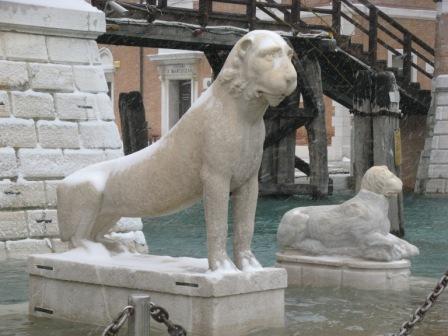
The lions in front of the Arsenal were not amused.  "Remind me again how we ended up here, surrounded by water?  Oh, right: spoils of war.  Great."
The lions in front of the Arsenal were not amused. "Remind me again how we ended up here, surrounded by water? Oh, right: spoils of war. Great."


As long as you don't have to drive, scenes like this are really beautiful.


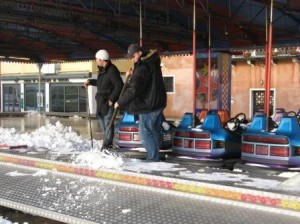
The guys who run the bumper cars at the temporary amusement park on the Riva dei Sette Martiri have to clean up the old-fashioned way: physical exertion.


Eventually at least a couple of ecological operators, as they're called, had to get out and do something. The Barbie-sized wheelbarrow appears to contain enough salt for exactly one bridge.


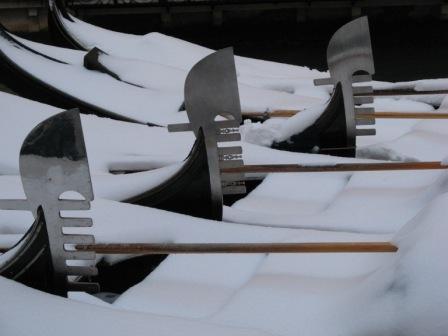
All the gondoliers who didn't come to work in the Bacino Orseolo are just going to wait for it to melt, then bail.
Continue Reading

Folpo and friends

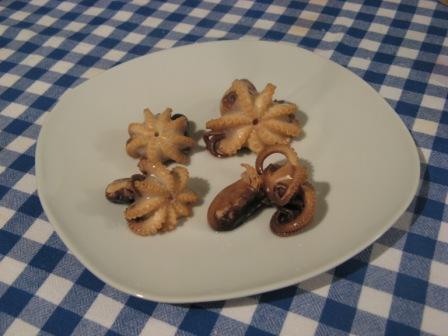
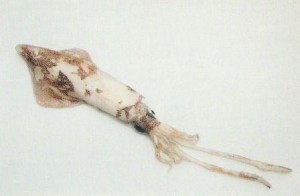
Each is easily munchable in one bite, assuming you have even the slightest desire to consume it. Folpi have the interesting property of becoming tougher, not more tender, the more you cook them.

This is apropos of absolutely nothing, but as I was discussing the folpo the other day, it occurred to me that even with my impressive powers of description, a picture of the creature after its refreshing plunge into boiling water might be in order.   So here are four of the little honeys, ready for immediate annihilation.  

The great thing about  fishy creatures– most of which were so familiar to Venetians in days gone by that they could have been members of the family–  is that they make excellent synonyms for non-fishy things.   The folpo, for example,  provides the ideal code word for a person (of either sex) who is overweight — not grossly, but noticeably — in a formless, galumphing sort of way.   You might hear someone say, “Look at that folpo” as an individual goes by who looks as if he/she might be more comfortable (and attractive) submerged than walking on land.

A very close relative of this mollusc, in biological but especially metaphorical terms, is the zottolo (ZAW-toh-lo, or zotolo, in Venetian: SAW-to-yo).     Official name: Todarodes sagittatus.   It’s another one of those tentacly creatures, related to the seppia and the folpo. You   may not notice them in the fish market but you might well get a batch of their babies (totani)  in a mixed fishfry here.    Little crunchy deep-fried objects somewhat bigger than your thumbnail that don’t look like they ever were anything.

The reason I’m telling you this isn’t the animal itself, it’s  because “zotolo” is also a common and highly useful way to  describe a certain kind of person.   In fact, there are people who  can’t be characterized as anything other than zotoli because of their particularly unfortunate assortment of mismatched traits.  

Why a zotolo would be considered less attractive than a folpo is a mystery.

A  person who can — and even must —  be described as a zotolo would be someone who would be  not only physically unattractive in a way that might be  mitigated or even overcome if he or she were to care  (heavy,   scrawny, uncoordinated, slouchy, clumsy, perhaps also pimply or with neglected teeth), but would dress and/or behave in only a marginally civilized way.

Your zotolo could be the person who comes to the office Christmas party (evening, trendy bar) wearing a slightly frayed shirt and/or torn jeans.   Or maybe he or she dresses just fine, but who can be counted on to say or do something that’s just  that little bit  cringeworthy.   In other words, a person who gives the impression of being upholstered, physically or mentally,  with the old slipcover from the   divan in the basement rec room.

Can also be used as a term of endearment.  

   
Continue Reading

Acqua alta: some snaps

I will eventually be organizing a Gallery page, but meanwhile here are a few additional views of the water-on-the-ground of yesterday.   They are not intended to be sensational, but instructive.   There is an important difference in the two concepts, especially where issues involving Venice are concerned.

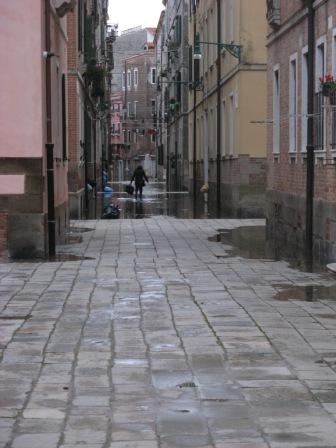
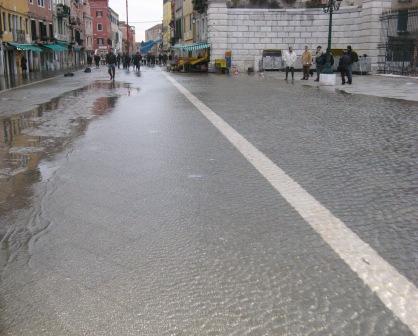
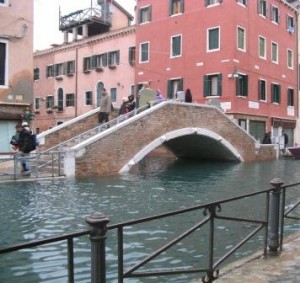
As you see, the streets of Venice are neither perfectly flat, nor a uniform height above sea level. Therefore reports of Venice being FLOODED are not very helpful. Is this street flooded?
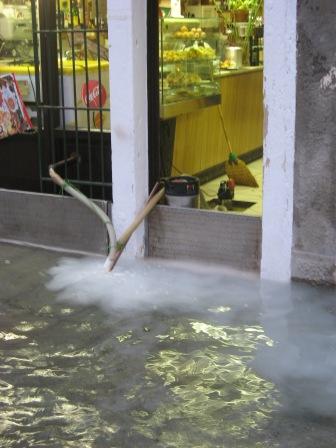
The immediate point of pumping is not to empty your place of water; it's to keep it from getting any higher while the tide is still rising.  (Then you pump to get it all out.)  One theory of what is making the liquid white is that it is detergent.  The theory of my nose leads me to suspect something more primeval.
The immediate point of pumping is not to empty your place of water; it's to keep the level from increasing while the tide is still rising. (Then you pump to get it all out.) One theory of what is making the liquid white is that it is detergent. The theory of my nose leads me to suspect something more primeval.
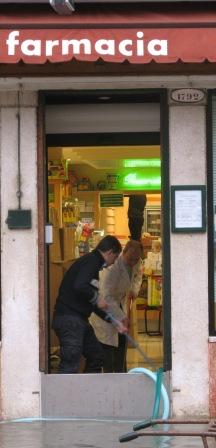
Sorry, your prescription isn't going to be ready till the pharmacists finish bailing out the store.
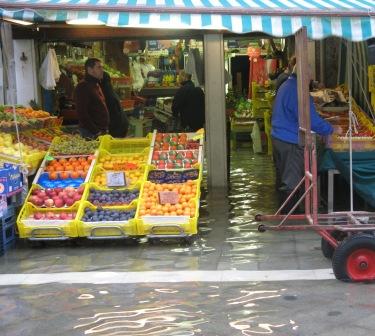
No special drama here, they keep the vegetables up off the floor all the time anyway.
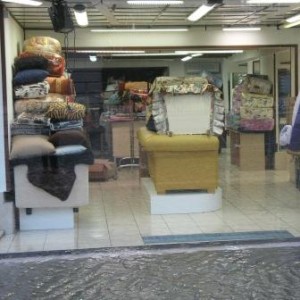
Now here's a solution: Get your stuff up off the floor before the water comes in.  Simple, cheap, effective -- I welcome explanations of why so many merchants prefer to beg for sympathy as well as contributions from the city to pay for damages.
Now here's a solution: Get your stuff up off the floor before the water comes in. Simple, cheap, effective. I welcome explanations of why so many merchants prefer to beg for sympathy as well as handouts from the city to pay for damage. Why should there be damage in the first place? And by the way, the city doesn't own your shop, you do.
What often contributes to high water occurring is an insistent southeast wind, as you see blowing across the water here.
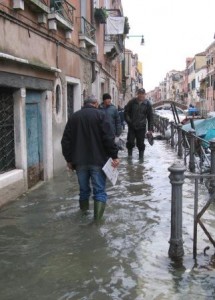
High-water etiquette requires you to slow down when approaching and passing anyone with knee-high boots.  If you are sloshing along you will splash them, and they are already desperately trying to keep their clothes dry.
High-water etiquette requires you to slow down when approaching and passing anyone with knee-high boots. If you are sloshing along you will splash them, and they are already desperately trying to keep their clothes dry.
A very humble but crucial byproduct of high water is that it makes it impossible to pass under most normal bridges.  Gondolas, taxis, and especially barges have to either find an alternate route or just wait till the tide falls.  Even some vaporetto lines are sent up the Grand Canal because they can't pass under the bridge near Piazzale Roma.
A very humble but crucial side effect of high water is that it makes it impossible to pass under most normal bridges. Gondolas, taxis, and especially barges have to either find an alternate route or just wait till the tide falls. Even some vaporetto lines are sent up the Grand Canal because they can't pass under the bridge near Piazzale Roma.
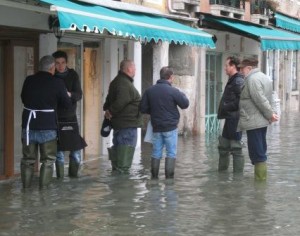
Oh gosh -- we couldn't get to work on time because there was acqua alta.  Here are some men who are looking desperately concerned and distressed by this.  I imagine at least one of them is trying to think of the nearest cafe that is on dry ground.
Oh gosh -- we couldn't get to work on time because there was acqua alta. Here are some men who are looking desperately concerned and distressed by this. I imagine at least one of them is trying to think of the nearest cafe that is on dry ground.
Or maybe it's a guy thing and not related to having boots at all, the need to stop in groups to analyze, compare, contrast, discuss, and otherwise dissect the moment.
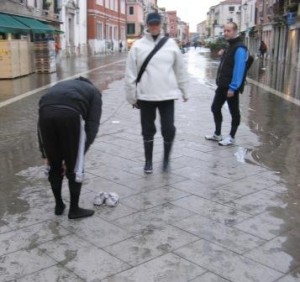
I am fascinated by the problem-solving approach taken by the man on the left.  His knee-high socks were drenched (see wet footprints) and he is rolling up his trousers.  I'm hoping he had the sense at least to have taken off his shoes before he stepped into the water.  But why didn't he take off his socks as well?
I am fascinated by the problem-solving approach taken by the man on the left. His knee-high socks were drenched (see wet footprints) and he is rolling up his trousers. I'm hoping he had the sense at least to have taken off his shoes before he stepped into the water. But why didn't he take off his socks as well?
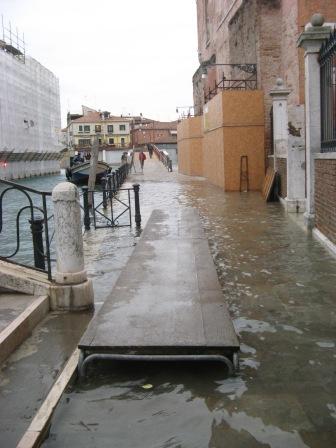
One has heard of a bridge to nowhere.  I offer the passarella, or walkway, to -- well, not exactly nowhere.  Right to the water from which it has been placed to defend you.  Maybe they ran out of boards.
One has heard of a bridge to nowhere. I offer the passarella, or walkway, to -- well, not exactly nowhere. Right to the water from which it has been placed to defend you. Maybe they ran out of boards.
Continue Reading