
seeking Sant’ Elena
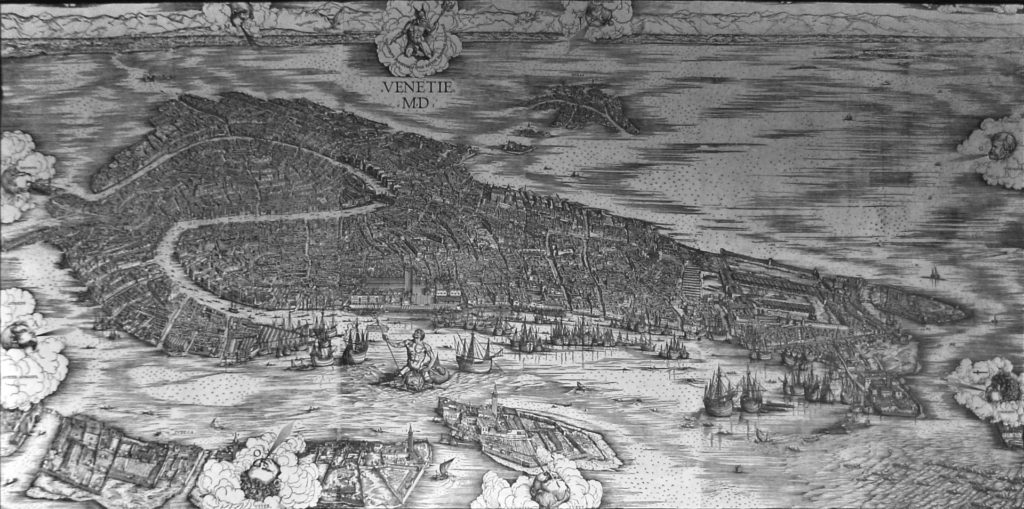
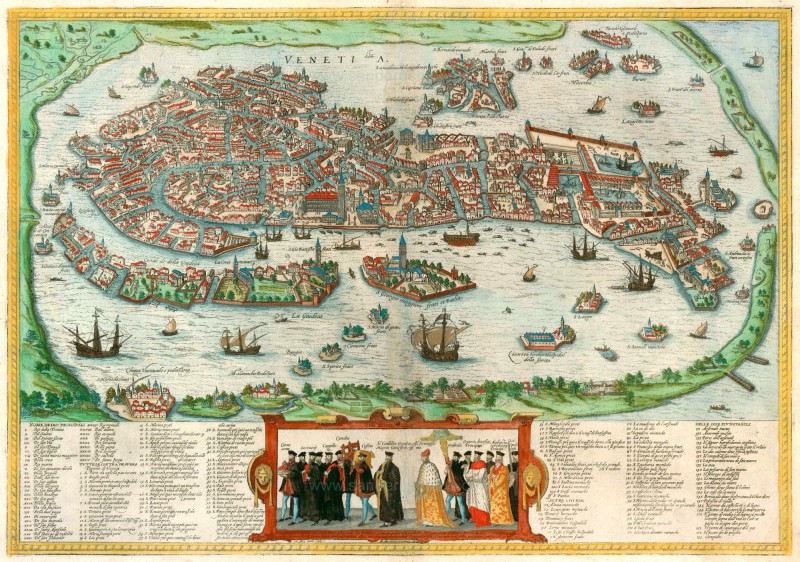
Reader Christopher has written the following Comment: I am perplexed and maybe you can help me. The Chiesa di Sant’Elena was built in as early as 1060 by some accounts. Saint Helen was brought to the lagoon and interred in her eponymous church in 1211. It’s curious that the church is not shown on the earlier maps. Any idea why this might be? ….
If I understand your question to be why isn’t the church dedicated to Sant’ Elena shown on maps prior to the arrival of her remains, I can only reply that I think there could be several reasons.
One reason is that there aren’t many maps of Venice prior to 1211, and those that do exist are not very detailed. Even 17th-century maps don’t show everything. Also, Venice has plenty of churches named for saints whose remains are not in residence. There’s no reason why a mapmaker with limited space would choose to show a church if it didn’t contain its tutelary saint. Which raises the interesting question, which I had never considered till now, as to who decides what to include in a map and what to leave out.
As to the dates you mention, “…the first chapel dedicated to St. Helen was built in 1028 and entrusted to the Augustinian order, which constructed also a convent. In 1211 the Augustinian monk Aicardo brought to Venice from Constantinople the presumed body of the empress. Following which the Augustinians enclosed the chapel within a larger church.” More confusion arises from the statement that there was a “hospital” dedicated to her, built in 1175 — 36 years before the saint arrived — maintained by the Augustinian order, for the care of the poor.
In the 15th century the convent and the church passed to the Benedictine monks, who rebuilt it in 1439. A century later, in 1515, the church was consecrated by the bishop of Aleppo and became an important religious center, with vast property and notable works of art. So evidently three centuries, all told, had to pass before her church (or let’s just say “she”) became sufficiently important to warrant identified inclusion on a map.
These sources don’t identify where the church was located, but I’m going to suppose it was on the island of Sant’ Elena.
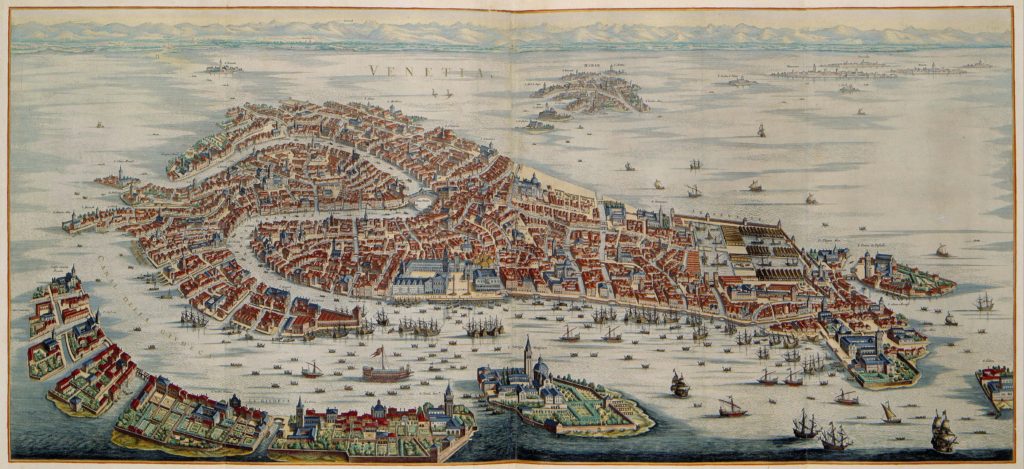
Some maps, from the 1400’s onward, show at least part of an island floating off the eastern shore of Castello, just below Olivolo, where the church of San Pietro di Castello stands. So something was there, even if it isn’t identified. Yet if her eponymous original church was there, it does seem strange that so many cartographers didn’t show it, or if they did, why they didn’t always label it.
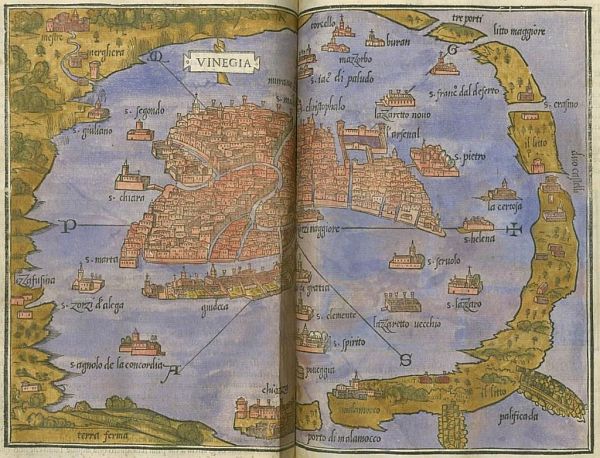
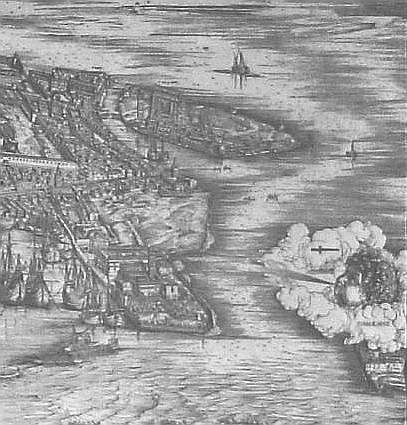
I think it’s evident that no map except Dei’ Barbari’s (1500) could claim to show everything. A good number of maps show only a smattering of churches, even though we know that there were many more. But he gives a only glimpse of the island, going so far as to cover half of it with a cloud-bedecked cherub. And yet the island, not to mention the mother of the Emperor Constantine, were hardly a secret.
If I ever find out why she was snubbed so often, I’ll let you know.
Mini-Memorial Day
Memorial Day is now disappearing in the traffic behind us (though my calendar notes that yesterday, May 30, was the traditional date for the same), but what are dates? As a wise person once remarked, for Gold Star families every day is Memorial Day.
In any case, many nations commemorate their fallen with masses of marble, eternal flames, and other worthy symbols of pride and humility. Italy has the “Altare della Patria,” or Altar of the Fatherland, in Rome.

And then there is a schlumpy little chunk of some kind of stone that was sitting in a tangle of green-and-brownery at Sant’ Elena. This last bit of Venice before the Adriatic Sea isn’t known for monuments, unlike the rest of the most-beautiful-city-in-the-world up the street. But in fact the whole neighborhood is a sort of memorial to World War I, its streets named for generals, battlefields, dates and exploits. And there is also this cube on which two words were long since incised: MILITE IGNOTO (MEE-lee-teh Ih-NYAW-to). Unknown soldier.
Lino came across this relic a few months ago, and was startled and more than a little offended. Not that he makes a cult of military cenotaphs, but he stated clearly that he saw no point in having such a significant object if it was just going to lie there, neglected and forgotten. He said this also to a few other people too, especially to some of the officers at the nearby Scuola Navale Militare Francesco Morosini, where he teaches Venetian rowing.

Most comments float away like dandelion fluff (if you’re lucky), but Lino’s particular comment stuck somewhere because a cultural association devoted to World War I entitled the Associazione Cime e Trincee (Peaks and Trenches) got to work, and last Sunday the newly furbished memorial was rededicated in the sight of God and a small but trusty company of assorted veterans.
This ceremony wasn’t matched with any particular date — they could have waited till Saturday and combined emotions with the national holiday commemorating the founding of the Italian Republic. But they did it on Sunday, and we went. We felt mystically involved, even though we still haven’t found out how the notion of bringing the stone back to life, so to speak, ever occurred. It’s enough that it happened.


Disaster strikes
A tornado crossed part of the lagoon yesterday morning, and part of Sant’ Elena was in its way, And all of our boat club.
The office is gone, the two buildings and sheds where our boats were kept are gone. And the boats are pretty much gone, too. I don’t mean “gone” as in lifted to heaven in the rapture, I mean it in the sense of smashed to various bits. Because we were in a phase of demolishing the old clubhouse in anticipation of a new facility and all our 34 boats were outside.
The man who operates the winch to put the boats in and out of the water was in the metal container that served as his temporary shelter at the water’s edge. The tornado rolled it over a couple of times with him in it, and two men managed to get him out. He was rushed to the emergency room with a gash in his head and two broken ribs, but at least the container wasn’t tornado’d into the water with him in it.
Trees snapped and uprooted, but no further victims, as far as I know, unlike the previous tornado in 1970.
When the tornado struck, we were at the Rialto market where our attention was mostly dedicated to the price of cherries. It rained, but we had not even the slightest hint that devastation was being wrought just over the way. We had a blast of rain, but there wasn’t anything about it that made you think of anything worse than your wet feet.
We got the news from a friend who was at San Marco, and who had seen it. Then the phone calls began to spread the word. At that point I was on Murano with a friend, so I wasn’t able to go help with the first load of work, But Lino was there all afternoon, along with almost every club member who was available.
I’m still trying to get a grip on all this. Because this morning has dawned cool, clear, and dazzling with cloudless sunshine. Translation: The perfect day to go out in a boat.
The website of the Remiera Casteo has photographs and film of what the tornado left behind.
YouTube has a number of clips of this event but here is one of the best. If the video isn’t shown, here is the link: http://youtu.be/KFCaI_L_K4s
Voga-not-so-longa
Considering how well my personal Vogalonga went this year (along with my six boatmates), it’s taken me this much time to find anything to say about it other than that.
Also, I have no photographs whatsoever of us, for one reason which explains both these little paragraphs. We didn’t start in the Bacino of San Marco.

The tradition in any boat I’ve been in that includes Lino (all but one — the first year — of the 16 editions I’ve joined) is that we start in the Bacino of San Marco when the cannon fires and all the bells ring. It’s thrilling and I love this moment, which is all too brief because we then commence rowing, along with a mass of boats surrounding us like migrating krill.
This means that while we have the chance to savor the richness of the moment — boats, cannon, bells — the krill create many well-known problems along the way. Such as at what I think of as the “death corner,” the first turn at the point of Sant’ Elena, where any number of non-Venetian rowers suddenly discover some problem which they hadn’t planned on facing — such as a tricky current, or some boats around them also having problems, or, I don’t know, existential lack of nerve, like cragfast climbers. You can expect to see at least one capsized vessel here, and a batch of confusion from the mass of boats trying to avoid it.
Then there are the snaky curves along the flank of Sant’ Erasmo, also excellent territory for making miscalculations of available space, relative speeds, and wind direction and force.
Then, of course, there is the every-year-more-difficult (I meant to say “ghastly” but changed my mind) passage into and through the Cannaregio Canal, where inexperience, fatigue, and lack of common sense create packs of boats like Arctic ice.
This year we didn’t have any of that — I mean, ANY of that — for one surprising reason. We forgot our boat’s number, without which the boat can’t be checked at various points along the way and hence acknowledged as officially doing the course.
So when the cannon/bells/confusion began at 9:00 AM, we were back at the boat club behind Sant’ Elena digging the numbered bib out of Lino’s locker.
Which meant that we joined the scrum after the “death corner,” and — this was unexpected — in some way near the head of the herd. Please note that this does not mean we started early, as some unsporting people tend to do. We slipped into the traffic stream at 9:10, roughly the same time it would have been for us at that point even if we’d started in the usual place.
The result of all this being that not only did we cover the entire course in record time without even breaking a sweat (three hours — unheard of), we were able to do it in unearthly tranquillity. Yes, there were other boats, but noticeably fewer at that stage. We slithered along Sant’ Erasmo as if there wasn’t anybody else around, and we entered the Cannaregio Canal (over which I always see an invisible sign saying “Abandon all hope, ye who enter here”) as if it were a normal day, only better: The reasonable number of boats ahead of us were proceeding in a reasonable way at a reasonable speed and behaving, well, reasonably. I had never imagined I could see such a thing.
The only flaw in the ointment, as a friend of mine used to say, was that we were also ahead of the photographers. We missed the departure, which is always good for spectacular pictures, and we missed the mass return, ditto.
So unless some unknown photographer makes him- or herself known, I’m just going to have to keep my memories dusted and polished, because there isn’t anything else I have to show for this event.
It was so wonderful that I’m already trying to think of ways to convince the crew to leave before 9:00 next year. If all goes well, I’ll be able soon to report that we finished the course before the others had even started it.
Crazy? Unsporting? Simply wrong? Yes indeed. But now the rot has set in.