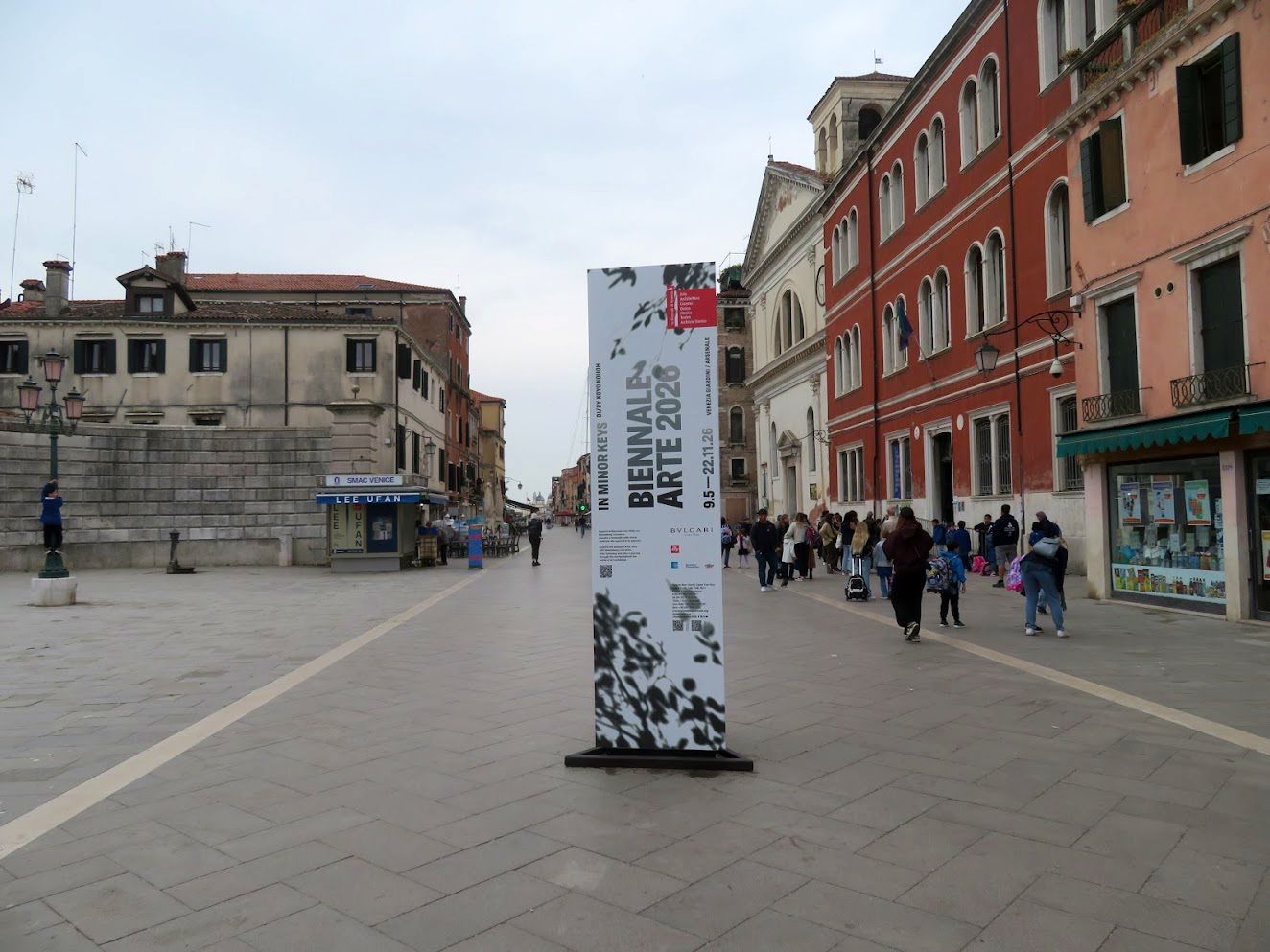
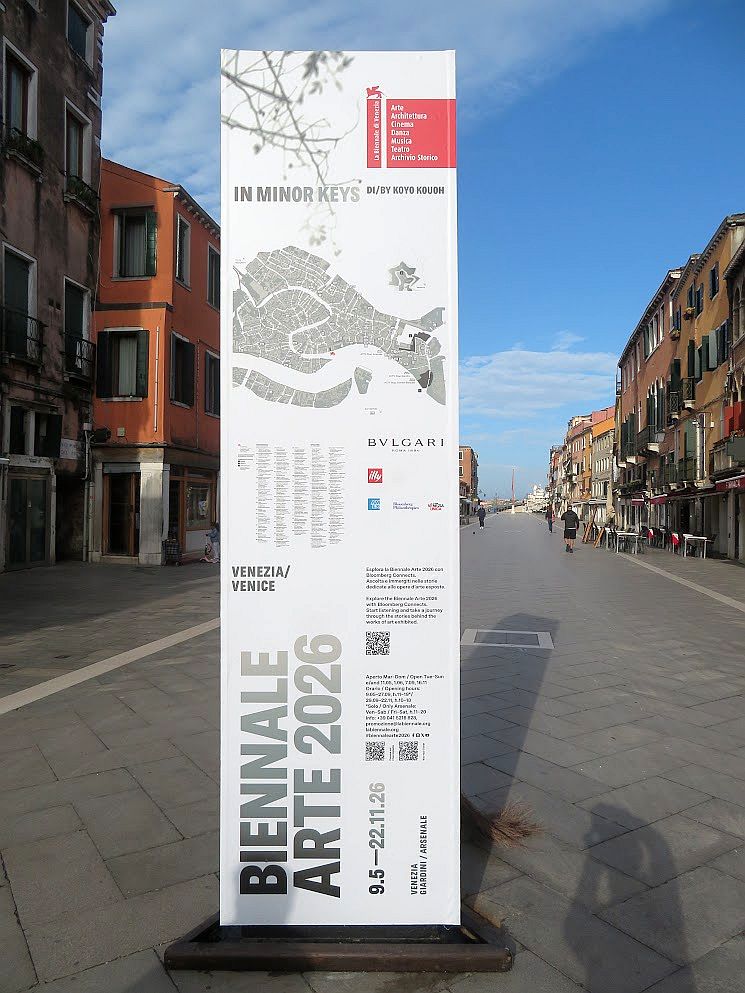
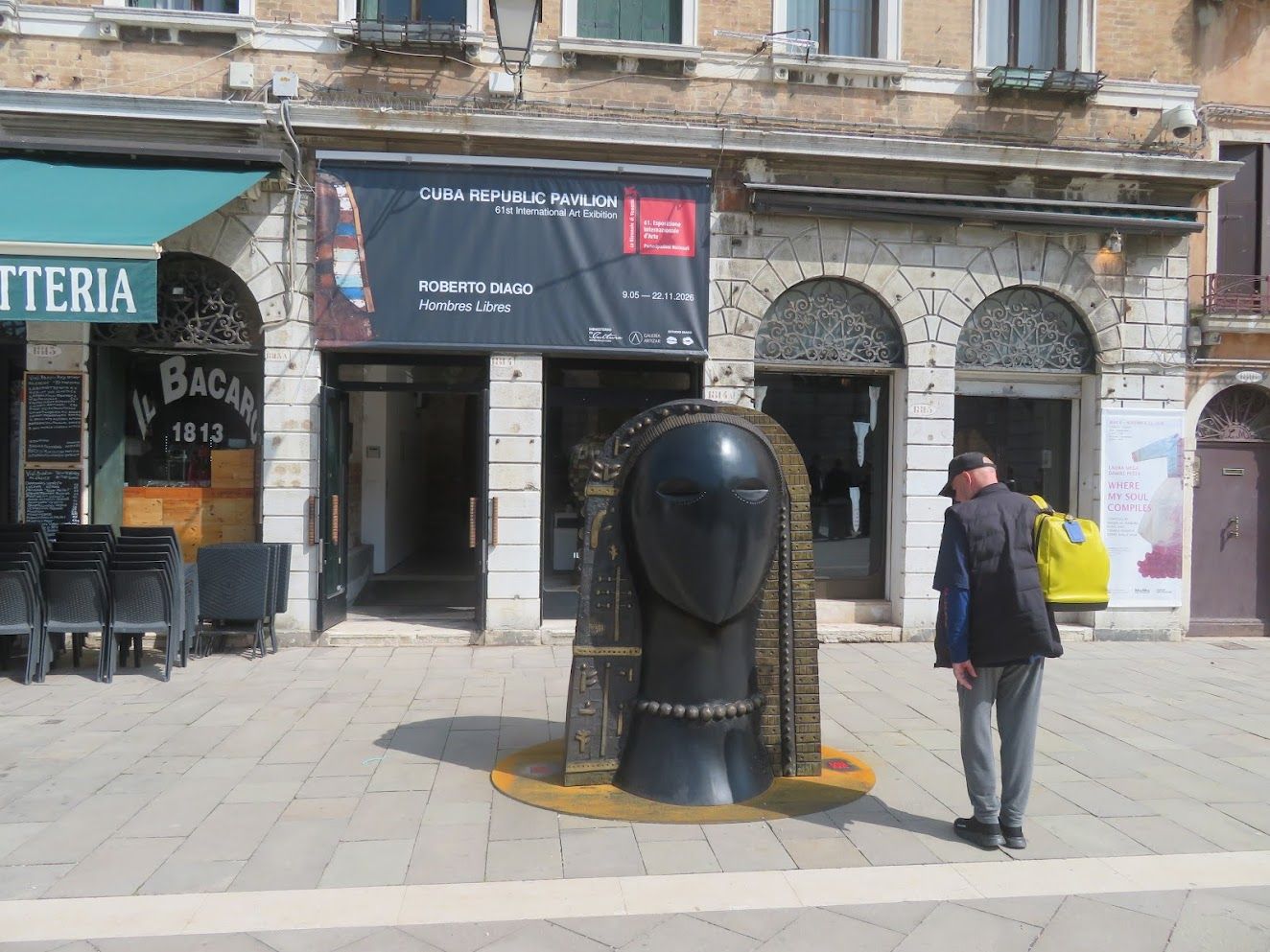
One of the earliest precursors was the stele showing the map of the exhibitions. I notice that the newsstand to the left is earning some extra pelf by dedicating its magazine-display space to an important exhibitor, Lee Ufan. Let the games, so to speak, begin. The Biennale runs from May 9 to November 22.Another side of the triangular structure.
“Art is above politics,” goes the common fantasy here every year when the Biennale international art exposition is about to open. Those who were especially inclined to say (or imagine) it were the directors of the event this year, who invited not only Russia, but Israel, to join the starring lineup.
This struck the public and various political and/or cultural figures or groups as a very bad idea, and they spoke out against permitting Russia and Israel to participate. (“Spoke out” is code for “Pussy Riot made huge scenes with their bare breasts at the Russian pavilion.”) The jury resigned en masse in protest, what with the Russian invasion of Ukraine and the genocide in Palestine and all. They have not been replaced. Off to a great start.
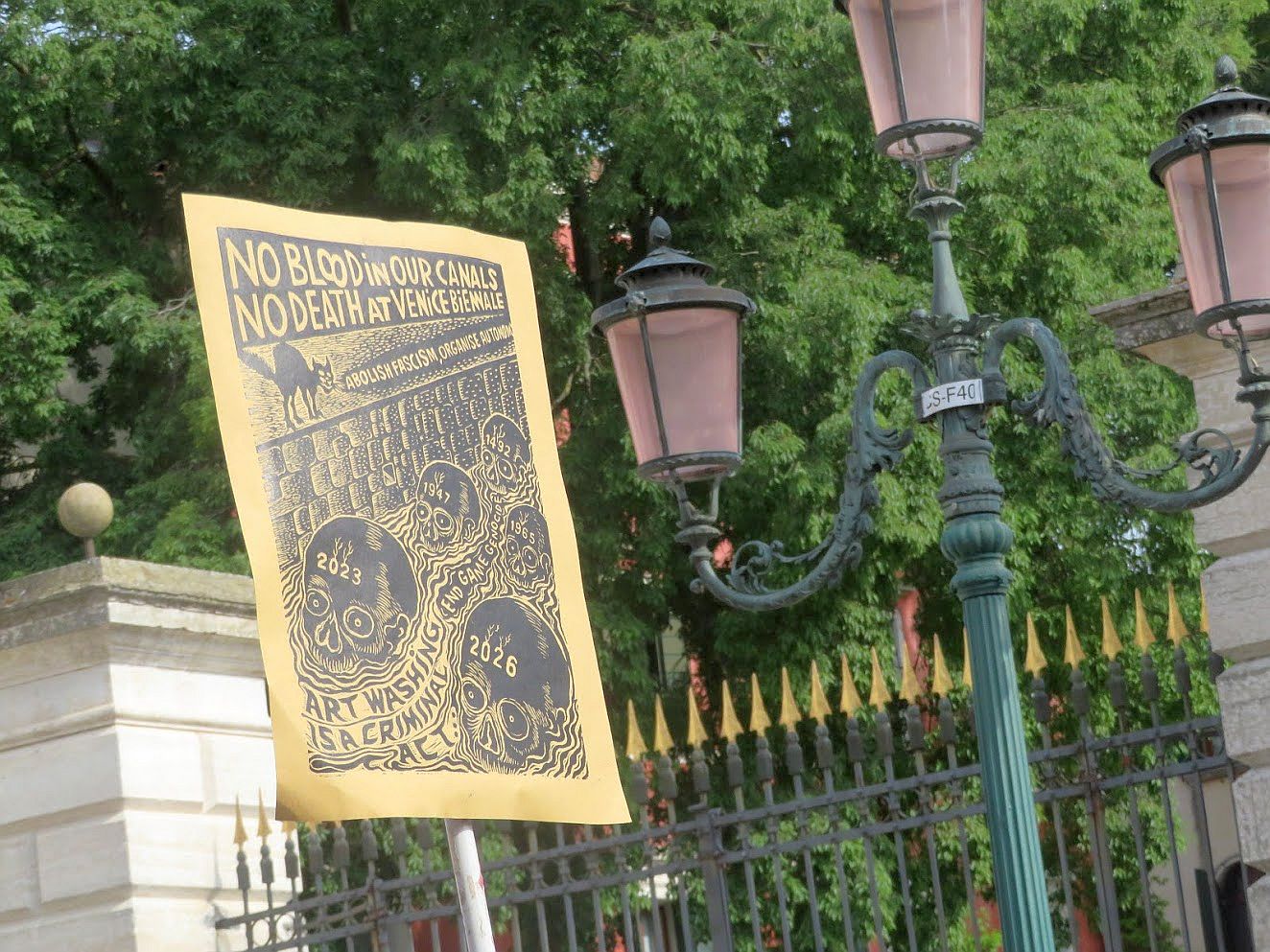
In fact, a new term has appeared to describe the art/politics connection in Venice this year: “Artwashing.” That’s harsh but makes its point. Skipping the politics and heading straight to the art, the critic from The Guardian in London mentioned the “art that stinks.” Not figuratively, but literally. In a world in which pretentious euphemisms stand in for thought and communication, that was an invigorating change. It turns out that some artists were focusing on the excretory, with the addition in some cases of perfumes that reinforce the atmosphere. Belarus, for example, commissioned the creation of a perfume with its artwork that replicated the smell of a “freshly dug grave in the Belarus countryside in late August, laid with rotting flowers.” Is this art? Politics? Their mutant love child?
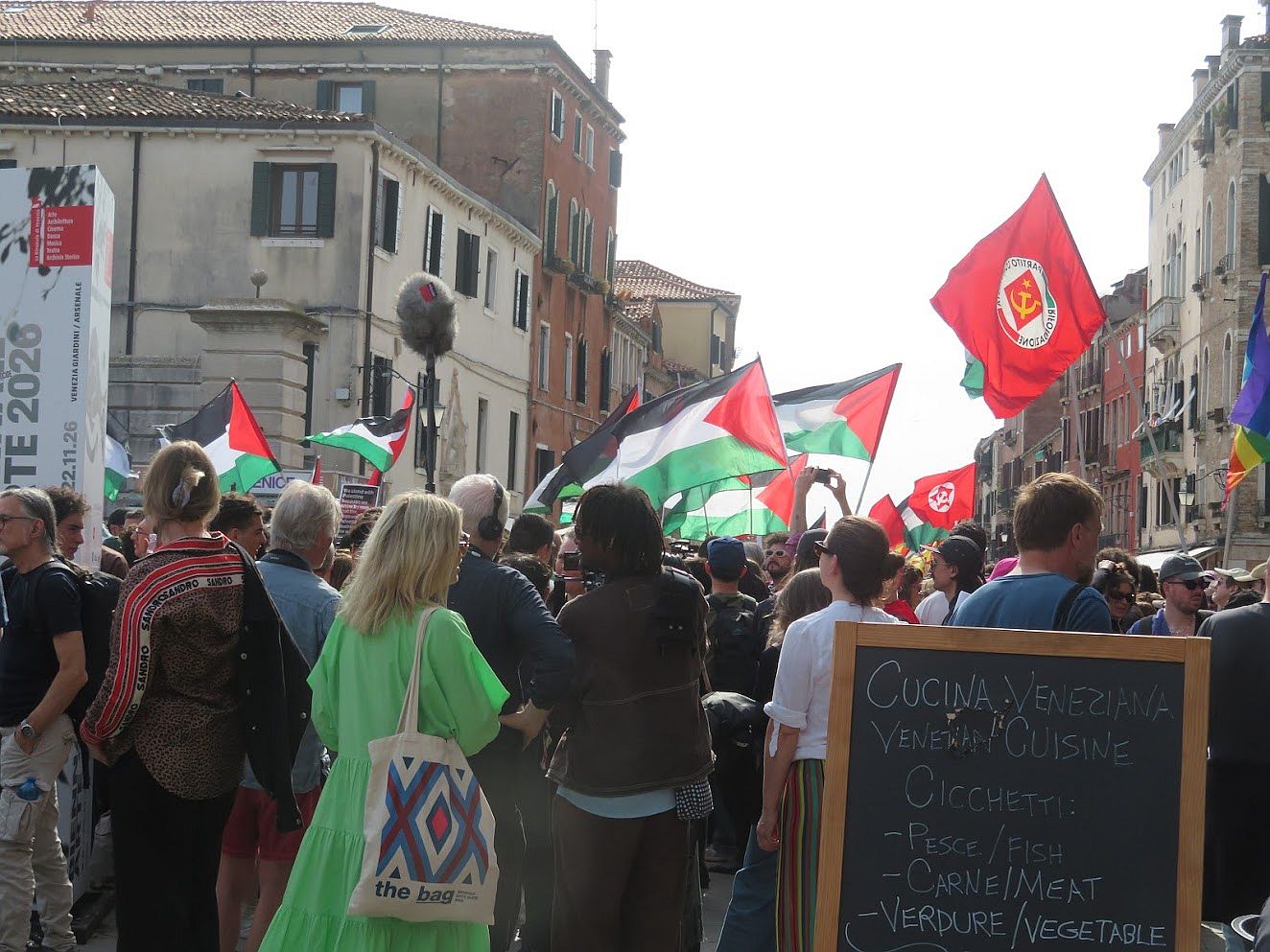
As far as I can see, politics has long since taken the Biennale hostage. Participants have something to say, and then they call it art. We even had a real protest, complete with riot-geared police and a police helicopter roaring overhead for hours.
But I’m getting ahead of myself.
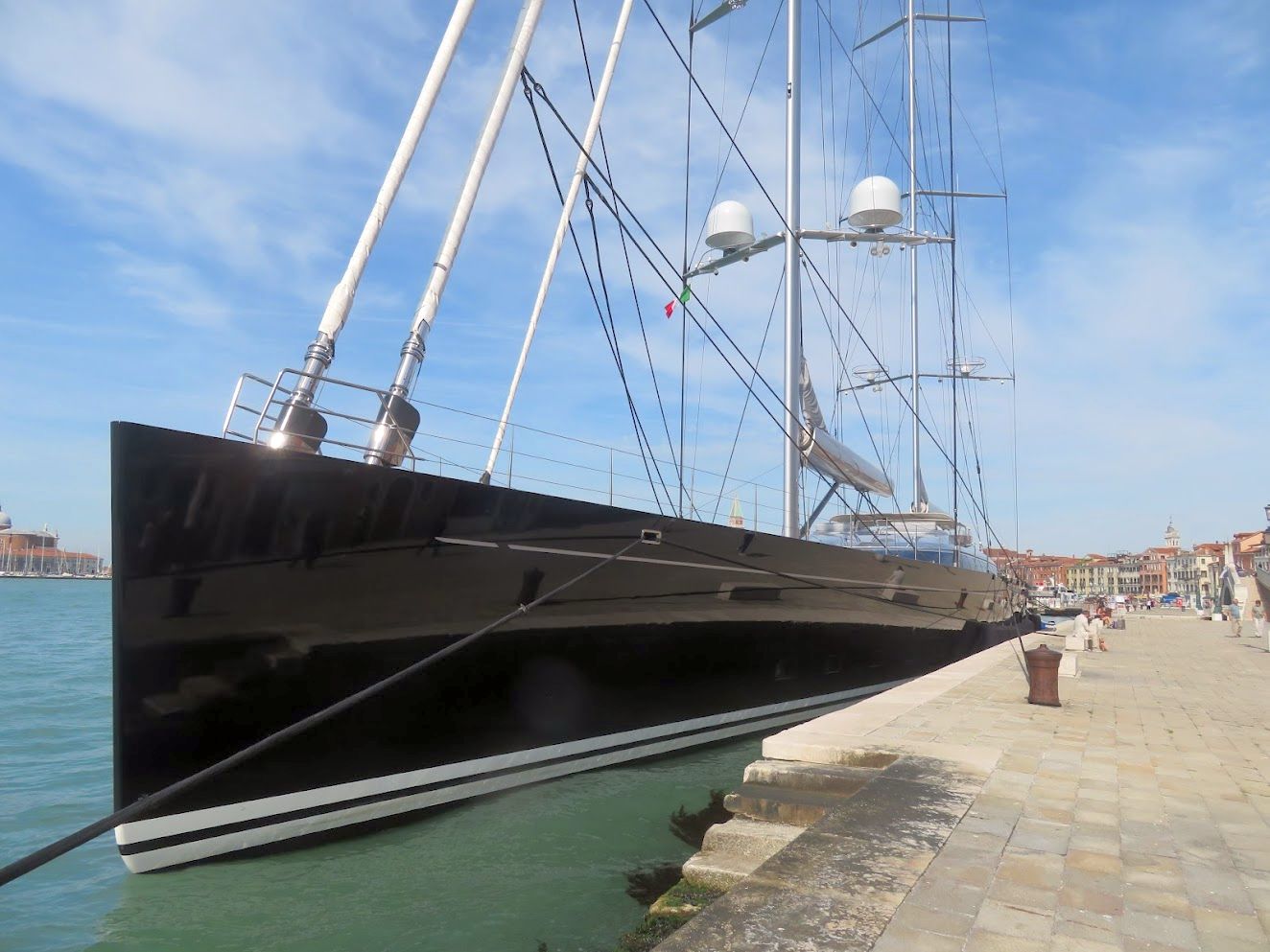
Rupert Murdoch’s yacht “Vertigo” was the first of several luxury boats brought in presumably for publicity parties. I can’t say what happened on this yacht, it disappeared before the real activity began.
The “pre-opening” week is an experience in itself, protests or no. It began more or less on May 4, with the always entertaining international swarms of journalists, critics, maybe even some artists. They descend in their thousands on Castello for an early look at what is sometimes referred to as “the Olympics” of the art world. I get what they mean, but considering that Italy is currently evaluating the usual damage — financial and environmental — that the Winter Olympics inflicted on the Italian Alps only two months ago, it’s a term I’d suggest avoiding.
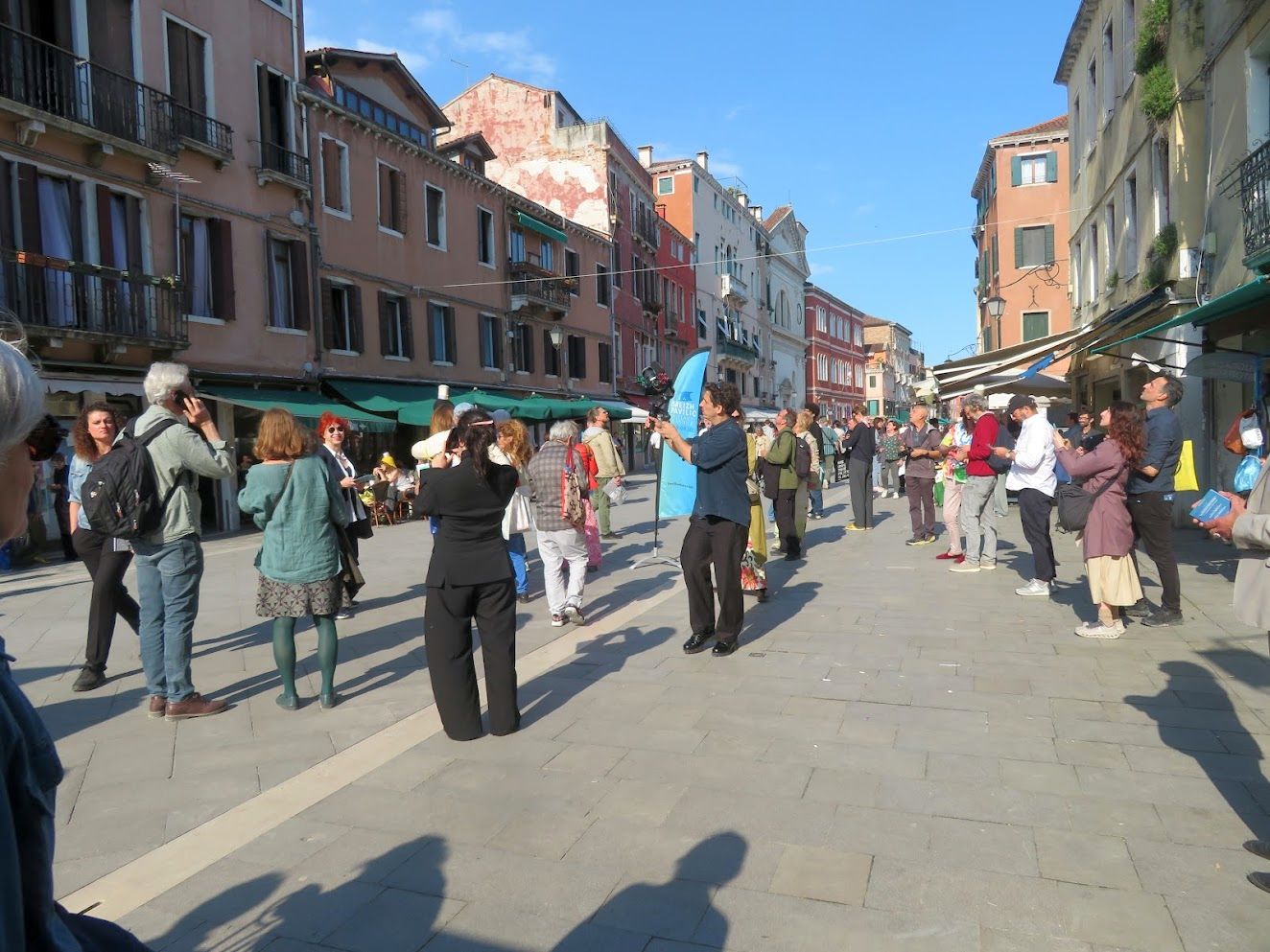
Seeing as much of the activity is concentrated outside our front door, the week is an assortment of sensations brought by streams of journalists and art-world people. The sound of many rolling suitcases at all hours, the plundered supermarket shelves, the clogging of streets and bridges by people who have to stop to talk, to consult their phones, to look at each other, or just look around. You get the feeling that it isn’t that they have stepped into your world, but that you’ve been somehow transported into theirs.
The official inauguration was Saturday, May 9, so for the next seven months (closing November 22) Venice will be chugging along powered by the engine of the Biennale. Here is an assortment of images from the week.
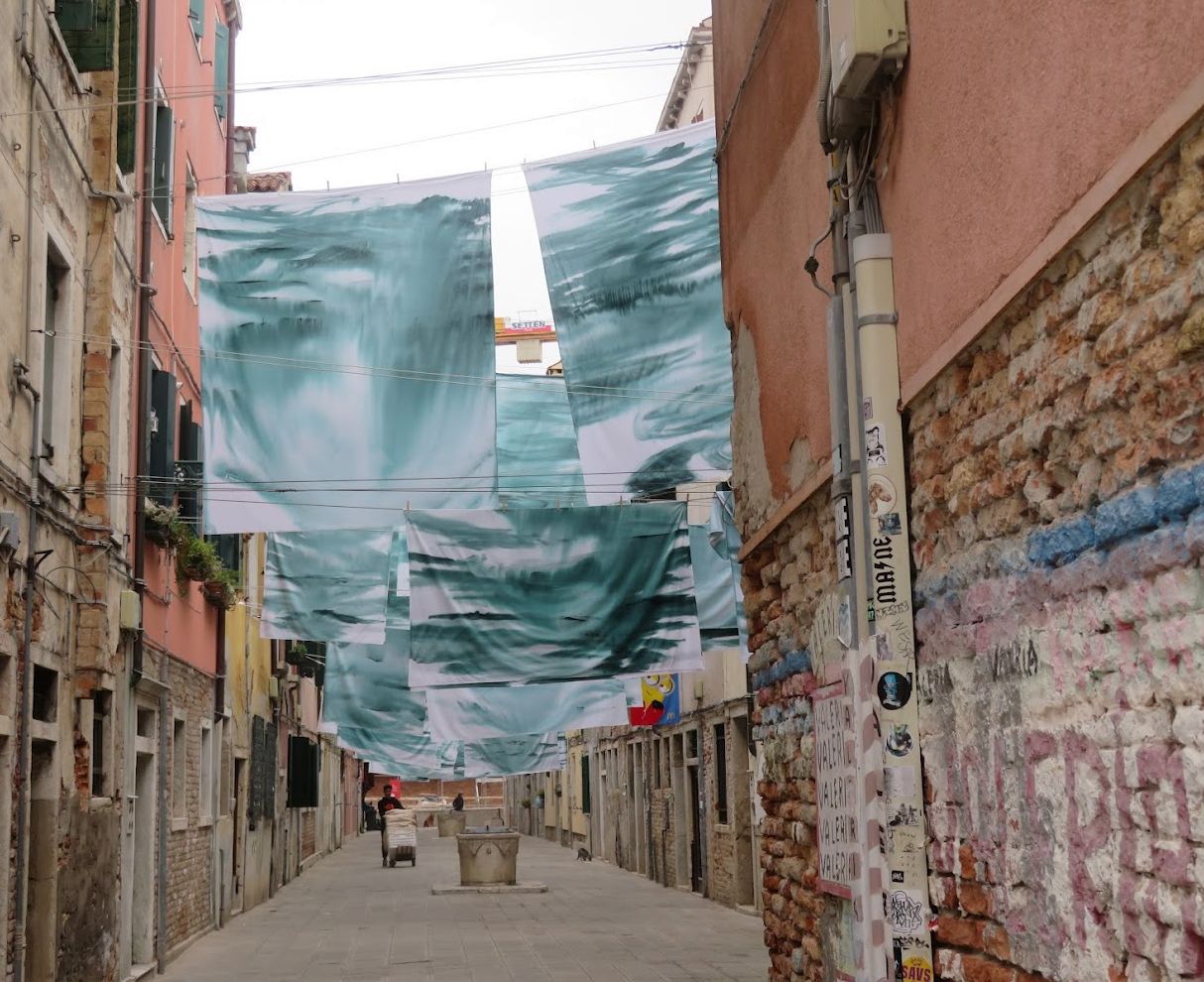
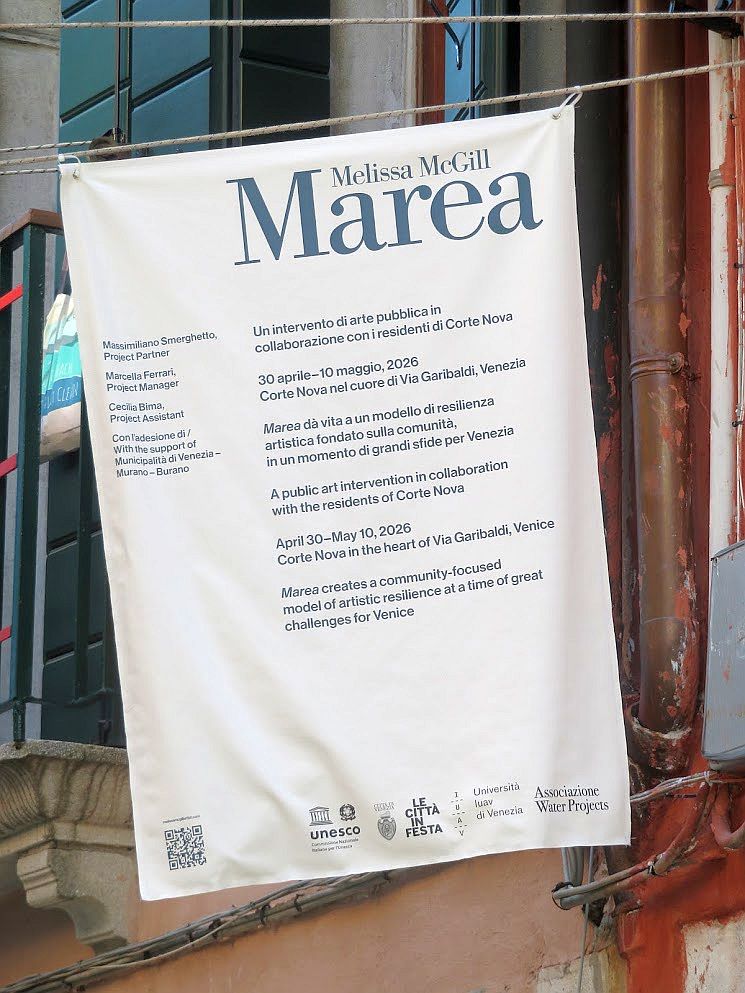
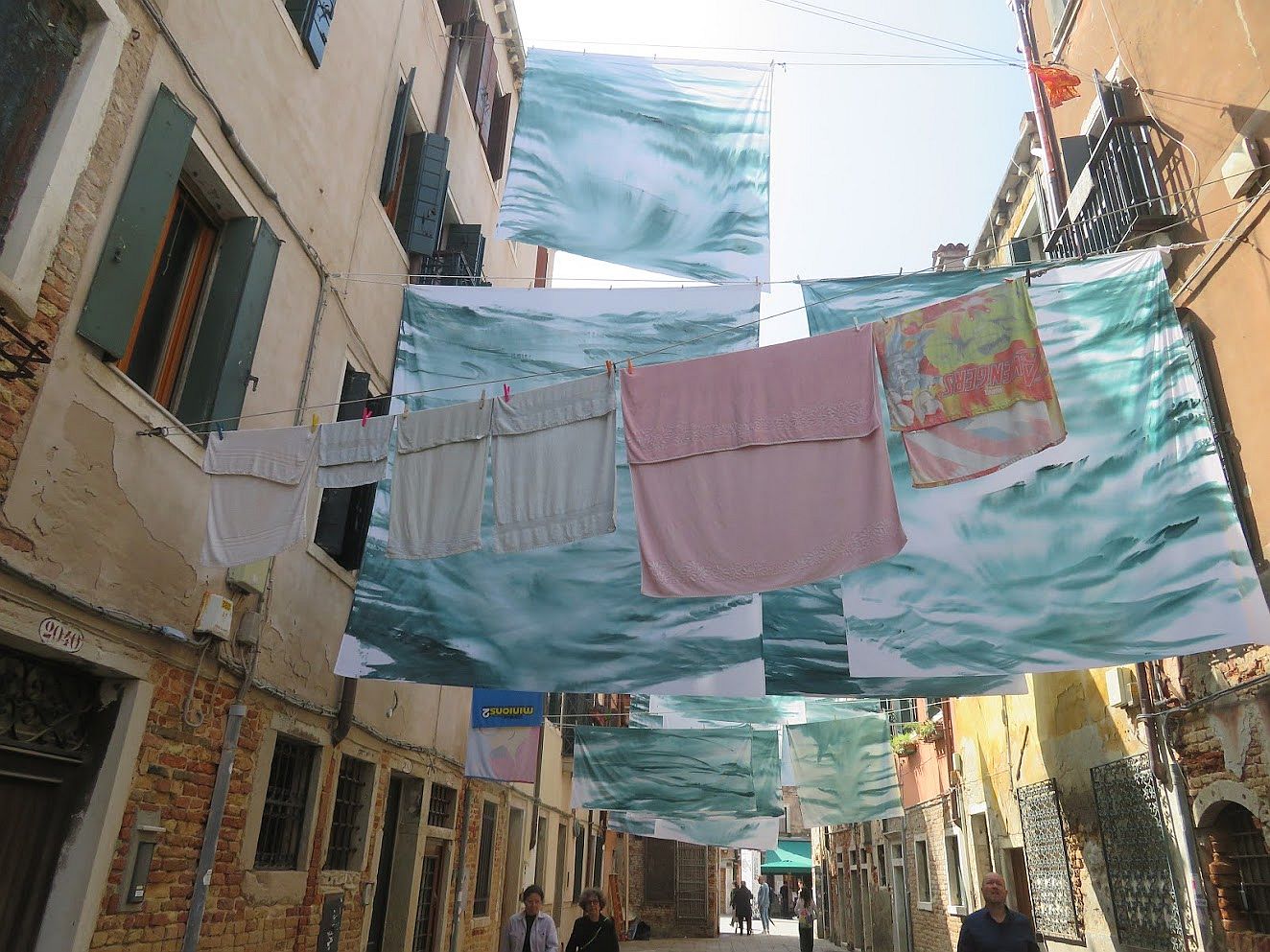
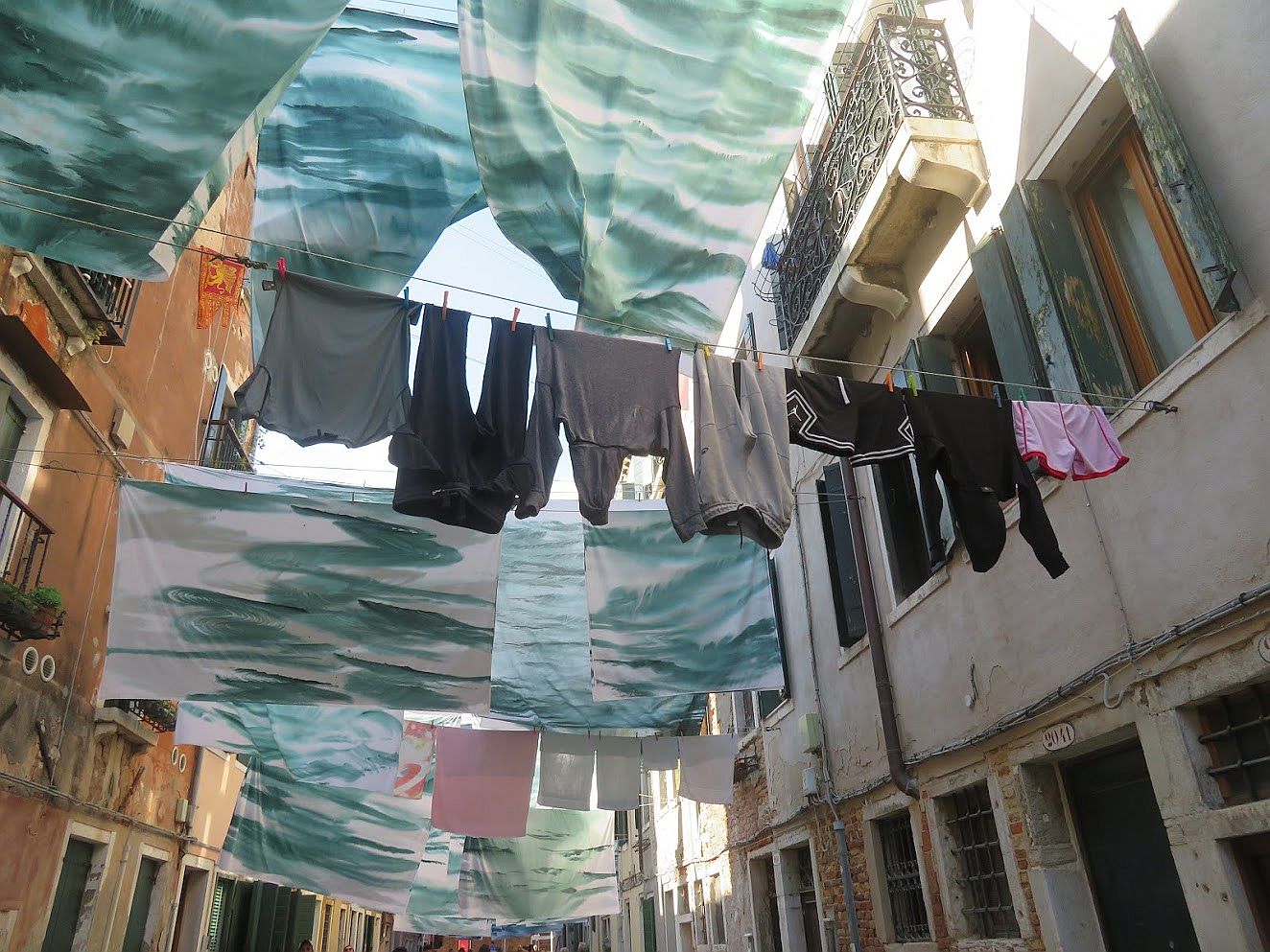
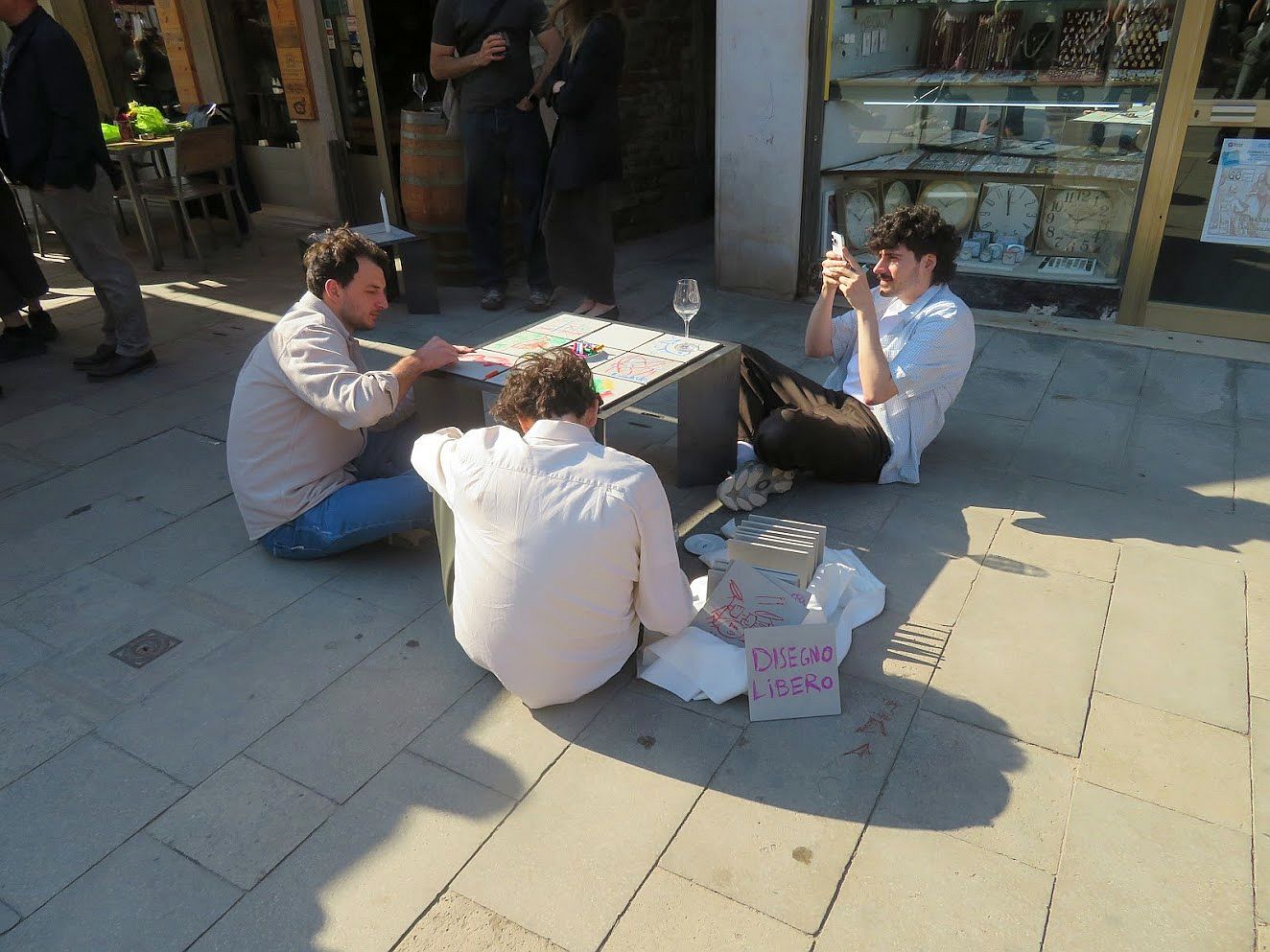
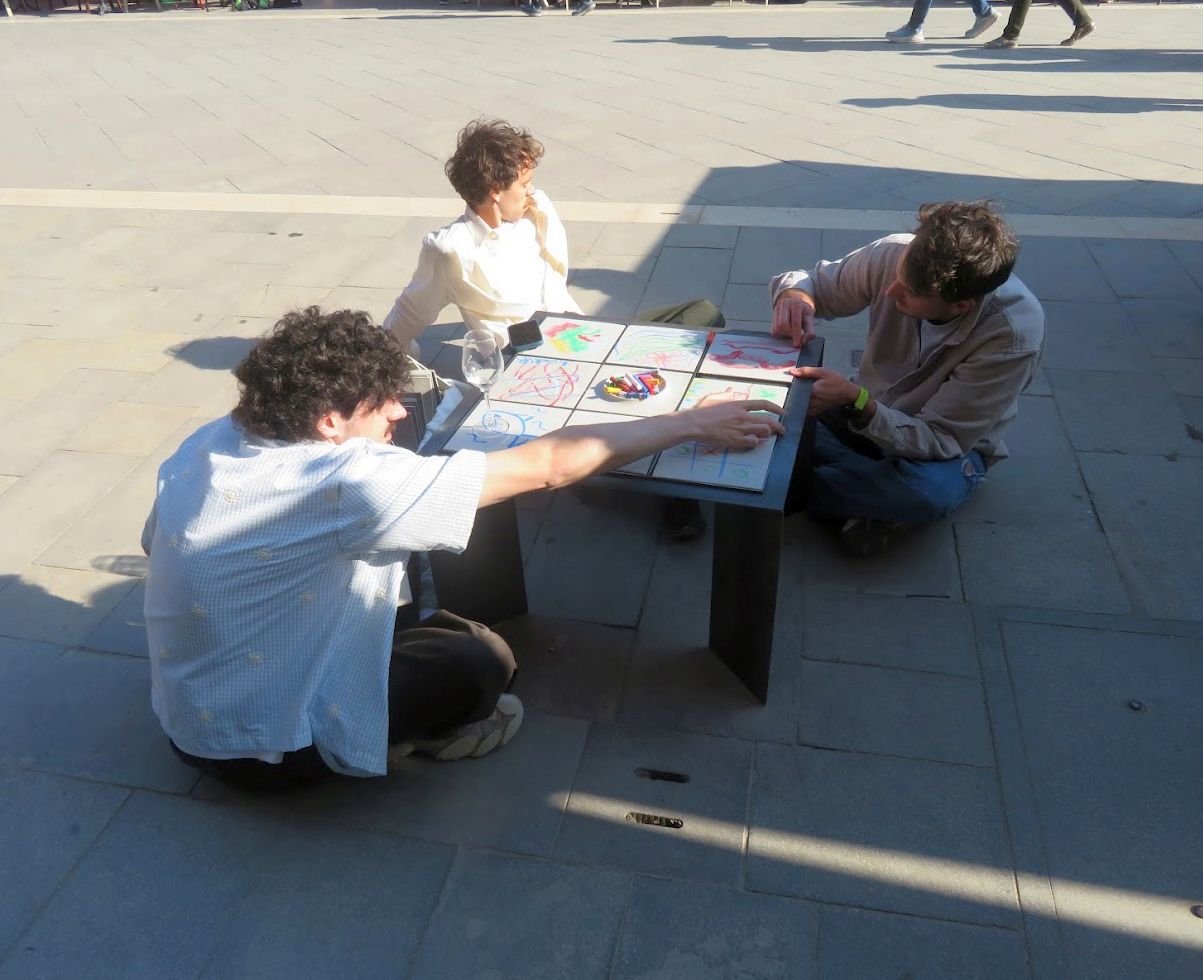
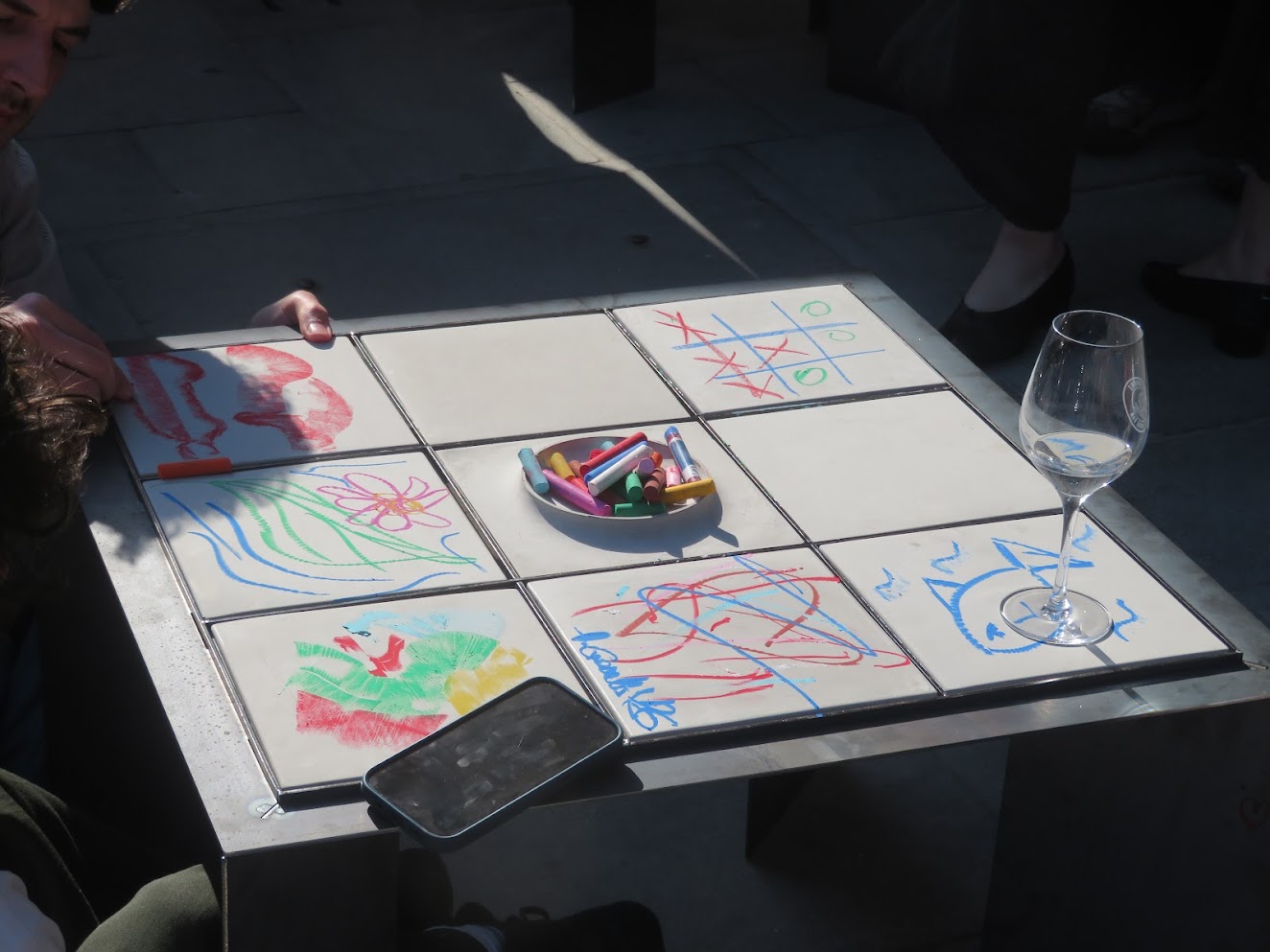
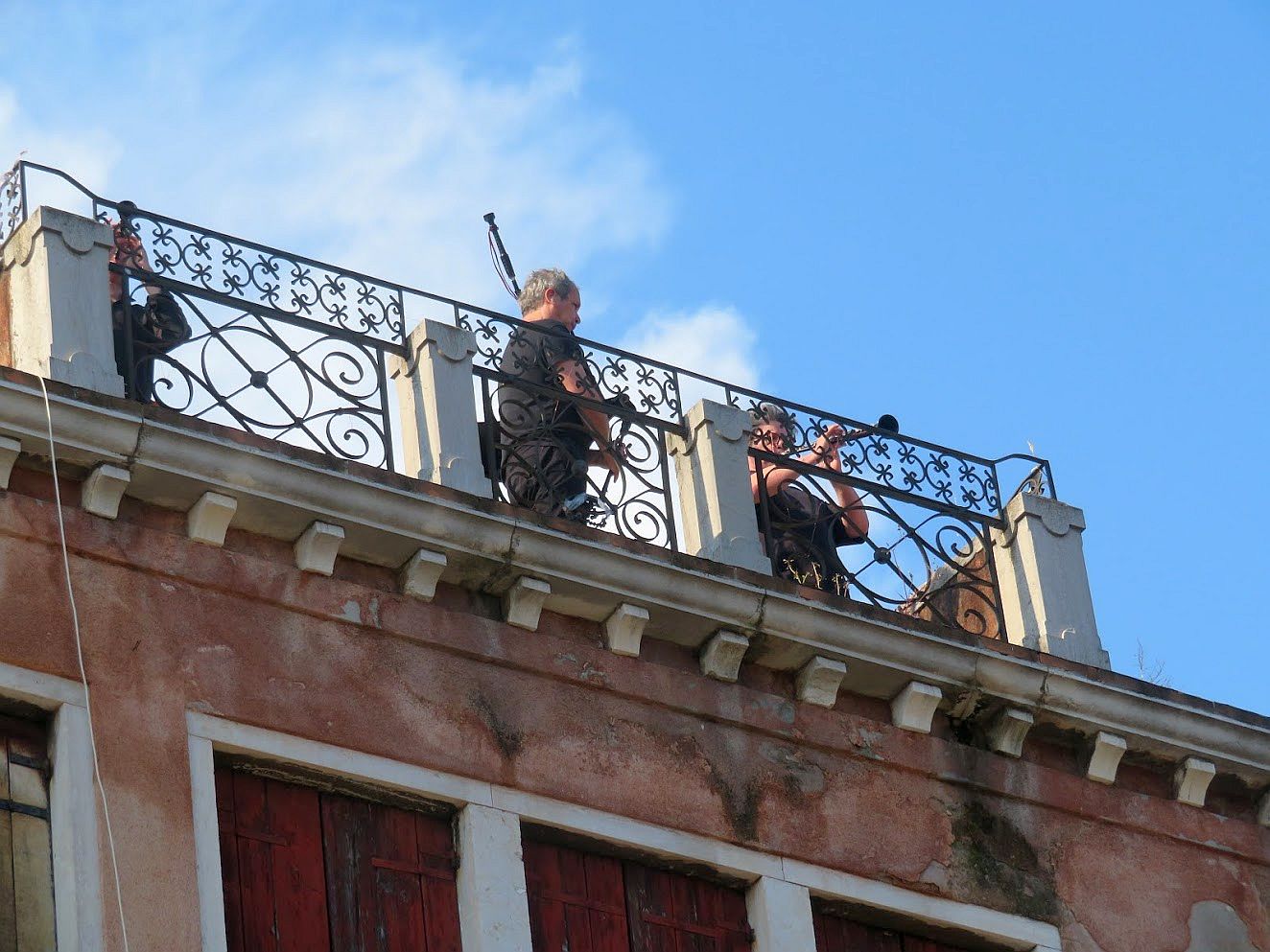
This was the first artwork that took its place on via Garibaldi. They don’t drag it inside at night, it will be here till winter. I’m wondering whose dog will be the first to succumb to its exotic allure.This creation is called “Marea” (“tide” in Italian). It was up for eleven days and looked very blithe when the sun was shining (not for long on a side street like this) and with the breeze blowing, which it isn’t here. Without those elements it was rather lackluster.I like the reference to resilience. I’m not sure what “artistic resilience” might be, or how this model might be a useful illustration, but Biennale-speak makes everything sound important.A few residents decided to return to domestic resilience and let the symbolism of the tide fend for itself. The sun is shining, the towels are wet. Art is all very well but the basics of life are not to be trifled with.There’s the art world, and there’s the real world. Real world wins.The little sign saying “disegno libero” means “free design,” implying you can join in to express your inner artist just like you did in kindergarten, including sitting on the ground.At least they’re not promoting some complicated theory of art or life.I didn’t even ask why. You just go with it.Raucous instruments were audible coming from somewhere up high along via Garibaldi. People stopped when they realized it was a performance by musicians from the Brittany pavilion.I love that Celtic music but these three were stuck on “Celtic” and hadn’t yet made the leap to “music” and got lost at “cacophony.” Fabulous position for their show, though. People seem to have really made an effort to use whatever space they could find. Newsstand, clotheslines, rooftop terrace. Pavement… probably a bathroom somewhere…
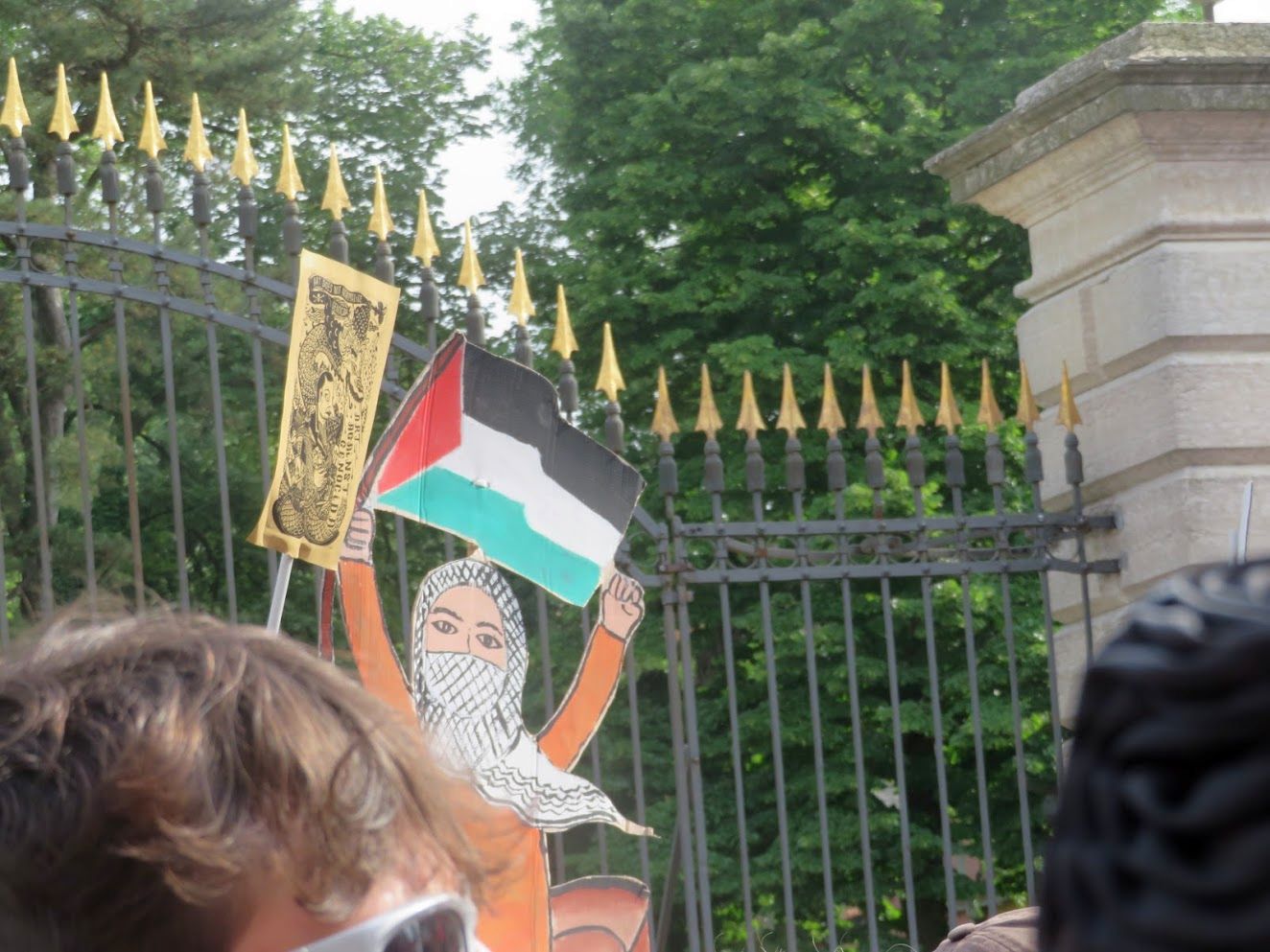
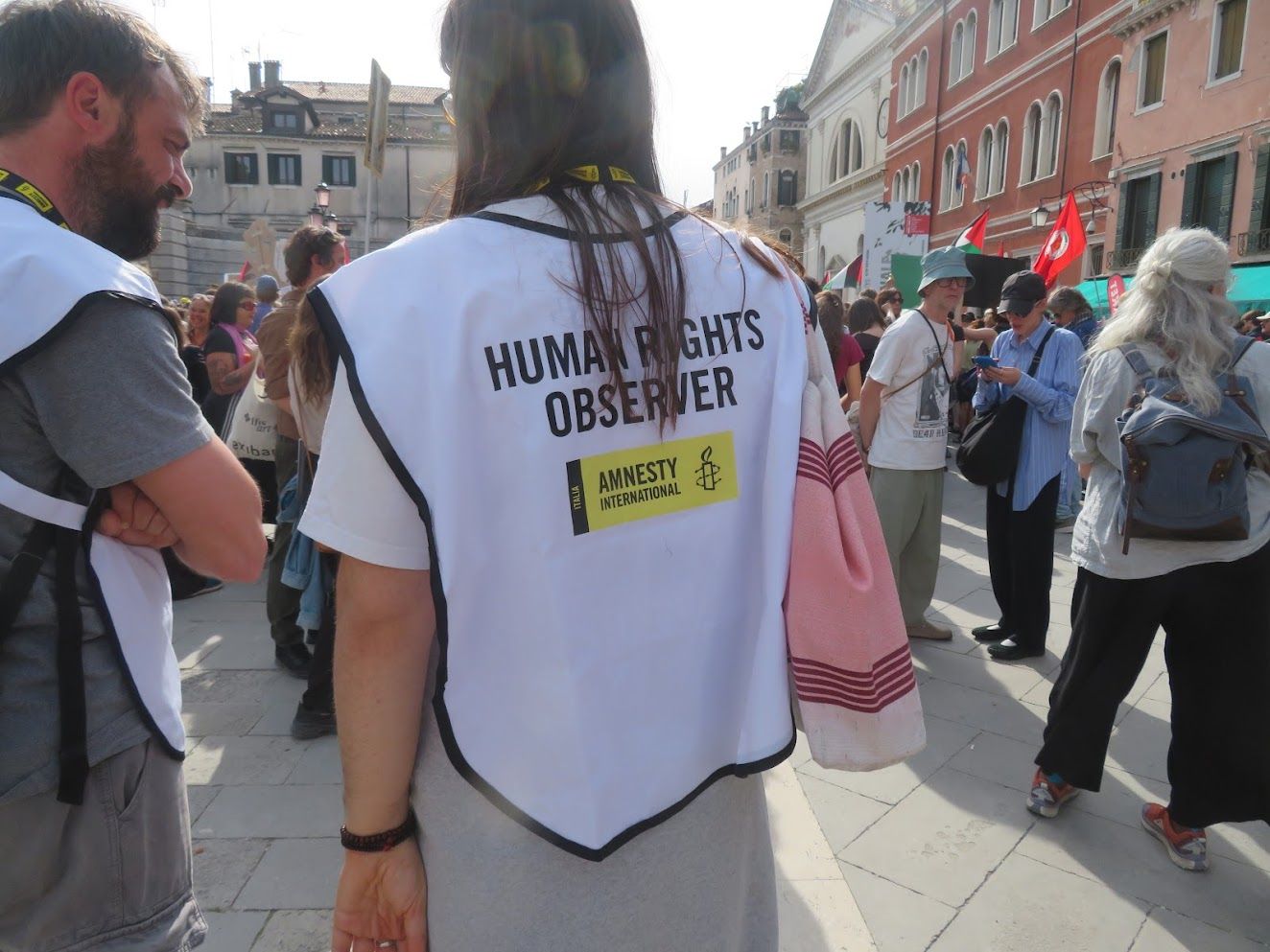
Friday afternoon saw the big protest against Israel’s participation in the Biennale. Not only did we have people here on the street, 20 national pavilions were closed because their staff was on strike in solidarity. For the record, they were Austria, Belgium, Egypt, Lithuania, Catalonia, Luxembourg, Poland, Slovenia, Spain, Switzerland, Turkey, Finland, The Netherlands, Ireland, Qatar, Malta, Cyprus, Ecuador, and the UK.
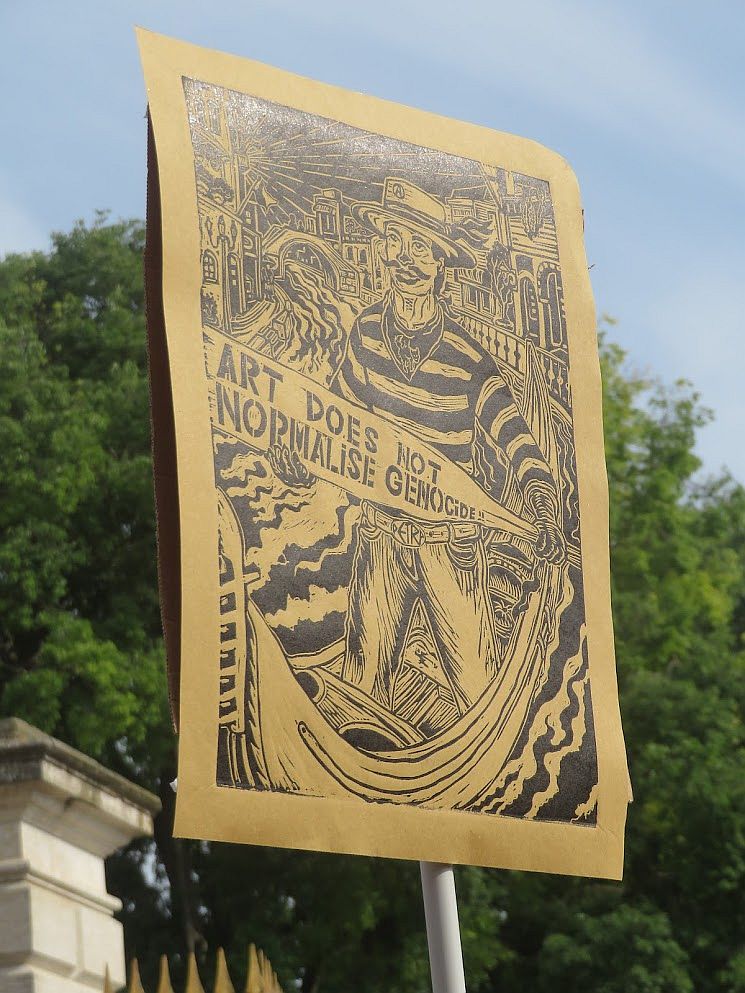
Needs no translation.“Artwashing is a criminal act.” Finally art and politics have to look at each other.Suddenly all that Biennale-speak has been pushed aside for clear, declarative sentences.
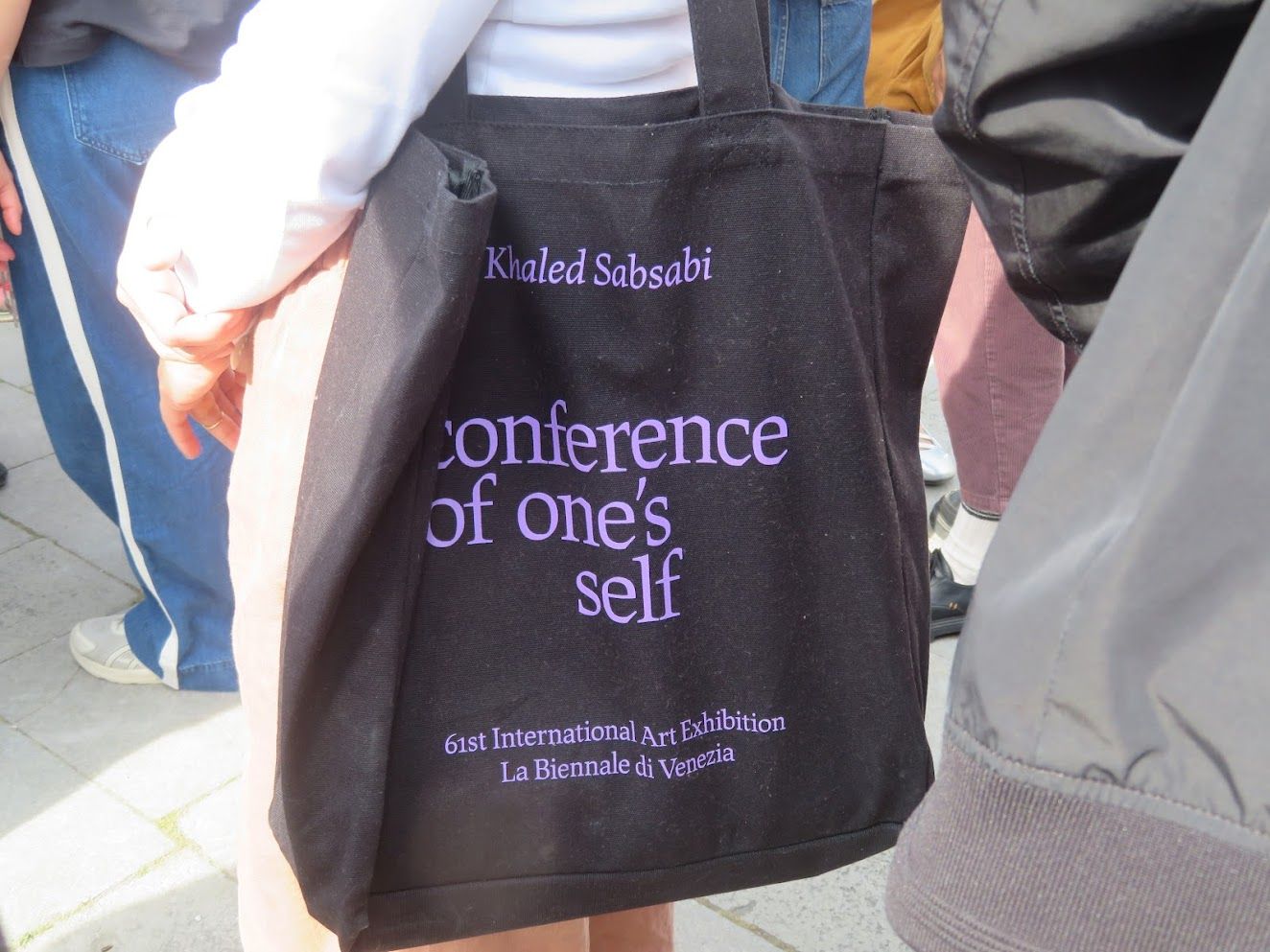
Everybody seems to have been somewhere before coming here. The Biennale was bursting with itself.
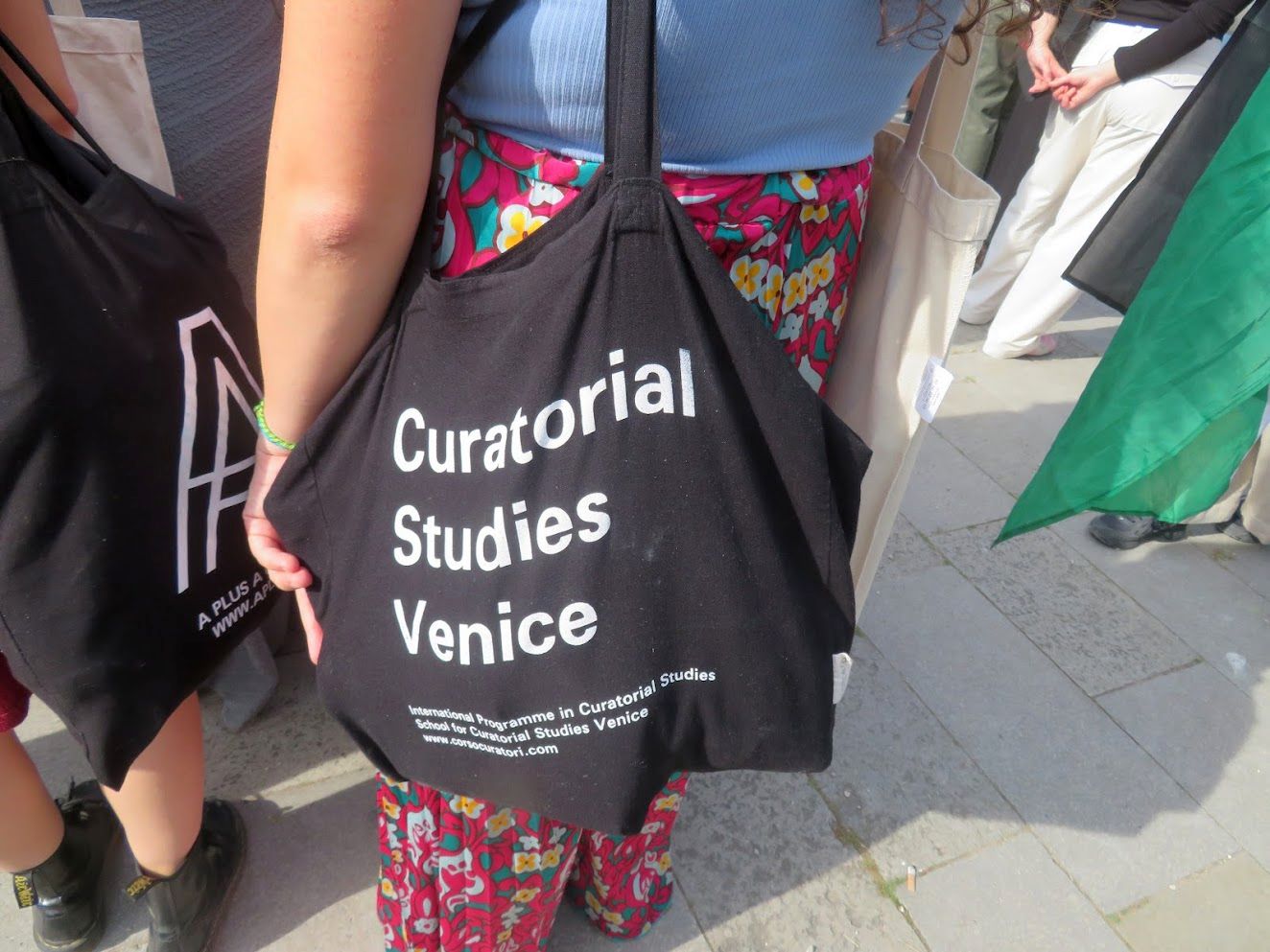
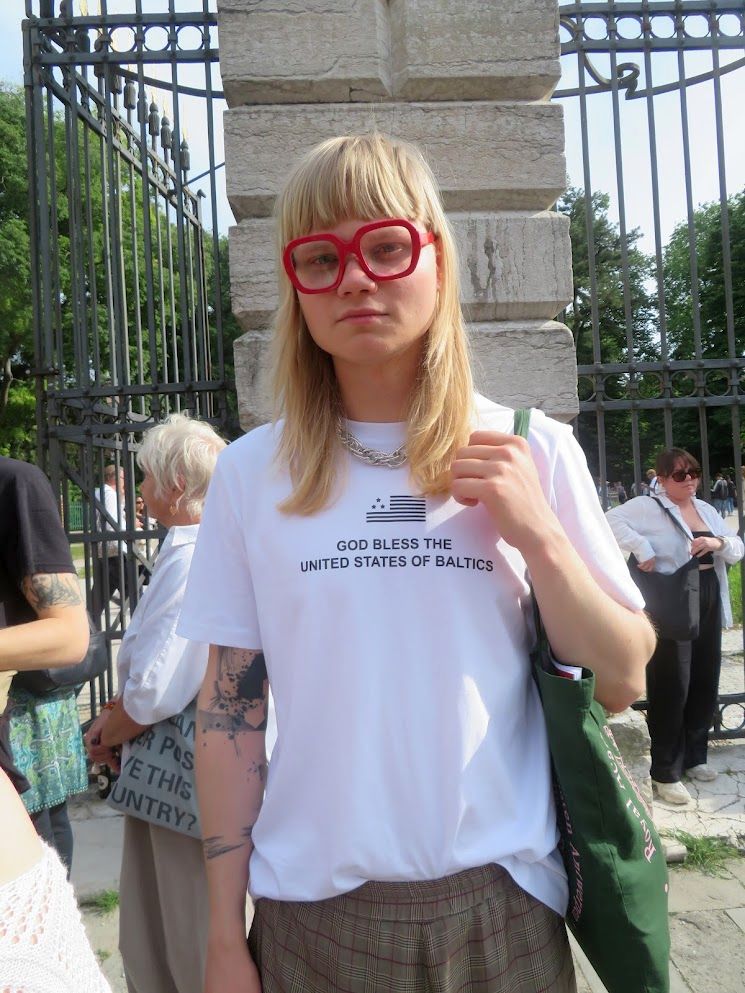
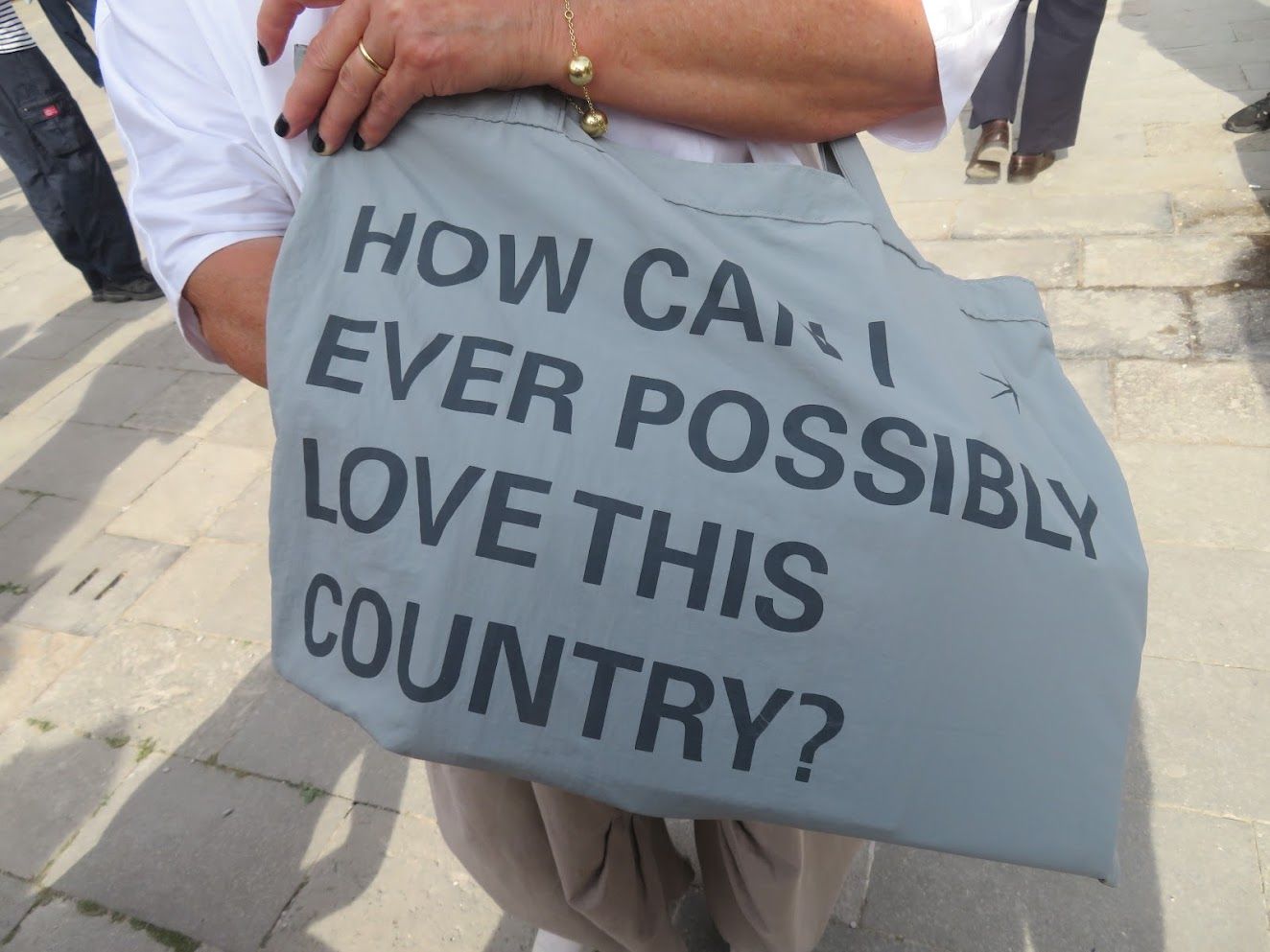
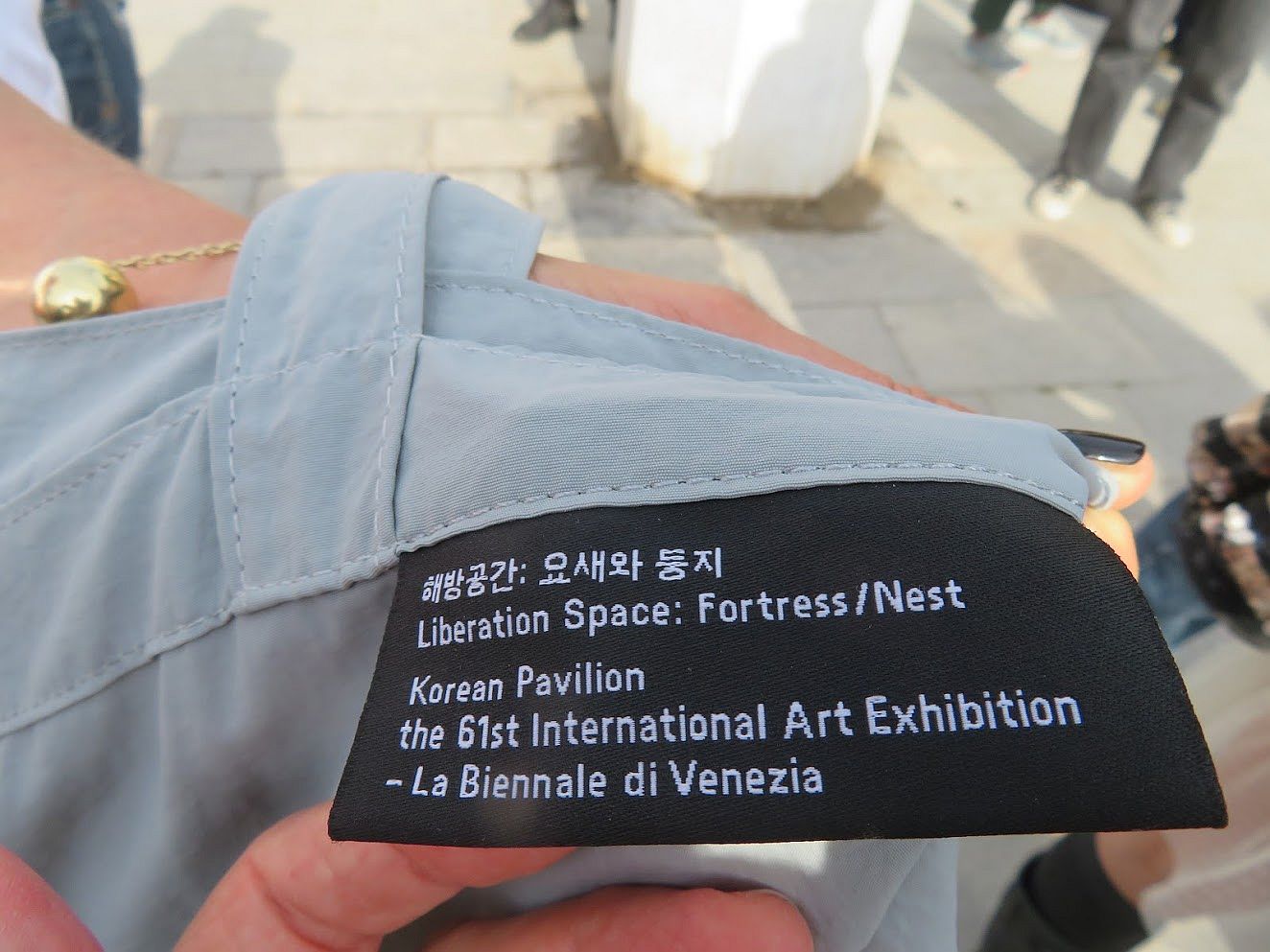
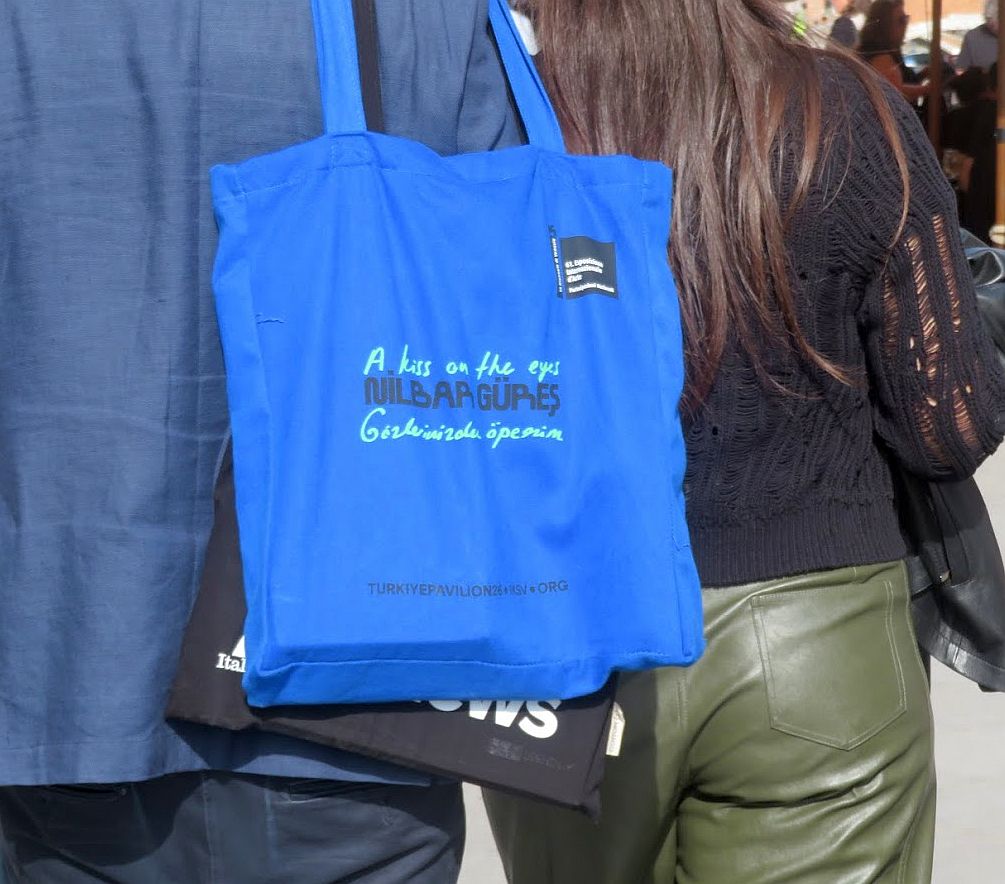
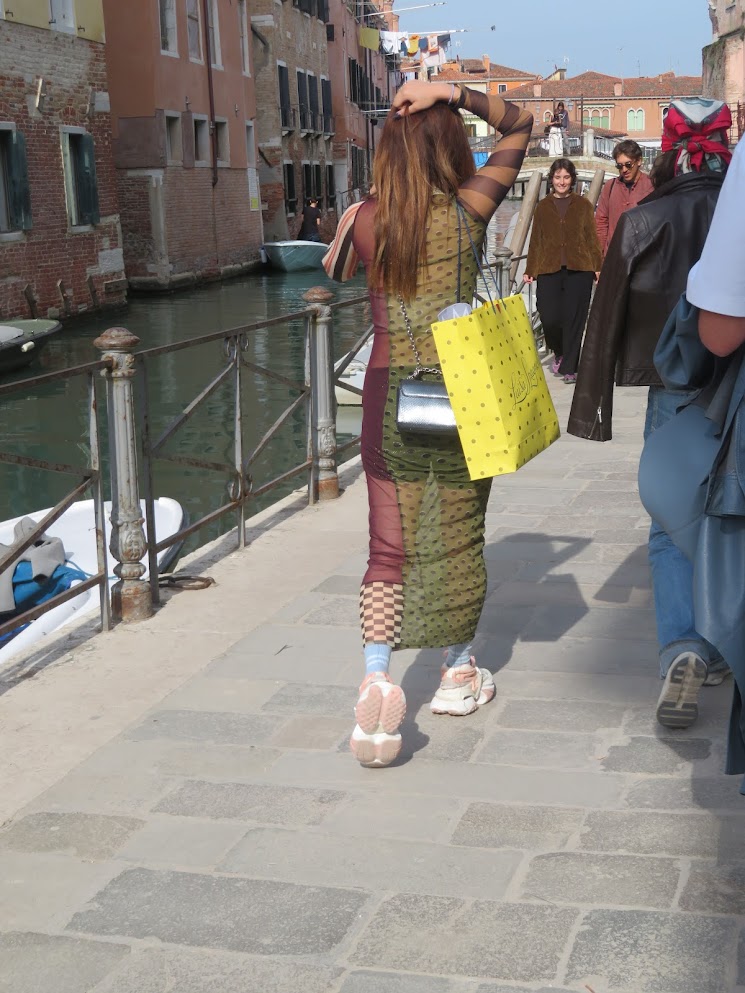
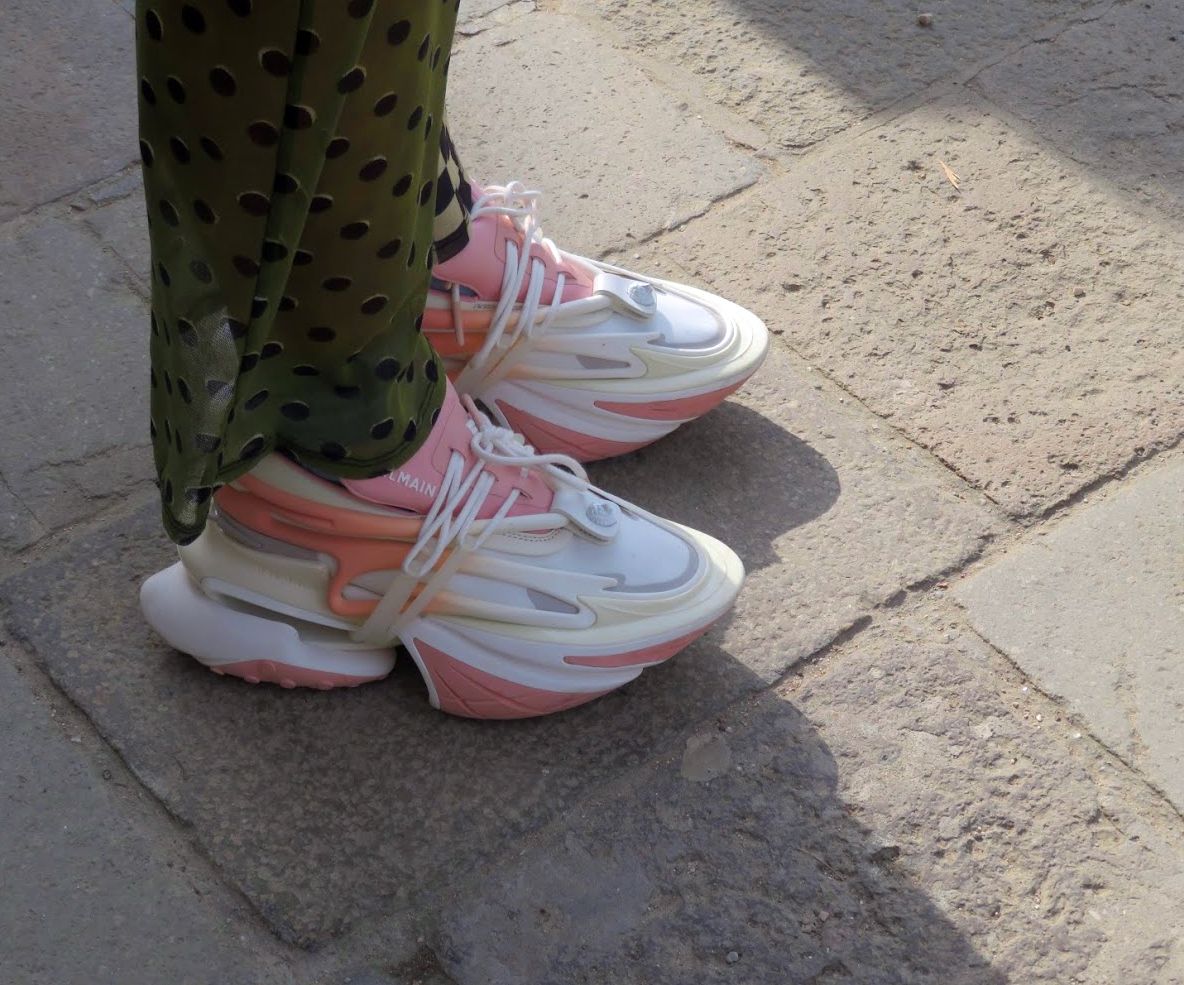
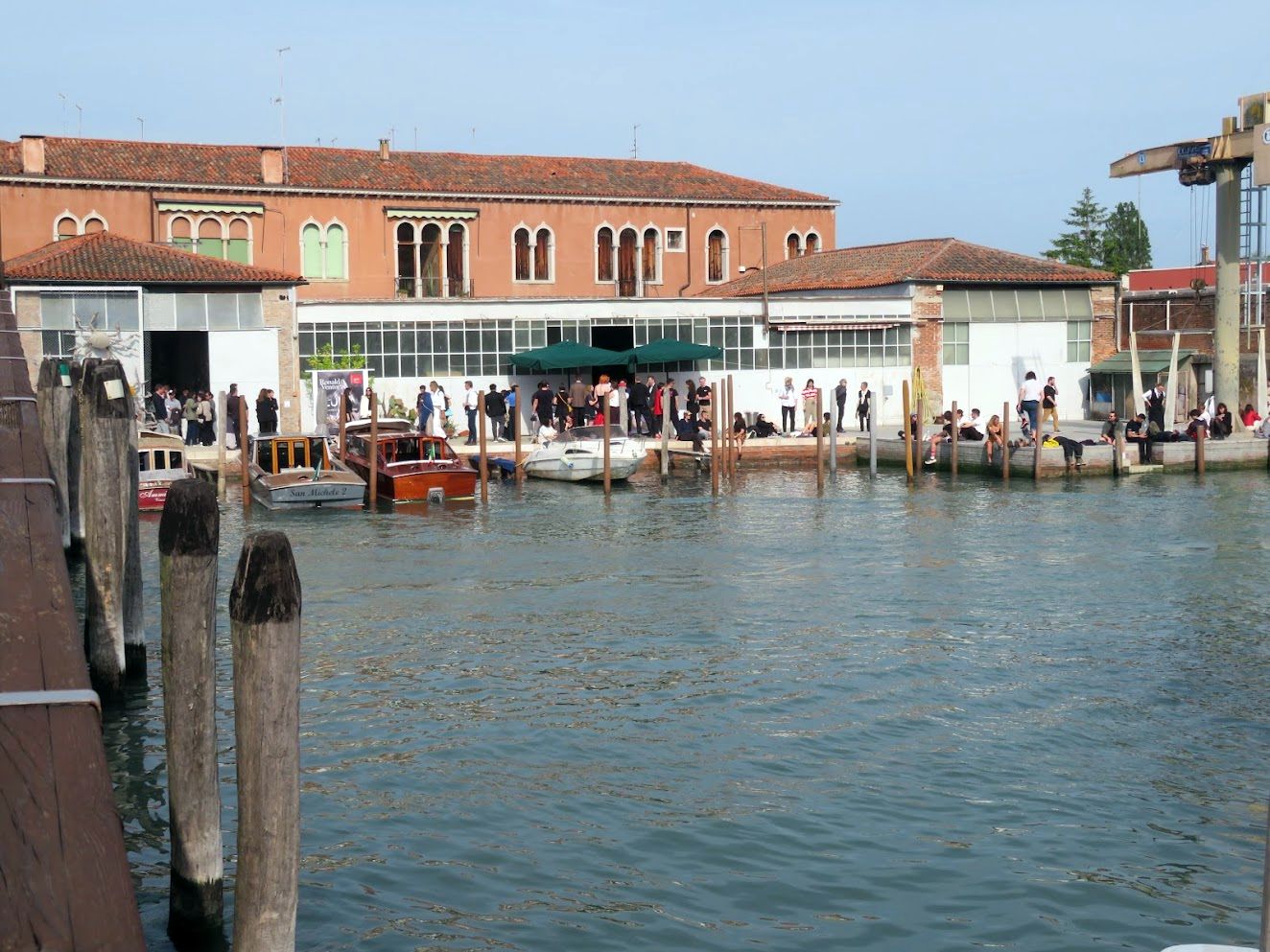
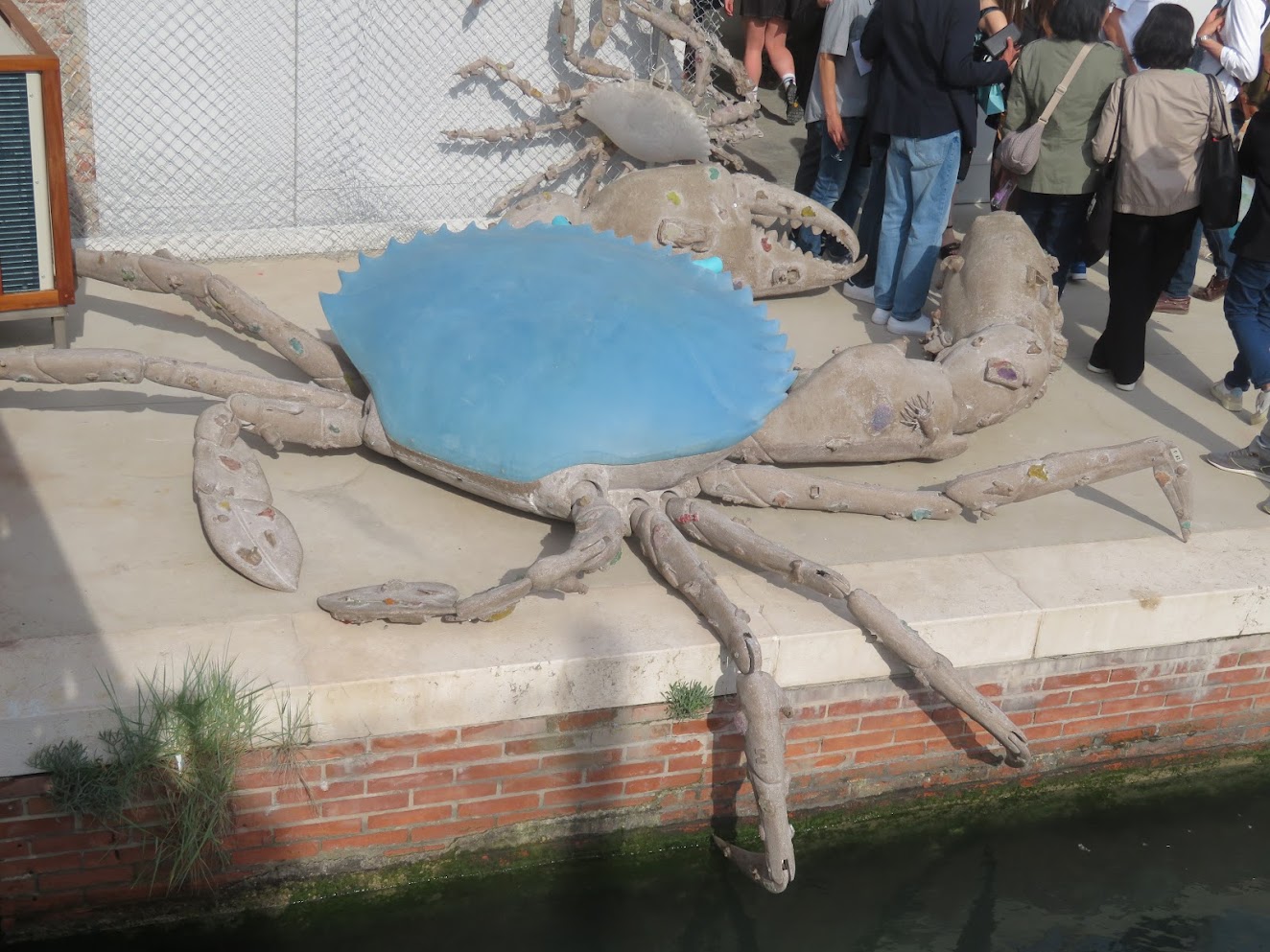
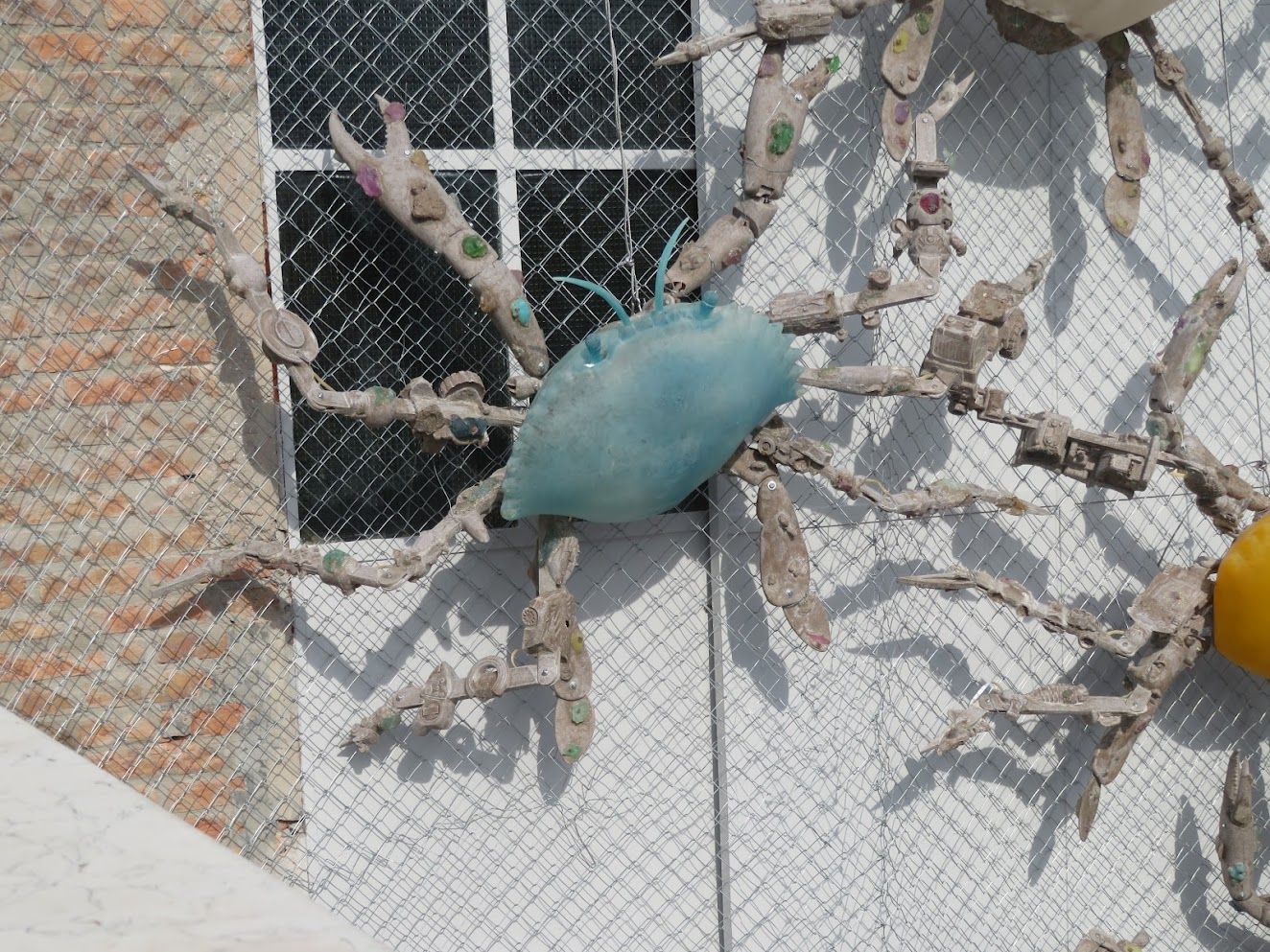
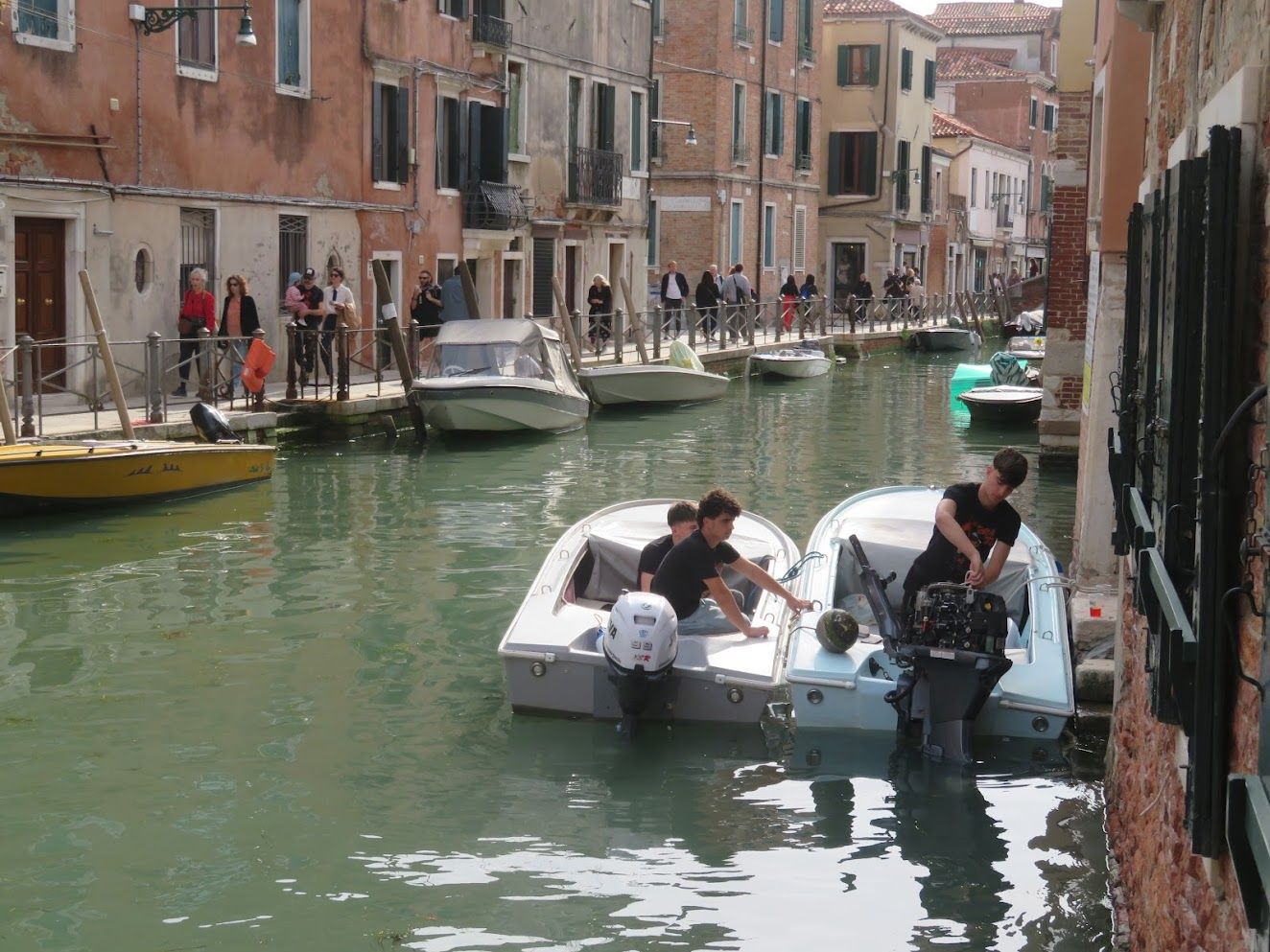
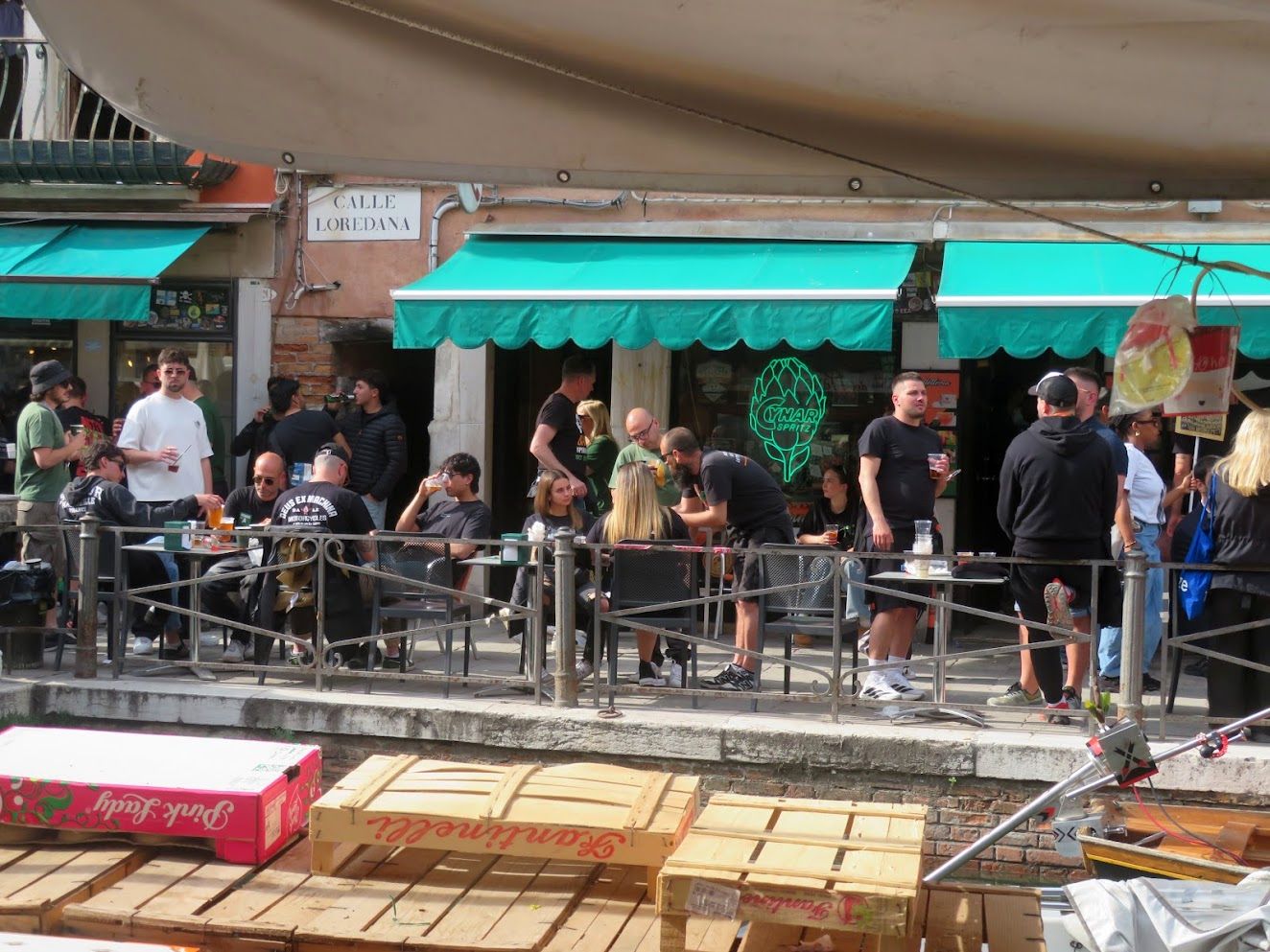
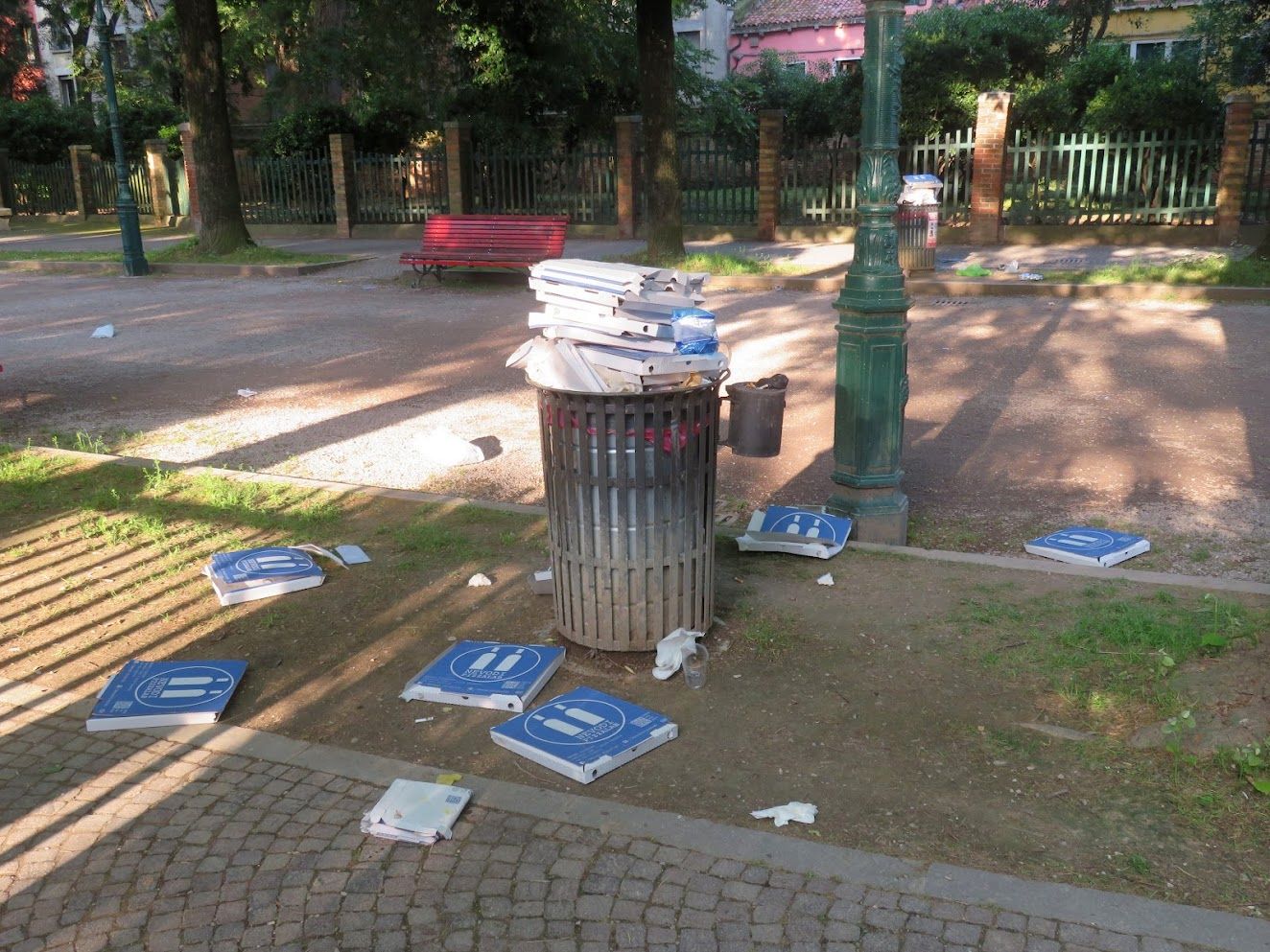
Very tall young person from the Baltics. The person, however self-defined, had a lovely deep voice. I make no guesses or assumptions. The flag resembles the Breton flag but no — it’s of the United States of Baltics, as you see. The shirt’s makers explain the design on their site: “3 stars represent the three Baltic states, and 13 stripes the countries that have owned us.” You could easily have one yourself (note: I get no benefit from this mention, I just think it’s extremely cool): https://pood.dokfoto.ee/tootekategooria/riided/This is a big question. My own question is: Which country? Any country? All countries?Answer: South Korea. I didn’t know we had to worry about them too.The Turkish pavilion weighs in. No soul-crushing comments here, which is nice.I didn’t pay enough attention to how people were dressing this year, but this girl cried out to be immortalized. She is literally shedding money. The dress-like wrapping is amazing all on its own and I’m guessing it cost plenty of bahts. The Luisa Spagnoli shopping bag makes it clear she hadn’t been spending all day looking at art. But the shoes were the crowning (so to speak) touch.The shoes are called “Unicorn” and are made by Balmain, the French haute couture house. They cost 995 euros ($1,172).Just over the bridge leading toward San Pietro di Castello a boatyard has joined the crowd in hosting exhibitions. Forget repairing taxis and barges in the old shop, there’s art to be shown.Yes, blue crabs made of iron are art. At least it looks like iron. At the Biennale it could be ground-up extruded distressed cowrie shells made to look like iron.Smaller crabs clinging to the netting. Ahoy matey.And in viaGaribaldiWorld life is proceeding in a totally normal way.This bar/cafe is where the local fans of the Venice soccer (football) team gather before the game. Or any time they feel like it, like today.Sunday morning you can see that the festivities have peaked and passed. The pizza-eaters deserve a compliment for trying to put the trash away neatly. Lack of sufficient bins and more than enough seagulls have created this scene. Or wait — maybe this is an art work?
Just remember — and I’m not being sarcastic — the Biennale is better than Carnevale. Because Carnevale is full of people dressing up and pretending to be something or someone they’re not. The Biennale people aren’t pretending anything. They’re absolutely serious about all this.
Contains information related to marketing campaigns of the user. These are shared with Google AdWords / Google Ads when the Google Ads and Google Analytics accounts are linked together.
90 days
__utma
ID used to identify users and sessions
2 years after last activity
__utmt
Used to monitor number of Google Analytics server requests
10 minutes
__utmb
Used to distinguish new sessions and visits. This cookie is set when the GA.js javascript library is loaded and there is no existing __utmb cookie. The cookie is updated every time data is sent to the Google Analytics server.
30 minutes after last activity
__utmc
Used only with old Urchin versions of Google Analytics and not with GA.js. Was used to distinguish between new sessions and visits at the end of a session.
End of session (browser)
__utmz
Contains information about the traffic source or campaign that directed user to the website. The cookie is set when the GA.js javascript is loaded and updated when data is sent to the Google Anaytics server
6 months after last activity
__utmv
Contains custom information set by the web developer via the _setCustomVar method in Google Analytics. This cookie is updated every time new data is sent to the Google Analytics server.
2 years after last activity
__utmx
Used to determine whether a user is included in an A / B or Multivariate test.
18 months
_ga
ID used to identify users
2 years
_gali
Used by Google Analytics to determine which links on a page are being clicked
30 seconds
_ga_
ID used to identify users
2 years
_gid
ID used to identify users for 24 hours after last activity
24 hours
_gat
Used to monitor number of Google Analytics server requests when using Google Tag Manager