
I’m thinking about World War I today, partly because yesterday, May 24, used to be a date engraved in every Italian’s consciousness. Yet it passed unremarked in any way, which to Lino is yet another sign of the general deterioration of just about everything.
We were walking along the fondamenta yesterday morning when all of a sudden Lino said: “It’s May 24! …‘il 24 maggio l’esercito marciava…” and he was off, declaiming the four long stanzas of the “Legend of the Piave.”
This is one of the great patriotic songs, immortalizing the departure of the army to war against the Austro-Hungarian Empire on May 24, 1915. Some of the most ferocious battles toward the end took place along the Piave River. 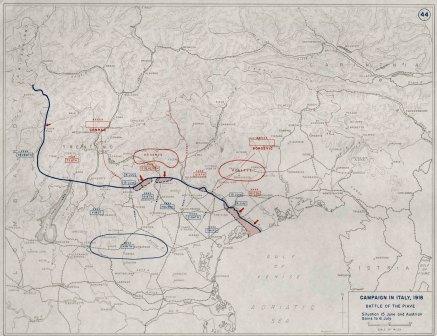 It is a pleasant little stream which starts in the Alps and empties into the sea not far from Venice, but more importantly, it formed the front which finally stopped the enemy advance and led to its ultimate defeat. The Piave is therefore also known as “The river sacred to the motherland.”
Schoolchildren used to be taught these impressive chunks of poetry and as you see, it stuck. This feat was perhaps made a little easier by singing; the music of “The Legend of the Piave” is so distinctive that you can’t get it out of your mind no matter what you try to put in its place. Everybody knows it. It was in the serious running to be designated the Italian national anthem.
“My father fought in the war,” Lino was telling me, “on the Asiago plateau. He was taken prisoner, and they took him to Trento, to the Castle of Buonconsiglio. He took me there once, when I was little, to show me. We went into the big room and he said, ‘That’s where the judge was sitting, and that’s where the bench was where I was sitting.’ He always told me he was going to take me to Asiago to show me the trenches he was in, but he never did. I’ve always been sorry. ”
The military judge’s job was very simple. All he had to do in order to know what to do with a prisoner was to ask where he came from. Large areas of what are now Italy only became demarcated as such after hideous battles. So if the prisoner came from Venice, or anywhere south of there, he was treated as a normal prisoner of war because he was fighting for his own country, Italy. Lino’s father got sent to the internment camp at Mauthausen for the rest of the war, came home, and went back to work driving the train from Venice to Trento.
If, however, the captured soldier came from Trento or Trieste or any of the many northern, now-Italian, towns which were then still part of the Austro-Hungarian empire, he was considered a traitor and dealt with accordingly. Firing squad,say, or hanging (Nazario Sauro, August 10, 1916), or hanging and garroting (Cesare Battisti, July 12, 1916) — it was all good. 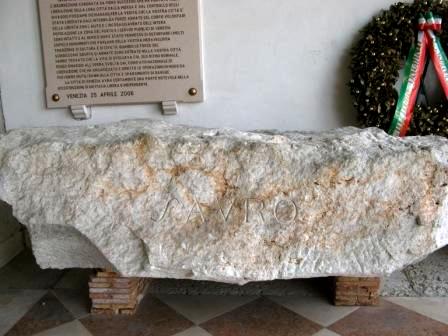 These are famous martyrs of the Italian resistance. Despite living in Austrian territory they considered themselves Italians were fighting for Italy, while according to the Austrian viewpoint they were supposed to be fighting against it. These men were epic heroes. I can’t understand why their life stories haven’t been turned into tragic operas. Where is Verdi when you need him?
So the First World War, which to many of us seems extraordinarily remote, is still part of the lives of many people — like Lino — still walking around loaded with memories. Did I say memories? He and his twin brother, Franco, have lived their entire lives carrying the names of two of their mother’s brothers who were killed in the war. Every Venetian parish, as well as the Jewish Ghetto, displays a memorial plaque listing the names of the local boys who died in the carnage. The names of Lino’s doomed uncles are inscribed on the memorial in Campo Santa Margherita. Whenever I go by I stop to look; I have this odd feeling that they’re part of my family.
The Piave, let it not be forgotten, was also where Ernest Hemingway was wounded at the age of 19, after only two weeks at the front. Because his poor eyesight prevented him from enlisting as a soldier, he volunteered to work with the Red Cross ambulances bringing soldiers down from the action on Monte Pasubio.
He was sent to Fossalta di Piave, a town on the river not far from Venice. At midnight on July 8, 1918, an Austrian mortar hit the trench where he had gone, more out of curiosity than merely to distribute cigarettes and chocolate.
“The 227 wounds I got from the trench mortar didn’t hurt a bit at the time,” he wrote to his parents from the American Hospital in Milan, “only my feet felt like I had rubber boots full of water on. Hot water… But I got up again and got my wounded into the dug out… I told him in Italian that I wanted to see my legs, though I was afraid to look at them. So we took off my trousers and the old limbs were still there but gee they were a mess. They couldn’t figure out how I had walked 150 yards with a load with both knees shot through and my right shoe punctured in two big places… ‘Oh,’ says I, ‘My Captain, it is of nothing. In America they all do it! It is thought well not to allow the enemy to perceive that they have captured our goats!”
When the bravado wore off, he was left with nightmares, insomnia — I had been living for a long time with the knowledge that if I ever shut my eyes in the dark and let myself go, my soul would go out of my body — five months of physical therapy, and his vivacious American nurse, Agnes von Kurowski. In the end, she jilted him and shattered his soul into more pieces than the shrapnel ever had.
Bombs even fell on Venice here and there (there were victims in Cannaregio). There is even an unexploded bomb which was retrieved from the roof of the basilica of the Frari, and which is mounted on the wall near the Pesaro altarpiece as a memento to this small, perhaps, but marvelous moment of salvation.
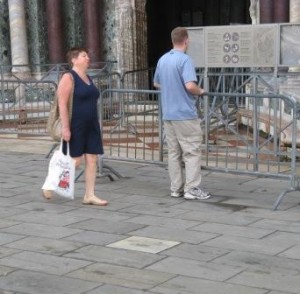
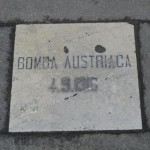
Speaking of bombs, there is a slowly disappearing stone in the Piazza San Marco. It has been worn away by millions of undiscerning feet. Sometimes I pause and just watch people walk over or past it, oblivious, snapping their pix, thinking about work, looking for a bathroom. It marks the spot where an Austrian bomb fell on September 4, 1916, five steps from the entrance to the basilica. It is just another stone, mute, but eloquent.
Every barracks and City Hall in Italy (as here, at the entrance to City Hall in Venice) displays a large bronze plaque made of melted-down enemy cannons. 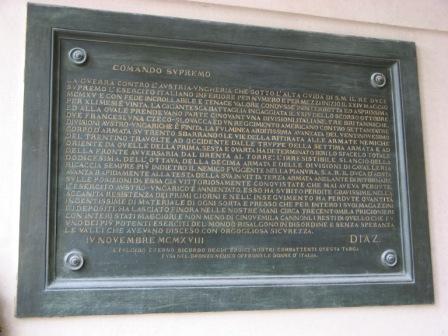 It gives the full text of the address given by General, later Marshal, Armando Diaz, chief of general staff, announcing the Italian victory of the Battle of Vittorio Veneto and the end of the war. It manages in very few lines not only to report the precise details of the enemy’s undoing but to convey every emotion conceivable in the victors of a struggle beyond human comprehension.
The war against Austria-Hungary which, under the high command of His Majesty the King, the Italian Army, inferior in numbers and means, initiated on May 24, 1915, and with unwavering and tenacious valor conducted fiercely without interruption for 41 months, is won.
The gigantic battle engaged on the 24th of last October and in which took part 51 Italian divisions, three British, two French, one Czechoslovakian, and one American regiment, against 73 Austro-Hungarian divisions, is finished.
The rapid and daring advance of the XXIX Army Corps on Trento, blocking the enemy’s means of retreat in Trentino, overwhelming them on the west by the troops of the VII Army and on the east by those of the I, VI, and IV, determined yesterday the total ruin of the adversary’s front. From Brenta al Torre the irresistible surge of the XII, the VIII, and the X Army, and of the cavalry divisions, drove the fleeing enemy even further back.
On the plains, His Royal Highness the Duke of Aosta rapidly advanced at the head of his undefeated III Army, longing to return to the positions which they had already victoriously conquered and had never lost.
The Austro-Hungarian Army is annihilated; it suffered grave losses in the fierce resistance of the first days and in the pursuit it has lost huge quantities of materiel of every sort and virtually all of its stores and warehouses. It has left in our hands about 300,000 prisoners with entire general staffs and not less than 5,000 cannon.
The remains of what once was one of the most powerful armies in the world is ascending, in disorder and without hope, the valleys which it had descended with such proud security. DIAZ
For me, though, the most powerful and poignant epitaph to war — military, emotional, or both — is what Hemingway wrote as one of the 40-some endings he crossed out for “A Farewell to Arms”:
“Many things have happened. Everything blunts and the world keeps on. You get most of your life back like goods recovered from a fire… It never stops. It only stops for you. Some of it stops while you are still alive. The rest goes on and you go with it.”
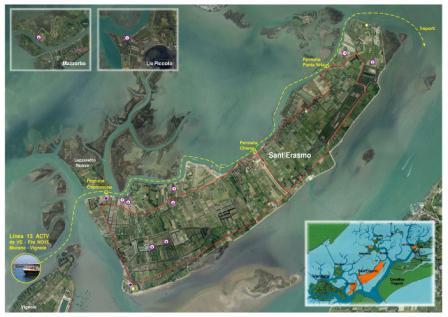

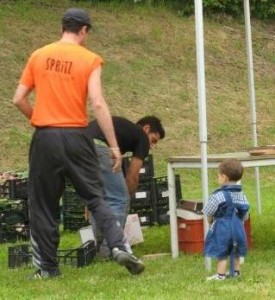 The farmers don’t have cows, but they know that they’ll be milking tourists later, so there’s no need to bust a gusset setting up their stands. Still, some enterprising souls had begun unloading crates of artichokes from their assorted vehicles, and the sight was Extremely Tempting.
 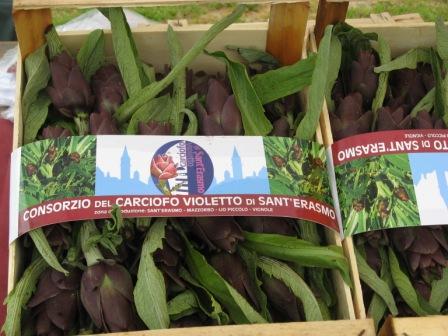 You’ll be glad to know I haven’t made a study of the soil, but it seems logical that there would be some salty component to their habitat. The artichokes of Malamocco were equally celebrated, back before houses took over the fields there. Meanwhile, the artichoke consortium oversees the production of them at various limited sites around the lagoon.
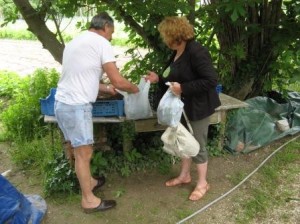 stalks in the adjoining plot. We took home a large sack of them — in fact, he went back and cut some more for us — for .29 euro cents each.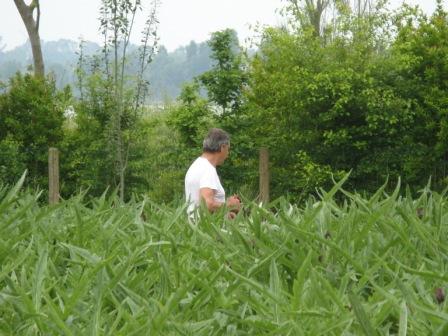
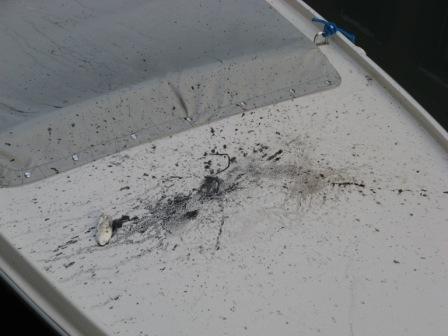 and a battle ensued, which the seppia lost. You can tell by the splashings of desperate black ink. Another clue is the cuttlebone, which if I had a parakeet or Andean condor I would immediately have taken.
 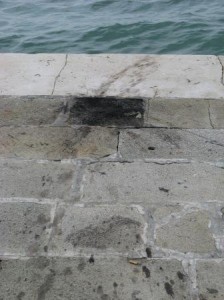 Many of them indicate epic battles, all futile.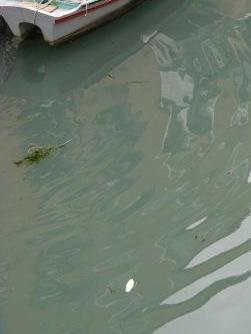
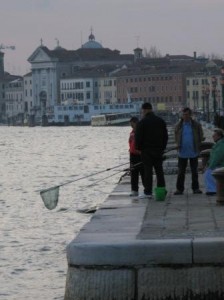 They often go out at night, too, depending on the tides, rigging up a strong light to attract the animals. Or they use a fish-like lure. Lino once slew a vast number of them by hooking a medium-length remnant of a white plastic bag to his line and pulling it slowly through the water; despite the fact that seppie have some of the most developed eyes in the animal kingdom, it somehow looked irresistibly like another seppia. They don’t eat only crabs, shrimp, worms, or whatever — they snack on each other, as well. Too much information?
 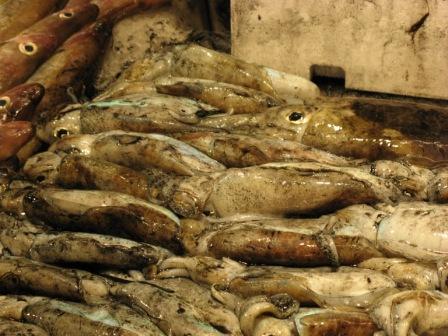 One more thing: It may not be very likely that you’ll be buying seppie in the fishmarket, but if you are looking at them for whatever reason, you should know that the whiter they are (it’s more like a ghastly gray mortuary pallor), and the more smeared with sticky black ink, the older they are. Lots of ink is a Bad Sign.