Health returns to Venice, on schedule

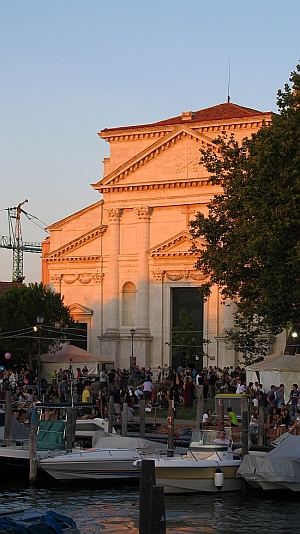
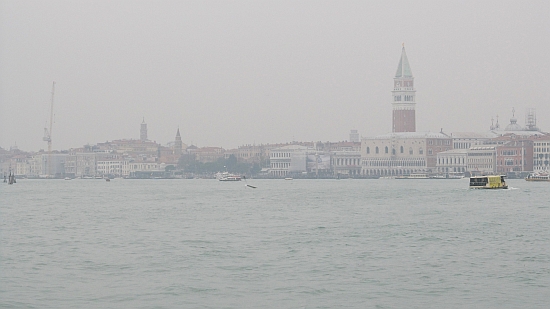
A satisfyingly dim view of the panorama as we headed to church. This is the very least the weather should be doing for this holiday.

Yesterday one of the most important days in the Venetian (hence in my) calendar came around again: the annual feast of La Madonna della Salute, Our Lady of Health.

Health is one of those things, like air or the ability to speak your mother tongue, that you don’t give much thought to till it’s been impaired.  Or removed.

In a city that has the highest median age of any city in Italy, health is a subject that’s right up there on the short list of things to really worry about, several places ahead of acqua alta and even a close second to tourism.  Considering that the city government is currently debating (or not — I can’t keep track) whether to close the hospital here and send everybody who needs help to the big hospital on the mainland (pause for screams of rage and disbelief), health is clearly a big issue.
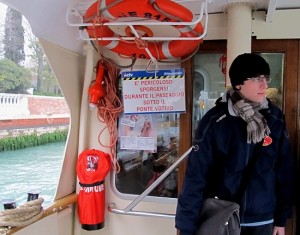
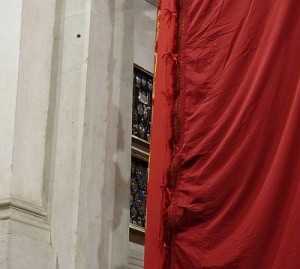
The sign is put up every year: "It is dangerous to lean out when passing under the votive bridge." Those who don't speak Italian probably discover this fact on their own.

But let us return to the health at hand.  This feast was established in 1630 in thanksgiving for the Madonna’s response to the desperate plea of the city of Venice for deliverance from arguably the worst plague in its history, though the pestilence of 1574 was also noticeably catastrophic.

If anyone (such as me) has ever tried to imagine what an epidemic of plague might entail, a few passages from “The Betrothed” by Alessandro Manzoni might help. They certainly provide a way to grasp the magnitude of this festa (not to mention the votive church, which took 50 years to build).
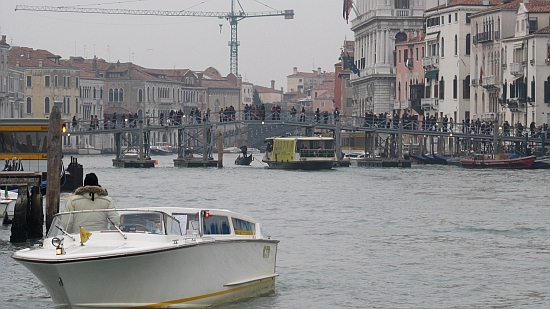
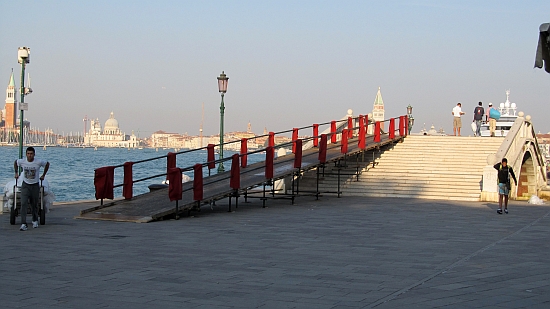
The votive bridge, made of a few bits of the big bridge that's installed for the feast of the Redentore (another plague situation). Highly useful for pedestrians but a large pain for transport, which is one of many reasons why it isn't permanent.

The plague of 1630 exterminated much of northern Italy, and drawing on contemporary documents, Manzoni describes the plague in Milan. I presume that it was much the same in Venice, where 80,000 Venetians died, including the doge, though here the carts obviously were replaced by boats.

…sickness and deaths began rapidly to multiply…with the unusual accompaniments of spasms, palpitation, lethargy, delirium, and those fatal symptoms, livid spots and sores; and these deaths were, for the most part, rapid, violent, and not unfrequently sudden, without any previous tokens of illness….

All the doorways into the streets were kept shut from either suspicion or alarm, except those which were left open because deserted or invaded; others nailed up and sealed outside, on account of the sick or dead who lay within; others marked with a cross drawn with coal, as an intimation to the monatti [men who removed the bodies] that there were dead to be carried away….

Everywhere were rags and corrupted bandages, infected straw, or clothes, or sheets, thrown from the windows; sometimes bodies, which had suddenly fallen dead in the streets, and were left there till a cart happened to pass by and pick them up, or shaken from off the carts themselves, or even thrown from the windows….

And while corpses, scattered here and there, or lying in heaps…made the city like one immense sepulchre, a still more appalling symptom, a more intense deformity, was their mutual animosity, their licentiousness, and their extravagant suspicion…not only did they mistrust a friend, a guest; but those names which are the bonds of human affection, husband and wife, father and son, brother and brother, were words of terror, and dreadful and infamous to tell! the domestic board, the nuptial bed, were dreaded as lurking-places, as receptacles of poison…

Men of the highest rank might be seen without cape or cloak, at that time a most essential part of any gentleman’s dress; priests without cassocks, friars without cowls; in short, all kinds of dress were dispensed with which could contract anything by fluttering about…And besides this carefulness to go about as trussed up and confined as possible, their persons were neglected and disorderly; the beards of such as were accustomed to wear them grown much longer, and suffered to grow by those who had formerly kept them shaven; their hair, too, long and undressed, not only from the neglect which usually attends long depression but because suspicion had been attached to barbers…

The greater number carried in one hand a stick, some even a pistol, as a threatening warning to anyone who should attempt to approach them stealthily; and in the other, perfumed pastils, or little balls of metal or wood, perforated and filled with sponges steeped in aromatic vinegar, which they applied from time to time, as they went along, to their noses, or held there continually.

Some carried a small vial hung around their neck, containing a little quick-silver, persuaded that this possessed the virtue of absorbing and arresting every pestilential effluvia; this they were very careful to renew from time to time…

Even friends, when they met in the streets alive, saluted each other at a distance, with silent and hasty signs.  Every one, as he walked along, had enough to do to avoid the filthy and deadly stumbling-blocks with which the ground was strewn, and in some places even encumbered.   Every one tried to keep the middle of the road, for fear of some other obstacle, some other more fatal weight, which might fall from the windows…

…the sick… were wandering about as if stupefied; and not a few were absolutely beside themselves: one would eagerly be relating his fancies to a miserable creature laboring under the malady; another would be actually raving; while a third appeared with a smiling countenance, as if assisting at some gay spectacle.

…two horses, which, stretching their necks and pawing with their hooves, could with difficulty make their way; and drawn by these a cart full of dead bodies, and after that another, and another, and another; and on each hand monatti walking by the side of the horses hastening them on with whips, blows, and curses.  These corpses were for the most part naked, while some were miserably enveloped in tattered sheets, and were heaped up and twined together, almost like a nest of snakes  unfolding themselves….at every trifling obstacle, at every jolt, these fatal groups were seen quivering and falling into horrible confusion, heads dangling down, women’s long tresses disheveled…
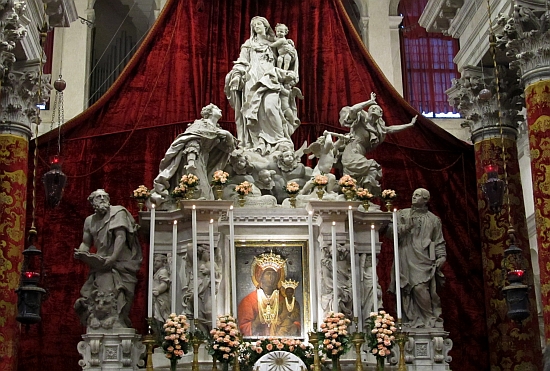
The entire story contained in one extravagant altarpiece by Giusto Le Court: On the left, the city of Venice (as usual, represented as a beautiful and wealthy woman) kneels to implore mercy and deliverance from the plague. In the center, the Virgin Mary, holding Jesus, makes a gracious gesture of assent. On the right, a cherub uses a torch to drive away the Plague, shown as a hideous hag, fleeing. Below is an icon of the Mesopanditissa, or Madonna of Health, brought from Crete by Francesco Morosini in 1670.


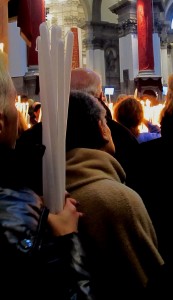
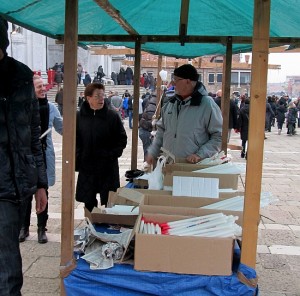
A few stalls are set up for selling candles; it's inconceivable to me that someone could come and not offer a candle, though I suppose there's no rule against it. The cheapest candle costs 2 euros (($2.69). The ones with the red base are often taken home, to be lighted in times of peril (usually storms). Burning a few leaves of the olive branch you brought home from Palm Sunday was (is still?) believed to ward off the danger.

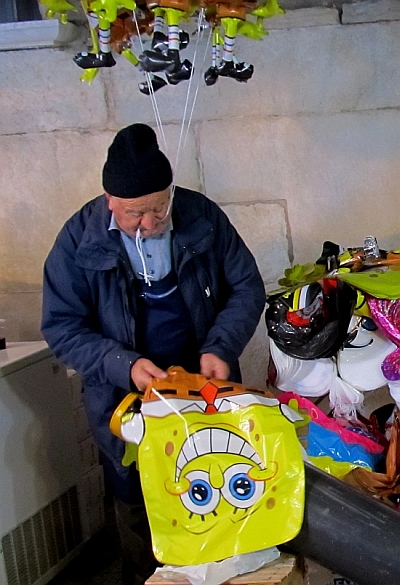
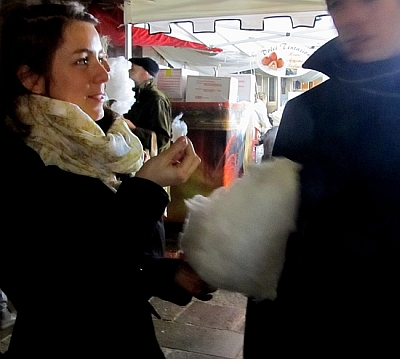
Not wishing to spoil the party, I think it’s not a bad idea to acknowledge at least briefly that the day was fixed to express gratitude (or desire) for heavenly intervention in matters of life and death, and not primarily so we could buy balloons of Nemo and Spiderman and eat cotton candy and slabs of deep-fried dough slathered with chocolate.

The weather was perfect, by which I mean cold, raw, damp, foggy, and breezy. I’ve been to the basilica of the Salute to offer my candle on days when it was sunny and the temperature in the sixties, and I can tell you that it just feels wrong.  This isn’t a happy holiday, it’s a solemn, penitential, I-really-mean-this kind of day, even though there are plenty of balloons and highly sugared and fat-laden treats being sold from stalls behind the church.  It’s probably years before Venetian kids grasp the fact that the day isn’t dedicated to Our Lady of Fat and Sugar.  Amazing, now that I think of it, that she should be honored as the guardian of health with this payload of calories.  They ought to depict her —  no disrespect intended — holding an insulin syringe.

Back to the weather: The worse it is, the happier are the Ladies who Mink.  I’ve remarked before that this city is an unrepentant recidivist on the animal-skin subject.  (I don’t count shearling in this category.)  One winter evening I counted 11 mink coats on the vaporetto going home. Someone I know told me about a little old lady on the Lido who was packing her steamer trunks for a holiday in the Dolomites with four peltish coats.  This was the minimum a woman could rationally consider bringing; no telling what your friends would think if they should see you in the same old fur, day after day.

Therefore Lino refers to this legendary day as the feast of Our Lady of the Fur Coat.  And laughs on the rare days when it turns out to be, as I mentioned, sunny and warm, because wearing their fur coat to the basilica is more important to these ladies than offering a candle for their husband, or maybe even for themselves. We enjoy imagining them hanging tough in the heat, wrapped in mink, wearing terrycloth headbands, like sweating tennis players.

Yesterday, though, I only saw one fur-like garment, and I am dead certain it was fake.  This does not bode well, but I’m not sure for what.
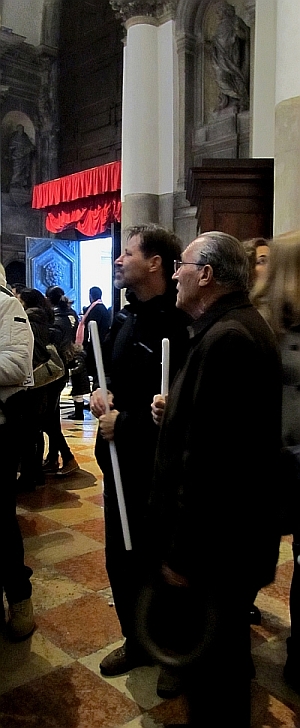
 

You bring your candle into the basilica and eventually decide to join the crowd that clusters near the few points where volunteers are feverishly lighting and installing them in the racks.


It's rare to see someone with this many candles, this big. I can only hope she was offering them in thanksgiving, and not with pleas for intervention.
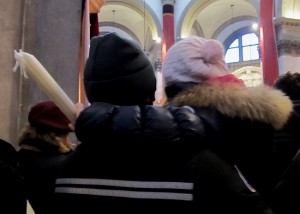
Sometimes the children get to hold the candles.


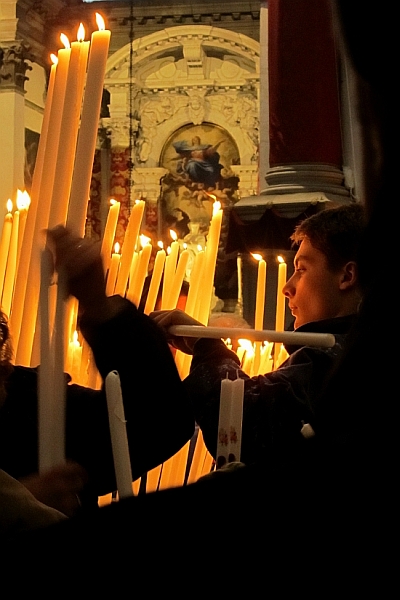
It's hard work to take people's candles, light them and install them. Because you also have to remove somebody else's flaming candle first. These young men spend the day covered with wax drippings.
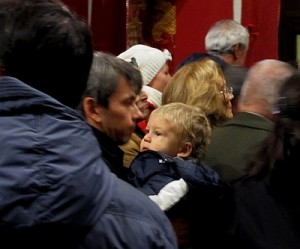
I wonder what the children are taking in; this little boy is not by any means the youngest child I saw.


A few of the classic thank-offerings for answered prayers are displayed on the wall near the high altar. When I came to Venice, the walls were covered with these tokens of gratitude, representing true healings, something much bigger than even a very big candle. I wonder where they went, and why.


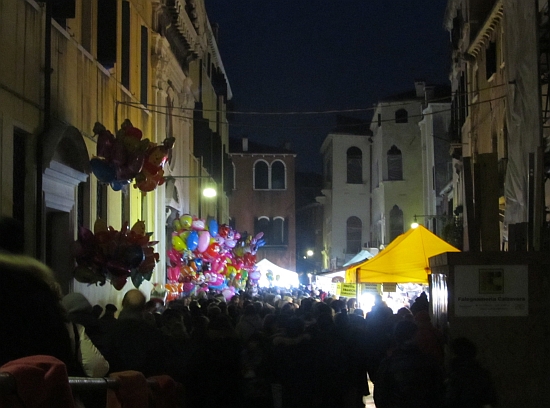
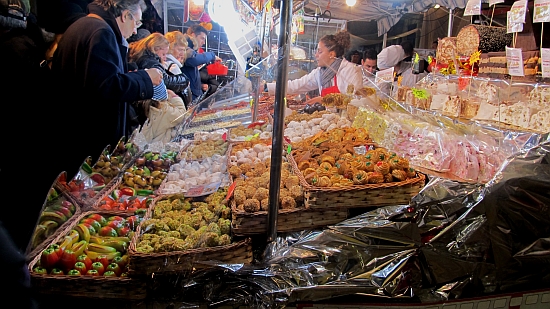
The street behind the church is just as crowded, but a lot more cheerful. Finally the kids get to gorge.


This is just one small part of the panoply. Lino remembers when only Venetian frittelle were sold, at stalls in front of the church. Now, with a minor exception, it's all sweets from Sicily.


The balloons have all gone Hollywood and evidently Geppetto is moonlighting.


Kids with candles, grown-ups with cotton candy. It's great.


Continue Reading

The ramps return to Capistrano — I mean Venice

Seasonal migrations (is that redundant? Sorry) are an excellent way to keep track of the year’s divisions, especially here, where you need a keen eye to discern that there is anything more than one season anymore, which is Tourists.

But at this moment, if you’re paying attention (and if you know, and if you care) you can detect a few important signs of autumn.  I don’t mean the drying, yellowing, falling leaves — anybody can notice them, and besides, the drought began drying them before their normal time to drop.  So leaves are out.

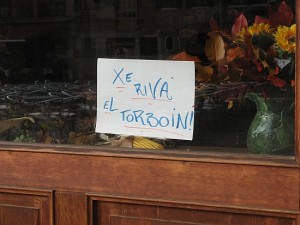
Torbolino — the first draw-off of the new wine.  That’s an excellent indicator, though again, this year it’s somewhat early due to the unusually early harvest (see: “drought,” above).

Ducks are also useful heralds of the season — I saw my first one paddling around two weeks ago, This always makes me happy, except that I had seen my first duck hunter even earlier: The ducks began hitting the water on September 3. So much for enjoying their winter haven.

Seppioline — sepoine (seh-poh-EE-neh) in Venetian — are baby seppie, or cuttlefish.  If “baby” anything on your plate upsets you, skip this paragraph.  We are now in the period of the fraima, which is the annual passage of the fish which have spent all summer fooling around in the lagoon moving out into the Adriatic (or beyond) for the winter.  The cuttlefish spawned months ago, and their small offspring are now in the process of making their first trip out into the world where they will become big, grown-up cuttlefish.  Unless they get snagged before they reach the exit, in which case they will be sold at an outrageous price (there I go, being redundant again), grilled and eaten.  Short migration.

The ramps are used by thundering racers for a few hours, and by countless humbler folk dragging suitcases, shopping carts, or strollers laden with small heavy tired cranky children for six months. I would bet that the shleppers appreciate the ramps just as much as any Ethiopian champion. Probably more.

But the ramps are back.  I saw my first one two days ago and it was like hearing a small, clear trumpet announcing autumn, winter, and early spring.  The ramps are set up for the Venice Marathon (this year scheduled for October 23), and they stay up till the end of March. That’s practically half the year.  Then they migrate back to hibernate in whatever warehouse keeps them till next October.

They’re only installed on the race route — logically — which conveniently passes the Piazza San Marco and other heavily traveled tourist routes.  I bet the people up in Cannaregio and along the northern edge of the city really envy us.  I know they don’t envy us the tourists, but we get the ramps.

Continue Reading

Swing low, sweet Venice Film Festival

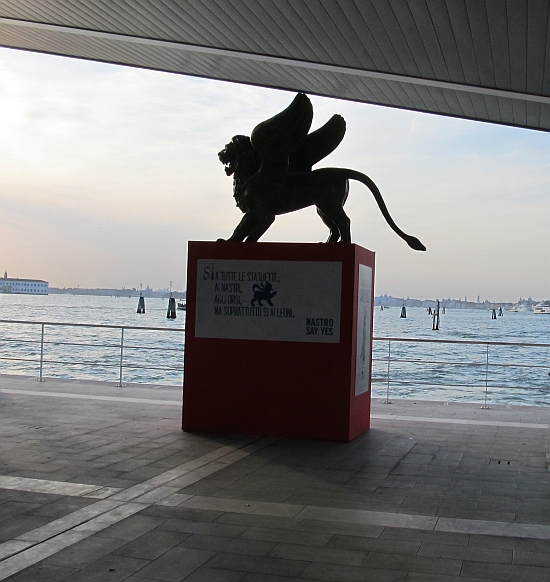
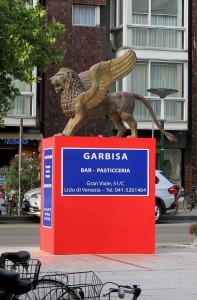
One of scores of winged lions stationed around the Lido; this one is at the vaporetto stop, on meet-and-greet duty.

It would appear that there is always a film festival going on somewhere in the world — 308 at last count, but no doubt the list is growing. That’s practically one a day.

And each one awards a (usually) golden trophy, The most famous give out lions, bears, and palm fronds but let us not disparage the Golden Crow Pheasant, Golden Pyramid, Golden Conch, Golden Frogs, Golden Space Needle, and even (I am not making this up), the Golden Calf, from the Netherlands.  Did they do that on purpose?

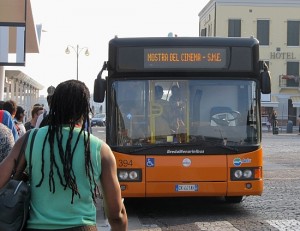
Special buses start in the morning to take people from the vaporetto to the movies. As part of the multi-purpose art extravaganza known as the Biennale, the film festival is correctly known as the 'Exhibition of Cinema," as if the movies were hung on a wall.

Until September 10, here we’re focusing on the lion, naturally.  For a thousand years the winged lion of San Marco stood for power, wealth, and glory, and struck fear, admiration and envy in the hearts of countless thousands.  For ten days in Venice, it stands for movie tickets, daily updates on assorted stars and tiny asteroids, a constant drip of complaints and criticism of what there is and what there isn’t, and parties where countless thousands stand around and talk about how they’re going to make some more money, which essentially brings us back to the aforementioned power, wealth, and glory.  Or maybe they don’t care about the glory.

The Venice Film Festival — 68 years old and still going strong, I guess — was the first of its kind in the world.

Back in 1932, the Lido must have seemed the perfect place to hold this innovative little event, seeing that in those days the Lido (well, Venice, but let’s be kind) indeed evoked some form of glamour.  It’s a little hard to imagine now, because there was basically just an airport, a church, a few luxury hotels, and miles of artichoke fields.  The people who came were mostly rich and did rich-people things, like spend a lot of money to drink, eat, and look at each other.

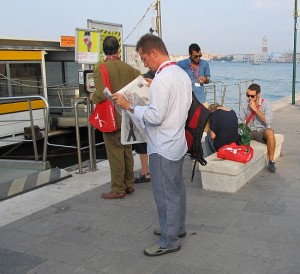
Reporters going to work, checking the paper for news on what they did yesterday, or what they have to do today. These are staying in Venice because there's no more room on the Lido. The symbolic winged animal on their bags looks like a GummiLion.

Now the masses on the Lido have almost no (actually, no) glamour, the artichoke fields are gone, and at least one of the luxury hotels is closed for semi-permanent restoration (Hotel Des Bains).

But the winged lions are posted all around the main streets, the phalanxes of photographers are in maneuvers, and, as usual, the vaporettos and busses are so full they’re practically shrink-wrapped.

Opening Day was George Clooney Day; his new film, “The Ides of March,” launched the ten-day marathon, and received a standing ovation.

Yesterday it was Madonna’s turn, here to promote her new film “W.E.”  As I understand it, her goal is to “rehabilitate” the image of Wallis Simpson, and best of British luck with that. The Guardian’s report observes: “It takes a twisted creative genius to produce a compellingly bad film….and that is why Madonna, try as she might, will never make one of the worst films ever made.  She just hasn’t got the talent. ”

The lions stand on pedestals which are four-sided billboards for beer, restaurants, and assorted Lido businesses. Wouldn't it have made more sense for some producer to have bought a batch to advertise the name of his/her movie? As in: Lion plus My Movie = Award me the top prize. But what do I know.

She reserved rooms in five hotels, to throw reporters off the track.  This is something I wish somebody would explain to me. You come here because you want to be seen and talked about, then you put on this pantomime of craving solitude?  Isn’t that why they invented Bhutan?  Anyway, she ended up staying in Venice, not even on the Lido.  Take that, Hotel Excelsior.

Now she’s probably gone, and so, day by day, the reporters too will shimmer away, leaving only the few hard-core journalists who actually write about movies, as opposed to people and what they’re wearing.  By the time the Golden Lion spreads his wings, he almost seems to be an afterthought.

Then the film world will turn its attention to whatever golden creatures are next being shoved into the starting gate.  Or at least who’s there and what they’re wearing.


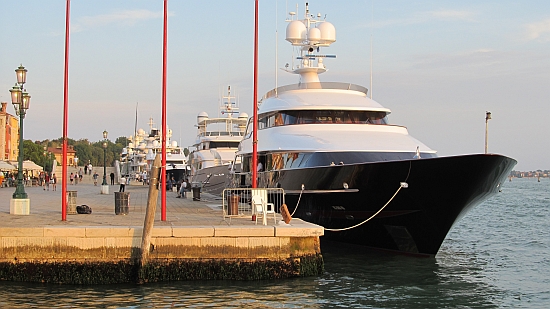
Yachts are excellent places to give parties, and every year a batch of them tie up along the Riva Sette Martiri for exactly that purpose. Expensive but sort of generic, not unlike the people who rent them.
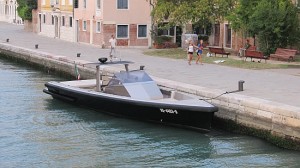
The launch belonging to one of those yachts. Lino says it reminds him of a funeral boat. It doesn't cry "Party! Party!" to me, either.


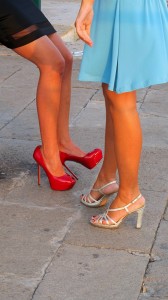
But where there are films (or yachts), there are likely to be girls. These were seriously waiting for something, or somebody.
Continue Reading

See you at the next St. Peter

When the sunlight looks like this, it's time for the party to start.

The dust has now settled on the festa of San Piero de Casteo and everyone is recovering (or not) from the toil, excitement, racket, and nearly suffocating odors of frying fish and charring ribs.

Fine as all this may be, it used to be, in many ways, even better.  Lino Penzo, president of the Remiera Casteo (our very local rowing club), was born in the next campo over, an open space named Campo Ruga.  And he remembers it the old way.

“There wasn’t anything here,” he said, looking at the stretch of grass in front of the church.  The party was in Campo Ruga where, to hear him tell it, as many people lived as in Albuquerque, New Mexico. Families everywhere.  Kids everywhere. Drama without any pause for station identification.  “We used to put cushions on the windowsill,” Lino said, “and just watch what was going on outside.  It was like the theatre, it never stopped.”

There was the day a certain man went across to the osteria to drink some wine.  Evidently his wife expressed the opinion that he was doing this far too often, so he locked her in the house and went anyway.  So she fixed up a bedsheet and let herself down through the window.  I don’t know if she chased him around the campo brandishing a rolling pin, but I can imagine it.

And there was a woman whose nerves would give out whenever there was a fight in the family (evidently she preferred the “flight” option of the famous pair of possibilities), and she’d suddenly go into a swoon. Everybody knew this, so when anybody heard the sound of nearby strife the men in the cafe would put out a chair for her. They knew she’d be needing it to fall onto, sooner or later, so they got ready.

And there were shops everywhere.  The series of doors we see today, many of them shut forever, belonged to a collection of every enterprise necessary for human life.  Two (two!) bakeries, fruit and vegetable vendors, a butcher, a cheese and milk shop, a cobbler, probably also an undertaker, though he didn’t mention it.  I don’t remember the rest, but they were all there. You didn’t have to go more than 20 steps from home to buy everything you needed.  As in most Venetian neighborhoods, going to San Marco was unknown, mainly because it was pointless.  This was the world.

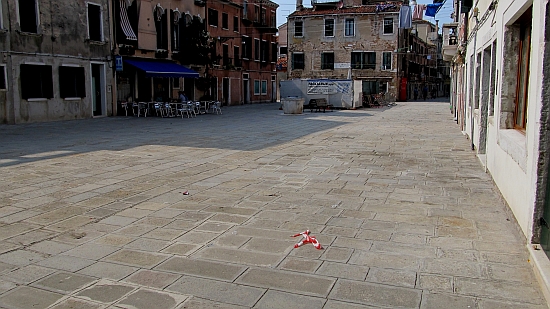
This is Campo Ruga on a typical morning. True, there are usually people traversing it on their way to hither and to yon, but the lone trattoria is now the only reason to stop. We just have to imagine this with a few thousand people in it, night and day, like every other campo used to be.

As for the festa, it was celebrated in the campo, and involved mostly eating.  Long tables were set up, where everyone sat and ate tons — “tons” — of bovoleti, and sarde in saor, and other traditional Venetian food.

Eventually one day somebody suggested moving over to the big empty grassy area in front of the church, and put up a little stand with some food.  From there, the festa just got bigger and bigger, and ultimately never went back to Campo Ruga.

So now we have live music and big balloons and grilled animals and gondola rides, and a big mass with the patriarch, and even a cake competition.  It’s like the county fair, without quilts.

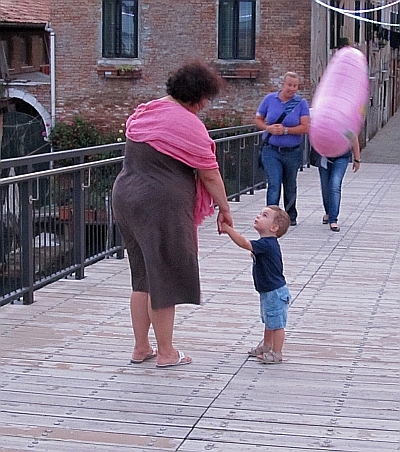
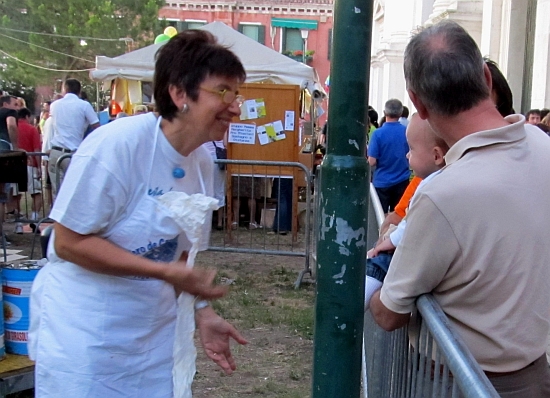
I wish I could know what she was telling him. Whatever it was, he was paying attention. Obviously he hadn't yet been crazed by sugar, fat, and all the stuff the other kids had.
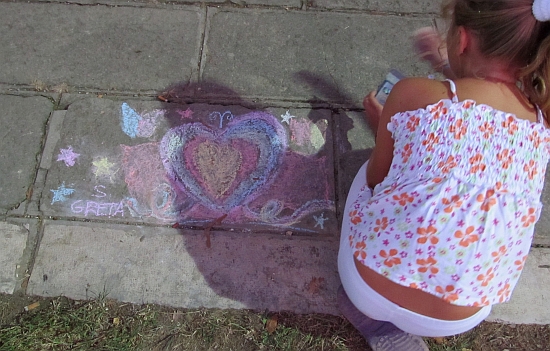
Greta was creating with the concentration of an icon-painter. Evidently knowing her creation was going to be gone tomorrow had no importance whatever. She's obviously destined for greatness.


There was a lot of this going on. It was great.


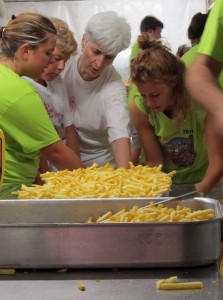
One man was producing these tumuli of french fries, but it took four people to study the numbered bits of paper to figure out which desperate customer got the next boxful.


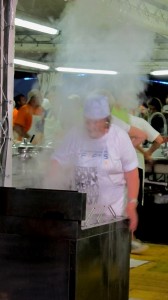
This lone woman stood over vats of boiling spaghetti like the Delphic oracle, and after five nights of this she could probably have made a few prophecies herself.
The last ray of light in a dying universe will be the gleam of the cell phone of a teenage girl.
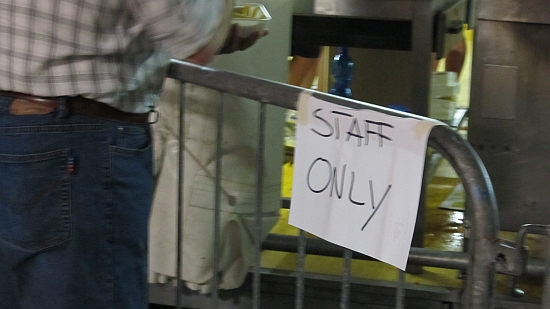
This useful sign may look completely at home here, except for one thing. Why isn't it in Italian? If they'd wanted to look really cool, they ought to have written it in Latvian. DARBINIEKIEM TIKAI. That certainly would have gotten people's attention..


Continue Reading