This morning we were walking along the fondamenta across the canal from our hovel, and my eye fell upon one of the boats tied up alongside.
It takes no time at all to reconstruct the scene: A seagull nabbed a seppia, or cuttlefish, 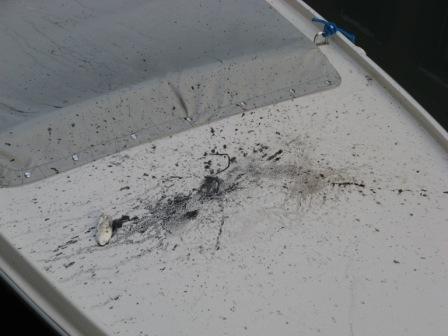 and a battle ensued, which the seppia lost. You can tell by the splashings of desperate black ink. Another clue is the cuttlebone, which if I had a parakeet or Andean condor I would immediately have taken.
Your cuttlefish are no match for a seagull’s beak, as you see, but don’t underestimate them. If you were a small marine creature you’d want to do everything possible to avoid any passing seppia (plural: seppie; in Venetian sepa/sepe). Soft and squidgy they may be (although technically a mollusc), but they too have a sort of beak, and it’s tiny and hooked and sharp. They look so innocuous, sort of like Mister Magoo, as they drift fecklessly along, but just remember that they have that mouth. Not much use in land combat, though. I could tell you some stories about that sharp little beak, and I probably will, at some point, but I don’t want to ruin your enjoyment at thinking of how delectable they are, so I’ll stop. The little ones are wonderful grilled. They are a classic Venetian snack, or cicheto (chih-KEH-to). The bigger ones are chopped up and simmered in water and tomato paste, and their ink. Some people omit the ink, which is heathen.
While we’re talking about their being eaten, by whatever sort of life form, make a note that seppie (on spaghetti or in risotto) are the only fish on which you are allowed to put grated parmesan cheese. To see someone put cheese on any other fish dish makes Venetians shudder. But it is, in fact, required on seppia. If you don’t try this, you won’t know what I mean. Trust me. If your waiter tells you not to do it, ask him where he’s from. Or just smile and go ahead anyway. Or skip the smile.
Another seppia clue: If you walk along the fondamentas edging major channels — say, along the Riva dei Sette Martiri in Castello, or the Zattere in Dorsoduro, or the opposite side of the Giudecca Canal, on the Giudecca — you will certainly see stains like these on the stones. Now you know they’re not paint. 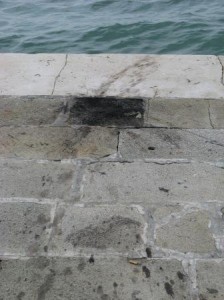 Many of them indicate epic battles, all futile.
There are two seppia seasons: Spring, which is when they come into the lagoon from winter quarters somewhere in the Adriatic in order to spawn, and anytime after the festa del Redentore (third Sunday in July), when the fraima (fra-EE-ma) begins, the general ichthyous exodus from the lagoon out to sea. This second period is, obviously, the time when you are aiming for the little ones — I hate calling them babies, but that’s what they are. In both of these periods the deepest lagoon channels are strewn with temporarily anchored boats from which men, and often their wives, too, are fishing for seppie. These boats refuse to move for any passing craft, from the vaporettos to the cruise ships. It drives the captains to the verge of crazy.
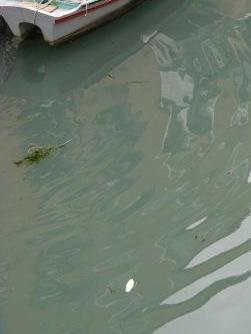 And speaking of decoding cuttlefish, I saw my first seppia this year on March 6. It wasn’t the little cephalopod itself, but its remains, floating in with the tide in the canal outside our hovel. It made me so happy I took a picture of it — it was like seeing the first [crocus, sandhill crane, or add your favorite seasonal thing here].
Then the fondamentas begin to fill up, lined with amateur fishermen, some of whom take their catch home, and some who sell it. 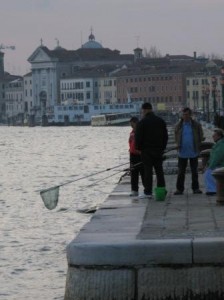 They often go out at night, too, depending on the tides, rigging up a strong light to attract the animals. Or they use a fish-like lure. Lino once slew a vast number of them by hooking a medium-length remnant of a white plastic bag to his line and pulling it slowly through the water; despite the fact that seppie have some of the most developed eyes in the animal kingdom, it somehow looked irresistibly like another seppia. They don’t eat only crabs, shrimp, worms, or whatever — they snack on each other, as well. Too much information?
But we’ve caught seppie without even trying, when we’ve been out rowing, minding our own business. There one will be, just floating along; if it’s close enough to the surface you can pick it up with your hands. It’s better, though, to have a volega (VOH-ehga), the net on the long pole, because you can go deeper. If you can see it, you can probably catch it. I used to feel sorry for them; Lino’d be all excited and I’d be shouting, “Dive, little seppia, dive!” He thought I’d lost my mind. Now that I know how good they are, I’ve quit that. There will always be more. It’s not like they have names.
Last tidbit for the day: In the fish market, they used to use seppia ink to write the prices on pieces of paper. (Hence the color tone called “sepia,” which is more brown than black, really, but which came from the cuttlefish’s ink.) There must have been generations of fishmongers with permanently black hands. Just as soon as the Sharpie and Magic Marker were born, and tourists began to pay good money to eat spaghetti with cuttlefish ink, you can believe that stopped.
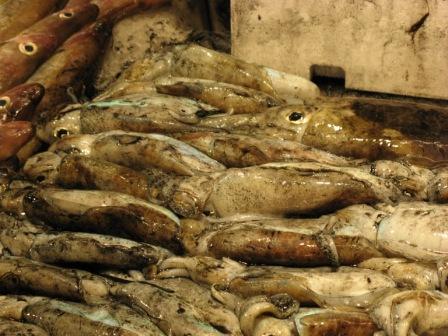 One more thing: It may not be very likely that you’ll be buying seppie in the fishmarket, but if you are looking at them for whatever reason, you should know that the whiter they are (it’s more like a ghastly gray mortuary pallor), and the more smeared with sticky black ink, the older they are. Lots of ink is a Bad Sign.
The super-fresh ones, as shown here, have very little ink on them, are a lovely brown with faint pale stripes, and display the most amazing iridescent stripe along their bodies, which is another guaranteed way to confirm their freshness. This stripe is made up of iridophores, which reflect the color of the seppia’s immediate surroundings and hence are part of its system of camouflage. I did not make that up.