the voyage of the swan

May 1 was a national holiday, here and in many other countries, and it’s generally known as International Workers’ Day. So in honor of workers everywhere, we also did not work that day. We went out for an early morning row, and were amazed to be met in the Bacino of San Marco by a very fine, and very unexpected, feathered friend.


We have often seen a pair of swans in the northern lagoon, beyond Torcello, and also on the Brenta river near Malcontenta; one time we counted nearly 50 floating in the distance near Sant’ Erasmo. Lino told me that when he was a lad, some birds that we now commonly see in the city, such as cormorants, egrets, and seagulls, never came to town. You’d see them only in the distance, he says, if you saw them at all. Now they’re everywhere.
But the swans weren’t to be seen anywhere. About 35 years ago, Giampaolo Rallo, now president of the Mestre Pro Loco, then a naturalist at the Natural History Museum, noticed that there wasn’t a swan to be found in the lagoon, “not even if you paid it,” as one account put it. So he got what he calls “this crazy idea” to bring back the swans. On April 13, 1984, the World Wildlife Fund (WWF), together with the Gazzettino, launched a drive to find individuals willing to sponsor (fancy word for “pay for”) pairs of swans — not a small contribution, considering that a pair cost the equivalent of $315 today.


Over a period of two years, up to one hundred couples were acquired in the Netherlands and placed in the “fish valleys” of the southern lagoon. “It was a great cultural work,” Rallo explained to a journalist from La Nuova Venezia in 2019, “because we had to teach the respect of all the great waterbirds — I’m thinking also of the flamingoes. But there was real enthusiasm in the city for this initiative and there were important signs, such as the participation of Federcaccia Venezia” (the hunters’ association) “which bought a pair and made their volunteers available to watch over the swans to prevent anyone from disturbing or wounding them.” Who would hurt a swan? Well, hungry people a few generations back had no problem with trying to get these spectacular creatures on the table.
Today there are a thousand swans in the lagoon, and are sometimes seen even in Mestre’s modest waterways. A breeding pair named Silvia and Peter live near the lagoon at Caorle, and are awaiting the hatching of their eleventh brood of cygnets.


My most powerful memory of swans was a moment that was not, and anyway could not have been, photographed. It all happened so quickly.
Years ago, we were out rowing near the island of Santo Spirito on a deep grey morning in winter. Suddenly a trio of large birds flew toward us — three swans — flying so low it seemed we could touch them.
I had never seen swans flying, much less so near. As they passed overhead, their long graceful necks undulated slightly, and a barely discernible murmuring sound came from their throats.
Swans may be beautiful when they’re doing nothing, but when they fly they are magic.

Birdsong and bluster

As you well know, if you’ve stuck with me, I am driven to gnash my teeth more often than is dentally advisable at the uncivilized, un-neighborly behavior of certain people around here.
But then I come across something that demonstrates that I personally am still in the safe zone, because “neighbors” to me is a vague, general term that means everybody and nobody. On the other hand, some residents define “neighbor” as the ballbuster who lives next door who (A) annoys me or (B) annoys me. According to whichever neighbor you are.
Here is what I discovered: two signs attached to what evidently was once a shop (as is the case with many closed doors and windows) and which has become someone’s garage/basement/attic/storeroom, here generally called a magazzino.
I am now going to file this in my TAKE THAT! folder, just as soon as I make it.


And speaking of animals
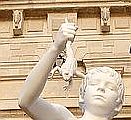 I suddenly realized that when I was proposing the going-away party for the boy — clothes, but possibly also food, because he must be really hungry by now — I didn’t mention the frog.
That was an oversight. So here’s the plan.
First, the frog would be freed.
Second, he would be given a large pile of small- and medium-sized rocks to throw at the boy.
Third, he would be given a hundred things his heart might desire, from the unlisted phone numbers of Charles Ray (sculptor) and Francois Pinault (collector), to his own private estate with tennis court and helipad in the Great Moss Swamp, to a date with every winner of the Miss Humanity of the Netherlands pageant. And a huge party at the Waldorf-Astoria for freed dolphins, liberated dancing bears, wounded hedgehogs, rehabilitated slow lorises, and birds whose owners accidentally left their cages open. He’ll also have his own smorgasbord with all the beetles, grasshoppers, spiders, and Purina Frog Chow he’ll ever want. And a trampoline. And a pony.
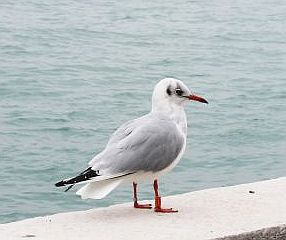
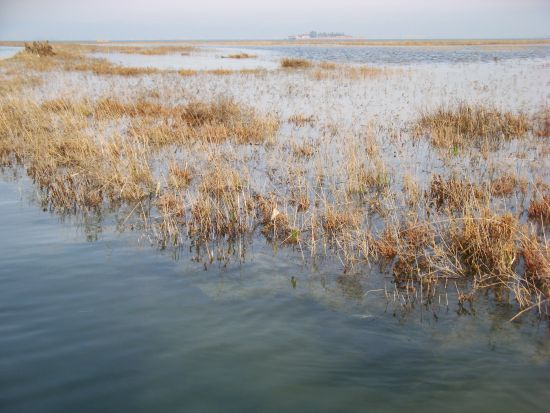
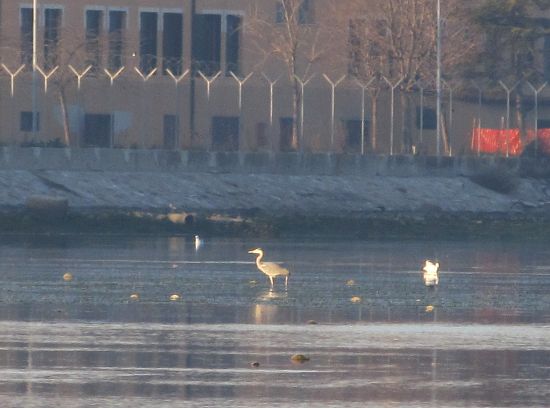
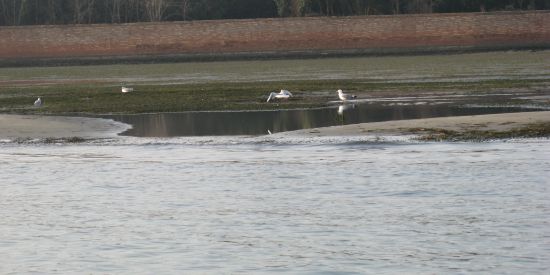
While we’re on the subject of animals, here’s something you might find interesting. More than 240 species of birds spend at least some, if not all, of their time in the Venetian lagoon and immediate vicinity.
An article in the Gazzettino announced this fact along with the notice of the publication of a new atlas of birds, the result of five years of data-gathering. For the record, the title is “Uccelli di laguna e di citta’ – L’atlante ornitologico del comune di Venezia 2006-2011,” written by Mauro Bon and Emanuele Stival, ornithologists of the Museum of Natural History, published by Marsilio.
Of these birds, 142 species come only for the winter, 115 come to nest, and about 60 are migrating. If you stop and read that over again, I think you’ll be respectfully amazed. In fact, the lagoon is at a crucial point on a major north-south flyway, and is one of the largest lagoons left in Europe. It’s far from being just scenery.
Even though I’ve never seen them, I now have learned that there is a Hungarian royal seagull which arrives in the fall, and spends the winter in the Giardini Reali between the Piazza San Marco and the lagoon. And there is an extremely rare black-legged kittiwake that comes from England.
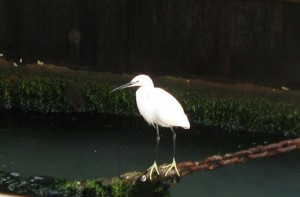
I was already interested in birds because rowing around the lagoon at all hours and in all seasons means that you see plenty of them. For one thing, they’re everywhere. For another, they’re generally easier to see than fish.
Some of the birds I’ve come to recognize are as much as part of Venice as canals and tourists. The svasso (grebe) and tuffetto (little grebe), only appear in the winter. The cormorants, mallards, seagulls, egrets and herons are here all year. I’ve already gone on too long about my passion for blackbirds (a few months per year), and I’ve never bothered to mention pigeons because there’s nothing worth saying about them. They are the roaches of the avian world; they’ll be here pecking around and crooning after the last nuclear device explodes. I am prepared for hostile letters from pigeon-feeders.
There is one kingfisher who I watch for as we row behind the Vignole; all you can see is a flash of iridescent blue-green flitting through the trees and over the water. I wish he’d hold still somewhere just for a minute, but he’s not interested in being admired.
In the plush summer nights we almost always hear a solitary owl called a soleta (civetta in Italian), somewhere high in the trees in the Public Gardens. He or she makes a soft one-tone hoot, repeated pensively at perfectly regular intervals. It’s like a metronome, far away. It goes on for hours. It’s very comforting.
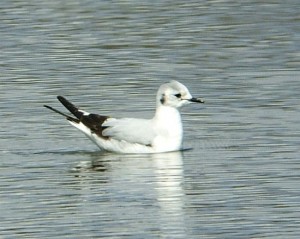
For two days not long ago we were startled to see a fluffy young gull we’d never seen before, standing on the fondamenta gazing out at the lagoon. Determined research revealed that it is a Little Gull. We haven’t seen it since.
And one magical winter day a trio of swans flew over us. You hardly ever see the wild swans, but here were three, flying so low that I could see their long necks undulating slightly and hear a curious murmur from their throats.
Many of these birds depend on organisms and elements in the lagoon wetlands which exist because of, or are replenished by, acqua alta. If so many people who never leave the city didn’t get so worked up about having to put on boots, the water could continue to provide for lots of creatures who like being here too. Maybe your tourist or trinket-seller doesn’t care about the birds, but the birds probably don’t care about the Doge’s Palace and Harry’s Bar. Just saying.
The next small thing
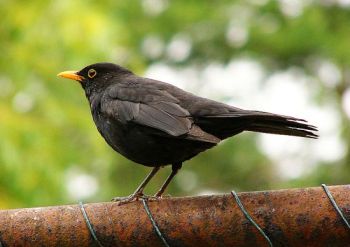
As I have undoubtedly mentioned at some point, there are many moments throughout the year which I await with all the focus of a hunter watching for the tiniest tracks of his prey. Or something like that.
This morning, to my astonishment, I heard the first blackbird of the year. This is great news, because the few months in which blackbirds sing the sun up are a very big deal to me. Not because of the sun, because of the birds.
The freezingest days of January/February (which have yet to log in, though they’re apparently en route from Siberia) are known as the “giorni della merla” (days of the female blackbird), so considering the curiously mild weather, it does seem a bit early.
No matter. I heard one distant cadenza this morning. It was brief, it was beautiful, and it was the first. I’m happy.