
The Corfu caper
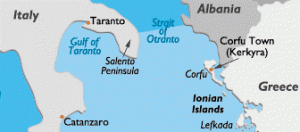 Our week in Corfu (known to the Greeks as Kerkyra) with the club’s gondolone (8-oar gondola) was interesting, entertaining, diverting — I pause before applying the word “fun,” though it was certainly much more fun than a slap across the belly with a wet fish.
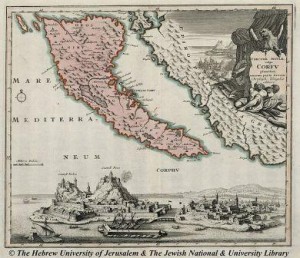
I’m using generic terms, though, because it was sort of a generic experience. We’ve been to Greece with the boat for other events, so I have some means of comparison.
The basic outline was to load the boat onto a truck (the truck travels on the ferry with us); we departed at 2:00 PM and arrived in Corfu at 1:30 PM the next day.
Then we unloaded the boat and rowed it to its base camp in a small marina under the flank of the Old Fortress.
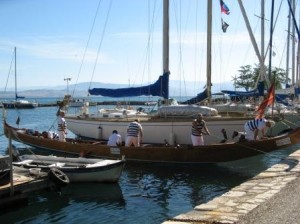
The marina had a good bar, too, with excellent lemonade. These things matter.
The occasion for all this was a long weekend labeled “Italian Days,” a collection of cross-cultural events more or less arranged around the finish of the Brindisi-Corfu yacht race. It was as good a reason as any to choose the second weekend of June.
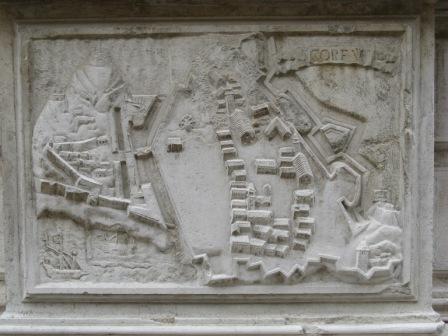
Apart from the yachts, the program concentrated on the many links binding Venice and Corfu over the centuries — a bond which was
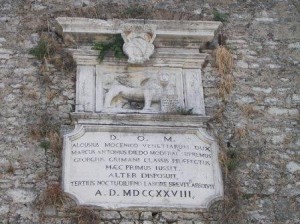
maintained for the almost 500 years in which Venice essentially owned the island. A few links that weren’t acknowledged much were the commercial, political, and military ones, which only left Links Lite such as literature and art. (By “commercial link” I mean things like the fact that most of the 3 million olive trees on the island were planted by the Venetians, whose interest obviously was not landscape gardening but the olives and their oil.) There were also lectures and concerts and exhibitions and so on.
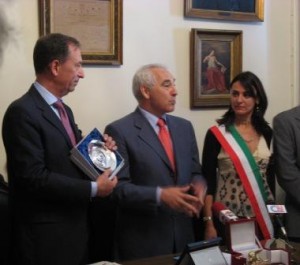
There was also an official press conference in the mayor’s office, with the usual speeches and exchanges of shiny official dust-gatherers.
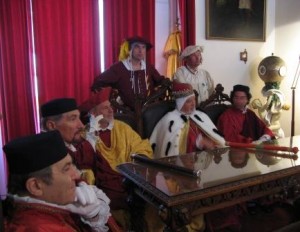
The scene was completed by a contingent of “figuranti,” or historic-costume/re-enactors from the “Serenisimo Tribunal de l’Inquisithion,” the Venice chapter of an organization known as CERS, the Consortium of European Re-enactment Societies. Among the various characters represented with great accuracy is, naturally, a doge. The doge in this group is a great guy, he’s a retired fire chief. Bedecked in all his regalia, he has a way of appearing both imposing and ingratiating, not an easy trick and something I doubt any real doge ever tried.
Our boat was probably the most Venetian element of all, especially considering how much pounding she’s taken and how little maintenance she’s ever been given. Being pounded and neglected being two of the primary aspects of Venice today, I mean.
Our job was to be at the prescribed place at the prescribed hours to offer free boat rides to anybody who wanted to be rowed in a gondola (even a big one) for a few minutes.
Here’s my quick scorecard:
The plus side:
- The trip on the overnight Minoan Lines ferry from Venice to Corfu. Leaving Venice on a ship — in fact, going anywhere on a ship — is the best. It was fun the first time because it was strange and new; it was fun the seventh time because it was familiar.
- Hanging out with my friends, a very eccentric bunch with curious bits of personality flapping around like untied shoelaces. In the un-eccentric contingent I place His Excellency Giampaolo Scarante, the Italian Ambassador to Greece, and his effervescent wife, Barbara, who are two total mensches and our guardian angels. It’s due to them that we are invited to join these frolics.
- Being in Greece. It’s never bad. It’s impossible for it to be bad. Greece, however touristic it may have become, never disappoints me. On the contrary.
- The sun. I love the sun and this is one sun that means what it says. You walk out the front door and you feel like you’ve just been thrown face-down on a skillet. I like this for short periods; then what I really like is sitting in the shade sipping a frappe, or iced coffee. The cafe offered us little ice-cream bonbons, too, which was a novelty — perfect in the heat, but only if you ate them within 18 seconds of their arrival. Which was not a problem for me.
- The food. I love Greek food, though some of my Venetian cohorts reserved judgment (mostly) because many of them are unapologetic food fascists who think the only fodder worth ingesting is Italian.
- The rowing, what little of it we ever eventually got to do. The wind in the afternoon made the return to base camp extremely diverting, not to mention the waves from the many passing ferries and hovercraft.
- Seeing the Venetian fortresses, the Old and the New. Both are stupendous constructions, which resist admiring adjectives as effectively as every missile the Turks hurled at them in three failed sieges.

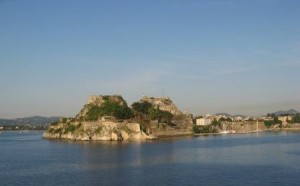
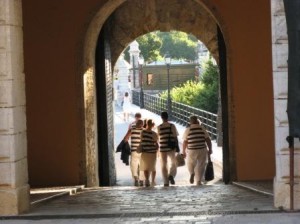
The Old Fortress, on the site of a Byzantine fort, was built, enlarged, and re-fortified between the 13th and 16th centuries. It now provides office and other space for various departments of the city government, as well as for the University of the Ionian. We had to pass through the Old Fortress four times a day and it just got more amazing each time, not to mention rounding the very point of the peninsula where the fort looms in order to get to our rendezvous point. If nothing else, looking at the fort from whatever distance or perspective made you realize in a visceral way how important Corfu was to the Venetian Republic, and how seriously the Venetians intended that the island should not fall into Ottoman hands, which would have been the End of Everything. And they succeeded. I know they were bandits but they really got the job done.

The crew, having clocked out, leaves the Old Fortress.
The minus side:
- Lack of customers. Unfortunately, the heat, lack of publicity, and disastrous location of our boat worked against the hoped-for mass of passengers. The few that wandered past were more or less like stragglers from the Retreat from Caporetto.
- Our hours, which were 10-1 and 5-8. Looks good on paper, but not so good when you’re tied up next to an esplanade that qualifies as the concrete equivalent of the Nefud Desert, the one Lawrence of Arabia had to cross at night, otherwise they’d all have died. 8-10 AM would have been perfect, as far as the climate is concerned, because the early morning is heavenly, but no Greek (or tourist) in his right, or even totally deranged, mind, would ever be up at that hour. So our window of opportunity was really from 10-10:15. Of course we were good soldiers and waited, till even we couldn’t take it anymore. Ditto the afternoon. After about 6:30 a person can begin to imagine going out on the water, but by then we had lost whatever desire to perform that we might have had, and any potential passengers were thinking of showers, drinks and dinner.
- In the organizers’ defense, however, I can’t think of any other embarkation point that would have been even slightly feasible. So there you are.
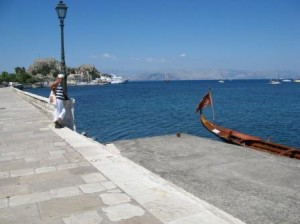
Lino thinking Corfiote thoughts, in the center of the Sun's Anvil. The Old Fortress makes a nice touch. - Dinner. Not the food, which was fine, organized in restaurants which had set out long tables for our contingent, the figuranti, the assorted politicos and their assorted consorts who had tagged along, etc. etc. The problem was the hour, which was usually toward 10 PM, which meant finishing toward 1:00 AM. This is a stretch of time which God intended for sleeping, not eating. Or if eating, not to be followed immediately by sleeping, which some of us were on the verge of even as our jaws continued to grind. Hard on the old internals.
But now we’re back, and I’m sorry it didn’t last longer. Of course I would do it all again tomorrow.
Memorial Day reflections, Venice version
I’m thinking about World War I today, partly because yesterday, May 24, used to be a date engraved in every Italian’s consciousness. Yet it passed unremarked in any way, which to Lino is yet another sign of the general deterioration of just about everything.
We were walking along the fondamenta yesterday morning when all of a sudden Lino said: “It’s May 24! …‘il 24 maggio l’esercito marciava…” and he was off, declaiming the four long stanzas of the “Legend of the Piave.”
This is one of the great patriotic songs, immortalizing the departure of the army to war against the Austro-Hungarian Empire on May 24, 1915. Some of the most ferocious battles toward the end took place along the Piave River. 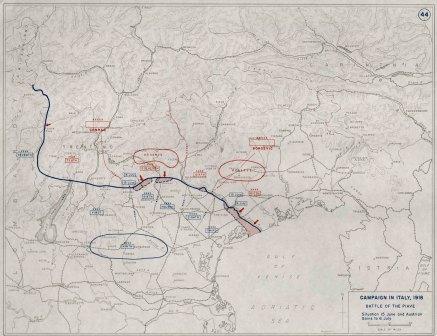 It is a pleasant little stream which starts in the Alps and empties into the sea not far from Venice, but more importantly, it formed the front which finally stopped the enemy advance and led to its ultimate defeat. The Piave is therefore also known as “The river sacred to the motherland.”
Schoolchildren used to be taught these impressive chunks of poetry and as you see, it stuck. This feat was perhaps made a little easier by singing; the music of “The Legend of the Piave” is so distinctive that you can’t get it out of your mind no matter what you try to put in its place. Everybody knows it. It was in the serious running to be designated the Italian national anthem.
“My father fought in the war,” Lino was telling me, “on the Asiago plateau. He was taken prisoner, and they took him to Trento, to the Castle of Buonconsiglio. He took me there once, when I was little, to show me. We went into the big room and he said, ‘That’s where the judge was sitting, and that’s where the bench was where I was sitting.’ He always told me he was going to take me to Asiago to show me the trenches he was in, but he never did. I’ve always been sorry. ”
The military judge’s job was very simple. All he had to do in order to know what to do with a prisoner was to ask where he came from. Large areas of what are now Italy only became demarcated as such after hideous battles. So if the prisoner came from Venice, or anywhere south of there, he was treated as a normal prisoner of war because he was fighting for his own country, Italy. Lino’s father got sent to the internment camp at Mauthausen for the rest of the war, came home, and went back to work driving the train from Venice to Trento.
If, however, the captured soldier came from Trento or Trieste or any of the many northern, now-Italian, towns which were then still part of the Austro-Hungarian empire, he was considered a traitor and dealt with accordingly. Firing squad,say, or hanging (Nazario Sauro, August 10, 1916), or hanging and garroting (Cesare Battisti, July 12, 1916) — it was all good. 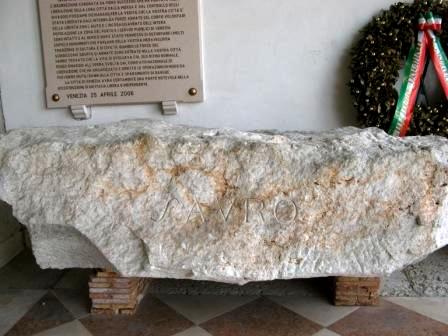 These are famous martyrs of the Italian resistance. Despite living in Austrian territory they considered themselves Italians were fighting for Italy, while according to the Austrian viewpoint they were supposed to be fighting against it. These men were epic heroes. I can’t understand why their life stories haven’t been turned into tragic operas. Where is Verdi when you need him?
So the First World War, which to many of us seems extraordinarily remote, is still part of the lives of many people — like Lino — still walking around loaded with memories. Did I say memories? He and his twin brother, Franco, have lived their entire lives carrying the names of two of their mother’s brothers who were killed in the war. Every Venetian parish, as well as the Jewish Ghetto, displays a memorial plaque listing the names of the local boys who died in the carnage. The names of Lino’s doomed uncles are inscribed on the memorial in Campo Santa Margherita. Whenever I go by I stop to look; I have this odd feeling that they’re part of my family.
The Piave, let it not be forgotten, was also where Ernest Hemingway was wounded at the age of 19, after only two weeks at the front. Because his poor eyesight prevented him from enlisting as a soldier, he volunteered to work with the Red Cross ambulances bringing soldiers down from the action on Monte Pasubio.
He was sent to Fossalta di Piave, a town on the river not far from Venice. At midnight on July 8, 1918, an Austrian mortar hit the trench where he had gone, more out of curiosity than merely to distribute cigarettes and chocolate.
“The 227 wounds I got from the trench mortar didn’t hurt a bit at the time,” he wrote to his parents from the American Hospital in Milan, “only my feet felt like I had rubber boots full of water on. Hot water… But I got up again and got my wounded into the dug out… I told him in Italian that I wanted to see my legs, though I was afraid to look at them. So we took off my trousers and the old limbs were still there but gee they were a mess. They couldn’t figure out how I had walked 150 yards with a load with both knees shot through and my right shoe punctured in two big places… ‘Oh,’ says I, ‘My Captain, it is of nothing. In America they all do it! It is thought well not to allow the enemy to perceive that they have captured our goats!”
When the bravado wore off, he was left with nightmares, insomnia — I had been living for a long time with the knowledge that if I ever shut my eyes in the dark and let myself go, my soul would go out of my body — five months of physical therapy, and his vivacious American nurse, Agnes von Kurowski. In the end, she jilted him and shattered his soul into more pieces than the shrapnel ever had.
Bombs even fell on Venice here and there (there were victims in Cannaregio). There is even an unexploded bomb which was retrieved from the roof of the basilica of the Frari, and which is mounted on the wall near the Pesaro altarpiece as a memento to this small, perhaps, but marvelous moment of salvation.
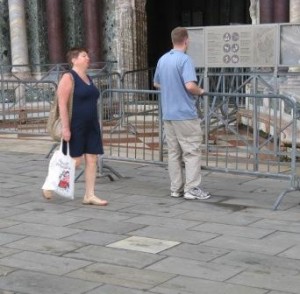
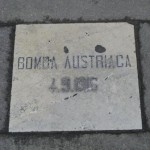
Speaking of bombs, there is a slowly disappearing stone in the Piazza San Marco. It has been worn away by millions of undiscerning feet. Sometimes I pause and just watch people walk over or past it, oblivious, snapping their pix, thinking about work, looking for a bathroom. It marks the spot where an Austrian bomb fell on September 4, 1916, five steps from the entrance to the basilica. It is just another stone, mute, but eloquent.
Every barracks and City Hall in Italy (as here, at the entrance to City Hall in Venice) displays a large bronze plaque made of melted-down enemy cannons. 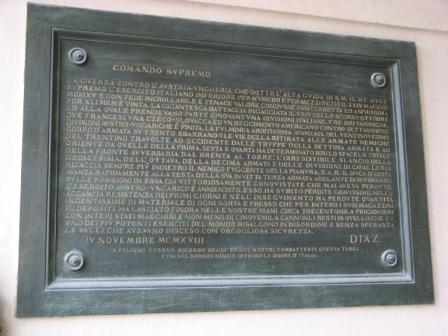 It gives the full text of the address given by General, later Marshal, Armando Diaz, chief of general staff, announcing the Italian victory of the Battle of Vittorio Veneto and the end of the war. It manages in very few lines not only to report the precise details of the enemy’s undoing but to convey every emotion conceivable in the victors of a struggle beyond human comprehension.
The war against Austria-Hungary which, under the high command of His Majesty the King, the Italian Army, inferior in numbers and means, initiated on May 24, 1915, and with unwavering and tenacious valor conducted fiercely without interruption for 41 months, is won.
The gigantic battle engaged on the 24th of last October and in which took part 51 Italian divisions, three British, two French, one Czechoslovakian, and one American regiment, against 73 Austro-Hungarian divisions, is finished.
The rapid and daring advance of the XXIX Army Corps on Trento, blocking the enemy’s means of retreat in Trentino, overwhelming them on the west by the troops of the VII Army and on the east by those of the I, VI, and IV, determined yesterday the total ruin of the adversary’s front. From Brenta al Torre the irresistible surge of the XII, the VIII, and the X Army, and of the cavalry divisions, drove the fleeing enemy even further back.
On the plains, His Royal Highness the Duke of Aosta rapidly advanced at the head of his undefeated III Army, longing to return to the positions which they had already victoriously conquered and had never lost.
The Austro-Hungarian Army is annihilated; it suffered grave losses in the fierce resistance of the first days and in the pursuit it has lost huge quantities of materiel of every sort and virtually all of its stores and warehouses. It has left in our hands about 300,000 prisoners with entire general staffs and not less than 5,000 cannon.
The remains of what once was one of the most powerful armies in the world is ascending, in disorder and without hope, the valleys which it had descended with such proud security. DIAZ
For me, though, the most powerful and poignant epitaph to war — military, emotional, or both — is what Hemingway wrote as one of the 40-some endings he crossed out for “A Farewell to Arms”:
“Many things have happened. Everything blunts and the world keeps on. You get most of your life back like goods recovered from a fire… It never stops. It only stops for you. Some of it stops while you are still alive. The rest goes on and you go with it.”
Naval cadets pledge allegiance to everything
Down on the island of Sant’ Elena, the last lobe of land at the eastern tip of Venice, is the Scuola Navale Militare (Naval Military School) Francesco Morosini.

It was founded in 1937, closed in 1945, then went through various versions till it was reopened in 1961. The school is named for one of the Venetian Republic’s greatest Captains-General, who held on to the Peloponnese while most of the rest of Venice’s Greek possessions were dropping like rotting olives into Ottoman hands. Yes, no point pretending we don’t know: He’s the one who ordered the cannons to fire on the Parthenon (September 26, 1687) during the siege of Athens, turning Athena’s temple into an instant ruin. Of course if the Ottomans hadn’t used the temple as an ammunition dump, none of that would have happened. The Republic made him doge a year later. You can see his stuffed cat in the Correr Museum. But back to the school.
“Morosini,” as we call the whole thing for short, is a three-year high school which till the end of this year was strictly for boys (this will change next fall — everyone is pretty keyed-up) and its students are, in fact, officially sworn into the Navy.

They wear the stars on their collars, they get paid a pittance, and they march and salute and haze each other and complain about their commanders and do everything else that military men do.
They also learn Venetian rowing, which is where Lino comes in. He’s been teaching this uniquely Venetian sport/skill/art/tradition to the boys here since 1994. Sailing was already part of their sports program, but Lino thought they ought to learn something that belonged to the place they were living. The Commandant took him up on his proposal, and so it has gone, ever since.

So that’s why we were invited, as we are every year, to the ceremony of the Swearing of Allegiance to flag and country by the boys who are finishing their first year. By this point any boy who’s likely to drop out has already done so, and the remaining first-year cadets — this year numbering 46 — have chosen a name for their class and ordered their banner. This is where it gets really good. Because they not only pledge fidelity to national and military values, but officially present their class banner to the Commandant, which the chaplain then blesses with holy water. Then they swear. Stay with me.
At this point, any reader who doesn’t have the slightest interest in the navy, the military, banners, oaths, or ceremony of any kind can be excused from the rest of this post. (They may already be gone.) On the whole, I wouldn’t have admitted to a particular interest in some of these elements, but now that I’ve gotten to know so many of the boys and their commanders, rowing or going out to dinner with them, that I have to say that I really love this event.
This is one occasion where the ceremonial isn’t the sort of “Hey, crack yourself a cold one” approach that you see at other events, such as the lowering of the flags in the Piazza San Marco on Sunday evening. And any time that the military demonstrates that it takes itself, its comrades, and its history, seriously, will virtually guarantee an event that impresses and moves me. The Navy Band, the oldest military band in Italy, is brought in from Rome just for the occasion, to play the appropriate pieces such as the Submariners’ Anthem, the Navy Anthem, and the national anthem. And if the speeches get boring, I can always watch the boys, as the sun rises toward noon and they start to collapse. This year there was a cool breeze and they all managed to stay vertical.
The class of 2011 chose the name “Ulixes” (as in Ulysses), and the motto is “Suae Quisque Fortunae Faber Est” which as you all know means “Every man is the architect of his own fortune,” a much-quoted observation of a certain Appius Claudius Caecus.  Sounds excellent, just the sort of half-boast, half-challenge that 15-year-old boys would like, but if you look closely at the sharpness with which Appius C.C. seems to have designed and built his own fame and fortune, not to mention the Appian Way and Appian Aqueduct at the total expense of more talented colleagues and the state treasury, it makes you wonder if the boys chose an example they seriously intend to follow. For any who might be curious, the class of 2010 is named “Eracles,” and the one that’s about to graduate is “Theseus.” I haven’t discovered a reason for the sequence of Greek heroes. Just a coincidence; they could just as easily have chosen the names of stars, constellations, and other terms that look very good on the stern of a dreadnought.
There are two high points in the ceremony for me. The first is the entrance of the class banners. There are more than 40 by now, of all sorts of colors and sizes and mottos and designs, and each is carried by one member of that class. Some of these individuals are not holding up quite as well as their banner, but it’s brilliant to see them all marching across to the martial music of the band.


(Above and above right): procession of class banners; (lower right), the Navy standard displaying copies of all the medals awarded either to ships or to individuals. It is kept by the National Association of Discharged Sailors.
The second great moment, naturally, is the oath-taking itself.
At the crucial moment, the Commandant orders “A me la bandiera!” (Give me the flag — he means the Italian flag). He grabs the flag on its pole and holds it up in front of the boys, all standing at attention. Then he pronounces the oath: “‘I swear to be faithful to the Italian Republic, to observe the Constitution and the Laws, and to fulfill with discipline and honor the duties of my State for the defense of the Motherland and the safeguarding of free institutions.’ Do you swear?” 
What follows is something between a bellow and a roar: “I SWEAR!” It’s thrilling. It’s like something out of the “Oath of the Horatii.”
Then, of course, there’s lunch. As the saying here goes, “All the psalms finish with the Gloria,” meaning however whatever-the-thing-is may have gone (you remember that there are happy psalms and ghastly, garment-rending psalms), just about any gathering will finish with a feed. In case you might have felt any extreme emotions or thought any inappropriate thoughts along the way, this makes everything all better.
By now the buffet is as predictable as the speeches and the oath — and much less moving — but by this point we’re always famished so we don’t mind facing the same platters of prosciutto, skewers of mozzarella and cherry tomatoes, rice salad, some half-hearted pasta, assorted sandwiches, and so on. No no, I’m not complaining. Anything I don’t have to cook is fine with me.
Besides, it gives me a chance to review the assortment of mothers. There is quite a component of women who, where their garb and jewelry are concerned, will never, ever give up the ship.


Below is a small gallery of the assorted uniformed guests who gave the ceremony its sense of real importance.


Veteran commando frogmen of the legendary “Decima,” or Tenth Assault Vehicle Flotilla. Their first operation was an attack on an Austrian warship on Nov. 1, 1918, making Italy the first ever to use frogmen and manned torpedoes, predating both the U.S. Navy SEALS and the British Royal Marines Special Boat Service. Their badge is crowned by a skull clenching a red rose in its teeth, symbolizing they have pledged themselves up to and including death. MAS stands for various phrases, some technical, but the best is their motto: “Memento Audere Semper,” or, “Remember always to dare.” Today the unit is known as COMSUBIN, which sounds dull even if you do say it in Italian.

(Above left) A captain of the mountain artillery, part of the Alpine regiment of the infantry. Troops carry a black raven’s feather in their cap; junior officers a brown eagle feather, and senior officers a white goose feather. Said Radio Moscow during World War 2, “Only the Alpini can claim to be undefeated on Russian soil.” (Above right) A general of the Carabinieri who is also a pilot, with a monsignor of the Military Ordinariate, a type of military chaplaincy.


Members of the National Association of Italian Partisans, who fought in the Resistance during World War 2. The subject of the partisans is still a highly-charged subject, politically and emotionally, and while they are always present at military ceremonies, they are never officially acknowledged.

Immediately after the oath is the singing of the national anthem. The emotional payload of the moment is clear; this may well be the only time they will ever sing this song with this much conviction.
