Generations have made their fortunes, to one degree or another, promoting Venice as a city of mystery, secrets, enigmas. What amazes me, though, is how many discoveries one can make by just looking around. It’s not as if you have to go looking for secrets — there are plenty of extraordinary things sitting right out there in the open, in front of everybody, but that go unnoticed for ages.
I have walked with Venetians, on our way to do something, who have suddenly stopped, looked up at/around/behind/next to some normal thing (a bridge, a window, a door) at something strange or beautiful and said, “I never saw that before.”
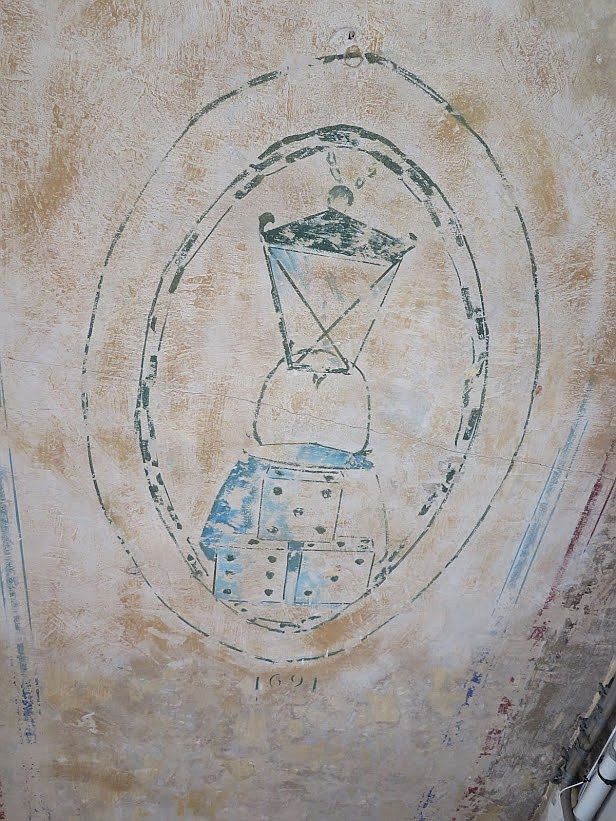
So here is something I saw because I looked up. Was it a secret? Only from me until that afternoon.
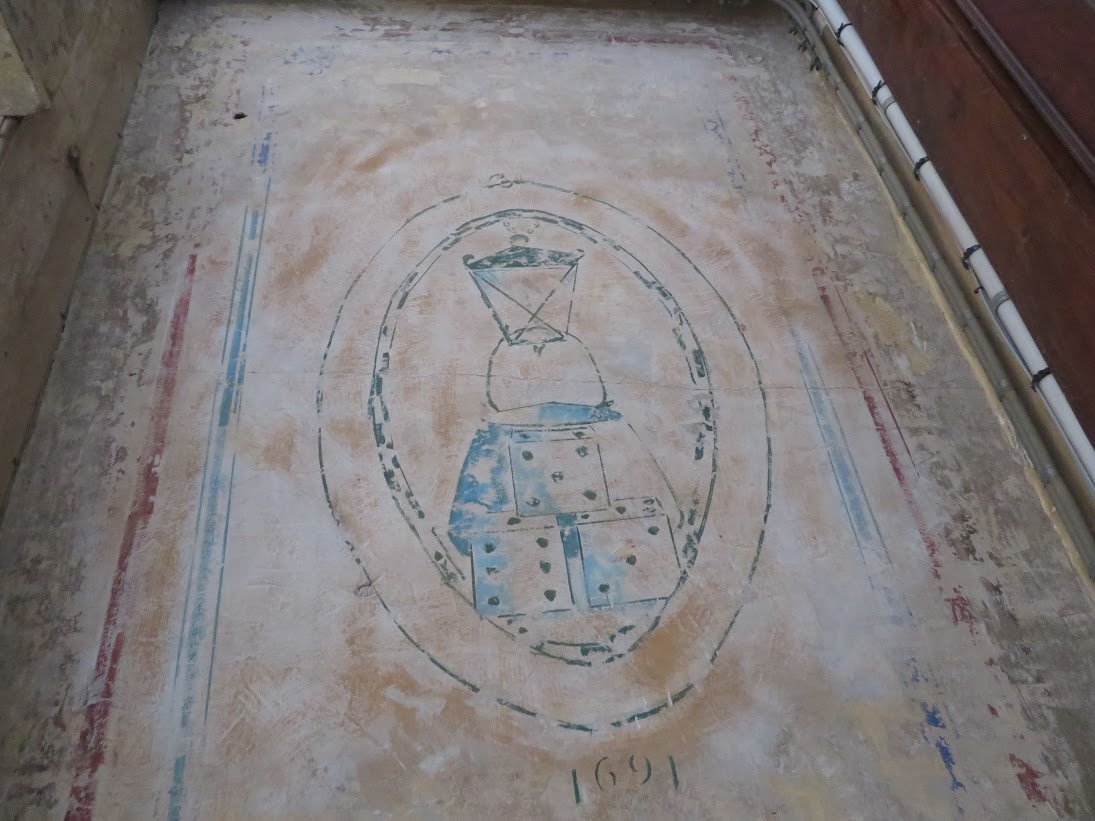
And the date is the same when read upside down or downside up. A new sort of palindrome? A mystic code opening to another dimension? Somebody’s PIN number?
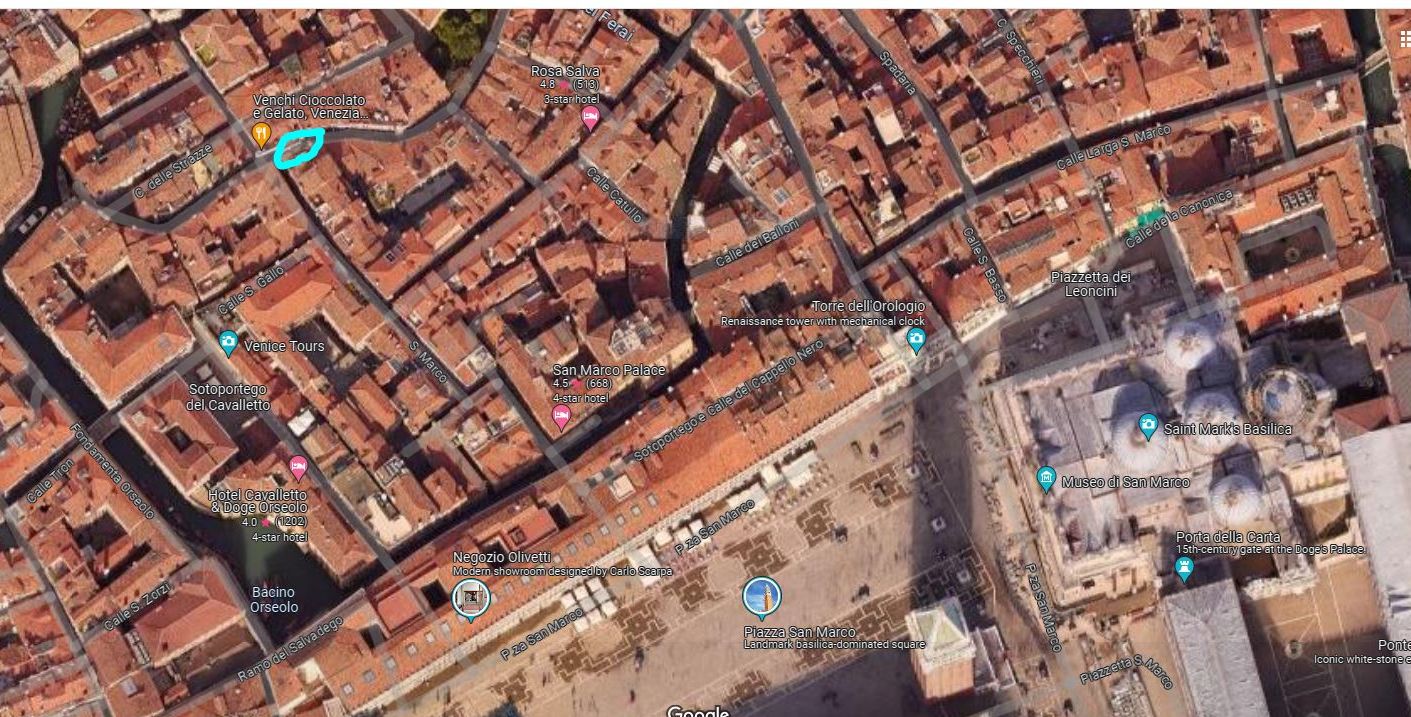
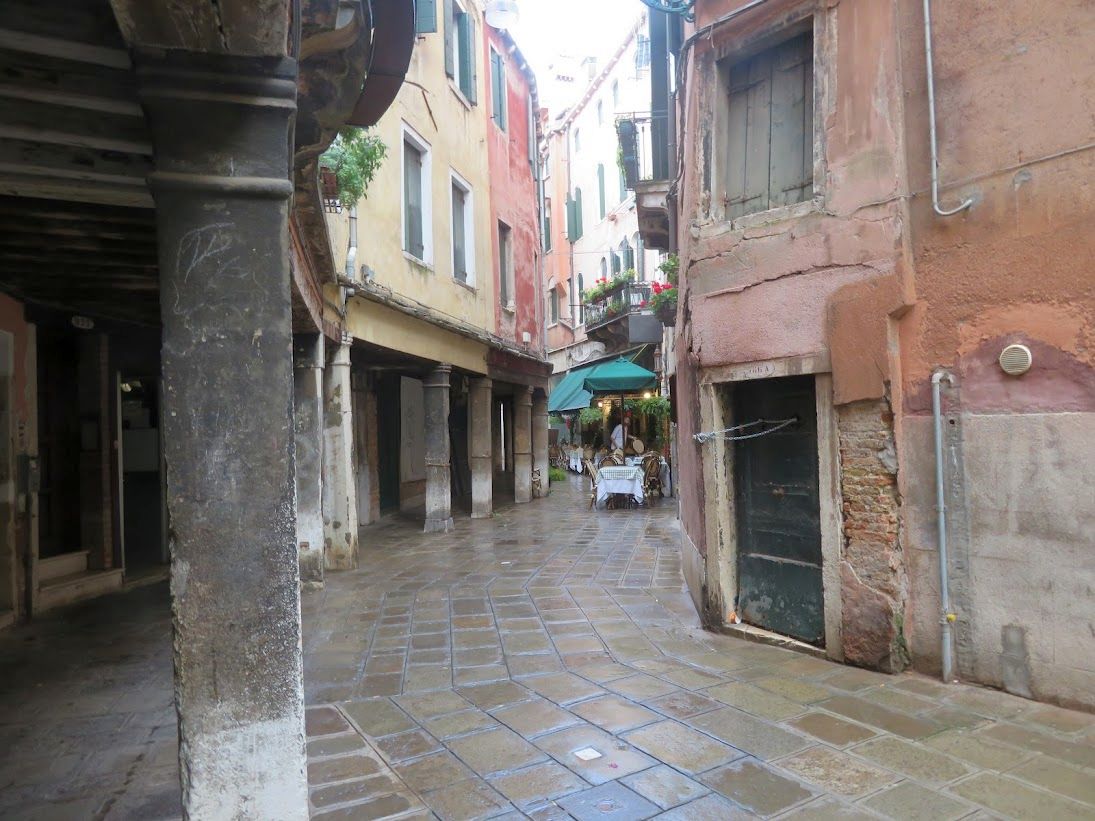
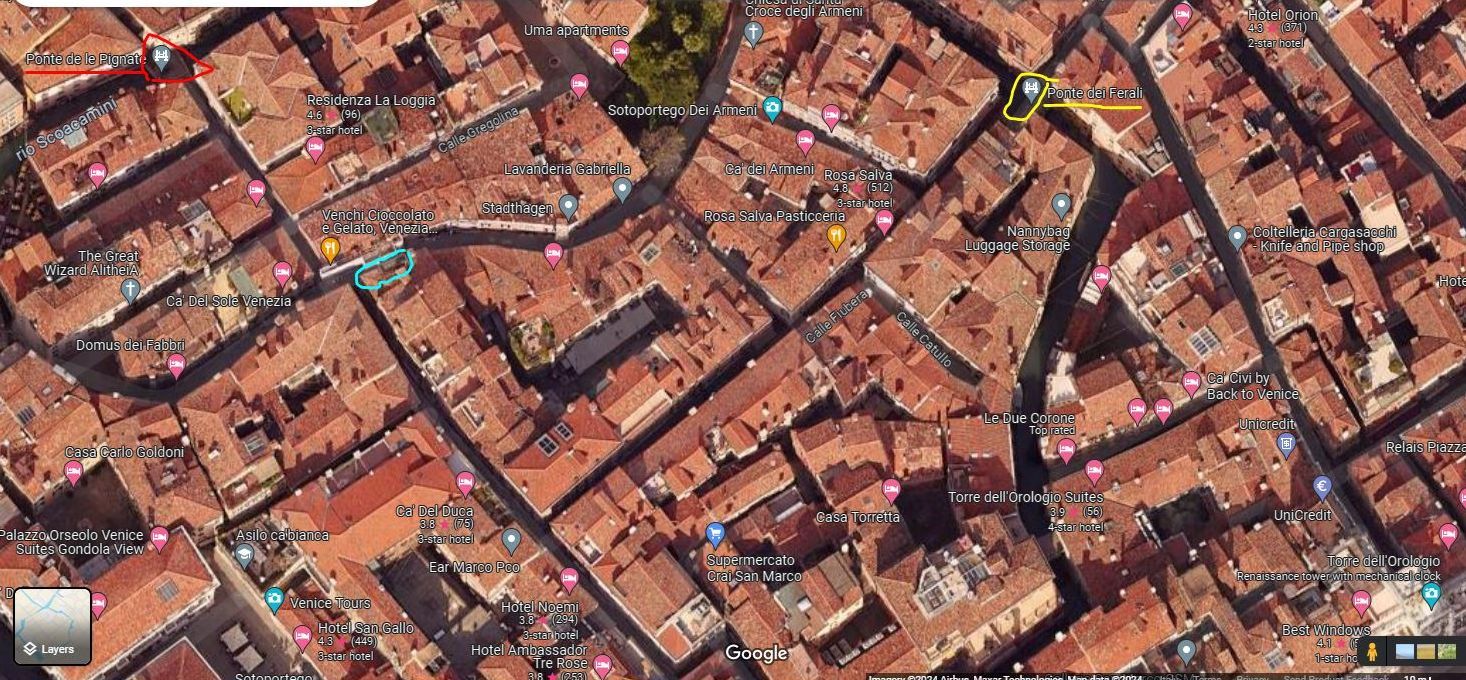
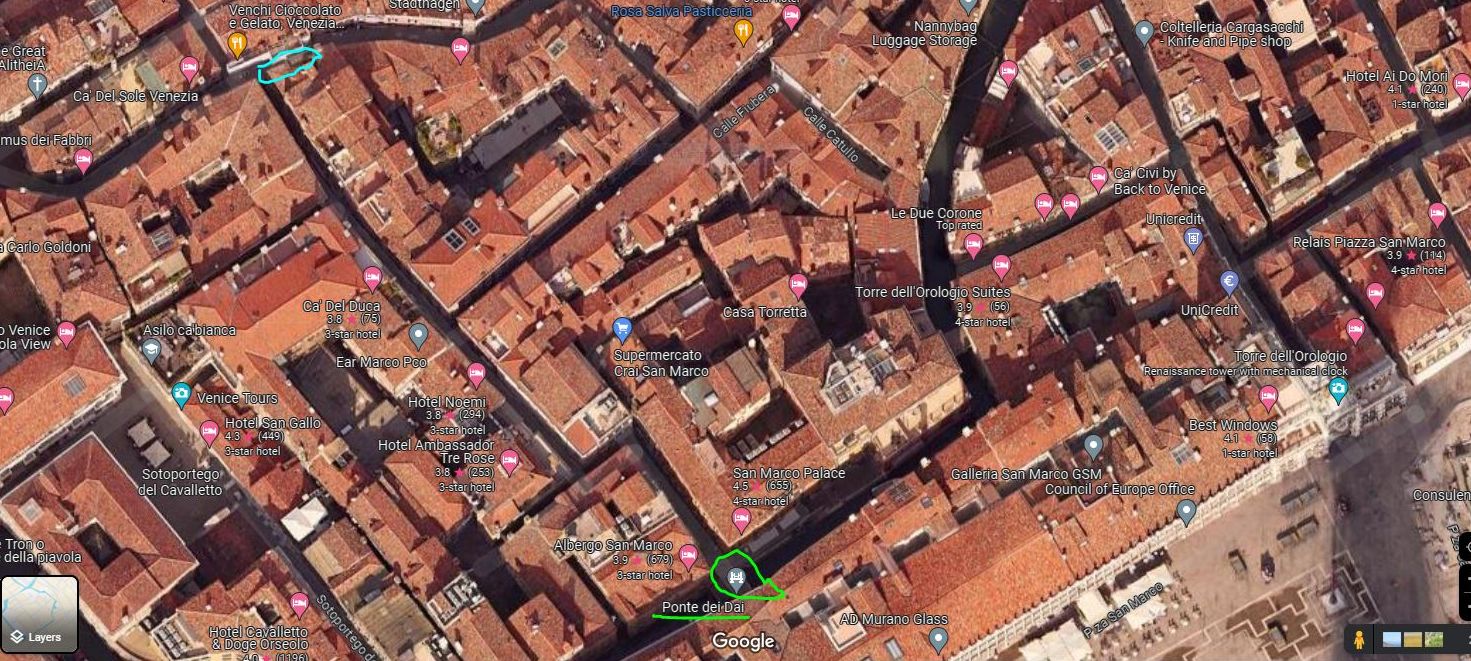
This fresco isn’t far from San Marco at the intersection of the Rio Tera’ de le Colone and Calle dei Fabbri. Here is a map to clarify.
The garish aqua-tinted circle marks the position of this now-no-longer surprise.
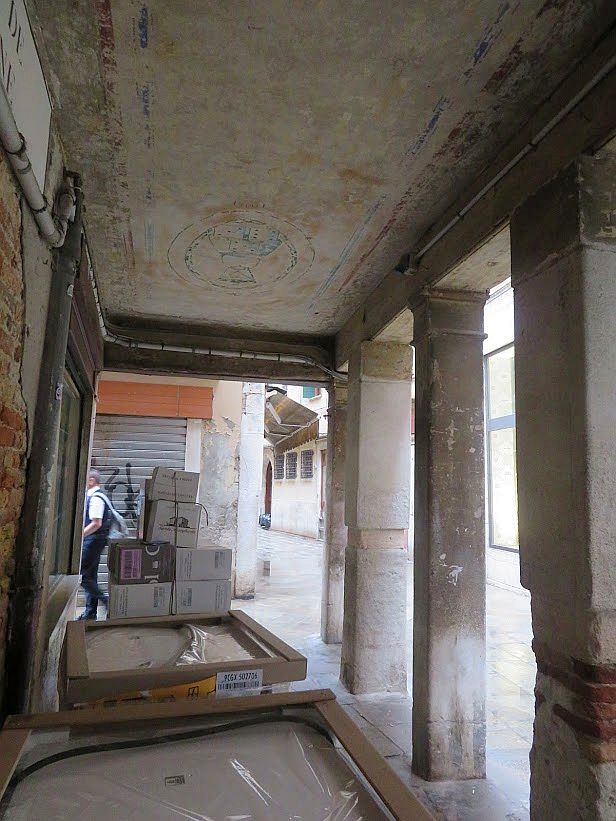
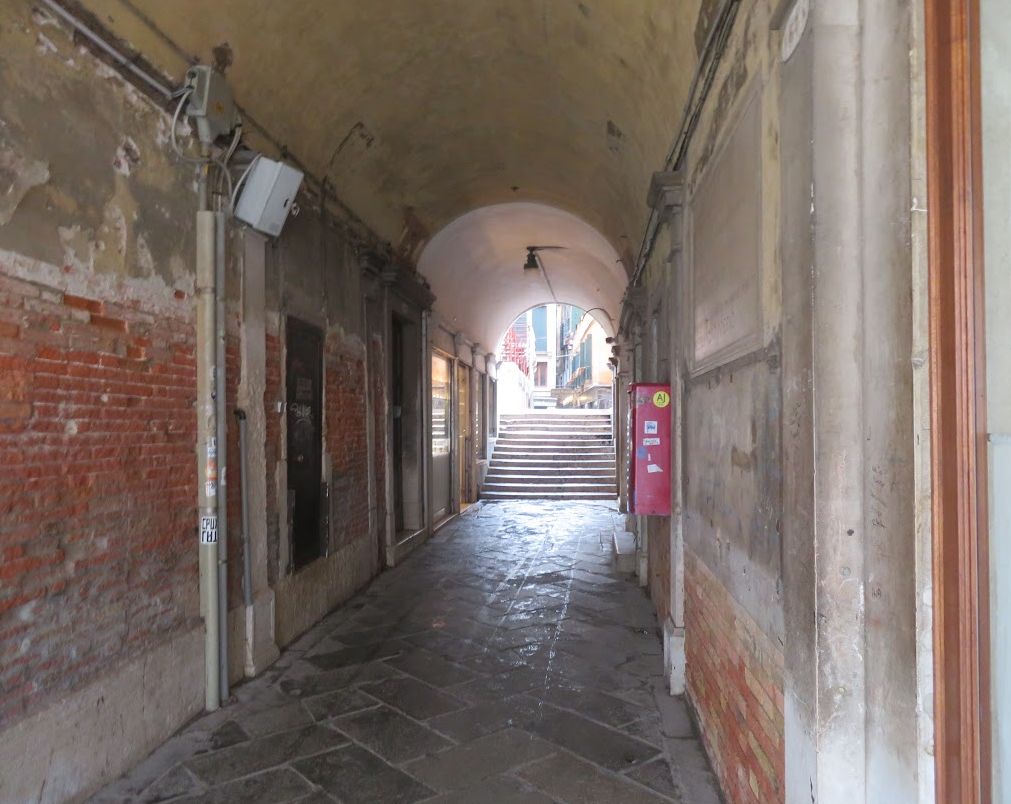
Looking up as I walked west along the columned walkway …
This is the view along the Rio Tera’ de le Colone, for anyone in charge of navigating.
I came upon this, as previously noted:
The passageway was temporarily blocked, as you see, but that’s not important. Just look up.The edited street sign is a relic of a brief but intense period when the populace revolted against the “Italianizing” of the local street names; they had always been in the Venetian language, but an official urban improver in the city administration thought Italian would be better. For a while nocturnal vigilantes took a hand in correcting this cultural vandalism, but don’t let this deviation from the name printed on your map disturb you.
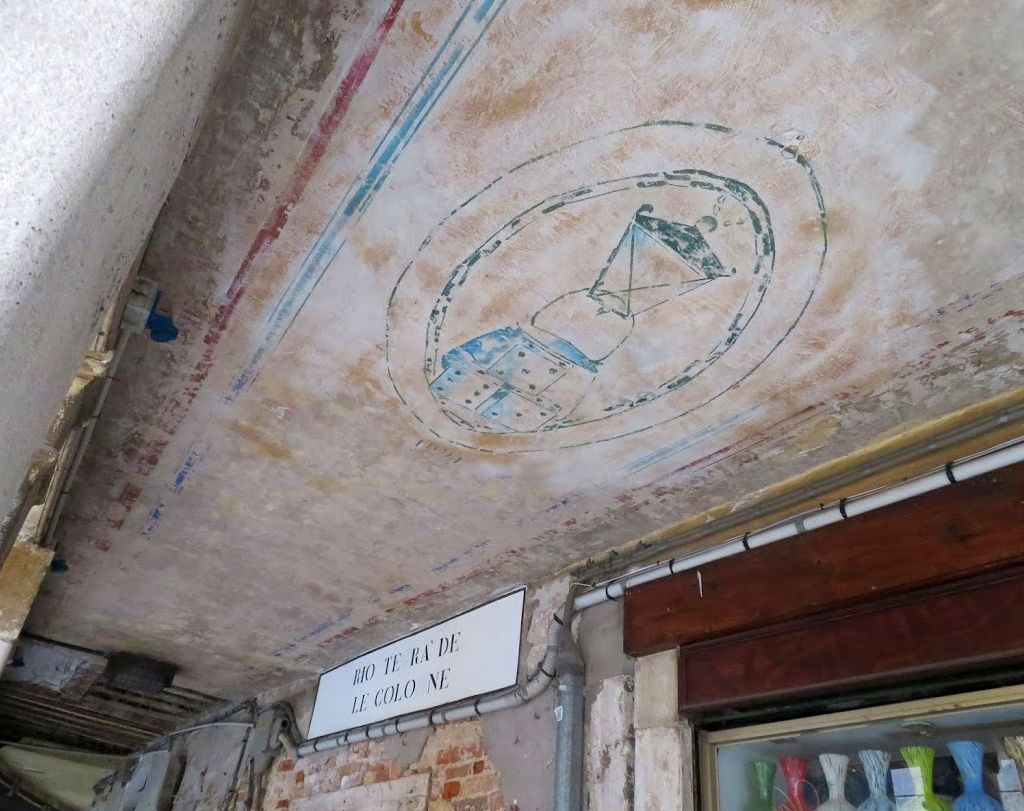
Back to the fresco at hand. My first theory was wrong, of course, but I wasn’t alone in supposing the dice in this design to be a mystic reminder of what may have been a gambling establishment back in 1691. There were plenty of them, but people probably didn’t need signs to show them where to go, mainly because gambling was mostly illegal.
Rummaging through the internet I found that several people had also found it reasonable to suppose that gambling inspired this curious fresco. But then I was even more surprised to discover a much simpler explanation. No need to go any further back than the 1980s and a particularly whimsical artist named Dorino Cioffi (born 1932 in Este, Veneto region), now living and working in Venice.
I could go find him and ask him about all this, and I’m not saying I won’t, but I wanted to get this little tale out into the ether. Whatever his motivations might have been, and however he may have managed to get permission to paint on a public space (“No worries, it’ll be down by Wednesday”), he created this diverting little image. Fooling people is so much fun. Carnival comes to mind.
Starting at the top is a streetlight (feral, in Venetian, pronounced fehr-AHL), sitting atop a cooking pot (pignata, in Venetian), behind three dice (dai, in Venetian). This is important to the story, so read on.
For reasons as yet, if ever, to be discovered, the artist devised this image to refer to the three bridges nearest to the location of the fresco. I don’t know why that spot was chosen, though if you’ve decided you want to paint on an outdoor ceiling, your options are already limited.
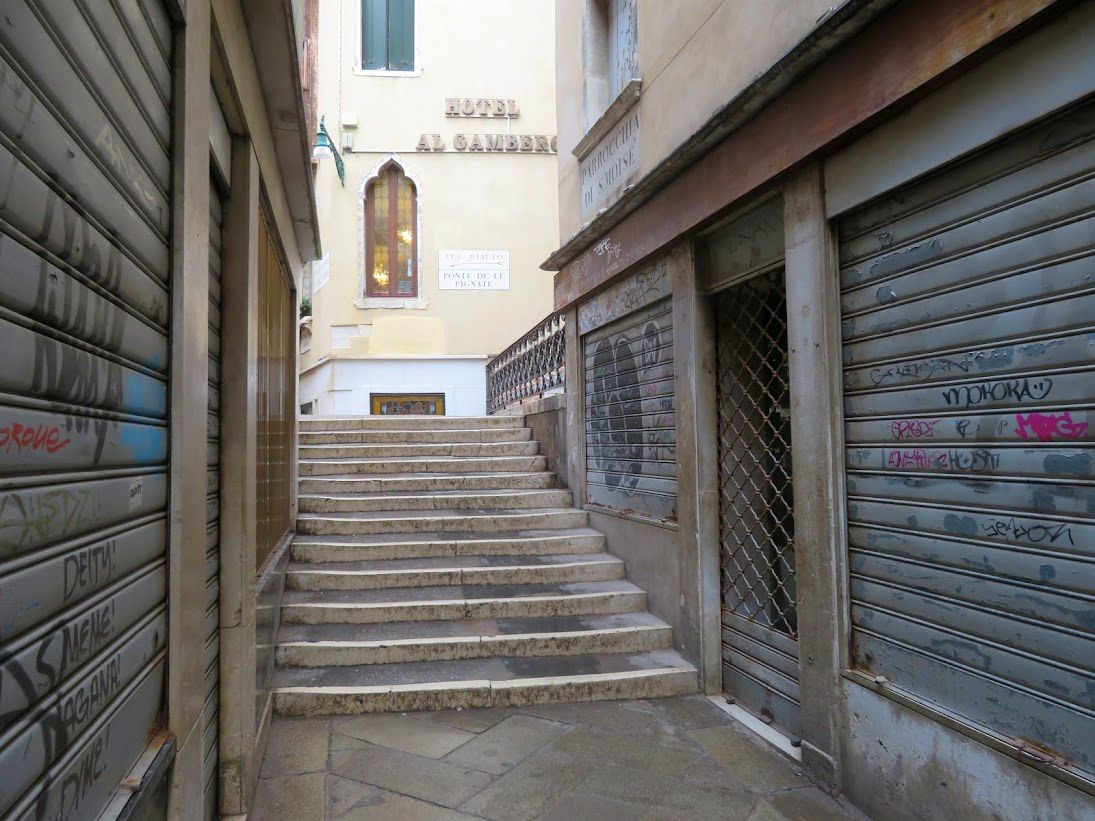
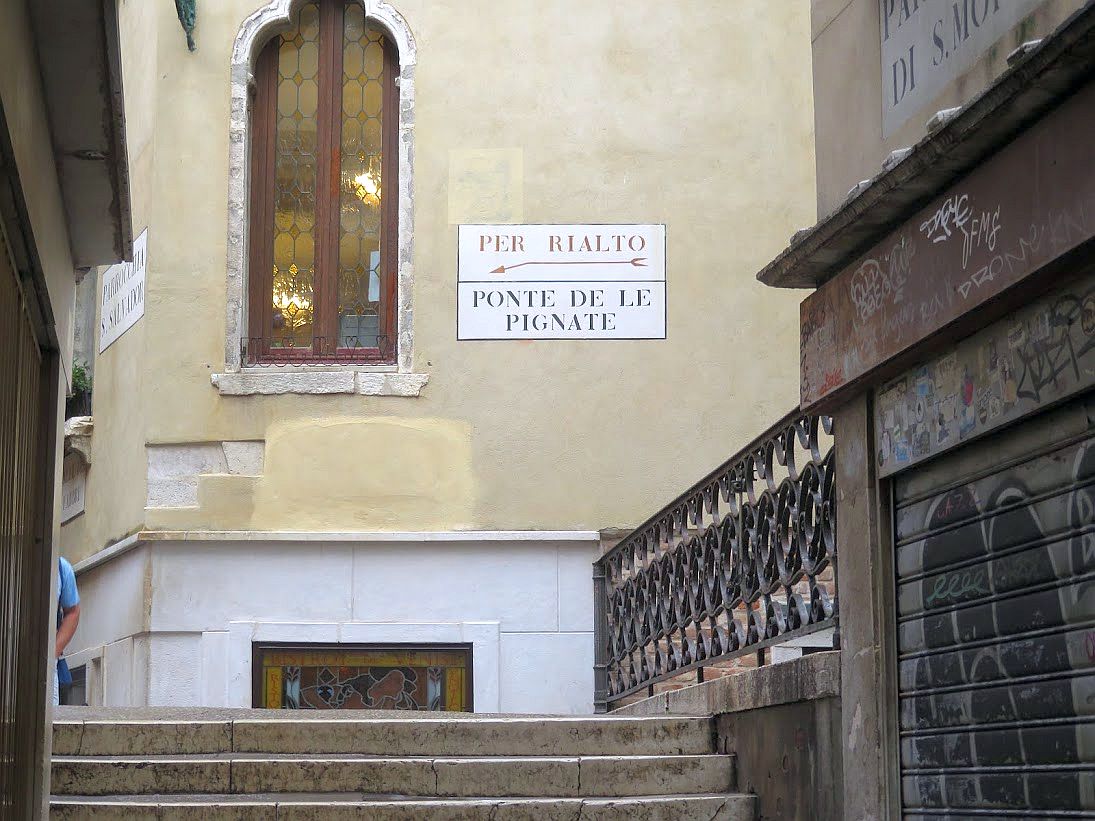
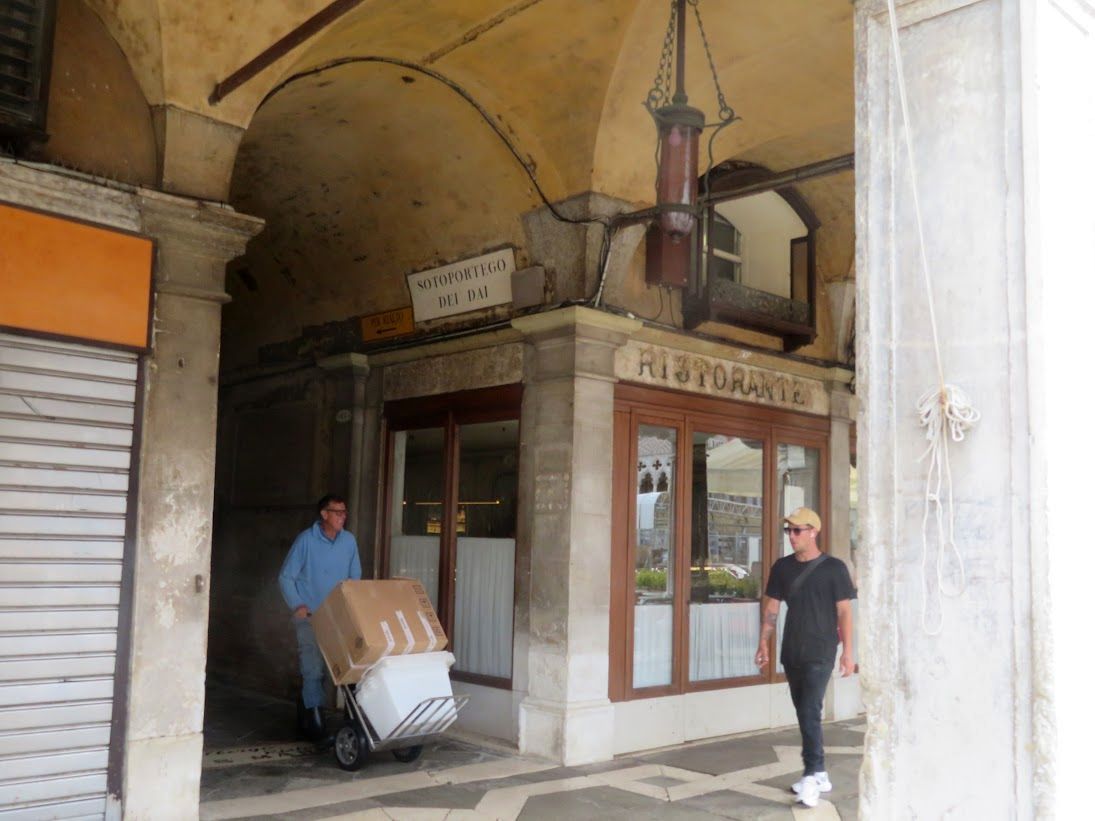
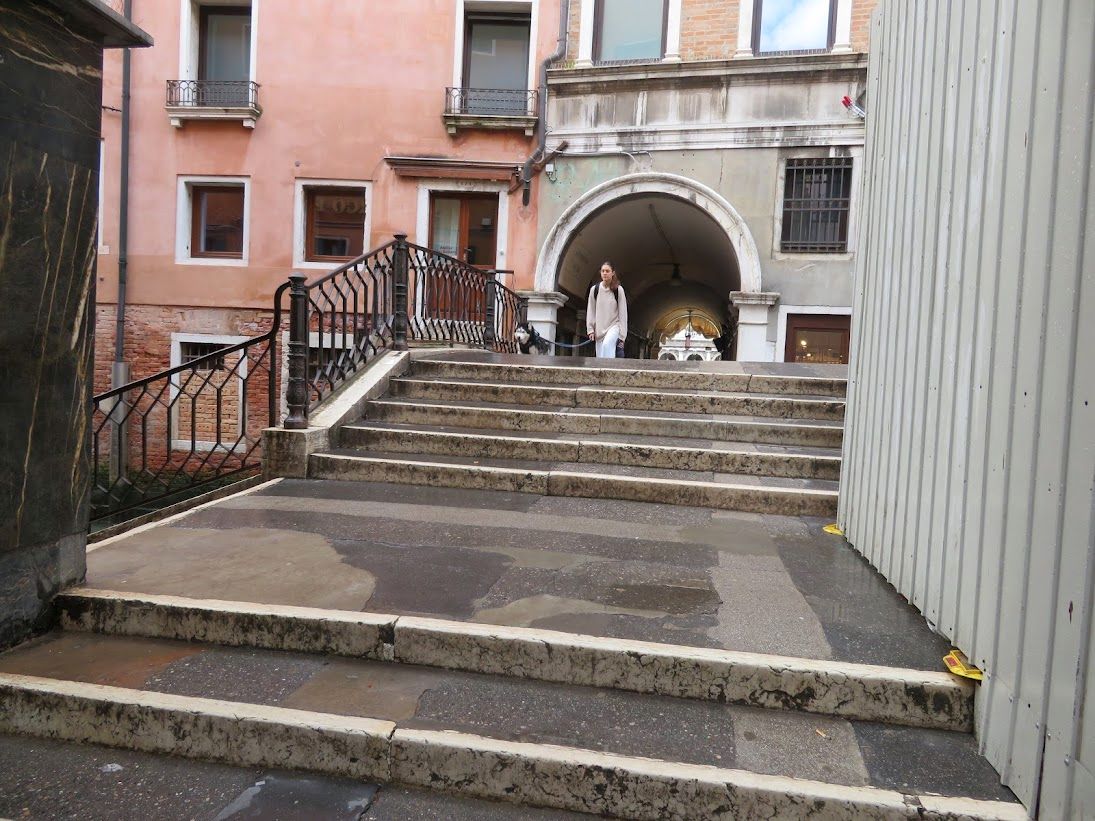
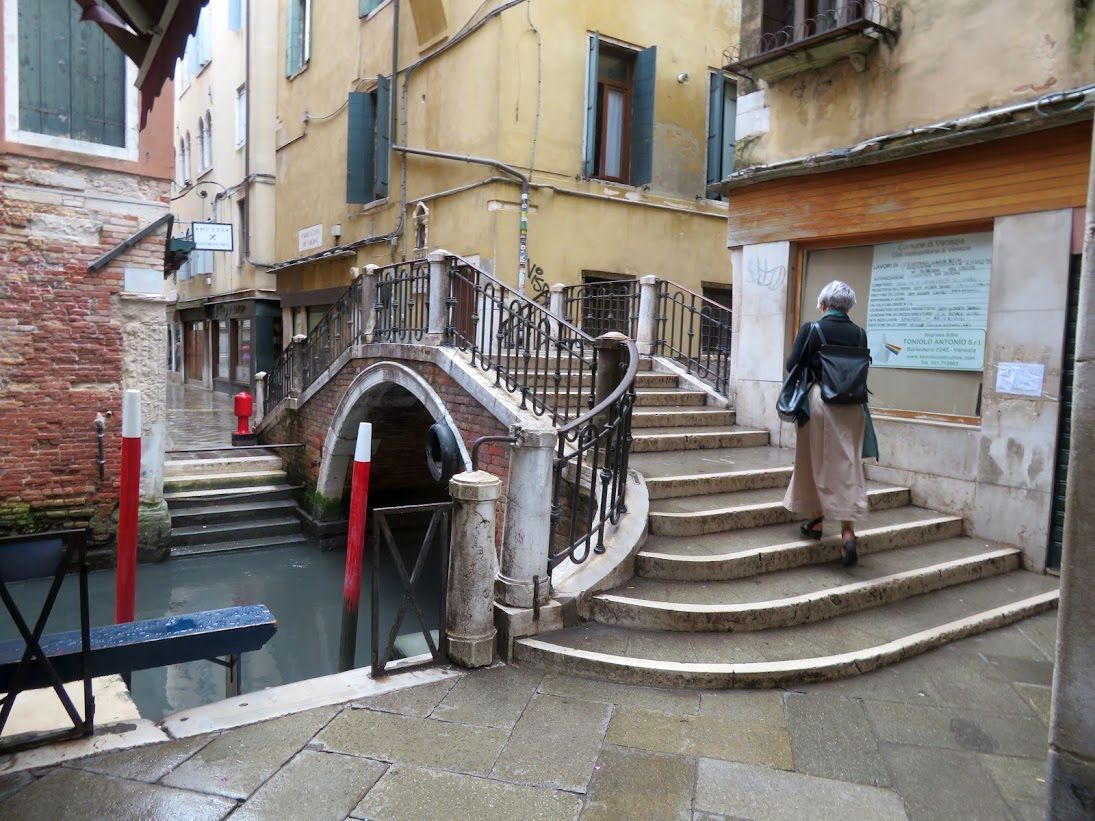
The aqua circle is the fresco; the yellow circle to the right is the Ponte dei Ferali, and the red on the upper left is the Ponte de le Pignate.The Ponte dei Dai connects to the Piazza San Marco, as you see.The Ponte de le Pignate, walking toward the Rialto bridge.
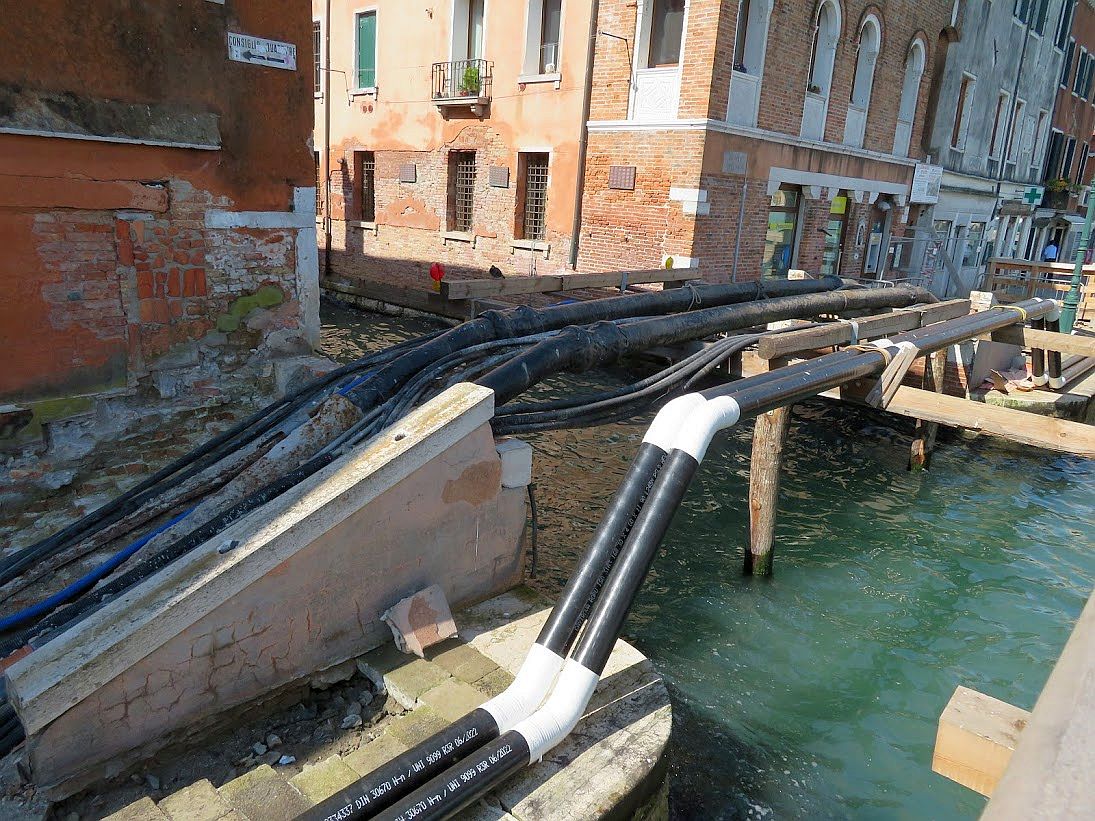
Heading toward the Ponte dei Dai.The Sotoportego dei Dai, with the bridge just coming up.Having just crossed the bridge, I look toward the Piazza San Marco. This bridge, like so much of Venice, has been patched and repaired to a Frankensteinian degree. The long strip of lighter-colored material stretching along the right side is undoubtedly the scar left when it was necessary to open that part of the bridge to get at whatever pipe is installed beneath it. Water pipes, cables, or any other tubes that may need repairing and replacing are reached by incisions made in the bridge as needed and then closed up with varying degrees of finesse. I have seen bridges that are held together after numerous dissections by various materials from asphalt patches to leftover concrete. In some cases the only things they haven’t used to put a bridge back together are safety pins, duct tape, chewing gum, and a few staples.This is what bridges look like under the paving stones. Stripping this bridge to its very innards was a drastic move indeed — usually they just remove the bare minimum to resolve whatever little problem may have been bubbling under the surface. I’m guessing it wasn’t the innards that were the problem, but the bridge itself.
The names of the bridges, like the streets, referred to something that was made, or sold, or both, on or near that bridge. As far back as the 1200’s the feraleri, or makers of streetlights (ferali), had set up their shops on nearby streets, as well as on the bridge itself (do not ask me how that worked). The same explanation applies to the pignate (cooking pots).
As for the dai (the original name was dadi, or dice), they were not so much produced as simply sold near their eponymous bridge. This is amusing, considering that gambling with dice was forbidden. You and your friends might call a place the “bridge of crack cocaine” if that’s what makes sense to you, but painting the name on an official street sign would be strange. I think we can agree on that?
You may be awaiting more information on the pots and the dice, which I suppose there is, but the streetlights turn out to be far more interesting than the other two items put together. (Do not recommend.) As I leave the eccentric fresco behind, though, I can say that without it I almost certainly wouldn’t have given a thought to the lamps.
My next post will be shedding plenty of light on the subject.
This is the Ponte dei Ferali, looking east toward the church of San Zulian.
You think Venice is just museums and restaurants? This particular moment will show that you can be in Venice without doing any of the things you typically expected to do, at least in the heart of darkest Castello. Sumer is definitely icumen in.
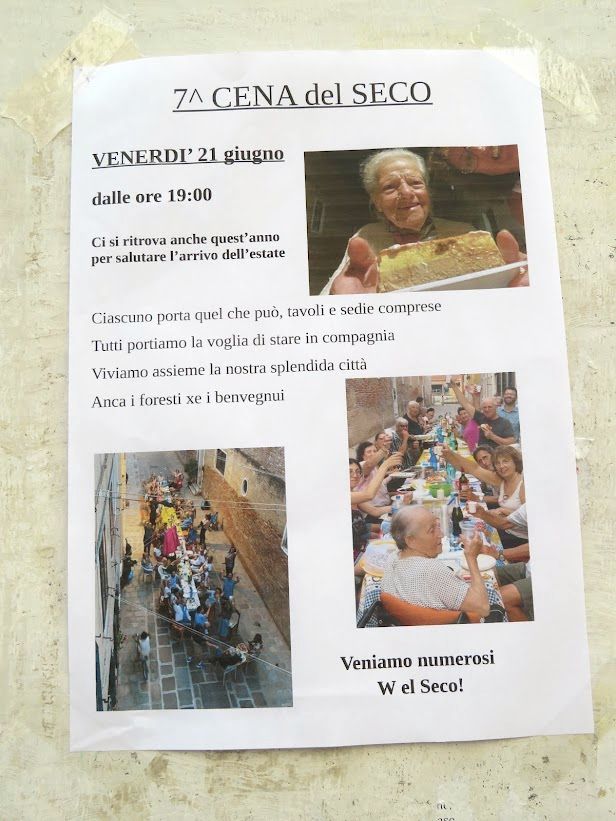
Potluck dinner tonight in Seco Marina.
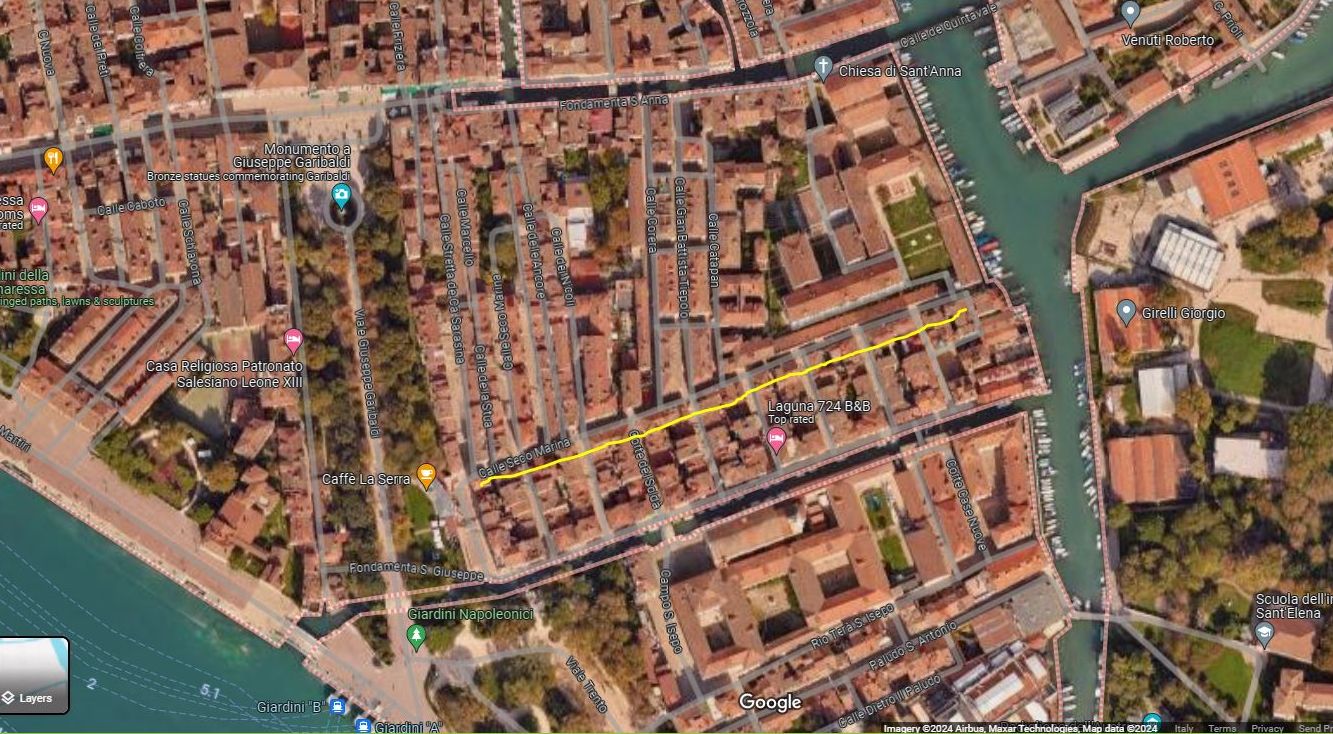
This announces the Seventh (!) “Dinner of Seco.” Seco Marina is the official name of the long major street stretching parallel to the canal at the bottom of Via Garibaldi. (See map). Neighborhood gatherings of this sort are not common, but as you see, Seco is forging its own destiny. (Smaller alfresco feasts are common on the evening of the Redentore, but they are usually organized among friends and/or family.) Extremely loose and colloquial translation: “Friday June 21 at 19:00 hours (7:00 PM) let’s get together again this year to celebrate the arrival of summer. Everybody bring whatever they can, tables and chairs included. Everybody bring their desire to hang out. Let’s live our splendid city together.” And then, in a truly lovely touch that embodies the “let’s hang out” spirit, is the final phrase in Venetian: “Even foreigners are welcome.” Conclusion: “Let’s all make a huge crowd. Long live Seco!”
Not being sarcastic, I think that is absolutely adorable, because extending the invitation to foreigners (just for starters) especially in the local language, is the essence of welcome. Also not being sarcastic, maybe it’s a cleverly calculated risk, because I’m not sure how many foreigners speak Venetian.
A Venetian I know, working on the assumption that some foreigners would understand this invitation anyhow, also assumes that said foreigners would bring next to nothing to the table but a large desire to eat free food. I’m not going to be there to confirm or deny this, but the notion that at least one foreigner might interpret the invitation in this way does give an regrettable indication of how some foreigners have led at least one Venetian to imagine something so unpleasant. This foreigner (me) unhappily believes that the aforementioned Venetian may well not be wrong.
The yellow line traces Seco Marina. Just trust me, because there is no street sign. You may well have walked along it many times without even knowing its name.
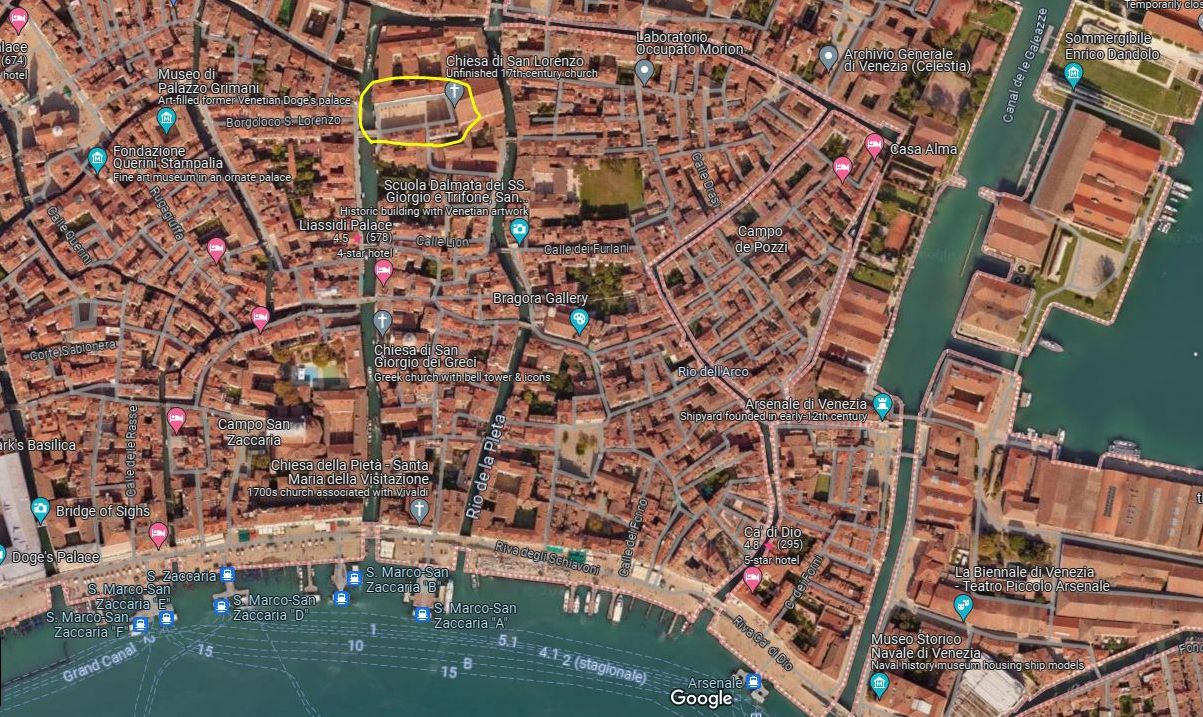
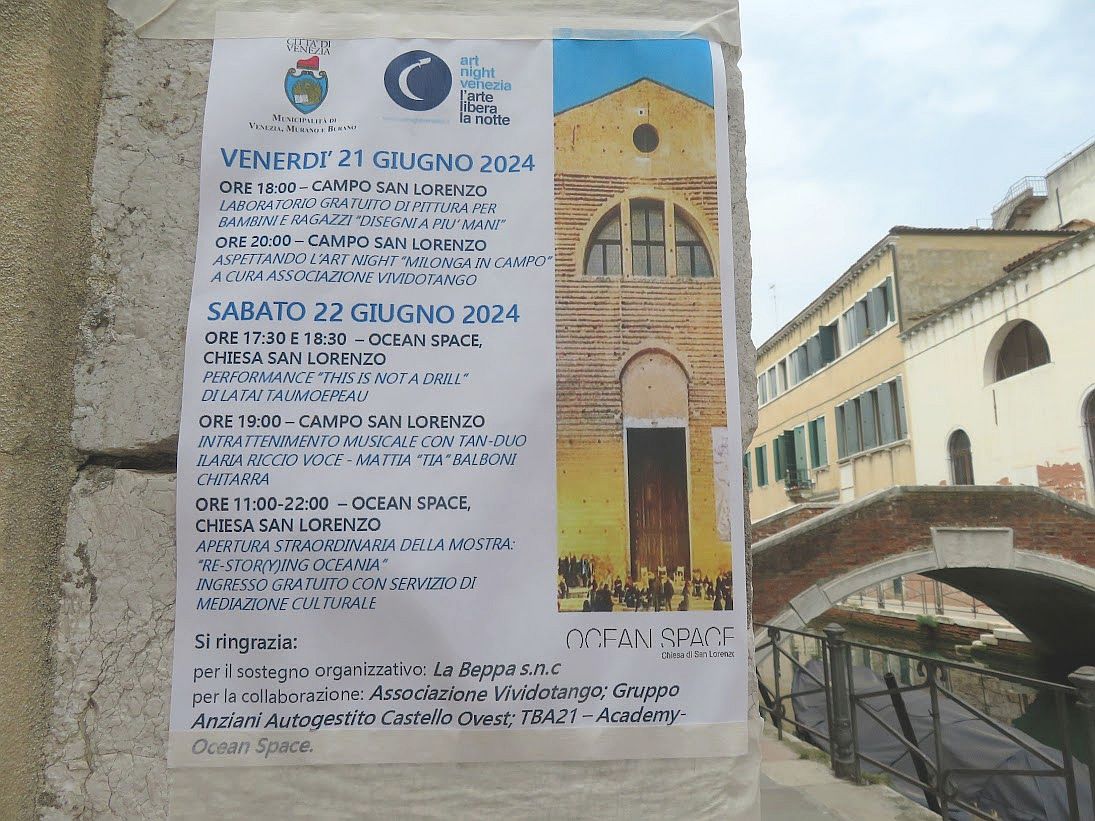
While we’re on the subject of Friday evening, you could wander over to the Campo San Lorenzo and enjoy an evening organized by “Art Night Venice.” (Please note the Comune’s commitment to serving its tourists by organizing or sponsoring all these events on June 22 by promoting it on their website whose English-language option does not translate into English. You might chance your arm by using Google Translate, if you care.) There are scores — they say “hundreds” — of free events that night. Here’s an English-language rundown.
San Lorenzo is a bit out of my circuit even though it’s not far. You could be there in ten minutes or even fewer from via Garibaldi.
The decommissioned church of San Lorenzo (that once held the tomb of Marco Polo) is now used by various exhibitors of the Biennale. Art Night is a vivacious addition to the area.On Friday, June 21 a free painting laboratory will be set up in Campo San Lorenzo “for little kids and youngsters.” I make no assumption as to the true age limit — perhaps you can tell them how young you feel and get a tube and brush or whatever they’re using to make instant art. If you prefer your paintings by Tintoretto and not unknown small people (bearing in mind that Tintoretto too started out as a kid), just wait till 20:00 hours (8:00 PM) when “Milonga in Campo” will start up; I interpret this as “music and dancing” because of the name of the organizers: Associazione Vividotango. As for who will be dancing, it may or may not be you, depending on how many beverages you might have imbibed. Wikipedia explains that “Milonga is a musical genre that originated in the Río de la Plata areas of Argentina, Uruguay, and the Brazilian state of Rio Grande do Sul. It is considered a precursor of the tango. ‘Milonga is an excited habanera.'”
Then there is the annual five-day festa of San Piero di Casteo June 26-30. Every year thousands of revelers come to revel till midnight or so to live music and equally live mosquitoes (bring your strongest repellent). When the music ends and the food stands close, everybody all reveled out wanders homeward along the street outside our bedroom window. We are at street level. The windows are open because we are sweltering. So we get to hear everybody’s chaotic closing remarks till 1:00 AM or so.
And let us not forget that the Biennale is still in full swing. Last Wednesday morning about 4,936 kids (by my estimate) from Campalto, a village up on the way to the airport, were coming to see it. They were excited, which is nice. But 4,936 excited kids on the 5.1 vaporetto from the Zattere was not at all nice. I closed my eyes all the way back, trying not to imagine those doomed ferries in southeast Asia that go down because they are so groaningly overloaded. I asked Lino if we were going to start seeing people riding atop the vaporettos, like trains in India. He didn’t reply. I did not take that as a “no.”
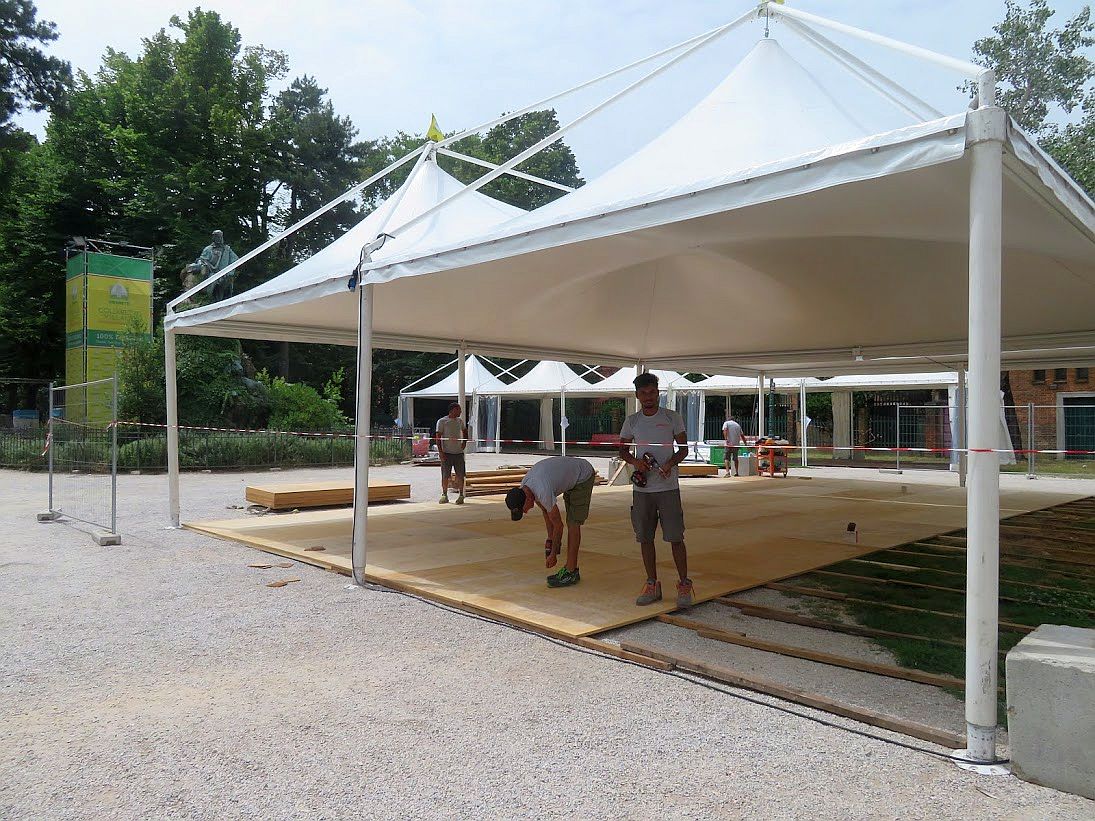
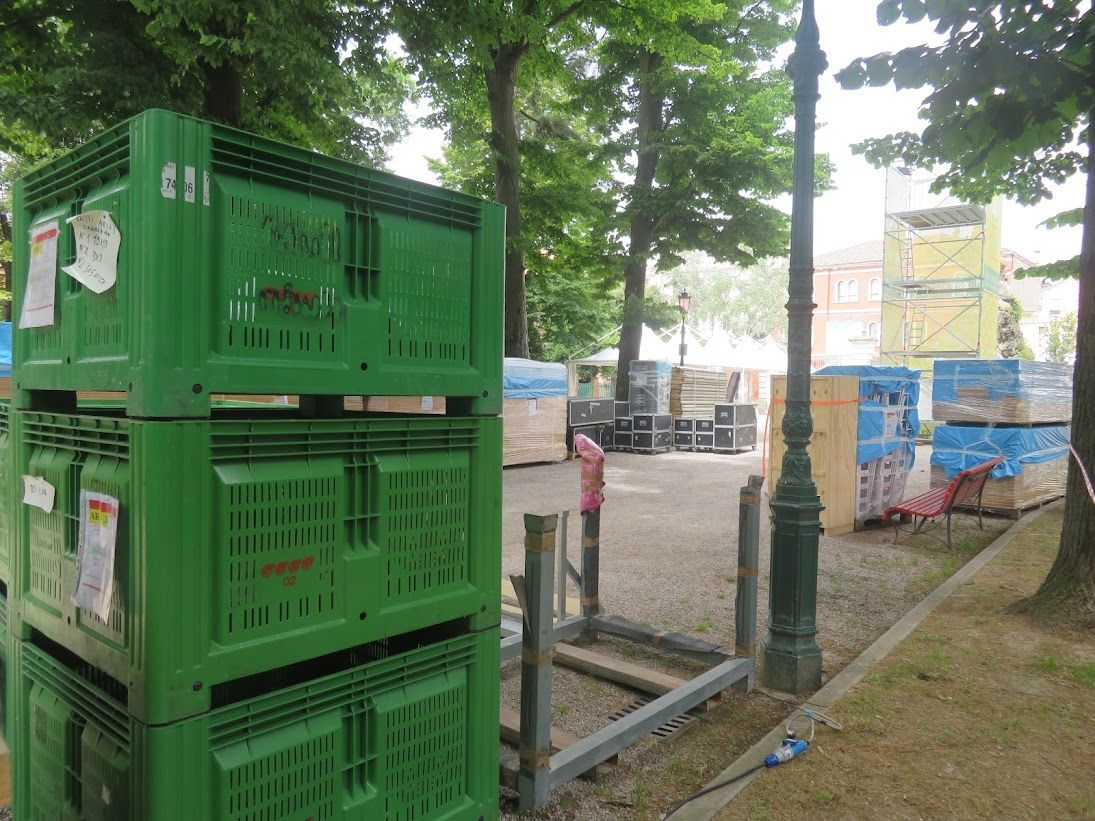
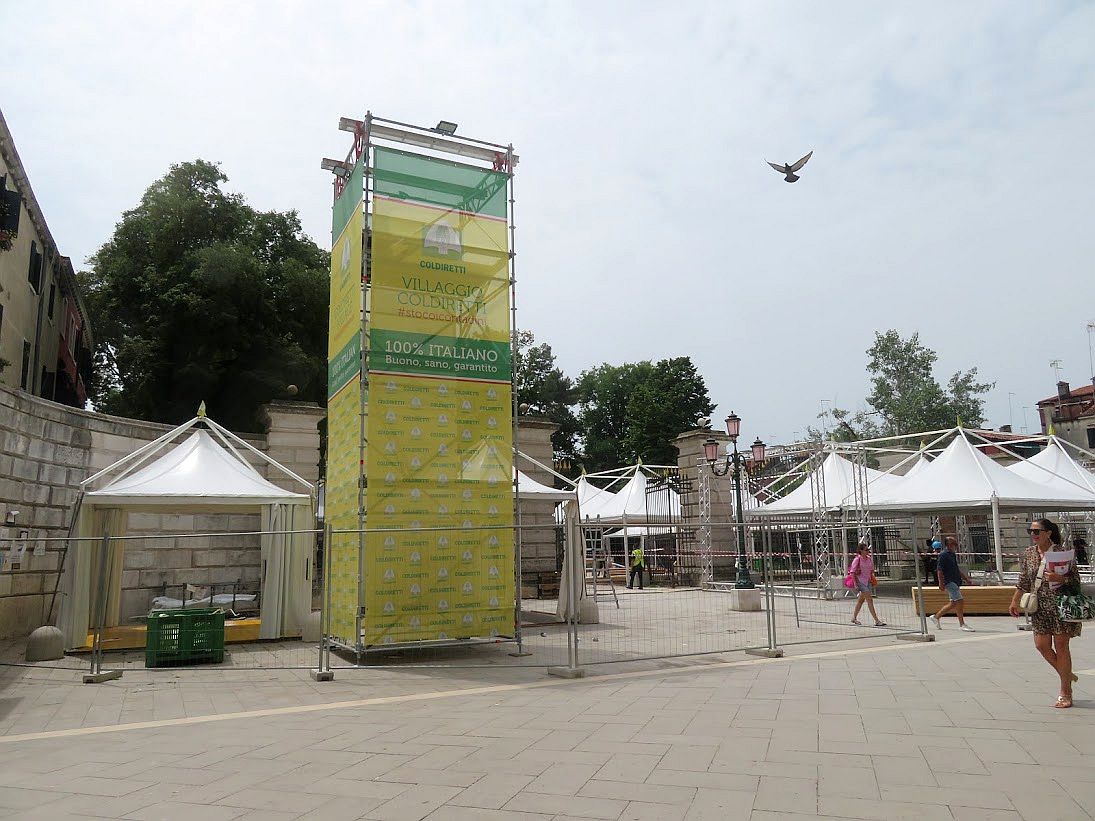
But the true drama underway in the neighborhood — speaking of entertainment, which I guess we were — is the gobsmackingly ponderous Coldiretti Villaggio that has been under construction for a week and will continue to be under construction till it opens on June 28 for three gobsmacking days. I couldn’t find anything in English about this phenomenon but click on the link to see a brief video from the same undertaking a few months ago at Naples.
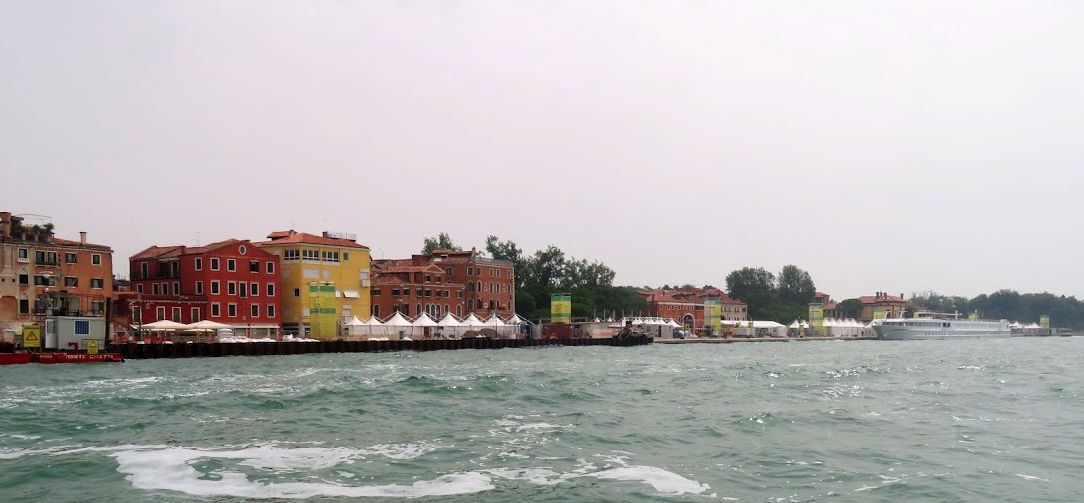
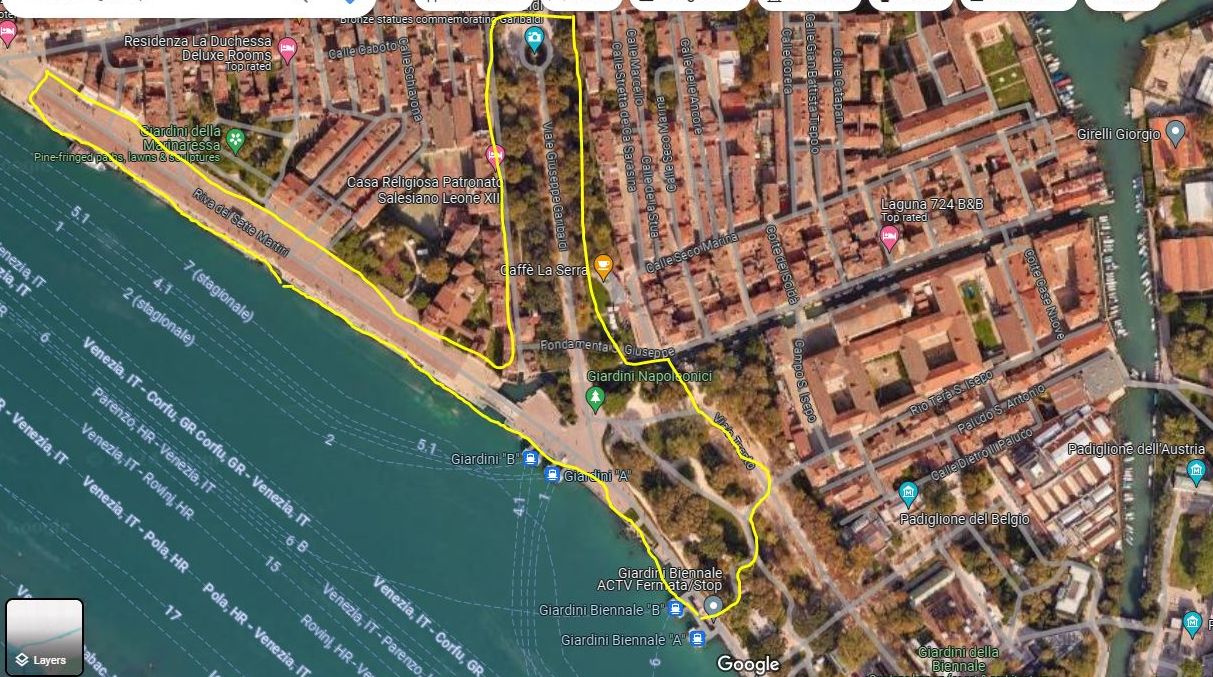
Stands where producers and cookers of food will be in full tilt, as well as areas presenting live farm animals of all sorts and sizes, are being set up along the Riva dei Sette Martiri as well as in the Giardini. Sorry, Biennale visitors, you’re going to have to take the scenic route to get to the pavilions.I suppose one could look at this acreage and say it doesn’t look like so much space. Perhaps it isn’t, if you don’t want anybody to be able to move. You should know that even though entry is free, they have installed fences. (See: livestock.) The area is completely fenced in. I don’t know why that makes it all seem so much more claustrophobic, but it does. Safer? Okay. But I’ll be watching to see if there are any “exit” signs.
You may recognize this area as via Garibaldi looking toward the statue of himself. If you are asking yourself who could have thought of this area — or any part of the historic center — as being ideal for an event predicted to draw literal thousands of visitors, you will not be alone. Every single person in the neighborhood is asking the same question, and not of themselves, and not quietly or pensively. They’re asking it of anybody who had any authority to sign off on any part of it.
This event is of dimensions so extreme and gnarly that it needs its own post. Meanwhile, as I struggle to write it, may I suggest that you pause to evaluate the theoretical value/importance/necessity/desirability of awakening Venetians (I think the three days are intended to awaken people) to the problems of farmers and raisers of livestock by bringing the farmers and livestock straight into the heart of a desperately fragile World Heritage Site that is already known to be staggering under the weight of human hordes.
And on that note (I think it’s a G-flat), let the summer begin.
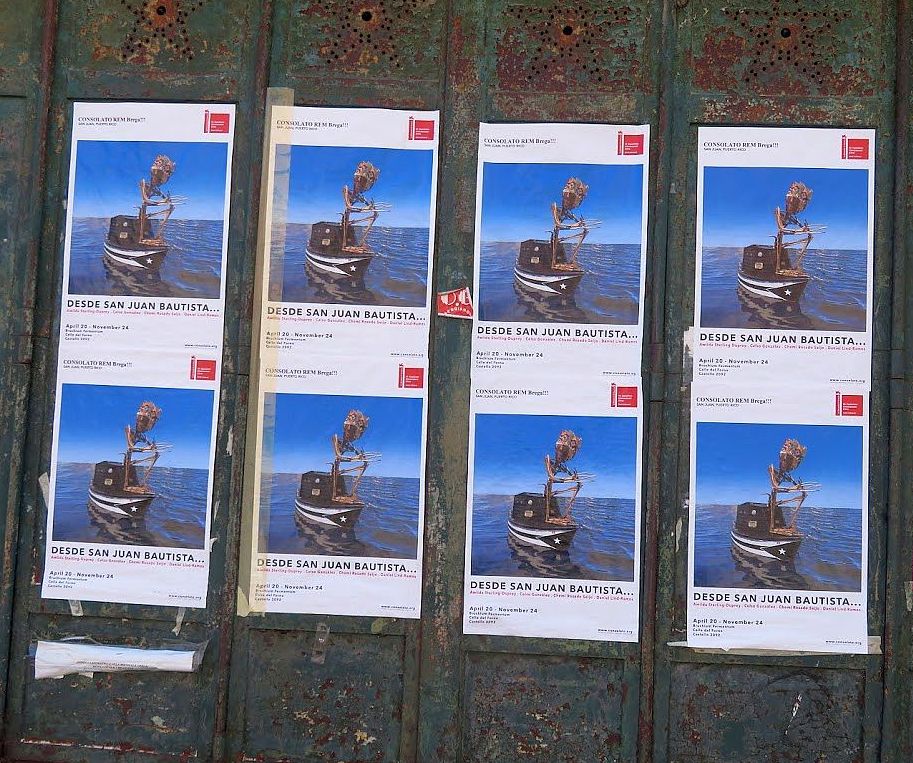
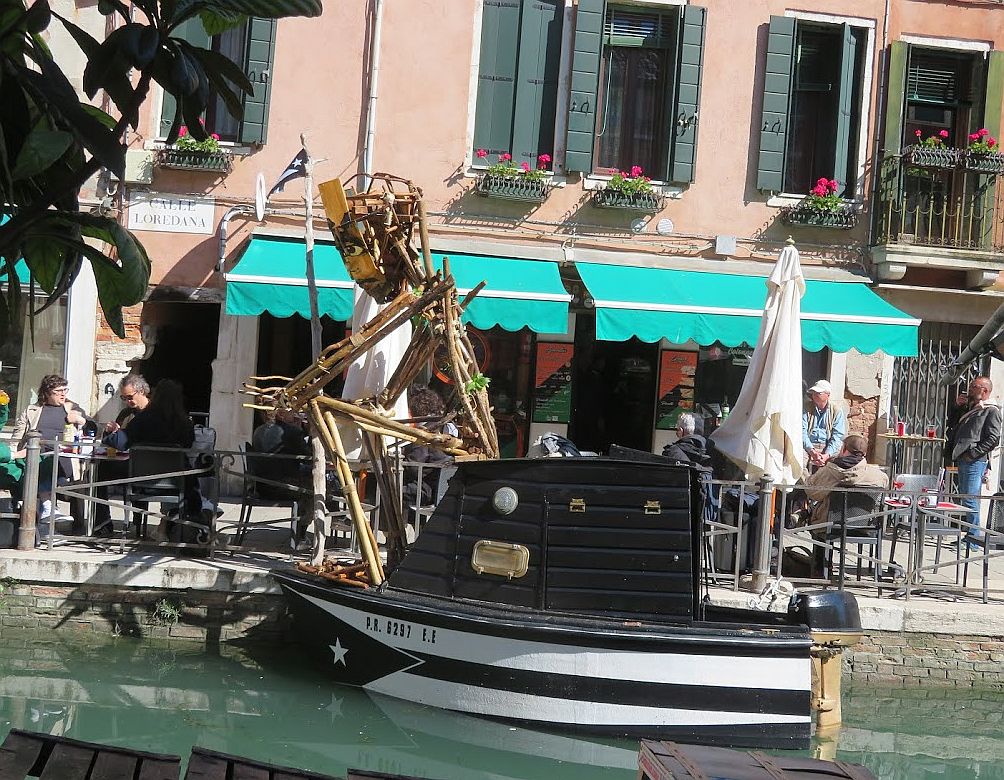
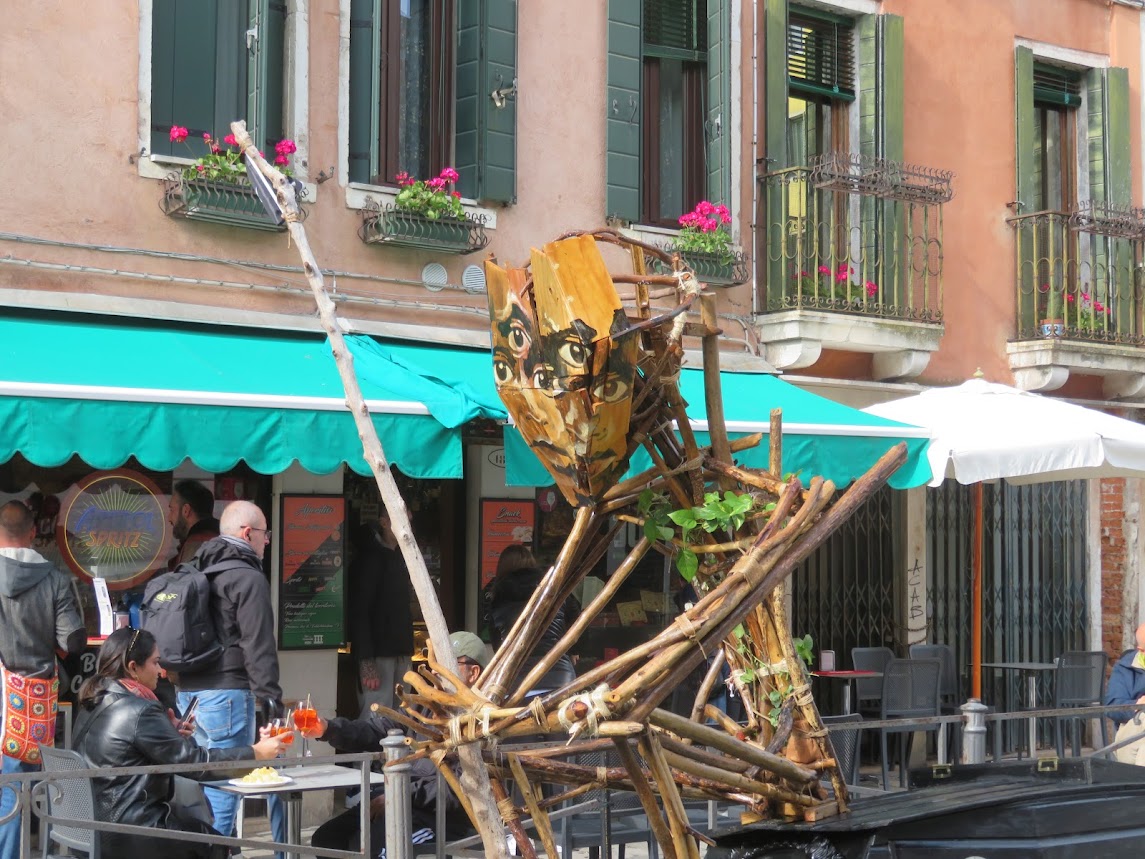
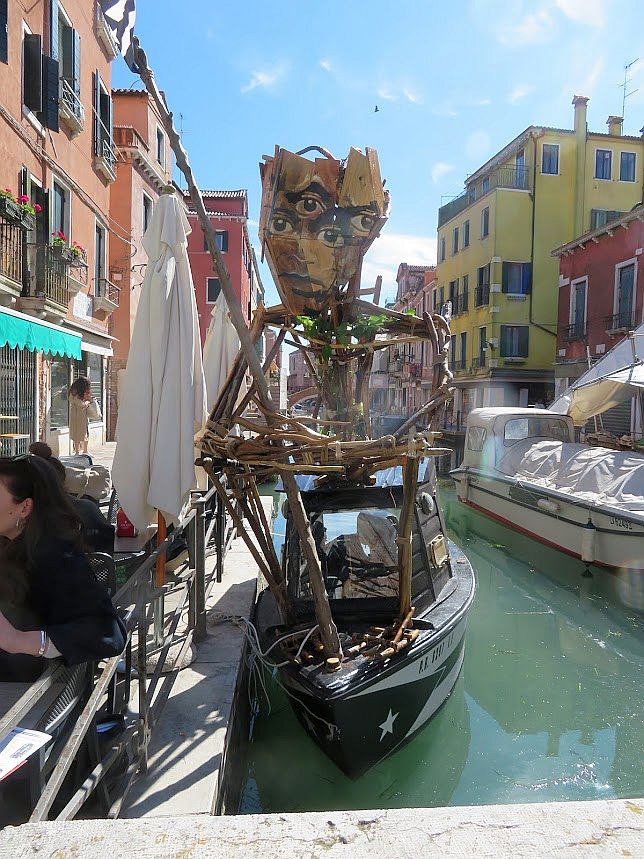
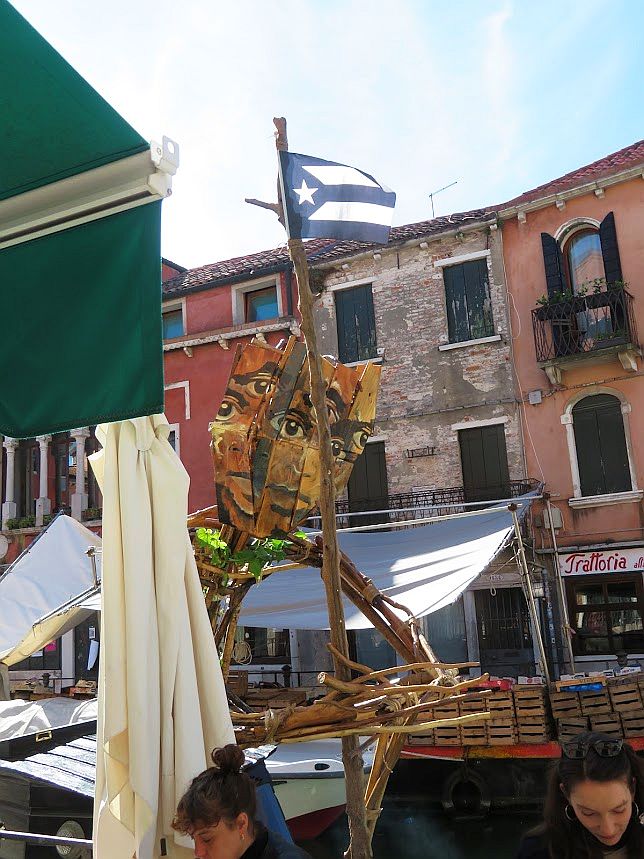
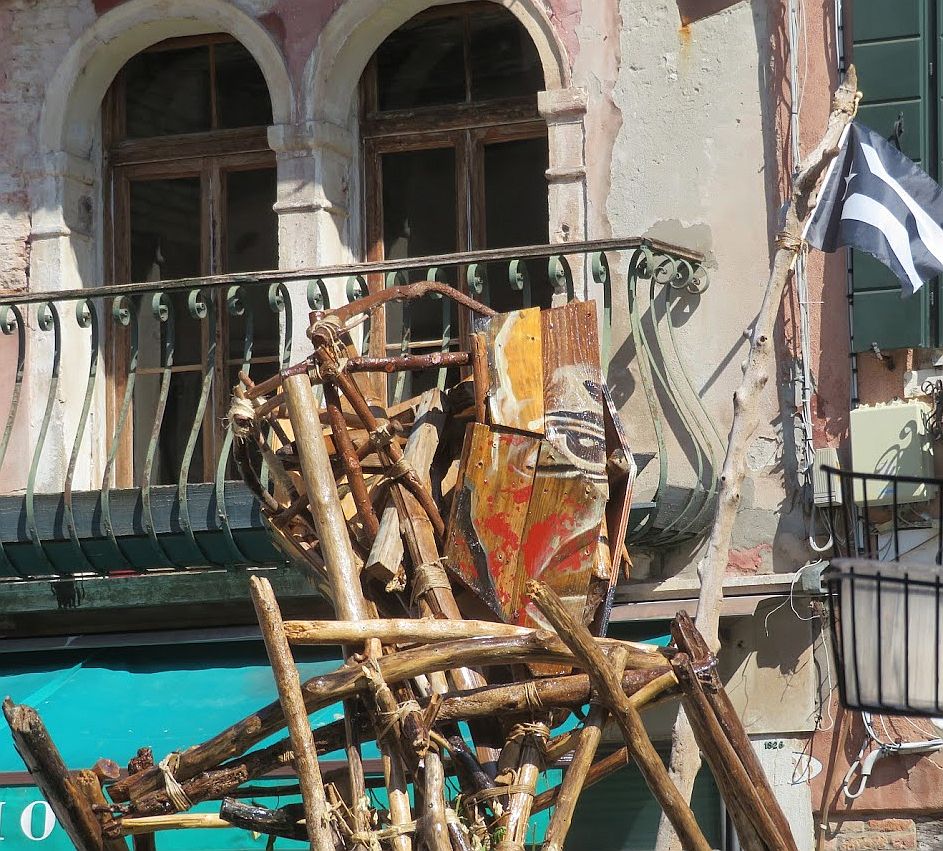
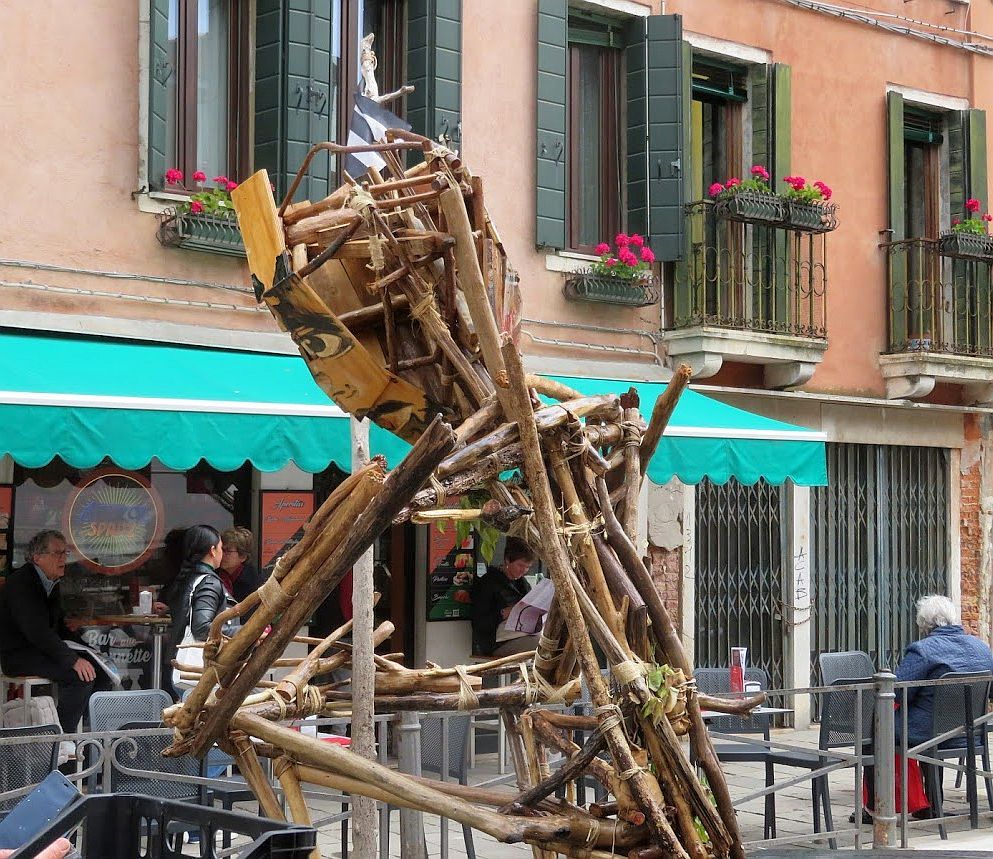
It’s been several years since a boat featured in a work of art here. This construction was the first submission ever made by artists of Puerto Rico, an island whose patron saint is St. John the Baptist, as you know. Here’s what I can tell you as gleaned from an article on venezianews: “The exhibition…reunites some of the best interdisciplinary artists of Puerto Rico… Around the monumental sculpture ‘San Juan Bautista,’ potent symbol of the capital, San Juan, actions, works and performances come to life, incorporating the complexity and the resilience of the Puerto Rican spirit, confronting at the same time the persistent heritage of colonialism and urgent questions of urban injustice.”
The Biennale has opened several weeks earlier than usual this year, and the inauguration was Saturday, April 20. What remained usual, however, was the mass of international art(s) journalists and assorted contributors that swarmed the streets of Castello for the three preceding days.
I usually enjoy seeing the exotic plumage of these migrating creatures, not to mention their extraordinary behavior, but this year netted little. A good friend told me he saw a person in the street wearing a toilet on his head and I’m really sorry I missed that. Lino’s father-in-law was a plumbing contractor and was occasionally seen around town carrying a toilet on his shoulder — clearly he didn’t realize the artistic potential in his humdrum little existence and its porcelain trappings. I suspect that supporting four children during a world war might have limited his frivolous side, if he had one.
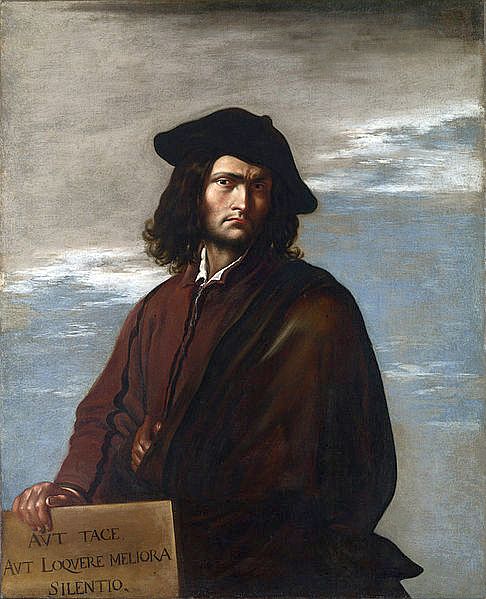
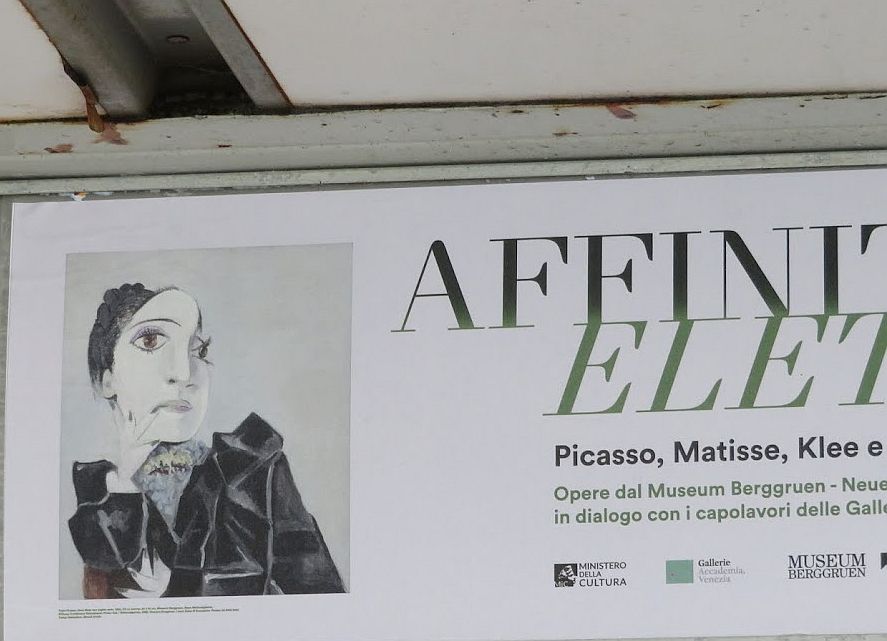
But such a jape would only have appeared frivolous back then, when life was real and life was earnest. Whoever porta’d that potty the other day was doing it seriously. To what end, I can’t say, but everything at the Biennale is done with a degree of seriousness denser than black granite. Along with the art we get diatribes and philippics and harangues, and also sermons and lectures and platitudes. Lots of words that labor to obscure rather than illuminate. Speaking of art — I mean, words — I’m remembering this self-portrait by Salvator Rosa (1645):
Translation: “Be silent, unless what you have to say is better than silence.” He would never make it at the Biennale.
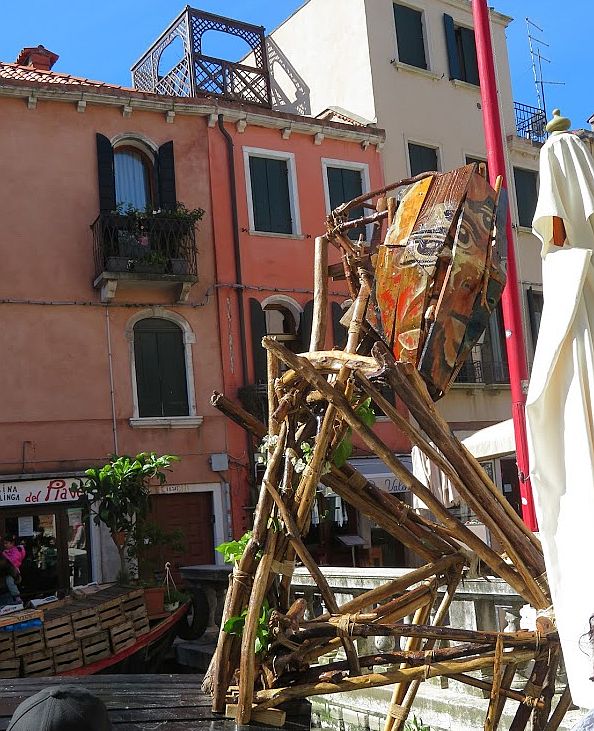
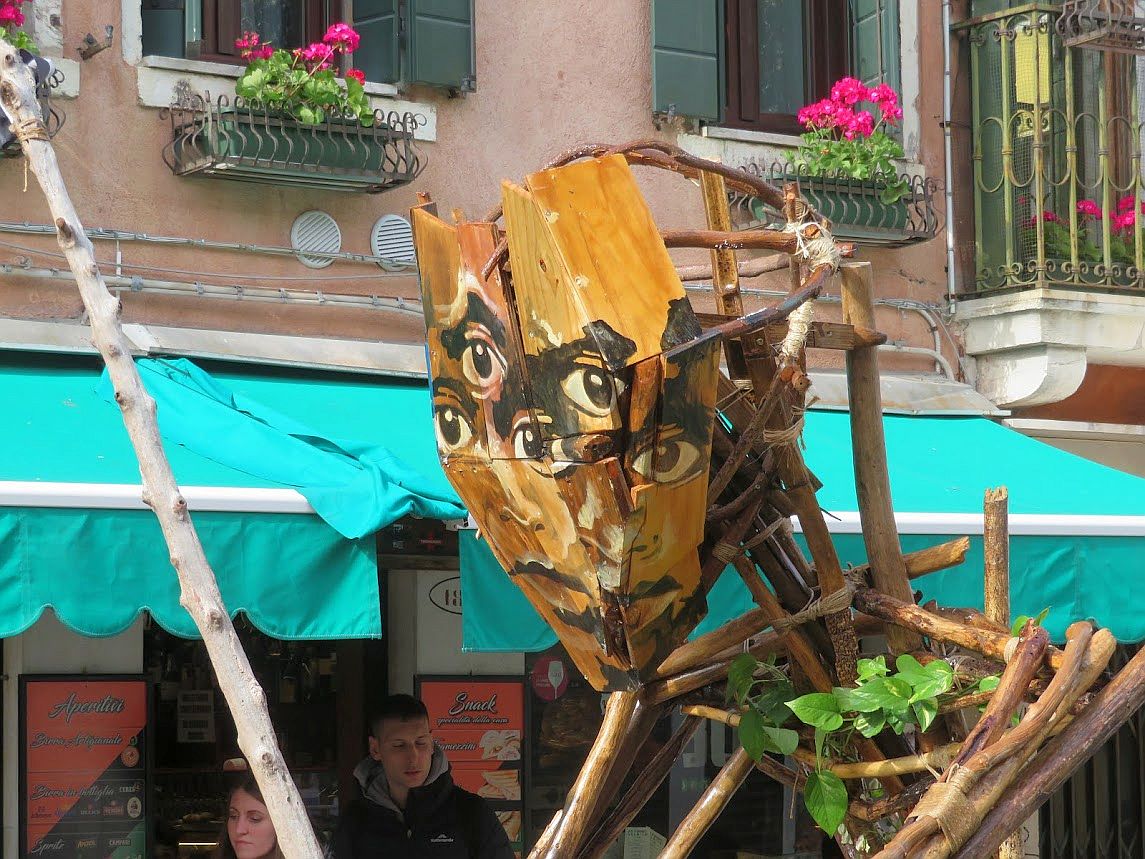
Back to the bony statue on the boat. It has been moored alongside the fruit and vegetable boat at the bottom of via Garibaldi. It will be there till the Biennale closes in November.
After only two weeks he is beginning to fit right into the neighborhood. I’ve already come to like this little dude. Doesn’t bother anybody, doesn’t need anything.
But if you desire meaning, maybe the following will help:
The exhibition reflects the dissociation and exploitation of a colonial political system that has attempted to unravel the fraught complexities of contemporary Puerto Rican identities. The estrangement that is inherent to the colonial status is an extended act of violence resulting in a psychic malaise because of what Anibal Quijano has so aptly described and defined as “the coloniality of power”.
At the heart of the exhibition stands Celso González’ monumental Yola Sculpture, “San Juan Bautista,” a powerful symbol of Puerto Rico’s enduring spirit. This site-specific installation challenges the constraints of its political status, whil honoring the Island’s rich maritime heritage.
Wishing he could have a puppy.
Remembering the little girl he had a crush on in 4th grade.Trying to come up with a system for knowing which contact lens goes in which eye.It’s like living with a floating room full of masks from Oceania.Come to Venice, they said. You’ll have so much fun, they said.Has just missed the next-to-last vaporetto to Sant’ Erasmo and has to wait an hour for the next one. Good thing he’s not hungry. And doesn’t have to go to the bathroom. And isn’t cold. Wishes he’d brought something to read.St. John on the boat got lots of faces but they only gave her part of one. It’s pretty cool that she’s got those independent eyes, though, like a chameleon.
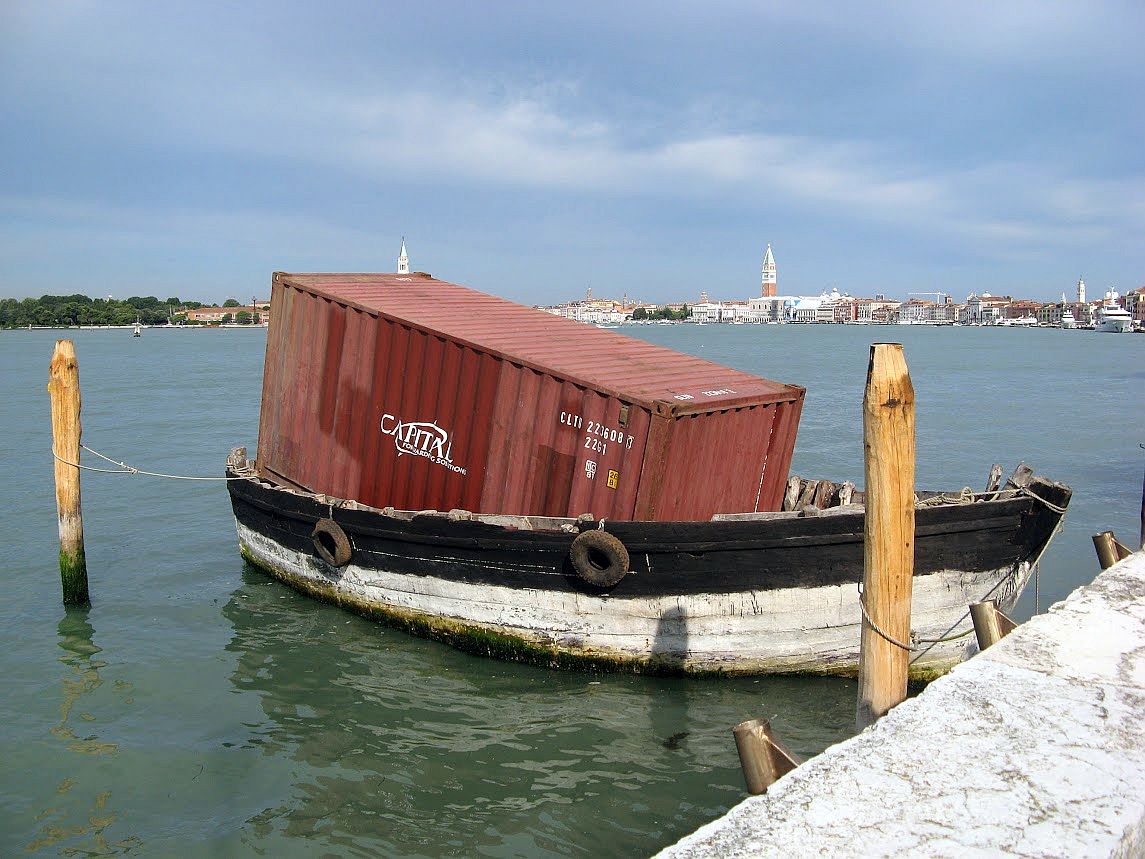
There have been boats at the Biennale before now. The water is evidently an element that helps some projects seem more interesting. Or important.
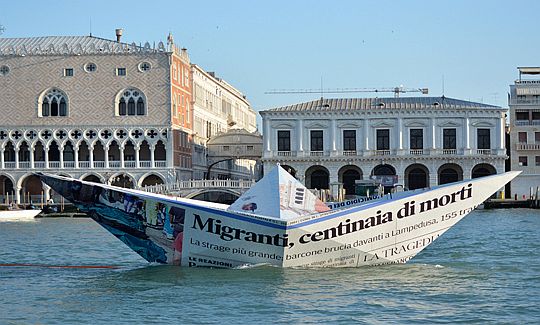
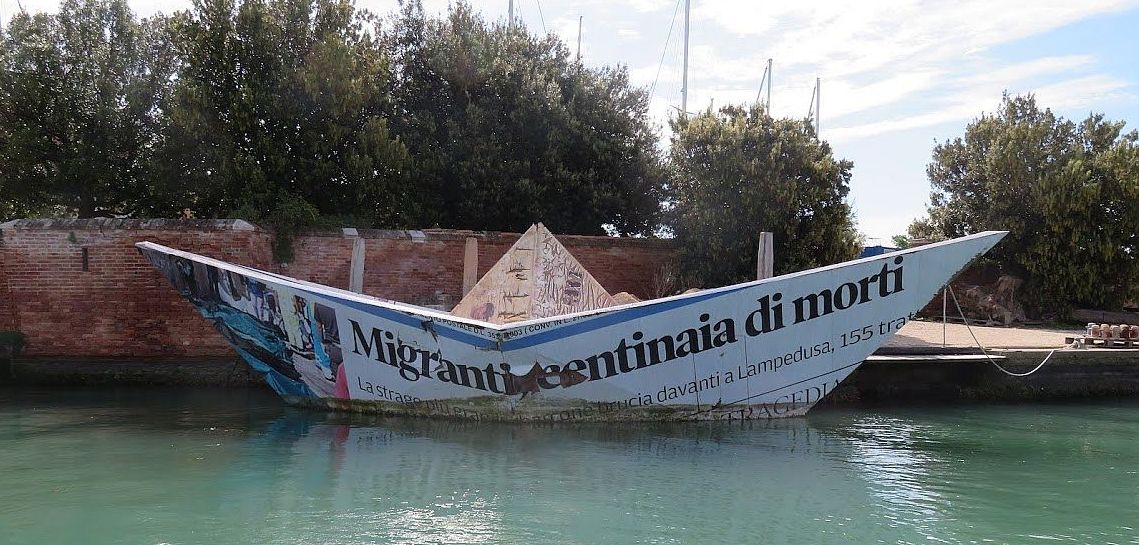
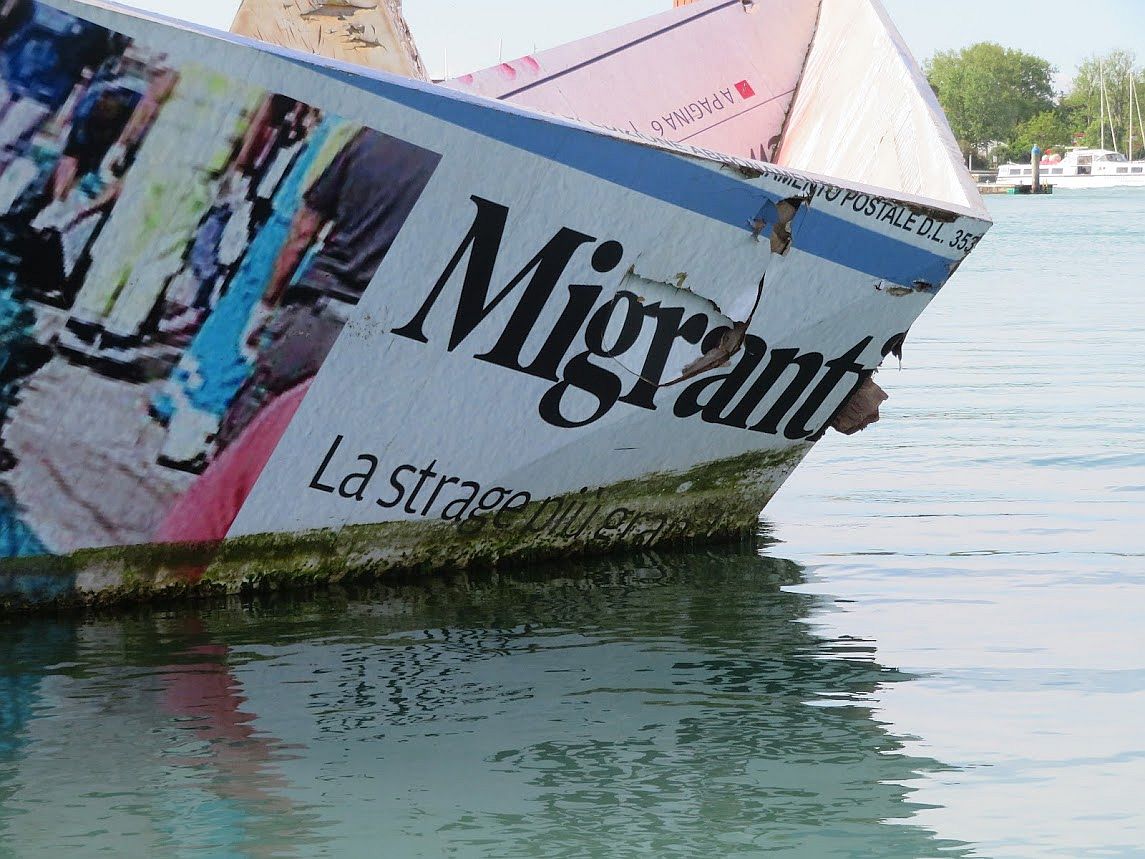
The Comoro Islands sent this in 2009. I can’t tell you anything about it, but then again, you know that if you have to ask, you shouldn’t be here.In 2013, a boat overloaded with desperate migrants capsized on its way from Libya to Italy. “Migrants, hundreds dead” is the headline on the borrowed newspaper that reported the tragedy off the coast of Lampedusa in which 360 persons drowned. How audaciously droll to remind people of the catastrophe in such a blithe and child-like way. (uncredited photo)
Vik Muniz’s floating installation Lampedusa was launched during the 56th Venice Biennale in 2015. The article published in the Haifa Museum of Art publication stated that “the 14-meter-long (45 feet) paper boat was coated with a giant reproduction of the Italian newspaper that reported the tragedy. The gargantuan paper boat drifted along the Canal Grande, Venice’s main transportation route, docking near luxury yachts. As art critic Jonathan Jones wrote in The Guardian, “This art project has been overtaken by real-life horror. Perhaps, in theory, it seemed reasonable to make a vaguely thought-provoking, ‘playful’ piece about migration. But now the scale of our cruelty, the true consequences of all the rhetoric that dehumanises migrants, have become so lethally clear. Surely, art on such a theme should be less equivocal, more angry.”
Well said, Mr. Jones. But this is the Biennale, where scruples find little nourishment.
These objects are occasionally left behind, and Muniz’s has been here for nine years now. No idea who is paying mooring fees at the “Vento di Venezia” marina, or why. If its purpose was polemical it has lost whatever value it might have had; migrants keep drowning.One critic explained that “Vik Muniz employs his traditional use of unlikely materials and scale manipulation to generate wonder from predictability. Contextualized in the naval environment of Venice, ‘Lampedusa’ is … built to scale of one of the town’s traditional vaporettos.”
I’m going to go back to floating St. John. Despite not being any closer to resolving urgent questions of urban injustice or the coloniality of power, I’m starting to feel that we understand each other.
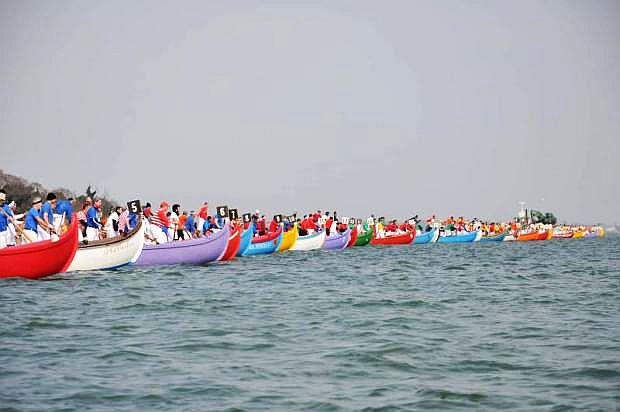
The 38 boats at the starting line stretched across most of the Giudecca Canal between the Maritime Zone and Sacca Fisola. (City of Venice, uncredited photo)
Last Sunday morning was special: Several very different events were rolled into one efficient package, and the sun came out and burned off the mist, and also there were leftovers.
The amalgamated elements were: A Venetian-rowing race, a deft promotion of the next Winter Olympics, and an appeal for world peace that was ingeniously linked to the preceding two. And there was food — oh, right. I already mentioned that.
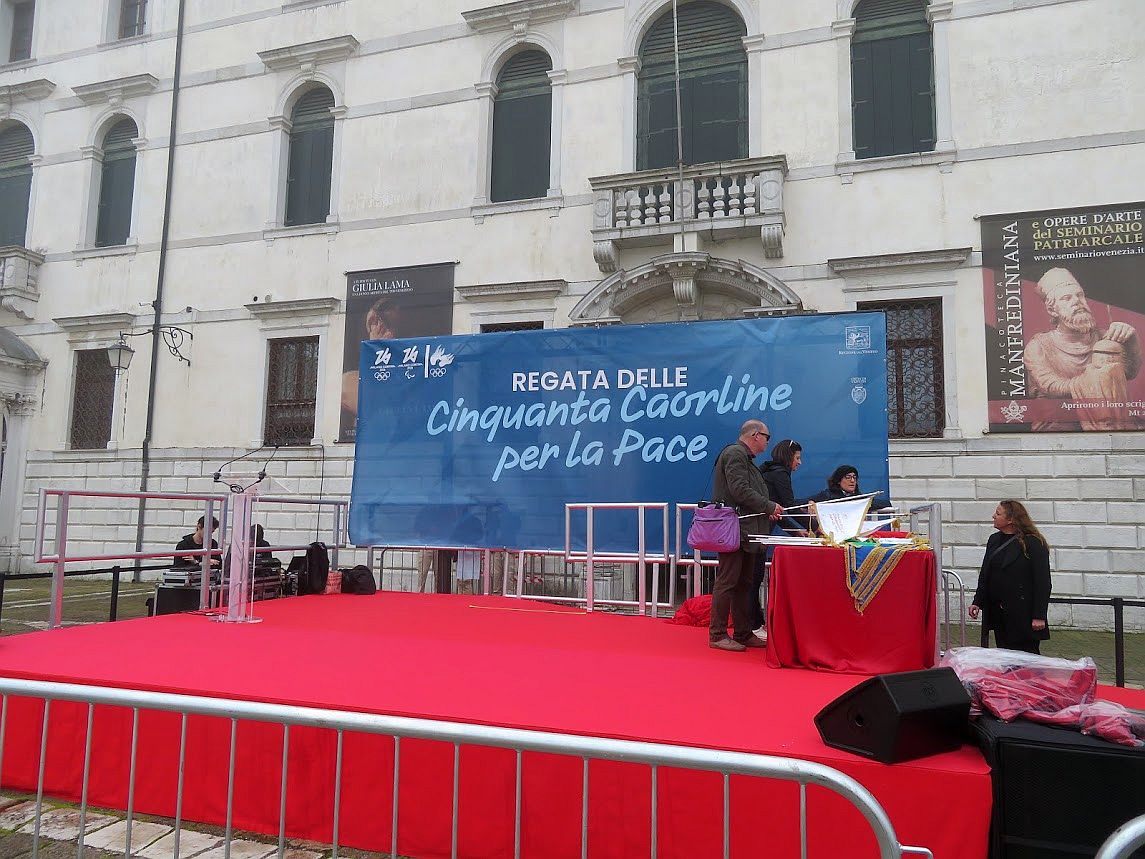
The prize- and speechgiving stand being prepared Sunday morning in the area by the basilica of the Madonna della Salute. Several people are attaching the pennants for the first four boats to finish to their respective little metal sticks.
The race is called the “regata of the 50 caorlinas” to indicate the type and number of the boats involved. Allow me a bit of backstory to help you appreciate it more fully.
Some years ago (I’m estimating as many as 15), there was formed a type of consortium of the local rowing clubs called the Coordinamento Associazioni Remiere della Voga alla Veneta (Coordination of the Venetian Rowing Associations). The consortium still exists in a suspended-animation sort of way, but while it was young and glowing it organized an annual boat festival and race on Saint Andrew’s Day (Nov. 30, as you know) because Andrew is the patron saint of boatwrights, among many other things.
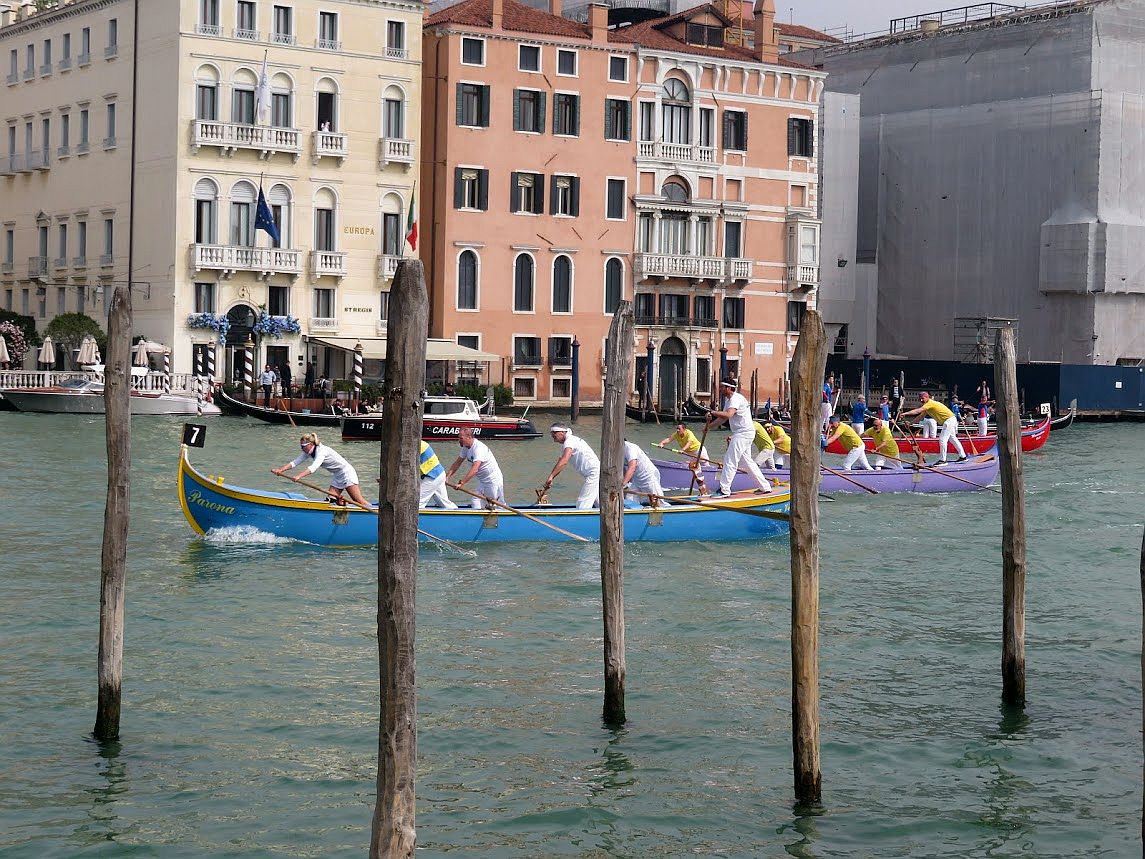
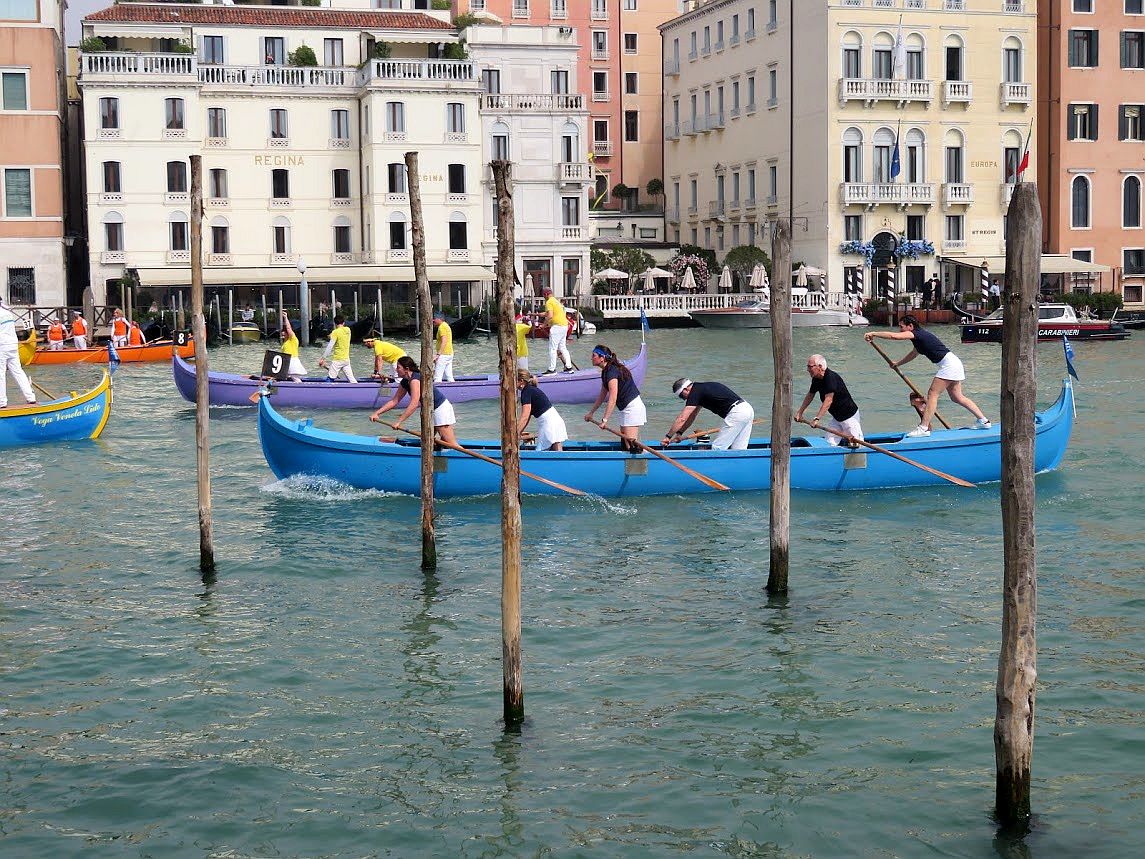
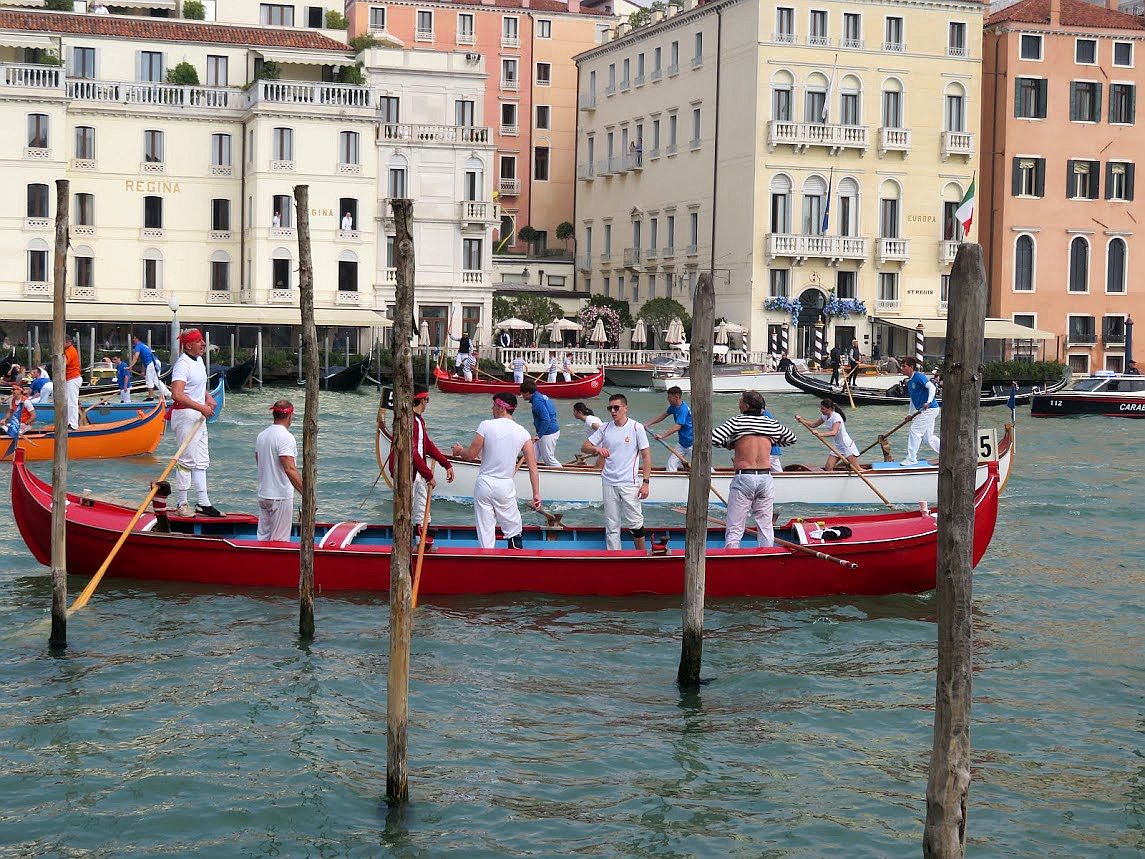
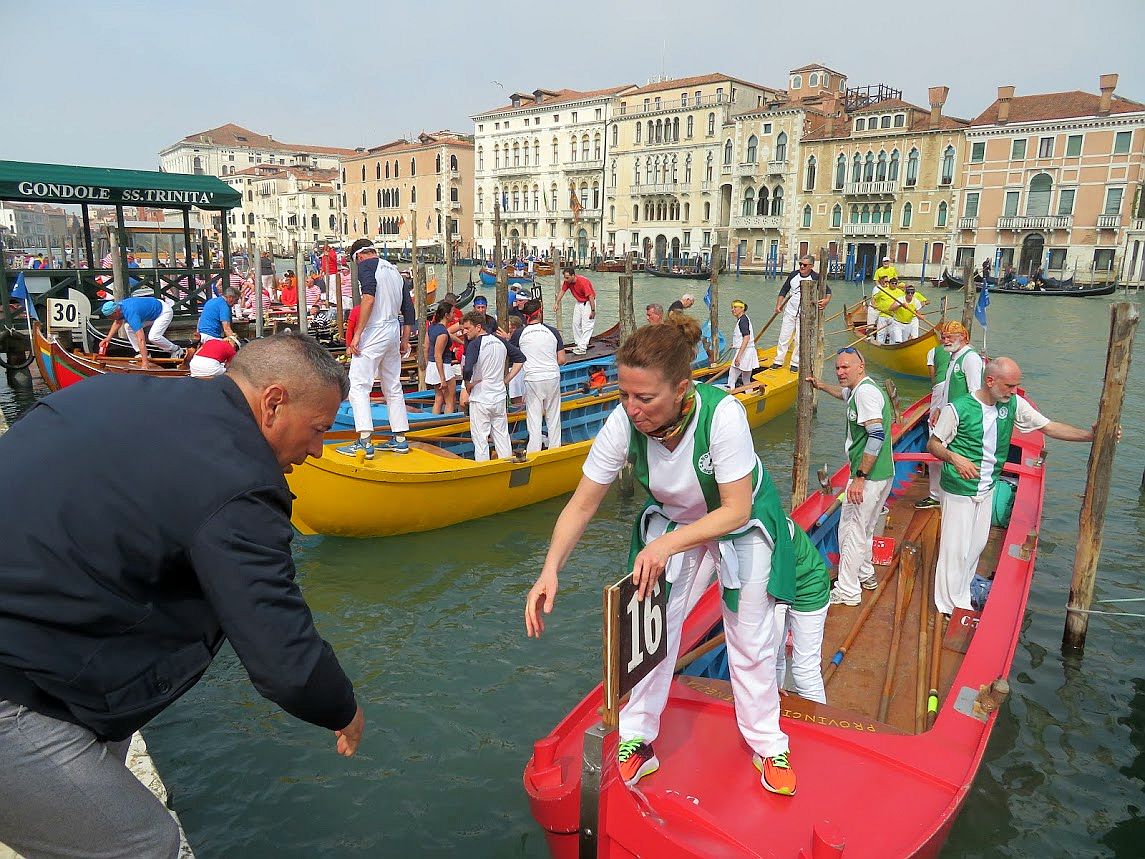
Almost all of the rowing clubs have at least one caorlina — a trusty boat created generations ago for lugging cargo around — and it’s very useful for fun because six people can row it even if they aren’t all at any particular level of skill. It’s a social sort of thing.
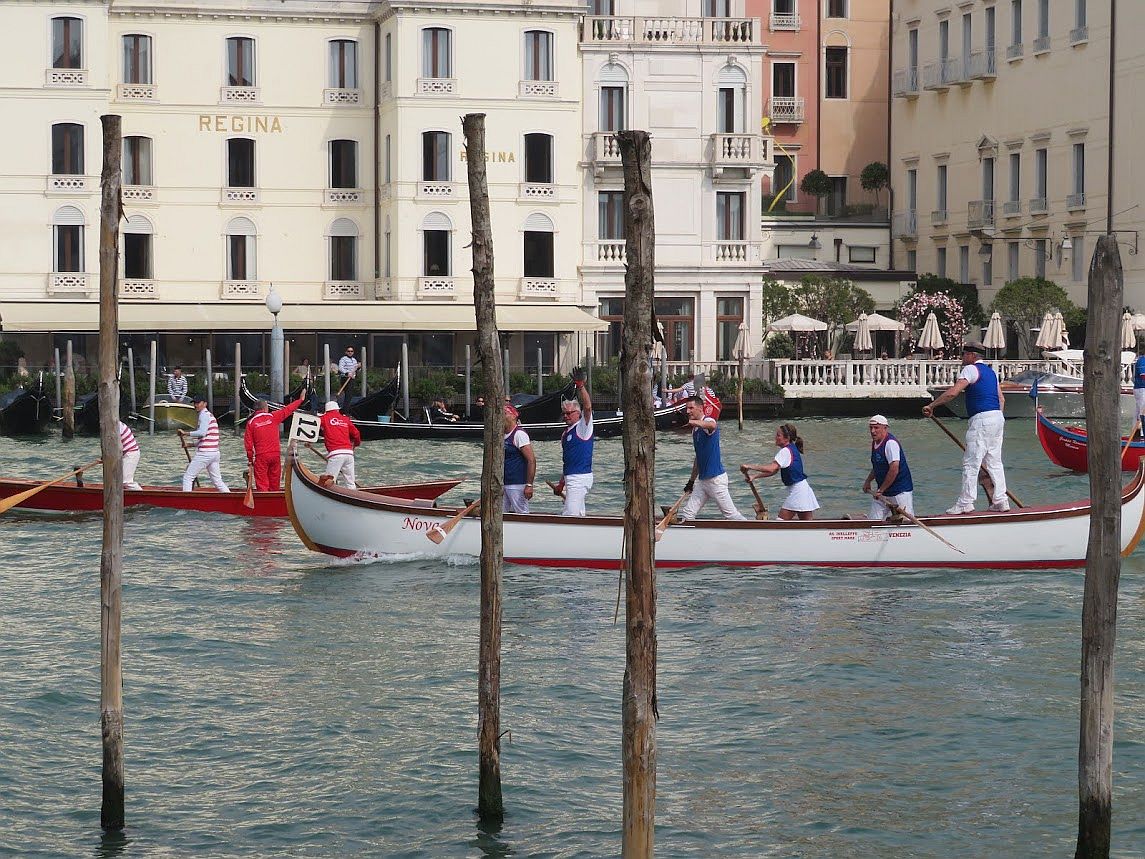
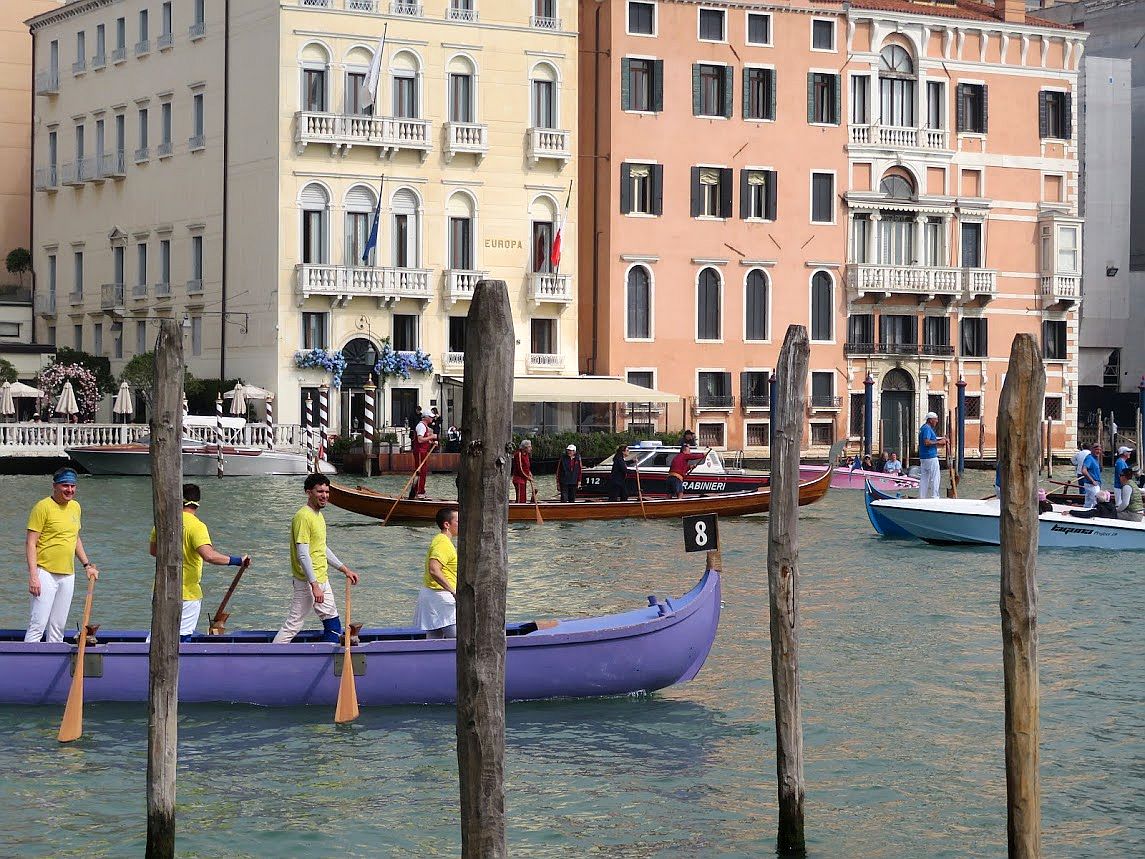
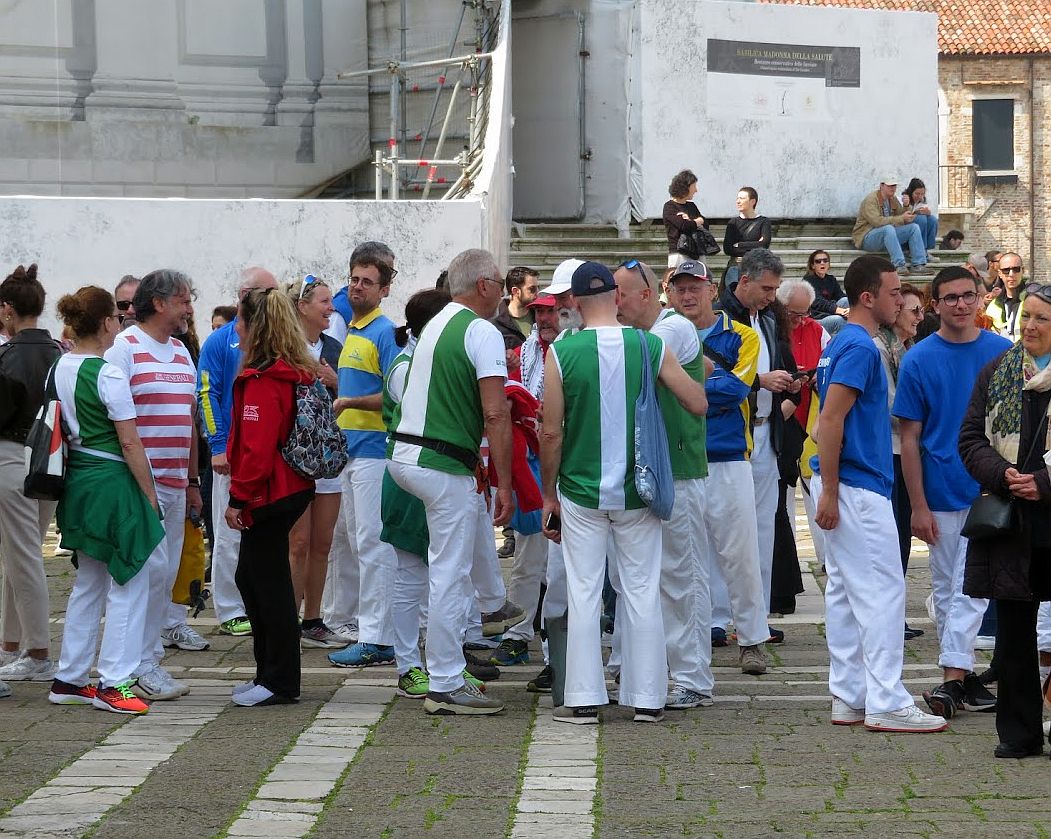
The rowing group of the railway’s after-work sports club was looking fine. As you see, height is no handicap — or, barring extremes, advantage — in rowing. And speaking of work, to their starboard is a four-oar sandolo rowed by members of the Generali Insurance company, out to cheer on or loudly denigrate their team.
So for a few years this race was a great occasion for everybody to just throw themselves into the scrum. Your correspondent participated in one edition and our little crew was quite the mixed bag. I can’t remember our position at the finish — we were pretty far back. Maybe we’re still rowing. Your correspondent also participated for several years in the clubhouse kitchen, preparing and slinging vast amounts of pasta at the ravenous rowers and their relatives and friends afterward. The fame of this little jamboree spread across the Venetian-rowing world, so crews came from Cremona and Florence and Milan and Pavia, and so on. That’s how the number of participating boats rose to a mighty 50. If there was a party for just us rowers, that was it.
The last edition was held in 2018. Then Covid and the lockdown and many other things happened, and no more festa until now. And why now, considering that St. Andrew is on vacation in the month of April? Because April 6 was designated by the United Nations as the International Day of Sport for Development and Peace. And so once again, Venice provides the perfect setting for initiatives or ceremonies that have little, if anything, to do with it.
I’m thinking back to the years when one of the more active and public members of the Coordinamento was vehement in his opposition to traditional rowing events being exploited for touristic or other purposes of promotion. He would shout “We’re not figuranti!” (the costumed performers who parade in period dress to enliven certain events or ceremonies).
But here, in the fullness of time, it appears that what was once something truly local, that had nothing to do with anything but its participants, was suddenly the perfect way to draw attention to other things that have nothing to do with the city or its people. This, without a squeak from the former paladin of Venetian-ness. They like to say that Venice is the world city of peace, but I think it’s more like the world city of irony. But let’s get back to the events.
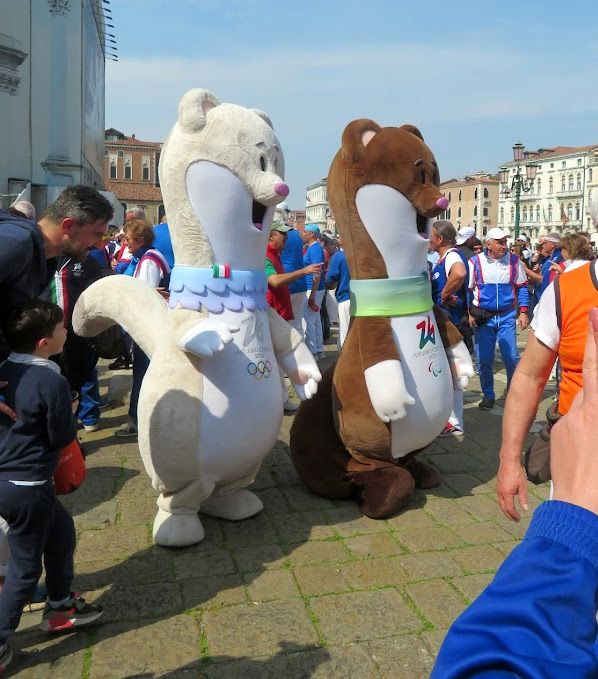
This brings us to the second element: Sport. Not Venetian rowing, per se, but the 2026 Winter Olympics. The venues will be divided between two regions — Lombardy and Veneto — and naturally Cortina d’Ampezzo, the Pearl of the Dolomites, represents the Veneto. Cortina is arguably one of the most famous names in winter sports, having hosted the winter Olympics in 1956. So Sunday’s race was an extra-Venetian way of publicizing the Olympics, and also — did you notice? — the Veneto Region. It was a match made, if not in heaven, certainly in many offices, bars and restaurants.
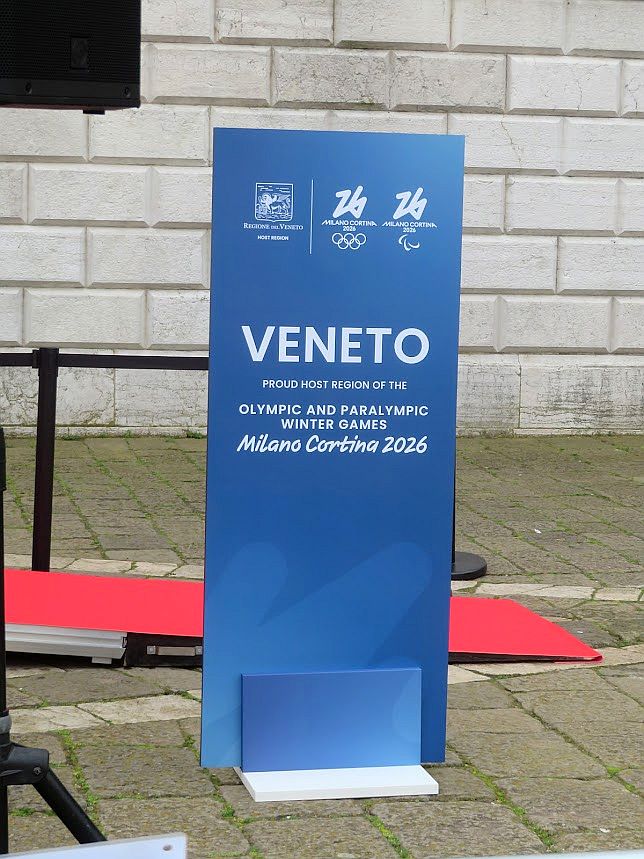
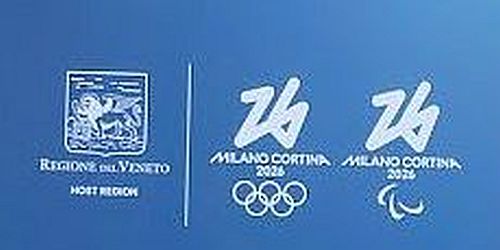
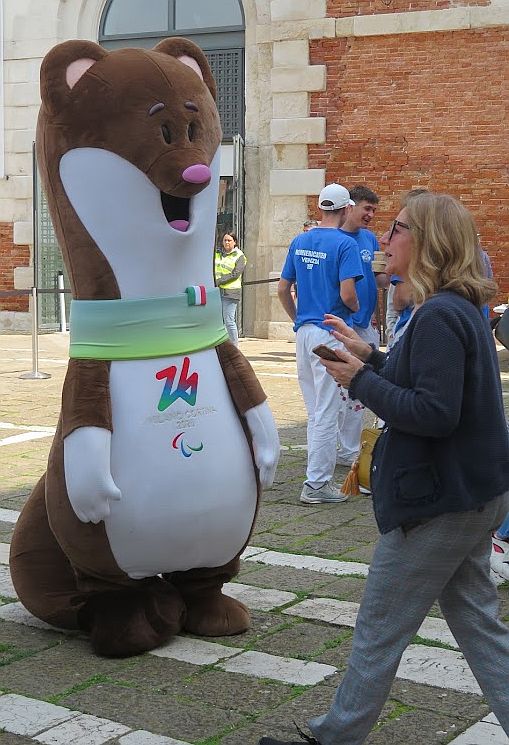
It took me more time than it should have to decipher the ultra-designed emblem. The Veneto is identified as “host region,” and the two star cities, as you see, are Milano Cortina. The three-swirl symbol on the right is for the Paralympics.
Third and final element: Peace. We all need it and want it, and the Olympics were a fine reason to ask Antonio Silvio Calo’, president of the Fondazione Venezia per la Ricerca sulla Pace (Venice Foundation for Research on Peace) for his thoughts on the subject.
Bonus points: The regional councilor for sport, Cristiano Corazzari, drew our attention to the “Ancient memory of the ‘Olympic truce,’ that it should continue to be the central theme to evoke the profound value of the Olympics.” If the long jump and the luge can promote peace, I say let’s extend the Olympic truce for the next 250 years.
Fun fact: The sacred truce did not put a stop to all warfare, only to conflicts which hindered the games. (Always check the fine print before signing anything, especially a truce.) The truce protected travelers on their way to the sanctuary and only forbade military operations against and by the organizing city. But even this truce was breakable. In 420 BC, the Spartans were excluded from the Olympic games because they had attacked a part of the Elean territory. In 364 BC, Arcadian soldiers even attacked the holy domain of Olympia during the games. So seek it as you will, peace appears to remain an elusive and fickle ideal.
Back to Venice. Boats, Olympics, and peace got wrapped up together, and then we ate bigoli in salsa and went home. The caorlinas and their rowers went home, the Olympics went back to the offices and the construction sites, and peace is yet to be found. If only we could remember where we put it the last time we used it.
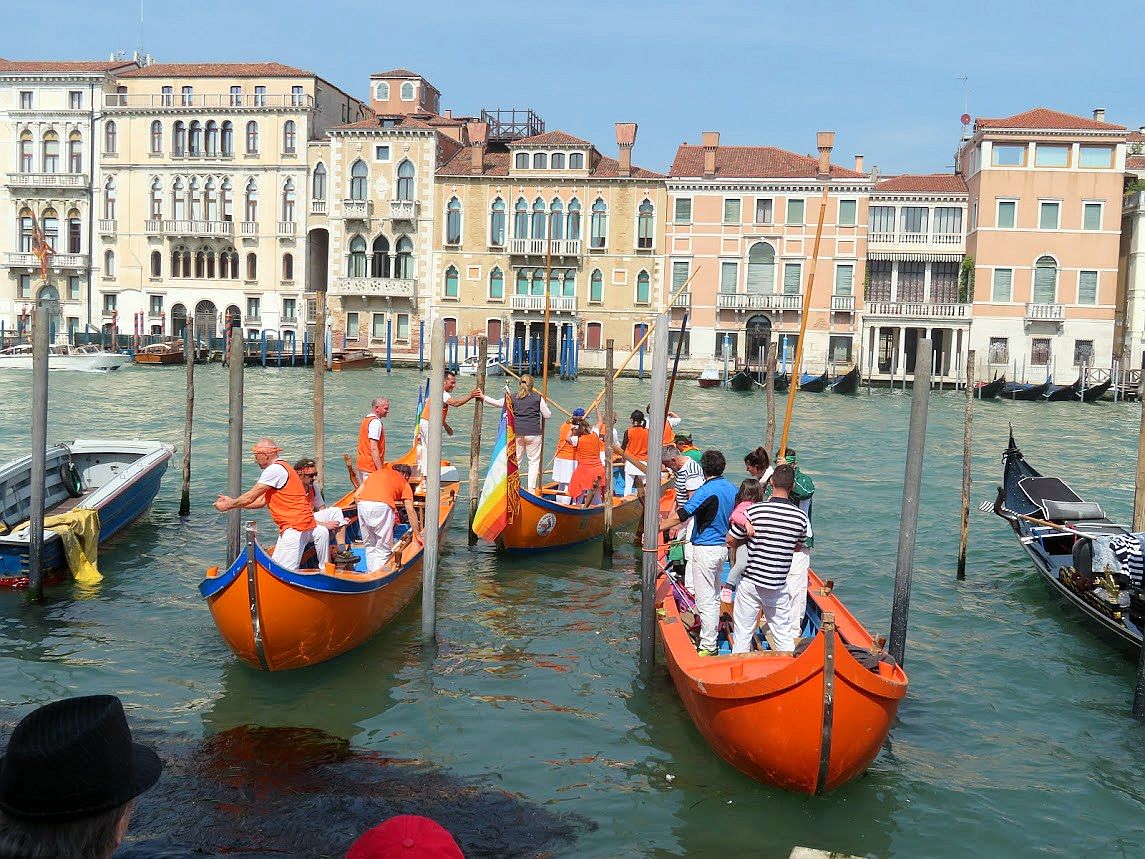
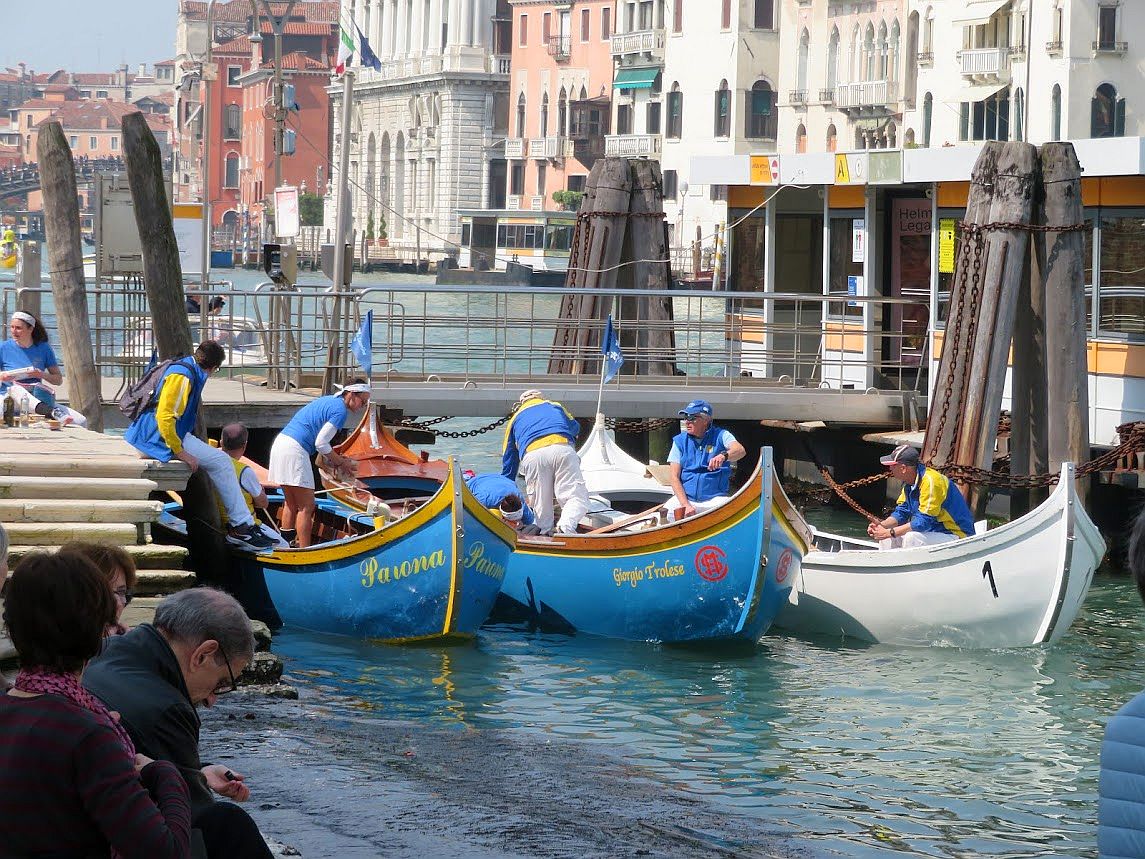
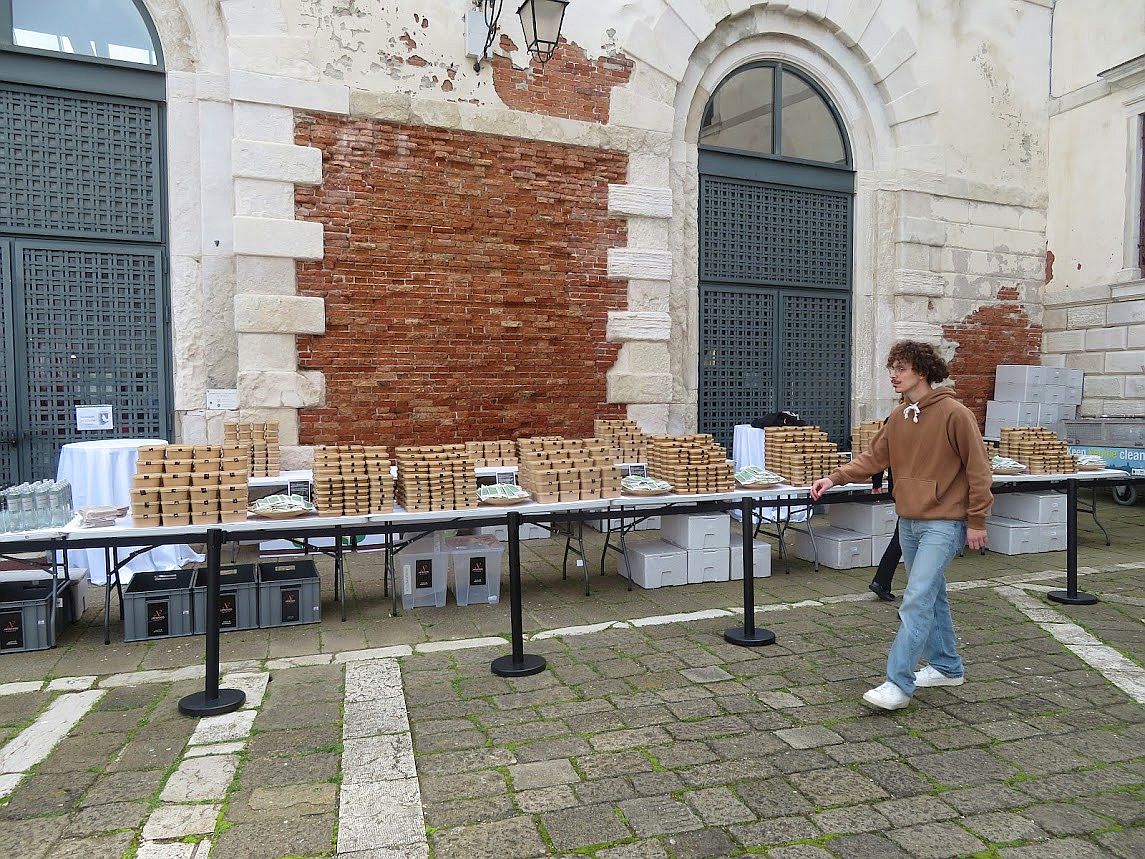
Some members of the Bucintoro club came out on their six-oar gondola to watch the proceedings. Anything on the water looks better when seen from something on the water.The gondolas that are usually tied up here are either at work or have been sent elsewhere for the morning. Thirty-eight caorlinas have to find somewhere to dock.Several clubs sent more than one boat. The orange-and-blue rowers from the Voga Veneta Mestre were out in force.Ditto the hardy members of Voga Veneta Lido, who rowed not only their own two caorlinas but borrowed one of the city’s set used for official races.The Canottieri Mestre, green and white, sent their best.The Olympics mascots were bouncing around. Tina (Cortina) on the left represents the full-bore Olympics. Milo (Milano) on the right stands for the Paralympics. As you can somewhat see, his tail and right foot are not like hers. The story is that he was born with only three legs, and has learned to use his tail instead to help him walk. His motto: “Obstacles are trampolines.”A slightly better look at Milo’s right foot. The normal right foot of the costume has been covered by the end of the tail, which is looped around the foot. The animals are stoats, otherwise known as ermines. I haven’t discovered why they were chosen, but I’m sure there’s some significance somewhere.Finally the refreshments. In a departure from the usual vats and cauldrons and countless plastic plates, the Art & Food Group catering organized portions of bigoli in salsa — one of the most basic and primordial Venetian dishes — neatly boxed in recyclable and/or compostable materials. Incredibly efficient. The leftovers were sent, it was said, to the Emporio della Solidarieta’, a type of local food bank and assistance organization.
If you’re in the mood to live the race, here goes. The race itself begins at about 6:00.