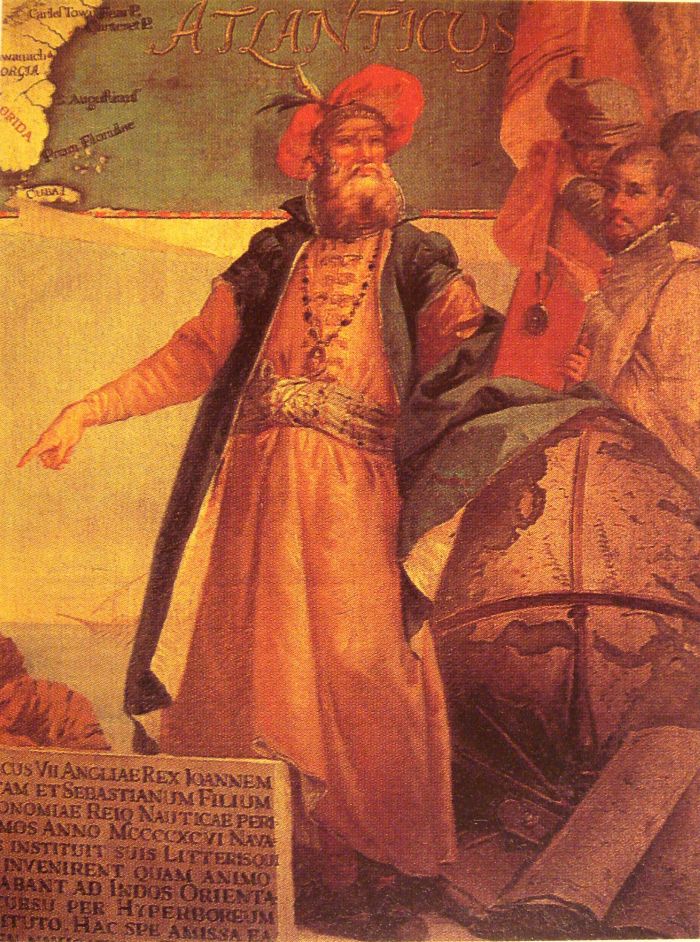
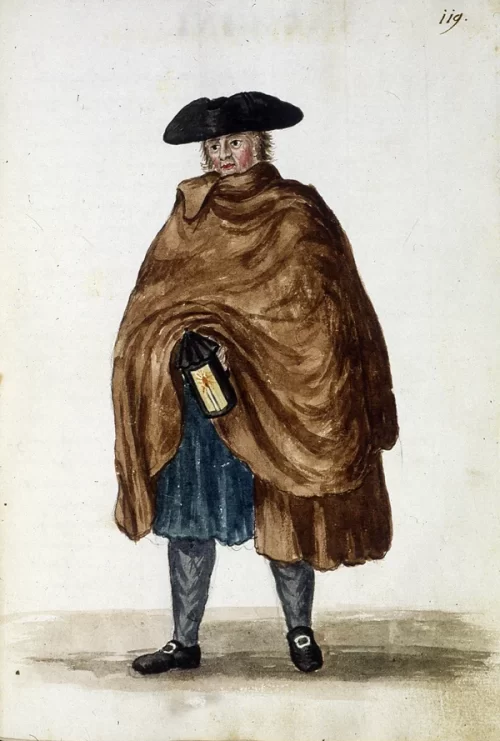
This is Giovanni Caboto as painted by Giustino Menescardi in 1762. Accuracy of detail limited by the fact that Caboto departed on his third and final voyage in 1498 and was never seen again.
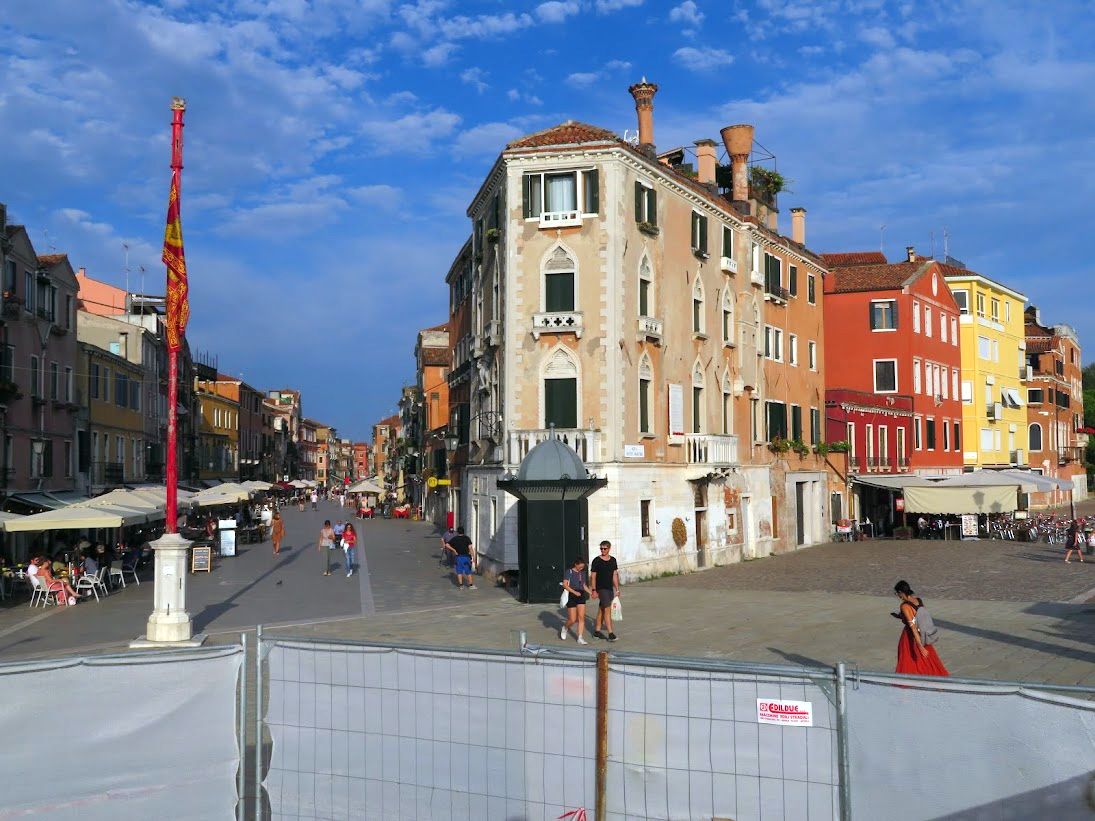
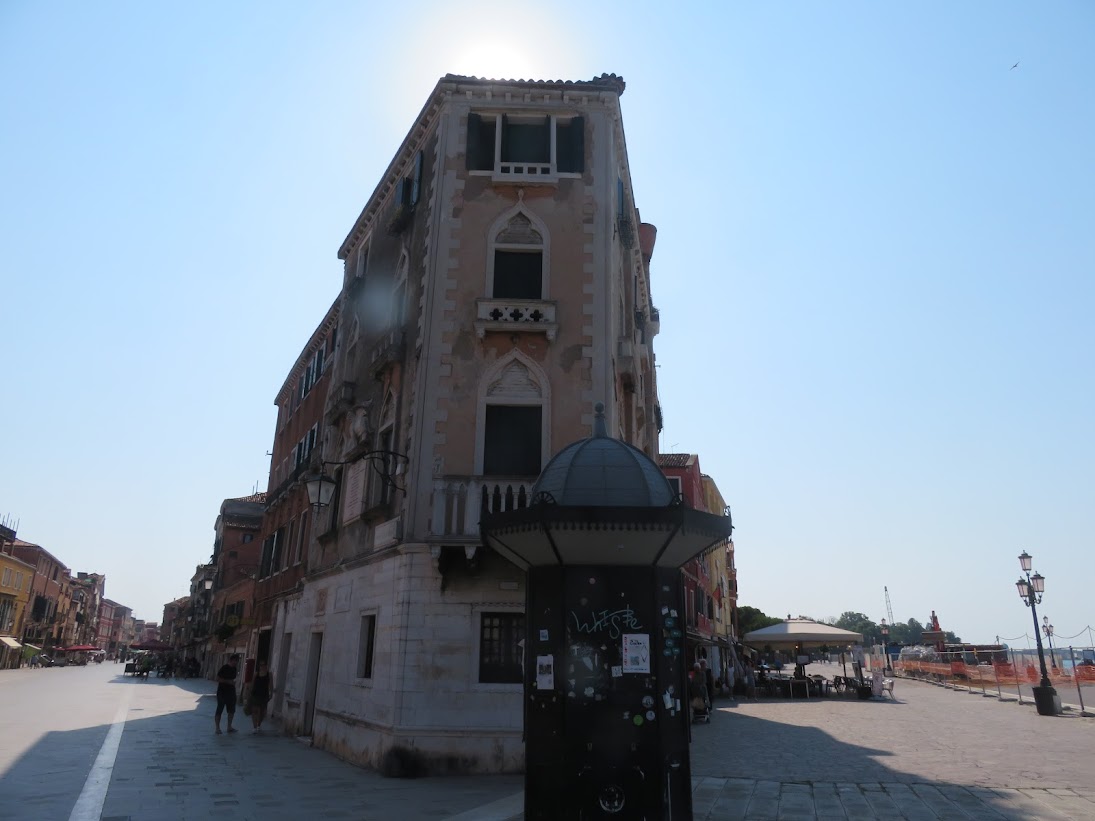
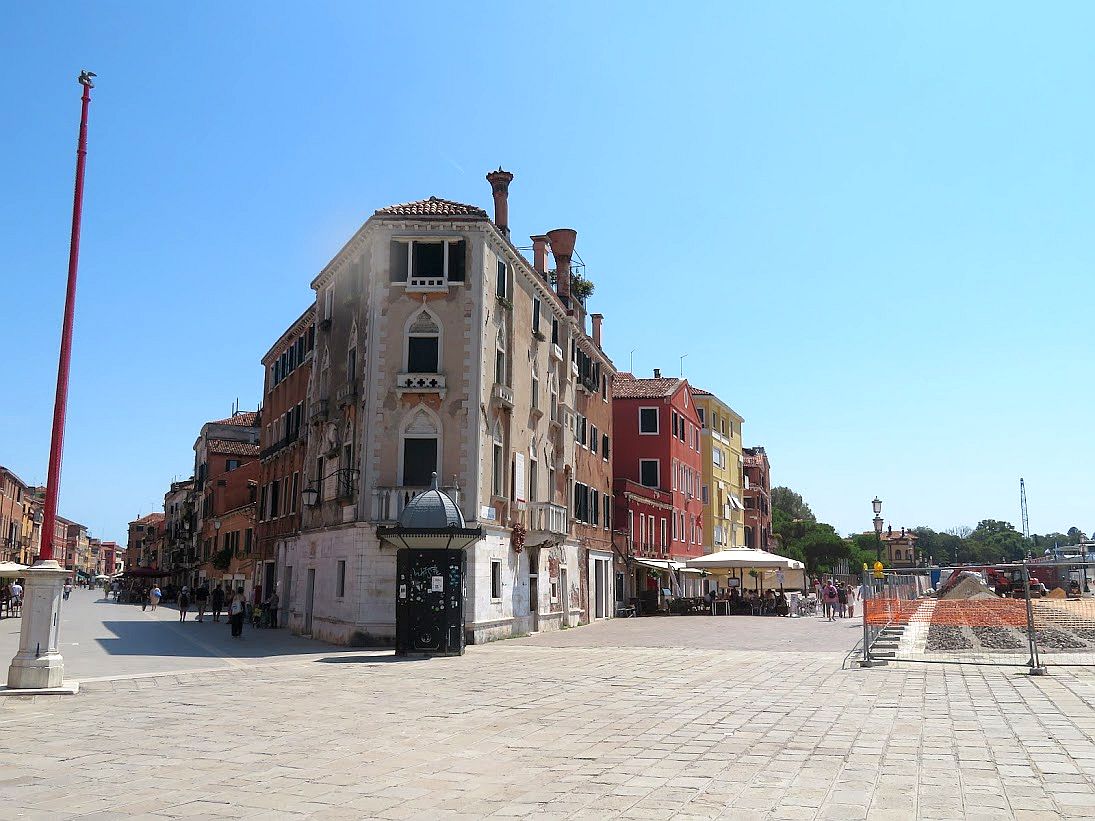
Giovanni Caboto (John Cabot) was not only a rockstar navigator/explorer, he was also a Venetian citizen and lived in what I consider to be something of a rockstar house: Palazzo Caboto. You’ve seen it at the top of via Garibaldi, dividing that street from the Riva Sette Martiri. And I wouldn’t be writing anything about him or the riva if I hadn’t had the chance to go inside it not long ago, thanks to an exhibit that was part of the Biennale.
As with so many Venetian houses, the builders managed superbly with the space they had available.
Some sources maintain that his family was originally from Gaeta, near Naples; another source says that “John Cabot’s son, Sebastian, said his father originally came from Genoa. Cabot was made a citizen of the Republic of Venice in 1476; as citizenship required a minimum of fifteen years’ residency in the city, he must have lived in Venice from at least 1461.”
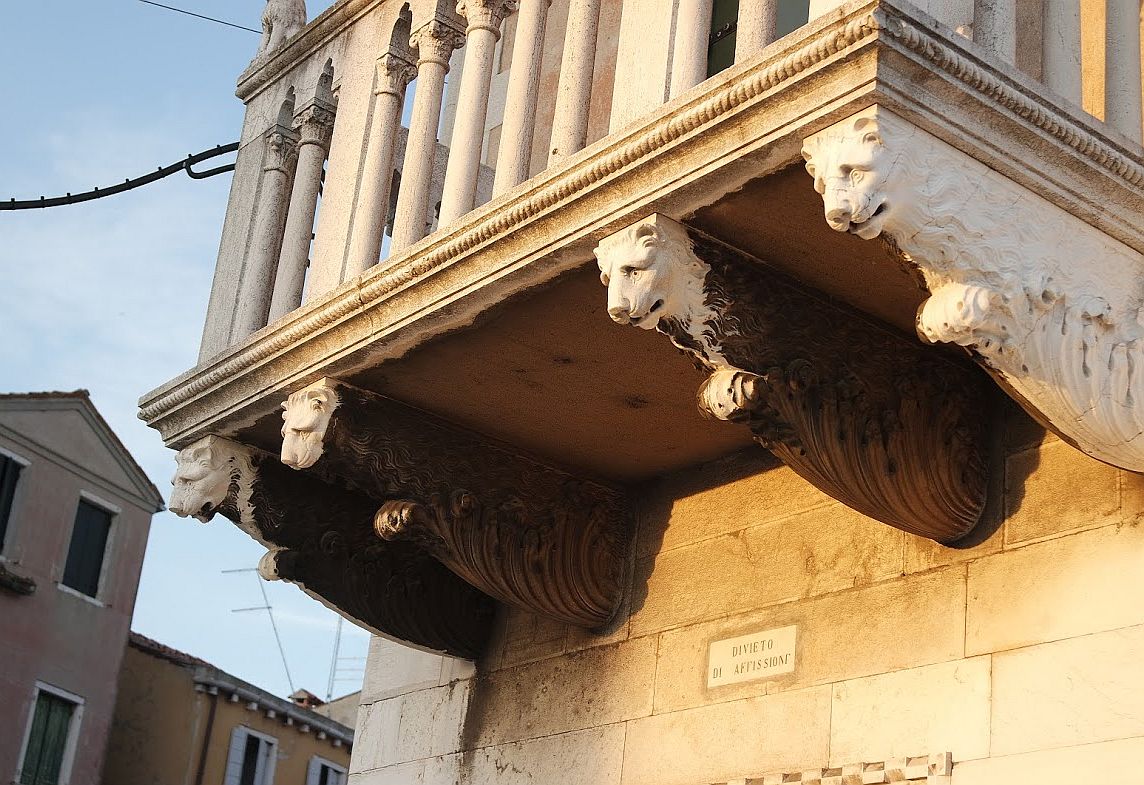
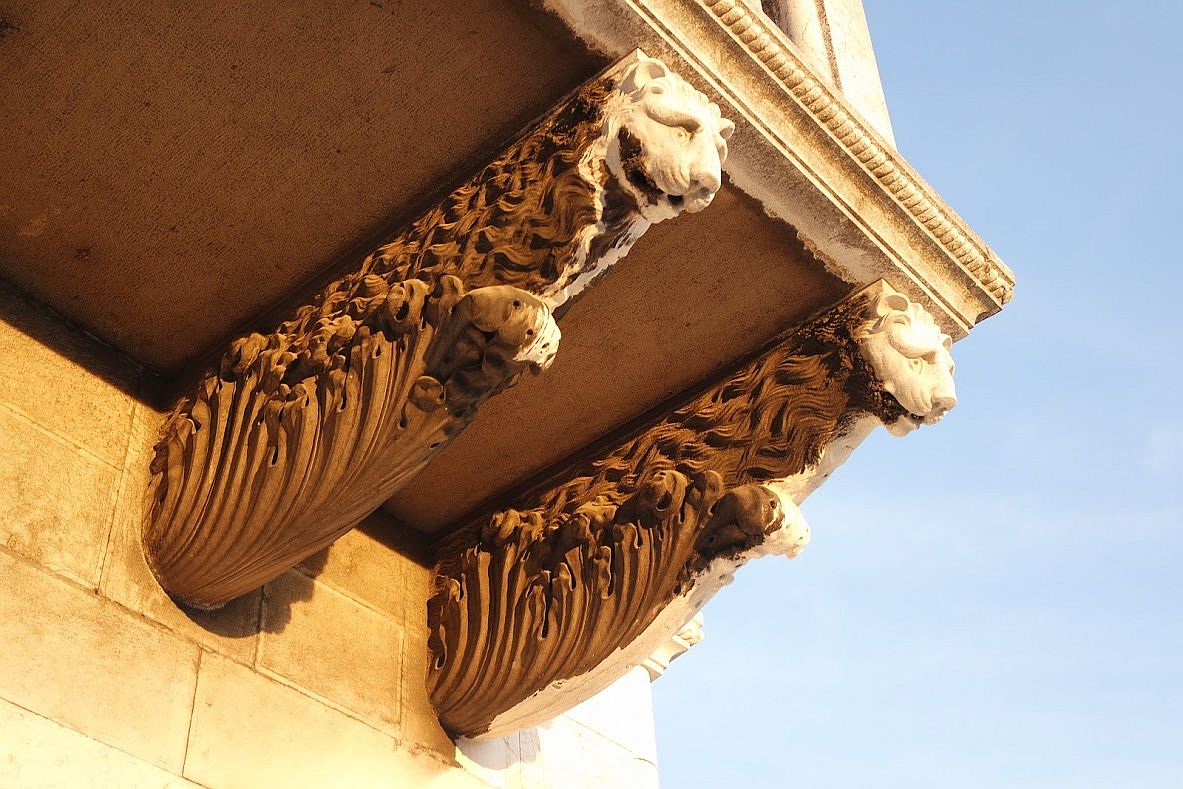
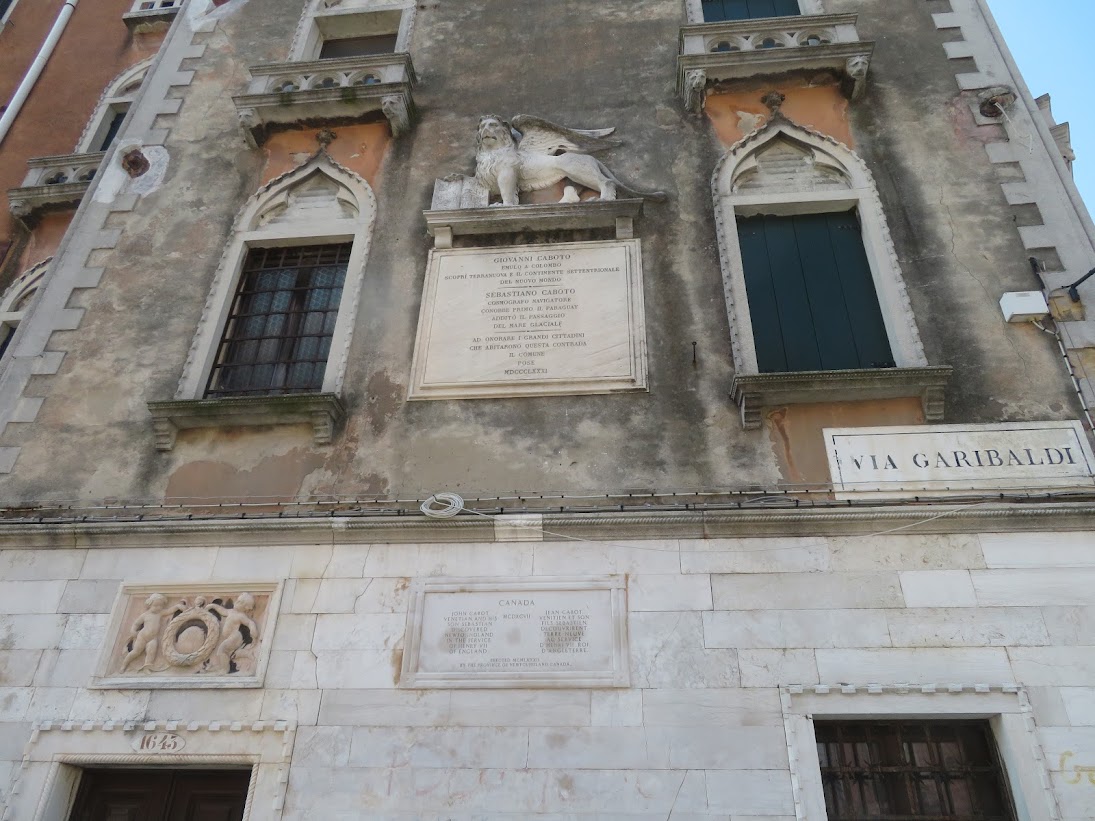
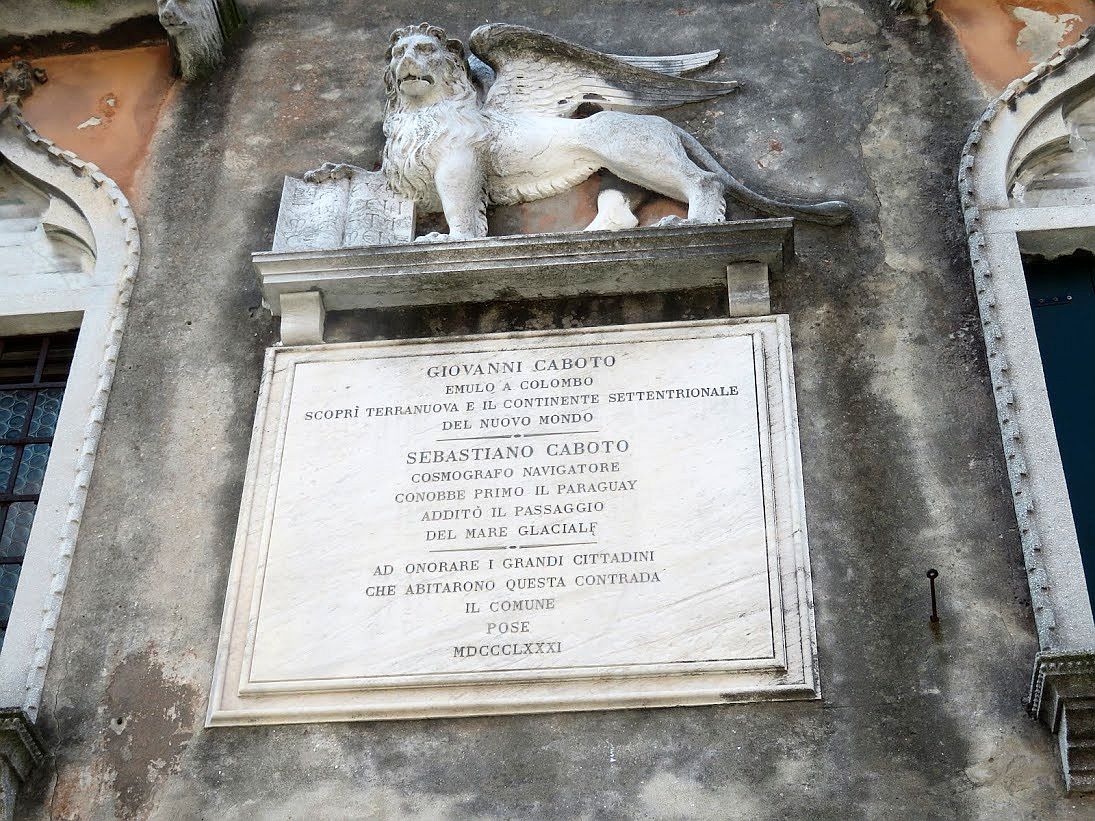
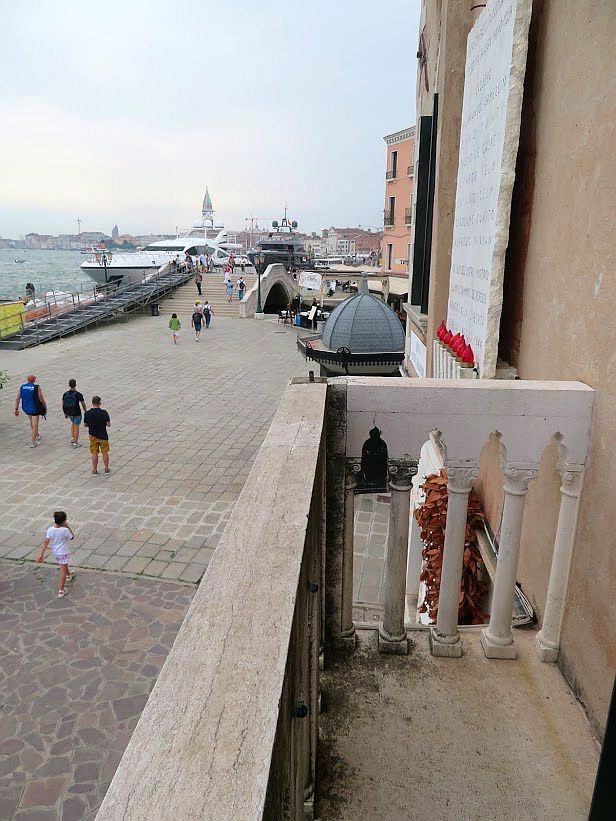
To somebody accustomed to spending years on a ship, this could have seemed attractively normal. Except that it wasn’t moving, of course.The lions rule the waves on this bijou balcony. I’m not sure which is more ripply, the acanthus leaves or the feline tresses. Only thing missing are a few barnacles.The waves and fronds are delightful. Full speed ahead.On the landward wall are these imposing plaques.It says: “Giovanni Caboto emulated Columbus discovered Newfoundland and the northern continent of the New World. Sebastiano Caboto, cosmographer, navigator, was the first to know Paraguay pointed to the passageway to the glacial sea. To honor the great citizens who lived in this district the Comune placed this 1881.”
So much for the basic background on the indomitable Caboto.
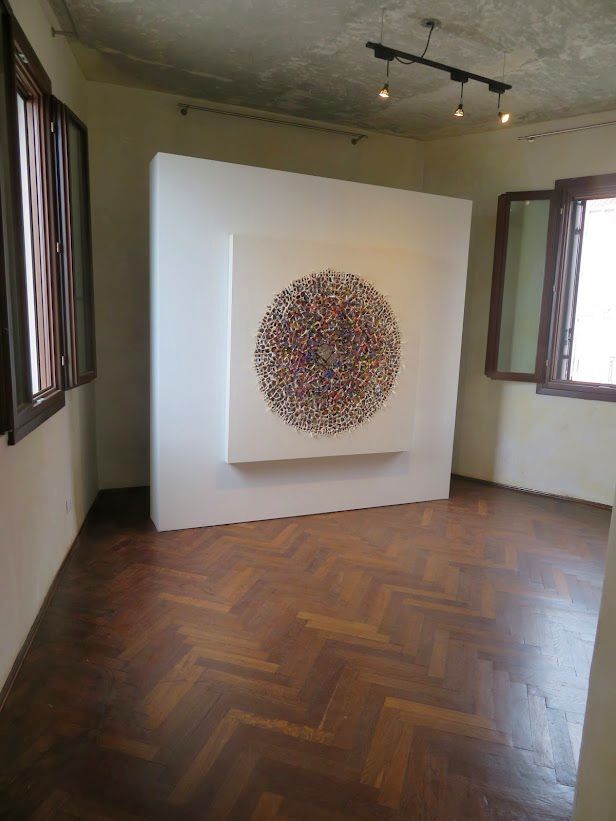
For the first two months or so of the Biennale this year the house was hosting an exhibition by Korean artist Shin Sung Hy. My interest in contemporary art is skittish, but it was my first chance to see the house itself. So I invited myself into what was designated Gallery Hyundai.
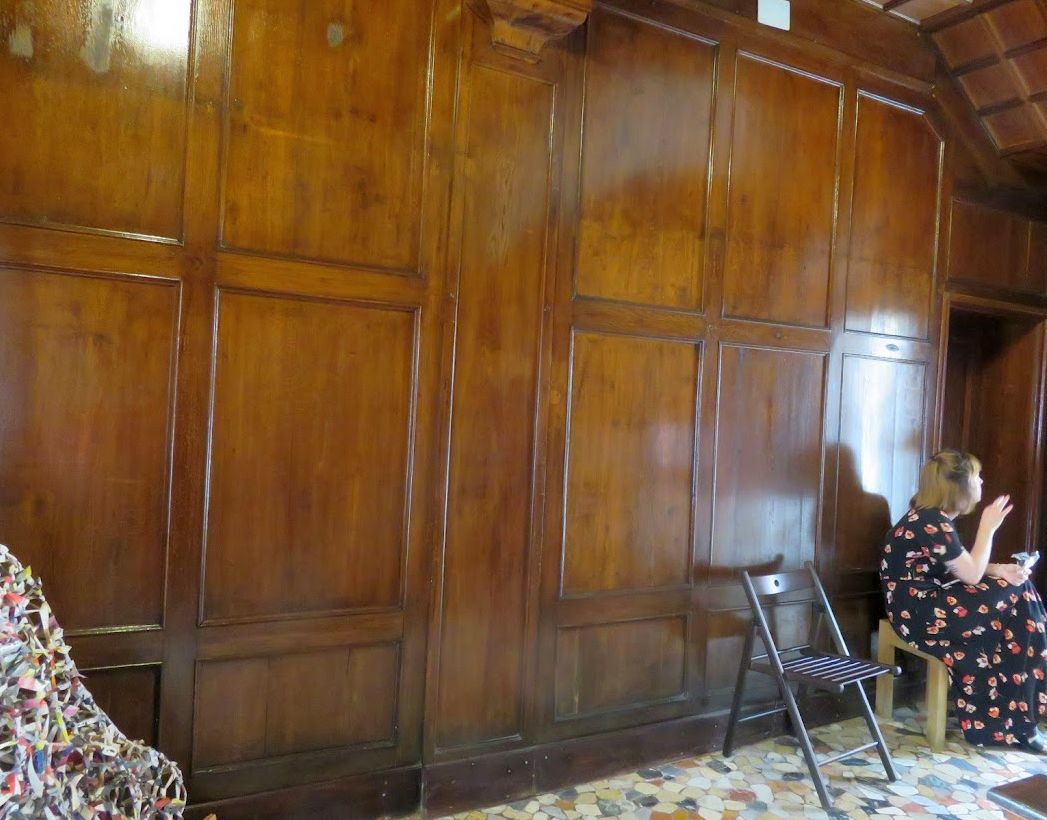
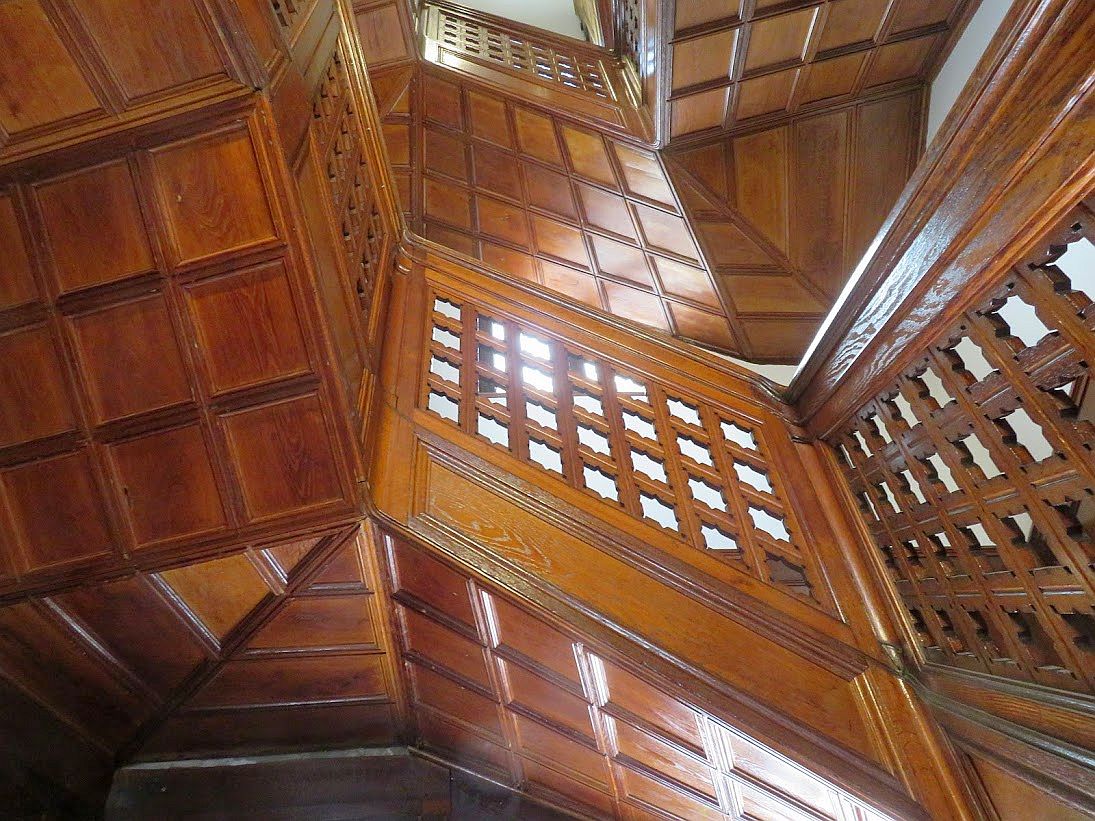
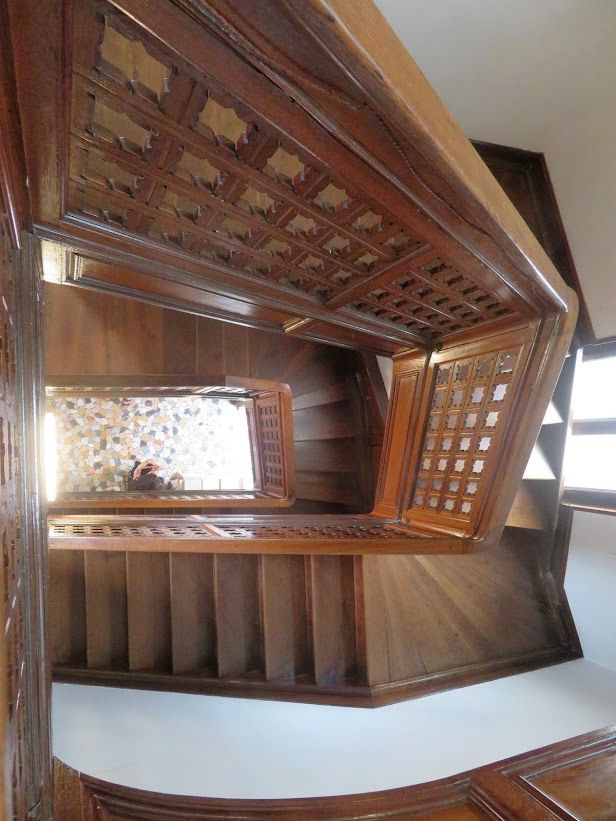
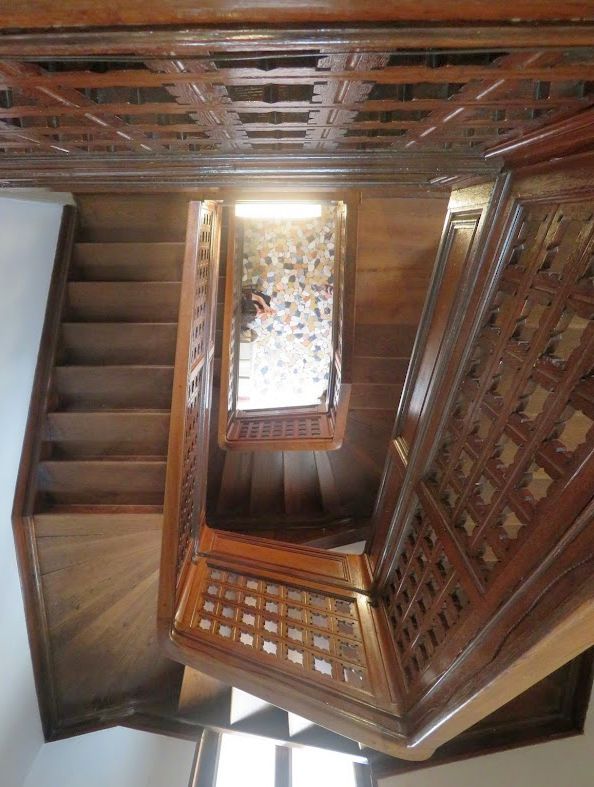
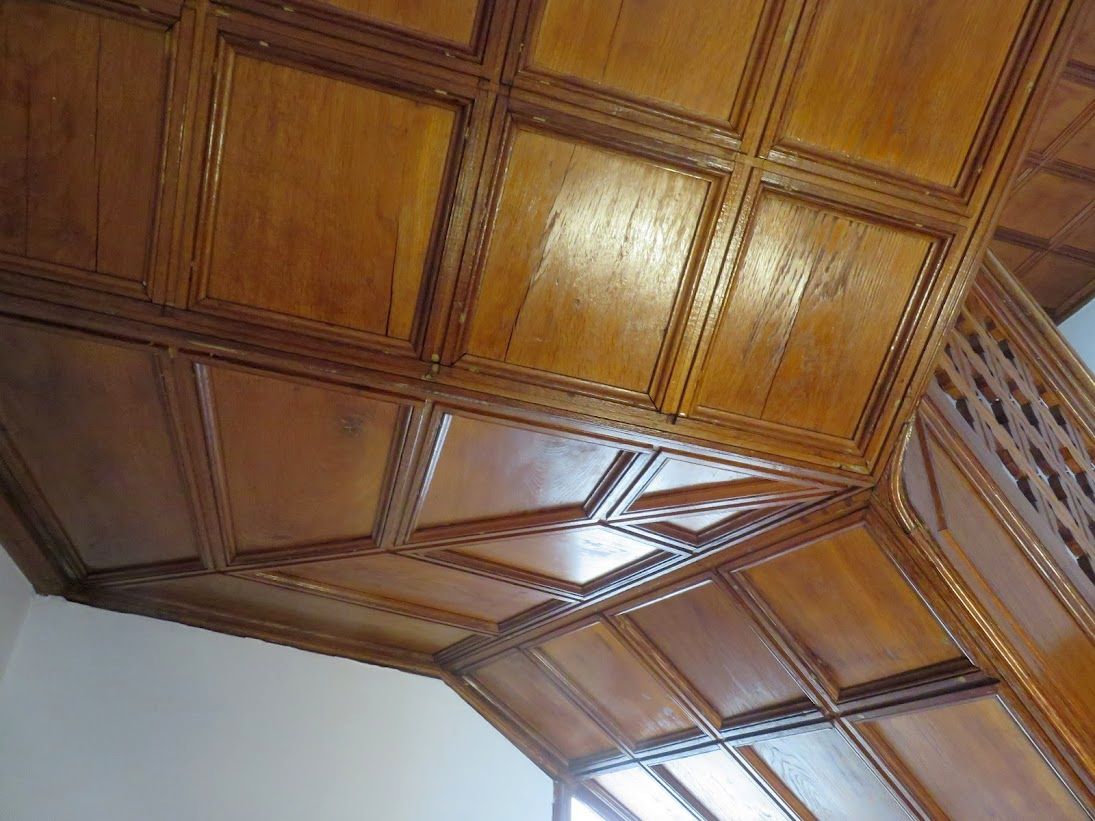
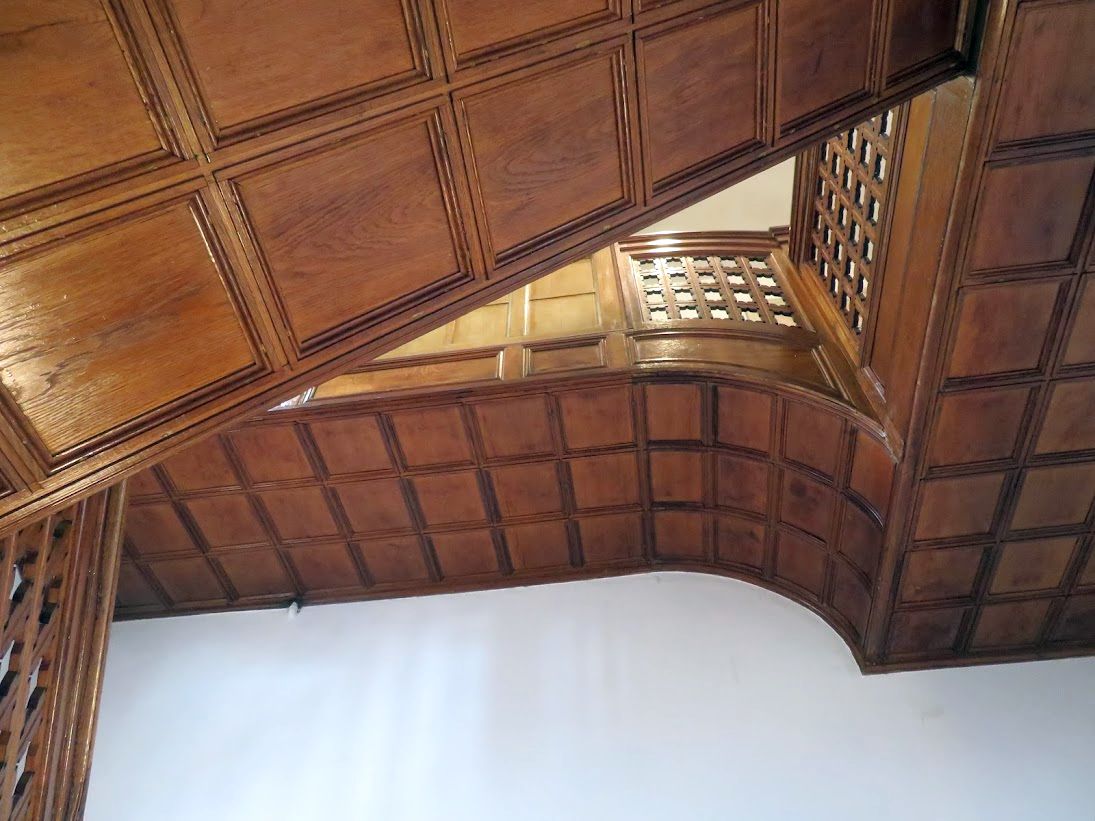
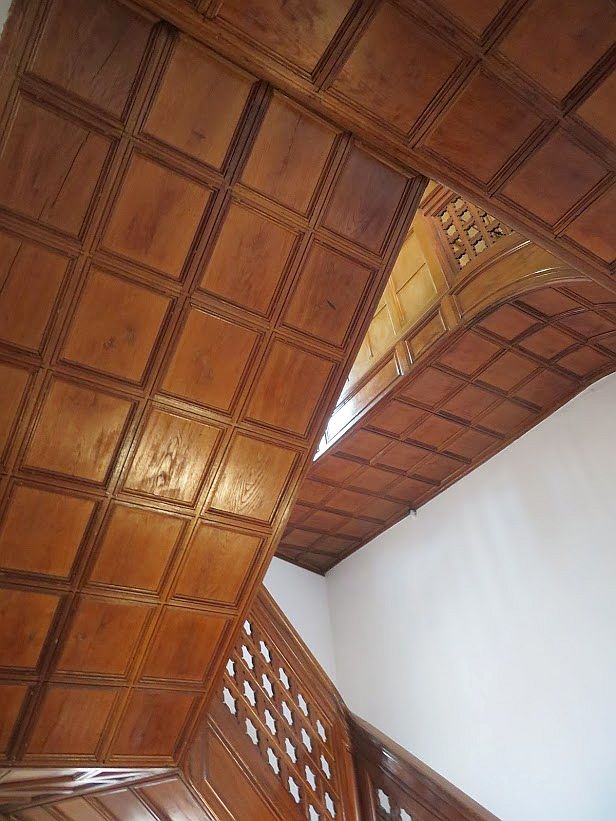
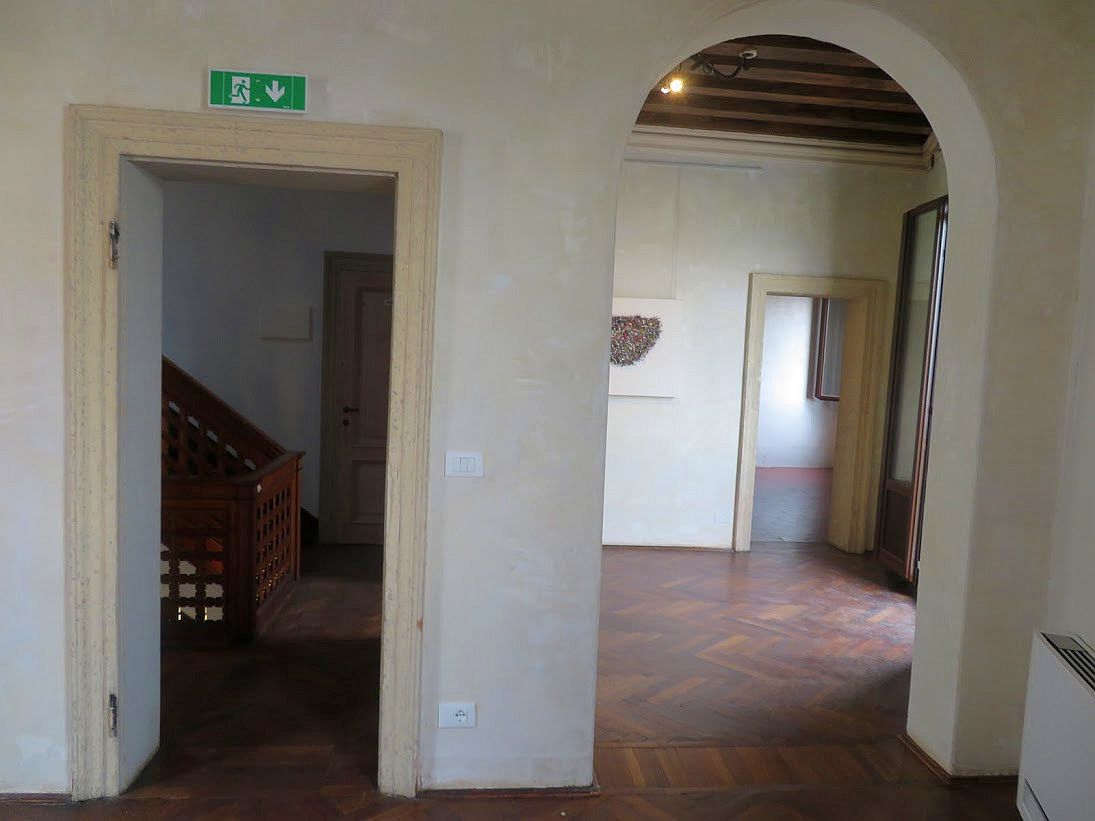
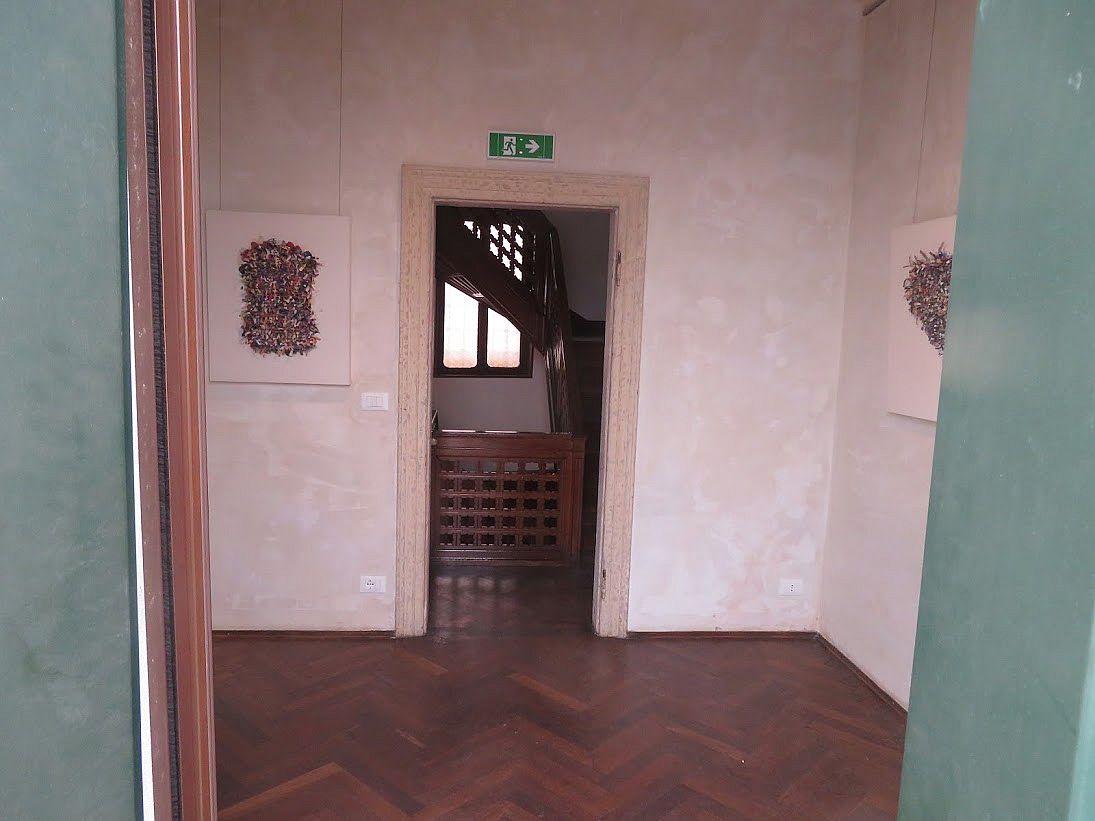
The ground-floor entrance is all about wood, as is much of what follows — another friendly link with his trusty ship Mathew. The Biennale refers to this dwelling as Palazzo Caboto, but when you see the size of the rooms, you may want to rethink what you imagine when you hear “palazzo.”Staircases rule. The upper two floors are the exhibition spaces — I can’t say what, if anything, is to be found anywhere else in the building.Looking down the stairwell the situation is slightly less dramatic.
But I like the angles better.
Feeling a little seasick yet?
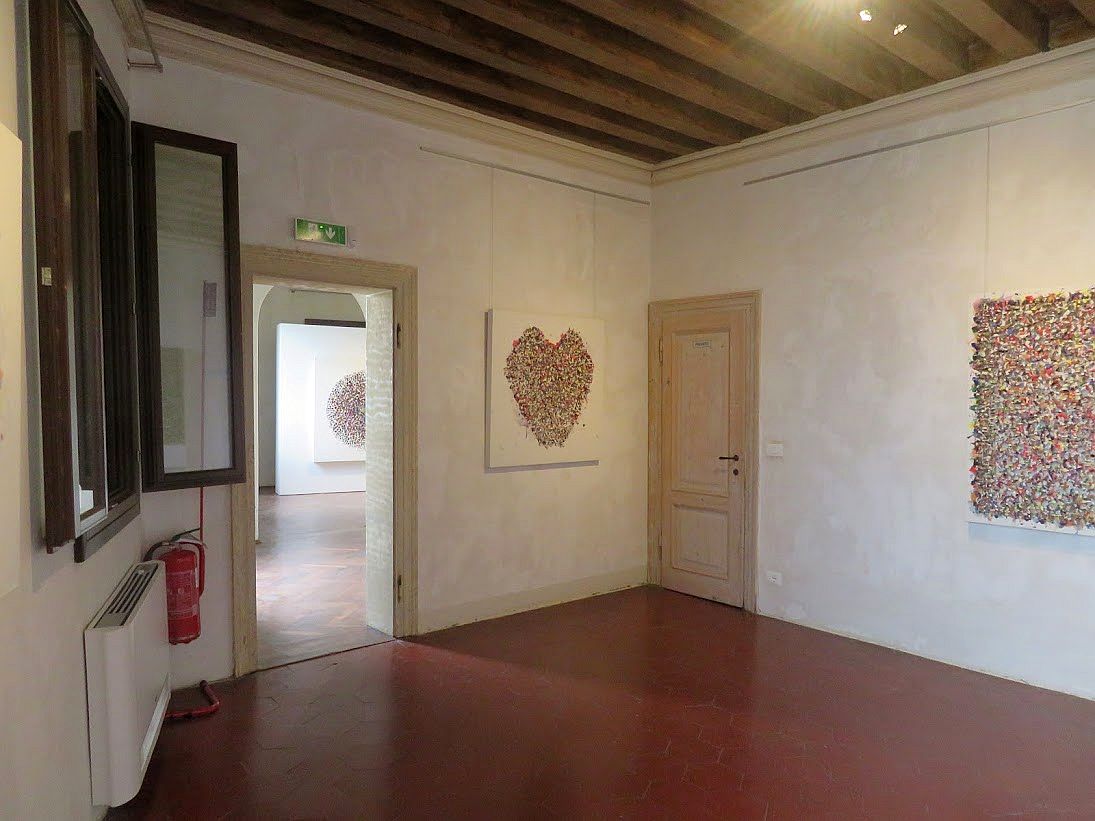
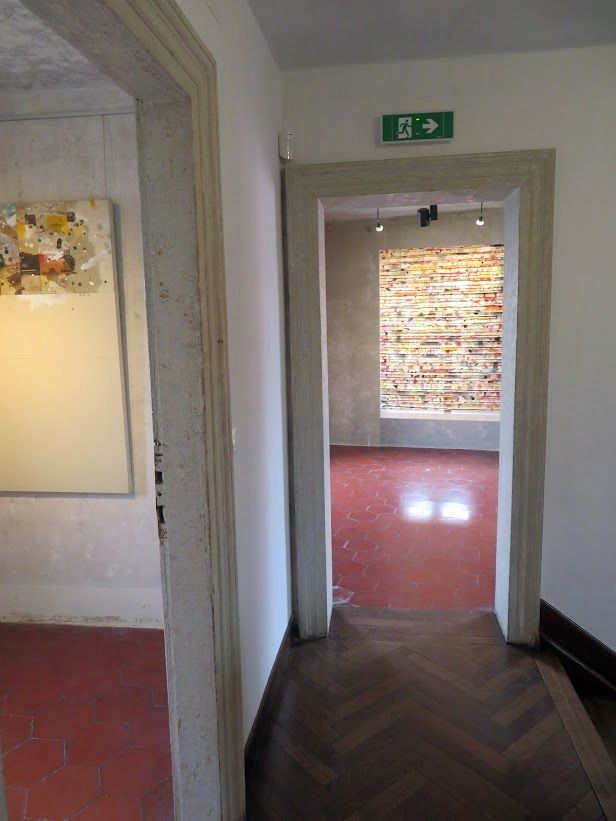
Let’s have a look at the rooms. As you would expect, they are cut into small eccentric shapes.
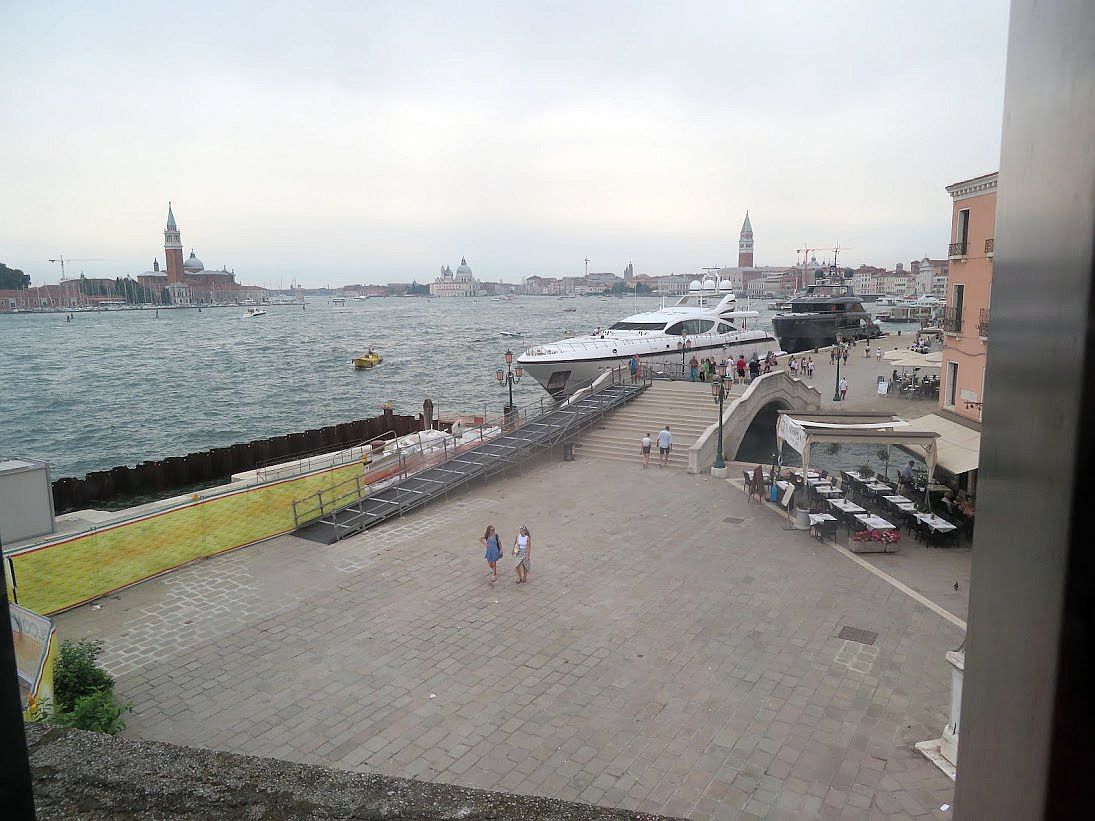
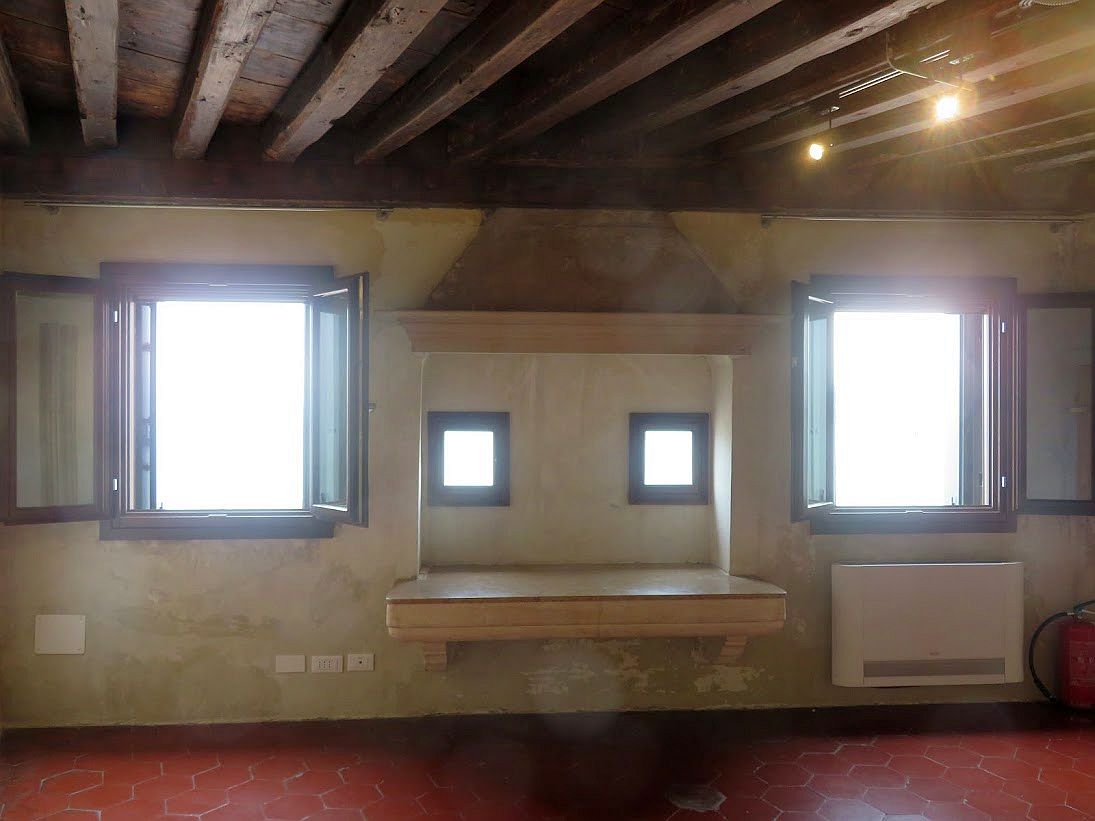
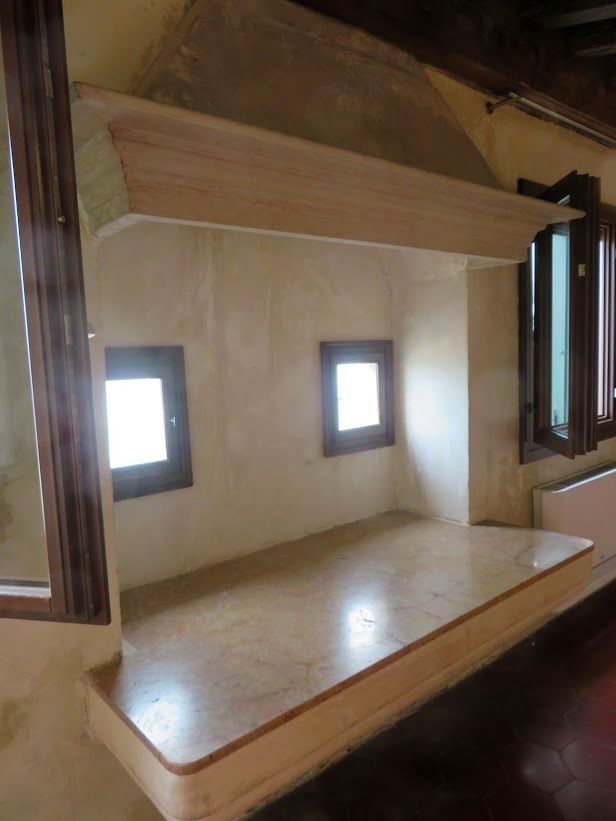
Reaching the first upper floor, the room in the bow of the ship — I mean house — is what I really was curious to see. Yes, I’d like to live there.Turning around, you see this. The light entering the room on the right comes from a door opening onto a small balcony.The balcony. The plaque commemorating the death of the “seven martyrs” is attached to the wall just next to the balustrade, but that’s a story for another time.Turning around, you see a room and the stairs. Yes indeed, this room is small.Leave the little balcony, turn right through the small room shown above and proceed into the adjoining room (also small) where I’m standing. Look ahead toward the “bow” of the house. I’d like to know how people here communicated their whereabouts. “I’m in the rhomboid room!”Let’s go up the stairs to the next floor. The same choice of rooms, not surprisingly; to the right is the “bow” again, pointed toward San Marco. No more parquet floor, though; it’s strictly terra cotta.And the better balcony view, pointed toward San Marco.Facing the lagoon, on this floor we see the revised remains of an impressive fireplace with a very welcome table/bench/bed protruding from it.
I could stop here, but as we consider how many renovations and alterations the house has undoubtedly experienced since Sig. Caboto last quaffed here whatever his preferred quaff was, I think he’d be most amazed by what has happened outside his two or more streetward doors in the intervening 500 years or so. Actually, I mean the last 150 years.
First of all, the vaunted via Garibaldi stretching along the flagpole side of the house used to be a canal, so he’d be missing that. It was filled in in 1807, part of the mastodontic changes the French were wreaking on the neighborhood. First it bore the name Strada Nuova dei Giardini, then was re-named via Eugenia in honor of Napoleon’s stepson, Eugene de Beauharnais, viceroy of Italy. In 1866, when Giuseppe Garibaldi’s troops entered Venice (and Venice had voted to join the newly formed nation of Italy), the name changed again. The canal continues to flow beneath the pavement, however.
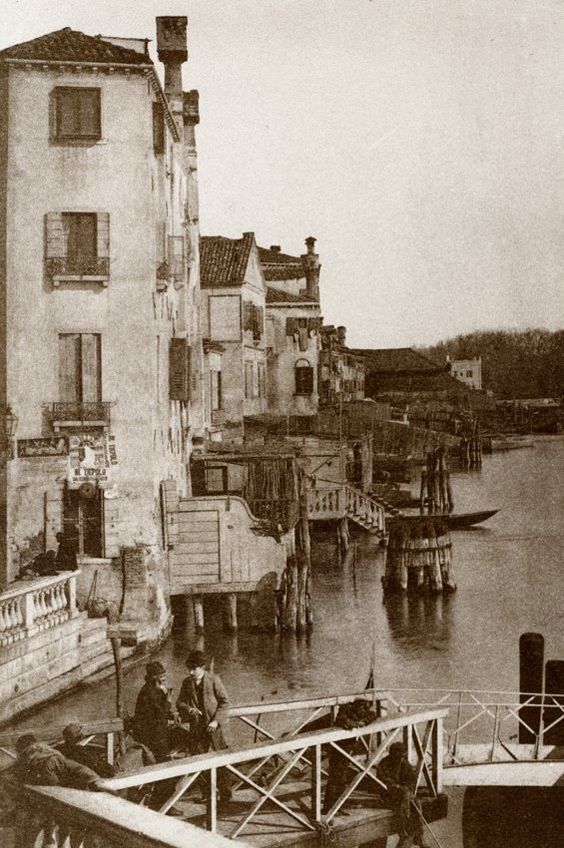
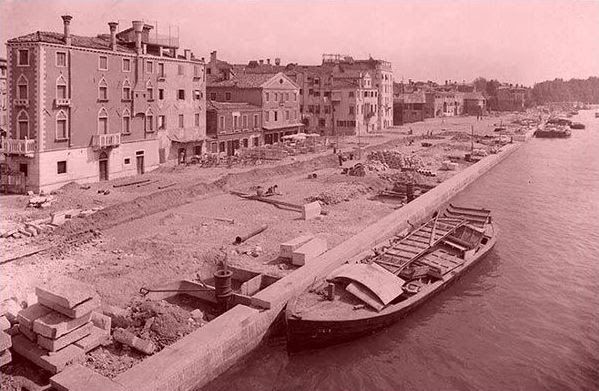
On the lagoon side of Cabot’s house, though, yet bigger changes were on the way. Because until the 1930’s, water was still lapping at its wall.
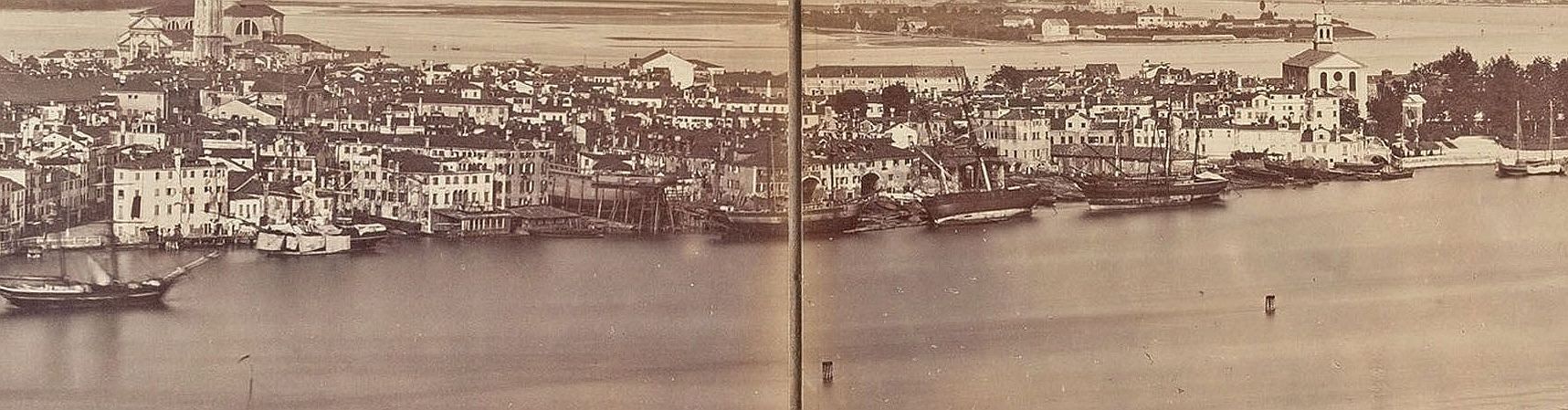
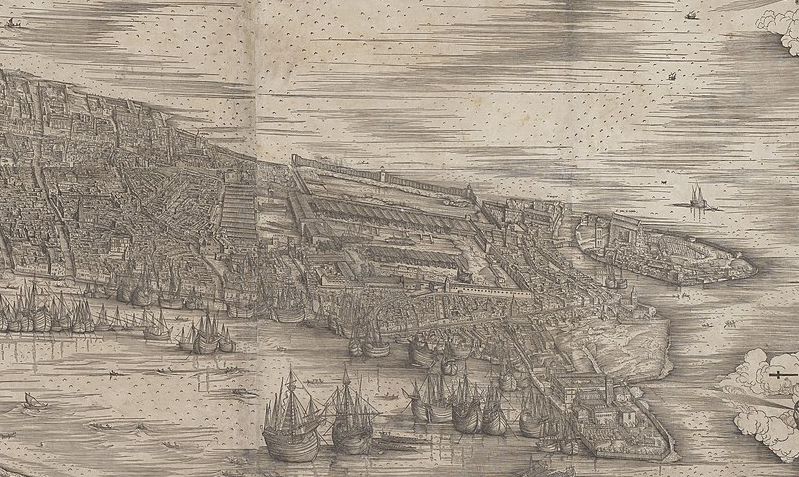
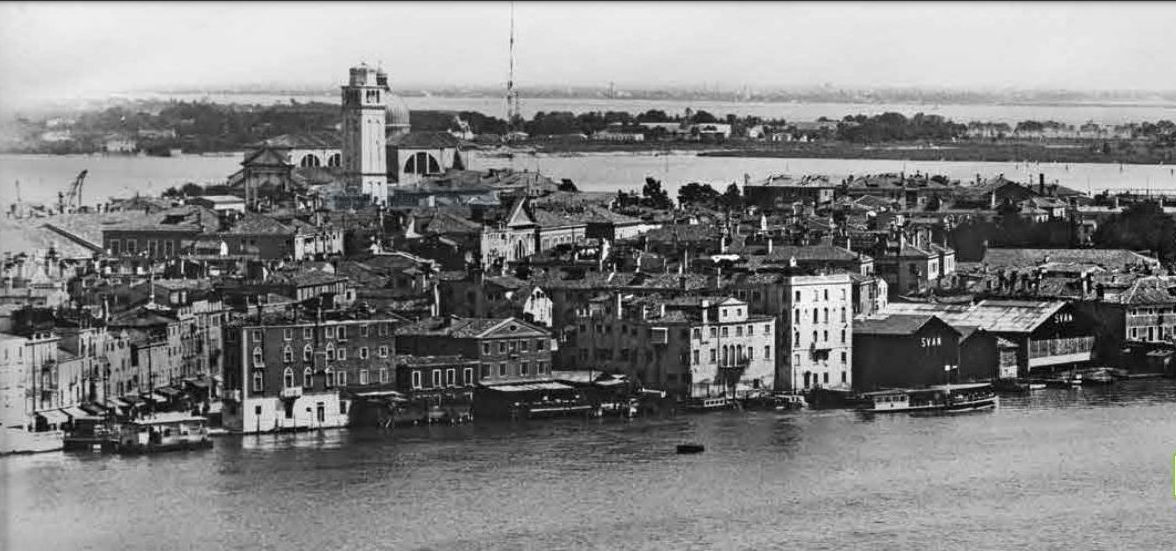
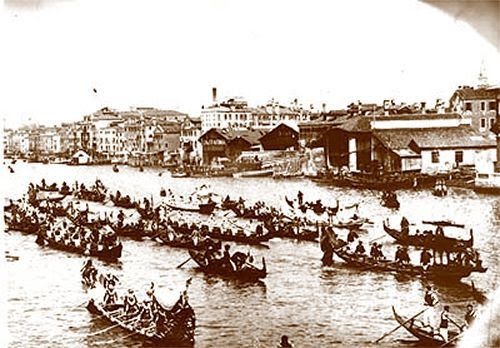
In the 1870s the waterfront looked like this. We can see via Garibaldi at the extreme left, but otherwise this stretch of Castello was still the realm of boatyards and squeri, as it had been at least since Jacopo dei’ Barbari mapped it in 1500.Permit me to refresh your memory on this monumental work and its insane detail of the Castello waterfront.Vaporetto service began in 1881 (notice the vaporetto steaming toward the Lido), and where better to put the dock than at the edge of via Garibaldi? (As we see, it was the only “where” there.) Or, to put it another way, on Caboto’s front doorstep. I think this image is later than 1881, though, because the ornamental stone balconies are in place here, while in the next image the windows are protected by humbler wrought iron. Too many things to keep track of.Anyway, the important point is that Caboto’s house, as seen from the steps leading to the vaporetto dock, is still keeping the lagoon at bay.An undated photograph(possibly early 1900’s) shows the boat procession celebrating the Feast of the Ascension, a remembrance of the annual ceremony of the “Wedding of the Sea,” in which the doge symbolically renewed Venice’s vows as the faithful spouse of the Adriatic, with all the rights and privileges a spouse was entitled to. Ignore the procession for a moment, though, and regard the agglomeration of boatyards still hard at work at the water’s edge. Venice was a real working-boat city until progress caught up.
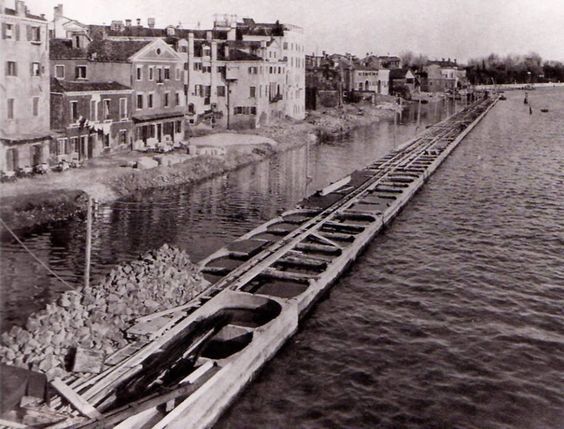
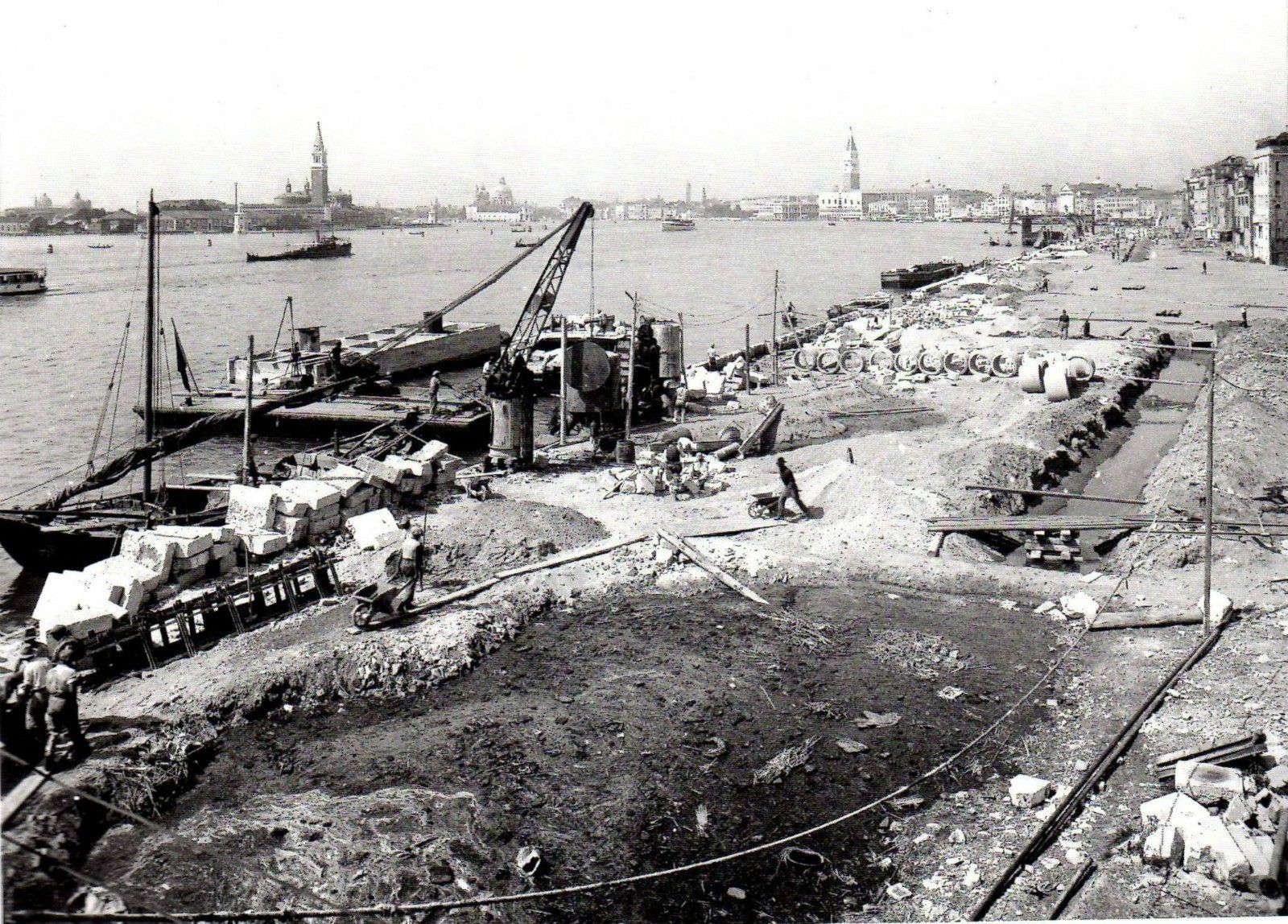
But as thought Napoleon, so did Benito Mussolini. I don’t refer to politics, but to reshaping Venice. There is undoubtedly massive history behind these decisions, but in my own tiny mind I summarize the Duce’s thought as “Piffle! Away with the grotty shipyards, we want a promenade. Actually, what we want is a long stretch of pavement ideal for mooring ships. Preferably battleships, and many of them. It can also be a promenade, or whatever we want to call it, in its spare time.” And so it was.
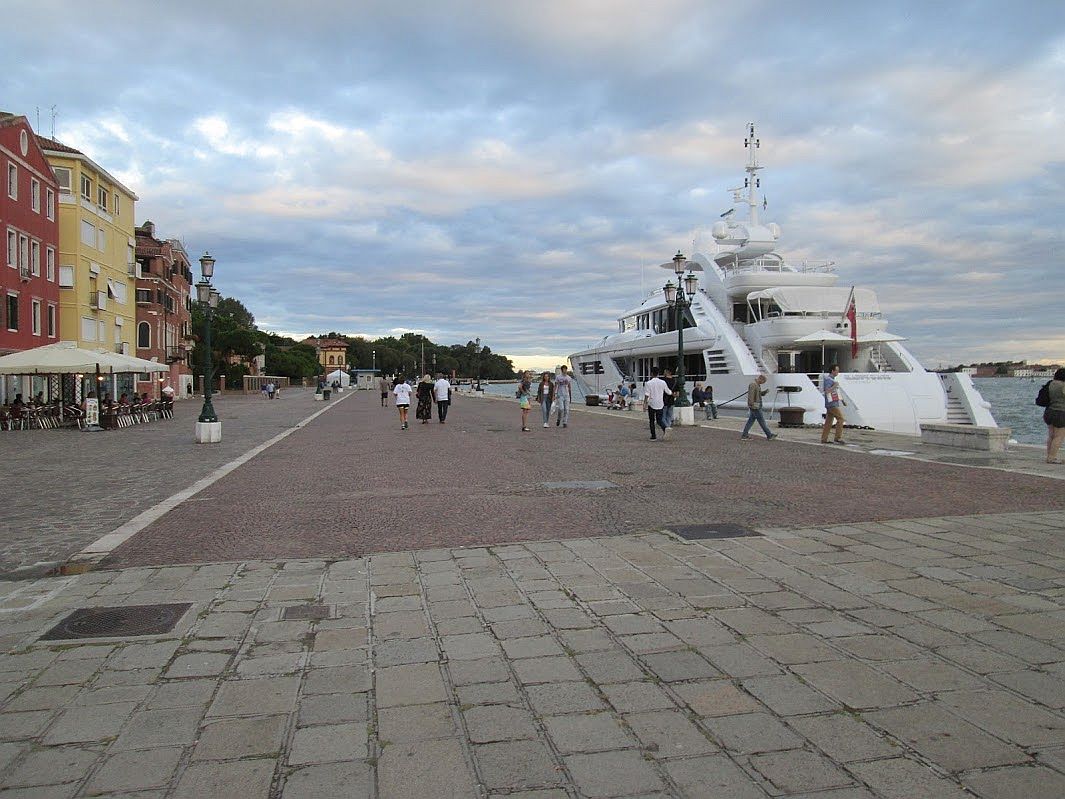
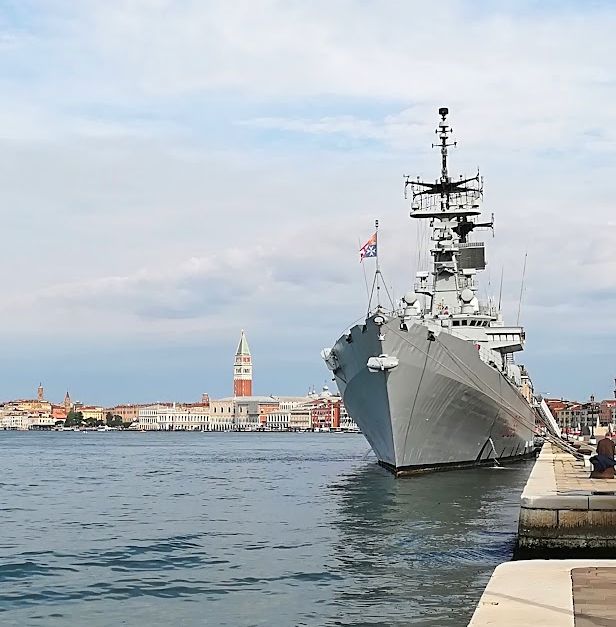
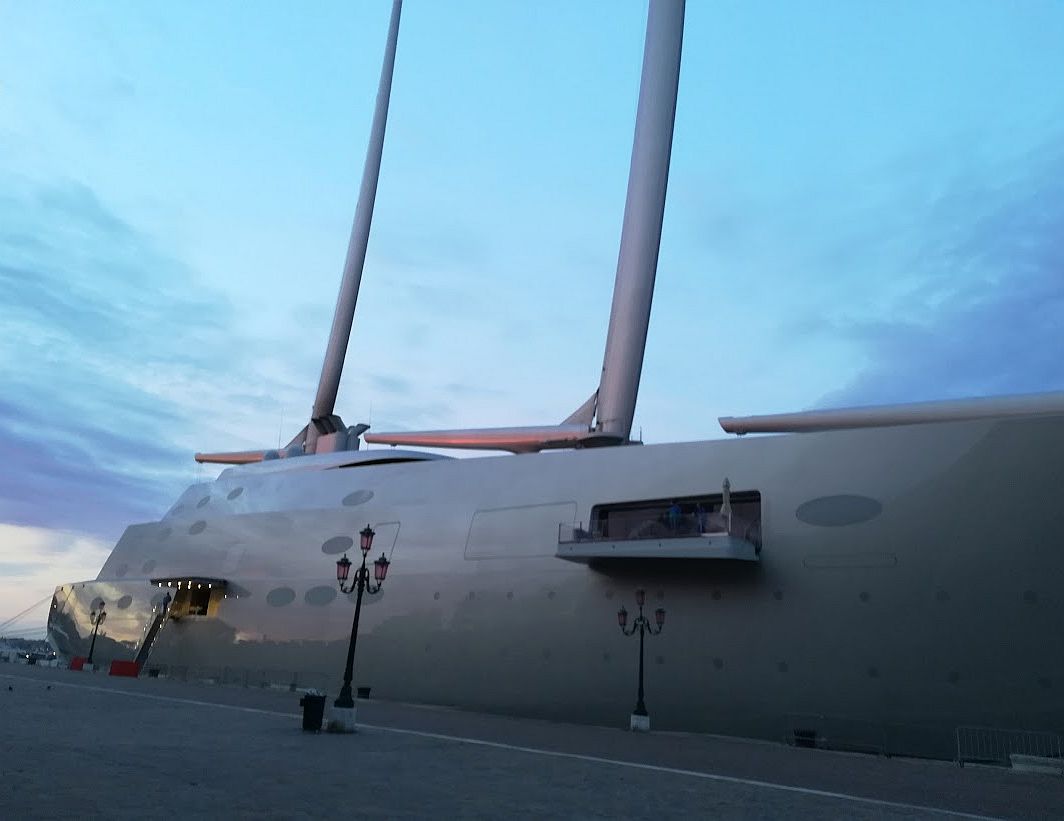
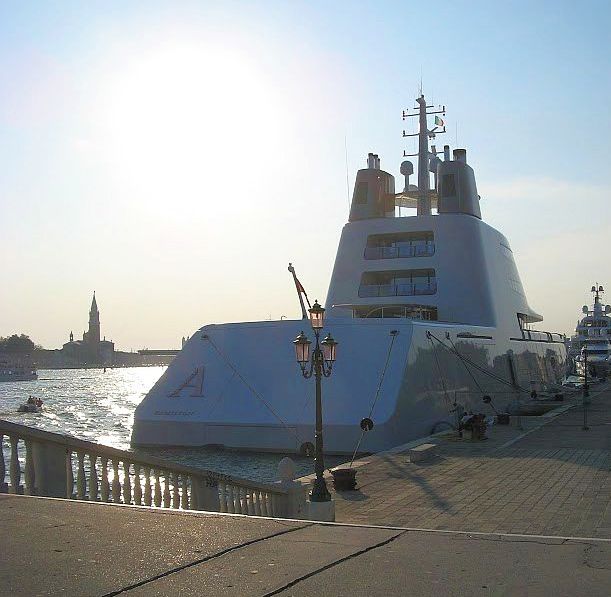
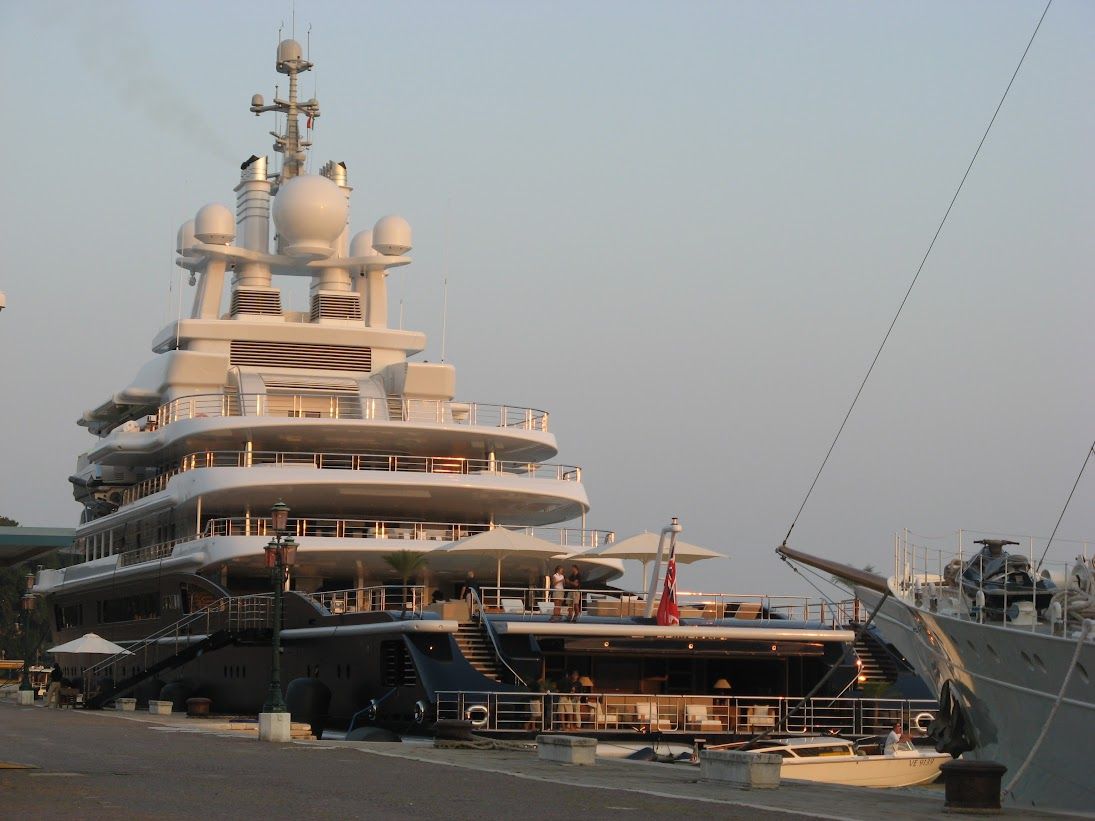
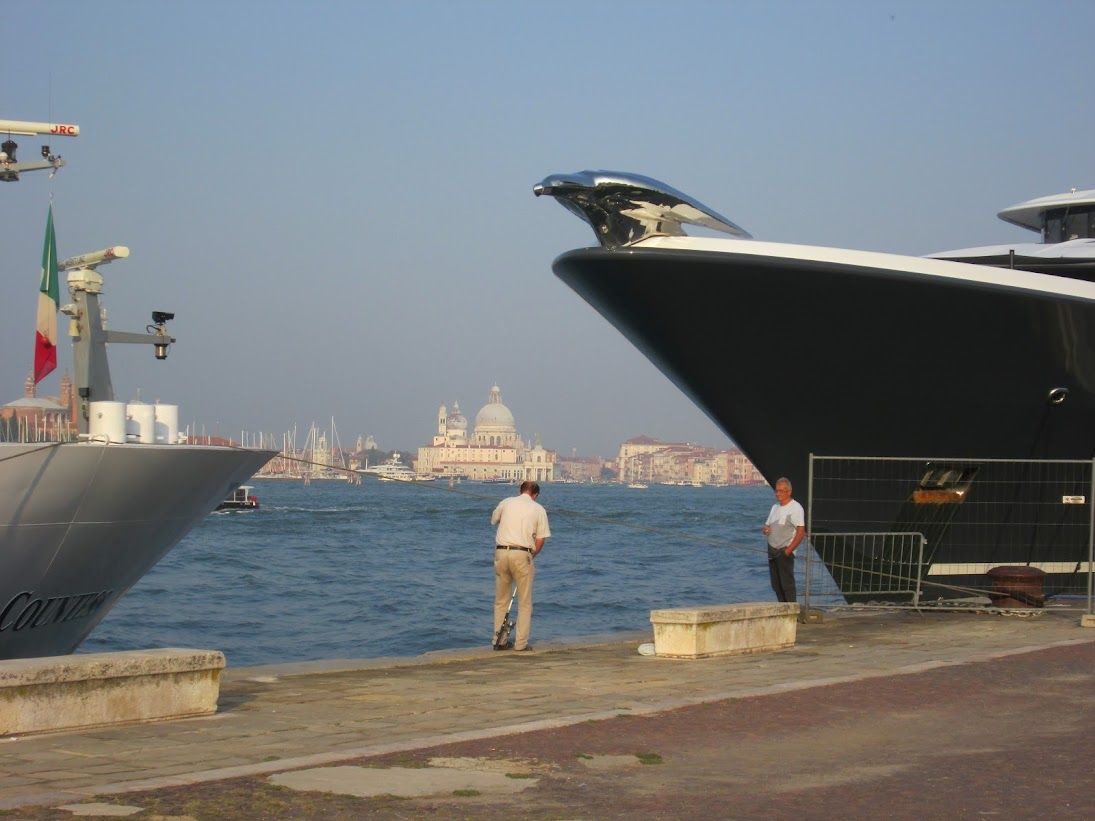
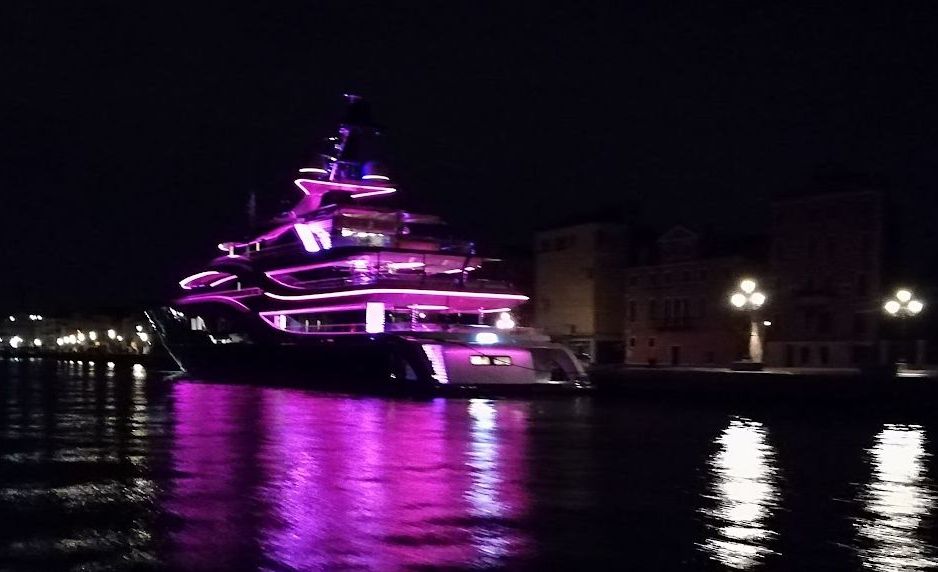
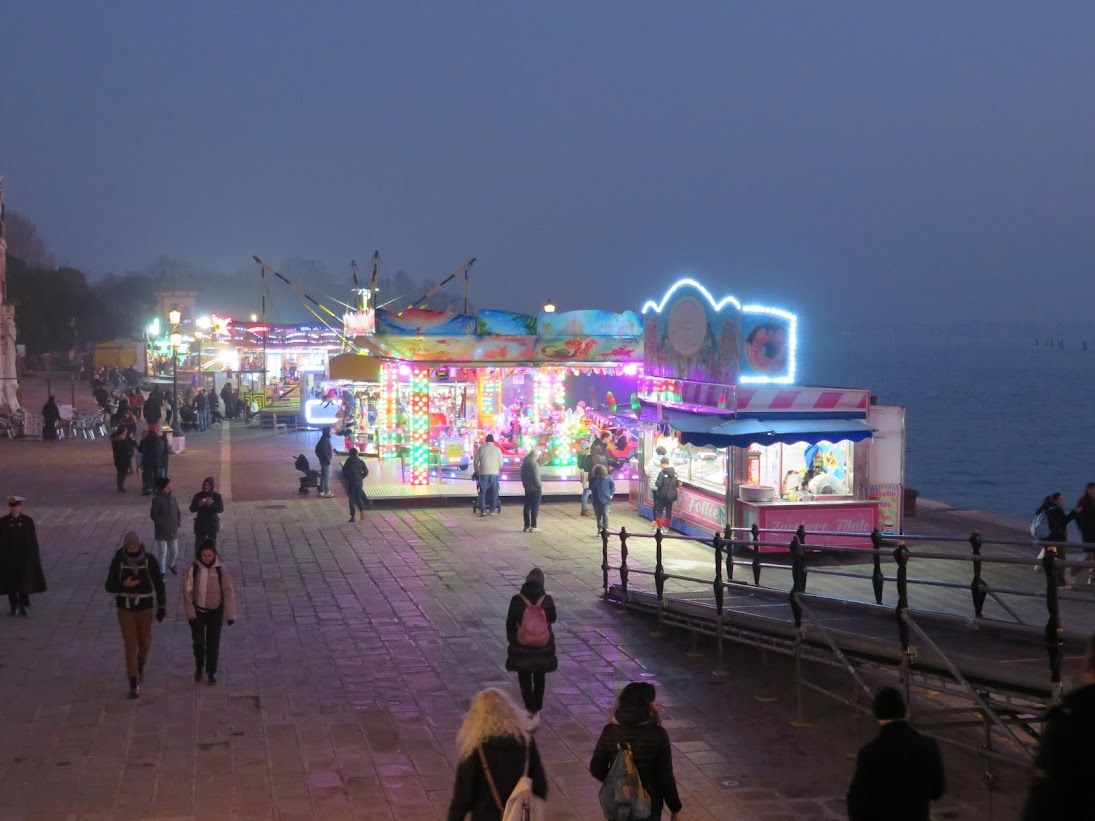
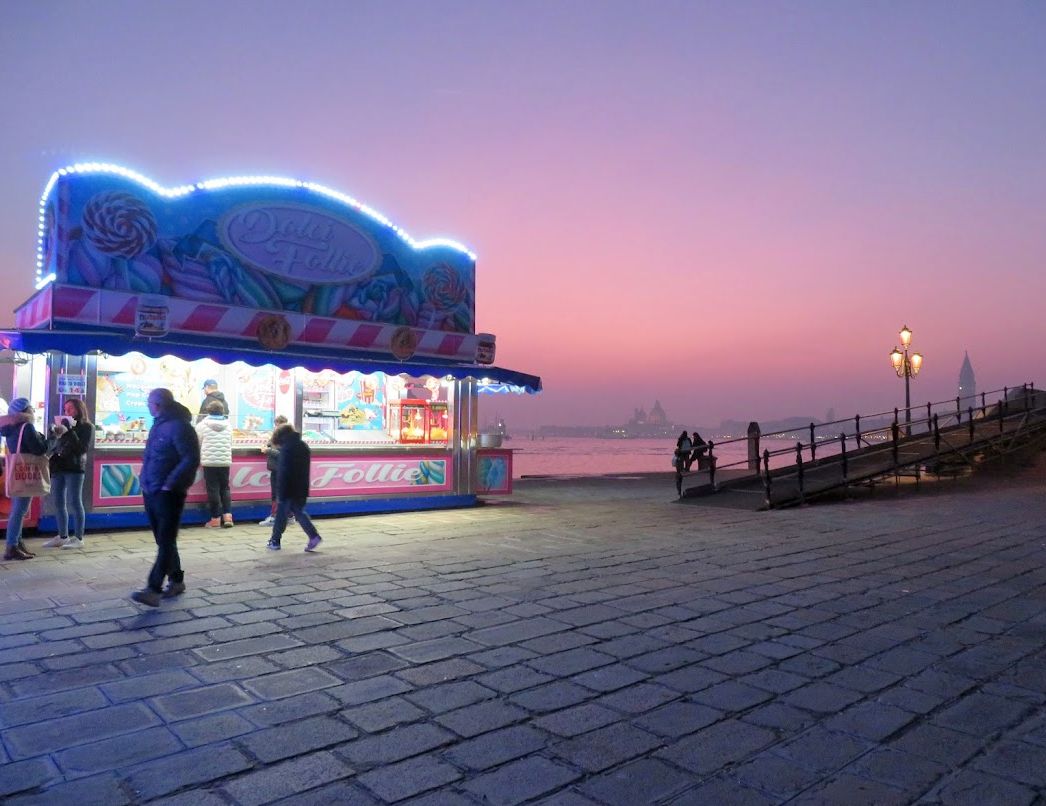
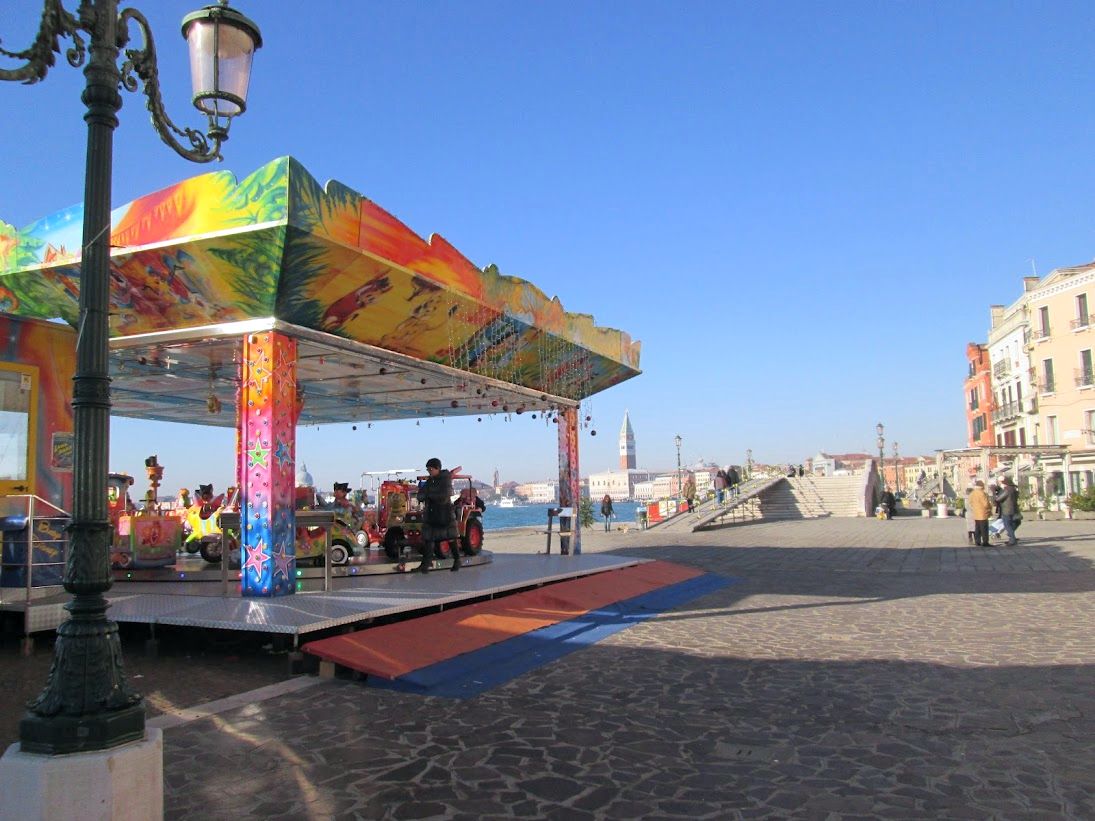
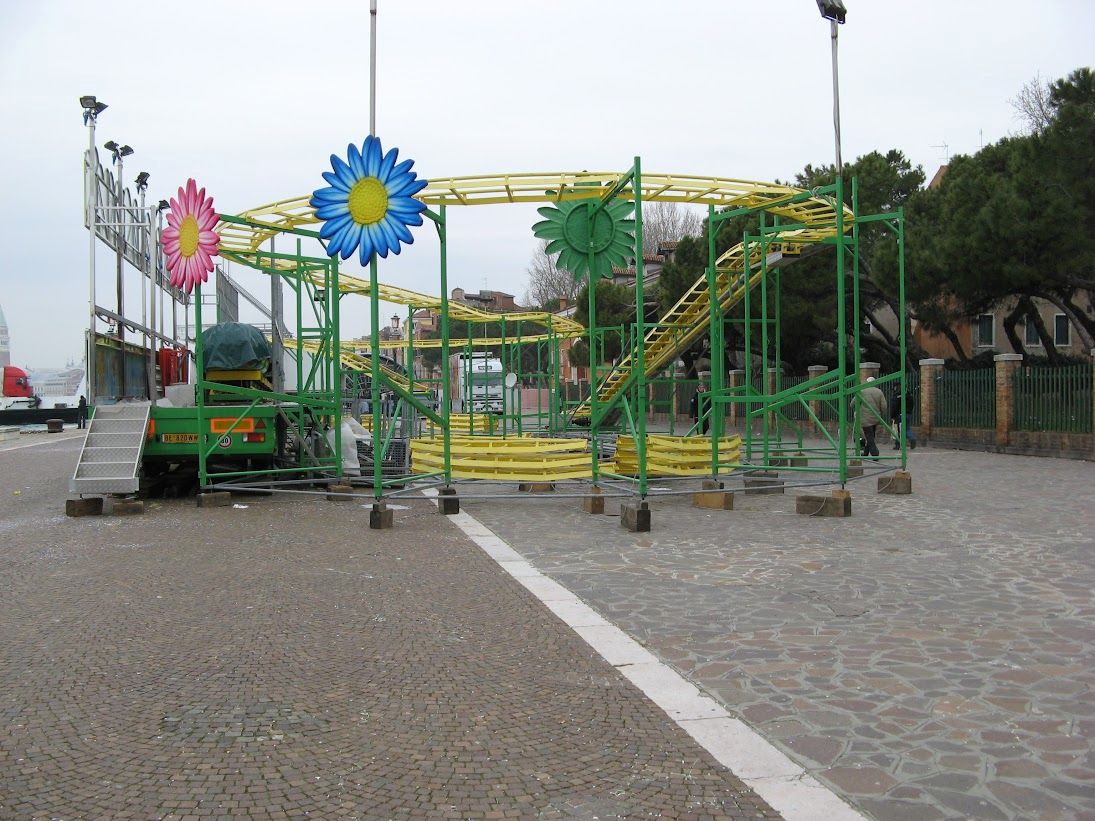
The birth of the Riva Sette Martiri. In point of fact, it was christened the Riva dell’Impero (the riva of the empire) because Mussolini. The name was changed after the tragic execution of the seven martyrs in 1944, but older people still sometimes use the old name (in the same way that they refer to the bridge to the mainland as “Ponte del Littorio”).When he said “Get it done,” it got done. I’m fascinated by the coexistence of the hydraulic crane and the boat still powered by sail moored alongside. In the Thirties boats with motors were still in the extreme minority.Plaase admire the peata alongside, the biggest working boat in the Venetian working-boat fleet, propelled by oars. In the Thirties. Much of the entire city was built with materials brought on boats like this one. When Lino was a lad there were still peatas everywhere, working away. On a less sublime note, we can see that the grotty shipyards are gone, with their men and their skills and traditions. Progress pushes onward.The riva did serve as a mooring place for warships, but the aforementioned progress has since found other needs and uses for this gigantic walkway. Mussolini may not have given much thought to the pressing needs of ever-increasing numbers of tourists — to stroll, run, walk their dogs, moor their colossal yachts… Entertainment gets first dibs on this space now.Warships still occasionally stop by, often when an important ceremony is imminent. Here the destroyer “Luigi Durand de la Penne” is looking good.Or there are mega-yachts whose billionaire owners really like that battleship vibe. This belonged — perhaps it still does — to a Russian oligarch back in the palmy days. Note that those are not fangs or jaws on the stern, but he’d be so glad to know that you thought so.Another mega-yacht dreaming of combat.One of the best things about the riva is that it’s perfect — for a fabulous daily fee — for hosting colossal yachts. I’m not sure what Mussolini would have thought, much less what Caboto’s reaction might have been. I’m tempted to think Caboto would have said “I WANT ONE.”The traditional figurehead has been re-tooled as a hood ornament. The Maltese falcon? A carrier pigeon on steroids?Build a riva and just stand back for all those good times waiting to roll.But the fun isn’t limited to floating entertainment. For a few months each winter the traveling amusement park plants itself on this conveniently wide open space.
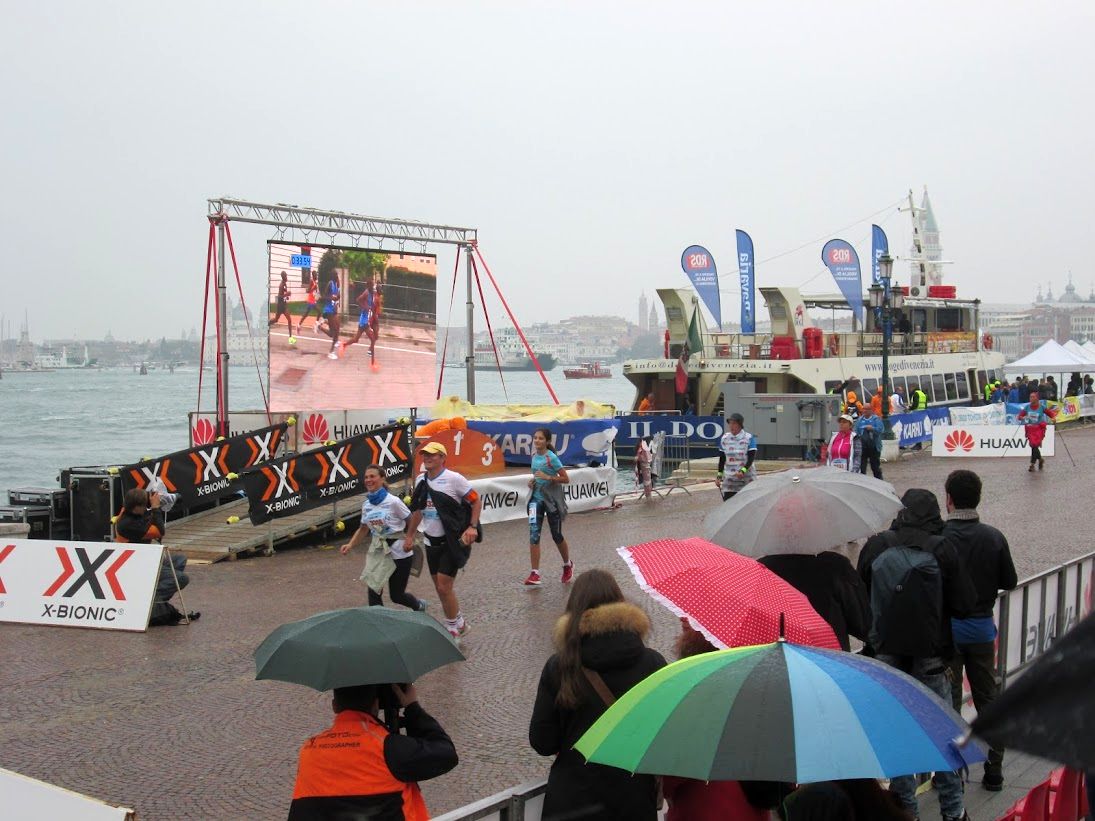
Not to forget the Venice Marathon, the last Sunday in October. The finish line is just beyond Caboto’s house. He had no idea that the ordinary old lagoon outside his window was going to pushed aside to make room for an entertainment multiplex.
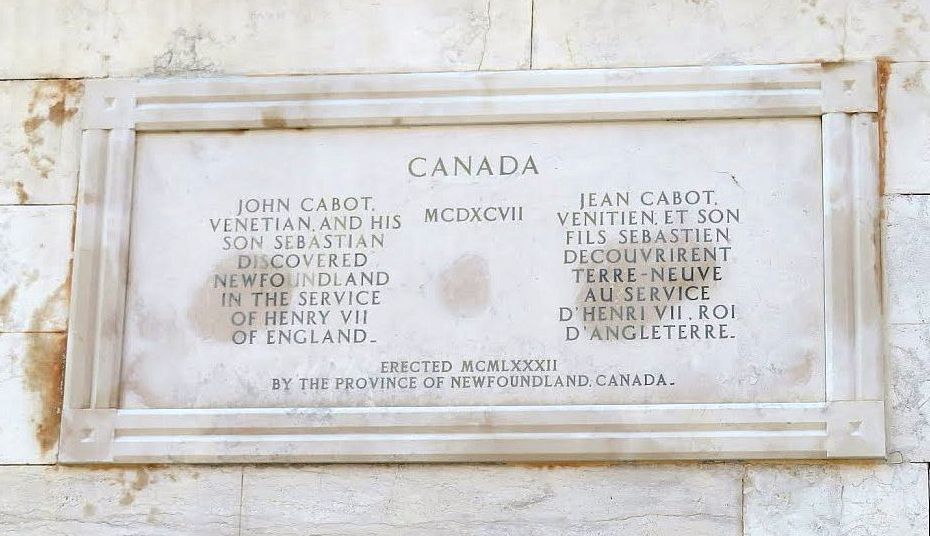
I didn’t intend to reduce the invincible Giovanni Caboto to a mere bystander at a waterfront playground, yet that’s what happened. My apologies to his descendants, wherever they are. One could have made a good case to name the riva after him, but that didn’t happen. We’re going to pretend we did right by him via the two plaques and — bonus! — Calle Caboto, a small cross-street mortised into the maze between his wonderful house.
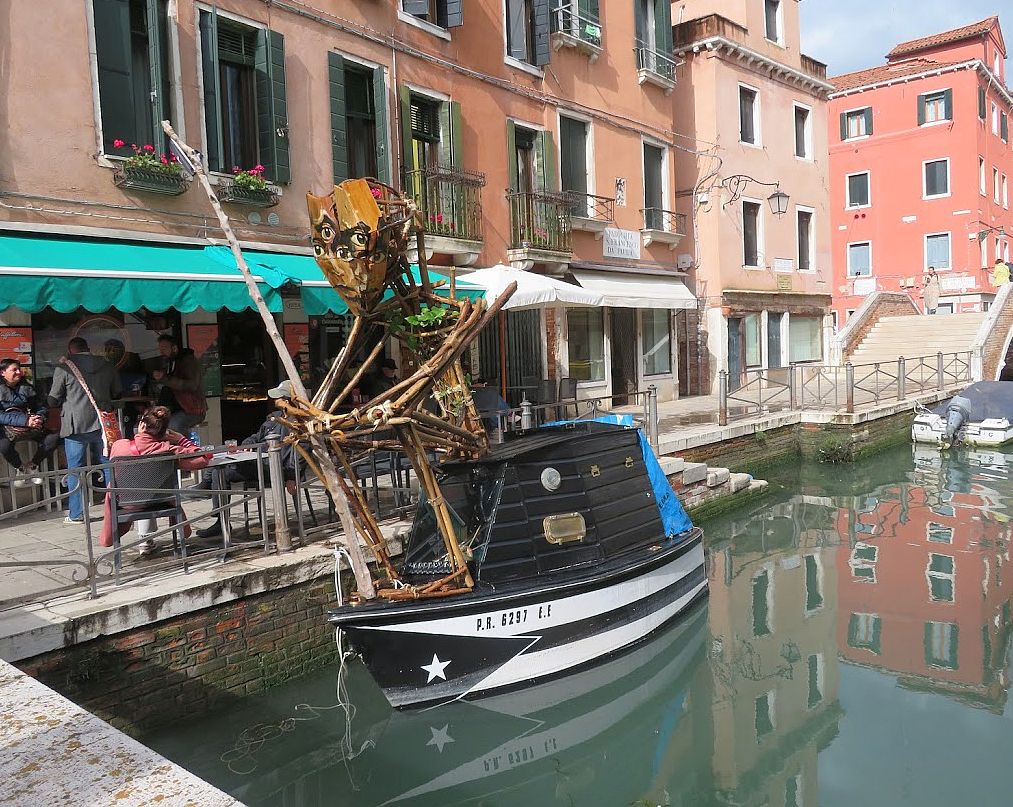
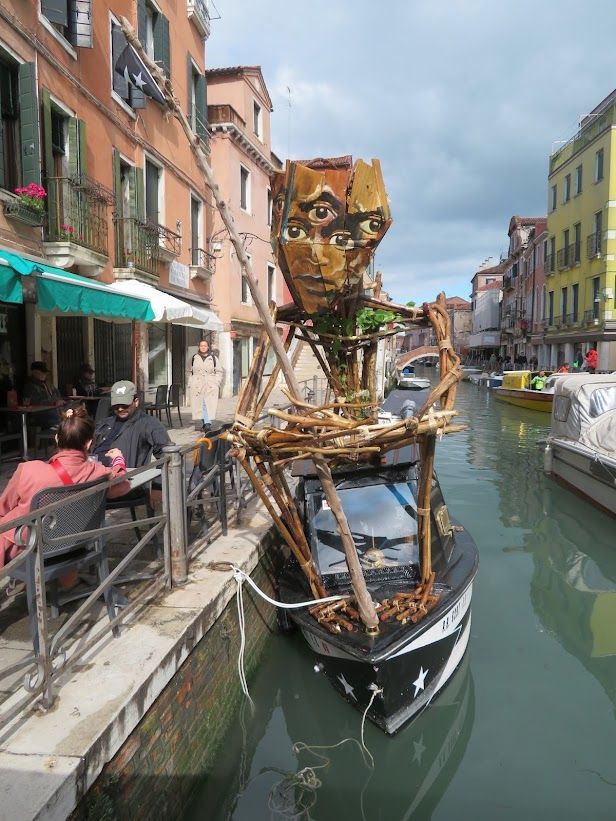
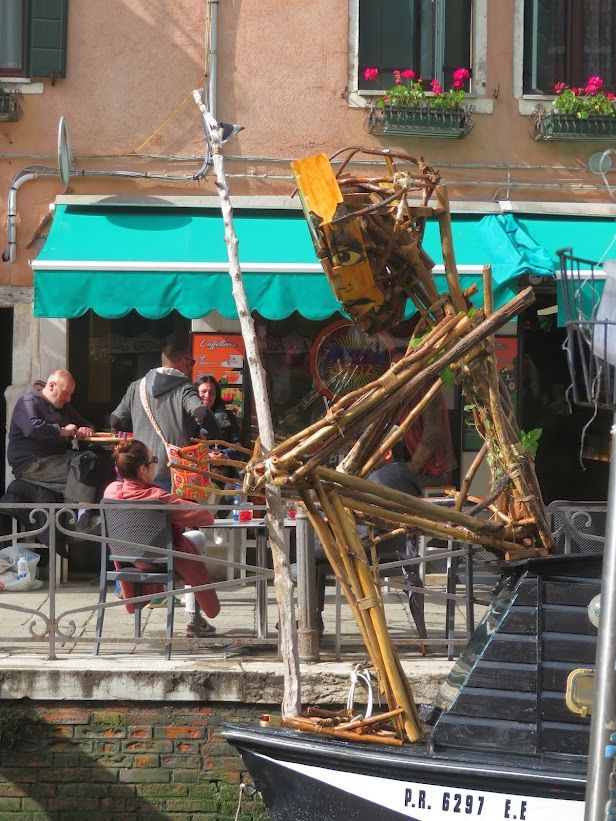
He seemed to have settled in here, or as much as he could while sitting on a boat that looks like a bathtub toy. This is before the storm.
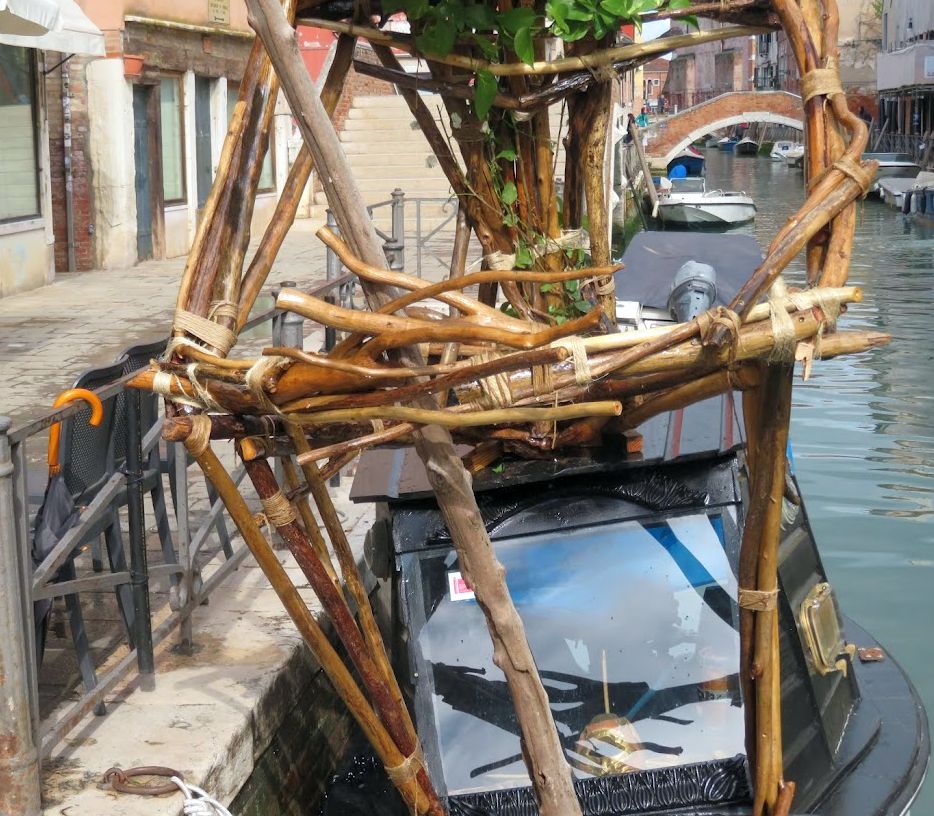
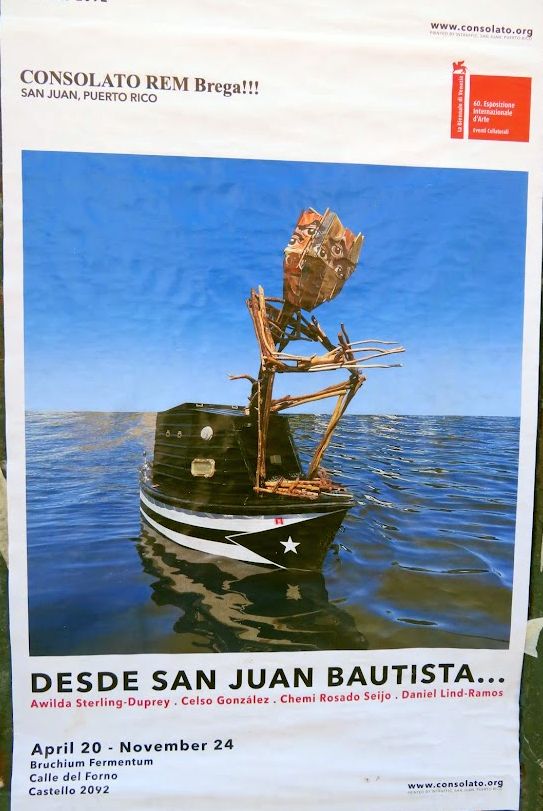
I thought I’d update the life, times, travails, and tribulations of San Giovanni Battista (Saint John the Baptist), visiting Venice as a work of art in the guise (or as they say here, in the clothes) of San Juan Bautista, patron saint of the island of Puerto Rico, as you know.
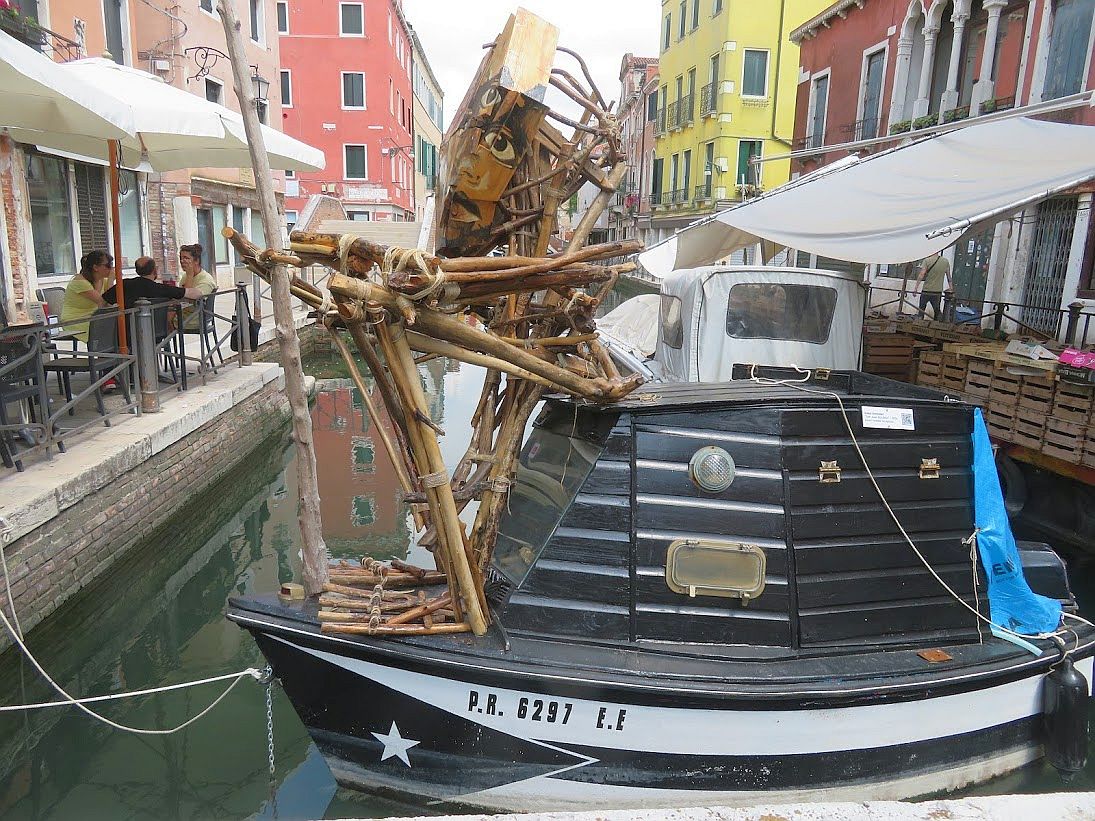
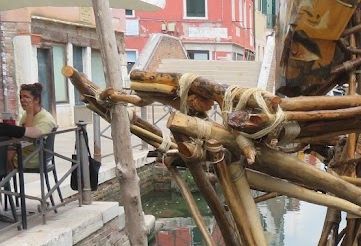
After unpacking his imaginary baggage back in April, he was left to perch pensively atop a little boat in the canal at the bottom of via Garibaldi. That was fine. Then one night a tempestuous rainstorm swept through, and the next morning he had been removed. He might have blown over or been in danger or damaged or something. I felt sorry, because he was supposed to hang out with us down here in the bilge of the Good Ship Castello till the Biennale closes on November 24.
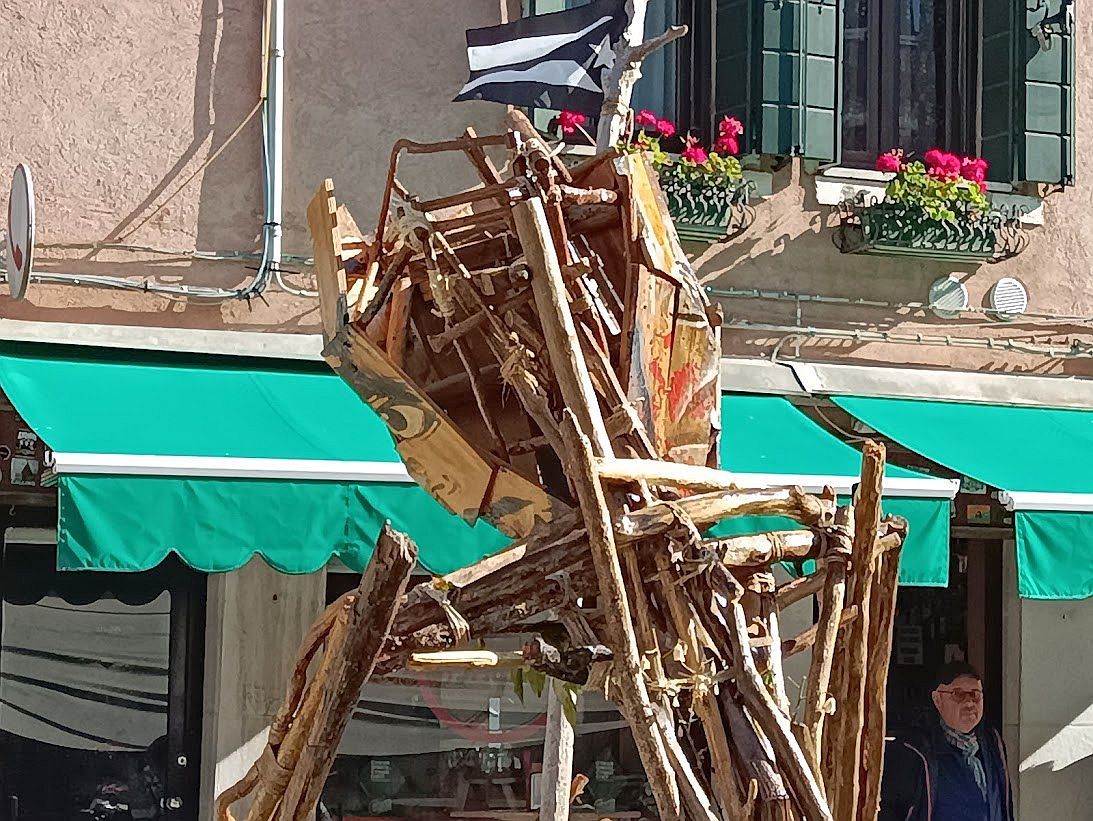
Then suddenly he was back. But he was shorter somehow, a little less majestic — the storm had taken something out of him, but I couldn’t figure out what — yet he was just as contemplative as before. Maybe more so. I sensed that the experience had sobered him.
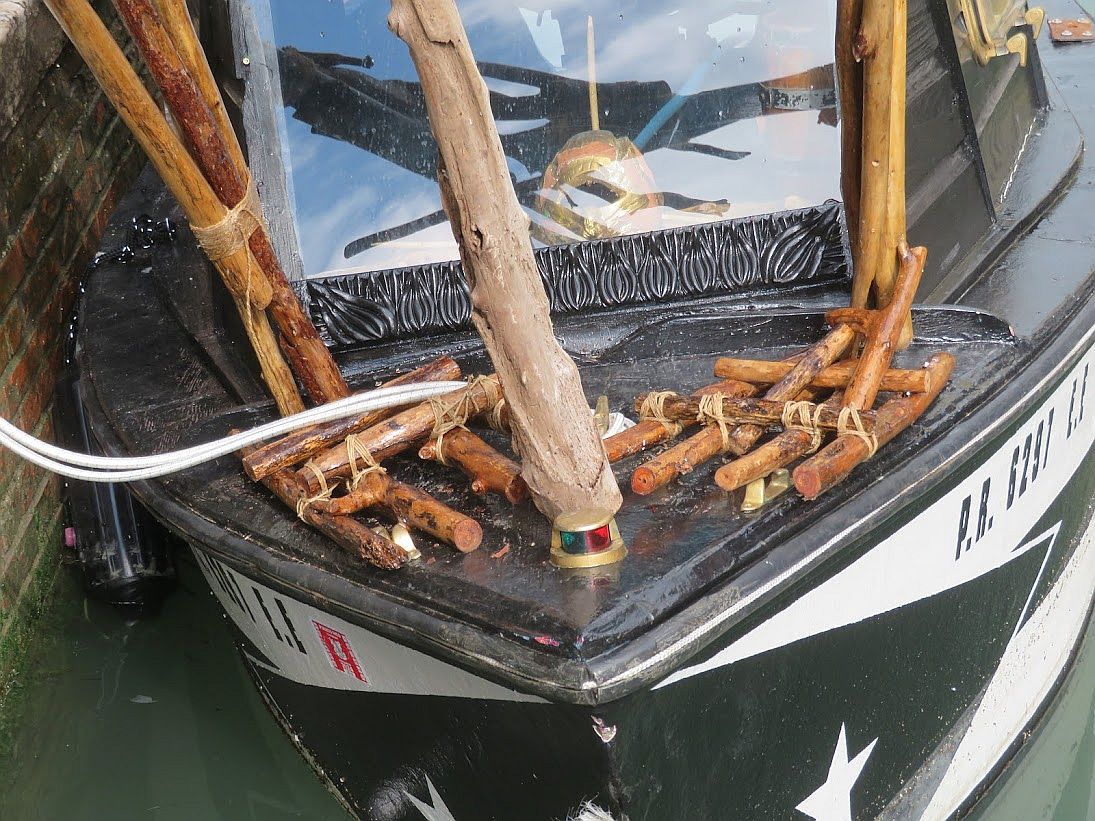
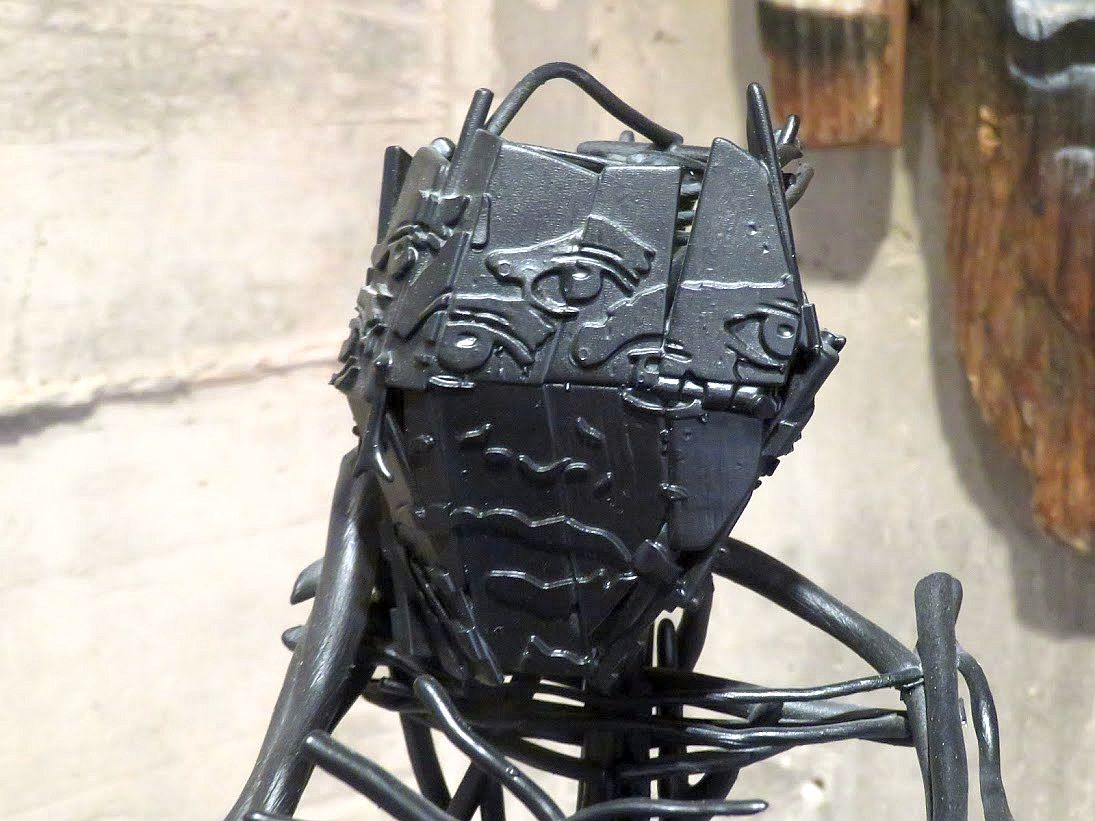
Duck feet that want to be rafts? They’re perfect for bracing yourself barefoot in a very small space, that’s clear.These were his hands at the beginning. After the storm, these aren’t the hands of the saint that was. No more arpeggios on the piano for him.Clever machinery in his skull must be there to continue forming new thoughts and ideas. More or less like our skulls.
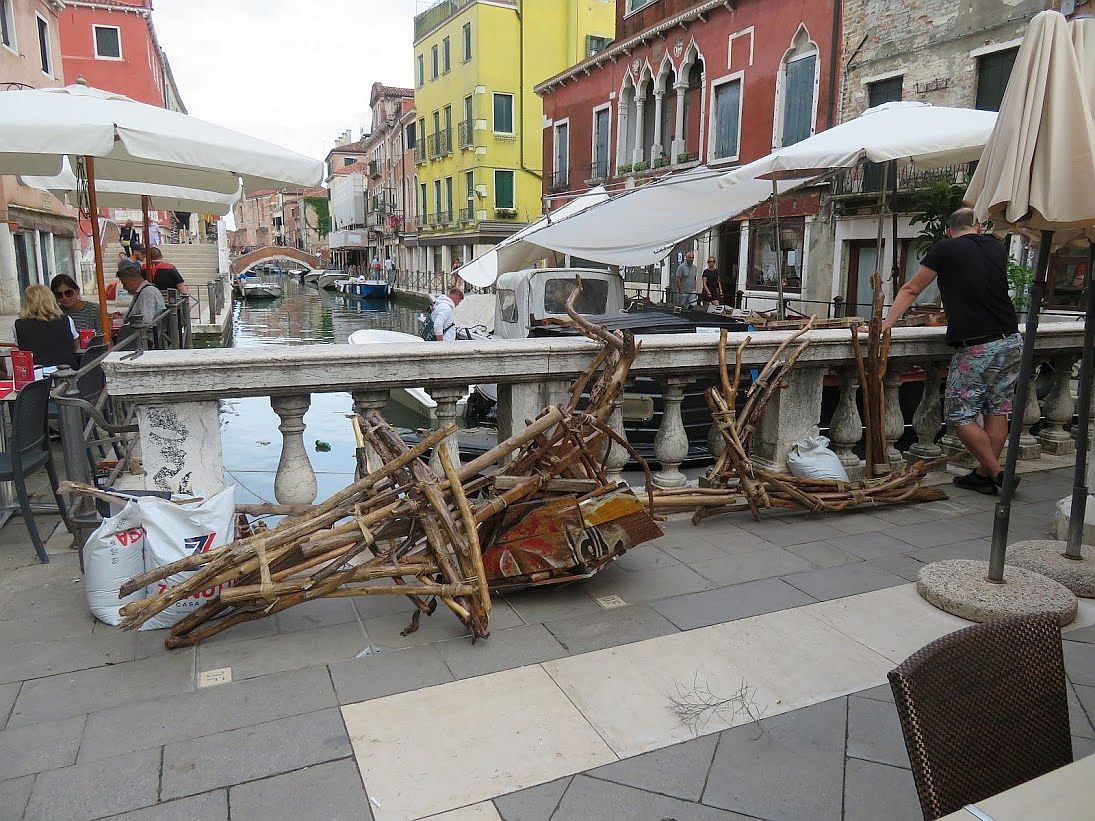
Time passed, but just when it seemed normal to have him hanging around two men showed up, disassembled him, and carted him (it/them/those) away, down via Garibaldi under the blazing sun. The boat remains, but the saint has left the building.
Saint-moving day. Get some friends, offer pizza.This is my brain either on Friday afternoon or Monday morning.
I went by the small exhibition space dedicated to him to discover his fate. The young Greek woman who had been engaged to answer questions on the art and the artists’ cooperative was startled to hear that Saint John was no longer at his post. This was awkward; she had been encouraging visitors to go down the street to see the creation in the flesh (technically, in the driftwood). Nobody had thought to let her know that the work was no longer working. And therefore she knew only what I knew.
I passed by the space some time later, and another young woman explained that the problem is that when it rains the little boat fills with water and becomes unstable as a base on which to position a saint made of driftwood. Solution: Remove the saint and — one hopes — bail the boat. Not sure about that last part, though. It just floats there, all alone, possibly aware that an abandoned boat really is nothing more than driftwood waiting for the next storm.
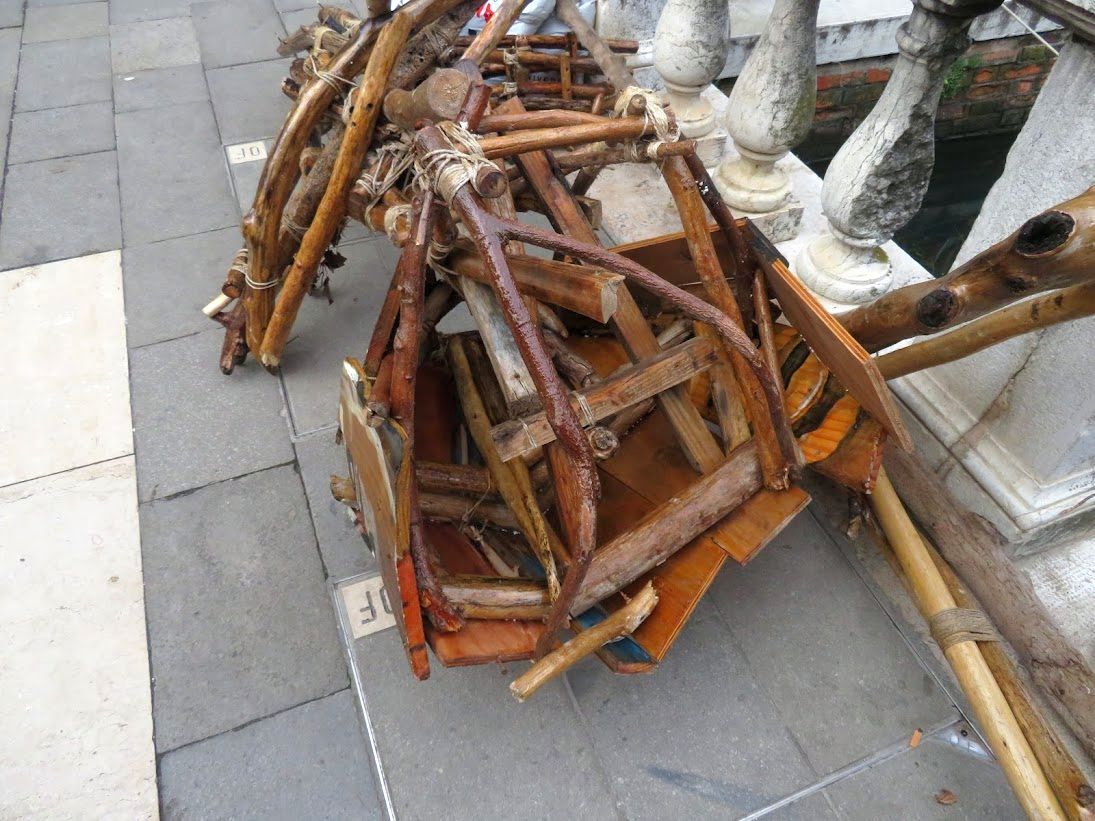
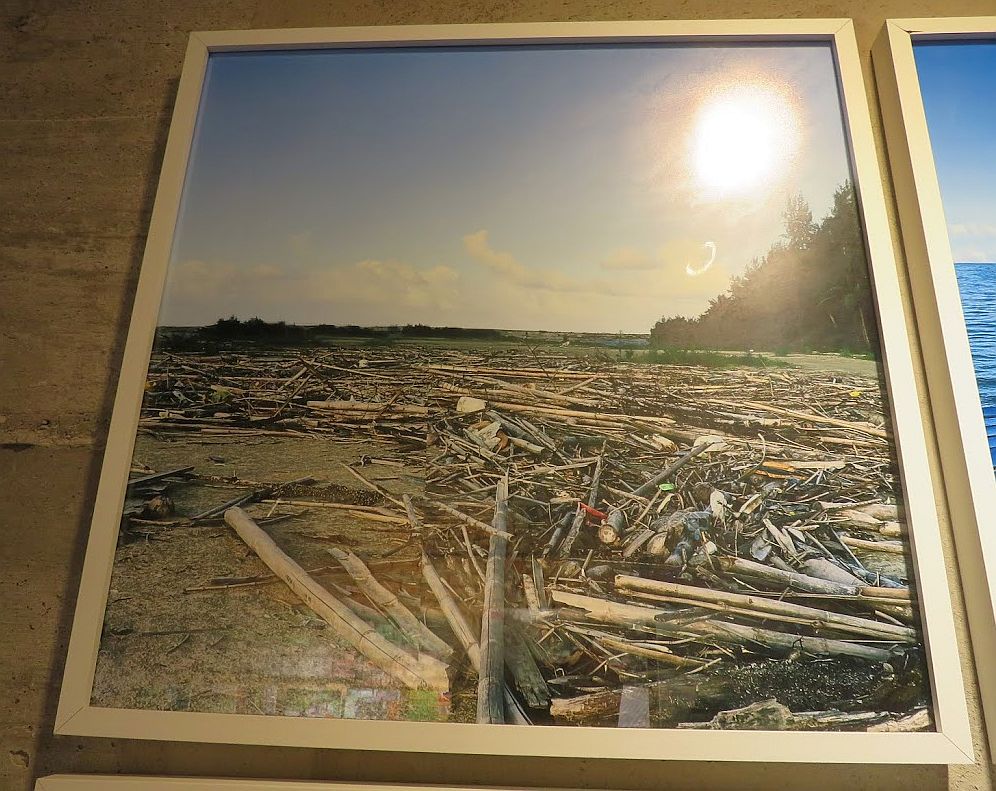
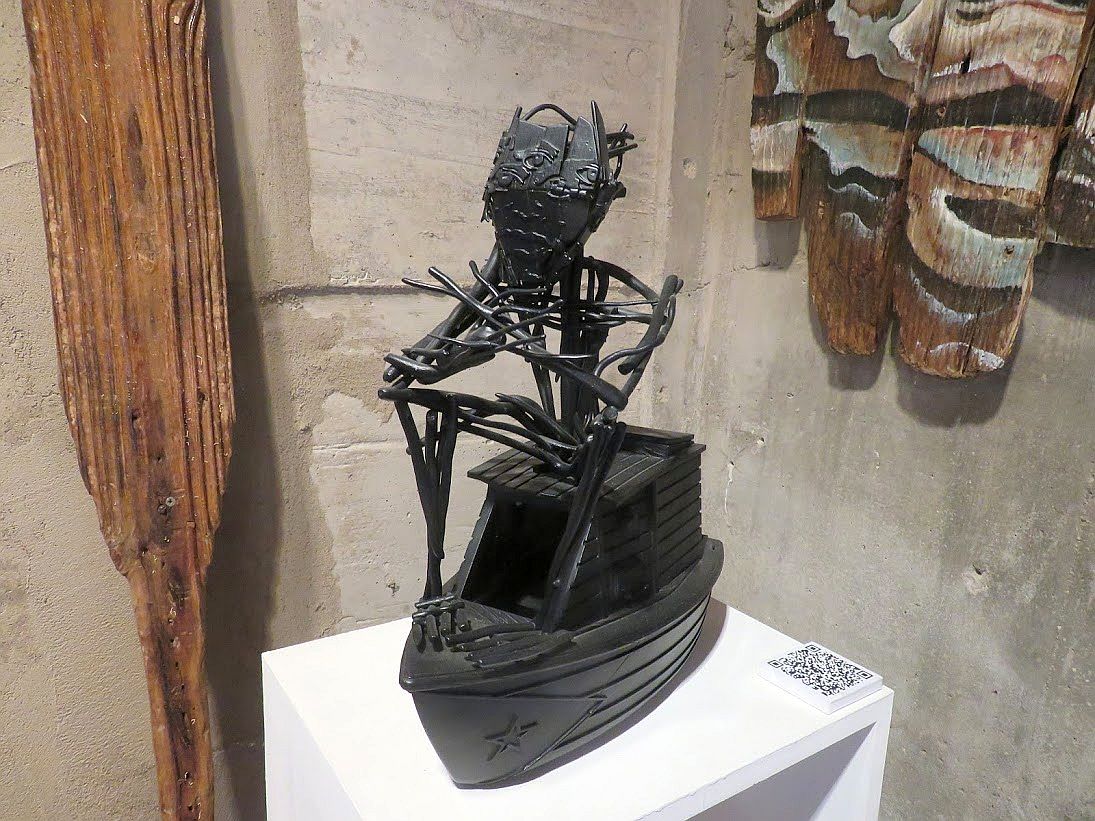
I can sort of see the point about the statue’s instability on a waterlogged boat, but maybe the instability is part of the whole concept? Like a metaphor?This image is exhibited in the small space on a narrow side street used as the Explanation Point for this piece of art. This wreckage was the trove from which the statue was constructed.The artist made a model of the assemblage in metal before he started looking for driftwood. I admit I’m out of step with art, but this seems like evolving backward.If you’re capable of making this, I struggle to grasp what could be the point of doing it later in driftwood. I think this is way cool enough. It’s still inexplicable, but much cooler.The artists are listed at the bottom of the poster. My search for enlightenment ends here.I look at his expression and can only say “Same, your saintship. Same.”
Of course people want to come to Venice. In the case of the ticket, the earlier the better.
Maybe you remember that in April there was an international wave of publicity/curiosity/dread/disbelief at the announcement that the city government — after nine years of dithering — was ready to start a 29-day program that imposed what was vulgarly called an “entrance ticket” on visitors to the city. (The city, attempting elegance, called it a five-euro “contribution for access.”) To lessen the unpleasant connotations, the plan was termed “experimental,” which means that no matter what happened, everything would be fine. That being the nature of experiments. You want to see what happens.
Many, including your correspondent, were perplexed as to what this project was intended to accomplish. Theories abounded. Mayor Luigi Brugnaro said it was to slow the flow of tourists that was swamping the city. I myself doubted it, because if five euros were a sufficient deterrent to a prospective day-tripper, that person should be spending those five euros on food and shelter instead of lollygagging around the most beautiful city in the world.
Definitely need to see Venice. What’s a measly five euros?
Also, the ticket was only required on weekends and holidays, from 8:00 AM – 4:30 PM. So the flow could easily shift to other days, and other times of day, too. Finally, there were so many exemptions almost nobody, it seemed, was going to have to pony up. Resident Venetians, Veneto citizens, anybody with a job here, tourists who overnight in hotels/apartments, temporary residents, children under 14, students, persons with disabilities, persons participating in a sports event, persons with medical appointments…You get the idea. My favorite: “Going to visit a friend.” You fill out the exemption request on the city’s website naming some Venetian you met once standing in line at the supermarket cash register, and you’re all set. Not saying it ever happened, I’m just saying it could.
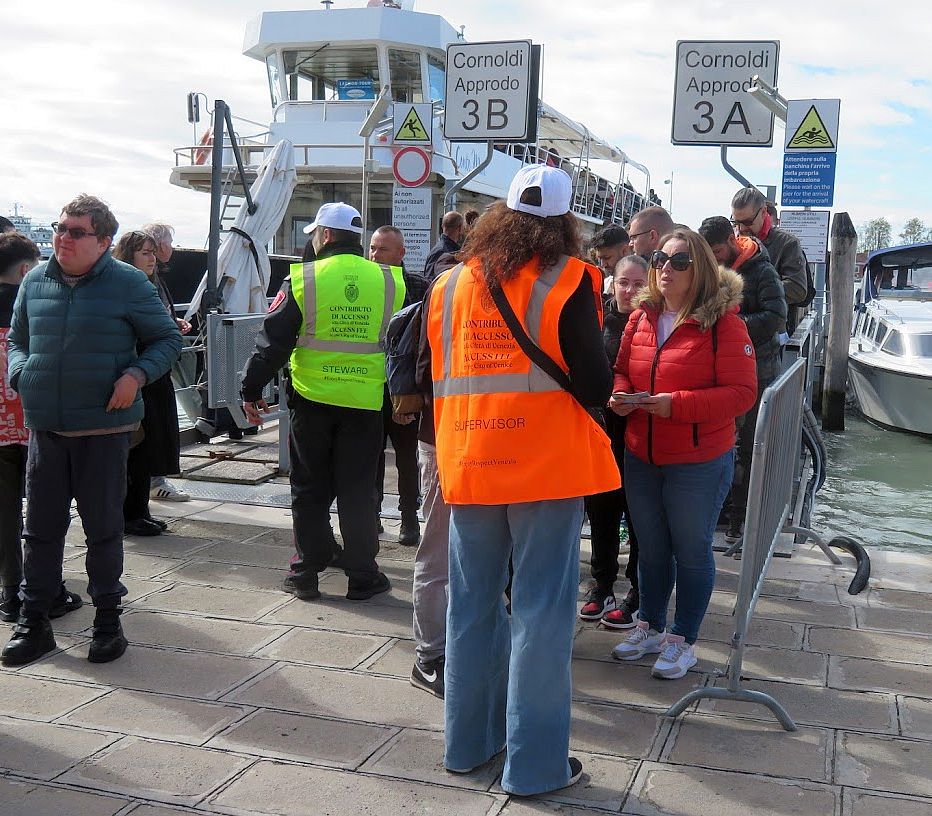
The first day was April 25, a national holiday as well as the feast of the city’s patron saint. The hundreds of tourists arriving on big launches were met by stewards who checked their paid online tickets, or were prepared to sell the ticket on the spot. The jackets clearly stress their role in handling the “Contributo di accesso.”
Some more cynical people theorized that this was a cleverly mislabeled method for the city to make some money. Crass! The city denied this, of course, saying that the expenses of administering the program (and staff and other stuff) far outweighed any potential profit. I’m confused. Why is the city pretending to be so bashful about wanting money? We’re already completely accustomed to the tourist tax on overnight visitors. Why wouldn’t there be more fees popping up?
Interestingly, the whole scheme depended on the honor system, which seems like a shaky way either to limit traffic or make money. If you arrived at 7:30 and just walked into the city, there wasn’t a dangerously high probability of being stopped during the day by somebody in uniform asking to see your ticket. It could happen, but as I say, the odds were pretty much on your side.
Soak up all that beauty, there’s plenty to go around.
On the city’s side, however, was the fact that there was no limit to the number of visitors, so simply pull out a crisp crackling fiver and you were in.
100,000 tourists arrived on the first day, and 8,000 paid. I’m no good with numbers, but those didn’t seem to indicate much of a deterrent, much less a slot machine pouring out cash. If the system worked as planned, there should have been fewer visitors and therefore less income. How wrong I was.
Deterrent it clearly was not, and the term cash-flow took on exciting new meaning. The city had estimated that in the 29 days of “limited access” there would be 140,000 paying visitors providing 700,000 euros total income. Yet the numbers up to the last two days revealed that there had been 440,000 paying visitors.
And as for those mournful remarks about how much it cost the city to run the program? The earliest report says that 2.2 million euros came in, three times the projected sum.
Just throw money at Venice, there’s no such thing as too much.
So we are all left with a huge question mark hanging over our heads (“we” meaning those who care, which I do not). What was all that?
At the beginning, the mayor stated that the ticket was “the first step to a plan to regulate the access of day-visitors.” In another interview, he said that “Our objective has always been to put a brake on those who come to Venice just for the day.”
So now, faced with the realization that the five-euro ticket hadn’t slowed the traffic at all, but that in some weird way had actually accelerated the situation, what is the next logical step? Already mooted: Raise the price to ten euros! That’ll keep ’em at bay! Or if not, it’ll bring us cataracts of cash. Either way, the city wins!
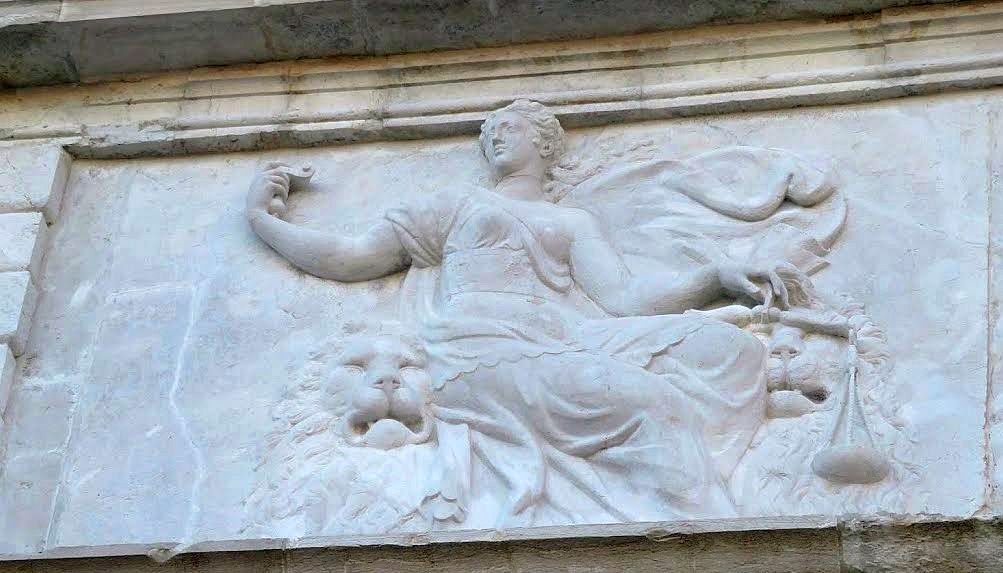
The Serenissima is often represented as Justice (a/k/a “the blind goddess,” though the blindfold is optional). The off-balance scales in her left hand appear to be making it difficult for the lion also to see straight.
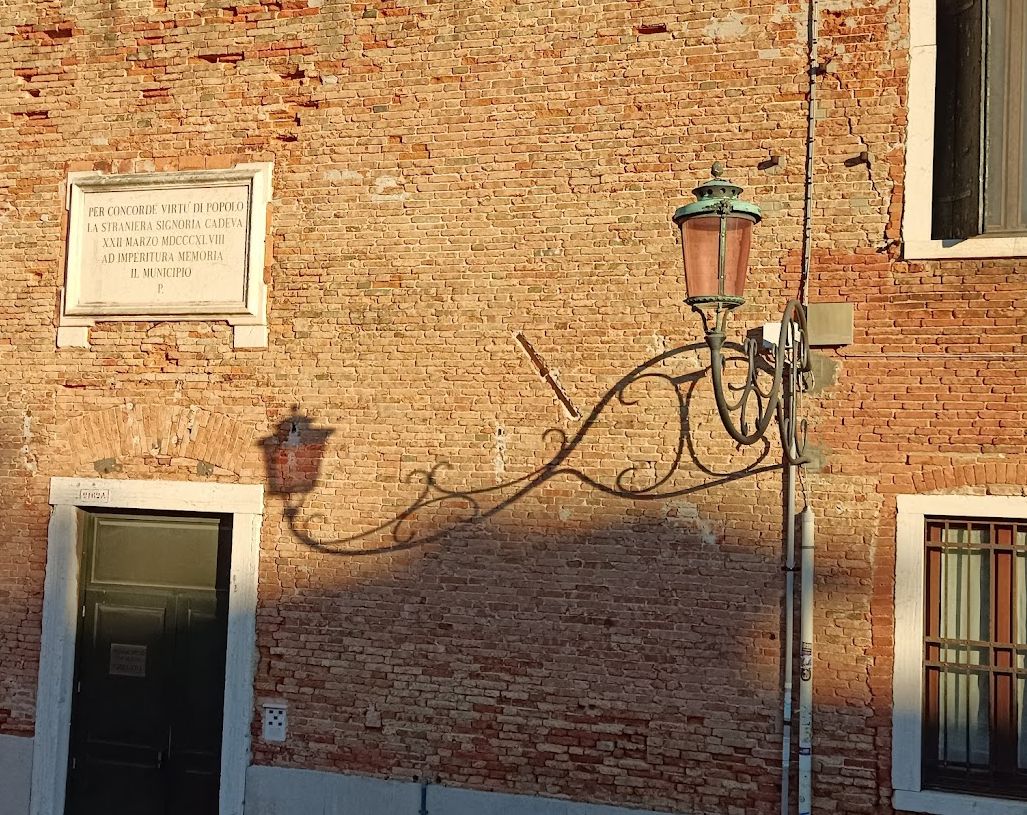
So I now walk away from the curious fresco crowned by the streetlight, and focus my attention on the streetlights themselves. We take them for granted, but lighting up Venice was an endeavor that went on for centuries and involved no granting at all.
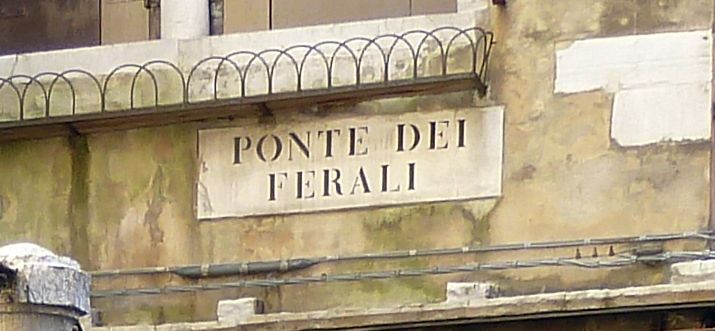
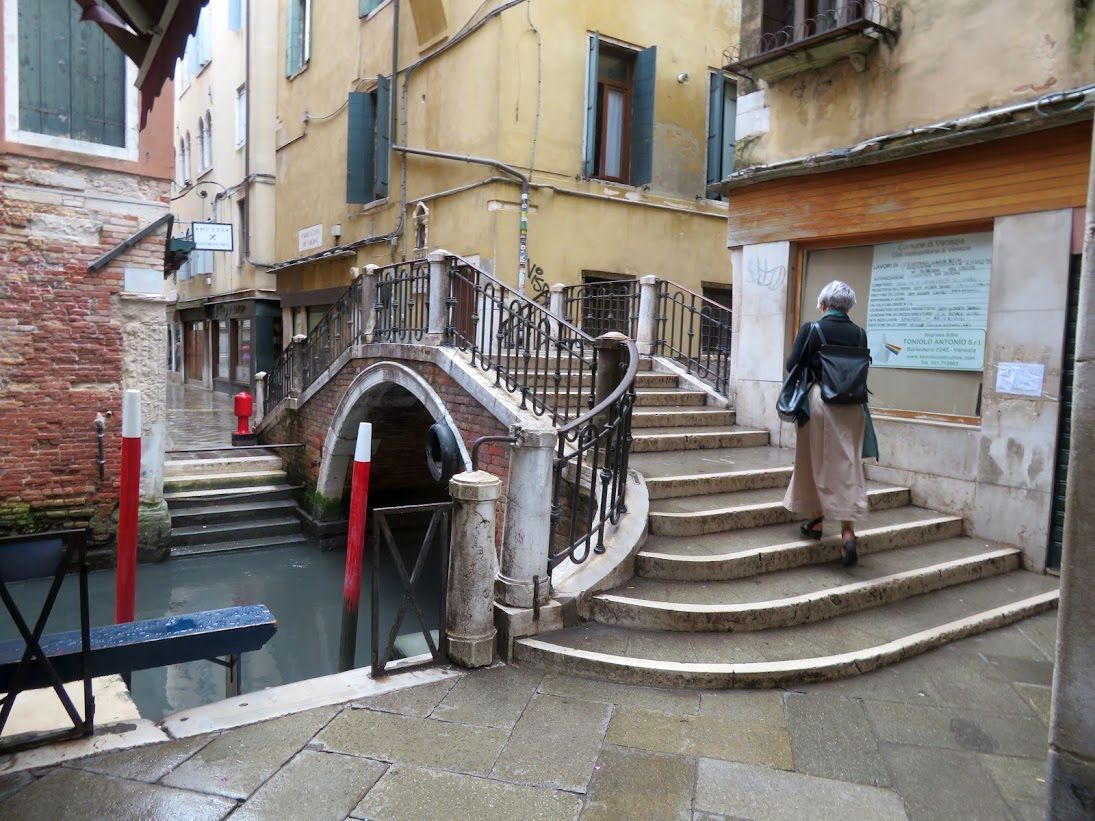
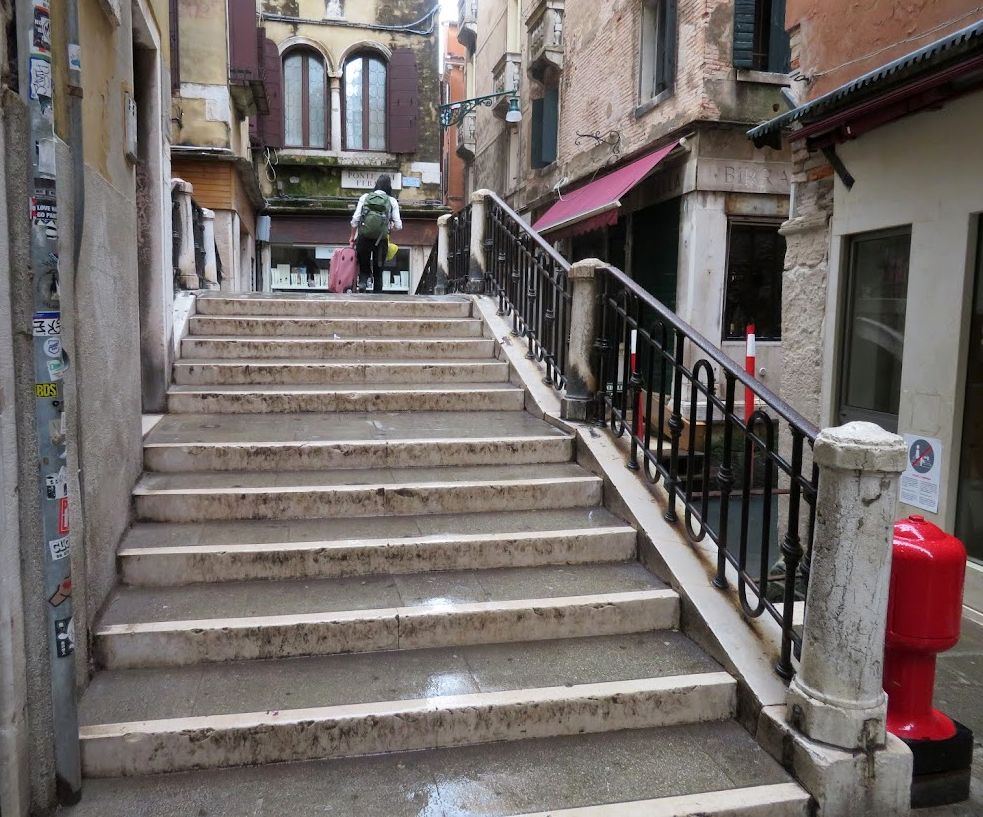
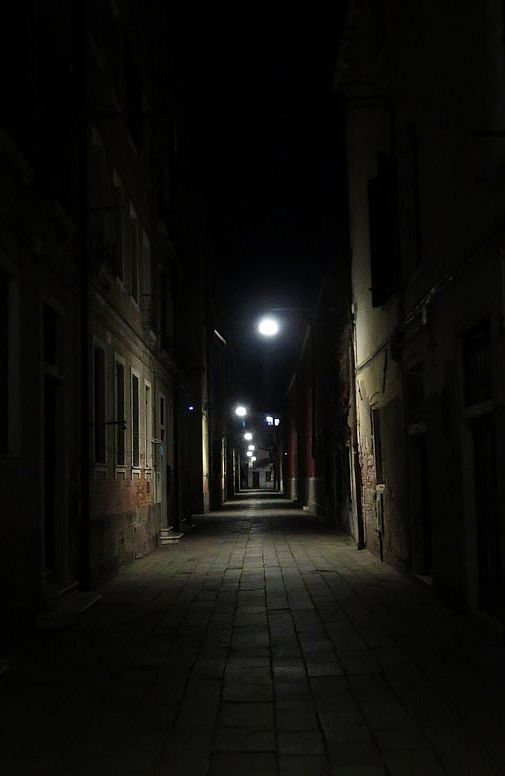
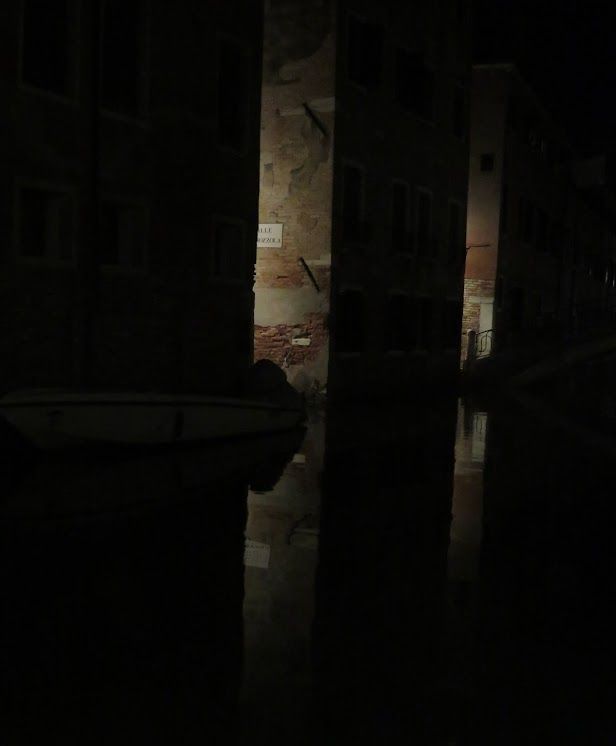
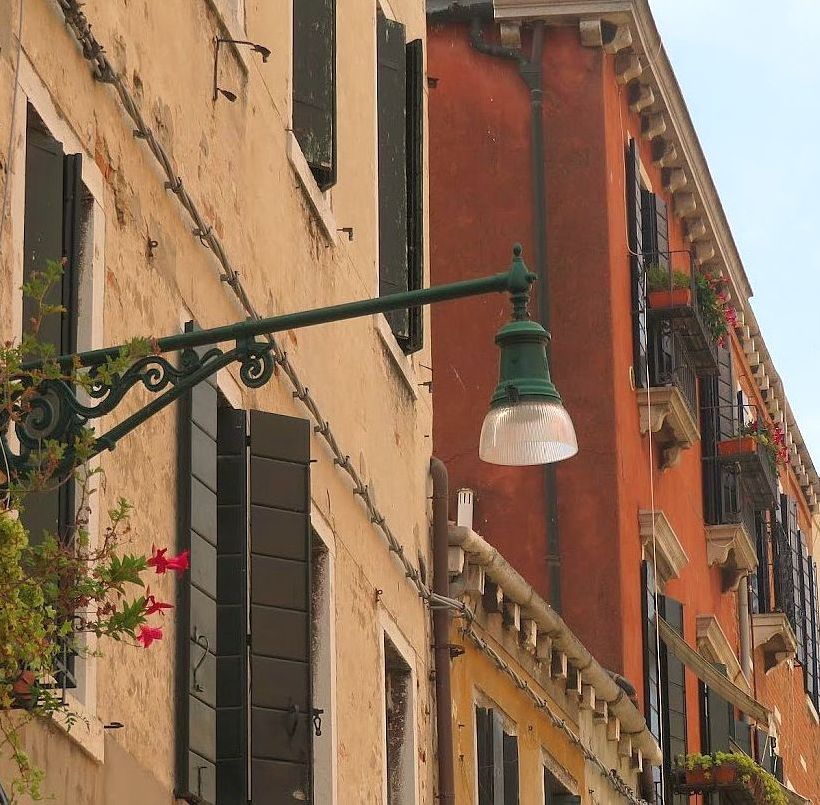
The Bridge of the Streetlights.This is the Ponte dei Ferali, looking east toward the church of San Zulian.Ponte dei Ferali, looking west toward Calle Fiubera. As far back as the 1200’s the feraleri, or makers of streetlights, had set up their shops on nearby streets, as well as on the bridge itself (hence the name).This is a feral; you’ve seen them all over the city in various sizes and shapes. They brought Venice to blazing life (eventually). Oil was the best they could do until 1843, after which gas was the combustible. Between 1915 and 1918 Venice returned to primeval darkness, hiding from Austrian bombardment, although the bombs still fell. There are numerous plaques around the city commemorating the destruction caused by what reached a total of 1,029 bombs. (In a single night — February 26-27, 1918 — 300 bombs, explosive and incendiary, were launched on the city.) Light returned with peace, but in 1927 gas gave way to electricity.Even though streetlighting in many places has now reached intense levels, there are still stretches of street here and there that reveal what darkness used to mean. I’m not referring to the medieval days with their timid little lamps at streetcorners; even as recently as the late Nineties the only light in the darkness of our stretch of fondamenta between Santa Margherita and Santa Marta was the glow from a single shop window. I called it the “lighthouse of the neighborhood.” When the street lights were finally installed, the glare was so extreme that I felt like we were walking home across a football field on game night.Via Garibaldi gleams in the distance, but in this tiny calle you’re on your own.
For centuries the streets had been illuminated to a feeble degree only by the faint flickering from the little lamps (cesendelli) at shrines on various street corners. “Be home by dark” really meant something because by 1128, due to the inordinate number of corpses found lying around the streets in the morning, the government began to take seriously the need to create real illumination.
Enter the ferali, or also farai, of various sizes, providing a great new line of work for their makers, the feraleri (not to mention the oil merchants). The parish priest was responsible for maintaining them, but the expense was covered by the government. By 1214 there were enough feraleri to merit their own scuola, or guild, and their devotional altar was in the nearby church of San Zulian. Fun fact: There is an osteria in Dorsoduro named Ai Do Farai, Venetian for “at the two streetlamps.”
But there were still plenty of dark streets to navigate on your way home from the theatre, or to secretly visit your lady- or boyfriend, or whatever you were up to after sundown. In 1450 the Venetian government had become so exasperated by the nocturnal carnage that it passed a law requiring people to carry a light– candles, lanterns, torches — when they were out at night. (Yes: We order you to protect your life! See: Seatbelts.) Not only was this a good idea in itself, but it was equally good as a job.
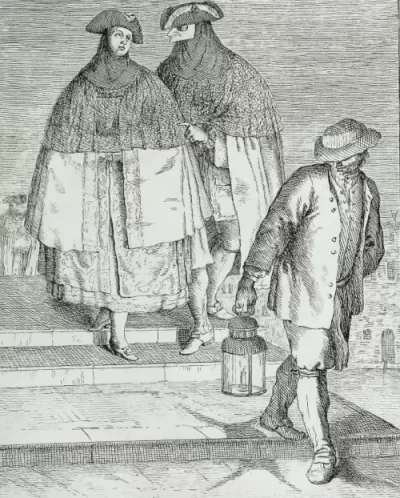
Enter the codega (CODE-eh-ga). He was a very poor hired man who waited with a lantern outside theatres, gambling houses, or other festive places, or was available on call, to light your way to wherever you were going next. Sometimes the lantern was suspended from a long pole.
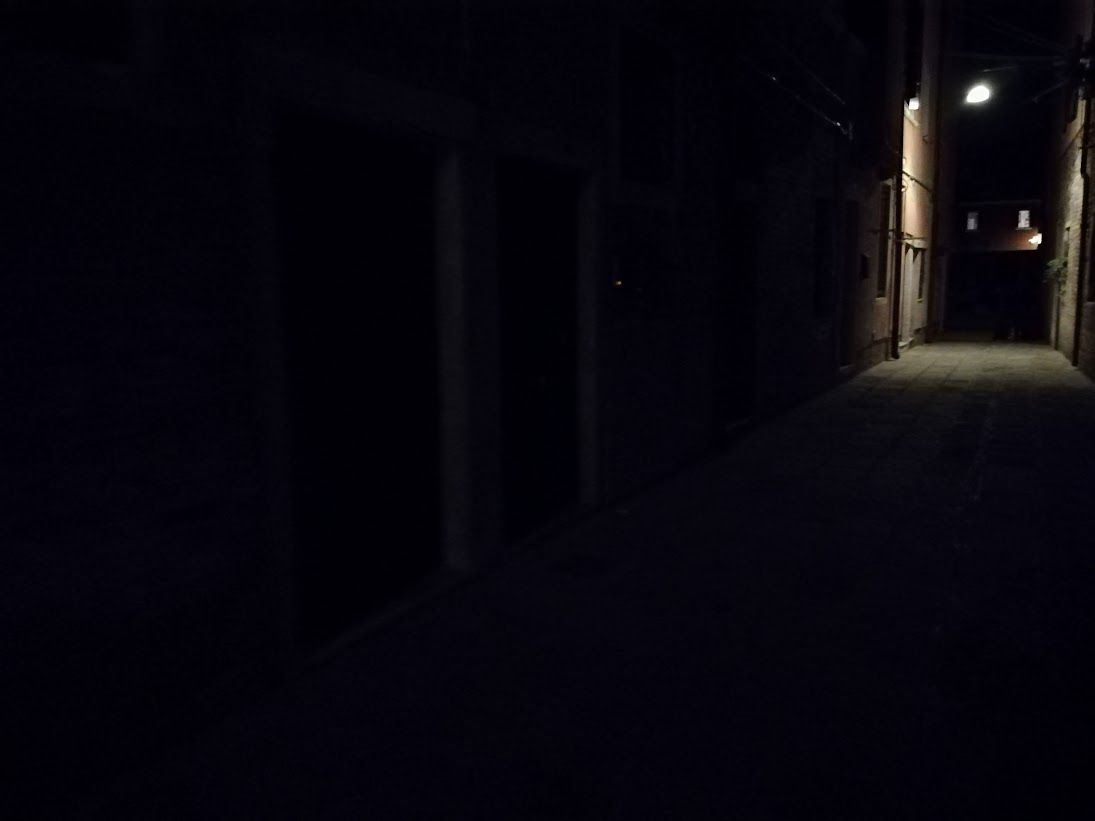
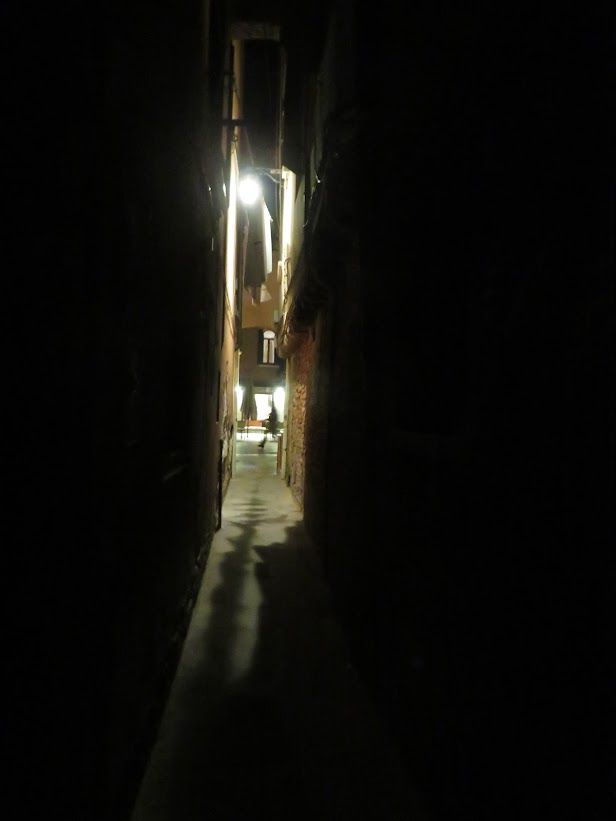
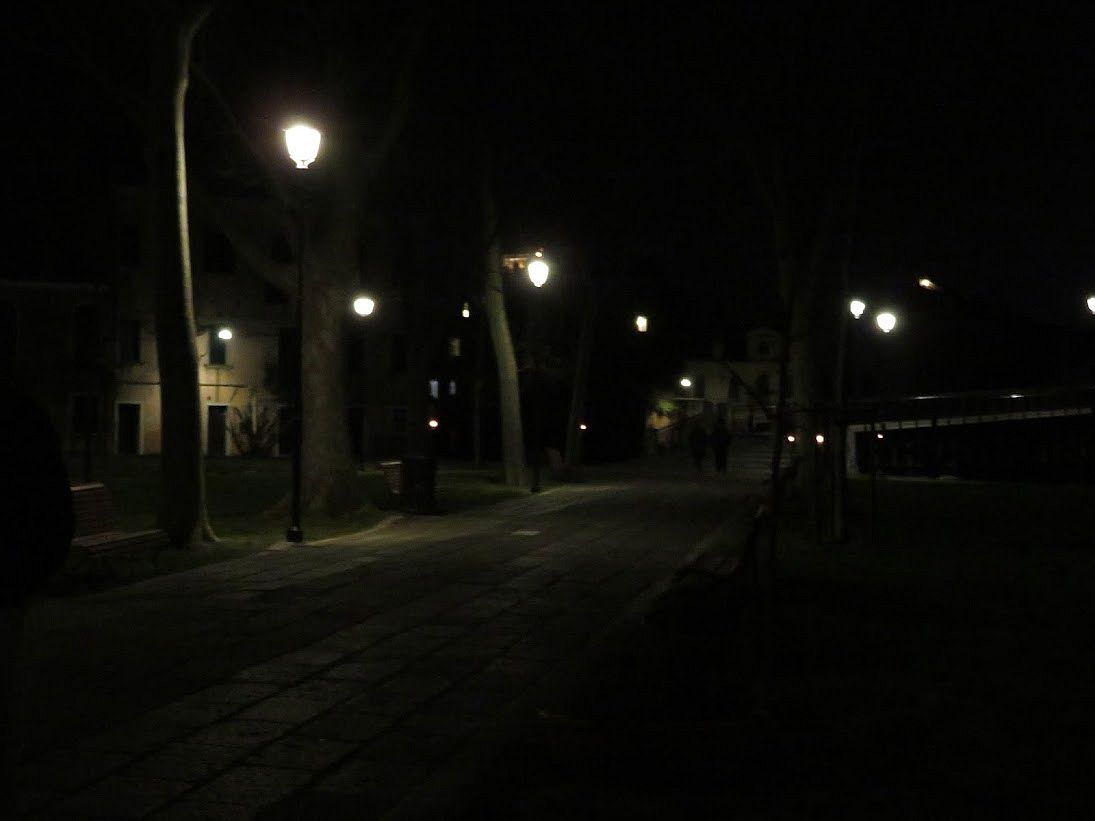
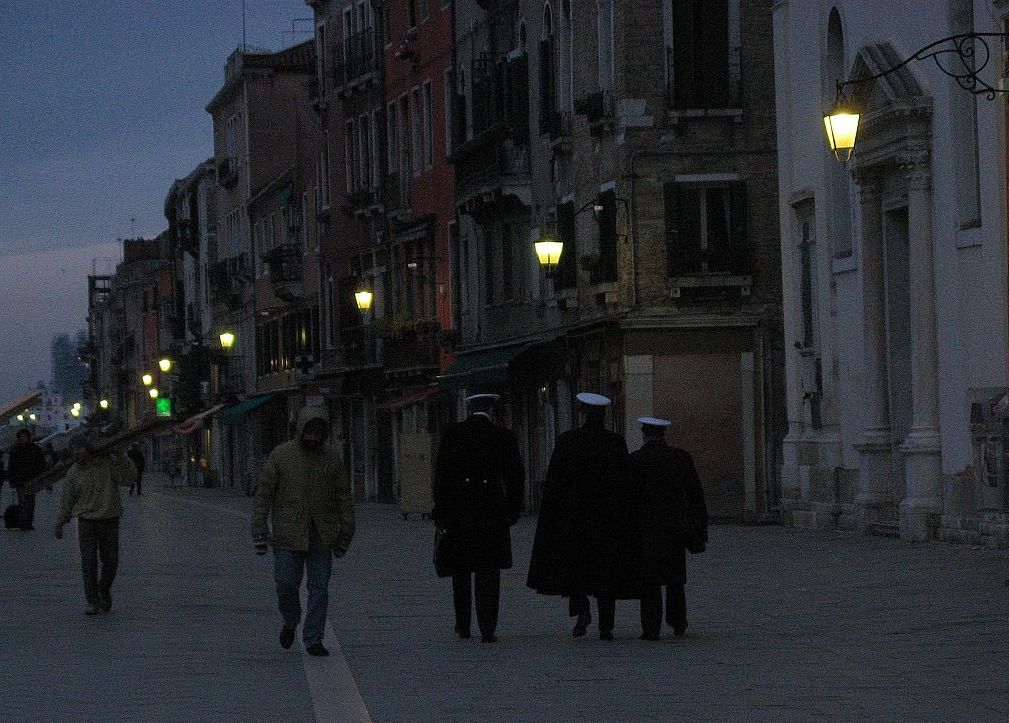
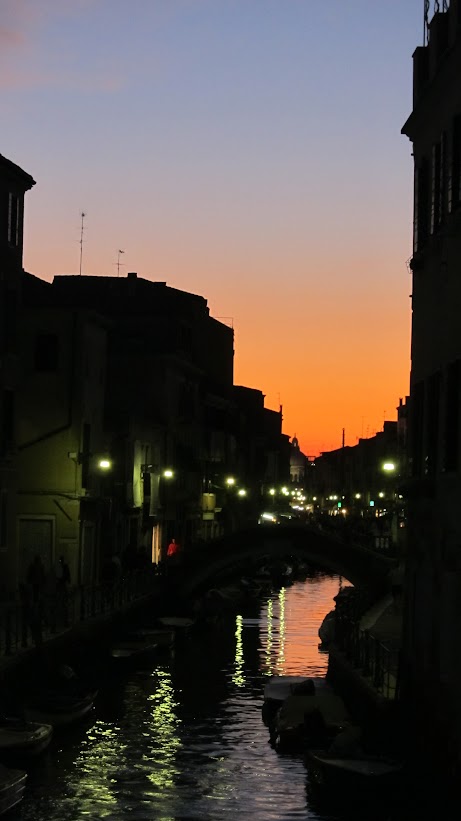
The codega’s candle was better than nothing, but those who carried oil lanterns undoubtedly shed more light. The oil was usually rendered pig fat (Venice is so romantic); it’s generally accepted that the word itself derived from cotica, or pork rind.Once your eyes adjust to the ambient light, these lamps seem adequate. Not Fifth Avenue, true, but better than a candle.Your mind adjusts this scene to say the street is lit. You instinctively ignore the dark intervals because you’re on the way to the next little luminescent island.Now just imagine the scene without the streetlights. And speaking of wartime blackouts, the same curfew applied during the Second World War. Anyone born in the late Thirties only knew the city as dark at night. Lino remembers when the lights were turned on after peace was declared. It was the first time in his life he’d ever seen the streets lit up, and what he remembers wasn’t so much the brightness itself as everyone in the neighborhood waiting outside together for the lights to come on, and how they clapped and rejoiced when it did.
In 1719 a nobleman named Stefano Lippomano is regarded as being the bright spark who convinced the shopkeepers around San Marco to put an oil lamp near their shops between the Mercerie and the Rialto. Did they need much convincing? (“You’ll make more money this way…”.) This worthy idea spread through the city to the joy of everyone except — naturally — the codeghe.
In 1726 a proclamation bearing the seal of the Signori di notte al criminal (the police magistrates) denounced the habit that the humble lantern-carriers had developed of smashing the streetlamps and carrying away their wrought-iron supports. It would be no comfort at all to the embattled men to know that one of the most prestigous international awards for innovation in lighting today is called the Codega Award.
Fun fact: Between San Marco and Rialto is the Hotel Al Codega. Presumably well-lit.
The codega walking you home. This illustration is one of a famous series of illustrations by Gaetano Zompini, who between 1746 and 1754 created a collection of scenes of everyday jobs practiced in the streets of Venice. The new idea of attaching his lantern to a wall and sending HIM home was one of those many human blows that mark the march of progress.
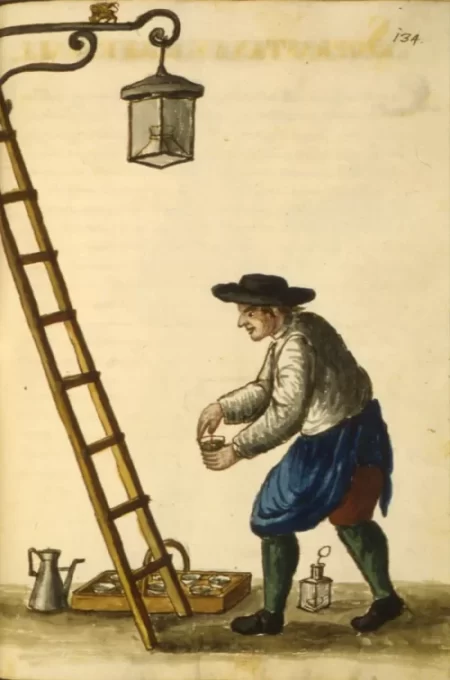
But smashing the lamps was futile — streetlights were the future. Crime was down at last, and between 1721 and 1732 the Signori di notte al criminal created a system of 834 public streetlights — not a lot, but it was a start — paid for by voluntary contributions. There were private lights on palace balconies, but the public lamps were lit by a public lamplighter, paid for by the magistrate.
The old lamplighter. He appears to be carrying lighted oil up the ladder. Seems risky in lots of ways but a better alternative (easier? cheaper?) hadn’t presented itself.
Everything settled now? Not even close. The problems in organizing and maintaining this municipal necessity were endless. By 1740 there were 1,046 public streetlights, but those voluntary contributions weren’t nearly enough to cover expenses and so a tax was levied on every “head of family.” The astonishing inequality of this tax burden (indigent widows paid the same as patrician clans) led to its abolition in 1756.
Flaws and defects in this worthy undertaking abounded. Service was terrible. The lamplighters didn’t always light (or keep alight) the lamps; the oil destined for burning turned out to be of an even lower quality than agreed (and paid for), and also was somehow inexplicably often in short supply, except for that time when the inspector general made a surprise visit to the warehouse and discovered 40,000 more liters of oil than were listed on the register; the lamps themselves weren’t especially sturdy, being made of sheet metal, often tin; the feraleri were not always of a consistently high level of skill or reliability (not charlatans, exactly….); and the fragility of a flame floating in oil facing wind and storms was all too evident. The brightness of everybody’s hopes was faint in comparison to the reality of, well, reality. The Serenissima kept trying to improve the situation by giving out new contracts to suppliers and artisans but graft and corruption reigned. The courts were full of complaints and denunciations, and those were only the most serious cases. But there was no going back.
This is dawn in the winter. Every little bit helps.
Despite all these problems, Venice at night had become something phenomenal. Carlo Goldoni, returning to Venice in 1733 after some time away, was astounded by what he found.
“Independent of the street illumination, there is that of the shops that stay open in all weathers until 10:00 at night and a great part of them don’t close until midnight, and plenty of others don’t close at all.” I pause to let that sink in.
He goes on: “In Venice you find at midnight, just as at midday, food being sold in the open, all the osterie are open, and beautiful dinners prepared in dozens of hotels and neighborhoods; because it isn’t so common in Venice that the diners are of high society dinners, but rather the really cheap little places (ritrovi di lira e soldo) are where you find the groups of the greatest liveliness and liberty.” In other words, the regular folks out there living it all the way up.
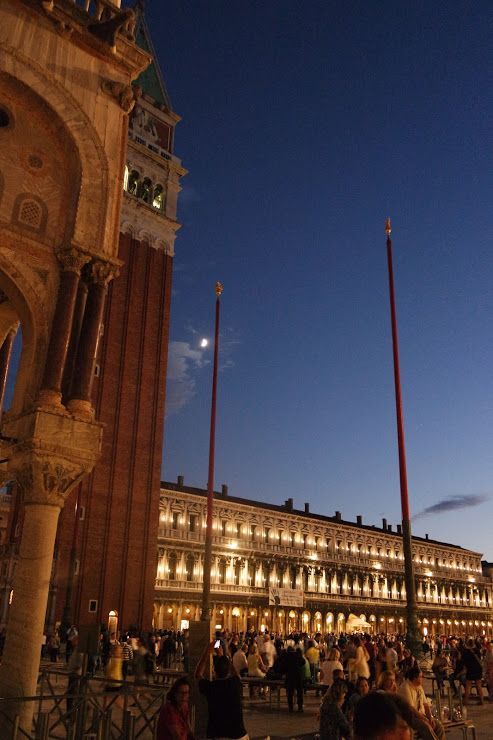
He concludes: “In summertime the Piazza San Marco and surrounding areas are busier at night than during the day, with men and women of every sort.”
Goldoni might have been talking about something like this.
By 1775 there were 1,778 public streetlights. Still not enough. On September 7, 1796 the magistrates proposed installing at least “one lamp every hundred paces.” So 1,145 additional lamps were set up, and duly noted in the register (catastico) that hadn’t been updated since 1740.
I’m sure this improvement got compliments from the French when Napoleon arrived less than a year later, and thereafter from the Austrians who moved in. There were more than 2030 lamps around the city by then. For any trivia maniacs, at the beginning of the 1800’s there were 12 on the Giudecca, 27 in the Ghetto, 76 in the Piazza San Marco, and 1915 scattered elsewhere around the city. The Austrian occupiers’ shiny new department responsible for “police, streets, canals and illumination of the city” found itself stuck with the same problems that had bedeviled the late great Republic for centuries. Because, you know, people.
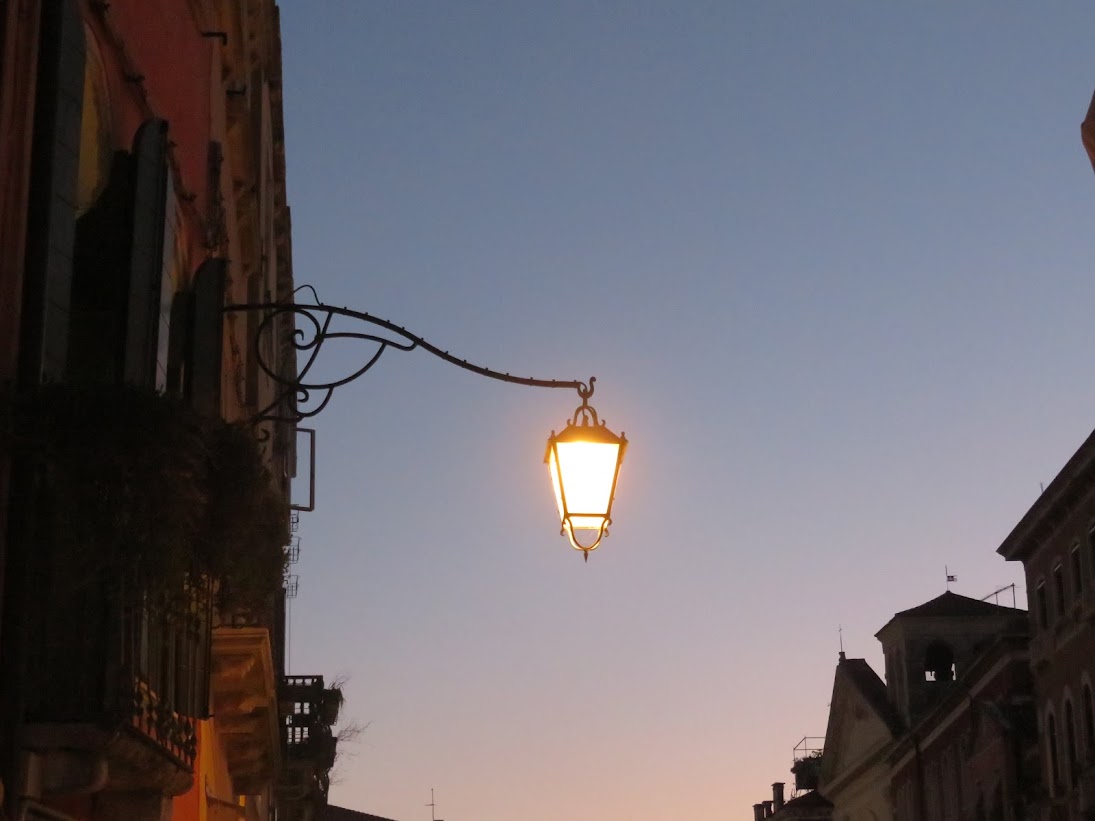
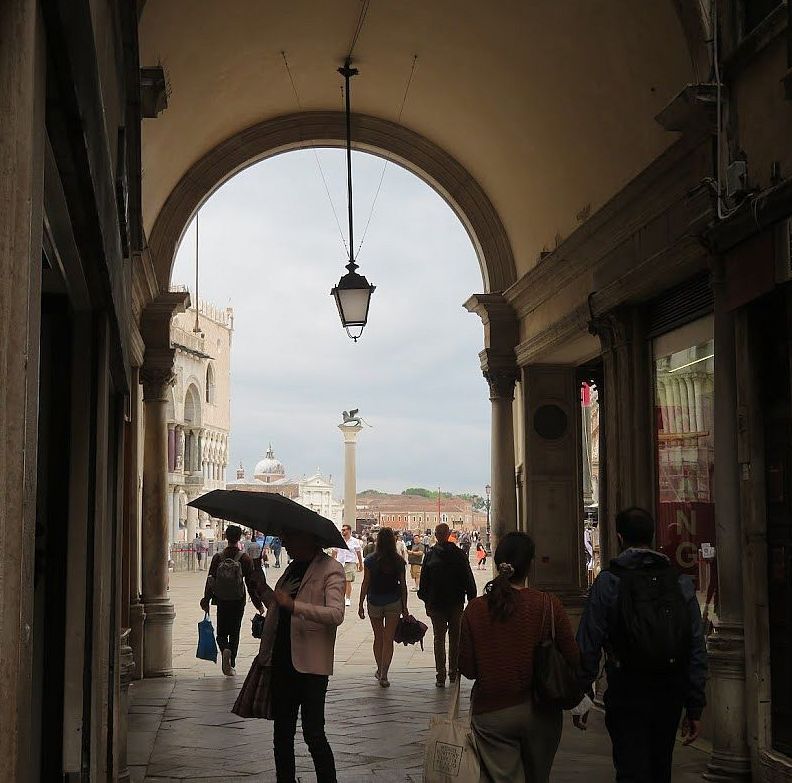
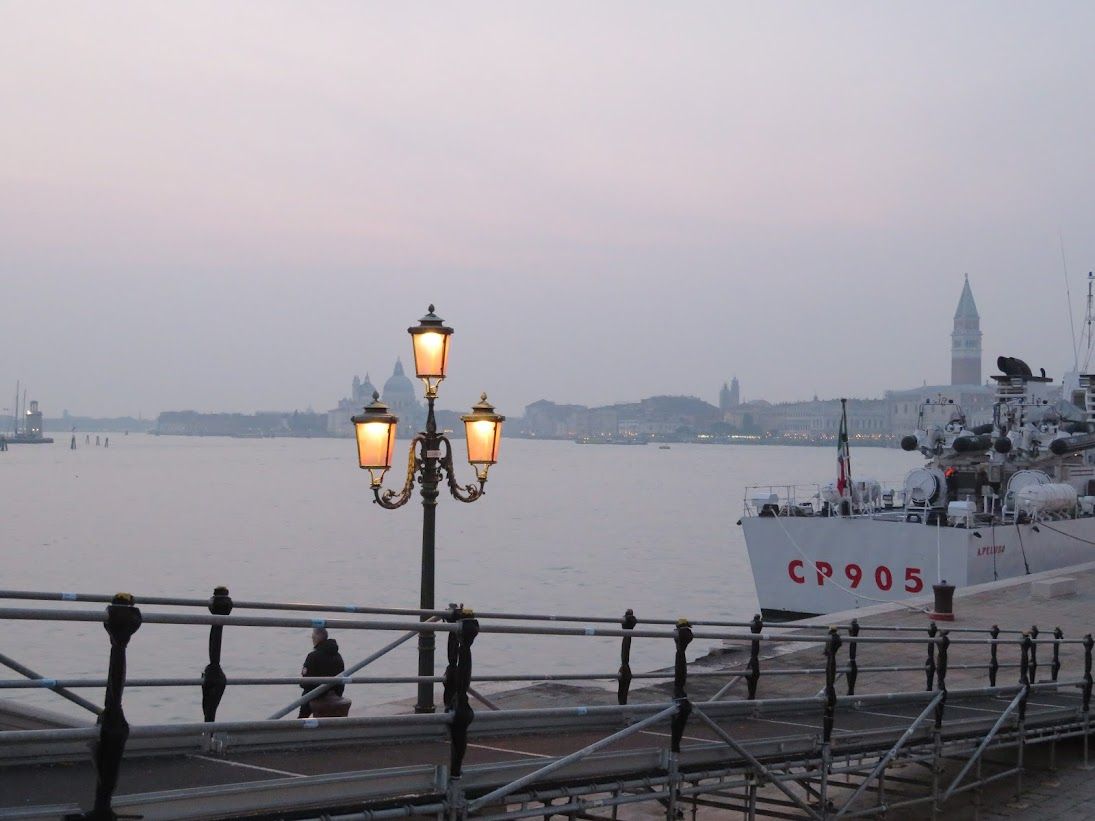
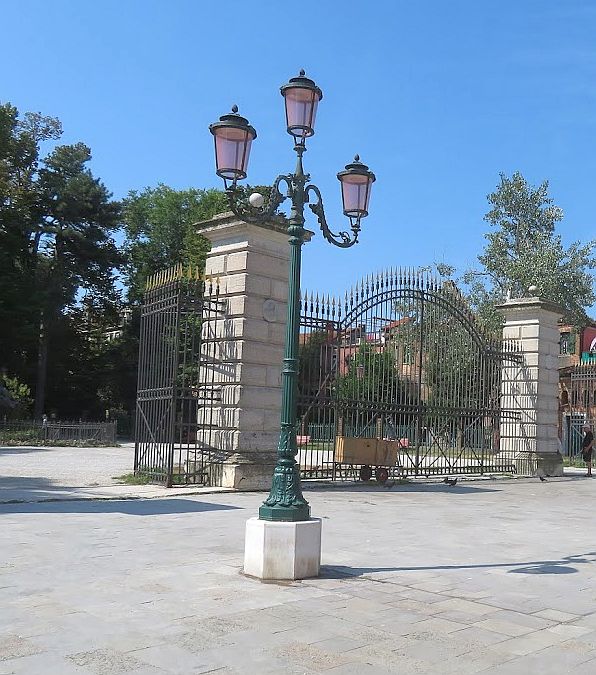
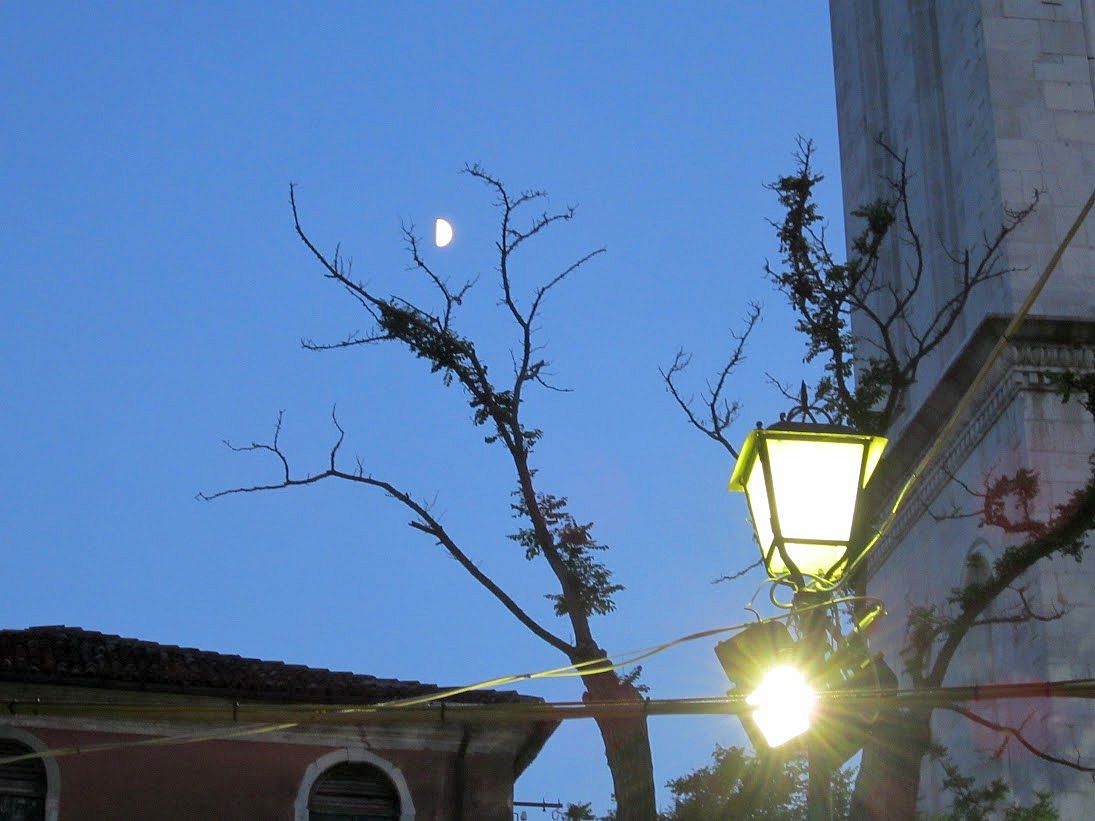
Lights by day mostly blend into the scenery.Though lights by day do have their own fascination, when the non-artificial light is right.Light at early twilight is lovely, though 500 years ago most people might not have begun to light the lamps just yet.It’s definitely time to turn them on.This streetlight is now as common as its more poetic predecessors.Many streetlamps have been placed on pedestals. Highly convenient for dogs, obviously, but the real motive was almost certainly to protect them from corrosion, to which many have fallen victim. Acqua alta has damaged not only marble, but iron.
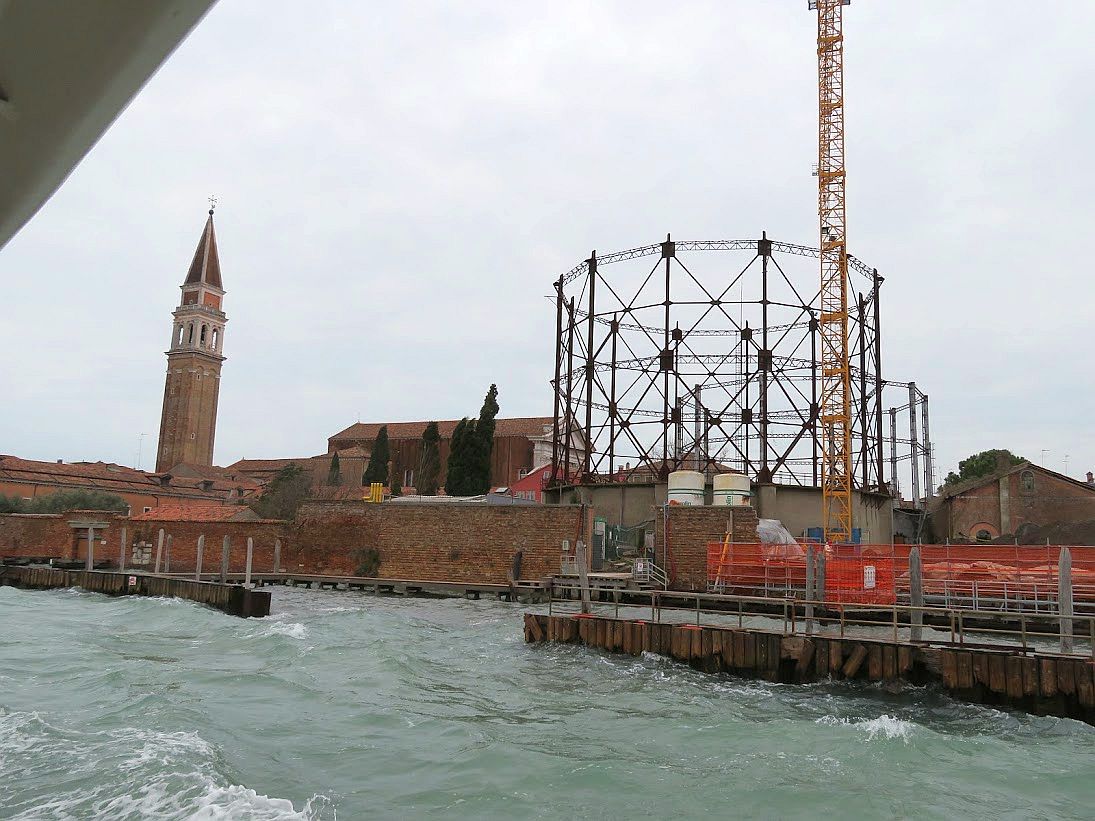
The lights in Venice, in the houses as well as on the streets, ran on gas produced by burning coal — coke, to be precise. Italy is full of decommissioned “gasometers” like the two left abandoned near San Francesco de la Vigna. (There was also one at Santa Marta, across the canal from where the prison currently sits.) Providing this crucial industrial service right next to a 16th-century church designed by Jacopo Sansovino and Andrea Palladio, and its adjacent Franciscan monastery, seems pretty crazy, but the land was there and space in Venice is valued far above rubies.
In 1969 came the switch from coal gas to methane, and the future of these relics of industrial archaeology has become as Byzantine as everything else here. The neighbors want a sports center for the kids (three high schools within a very tight radius); a German company proposed converting them to luxury hotels but got tired of waiting for the bureaucracy to conclude its Byzantine operations, and now luxury apartments have been mooted. As long as it’s luxury, that’s all that matters. After all, somebody is going to have to pay the cost of cleaning up the century of environmental horror in the soil.
A century ago, more or less, six of these “gasometers” were set up in farthest Castello near San Francesco de la Vigna, where practicality ruled over pesky artistic concerns. The two survivors here date from 1882 and 1926. Controversy continues to swirl around the fate of these structures but I mention them only because of their once-vital role in providing electric current to the city by producing gas from burning coal.
To recapitulate: Lighting Venice evolved over the generations from pig fat to methane. The world is amazed by building a city on water, but I have to confess that illuminating it was not much less impressive. If you were to want to read more — much more, and better — I recommend the lavishly illustrated “The Lights of Venice,” an extraordinary book published online in 2022 by the Fondazione Neri. I’d gladly have read it all myself, but I still haven’t finished War and Peace. But at least “Lights” has a happy ending.