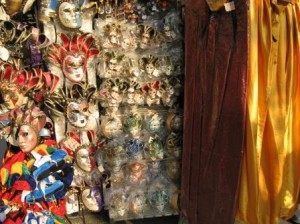
During Carnival nowadays, anybody who normally sells anything lays on a batch of souvenirs — masks, capes and other stuff.
Here are a few more morsels of lore about Carnival back in the Old Days:
Laws: I realize that the Carnival motto is “anything goes,” which makes the idea of laws somewhat incongruous. But “anything” could — and did — lead to enough dangerous and unstable behavior over time that the adults supposedly supervising this city-wide party were forced to set some ground rules. Their significance is pretty obvious. For example:
It was forbidden in 1703 to wear the bauta in the ridotti, or gambling houses. The government was apparently the last to realize (after centuries of Carnival) that being completely disguised was a great way to hide from your creditors. So, no hiding behind masks and capes for any nefarious purpose, because they were also …
… a great way to conceal your identity as you lurked around stealing things and killing people. On February 11, 1720, the government decreed that the capo, or head, of each neighborhood was to patrol his territory with eight men every night of Carnival; there had to be some effort made to limit, if not completely prevent, the mayhem and murder that seemed to be the natural consequence of fun and frolic. It must have been a great time to settle scores.
It was forbidden to wear masks during a plague.
It was forbidden to carry weapons if you were masked. Duh.
It was forbidden to dress up as a priest and it was most especially forbidden for men to dress up as nuns. If they did either of these things, it was just too easy for them to enter convents or churches and debauch the sisters. Not that the nuns cared, especially; a large percentage of them didn’t want to be Brides of Christ in the first place, and plenty of them absolutely made the most of Carnival anonymity. I’m presuming that women had also been making the most of voluminous Carnival coverings to visit the monasteries.
Just to make sure there was a stop to this particular bit of chicanery, on January 24, 1458 it was decreed that nobody wearing a mask would be permitted to enter a church, convent, or any other sacred place. Period.
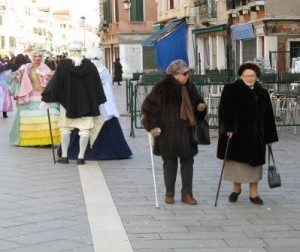
Once you really get into the Carnival groove, you start to look at everybody differently. Like these two individuals. Who are they really? And what an amazing costume they’ve put together — they look just like two little old ladies from the neighborhood.
The Carnival Calendar:
You couldn’t wear masks just any time you felt like it. It was like hunting season, with fairly specific dates:
It started in October, when everybody came back from summer vacation in their country villas, and the theatres began to open. At its height, Venice had 17 theatres, an extraordinary number for a city in those days. And Carnival continued, with a brief interruption for Christmas, until Ash Wednesday ushered in Lent.
Masks were also allowed to be worn during the two weeks of the feast of the Ascension and its phenomenal market, which filled the Piazza San Marco with vendors from all over the Mediterranean basin and beyond.
You know it’s Carnival when there’s confetti (sorry — coriandoli) literally everywhere
And then there was the convenient clause of “and whenever appropriate” (as I think of it). Masks could be permitted by special decree for very special occasions. For example, masks were allowed during the celebrations of the victory of the Battle of Lepanto (1571). Among the countless public festivities was a parade of allegorical floats: “Christianity” was represented in the act of crushing a chained dragon; “Victory” vaunted itself over the vanquished; and “Death” was triumphant, complete with sickle. It was all party, all the time for several weeks, and that could only mean break out the masks.
In any case, in good times or bad, one unassailable rule was that Carnival could not be interrupted. When doge Paolo Renier died on February 13, 1789, they didn’t report the death until March 2.
Contains information related to marketing campaigns of the user. These are shared with Google AdWords / Google Ads when the Google Ads and Google Analytics accounts are linked together.
90 days
__utma
ID used to identify users and sessions
2 years after last activity
__utmt
Used to monitor number of Google Analytics server requests
10 minutes
__utmb
Used to distinguish new sessions and visits. This cookie is set when the GA.js javascript library is loaded and there is no existing __utmb cookie. The cookie is updated every time data is sent to the Google Analytics server.
30 minutes after last activity
__utmc
Used only with old Urchin versions of Google Analytics and not with GA.js. Was used to distinguish between new sessions and visits at the end of a session.
End of session (browser)
__utmz
Contains information about the traffic source or campaign that directed user to the website. The cookie is set when the GA.js javascript is loaded and updated when data is sent to the Google Anaytics server
6 months after last activity
__utmv
Contains custom information set by the web developer via the _setCustomVar method in Google Analytics. This cookie is updated every time new data is sent to the Google Analytics server.
2 years after last activity
__utmx
Used to determine whether a user is included in an A / B or Multivariate test.
18 months
_ga
ID used to identify users
2 years
_gali
Used by Google Analytics to determine which links on a page are being clicked
30 seconds
_ga_
ID used to identify users
2 years
_gid
ID used to identify users for 24 hours after last activity
24 hours
_gat
Used to monitor number of Google Analytics server requests when using Google Tag Manager