I have been surprised and glad to get such a lively reaction to my two latest posts about Venice’s wells, and drinking water in general.
More is on the way, including, I hope, some answers to a few interesting questions readers have raised. Meanwhile, there will be a brief pause while I dig deeper (sorry) and proceed with further scribbling.
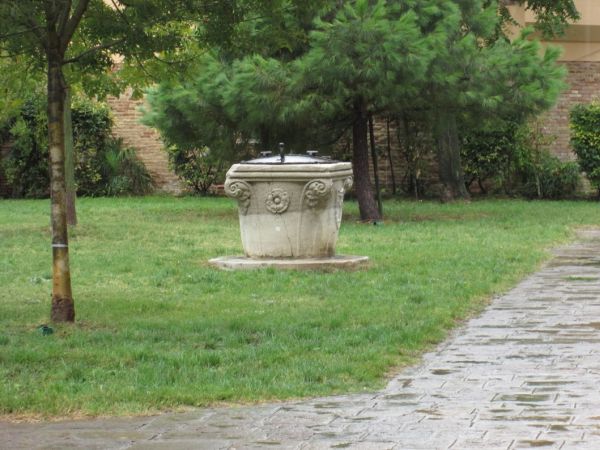
The wellhead on the canal side of the church of San Trovaso has two unusual features. One, it’s sitting in the middle of grass. That is clearly a recent innovation. Two, the line dividing white and gray was caused by the infamous acqua alta of Nov. 4, 1966, showing how high the water rose (and remained for 24 hours). Lino says that discoloration wasn’t universal among the city’s wellheads, though many experienced similar immersion. Various factors were the type of stone used for the wellhead, and how clean/dirty the water was in a particular area — many ground-level dwellings were heated by kerosene.
Looking at the picture of the wellhead with marks from the 1966 flood reminds me that one of the few times I saw my mother cry, was when I was thirteen.
I still remember her standing in the kitchen, gasping helplessly at the news on the radio that Florence and Venice were inundated, with loss of life and terrible destruction of cultural history. She was a small-town great-lover of art, and dreamed someday of seeing those defining treasures of western civilization, and now they seemed gone forever.
I’m pleased to report that only eight years later, my parents were able to visit these cities (with me as their guide at the end of my semester of study in Rome). The tons of mud and rubble were hauled away, the oil stained cleaned, the shop repaired and restocked, and such artworks as were not irredeemably lost were repaired.
It was that year of slim and quiet tourism, the year of the first oil crisis. We stood before the masterworks in silent awe and admiration, unruffled and unjostled by crowds. Under the mild and pretty sun of May we could at last displace the gritty newspaper images of the floods. But still, there were those sobering high-water marks on the walls.
Contains information related to marketing campaigns of the user. These are shared with Google AdWords / Google Ads when the Google Ads and Google Analytics accounts are linked together.
90 days
__utma
ID used to identify users and sessions
2 years after last activity
__utmt
Used to monitor number of Google Analytics server requests
10 minutes
__utmb
Used to distinguish new sessions and visits. This cookie is set when the GA.js javascript library is loaded and there is no existing __utmb cookie. The cookie is updated every time data is sent to the Google Analytics server.
30 minutes after last activity
__utmc
Used only with old Urchin versions of Google Analytics and not with GA.js. Was used to distinguish between new sessions and visits at the end of a session.
End of session (browser)
__utmz
Contains information about the traffic source or campaign that directed user to the website. The cookie is set when the GA.js javascript is loaded and updated when data is sent to the Google Anaytics server
6 months after last activity
__utmv
Contains custom information set by the web developer via the _setCustomVar method in Google Analytics. This cookie is updated every time new data is sent to the Google Analytics server.
2 years after last activity
__utmx
Used to determine whether a user is included in an A / B or Multivariate test.
18 months
_ga
ID used to identify users
2 years
_gali
Used by Google Analytics to determine which links on a page are being clicked
30 seconds
_ga_
ID used to identify users
2 years
_gid
ID used to identify users for 24 hours after last activity
24 hours
_gat
Used to monitor number of Google Analytics server requests when using Google Tag Manager

1 Comment
Looking at the picture of the wellhead with marks from the 1966 flood reminds me that one of the few times I saw my mother cry, was when I was thirteen.
I still remember her standing in the kitchen, gasping helplessly at the news on the radio that Florence and Venice were inundated, with loss of life and terrible destruction of cultural history. She was a small-town great-lover of art, and dreamed someday of seeing those defining treasures of western civilization, and now they seemed gone forever.
I’m pleased to report that only eight years later, my parents were able to visit these cities (with me as their guide at the end of my semester of study in Rome). The tons of mud and rubble were hauled away, the oil stained cleaned, the shop repaired and restocked, and such artworks as were not irredeemably lost were repaired.
It was that year of slim and quiet tourism, the year of the first oil crisis. We stood before the masterworks in silent awe and admiration, unruffled and unjostled by crowds. Under the mild and pretty sun of May we could at last displace the gritty newspaper images of the floods. But still, there were those sobering high-water marks on the walls.