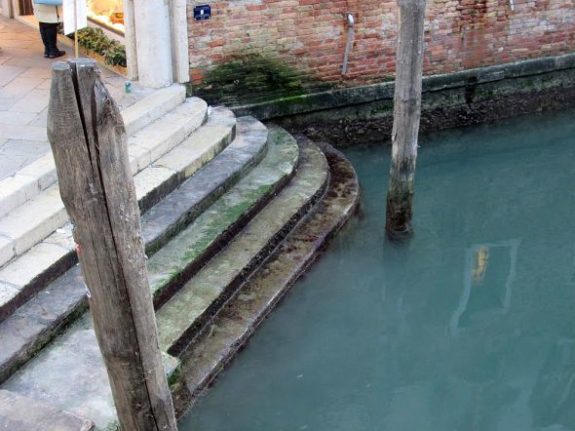
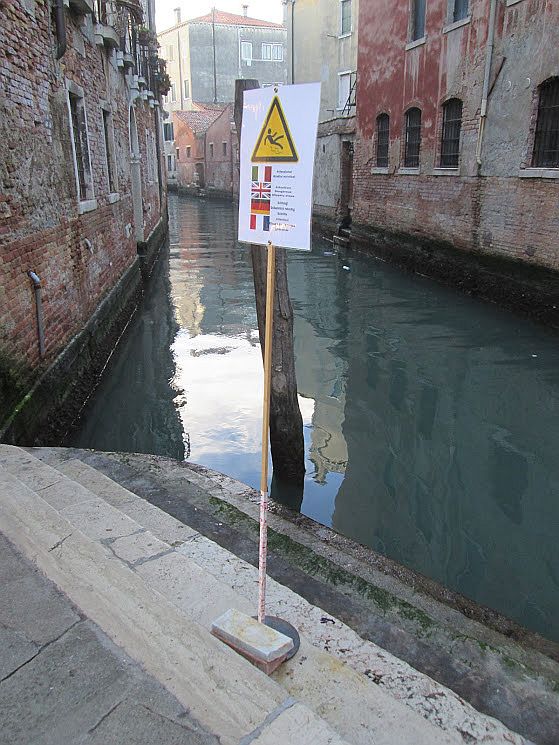
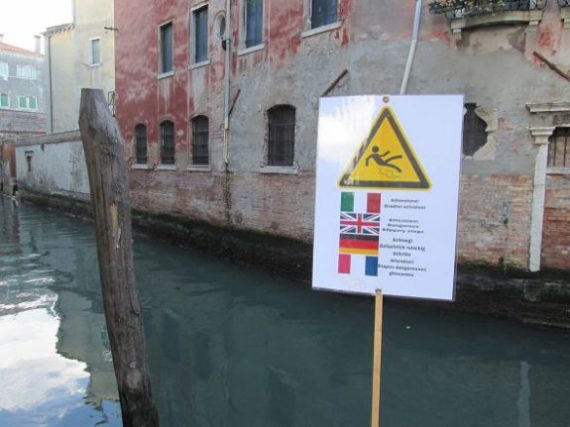
As we strolled along the Strada Nuova a few mornings ago toward the station, we came upon a curious addition to the urban fabric: A very fancy sign at a very tricky spot warning people not to slip on the steps in four languages. First, the steps:
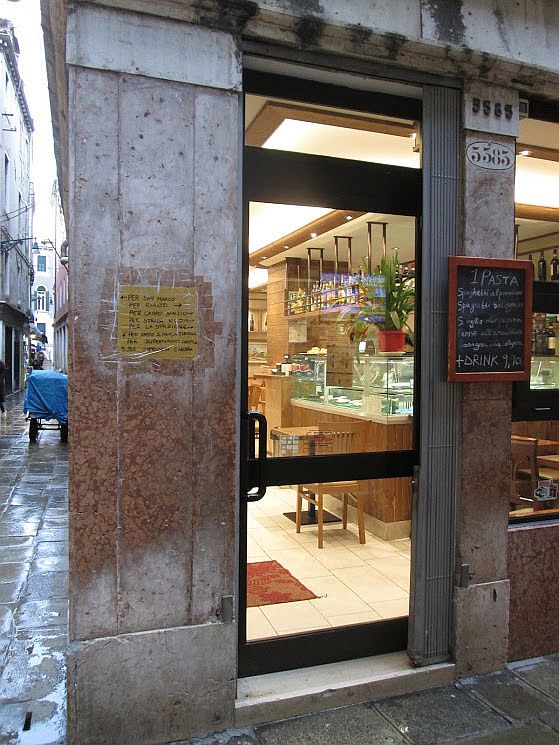
As you see, with each descending step the risk increases. You wouldn’t think a sign would be necessary to draw attention to that, but signs are always in short supply, and nearby merchants often volunteer to provide that missing piece. It’s not so much civic spirit as a desire to do something more with one’s day in the shop than answering the same lost-tourist questions over and over again.A sterling example of the sort of done-it-myself sign at a crucial intersection; it reminds me of those signs you see depicted at military bases overseas that give the distance from there to everywhere. It does not give the direction to your home town, though, or to your hotel. Life is short, paper is even shorter. But the spirit was spot-on. In order from top: To San Marco, To Rialto, To Campo (indecipherable here), To Strada Nuova, To Campo Santa Maria Formosa, and blah blah. I can’t read the photo, I’ll have to go past there someday to review the contents. I’m sure this effort has broken at least 15 decrees and ordinances, but that’s nothing considering how many the Superintendency of Fine Arts, etc. overrides every day.Back to the sign on the Strada Nuova. You can see that someone has gone to considerable trouble and expense on this one. It almost looks official.Reminds me of those yellow plastic sandwich-board signs they put out when they’re mopping the airport floor. I wonder if anybody pays any attention to them?
This morning, Sunday, at about 10:00 AM, we walked by here again. There was no sign. I conclude that either it keeps hours that correspond to the sign-maker’s work schedule (they’d have to take it inside overnight, that much is obvious. So you’re free to slip to a spectacular fall in the evening.) Or the Superintendency was annoyed by it and sent a culture-policeman to remove it. If I wanted to pursue this any further, I’d have to go back and check on the fate of the taped-up sign, as well. But I don’t care that much.
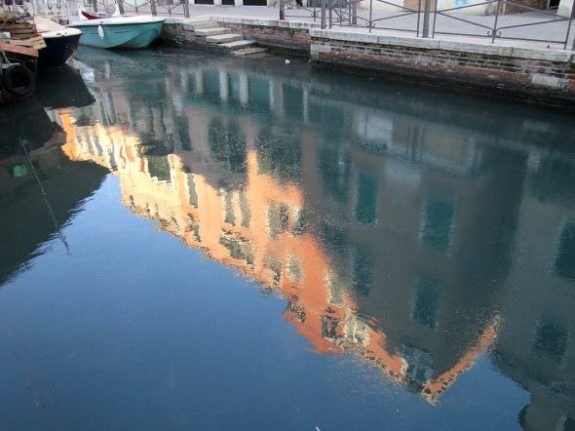
Water you wouldn’t enjoy falling into this morning: Ice. Not covering all the canal surface, and it’s that fine, filmy sort that remains somewhat flexible. I’m sure the next passing motorboat busted it to bits. But it’s been below freezing here for three days, and is expected to continue for a while longer. This is, by the way, exactly the blast of frigid weather that brings the seppie to the surface and back into our lives (if the southwest wind is blowing, I must note). I have no idea why, but I’ll be watching for their appearance. Maybe they’ve heard that we’ve got hot chocolate at home.
Let’s hope the sign is safely stored away, awaiting life-saving duties another day!
It reminded me of your last post with the wet footprints, maybe the sign-writer wants to avoid yet another tourist going A over T on those slimy steps?
Contains information related to marketing campaigns of the user. These are shared with Google AdWords / Google Ads when the Google Ads and Google Analytics accounts are linked together.
90 days
__utma
ID used to identify users and sessions
2 years after last activity
__utmt
Used to monitor number of Google Analytics server requests
10 minutes
__utmb
Used to distinguish new sessions and visits. This cookie is set when the GA.js javascript library is loaded and there is no existing __utmb cookie. The cookie is updated every time data is sent to the Google Analytics server.
30 minutes after last activity
__utmc
Used only with old Urchin versions of Google Analytics and not with GA.js. Was used to distinguish between new sessions and visits at the end of a session.
End of session (browser)
__utmz
Contains information about the traffic source or campaign that directed user to the website. The cookie is set when the GA.js javascript is loaded and updated when data is sent to the Google Anaytics server
6 months after last activity
__utmv
Contains custom information set by the web developer via the _setCustomVar method in Google Analytics. This cookie is updated every time new data is sent to the Google Analytics server.
2 years after last activity
__utmx
Used to determine whether a user is included in an A / B or Multivariate test.
18 months
_ga
ID used to identify users
2 years
_gali
Used by Google Analytics to determine which links on a page are being clicked
30 seconds
_ga_
ID used to identify users
2 years
_gid
ID used to identify users for 24 hours after last activity
24 hours
_gat
Used to monitor number of Google Analytics server requests when using Google Tag Manager

1 Comment
Let’s hope the sign is safely stored away, awaiting life-saving duties another day!
It reminded me of your last post with the wet footprints, maybe the sign-writer wants to avoid yet another tourist going A over T on those slimy steps?