We got snow! While I realize that our little meterological adventure was nothing compared to what the East Coast of the US has gone through, not to mention northern Europe (stories of the trains trapped under the Channel inspire a special kind of shudder), it still was enough to jolt us out of our midwinter torpor.
This was our wake-up call.
Even here, flights were cancelled, or delayed, and I have no doubt that stories of catastrophes on the mainland will be coming in.
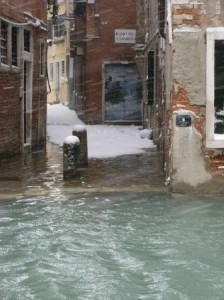
But for us, the situation was more beautiful than distressing, if you don’t count our miscalculation on getting home before the acqua alta was high enough to mostly cover our feet. (Yes, we were warned: two tones on the sirens. But I didn’t take it seriously.) Sorry about my Timberland hiking boots; hope I can salvage something from the effects of salt water.
We usually get at least one severe cold snap each winter, though it seems to want to wait till just after Christmas. So this year we got it early. For the past few days it’s been at or below freezing and Saturday morning we woke to the double-whammy of snow and acqua alta.
Two hours later, the scene had changed. One good thing about acqua alta is that at least it removes the snow.
When Lino was a lad, as soon as the flakes began to fall, men would present themselves at the central office of the Vigili (a sort of local police) to pick up a shovel and make some extra money cleaning the streets and bridges. He says you could hear them out on the street, talking, as early as 4:00 AM, waiting to get to work. Intensely intelligent and also effective and probably didn’t cost the city all that much. All good reasons why they don’t do it anymore.
Our faithful trash collectors were scarce to invisible this morning. Any tiny deviation from the norm throws the squad into total disarray. No snow shoveled, no garbage collected — I can’t believe that every sanitation worker in the city had to be in the Piazza San Marco to set up the high-water walkways. Perhaps they were all clustered in a doorway (more likely it was a warm bar somewhere) drawing straws to determine who’d be the one who had to go out and actually work.
I have some happy, if highly eccentric, memories of a real cold snap here. One winter morning a number of years ago, when the cold had come down from Siberia like the wolf on the fold, we went out rowing. Yes, of course we’re mentally unstable.
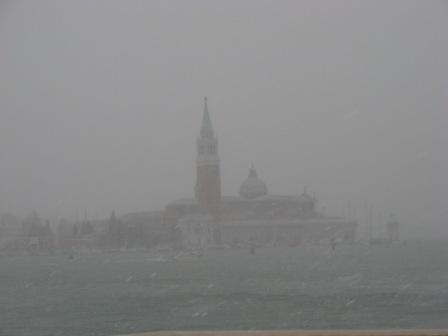
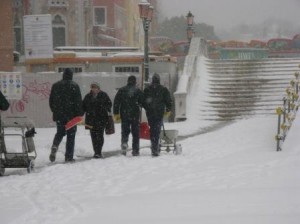
This time it wasn't fog that made the city look like this. Blowing snow is also pretty effective for blurring the scenery.
Here’s what I remember: Rowing down a canal and our oars slicing neatly (once in, once out) through the forming ice. What a fun little crunching sound it made. What wasn’t quite so fun was the wind blowing so hard that the spray from the waves froze in the bottom of the boat. I spent the entire time we were rowing back imagining that my shoes were nailed in place, because it was like standing on a skating rink. If I’d slipped just once, I’d never have gotten my footing back. I took my mind off this problem by trying to imagine if it would be possible to row on my knees.
But that was nothing. There was the famous — make that “epic” freeze of February, 1929: people were walking across the lagoon from the Fondamente Nove to San Michele. Impressive. Of course, one reason that happened (and probably could never happen again) isn’t just the factor of the degrees below zero. There wasn’t the constant maelstrom of waves back then that we have today, which would prevent any rational water from freezing. If you’ve got a really low temperature, few or no waves, plus only the tiniest tidal variation (twice a month, when the moon is exactly half, the tide scarcely moves, which would help the freezing, obviously) it’s almost inevitable that ice will form. I have to say I’m glad we didn’t reach that point. Delicate little skins of ice covering the water is one thing, but not this polar purgatory.
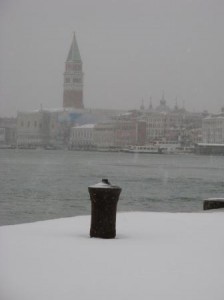
So on the whole, we made out really well. The snow came, and then, when the tide turned in the early afternoon, the sun came out and we were fine. Except, I mean, for the bags of garbage which will lie out there till Monday.
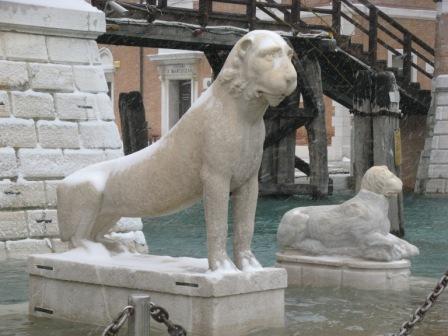
The lions in front of the Arsenal were not amused. "Remind me again how we ended up here, surrounded by water? Oh, right: spoils of war. Great."
As long as you don't have to drive, scenes like this are really beautiful.
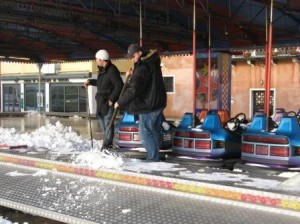
The guys who run the bumper cars at the temporary amusement park on the Riva dei Sette Martiri have to clean up the old-fashioned way: physical exertion.
Eventually at least a couple of ecological operators, as they're called, had to get out and do something. The Barbie-sized wheelbarrow appears to contain enough salt for exactly one bridge.
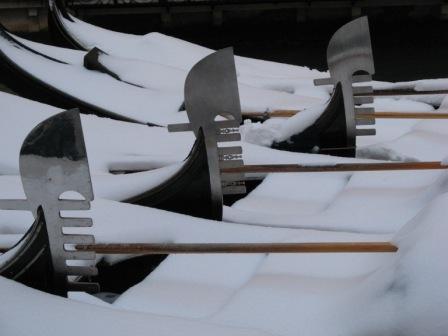
All the gondoliers who didn't come to work in the Bacino Orseolo are just going to wait for it to melt, then bail.
There are many things, I admit it, that deeply fascinate me about Turkey and one of them is its complicated linkage over the centuries with Venice. Polar opposites, one might think, until one begins to look closer.
As I was expatiating on this theme recently, I neglected to mention a few of the manifestations of this linkage lurking here. And one of them does not show Venice in her best light.
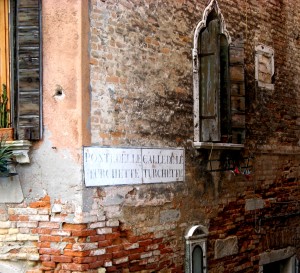
First: Two steps from Campo San Barnaba is a short, narrow street (with bridge) named the Calle (and Ponte) de le Turchette. If you were to guess, based on your elementary Italian, that this means “Street of the Little Turkish Girls,” you would be right.
Tradition maintains that in the era before the Casa dei Catechumeni was established to accommodate instruction in the Roman Catholic faith, there was a house here where Turkish women (“Turchette”), taken prisoner in assorted battles, were kept. Their time was spent mainly in being converted to Christianity. Or not. No word on the rate of conversion, or whether conversion was considered optional, or what the consequences were for not converting, at least not by the point where I stopped seeking information.
According to the estimable Giuseppe Tassini, writing in Curiosita’ Veneziane, a document in the Scuola di San Rocco states that the confraternity possesses a house in the parish of San Barnaba, “in Calle Longa, where the Turchette are housed.” That’s all I can tell you about this, though every time I pass this way I admit that images of exotic females, enclosed in another sort of harem, wander through my mind.
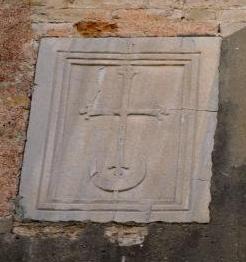
Second: An even more intriguing Middle-Eastern, let’s say, element is a mute patera (PAH-teh-ra) affixed to the side of a house behind the former hospital of the Incurabili. (These “incurables” were mostly syphilitics, if you’re wondering.)
This patera is very easy to miss, being so uncharacteristically high. Looking up is always a good idea when walking around in any city, especially here.
Patere were typically circular plaques carved in low relief on Istrian stone, often showing animals, which were placed on buildings generally from the 10th to the 12th century, though a few date till the 15th. These images were intended to ward off evil.
The one that fascinates me, though, has a very different vibe. It shows a cross, whose base is in the suggested form of a sword, standing upon a crescent.
The conclusions one might draw from this are fairly obvious, but that’s what annoys me — because so often the obvious turns out to be excitingly wrong. There is also the curious factor of the points of this crescent not being identical. So far, however, I haven’t been able to learn anything about it. But there it is.
A small digression on Turkishness: Ever since maize began to come to Italy from the Americas in the 1500’s, it has borne the name granoturco, or Turkish grain. There are various hypotheses for this, none of them definitive, but one of the more credible ones refers to the custom of lumping all sorts of foreign things together under the generic label “Turkish.” A relic of this habit applies here today regarding the Slavic women who come from Eastern Europe to work as caretakers of the elderly; even though they may come from Ukraine, Romania, or Moldova, I’ve heard at least a few Venetians refer to them as “Turche.”
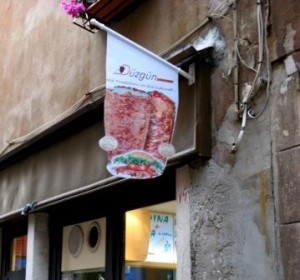
Now we come to a longish street whose official name is “Barbarie de le Tole,” but which I think of as the “Street of the Kebab Joints.” And here the theme of Turkishness becomes less attractive.
There are some 20,000 students in Venice, a total of the enrollments in the two universities (Ca’ Foscari, the University of Venice, and the I.U.A.V., or University of Architecture). There is also a noticeable number of immigrants in the city, some from the Middle East or North Africa. And there is also a growing group of tourists who are getting by on a squeaking budget. These are all people who typically seek nourishing and/or good food at a very small price. So from pizza-by-the-slice (Italian, even if not very civilized), the choice has broadened out to include doner kebab, or what in the U.S. is often called by its Greek name, gyros. Foreign. Suddenly this changes things.
Whether or not you read Turkish, the image itself translates as "good cheap food."
Doner kebab was invented in Erzurum, eastern Turkey, and since the Seventies it has become a common and familiar fast food in most European countries. The making and selling of it are virtually always in the hands of Turkish individuals.
But all of a sudden Venice isn’t happy with these little places. I can’t say whether the kebabs’ precursors were available in the declining years of the Venetian Republic, but considering the spectacular variety of ethnicities and creeds which were to be found milling around the streets and markets and waterfronts of Venice back in the Old Days, it wouldn’t surprise me.
In the past decade or so, the subject of immigration (to Europe, not only to Venice) has become an increasingly tormented one politically, economically, and socially. Considering the multi-cultural foundation of this town, any anti-foreign sentiment is in some ways difficult to justify — not that one can’t understand it. This is a theme which I will dissect at another time.
But on December 4, the Gazzettino announced that the mayor has signed an ordinance forbidding the granting of any new licenses for kebab joints until 2012. The reasons given for this are many; they bob like ornaments hanging on a tree which has been hollowed by termites. The reasons as stated are:
The proliferation of these establishments and the consumption of their product on-site contribute to the “impoverishment” of the typical local places, as well as of the architectural and environmental quality of the city “due to the particular nature of their furnishing and equipment,” and
The “incompatibility” of the opening of new pizza/kebab joints with the “conservation of the artistic patrimony” and the “typicality” (if there is such a word) of the historic center, and
Opening such places in certain points in the city conduces to the “maximum vulnerability of the cultural and touristic profile” of the city (whatever that might mean), and
That anyway there are already enough such places to satisfy the demand, so no need for more.
And who proposed this extraordinary measure? Not any of the assorted Superintendents of the Artistic/Historic/Cultural/Archaeological Heritage; nor the director of the Academy of Fine Arts, nor the Guggenheim Collection, nor anyone from the battalions of professors of art, history, or even tourism, if you will, though any of those protagonists might be able to make a reasonable case. Not a voice from the syndics of the Venice Atheneaum. Nobody from any sphere or stratum of the cultural or artistic universe here. Not even a wail from Augusto Salvadori, the City Councilor for Tourism and Protection of Traditions and Decorum.
Despite its being couched in cultural and historic and artistic terms, the proposal was in fact made by Giuseppe Bortolussi, the plain old City Councilor for Productive Activity and Commerce. Therefore one can interpret these cultural concerns in economic terms, in favor of the small businessmen who are the competitors of the kebabists.
And the decree will cover 13 of the 24 most important touristic points of the city, including the Rialto, the area of San Marco (where there is already a flourishing McDonald’s), the train station, and the Accademia. They might just as well have said “everywhere,” considering that they have stated that there are already enough such places to satisfy the demand.
I thought capitalism posited that the consumers, not the city councilors, were the ones who get to decide which businesses live and which die. And if it’s possible to determine at what point there are “enough” kebab joints, it ought to be possible to determine at what point there are “enough” shops selling glass and Carnival masks, which a stroll around the city reveals as being somewhere around 249,327. Enabling infinite choice in souvenirs (good!) doesn’t seem to translate into infinite choice in foodstuffs (not good!).
This ordinance looks strangely like an effort to protect the restaurateurs, not the city, from impoverishment. To herd the wandering tourist seeking sustenance back into the trattorias and restaurants where the prices can sometimes go so high, at least compared to the value received, that they practically glow in the dark.
But I’d like to close this little cultural pilgrimage with the observation that hypocrisy evidently provides more fertile terrain than volcano slopes after an eruption if you want to grow a bumper crop of contradictions. All those affirmations of protecting the artistic and historic nature of the city? One hardly knows where to start to list the examples of how that concept has been violated.
I’ll provide just a few random snaps, chosen mainly by their convenience. Anyone who can explain why these alterations are permissible (I’ll spare you the details of the laws designed to “protect” the artistic and architectural nature of the city) is eagerly invited to enlighten me.
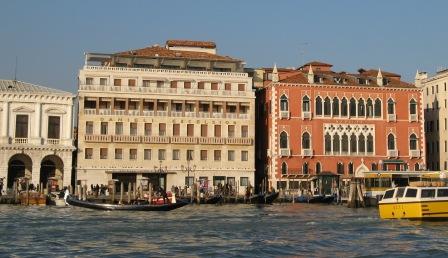
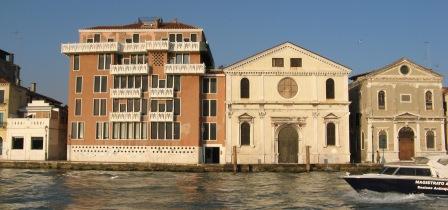
The "Danieli Excelsior" (center) was built in the 1950s as an addition to the Danieli Hotel, and wedged between the hotel, formerly a palazzo of the Dandolo family (late 1400s) and the New Prisons (1589-1616). Somebody thought these balconies would be just the thing on this already unattractive modern residence, right next to the church of the Santo Spirito (1506).
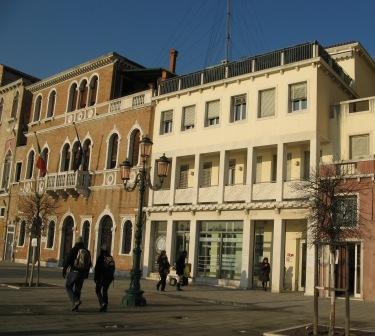
Then there is this construction, housing the University of Venice's Department of European and Post-Colonial Studies, next to the Gothic palace now housing the Capitaneria di Porto (Port Authority).
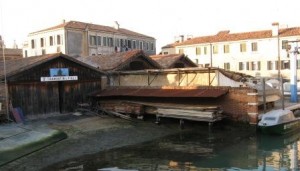
Tramontin and Sons (1884) is one of the few squeri still building gondolas in Venice, and it shows the traditional setup, from the wooden-chalet workshop to the ramp sliding down into the water.
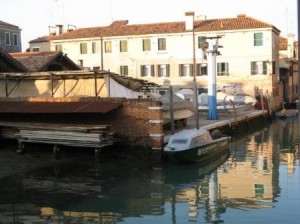
Right next door to Tramontin is the squero Daniele Bonaldo, which used to be its identical twin. I watched its inexplicable transformation from the traditional layout (he kept the wooden chalet workshop) into a major boatyard for motorboats. The cement platform covers the beaten-earth ramp, the hydraulic winch was unknown to his forebears, and of course the boats have nothing at all to do with gondolas.
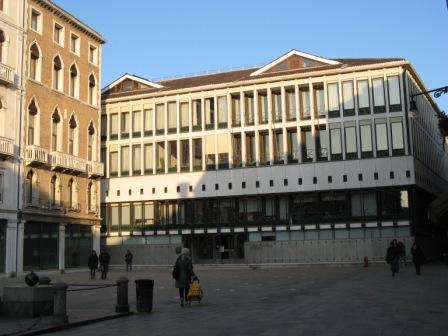
This is the headquarters of the Cassa di Risparmio di Venezia (Venice Savings Bank) in Campo Manin. It's called Palazzo Nervi-Scattolin (1972), not for conjoined noble families but for the two architects, who stated openly that they didn't intend to create a "false antique." They succeeded.
Yesterday I crossed another of the myriad little stepping-stones of life here that form my path across the seasons, things that are wonderful the first time partly because they’re surprising, then become more wonderful as I anticipate their annual return.
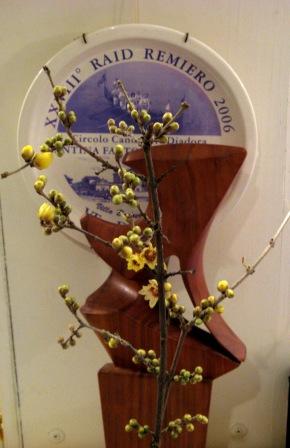
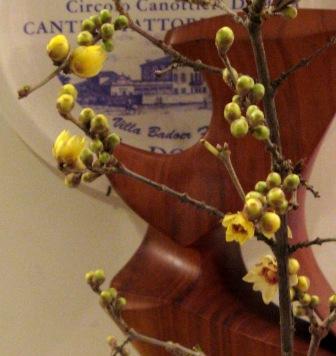
Yesterday I was given a flower. And not just any flower: two slim branches of calicanthus (Chimonanthus fragrans), with their small yellow blossoms and — supremely important — their fragrance. You hardy gardeners out there probably take it for granted (“a spiny shrub from Japan related to Carolina allspice”), but its common name, wintersweet, hardly begins to do it justice.
I grew up in Upstate New York, where winter comes with multiple personalities, most of whom are not in the mood for jokes. It snowed from October to April, for starters. Skiing, skating, sledding — all great for kids with some free time. Frozen locks, icy streets, whiteout conditions on the Thruway, chilblains — not so great for anyone responsible for anything or anyone.
So winter in Venice, with its heavy, grey skies and lacerating northeast winds and films of ice on the immobile water of the canal — or even its dazzling, diamond-cut dawns or scintillating, frost-encrusted trees — brought out the primitive, Protestant, life-is-real-life-is-earnest-and-the-grave-is-not-its goal side of my spirit. Winter isn’t just something to survive: One must prevail.
Then I was walking down a street one rigid day; the Calle de le Pazienze, to be precise, not far from Campo Santa Margherita. It’s not so different from most streets: narrow, stony, lined with solid objects (in this case, houses on one side, a brick wall on the other), and I was just passing through.
Suddenly I inhaled a waft of music, a delicate little caress, an aroma so warm and so sweet that it made me stop in my tracks. What? Where? And more to the point, how? Winter doesn’t smell like chiffon steeped in sunrise; winter smells like a constructivist experiment, all angles and sharp points and edges.
I looked up and saw a mass of branches rising from behind the brick wall, and (I am not making this up) the sun was shining behind them, turning the tree into a huge bouquet of tiny, glowing yellow blossoms.
Tears came to my eyes but they didn’t fall because I was too entranced by how something so blithe could be so compelling. A philosophical point which I will attempt to resolve some other time.
And so, every December, I manage to snag a few branches. Of course the thrill of discovery is gone, but in its place is the knowledge that winter has a heart that isn’t made of titanium. My Protestant forebears must be pretty pissed that I’ve found that out.
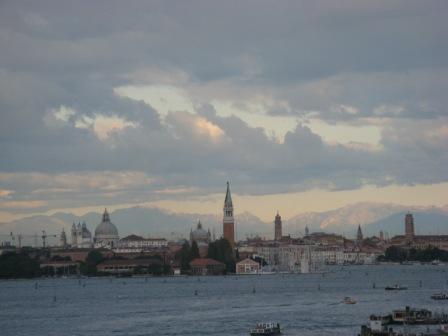
As you recall, poor old Venice got dragged out into the middle of the stage a few weeks ago and forced — not to recite poetry or sing a comic song in front of all the relatives — but to present itself as a plausible candidate for the Summer Olympics of 2020.
There's no question that Venice could make an amazing Olympics poster. It's a start.
You might also recall that Rome intends to make a serious bid for the same candidature. And that Italy only gets to field one.
There was a flurry — a small hurricane, actually — of fevered activity/ verbiage from a group of people here who all had clear and present interests in snagging the nomination and, eventually, the Olympics themselves, for Venice. There was also an equal amount of either rebuttal or silence (a more potent form of rebuttal) from non-believers. The cads.
But the dream is probably dead, though its proponents aren’t ready to admit it. (They’re like that person I read about a while ago who went to pick up the pension check for his just-deceased friend. Obviously without having revealed that the check-worthy individual was just-deceased. Obviously with the purpose of using the money himself. When the person was told that the friend had to come in person, he propped his dead buddy in a wheelchair and wheeled him to the pension office. Too bad it didn’t work.) The Venice Olympics people are still wheeling the idea around, but they’re not much more credible than the aforementioned dude at this point.
CONI (the Italian Olympic Committee), in the person of its president, Gianni Petrucci, had what must have been a fairly vivacious meeting the other day with mayor Massimo Cacciari, who is also a professor of philosophy. Everyone likes to point that out, I don’t know why. Maybe to emphasize that he isn’t just a boring old politician, but a genuine intellectual, which ought to be an impressive thing if you didn’t notice that the two qualities are seem to be mutually exclusive.
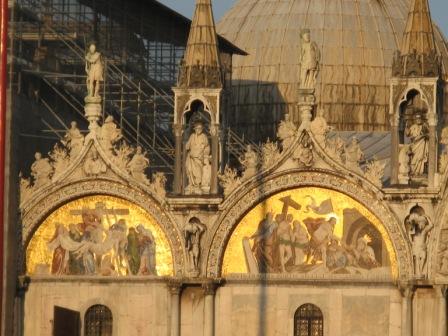
Unfortunately, sometimes just being beautiful isn't enough.
Mr. Petrucci was pretty clear when the meeting was finished. “As the philosophers say,” he began, “reality is that which is, and not what we would like it to be.” Nice one! “And I’m a realist: What will count is what is.”
What “is,” in this case, is a raft of sports facilities which are already up and running (or jumping, or throwing) — and not a list of facilities which are all going to have to be built new from the ground up.
“I was a realist with Prof. Cacciari,” Petrucci went on. “CONI wants to win, therefore we want to present a really strong candidate.”
These remarks were met with a random barrage of retorts — kind of like those moments when the embattled citizens on the parapets begin desperately to launch whatever they can get their hands on — rocks, wagons, donkeys — over the edge to stop the enemy advance.
“Venice would be something new,” was one retort. The Northeast is a region that “gives much and receives little” (translation: you owe us) is another. “They treat us like provincials.” And so on.
Giancarlo Galan, the president of the Veneto Region — in whose head dreams of a shiny new Veneto full of big new projects paid for by somebody else had been dancing — decided to object, not to the message so much as to the manner of its expression.
“I don’t think you’re capable of ironizing (it’s a verb in Italian, very useful) about philosophers,” he huffed in a letter to Petrucci. “It shows that you haven’t understood two things: The fact that the Olympics serve to transform the infrastructure and change an entire territory. (I never knew that. Is that why the athletes cry when they hear their national anthem?) The second is that you don’t know the Northeast and what we’re able to accomplish. Venice and the Veneto deserve this recognition because we’re among the most advanced in the world.” (I didn’t know that either. We may have reached the stage of launching a Jeep Cherokee over the ramparts.)
Petrucci was unfazed by this predictable range of objections. (You don’t love us, you don’t understand us, you don’t care…..) He replied, “Everybody knows his own world best. Galan knows the Northeast well, and I know the Olympics well.”
While this was going on, the mayor of Rome was off in London, busy bagging mayor Boris Johnson’s future vote for the Eternal City.
Maybe he’s the one who’s actually got the right philosophy for this situation.
 Tradition maintains that in the era before the Casa dei Catechumeni was established to accommodate instruction in the Roman Catholic faith, there was a house here where Turkish women (“Turchette”), taken prisoner in assorted battles, were kept. Their time was spent mainly in being converted to Christianity. Or not. No word on the rate of conversion, or whether conversion was considered optional, or what the consequences were for not converting, at least not by the point where I stopped seeking information.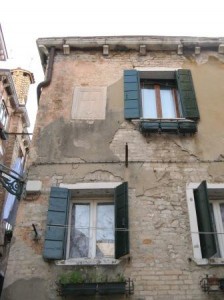
 Yesterday I was given a flower. And not just any flower: two slim branches of calicanthus (
 Suddenly I inhaled a waft of music, a delicate little caress, an aroma so warm and so sweet that it made me stop in my tracks. What? Where? And more to the point, how? Winter doesn’t smell like chiffon steeped in sunrise; winter smells like a constructivist experiment, all angles and sharp points and edges.