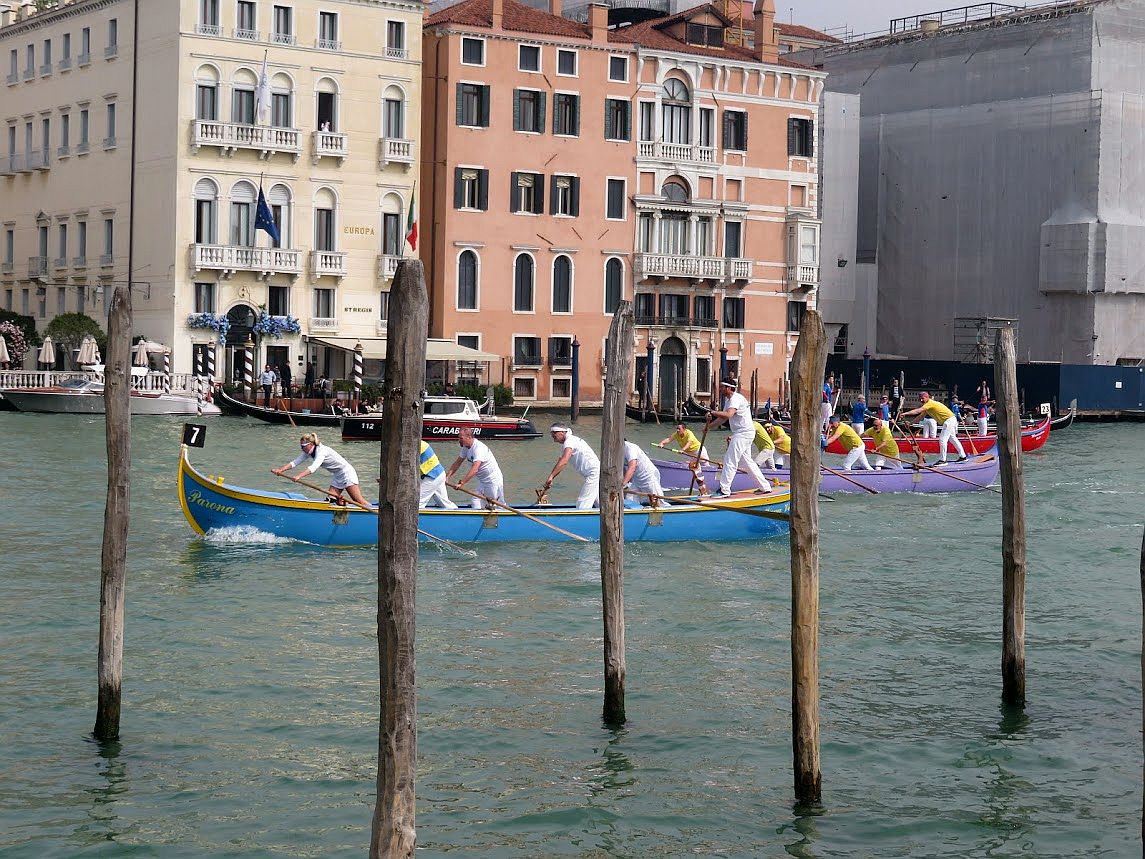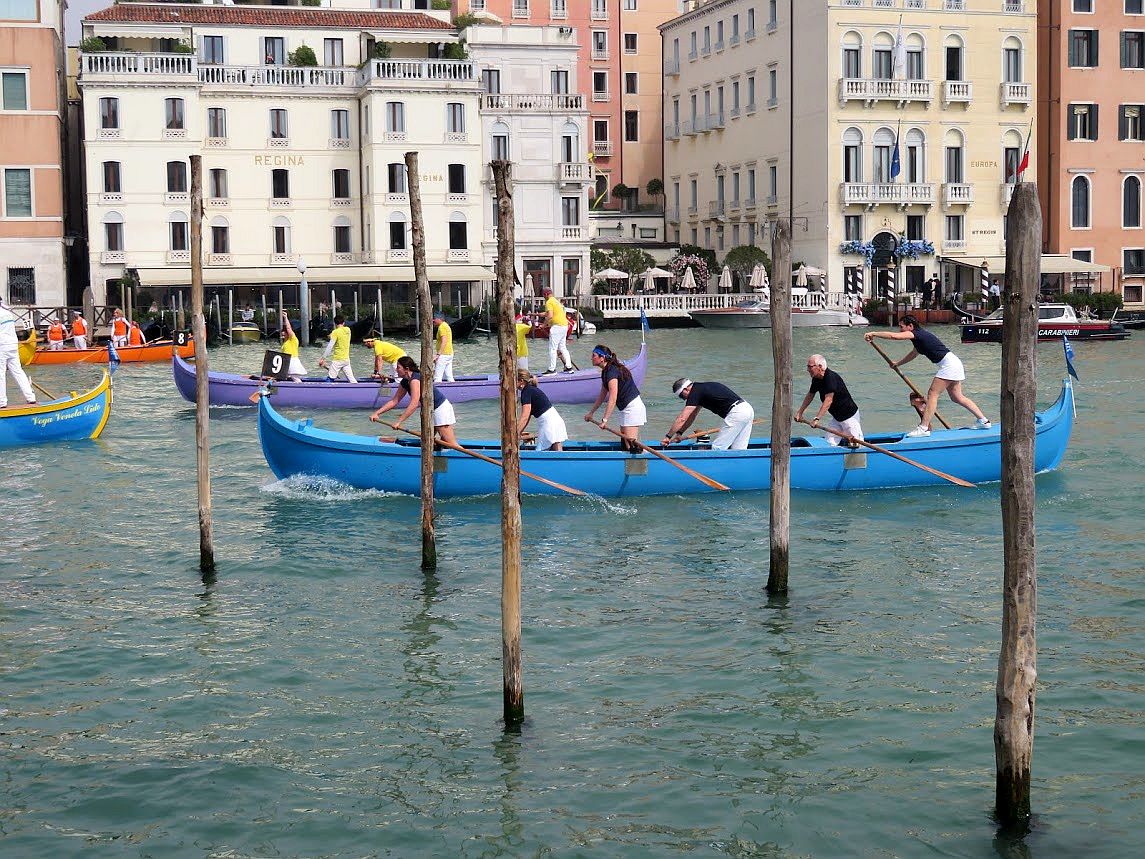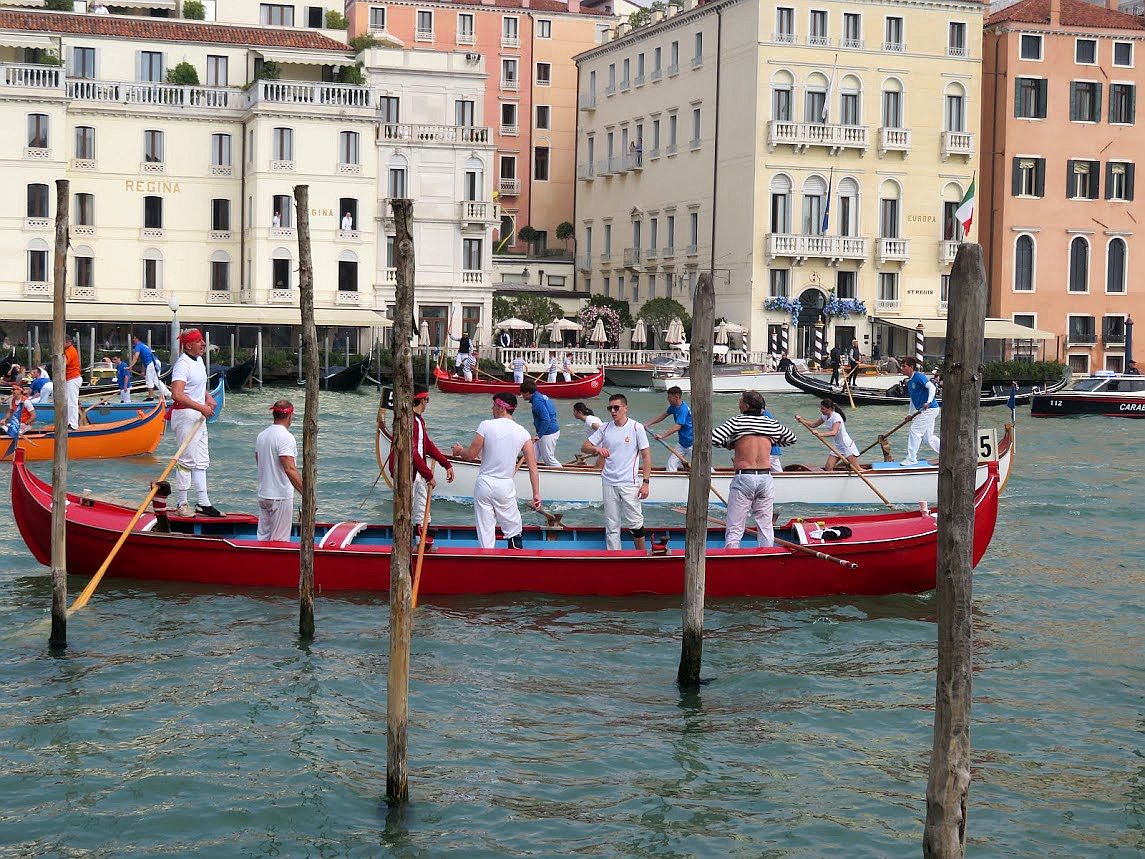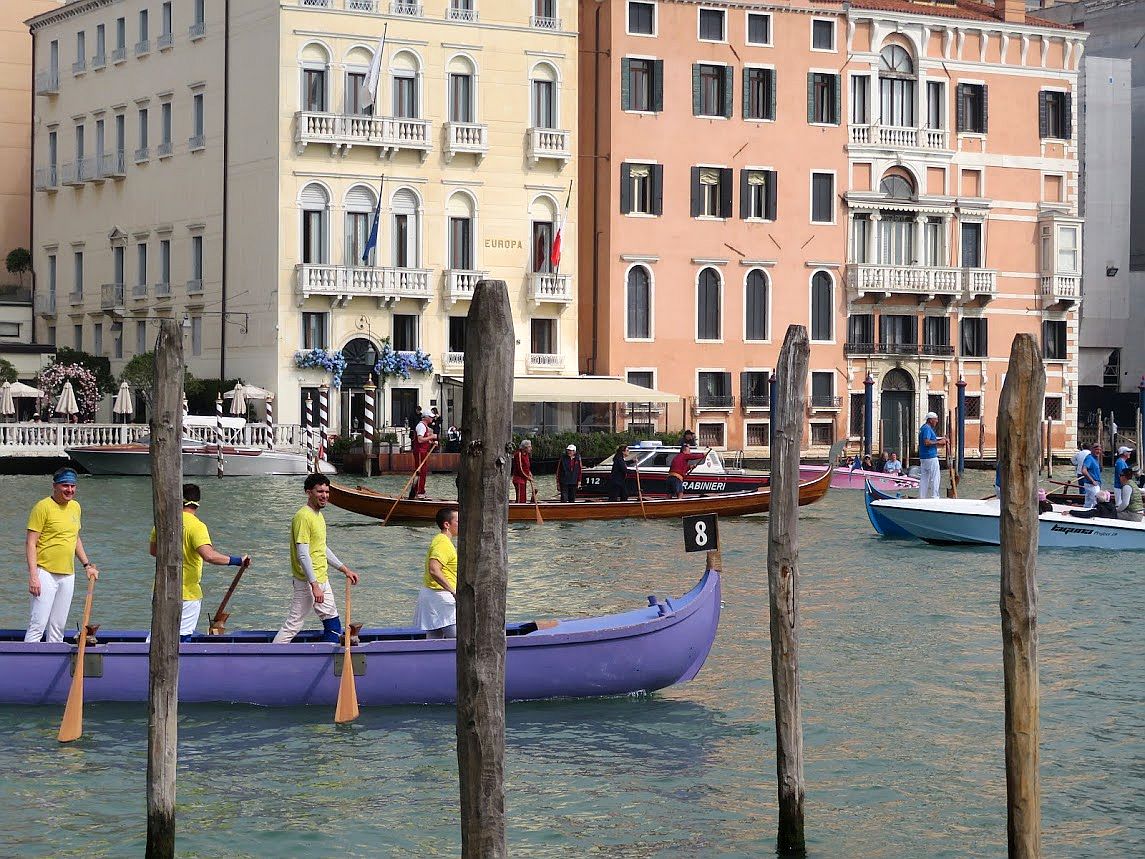
Preposterous, ludicrous, and any other “ous”ly things that come to mind can happen all year long. But either the summer seems to produce more of them, like tomatoes and zucchini, or we’re more in the mood to read about them.

Here are some tidbits from the recent past, as reported by the faithful Gazzettino:

“THE FAMILY JEWELS IN THE BADANTE’S CAKE”

(Note: A “badante” is a paid caretaker, usually living with a little old person in need of assistance.  They are mostly women, and mostly from Eastern European countries, not that that matters particularly to this or any other story).

“They wanted a piece of cake and instead they found a treasure.  Too bad the treasure was already theirs and the cake was destined for somebody else.  This is the grotesque misadventure of two residents of Castello, a mother and daughter, in what was supposed to be an ordinary domestic afternoon.

These ladies aren't in need of a badante yet.  Maybe they're discussing alternatives, like having more children.

These ladies aren't in need of a badante yet. Maybe they're discussing alternatives, like having more children.

The culprit was a 50-year-old Polish woman who has been living in the district for some years….

“She seemed like a good person [said the daughter]; she stayed with my mother all day, sometimes she even spent the night.  I trusted her completely from the very first; she did the shopping and cooking, and would take my mother out for walks.”

But one day the badante asked for money to buy the ingredients for two apple-cakes she wanted to make — one for the family, and one to send to her own people back in Poland.  And so the cakes were made, and one was sent off to Poland.

The following afternoon — the badante’s day off — the mother and daughter decided to taste the cake…..which turned out to be fairly difficult to cut.  ”It seemed like cement,” said the daughter.

Then the discovery: In place of the apples, the cake was full of her mother’s jewelry, necklaces and rings of gold.  ”There was even my baptism necklace.”

The other cake had been sent to Poland by mistake.

It was an exquisite plan — the only thing lacking was execution.  After all, there were only two cakes — it’s not as if there were hundreds to keep track of, like M&Ms.  Anyway, that was the scene: What a lovely cake, let’s have tea and a large piece.  The daughter takes the knife and cuts into it. Crunch. (Crunch?) And out come her mother’s 18-karat bibelots.  Like party favors, only, you know, not.  Not at all.  I’m not sure how you say “D’oh!” in Polish, but the badante is probably going to be saying it for quite a while.  If not to herself, to her folks back home who cut into their cake, imagining all the things they were going to buy with the money arriving via Betty Crocker, and who came up with nothing but jam and chopped walnuts.

I’m not sure which scene I’d rather have witnessed: The cutting of the wrong cake (either one), or the unsuspecting badante’s return home that evening. Not to mention the phone call from her family.

A tooth in the lung is no more mysterious than this wall, which someone decided was the perfect place to stick Chiquita banana stickers. I'm thinking it's some kind of secret signal.

A tooth in the lung is no more mysterious than this wall, which someone decided was the perfect place to stick Chiquita banana labels. I'm thinking it's some kind of secret signal. The fact that some have been partially removed is extremely suspicious.

“A TOOTH IN HER LUNGS MAKES HER SUFFER FOR 24 YEARS”

“Instead of swallowing it, which would have been simpler, luck would have it that the little girl unconsciously inhaled her milk-tooth molar, which had come loose, at the age, presumably, of 10 or 11.  She didn’t realize [that she had done this],  but soon afterward began to complain of a pain in her lungs.  It would come and go, more or less frequently, more or less intensely, up until a few days ago.  Today the little girl is a 34-year-old woman, married and the mother of two children. And by chance the other day, the pain having returned, she had a bronchioscopy and the cause was discovered: a milk tooth.  An intervention at the hospital at Dolo [16 miles from Venice], one good cough, and out came the tooth which had caused so much pain for so long.”

What makes me wonder about this woman isn’t that she inhaled her tooth — I suppose it could happen to anyone.  What I can’t grasp is that she lived 24 years without investigating further.  Did she think everybody has a pain in their lung? Did she never wonder about it at all?  Or does it take that long to get an appointment at the radiologist?   And if one of her children had a pain in his/her lung, would she have just said “Suck it up”  (sorry) and leave it at that?  I couldn’t put up with 24 years of anything, if I didn’t know what it was. Evidently curiosity went to Dolo to die.

“130 CITATIONS FOR TWO BARRELS”

There is a very cool restaurant in the Campiello del Remer, not far from the Rialto Bridge.  It’s called Taverna Campiello del Remer and I can remember when this campo was pretty desolate.  So I was glad to see that improvements began to be made a few years ago by unseen hands.  The main accomplishment was the fixing-up of a brick vaulted former warehouse (it would appear to have been) to become this congenial little eatery.  But there is no joy in the Campiello del Remer, because the police won’t stop giving the restaurant owner summonses.

This is the entrance to the restaurant.  The two barrels are usually within the arch somewhere.  This little patch of space doesn't appear to be public, but what do I know.

This is the entrance to the restaurant. The two barrels are usually within the arch somewhere. This little patch of pavement doesn't appear to be public, but what do I know.

The nub of the problem is that commercial enterprises which occupy public space (think cafe tables on the sidewalk), have to pay a special tax.  The space they are allowed to occupy is measured out and a record of these dimensions is kept in one of the city offices.

Emilio Farinon and Angela Cook, owners of the joint, put two big old wooden barrels (closed at both ends) outside the entrance.  These barrels were intended to be useful as little tables where people could put their drinks and their ashtrays, much better than putting this stuff all over the ancient marble wellhead in the courtyard.

But somebody in the Campiello del Remer objects to the casks and has decided they must be removed because they are occupying public space illegally. (It’s really heartwarming to find that there is someone who takes the letter of the law so seriously around here.  I wonder what they do for fun?). And so this person has taken to calling the police to come write out summonses for the alleged violation.  This has happened 130 times in one year.

But not so fast, says Giorgio Suppiej, the owners’ lawyer.  This is persecution, and a baseless one, because the square inches of soil upon which the hogsheads are sitting isn’t public, but private.  So the summonses have no validity.

To demonstrate this fact, Suppiej has shown the Comune as well as the Court the Napoleonic Cadastre, the first ever to document the property limits of every building in the city.  Suppiej then compared it to the subsequent version, and finally the one that is current today.  ”In all of the maps,” he says, “the space, which is under a staircase, is shown as private.

“Furthermore, the Comune can’t say the space is public; we previously asked the Comune to grant the plateatico [authorization to use public space], a request which was rejected because the space is under a staircase, a rejection which was suspect because other spaces beneath a sottoportico [passageway under a house] have been granted the plateatico, and anyway, this isn’t a sottoportico, but a sottoscala [under a staircase].”

Speaking of occupying public space, I still haven't figured out who this little clan might have been, or why they felt the need to set up a makeshift playroom outside the Accademia gallery.  It seemed to be on its way to becoming a small habitation, like something out of the Dust Bowl days.  If they got a citation, I wasn't around to see it.

Speaking of occupying public space, I still haven't figured out who this little clan might have been, or why they felt the need to set up a makeshift playroom outside the Accademia gallery. It seemed to be on its way to becoming a small habitation, like something out of the Dust Bowl days. If they got a citation, I wasn't around to see it.

A city councilor, Renato Boraso, has added his booming notes to the chorus, and asked the mayor to justify what Boraso regards as the “excessive zeal” of the municipal police.  [Didn't know they were prone to attacks of zeal, much less excessive ones.  This is heartening indeed.]

“One hundred thirty citations isn’t something to underestimate,” he says.  ”…It’s time to put an end to this persecution — we’ve reached administrative insanity and I’m going to ask for all the documentation and then send it to the Accounting office.  The city is going to have to justify all the hours which the police have spent on pursuing the complaint of a private citizen who evidently knows somebody at City Hall, distracting them from their public duties.

“Furthermore, it appears to me that the night that those vandals tried to set fire to Marino, the old derelict, the police were in the office writing out their usual photocopied report on this.”  I like this, not only because it shows the vivid contrast in importance between an attempt on someone’s life and a bureaucratic technicality, but because it implies that there were only two police on duty that night in the entire city.  But I mustn’t get distracted.

Ernesto Pancin, head of the merchants’ association, also sees some anomalies in this conflict.  ”I believe that businessmen ought to be rewarded, not punished, for their tenacity.  In the case of the Campiello del Remer, before a business was established there, there were only drug addicts.  I can guarantee that there are other cases which are flagrantly illegal but which inexplicably go unpunished.”

The Battle of the Barrels may, with all this publicity, have reached a turning point.  Perhaps the anonymous protester will turn to pursuits of more evident public value, though I doubt it because this vendetta doesn’t have any significance to anyone but him or her.  But if they’re still in the mood for persecution, I have a little list of offenses here that he or she could start on tomorrow.  I could help.

There are specific ordinances prohibiting the degradation of the city's aesthetic aspect. But they don't appear to apply to certified works of art, which is what this decrepit boat from the Comoro Islands with its container most certainly is. I know this because it was moored outside the Biennale for months on end, till the boat began to fall apart. Evidently objects fraught with symbolism do not qualify as eyesores under  the municipal edicts.

There are specific ordinances prohibiting the degradation of the city's aesthetic aspect. But they don't appear to apply to certified works of art, which is what this decrepit boat from the Comoro Islands with its container most certainly is. I know this because it was moored outside the Biennale for months on end, till the boat began to fall apart. Evidently objects fraught with symbolism do not qualify as eyesores under the municipal edicts, while two barrels are intolerable. And isn't the water public space? Did they pay the tax?


Comments (0)
The departure board at Venice's Marco Polo Airport.  The first flight left at TKTK

The departure board at Venice's Marco Polo Airport. The first flight left at 6:35. followed by 20 others before this list came up at 10:07.

I went to the airport one morning two weeks ago, and there I discovered that there is a dark side to cruising.  The only thing surprising about that is that I was surprised.

Going home from vacation is never very much fun, but it would seem that Marco Polo airport was designed to get you accustomed really fast to the fact that the fun is seriously over.

As I have often mentioned — sorry if I’m becoming repetitive, maybe I should set some of this material to music and we could all join in on the chorus – Venice has become a mega-major passenger port.

The wall on the right is where the line of check-in counters is placed. The left edge of this photograph is where the check-in line at each counter ends.

The wall on the right is where the line of check-in counters is placed. The left edge of this photograph is where the line at each counter ends.

Cruise traffic in the last ten years has quadrupled.  Expressed in bodies, that comes to 1,420,980 in 2009, which represented a 16.9 per cent increase over the previous year.  Venice is now the fourth busiest port in Europe, and the first in the Mediterranean.

The first ship on the dance card this year was the Costa “Deliziosa,” which arrived on January 30 (I don’t know from where — maybe there’s a cruise-ship launching platform somewhere around Queen Maud Land).  The last one scheduled this year is the MSC “Magnifica,” which will depart on December 27.   The word “season” has taken on new meaning: It’s every month of the year except January.

But until last Sunday, I hadn’t really given any thought to what these numbers might portend, not so much to the ships as to the airport.

The space from the man in the yellow shirt on the right and the red suitcase on the left is the space allotted to walking to your check-in counter, or wandering aimlessly.

The space from the man in the yellow shirt on the right and the red suitcase on the left is the space allotted to walking to your check-in counter, or wandering aimlessly.

After all, passengers mostly arrive by air.  I’ve often seen the young women who serve as cruise-passenger wranglers waiting in the Arrivals area at Marco Polo airport, holding up their signs for Princess or Costa or whatever the cruise line might be, to help them gather their arriving clients, each of whom appears to bring about ten metric tons of luggage.  The common idea about cruises is that people go on them in order to eat constantly, like blue whales (daily requirement: about 1.5 million calories).   But when I look at their bags, I think their main plan must be to pass the time changing clothes.

Anyway, it’s obvious that extraordinary machinery has been developed to keep these ships and their passengers and their supplies coming in and going out, doing a turnaround in the space of a day, for 11 months a year.

It doesn’t appear, however, that the same efficiency has been devoted to the airport phase of the experience.  Because when six or seven cruise ships come into Venice on a Sunday morning to finish their dreamy voyages, most of those people head for the airport. Where the party is definitively over.

Venice airport is the third busiest in Italy, preceded only by Rome and Milan.  This makes the airport people very proud, as well it should. But while their annual numbers might be impressive on the page, they’re not nearly as impressive as the struggle all those thousands of people have to make in order to leave Venice in something like a four-hour window of time.  Certainly there are early flights where the density of humans is less — the first departs at 6:35 AM. But no cruise company in the world would put its passengers on the airport bus at 4:30 AM, unless it were docking in Murmansk.

Another glimpse of the space for walking around, or staring at the Departures board, or trying to figure out what to do next.  This width is theoretically compensated for by the fact that it extends for 60 check-in counters.  Doesn't look like quite enough, though.

Another glimpse of the space for walking around, or staring at the Departures board, or trying to figure out what to do next. The width of the area is theoretically compensated for by the fact that it extends for 60 check-in counters. Doesn't feel like quite enough, though.

So as I say, I went to the airport on a Sunday morning to meet some friends who had debarked from their cruise and were flying out that night.  When I slid off the escalator on the Departures level, what greeted me was an appalling combination of the last day at summer camp (when all the kids are milling around being picked up by parents) and Buffalo Bill’s Wild West featuring Annie Oakley.

That morning there were 20 flights scheduled between 9:50 AM and 12:15 PM; that’s one every six minutes.  And three of those flights were to major US destinations, Atlanta, Philadelphia, and New York.  I mention that only because I presume that one flight to Atlanta involves more passengers than three flights to Palermo.

When I think back on the previous facility 15 years ago (a nostalgic reminder of the Oneida County airport at Utica, New York  in 1968), the shiny new version is something of an improvement.  But one has to ask oneself (I’ll stand in for “one,” in this scene), what they were thinking when they designed an airport that has more space for the planes than for the people.

IMG_8557 airport compTake the check-in area on the Departures level.  It is beautifully long, but ludicrously narrow.  There are 60 check-in counters, and the designer(s) evidently assumed that each check-in counter would serve a line of no more than 25 calm, lucid, well-organized passengers with no luggage or children.  Then they left just a smidge of space at the end of the line so that people could get through who needed to go somewhere else — another counter, or the newsstand or the bar.

But wait.  It turns out there are more than 25 people who need to line up at each counter, so they begin to clump together.  And hold on — we actually need lots and lots of space for the people who are walking from here to there because many of them got here the necessary two (or more) hours before departure but whose flight isn’t open for check-in yet.  So they wander (mill around, actually) or they sit, if they can find a place among the very designy but not very numerous seats.

Let’s talk about other things people need besides enough space to stand in a check-in line, or to sit and check their tickets and yell at their kids and or maybe take a snooze.

People need to go the bathroom.  There are two obvious bathrooms on the Departures level and one hidden away down a hallway.  I don’t know about the men’s room (men don’t care, anyway), but each ladies’ room has two (2) toilets.  That makes four stalls for women on a floor that is pullulating with hundreds and hundreds of people.  There are two ladies’ rooms on the Arrivals floor, too, so make that another four stalls on the ground level.  Eight stalls — I mean ten, if you count the hidden facility — for women in an airport that operates an average of 80 flights a day, or an average of one every 12 minutes.  (There must be a handicapped-accessible bathroom somewhere, it just doesn’t come to mind.)

Lest you think I am unreasonably obsessed with physiological needs (like, say, space to move around in and yes, to relieve oneself), I have some data from Robert Davis, an architect friend of mine.  He writes: “We have a rule of thumb for theaters which is ‘30 seats per seat.’ … So a 600-seat facility should have 20 fixtures, evenly divided male/female.”

Assuming that airport design is not radically different from theater design (some people spend more time in airports than they do in theaters, after all), if you have 600 people in the airport you would need ten stalls for the women.  So we see that the Venice airport is already in a bathroom deficit situation.  Because let’s assume there are more than 600 people in the airport at a given time, a pretty safe assumption based on the evidence of the other morning.  The people keep swarming in, but there are still only eight stalls. Just deal with it.

At the other end of the alimentary canal, there are two (2) bar/sandwich counters (one upstairs with no seating and one downstairs with some tables), and one multi-station buffet with very little space to move around in with your tray, and a batch of cramped tables and extremely little space for your luggage, assuming you’re snacking before checking in, or you feel like doing something other than wander and look for a place to sit.  The line for this facility stretches out to collide with the lines of people checking in at counters 59 and 60.

Then there's the way people come up the one escalator and then just stop -- to think, to look around, to consider the Departures board which is facing them on the other wall.  Perhaps an up escalator and a Departures board shouldn't be right together like that?

Then there's the way people come up the one escalator and then just stop -- to think, to look around, to consider the Departures board which is facing them on the other wall. Perhaps an up escalator and a Departures board shouldn't be in front of each other.

I have to say, pretty slim pickings for passengers at an airport which claims to be ready to handle 15 million passengers a year.  Especially considering that it is currently handling only about 8 million.

I’m not saying Venice’s aerodrome has to be like Frankfurt or Amsterdam airports, though I wouldn’t mind.  All I’m saying is that while everyone has been working night and day to increase cruise traffic, it doesn’t appear that anyone has been attending to how they will be accommodated (I mean wrangled) on the day they leave.  So far, Skytrax has not awarded any stars at all to Venice airport.  I wonder what that means.

So what advice could I give someone leaving their dream cruise and flying out of Venice airport in the summer?  Bring a book.  Your own food.  A folding chair.  A portable toilet.  Think of it as camping, in the middle of Times Square.  You’ll be fine.

The joy of cruising ends right about here.  No looking back, no going forward, either.

The joy of cruising ends right about here. No looking back, no going forward, either.

Categories : Uncategorized
Comments (0)

This past weekend we reached the summer’s festive culmination, the Feast of the Redeemer. But this year the routine was slightly different: No boat, no fireworks.  Sounds like heresy, I know.  It is heresy.  I might as well just call it a club cookout and forget all the historical/traditional frippery.

Things have changed because now we’re in a different rowing club, and in a different place altogether in our minds and spirits.  And while we could certainly take a boat and load it up with the usual bovoleti, watermelon, sarde in saor, pasta e fagioli, and all the other traditional noshes to get you from sundown to the fireworks, we just don’t feel like it.

One main reason we — and several other old Venetians I asked at random — don’t feel like going in a boat anymore is because of all the other boats.  It’s one thing to be crushed amid swarming hordes of people ashore, it’s quite another to find yourself in the dark with thousands of large motorboats operated by people who are drunk and who don’t know how to drive.  Obviously, this was not a problem when Lino and his cohort were growing up.  It’s pretty hard to hurt anybody with a wooden rowing boat, at least not to the degree a big boat powered by 90 or 140 or more horses.

In fact — not to cast a pall over what I intend to be a jaunty little post — two young women who were aboard a motorboat zooming back to Chioggia after the fireworks have not yet made it home.  Because the boat ran into a piling at high speed — just about every motorboat leaving Venice was going from fast to pretty fast to crazy fast — and one woman hit her head against the other woman’s head.  The first woman lingered about a day, and is now in heaven.  The other woman, who had snagged a ride home with them just on an impulse, is in the hospital recovering from various fractures.  As for the driver/owner/ friends who were aboard, I don’t know what state they’re in, but two of the boys/men/whatever have fled.  I tell you this only to indicate that I am not inventing notions about how dangerous it is out there.  What surprises me is that disaster struck so few.  Not much comfort to the families of all involved.

My first look at the morning's harvest made me wonder if there were any mussels actually to be found in the middle of this wreckage.

My first look at the morning's harvest made me wonder if there were any mussels actually to be found in the middle of this wreckage.

So Friday morning (Saturday night being the high point), Lino and I went to the club to help clean the mussels.  A vast feast — probably more Rabelaisian than Lucullan — was planned, and our contribution was to do some of the prep work.  Little did I know what ten tons of extremely wild mussels will do to your hands.

The set-up is simple.  Take mussel or clump from the big tub; remove the material covering it; throw mussel into medium-size bucket, and the nameless material into the small bucket.

The set-up is simple. Take a mussel or clump of same from the big tub; remove the material covering it; throw the mussel into medium-size bucket, and the nameless material into the small bucket.

Forget how they look, in their just-scraped-off-the-pilings dishabille.  They’re ghastly, I agree.  Even I gave some serious thought to striking mussels off my must-eat list for, like, forever.  But the ones we took home, all clean and shiny, were absolutely delectable.  So you know, don’t judge a mussel by its encrustations.

But as you see, real mussels emerge from the rugby scrum in the big tum.  These look almost edible.  Rinsed and stirred around with a big wooden stick, they come out looking just like something you can't wait to eat.

But as you see, real mussels emerge from the rugby scrum in the big tub. These look almost edible. Rinsed and stirred around with a big wooden stick, they come out looking just like something you can't wait to eat.

After spending hours pulling and scraping off plant and all sorts of other matter, not to mention rending them from each other one by one, my hands felt as if I’d been pulling nettles. Three days later, a few fingers were still a little red and swollen.  Now I understand why one of the men put on rubber gloves. I live, I learn.

A certain number of men got to cooking.   There were great things to eat but there was also fifty times more than anyone could ever consume.  Fried shrimp and deep-fried fresh zucchini and sarde in saor, the aforementioned mussels, grilled pork ribs and sausage and lamb chops and fresh tomatoes out of the garden in the back, and — I  begin to lose the thread here — there was also something I’d never even heard of, much less tasted: deep-fried sage leaves. You can have your fried zucchini blossoms, I’m going to take the sage any chance I get.

The blackboard at the club says, and I translate: (L) "Menu: What there is." (R) On the occasion of the Redentore, Saturday we close at 12:00."

The blackboard at the club says, and I translate: (L) "Menu: What there is." (R) On the occasion of the Redentore, Saturday we close at 12:00."

The table is set, the vases of basil are in place, ready (they say) to repel mosquitoes, and the view over the canal of San Marco toward the Lido cannot be surpassed.

The table is set, the vases of basil are in place, ready (they say) to repel mosquitoes, and the view over the canal of San Marco toward the Lido cannot be surpassed.

After that the sheer quantity began to press down on my brain — I know I ate many more things, but I can’t remember what.  At a certain point one of the wives pulled out a homemade frozen dessert called zuccotto.  The recipe I looked up here makes it sound elegant, but what we ate were pieces that seemed to have been hacked off the Ur-zuccotto with a dull cleaver.  And of course there was watermelon, which is utterly non-negotiable.  You can skip a whole batch of things, but yes, there will be watermelon.

Crossing the votive bridge from the Zattere to the Giudecca, to the very feet of the church of the Most Holy Redeemer, always touches me.

Crossing the votive bridge from the Zattere to the Giudecca, to the very feet of the church of the Most Holy Redeemer, always touches me.

We watched the fireworks from afar, enjoying the highest ones and intuiting the lower ones by the shimmering glow through the treetops.  It was more comfortable than sitting in a boat right under them, but much less exciting.  I don’t see the point in fireworks if the’re not going to be exciting.  You might as well watch them on TV, or through the wrong end of a telescope, and wear earmuffs.

After the fireworks – or as they put it, “pyrotechnic display” — the countless motorboats began to stream homeward.  The paper estimated that some 110,000 people came to party, but didn’t hazard a guess as to how many boats.  There were so many they were tying up to public lighting stanchions, not at all a good idea.

We all sat there, sticky with watermelon juice, watching the migration.  It was like the wildebeest at high speed, with big roaring mechanical voices, each with a little red light gleaming from its left flank.

Next day: The races.  Now they were exciting.  Lots of wind, lots of tension, lots of — unfortunately — waves.  Something is going to have to be done, the racers can hardly row anymore.  But that’s a subject for another day.

For those who are interested in a few more statistics, the spectacle (fireworks, etc.) cost about 100,000 euros.  Doesn’t sound like much, I know — actually, I had the impression that the show was shorter than some other years.

The poppieri, or stern rowers, gather with the judge to draw lots for their positions on the starting line. They may look relaxed, but there are men whose hands are visibly shaking when they reach into the bag for their number.

The poppieri, or stern rowers, gather with the judge to draw lots for their positions on the starting line. They may look relaxed, but there are men whose hands are visibly shaking when they reach into the bag for their number.

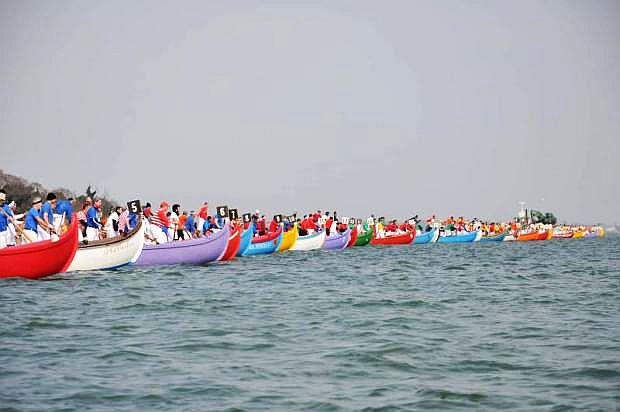
Three of the nine gondolas begin to warm up, and head for the starting line.

Three of the nine gondolas begin to warm up, and head for the starting line.

The men and the boat can take it, but the wind and waves were something to contend with.

The men and the boat can take it, but the wind and waves were something to contend with.

It was hard going for the pupparinos too.

It was hard going for the pupparinos too.

The "cavata," or blast out of the starting gate (so to speak) can make a huge difference.  Here, the "Vignottini" on the white gondola have shot to the front.  In the last minute of the race, pink pulled past them.

The "cavata," or blast out of the starting gate (so to speak) can make a huge difference. Here, the "Vignottini" on the white gondola have shot to the front. In the last minute of the race, pink pulled past them.

The phenomenal Franco Dei Rossi, known as "Strigheta," finished fourth in the 34th year he's rowed this race.  You cannot tell me that that is the arm of a 56-year-old man.  And yet, it is.

The phenomenal Franco Dei Rossi, known as "Strigheta," finished fourth (he takes home a blue pennant) in the 34th year he's rowed this race. You cannot tell me that that is the arm of a 56-year-old man. And yet, it is.

Comments (0)

Last night we had an especially delectable dinner, focusing (as often happens) on fish.

Sometimes we buy them, sometimes we catch them, and sometimes they thrust themselves upon us.

Two gilthead sea bream (orate) on the left and center, and the very strong, daring, not very clever gray mullet on the right. It was an impressive jump, but our plate was not his original destination.

Two gilthead sea bream (orate) on the left and center, and the very strong, daring, not very clever gray mullet on the right. It was an impressive jump, but our plate was not his original destination.

As in this case:  ”Orate” (gilthead sea bream) are highly prized around Venetian restaurants, and are vigorously cultivated in the various lagoon fish-farms.  We bought these two specimens from our neighborhood fisherman a few hours after he snagged them.

The other little guy, the slender one at the right edge of the plate, is a cefalo (”siegolo” — SYEH-go-yo — in Venetian), or gray mullet.  Very delicious, but very snobbed these days by restaurants who prefer to offer the very trendy orata, at preposterous prices.

Your basic gray mullet, or cefalo.  They come in various sizes and variaties, and we catch them with a simple gillnet when they're not practicing for the high-jump event in the fish olympics.

Your basic gray mullet, or cefalo. They come in various sizes and variaties, and we catch them with a simple gillnet when they're not practicing for the high-jump event in the fish olympics.

A few hours before the picture above was taken, our little siegolo had been swimming blithely along, zipping through the water thinking whatever busy ichtheous thoughts oppress teenagers of the Mugilidae family.

Suddenly, he felt like leaping.  This happens to mullet of all sizes, I don’t know why, but it strikes usually in the morning, sometimes in the dead of night.  You can be rowing along and they’ll just bounce out of the water as if there were a trampoline down there somewhere.  And it is not at all unusual for them to land, not with a splash, but a thud, as they hit the bottom of our boat.

The first time this ever happened to me, we were rowing in a four-oar sandolo at midnight back from Sant’ Erasmo all the way to the Lido. Summer nights are luminous in the lagoon and back then there weren’t quite so many motorboats tearing around all night, or at least not enough to drown out the pensive voice of a nightingale that came out of the dark woods as we rowed along the canal between the two islands called the Vignole, or the lovely, solitary note — just one — of the owl they call a soeta.  It was magical.

Suddenly there was a thump in the bottom of the boat, and it kept thumping.  In the dark I thought it was a bottle or something similar that had fallen over in the midst of our various voyaging detritus.  But no — it was a fish.  A big, strong mullet, who evidently had rejoiced as a strong man to run a race to see just how high out of the water he could hurl himself.  He found out how high, but he hadn’t calculated on the landing. Fish don’t get to go home again any more than people do, at least not those who launch themselves anywhere near us.  His future was pretty simple at this point: The skillet and a slather of extravirgin olive oil.

Anyway, sorry as I am to see a mullet’s morning, or evening, ruined by being taken prisoner and then executed, I know we appreciate him more than a lot of people do.  Maybe more than his friends and family do.  (Do fish have friends?)

Categories : Food, Nature, Water
Comments (0)

I was going to write about something else but it’s just too hot.  Every summer we get a heatwave around about now, but I’m not sure I remember one quite this heavy.  Or long-lasting. 

We’ve been having temperatures up around 100 degrees F. (39 degrees C) during the day, slightly less at night, for at least a week.  Yesterday the weather report indicated that it was hotter here than in New York.  I can tell you without consulting anybody but myself that it’s hotter than the hinges of hell.

Looking toward Murano at 8:30 this morning.

Looking toward Murano at 8:30 this morning.

In addition to simple heat, there is the element called “afa,” which means sweltering, sultry, breathless heat, the kind of mugginess that makes you feel like an old sponge that has been left in a dark damp corner next to things that smell.

There are only two places I can think of where this weather would be even more intolerable. One would be anywhere along the Po River plain, where the fields stretch for long, desperate distances with no shade.  Where there is shade, among the poplar plantations lining the river, there is no oxygen.  Whatever is taking the place of oxygen does not move, because the world has stopped.

Looking toward the Lido at the lagoon inlet of San Nicolo'.  The heron is happy, but herons don't sweat.

Looking toward the Lido at the lagoon inlet of San Nicolo'. The egret is happy, but egrets don't sweat.

The other place where the heat is torment is the mountains.  Mountains are made to be cool, at least at night.  If I had to endure this kind of heat at  4,000 feet, I’d have to think long and carefully about my revenge.

Clamming takes your mind off the fact that you're suffocating.

Clamming takes your mind off the fact that you're suffocating.

We’ve gotten through it so far by going out in the lagoon in a small mascareta, to a place where there is virtually always a breeze.  And enough water to immerse myself for ten hours or so.  Other people go to the beach on the Lido.  Other people go shopping at the small supermarket off Campo Ruga, where the air-conditioning is set to cryogenic depths.  We go clamming.  More fun, for us.  Probably not so much for the clams.

I’m off to bed now, planning to dream of the freezers at the Tyson chicken-processing plant.  Do not wake me.

Categories : Boatworld, Nature, Water
Comments (1)

Things are heating up here in an alarming manner, and I’m not referring to the Saharan heatwave that is currently sweeping the old Bel Paese and suffocating everybody’s capacity to think.

I’m referring to two recent spectacular homicides with distressing similarities, the kind one hears that judges in Provence excuse because of the effect of the mistral.  Here, I’m not sure that the weather is considered an accomplice or not.  But the girls are still dead.

These two tragedies demonstrate the most effective way to resolve your pain when your girlfriend breaks up with you.  Not a new approach, but it works:  You kill her, then yourself. 

Both of these recent calamities happened on the mainland (sorry, no romantic canals into which to throw the body), but just a few miles inland, and the Gazzettino has been providing the details for days, even though virtually every element is pretty much out of the handbook. 

Roberta Vanin (left) and her body being removed from Bio-Vit, her store.

Roberta Vanin (left) and her body being removed from Bio-Vita, her store.

Spinea is a small town in the Province of Venice about 10 miles from the Piazza San Marco, hitherto famous (I guess) for being the hometown of Federica Pellegrini, an Olympic swimming medalist.  Spinea is like numberless other small towns on the mainland near Venice; what were once little villages stuck in the middle of fields of corn or wheat differentiated only by the belltower of their parish church, and now are larger settlements surrounded by roads, highways, and shopping centers, differentiated by nothing, not even their love-deranged inhabitants.  I’ve been there several times to visit some of Lino’s relatives.

Now Spinea is stuck in my mind as the home of a certain Andrea Donaglio, a 47-year-old professor of chemistry, who was in love and lived with Roberta Vanin, 43; they even owned and operated a health-food store.

Anyway, she broke up with him, moved out, found a new boyfriend.  He began to stalk her.  He kept phoning her.  He threatened her with a knife.   (And then people start with the “We never imagined he could do such a thing.”  Makes no sense in Italian, either.)  She felt sorry for him.  Her friends and family told her to get a restraining order against him.  She didn’t.

So July 7, we pay our one euro for the Gazzettino to read the lead story: “He massacred his ex with 20 stab wounds.”  (Later accounts raised it to 40, then to 60; it appears he used two knives, perhaps because the first one broke.  Oy.)  Then he tried to kill himself with a couple of stabs to the stomach, but he’s recovering.  Physically, I mean.

"Death of Romeo and Juliet," by John Millais (1848).  Even in iambic pentameter, the onlookers say pretty much the things they say today: "What a waste."

"Death of Romeo and Juliet," by John Everett Millais (1848). Even in iambic pentameter, the onlookers say pretty much the things they say today: "What a waste."

So if this catastrophe is the pebble thrown into the pool, we now experience the ripples of the subsequent stories which go into all sorts of aspects of the situation from all sorts of points of view.  There is the story about how the scene of the murder is now a sort of shrine, covered with flowers and notes and stuffed animals, then the story about the funeral and how many people were there — a thousand, anyway,  because everybody knew them.   The story about her as told by her friends, how wonderful she was.  The story about him as told by his friends (or relatives) about how desperate and unhappy he was.

The one really unusual part of this whole horrible tale is the fact that Roberta’s parents declared that they forgave Andrea.  This is as amazing here as anywhere else, and I want us all to stop and reflect on that for a moment. 

Fabio Riccati and Eleonora Noventa.

Fabio Riccati and Eleonora Noventa.

A mere four days later, while all this was still boiling through the newspapers, another man decided to punish his girlfriend for leaving him.  (I thought romances were supposed to end in September.)  This happened at 9 in the morning on July 11 in a very small town, Asseggiano, a mere mile and a half from Spinea.

Fabio Riccati, 30 years old, had found the first girlfriend of his life, and they’d been seeing each other for six months or so.  Eleanora Noventa, an only child, was evidently one of the sunniest and loveliest girls ever.  Unfortunately, she was only 16.  Maybe a tad young to have started up with him, but not too young to have realized she had to break it off.  On Saturday she gave him the bad news and whatever little presents he had bestowed on her.

On Sunday morning, Fabio waited for her out on the street, expecting her to pass by on her bicycle.  She stopped.  They exchanged some comments.  He pulled out a Magnum .357 and shot her three times, the last shot to the head.  Then he shot himself in the heart.  

I want to live somewhere where nothing ever happens.  Nothing.  Ever.  And I never liked Romeo and Juliet, either.

Categories : Events
Comments (0)
Murano is just ten minutes from Venice, but it's a whole other world.  And not just because of all the glass, either.

Murano is just ten minutes from Venice, but it's a whole other world. And not just because of all the glass, either.

If you’ve ever been to Murano, one of the world’s great glass-making centers, you will know that it’s impossible to race through it.  You will be exhausted, but not because you’ve been going so fast; au contraire, you will have been plodding along at the pace of those debilitated galley slaves in Ben-Hur, going in and out of so many shops you’ll think they’ve been breeding in dark corners when you’re not looking.  The five islands that make up Murano, of which you will probably only visit two, cover barely one square mile, and the Yellow Pages list 61 shops.  I think there must be more.

Anyway, you will not have been racing.  Unless it’s the first Sunday in July, in which you can come to Murano to watch other people race, and believe me, they’re going to be more tired in less time than you and your whole family after an entire day.

A glimpse of the leaders last year, heading from out in the lagoon into the Grand Canal of Murano and the home stretch.

A glimpse of the leaders last year, heading from out in the lagoon into the Grand Canal of Murano and the home stretch.

The regata of Murano is really three regatas, each involving solo rowers, which calls not only for stamina but for skill.  The races are for young men on pupparinos, women on pupparinos, and grown men on gondolas.  It’s always hot, and there is always wind, and sometimes, like a few years ago, there can be sudden thunderstorms with pouring rain.  But the race must go on.

Only about ten more minutes to go, and unless something extraordinary happens, at this point the positions aren't likely to change much.  But they don't slack off, all the same.

Only about ten more minutes to go, and unless something extraordinary happens, at this point the positions aren't likely to change much. But they don't slack off, all the same.

The city of Venice organizes nine regatas a year, plus the Regata Storica.  Each race is designed for a particular type of boat and number of rowers, and each is held in a different part of the lagoon, which means that the conditions and course present their own particular quirks.  These changing venues also means that some are easier to watch from the shore than others, and the one at Murano is especially exciting not only because you can see both the start and the finish, but because there are good vantage-points along the fondamentas, and even a big cast-iron bridge from which to get a spectacular view of the finish.

The women on pupparinos are about 60 seconds from the finish line and it looks like the pink boat may still have a chance to overtake the white (2009).

The women on pupparinos are about 60 seconds from the finish line and it looks like the pink boat may still have a chance to overtake the white (2009).

Regatas (a Venetian word, by the way), have been an important feature of Venetian festivities since the Venetians crawled out of the primordial ooze;  sometimes they were part of a religious celebration, or part of the myriad spectacles staged for the amusement of visiting potentates, but they were one-time events.

Luisella Schiavon -- from Murano, as it happens -- has a clear shot at first place at this point.  She won last year, and this year, too.  Being tall, as well as talented, makes a difference.

Luisella Schiavon -- from Murano, as it happens -- has a clear shot at first place at this point. She won last year, and this year, too. Being tall, as well as talented, makes a difference.

But in 1869, the regata at Murano was established as a regular annual event and not for any prince or pope but to entertain — yes — tourists.  And whether or not tourists can look up for a few minutes from the heaps of glass necklaces and picture frames and flower vases, this race is arguably the most important occasion for a Venetian racer to show what he, or she, has really got.  I can tell you that the man who wins the gondola race is universally regarded as having won something akin to Wimbledon, or maybe the Ironman Triathlon, or the Tour de France.  Maybe all of them.

Here’s what it takes to win: Strength, stamina, skill, luck, and extreme and ruthless cunning.  It also helps if you’re tall.  It’s a physics thing; short rowers have a hard time keeping up with taller ones, though sometimes a short person has pulled it off, especially if he or she (I’m thinking of a she) is lavishly gifted with the aforementioned luck and cunning.  Or just cunning.

My two most vivid memories of this race are from one of the earliest ones I ever attended, and the one from last Sunday.  Both, oddly, involve a certain racer named Roberto Busetto.

Roberto Busetto last Sunday, crossing the finish line in third place just ahead of the yellow gondola.  Victory is sweet, at least until you black out.

Roberto Busetto last Sunday, crossing the finish line in third place just ahead of the yellow gondola. Victory is sweet, at least until you black out.

Mr. Busetto is strong — he looks like Mr. Clean, and he has biceps that make you think of whole prosciuttos.  He is also experienced, and very determined (I’m not sure that he’s made it up to “ruthless”), but if anything ever upsets him during the race — even if it may not have prevented him from finishing really well — he can be counted on to show up for his prize yelling about it.  In fact, there will always be something that’s wrong, and he goes all Raging Bull at the judges, at some fellow racer, at some onlooker, at anyone or anything that might have created even the tinest problem for him.  Or who looks like they don’t care.  It’s never easy to understand, in the midst of his tirade, what actually went wrong.  But you know he’s mad.

Okay, Mr. Clean, let's just check those vital signs again.

Okay, Mr. Clean, let's just check those vital signs again.

The first time I saw Busetto at full throttle, he had barely crossed the finish line when he started ranting.  It had something to do with what he claimed was some sneaky, illegal thing that another racer, Franco Dei Rossi, had inflicted on him, thereby preventing him from finishing better.

The confusion of boats immediately following the race doesn't usually include the ambulance.  Last year it was just the usual suspects.

The confusion of boats immediately following the race doesn't usually include the ambulance. Last year it was just the usual suspects.

But it wasn’t his tantrum that stunned me, though I didn’t know at that point that tantrums are his normal means of expression, the way some people can’t help starting every sentence with “Well” or “You know.”  It was the fact that under this deluge of outrage, Dei Rossi was sobbing as he mounted the judges’ stand to be awarded his prize.  A grown man, one of the greatest (in my view) racers of his generation, son of one of the greatest racers in history, was standing there weeping uncontrollably.  It was so astonishing and distressing that I know I didn’t imagine it, and I’m not exaggerating, either.  I’m glad I didn’t have a camera with me, I wouldn’t be able to bear looking at the pictures.  It really left a mark on me.

So we come to last Sunday.  It’s Busetto again.  He has been racing for at least 20 years, maybe more, but he had only a very brief peak, and that was quite some while ago.  In fact, I’d have to stop and do some research to determine when was the last time he won a pennant.  I think the Beatles may still have been together.  (Just kidding;  it was in 2000.)

But this year, he finished third.  Which means he won the green pennant, which means that after a ten-year drought he had managed to pull himself back into the ranks of the demi-gods. Pennants are awarded to the first four finishers, and they really matter to the racers, almost as much as the cash prize.

This is what normal collapsing looks like -- here, Sebastiano Della Toffola has just finished his first race with the big guys.  Franco Dei Rossi, a certified, gold-plated Big Guy, looks on with something that looks like comprehension.

This is what normal collapsing looks like -- here, Sebastiano Della Toffola has just finished his first race with the big guys. Franco Dei Rossi, a certified, gold-plated Big Guy, looks on with something that looks like comprehension.

Finishing third is pretty great, but about two seconds after crossing the finish line, he collapsed.  First he sort of let himself fall down backwards on the stern of the boat, which isn’t so strange except that it’s usually the younger men who want to show how completely wrung out they are.  It’s like when they throw their oar in the water (rage, joy, some other intense emotion — looks very dramatic, till you realize how dumb it is).

An excellent example of what incredible-victory collapsing looks like.  Last year, like this year, first place went to Igor Vignotto.  On the orange gondola both years.  You may laugh, but this is how superstitions are born.

An excellent example of what incredible-victory collapsing looks like. Last year, like this year, first place went to Igor Vignotto. On the orange gondola both times. You may laugh, but this is how superstitions are born.

But then my friend Anzhelika said, “He’s too white.”  Then I noticed that his boat had drifted slaunchwise across the canal, blocking the arrival of the last gondolas.  Then there was some commotion, then the sound of the water ambulance arriving at full speed.

Much pouring of cool water on his head, much checking of his blood pressure.  He tore himself away long enough to come pick up his pennant, annoyed (of course), though not yelling, because everybody was fussing over him.  He likes attention, but nobody with arms like prosciuttos wants it to be because he fell apart.

But some things in life are bigger than prosciuttos, and rowing under the searing sun for 40 minutes at full blast if you’re not in astronaut-type physical condition is asking for it.  “It” being an ambulance and a blood-pressure cuff, and lots of people suddenly looking at you like you’re some kind of invalid.

You know it’s serious when Roberto Busetto isn’t yelling.

Franco Dei Rossi in a more typical post-race moment: Smiling because he's won another pennant.  In this case, a blue one for fourth place.  Not at all bad in a field of nine, for a man who's drifting up on 50 years old.

Franco Dei Rossi (2009) in a more typical post-race moment: Smiling because he's won another pennant. In this case, a blue one for fourth place. Not at all bad in a field of nine, for a man who's drifting up on 60 years old.

This year's first and second-place finishers.  Igor Vignotto on the left (red pennant) and Rudi Vignotto (white pennant).  They were adversaries, but only sort of; not only are they cousins, but they have rowed together for years.

This year's first and second-place finishers. Igor Vignotto on the left (red pennant) and Rudi Vignotto (white pennant). They were adversaries, but only sort of; not only are they cousins, but they have rowed together their entire lives.

The fourth-place pennant, clutched by a sweat-soaked Ivo Redolfi Tezzat.  This is an especially nice design, with the rooster, the emblem of Murano, in the upper corner.  If you've won this, though, you really don't care whether it's a rooster or an Andean condor.

The fourth-place pennant, clutched by a sweat-soaked Ivo Redolfi Tezzat. This is an especially nice design, with the rooster, the emblem of Murano, in the upper corner. If you've won this, though, you really don't care if it's a rooster or a wall-eyed vireo.

Then we all followed the scent of the scorching sausage and ribs to the local festa.  This little girl out with her grandmother has the most astonishing pre-Raphaelite face.  I just can't stand the thought of her walking around with a cell phone and tattoos.  Must be getting old.

Then we all followed the scent of the scorching sausage and ribs to the local festa. This little girl out with her grandmother has the most astonishing pre-Raphaelite face. I just can't stand the thought of her growing up and walking around with a cell phone and tattoos and mutilated hair. Must be getting old.

Interested in the races?  The ribs?  The music?  The thunderstorm about to break the sky into a billion sharp wet pieces?  Not really.  That's what these parties are really all about.  The food and music are just ruses.

Interested in the races? The ribs? The music? The thunderstorm about to shatter the sky into a billion sharp wet pieces? Not really. Here is an excellent demonstration of what these parties are for. The food and music are just ruses.

Comments (0)

The period around St. Peter’s feast day (June 29) is notable for two things beside the annual bacchanale at the church, as described in my last post.

The littlest ones are St. Peter's pears.  They'll only be around for a brief time and that's why I like them, even if they have almost no flavor at all.

The littlest ones are St. Peter's pears. They'll only be around for a short time and that's why I like them, even if they have almost no flavor at all.

The two notable things are:  ”St. Peter’s pears,” which I haven’t been able to identify in any other way (maybe they’re here so briefly that Linneaus was never quick enough to nab them with a name), and thunderstorms.  Everyone expects thunderstorms in this period (we’re still waiting, oddly enough, though this year the weather has been very strange; last week it snowed in the mountains.  Maybe St. Peter is trying something new with water). 

St. Peter's fish (John Dory) by TK MacGillivray

St. Peter's fish (John Dory) by William MacGillivray.

For the record, there is also a fish, not necessarily associated with the feast day, which is commonly called “St. Peter’s fish” (Zeus faber), known in English as “John Dory,” who wasn’t a saint as far as I can discover.  This fish has a particularly gobsmacked expression which doesn’t resemble any saint I could ever respect, but maybe everybody in the Dory family has that look, not to mention the underbite.

June weather coming in: Roll out the barrel.

June weather coming in: Roll out the barrel.

Back to the storms.  Around here, the ones that crash down around us in this period have long since been associated with the Big Fisherman; well-meaning adults reassure their little people that the scary thunder is nothing more than the sound of St. Peter cleaning the wine barrels. 

But there is one folk-tale, recounted by Espedita Grandesso in her exceptional book on Venetian expressions (Prima de parlar, tasi, Edizioni Helvetia) that puts the blame squarely on his mother.  As told in Venetian it has an irresistible back-porch-stringing-beans atmosphere, as if the speaker were talking about a fractious family known to everybody in the neighborhood.  I’ll do what I can to render it here.

ST. PETER’S MOTHER

Well, St. Peter’s mother was so nasty and so nasty that when she died, even though her son was such a honking big deal as a saint, he had to send her to hell. 

When she got to hell, she got up to so many shenanigans, busting everybody’s fishing lines [polite euphemism for "balls"] and complaining and whining and calling her son at all hours of the day and night, that the saint went to Jesus Christ to tell him He had to let his mom into heaven.

“Can’t,” said Jesus, “she’s just too bad.”

Saint Peter wasn’t very happy because, when you get down to it, she was his mother, and the Lord was so sorry to see this that he told him, “Well, you know, Pete, if, maybe, she were to have done at least one good deed…”

Peter was quiet for a while, because his mother, as far as good deeds were concerned, had never done one in her entire life.  Then he remembered that, one time, his mother gave an onion to a little old man who was begging.

“Okay,” said the Lord, to make a long story short, “take this onion that’s got a few little roots still on it, and, if you can manage it, pull her up here with this onion.”

T-shirt design for the festa of San Piero in 2008. No onion, no roots, no mom. He looks so happy.

T-shirt design for the festa of San Piero in 2008. No onion, no roots, no mom. He looks so happy.

Peter went to the mouth of hell and said to her, “Mom, grab onto the roots of this onion and I’ll pull you up here.”

“Onion roots?  You nitwit!  How do you think they’re going to support me?”

“Don’t worry about that, just grab on.”

The old lady, grumbling, grabbed onto the roots of the onion and she started to rise off the ground, but she didn’t make it as far as the mouth of hell because a batch of other souls, who wanted to get out of hell too, grabbed onto her skirt and her ankles. 

St. Peter’s mother started to go crazy, screaming “Get out of here, you disgusting damned souls, the onion’s for me, it’s mine, and my son is St. Peter!!!”   [This is undoubtedly one of the best moments for the person who is telling this story to imitate the meanest, crankiest woman in the neighborhood.]

Onion roots do not inspire as much confidence as, say, a steel cable.

Onion roots do not inspire as much confidence as, say, a steel cable.

Seeing that the souls were still hanging on, she started to kick them to try to get rid of them.

At that point, the onion roots tore off, and St. Peter was left holding the onion while the old lady fell back down into the very center of the flames.

“What the heck have you done, mom?” St. Peter said.  “All you had to do was have a tiny bit of charity and you’d have made it out and so would all those other souls.  Now you’ve got to stay in hell forever.”  [Pause for cheers from the kids who must all be imagining whichever of their relatives--obnoxious big sister? busybody aunt?--would most deserve this doom.] 

BUT [the kids suddenly stop cheering], being that not even the Devil himself could stand to have this hellion among the damned souls, and also, well, it wasn’t exactly decent that the mother of St. Peter, he who carries the Keys to the Kingdom, would have to stay in hell, the old shrew got pulled out and stuck in a corner and given the task of washing the barrels of heaven before the season of new wine.

Wine barrels at the Robert Mondavi winery, Napa Valley, presumably not washed by St. Peter's mother.  (Photograph: Sanjay Acharya).

Wine barrels at the Robert Mondavi winery, Napa Valley, presumably not washed by St. Peter's mother. (Photograph: Sanjay Acharya).

Comments (1)

As you probably know, today is St. Peter’s feast day.  And in this neighborhood, it really means something.

St. Peter by Carlo Crivelli (1473).  Not looking particularly saintly here; those spectacular keys may be slightly more of a burden than a blessing.

St. Peter by Carlo Crivelli (1473). Not looking particularly saintly here; those spectacular keys may be slightly more of a burden than a blessing.

I’ll bypass the cadenzas about the saint himself, though he has always been my favorite mainly because for most of his life there was  nothing so saintly about him, except the part about his asking Jesus to cure his sick mother-in-law.  That was cool.  But then again, she must have been a saint as well.  Imagine having Peter as your son-in-law.  (Story about St. Peter’s mother in the next post).

The great thing about him is that before he became the Rock upon which the church was to be founded, he was just a working fisherman, which meant he probably smelled like fish — do they have algae in the Sea of Galilee?  He probably smelled like that too — and I’m sure he had chilblains and smashed fingernails and feet that were more like hooves.  If you want proof, I mention that he’s the go-to saint for people with foot problems.

Peter's feet, a detail from a limewood relief carving by Christoph Daniel Schenk.

Peter's feet, a detail from a limewood relief carving by Christoph Daniel Schenck (1685).


Peter's hands, a detail from a painting by Georges de la Tour (

Peter's hands, a detail from a painting by Georges de la Tour (1615-1620).


More to the point, he had one superb quality and that was, as they say in Venice, that “What he had in his heart, he had in his mouth.”  Impulsive, a little clueless sometimes, but spectacularly sincere and frankly never afraid to just put himself out there.  (Pause for sound of many, many chips falling where they may.)

The posters are a bit redundant, since everyone already knows all about it.

The posters are a bit redundant, since everyone already knows all about it.

Why I like him so much now isn’t merely all the above, but because he is the patron saint of the former cathedral of Venice, the church of San Pietro di Castello, which is just over the canal from our little hovel.  And each year they put on one heck of a festa in his honor.

Like most festas, there is music, and food, and dogs and old folks and little babies and a big mass, and etc.  But this one also has three regatas, the mass is celebrated byno less than the auxiliary bishop (the patriarch can’t ever be bothered to come to these things), and the party goes on for five solid days, by which I mean nights, too.

The juggler is working the audience into a frenzy.  "Festa" is just another word for frenzy.

The juggler is working the audience into a frenzy. "Festa" is just another word for frenzy.


Attempting to kill your friend with your balloon sword is always entertaining.

Attempting to kill your friend with your balloon sword is always entertaining.


Balloons that are not swords are also fun.

Balloons that are not swords are also fun.


I have no idea what happened. One minute he was fine, the next minute he was hysterical. Festas seem to have that effect on little people.

I have no idea what happened. One minute he was fine, the next minute he was hysterical. Festas seem to have that effect on little people.

What does this mean for us?  Well, it means not only five days of the fabulous aroma of charcoal-scorched ribs wafting around the area, and not only five nights of  inconceivably loud music audible from way over here, but five nights of all the festa-goers coming and going till 2:00 or even 3:00 in the morning.  The main street to the church is right outside our bedroom window and of course our windows are open.  Happy people going home always shout, I don’t know why.

So while Peter may be the patron saint of locksmiths (hint: he carries the keys to the kingdom) and butchers and cobblers (feet again) and other trades, including fishermen and netmakers and, naturally, the Papacy, for my money he is also the patron saint, at least in our neighborhood, of the deaf, the insomniac, the overtired and overstimulated (technically he’s the go-to saint for cases of frenzy, but people here like frenzy), and also the occasional Russian drunk.

The latter is a newcomer to the list, but at 4:00 AM last night whoever he was was wandering the streets, which had finally achieved slumber, calling out forlornly for Marco.  Surprising how far your voice can carry at that hour.

I have no idea if he ever found him, but I’m really sorry that his friend wasn’t named Peter.  That would have been so perfect I might actually have gotten up to help him look.

Maybe next year.

We rowed the auxiliary bishop and the parish priest to church for the big mass on Sunday morning.

We rowed the auxiliary bishop and the parish priest to church for the big mass on Sunday morning.

We were preceded by the band from Sant' Erasmo. I have only ever heard them play two pieces, maybe three. They're never completely in tune, but they’re very loud, which is all that matters.

We were preceded by the band from Sant' Erasmo. I have only ever heard them play two pieces, maybe three. They're never completely in tune, but they’re very loud, which is all that matters.

Two of the nine mascaretas rowed by women battling it out in the regata of the Marie (Marys). As always, the ladies were shrieking the most un-saintly remarks at each other. Of course, the men do too, but the women are much worse.

Two of the nine mascaretas rowed by women battling it out in the regata of the Marie (Marys). As always, the ladies were shrieking the most un-saintly remarks at each other. Of course, the men do too, but the women are much worse.

One of these ladies is trying to imitate the other.

One of these ladies is trying to imitate the other.

Mass is over, now we can all go eat.

Mass is over, now we can all go eat.

These guys must have to burn their clothes, after five days in the smokehouse.

These guys must have to burn their clothes, after five days in the smokehouse.

IMG_8343 san piero comp
IMG_8321 san piero comp
IMG_8345 san piero comp
IMG_8327 san piero comp
IMG_8367 san piero comp
IMG_8346 san piero comp
Categories : Events, Food, Kids, Venetian-ness
Comments (1)

Pitt stop

By Erla Zwingle · Comments (0)

You may have heard — or maybe you’re hearing it now — that several Venetian spring months were sparkled-up by the presence of Johnny Depp and Angelina Jolie, here filming “The Tourist.”  (Stuntman Vladimir Tevlovski was also here.  Just thought I’ve give him a shout-out.)

But naturally the excitement was generally focused on The Jolie and also Brad Pitt, who seems to have come along to drink and eat things and get photographed around town with the kids.  And perhaps to keep an eye on her and Johnny Depp, if some unkind comments are to be believed.

I’ve lived most of my life in cities where there are more celebrities than plumbers.  And usually Venetians aren’t too easy to impress, even with the annual Film Festival and other big events that so excite reporters and editors.  This “Hey buddy, you’re blocking the entrance” attitude is just another of the many similarities between Venice and New York, and just another reason why I love it here. 

Hoping to illustrate the reason for Venetians’ general indifference to stars (”So who is that?” “It’s Al Pacino!”  “It’s Heath Ledger!”  “It’s Daniel Craig!” “Oh……”) I thought I’d add here the number of films which have been shot in Venice over the 100-some years that cinema has existed.  But a complete list evidently has never been made.  Listers tend to name only their favorites, which is a little annoying.  Anyway, it’s a lot.   Since I’ve been here I’ve seen at least six in progress, which isn’t all that many.

But in a bar/cafe/pizzeria behind the trees in the generally nondescript area known as Sant’ Elena, at least one barista hasn’t made any effort to be blase’. 

The other morning I noticed that somebody had set up a little shrine to a moment of elation which will probably endure till the last person who knows who Brad Pitt was has been cremated and forgotten.

The note says: "Brad Pitt drank from this cup."  The date is April 24, 2010.  I'm sure it has never been, and never will be, washed.

The note says: "Brad Pitt drank from this cup." The date is April 24, 2010. I'm sure it has never been, and never will be, washed.

Categories : Events, Venetian-ness
Comments (0)