The latest meanderings have — as always — revealed some curious and beautiful things.
My personal account of living real life in real Venice, and more
The latest meanderings have — as always — revealed some curious and beautiful things.
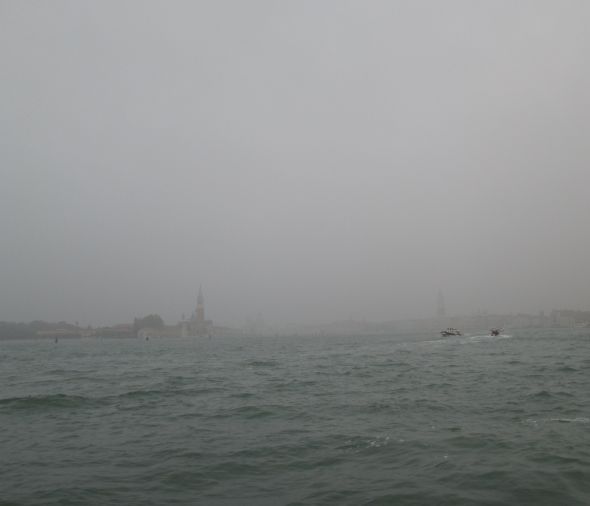
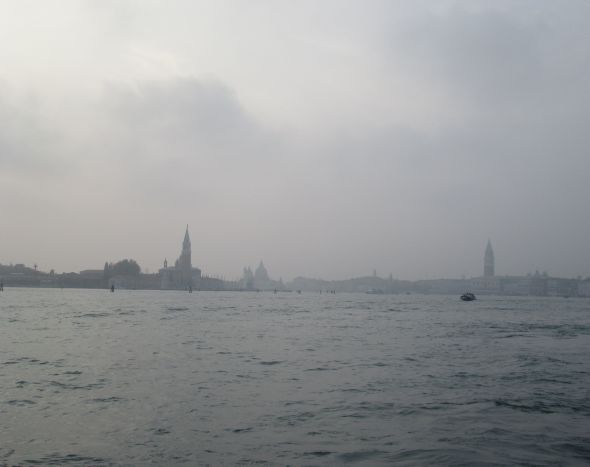
South Asia has the monsoon season; Lapland gets the white nights; Egypt endures the periodic simoom.
Here we have two separate months of heartless humidity, almost inevitably in October and April, two otherwise lovely months which in Venice reveal their dark, unregenerate side by smothering the city in a combination of cool temperatures and sodden, sticky air. Even when the sun shines, the dampness in the atmosphere is implacable. A gauzy mist softens the city’s silhouette, which is sheer photo-fodder, but its meaning in real life is quite otherwise. I haven’t given this phenomenon a title yet because I generally call it by short, rustic, Anglo-Saxon names.
The sheets on the bed remain repugnantly damp, the towels refuse to dry, potato chips no longer crunch. I am forced to wash the clothes even though I know they will not give up their moisture without a long, long fight. Five days after hanging them on the line, I’m still touching them and trying to convince myself that they’re dry. Of course they’re not.
Gone is that heavenly summer period in which you could hang out a huge soggy beach towel at 10:00 AM and by noon it would be crackling like desiccated firewood. Not yet arrived is the long winter season in which the radiators toast the underwear and bake the bedsheets. We have to accept this interval because, frankly, the longer we can put off turning on the heat, the better for everyone; the gas bill is an instrument of torture unknown to the Inquisition (deepest respect to the victims thereof), and after the recent unpleasantness between Ukraine and Russia, we know the gas bills will be higher yet this winter.
So much for the sense of touch around here these days. Clammy.
As for sounds, some are new, and many are old but more noticeable, or maybe I’m just becoming more sensitive.
Here are some highlights from the daily soundtrack:
From around midnight to 6:00 AM, a voluptuous silence wraps the city as far as I can hear. It is plush, it is profound. It’s so beautiful that I’m almost glad to wake up just to savor it.
At about 6:00, I hear a few random swipes of the ecological worker’s broom rasp across the paving stones. It must be exhausting work, because it lasts such a short time.
At 7:30 I begin to hear small children walking along the street just outside our bedroom window — you remember that only the depth of the wall itself separates my skin from theirs — on the way to school. Little mini-voices mingle with the bigger voices of whoever is accompanying the tykes up to via Garibaldi. If the day has started right, it’s a charming sound, though sometimes the voices make it clear that everybody needs to hit “reset” on their personal control panels.
Between 7:00 and 8:00 comes the thumping, clanking sound of the empty garbage cart bouncing down the 11 steps of the bridge just outside, guided by the ecological worker who sees no reason to fight gravity because he knows he’s going to face a serious battle with it on the return trip, his cart loaded beyond the brim.
At 8:00 sharp we get the morning hymn played five times from the carillon in the campanile of San Pietro, just over the way. The piece is performed in several keys — mainly the key of flat — and the melody has worn itself into my mind so deeply that if the bells were ever tuned I think it would actually disturb me, like those people who lived along Third Avenue in New York who were so used to hearing the elevated train roaring past their windows that the day the train was removed, the transit company switchboard was overwhelmed with calls from panicky people crying, “What’s that noise?” It was the silence.
Around 9:00 there is a brief but savage skirmish between what sounds like three dogs. This struggle to establish supremacy will be repeated, again briefly, toward 8:00 this evening.
At 2:00 the middle school in via Garibaldi lets out, releasing flocks of young adolescents in a homeward swarm. These children do not go silently, meditating on the poetry of Giosue’ Carducci or the whims of the isosceles triangle. Engage feet, open lungs. You can hear their chaotic shouts all the way down the street. Lino says, “They’ve opened the aviary.”
At 7:30 PM the carillon rings a another out-of-tune hymn, only two times. It’s longer than the morning music, so somebody decided twice was enough.
For a while, the evening noises separate and recombine in various ways (children, dogs, etc.). But peace is not yet at hand. It’s almost 11:00.
11:00 PM is the Hour of the Rolling Suitcase. Actually, by now almost every hour, and half-hour, belongs to the rolling suitcase, whose grumbling across the battered masegni has become a sound more common than shutters scraping open or banging shut.
What is it about 11:00? Where is this person (or persons) coming from? The flight arrivals list for Marco Polo airport gives options such as London, Vienna, or Barcelona, and Treviso Airport might be sending us passengers from Brindisi or Brussels, but whatever the starting point might have been, I marvel every night to hear that some intrepid soul’s day has been spent coming to Venice, and now he or she is finally here. Every. Night. Maybe I should set up a little refreshment stand by the bridge and offer some kind of energy drink, like at a marathon.
And speaking of 11:00, some time around then I hear a vivacious small group come down the street, walking from the direction of Campo Ruga toward however many homes they belong to. You could imagine a bunch of friends meeting every once in a while, and even going home later than 11:00 (which often happens in the summer). But what kind of a group always breaks up at 11:00? In high spirits? Coming from the direction of Campo Ruga? A mah-jongg club? Tango lessons? Choir practice? A renegade chapter of the Loyal Order of Moose? I cannot conceive of what could be going on that would require a group to attend every night, especially in this neighborhood. And yet, they pass, and happily. This, too, perplexes me. Happy every night? Where do I sign up?
But wait. The day isn’t over yet. Now we come to midnight — or almost.
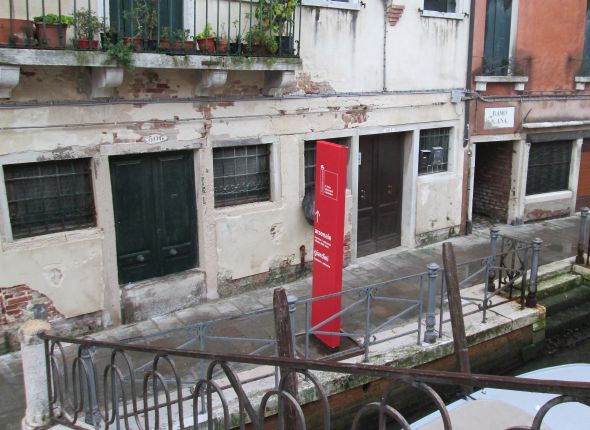
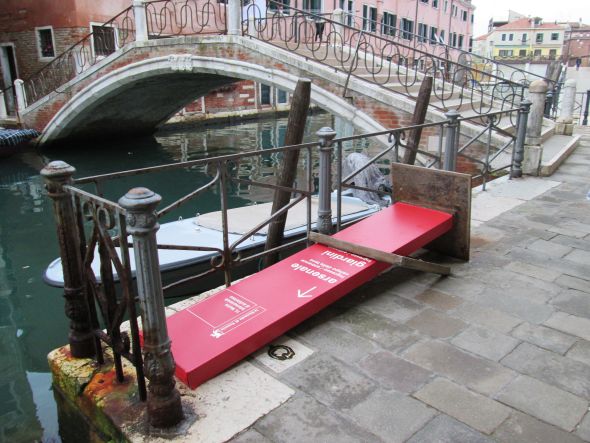
For the past week or so, just as the day has drifted toward midnight, and every normal noise has faded away, and every normal person has shut the front door behind him or her, we’ve heard a sudden heavy metallic CLONNNNNGGGG from the other side of the canal. No, we don’t ask for whom the bell is tolling, because it’s not a bell. It’s the red metal stele which indicates the direction of the Biennale ticket booths; a local consumer of controlled substances evidently cannot physically tolerate, philosophically accept, or rationally justify its verticality. It must be horizontalized, immediately. Maybe it’s some prehistoric variation of hydrophobia.
And in the morning, another person or persons stands it upright again, our own lonely little menhir unknown to archaeology.
Lino discovered the culprit one evening, and pointed him out to me the next day. But what I still don’t know is who puts the signpost upright again the next morning.
Maybe it’s Sisyphus.
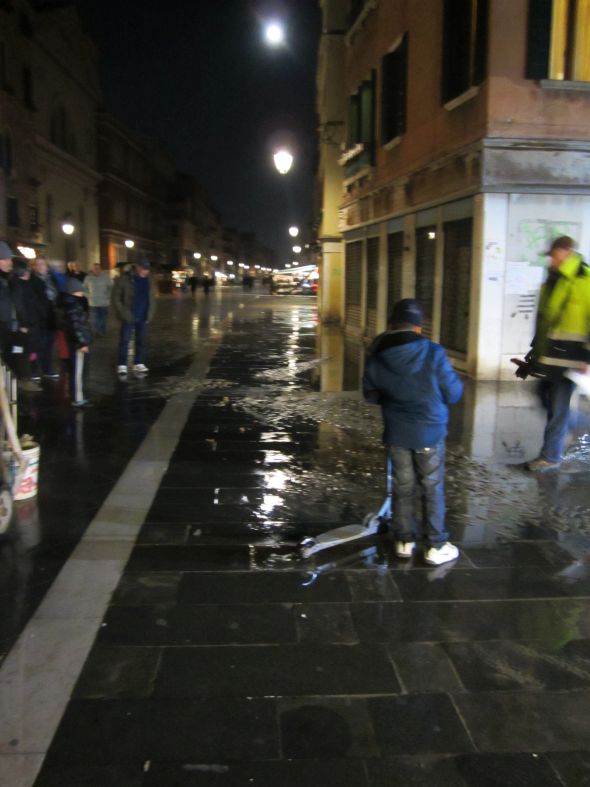
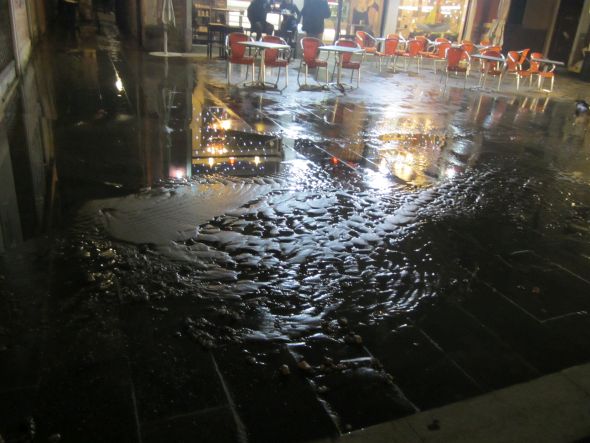
No, we don’t have bikini-clad babes rocking in-line skates zooming up and down via Garibaldi — yet — but one evening a while back we definitely had the beach.
Strolling up the street, we noticed an animated group forming. It was composed of people of various sizes and they were looking at something, and talking to each other about it, and looking some more.
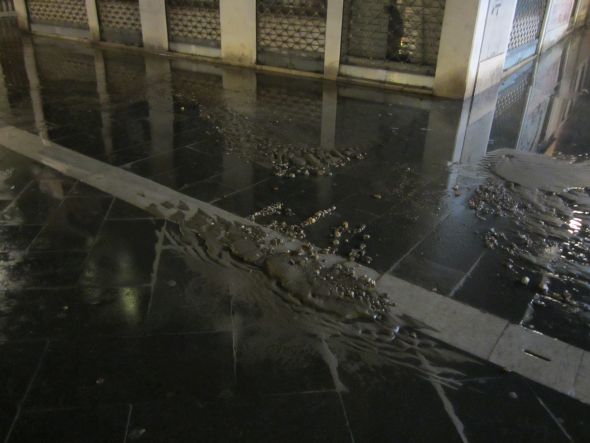
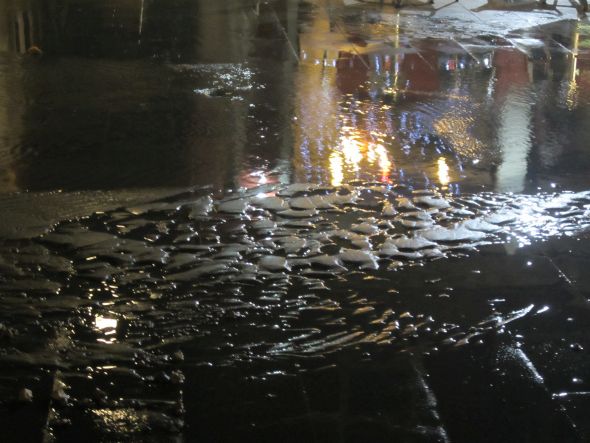
A pool of water was forming at the juncture between two stretches of pavement, stretches which were not on the same plane, hence the pool. And we could see water flowing toward the pool from an undiscernible source.
That’s a fancy way of saying: What? Where?
The “what” is a trick question — it was obviously a burst water pipe. But the “where” was beginning to concern everybody.
And there was also the “who,” as in: Who’s going to come find the lair of this rampaging beast and vanquish it?
There wasn’t any “why?,” though. Considering that most of Venice is held together with flour paste and baling wire, bits of the city breaking, separating, subsiding, or otherwise deteriorating does not, in itself, inspire surprise. So the fact that a pipe had burst appeared to arouse reactions no more urgent than “Gosh, wouldja look at that,” or “It could have been worse.” Why does that thought never comfort me?
So: A city falling to bits and water passing through pipes. So far, so not-worthy-of-wonder. Water would be the easiest thing to imagine issuing from a water pipe.
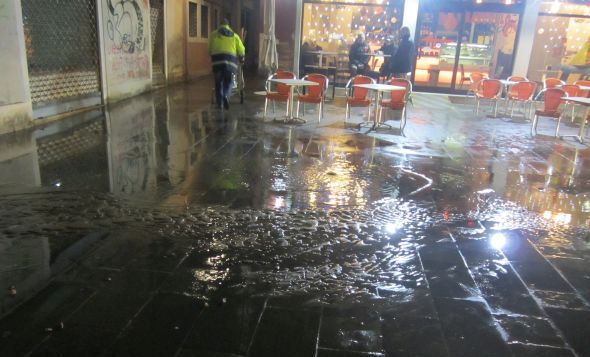
What surprised me was the sand. Unlike the Lido, most of Venice isn’t built on sand dunes. It’s built on mud, clay, or other forms of soil not containing a high percentage of silica.
But the silica is here now, because — as a fireman friend explained it to me — as pipes were laid over time, snaking around under those tough trachyte paving stones, the workers noted that the softer the soil, the easier it was to open up the street and work on the pipes, as needed. So over time the soil they replaced when the work was finished was more friable, more granular, just generally softer.
This is the main reason why the paving stones are now so apt to subside, especially near the fondamentas where the pounding of the waves caused by thousands of motorboats a day (not made up) pulls this now more fragile material out from under the stones and out to sea.
Help came in a relatively short time, the break was located, the water ceased to flow, the sand no longer swam out from the underworld into the light — artificial,true, but light just the same. Next day, the traces were hardly noticeable.
But now I know there’s all that sand just under the stones, more than I had suspected. This doesn’t bode well for anybody, except for babes in bikinis. And the maintenance men, naturally, for whose sakes Venice is now even more fragile than before.
My recent silence would typically have been due to the winding down of the summer, the winding down of me, an annual process which usually is distinguished by….nothing. Sloth, heat, tedium, what the doctors might call general malaise. (The tedium, unhappily, is also caused by the endless, predictable procession of homicides, femicides, drownings, drug overdoses, fatal mountain accidents, political did-so-did-not, and miles of traffic backups on the major days of departing and returning from vacation.) It’s practically a tradition.
There are usually some slight variations. Today we read “After he slit his friend’s throat, he went out to drink a beer.” That’s a little different. Or the young man who was accosted by a prostitute on the street in a town out on the mainland who got fined 450 euros for the verbal exchange even though he turned her down. The law says clients are criminals too, and it appears that even telling her no counts as much as hiring her for the weekend. But on the whole, a typical 30 summer days, not so unlike what people experience in many other parts of the world.
By now, though, we all know that August, which is supposed to be the Nothing Month, was very much a Something Month, for the gondoliers, ACTV, and city as a whole. Which also explains my recent silence because (A) I was trying to keep up with the constantly evolving situation and (B) doing so made my brain seize up, therefore (C) we went to the mountains for a few days where my brain wasn’t needed for anything but maintaining basic life functions.
Returning to Venice, we immediately fell into the groove, right where we had left it. There is a traditional sequence of events in this sliver of time, which involves lots of people moving ceaselessly around the city, especially in our neighborhood, not to mention the Lido.
Plenty of visitors are still going to see exhibitions of the Biennale; every evening, when the doors close at 6:00, we sit at our favorite cafe and watch the migration moving sluggishly from the distant Arsenal outposts toward and along via Garibaldi, in search of food, drink, and a place to sit. I’ve seen a lot of really nice dresses this year, if anybody wants to know.
The Venice Film Festival opened three days ago, so although actors and fans aren’t to be seen in our little cranny of the city, there are plenty of badge-and-totebag-and-camera-bearing journalists around (a reported 3,000 have come to cover the festival. How could there be that many outlets in the world that want hourly bulletins about movies and their makers?).
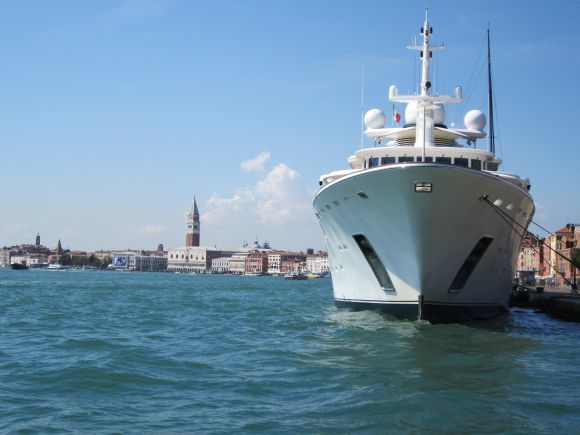
In fact, a number of traditions here are pleasant, even reassuring. I enjoy the eternal cycle of seasonal food; right now the grapes and the warty, gnarly pumpkins (suca baruca, “the veal of Chioggia”) are appearing in the market. And I feel the onset of the Regata Storica, to be fought out tomorrow, and there are the signs in the shop windows selling new backpacks and school supplies. That’s the happy side of tradition.
Then there is the also-traditional way in which events have been unfurling since the death in the Grand Canal. Everything that has happened since two weeks ago today has been as predictable as dusty bookshelves, but they are not positive developments. In fact, they’re not really developments at all.
In the days following the accident, there was a mighty outcry from all sides demanding change. That was predictable.
What is also predictable is that change is now being resisted with every weapon that comes to hand. Life here obeys Newton’s Third Law, the one about equal-and-opposite-reactions. Newton’s Laws are among the few edicts nobody objects to, mainly because Newton isn’t around to argue with.
When I say “laws,” I am referring specifically to the recent regulations that have been proposed to establish order on the traffic in the Grand Canal. Because even if you say you need them and want them, when you get them, you have to fight back.
The mayor and assorted sub-mayors and people who wear uniforms worked mightily and also rapidly to devise a new way of organizing the assorted boatly categories. In record time, a 26-point plan was presented, and published in the Gazzettino.
This plan contained a number of dramatic innovations, such as collecting garbage at night, and requiring the barges to have finished their chores by 10:00 AM.
But this is the point at which the true, fundamental, guiding-more-surely-than-a-compass tradition took over.
The tradition is: I’m not changing anything. Somebody else can change if they’re that dumb, but not me.
I knew the minute I read it that night work wasn’t going to fly. If people hate working by day, which it seems many do, they would hate even more doing it by night. Then the barge drivers said that working those hours would make everything more expensive. And so on.
So the very people who clamored for change in the heat of the moment have shown that they don’t want it. They want somebody else to want it. This is tradition!
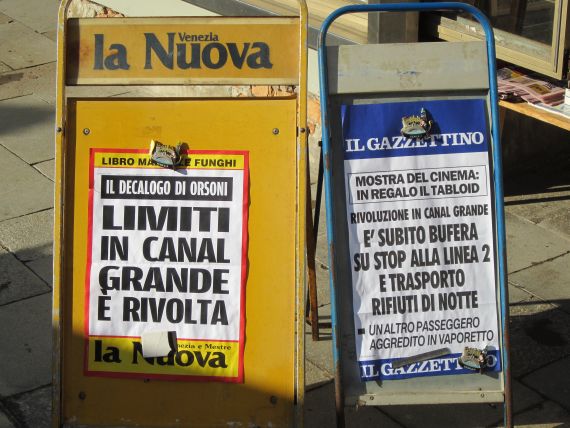
I can tell you how things are going to go in the next few months, or perhaps merely weeks: Some tiny tweaks will be made, and everything will return to the way it was. The #2 vaporetto is scheduled to go out of service on November 3, because it’s a high-season traffic-overflow adjunct. The proposal to cut it earlier makes moderate sense, but it’s really window-dressing, because then there would have to be more #1 vaporettos to handle the traffic.
The “Vaporetto dell’Arte,” an enormous, lumbering, amazingly underused and overpriced vehicle, will also stop on November 3. They could stop it now and nobody would notice, but it must be somebody’s pet project because it keeps on going. Empty and big and expensive and pointless. (The “pointless” part is a special ACTV sub-tradition.)
As for what everybody else thinks about revising the way things are done, Grug from “The Croods” put it best: “Change is always bad.” As his son replied: “I get it, Dad! I will never do anything new or different!” Just a cartoon? Maybe not.
By the staircase in the Palazzo Grassi, the original owner, Angelo Grassi, had the following phrase incised in 1749: CONCORDIA RES PARVAE CRESCUNT, DISCORDIA ETIAM MAXIMAE DILABUNTUR.” With harmony the small things grow, but with discord even the greatest things are brought to ruin.