The solemnity (more and/or less) of the past three days — All Saints Day and All Souls Day — dissolves today into the genuine solemnity of the annual commemoration of the end of World War I. November 4 (1918) is the date on which war against the Austro-Hungarian empire and its allies ceased.
It sounds so tidy: Victory. Peace. Ninety years have gone by. Let’s move on.
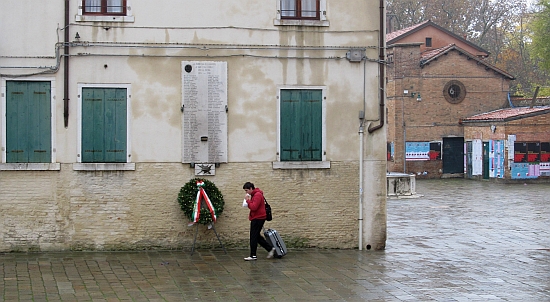
But every year the moving-on stops, to observe what is now called the Festa of the Armed Forces. Many civic monuments, and not a few of the parish memorials listing the fallen sheep of the local flock, are decorated with shiny fresh laurel wreaths given by the City of Venice. And a ceremony performed by veterans’ groups and other military elements is held every year on this day in the Piazza San Marco.
In Rome, the President of the Republic made the traditional visit to the Tomb of the Unknown Soldier, which soldiers guard night and day.
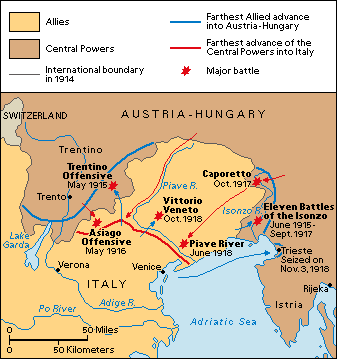
France had established the first tomb of the Unknown Soldier in 1920, and the Italians wanted to do likewise. They had lost some 1,240,000 men, almost entirely on the northern front which had stretched some 400 miles, almost one-third of the entire Alpine arc. In what some have called history’s greatest mountain battlefield, the gathering and burial of unidentified soldiers had been going on for two years.
A commission was formed to choose one soldier from each of the eleven sectors of the front (Rovereto, Dolomiti, Altipiani, Grappa, Montello, Basso Piave, Cadore, Gorizia, Basso Isonzo, San Michele, and Castagnevizza). No identifying marks of any kind were to be permitted — no name, or rank, or serial number.
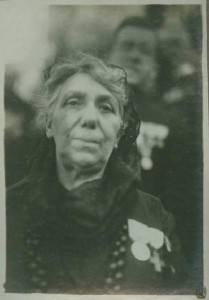
The eleven caskets were taken to the basilica of Aquileia, not far from Trieste. Here they were arranged in a line, and on October 26, 1921, a woman named Maria Bergamas from Gradisca d’Isonzo stepped forward to choose one.
Her son, Antonio, had been killed but his body had never been found. No one imagined, I’m sure, that one of the eleven victims could have been her son. She was there to represent all of the mothers, wives and women of Italy.
One eyewitness reported that she walked toward the row of eleven coffins, “with her eyes staring, fixed on the caskets, trembling…in front of the next to last one, she let out a sharp cry, calling her son by name, and fell on the casket, clasping it.” Strangely, there are less fervid accounts, also by eyewitnesses: “In front of the first coffin she seemed to become faint, and was supported by her escort of four veterans, all decorated with the Gold Medal for Valor. In front of the second, she stopped, held out her arms and placed her mourning veil upon it.”
As a journalist, I can’t grasp how there could be more than one version of the event, but I assume everyone was extremely keyed up.
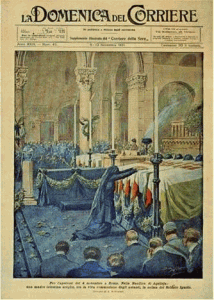
Here is the scene as depicted by “La Domenica del Corriere.” Meaning no disrespect, it clearly would have made an excellent third act to a tragic opera.
In any case, one was chosen, placed on a gun carriage, lashed onto an open-sided train carriage,and covered with the Italian battle flag. Four other open carriages were attached, to contain the flowers which undoubtedly were going to be offered by the people along the way.
The train stopped at Udine, Treviso, Venice, Padova, Rovigo, Ferrara, Bologna, Pistoia, Prato, Firenze, Arezzo, Chiusi, Orvieto, and finally Rome. But in fact it stopped — was stopped, actually, by the throngs which had waited for hours to see it — at all the stations, even the tiniest. Some threw flowers, others clasped their hands and knelt.
The train arrived in Rome on the evening of November 3, and the casket was taken to the basilica of Santa Maria degli Angeli e dei Martiri near the station. Mourners passed all night to pay their respects.
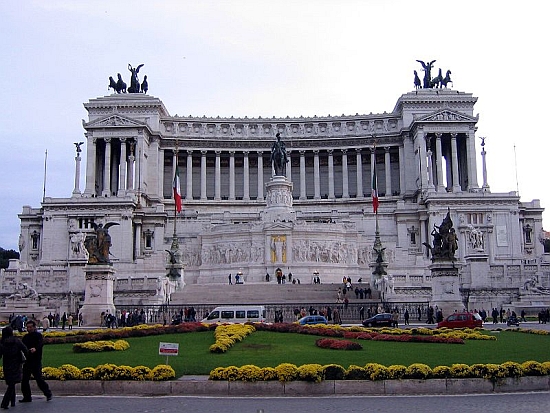
The next day, November 4, 1921, the war would formally end at 3:00 PM. The cortege proceeded slowly down the Via Nazionale toward Piazza Venezia and the massive monument known as the Vittoriano, where the body would be entombed.
The monument known as Il Vittoriano, in Rome. The “Altar of the Fatherland,” where the casket was placed is in the center, beneath the statue of the goddess Roma in the golden niche. (Photo: Alessio Nastro Siniscalchi)
Total silence reigned. King Vittorio Emmanuele III walked behind the gun carriage bearing the casket. At the monument, the casket was lifted and carried by six veterans, all of whom had been decorated with the Gold Medal for Valor. Finally, it was placed in the space beneath the statue of the ancient goddess Roma. http://www.youtube.com/watch?v=RrOMk91vCfo
You might be surprised, as I have been, to discover how many poems (at least in Italian) have been written about the Unknown Soldier. Some are even composed as accusations, reflections, admonitions, rebukes, spoken directly to the reader by the Soldier. There is also a number of songs about him and/or war, in the mold of the protest songs of the Sixties and early Seventies. They seem dated and futile.
Well, of course they’re futile. Just look around. Still, some respect for the fallen is the least we can do. Or apparently the most we can do.
She wasn’t weeping, she was eating something. Life insists on going on.
Contains information related to marketing campaigns of the user. These are shared with Google AdWords / Google Ads when the Google Ads and Google Analytics accounts are linked together.
90 days
__utma
ID used to identify users and sessions
2 years after last activity
__utmt
Used to monitor number of Google Analytics server requests
10 minutes
__utmb
Used to distinguish new sessions and visits. This cookie is set when the GA.js javascript library is loaded and there is no existing __utmb cookie. The cookie is updated every time data is sent to the Google Analytics server.
30 minutes after last activity
__utmc
Used only with old Urchin versions of Google Analytics and not with GA.js. Was used to distinguish between new sessions and visits at the end of a session.
End of session (browser)
__utmz
Contains information about the traffic source or campaign that directed user to the website. The cookie is set when the GA.js javascript is loaded and updated when data is sent to the Google Anaytics server
6 months after last activity
__utmv
Contains custom information set by the web developer via the _setCustomVar method in Google Analytics. This cookie is updated every time new data is sent to the Google Analytics server.
2 years after last activity
__utmx
Used to determine whether a user is included in an A / B or Multivariate test.
18 months
_ga
ID used to identify users
2 years
_gali
Used by Google Analytics to determine which links on a page are being clicked
30 seconds
_ga_
ID used to identify users
2 years
_gid
ID used to identify users for 24 hours after last activity
24 hours
_gat
Used to monitor number of Google Analytics server requests when using Google Tag Manager