Anger management

Just when I had concluded that there was nothing different or interesting to say about Venice, just when I thought life here was going to continue to grind deeper and deeper into its rut (same old problems, same old remarks, same old endless cycle of birth and rebirth), comes a blast of rage from person or persons yet to be identified.
Whoever they were, they trashed 7 of the gondolinos belonging to the city, discovered just today on the last day of the gondolino eliminations for the Regata Storica. The “Storica,” as you know, is the ultimate race, and it is conducted aboard the gondolinos. There is a total of 9, plus the reserve boat. Three boats, which were in another place and therefore escaped the axe murderer(s), weren’t much to work with for the eliminations today, but the nine two-man crews were divided into three sets of three, and extra time was eaten up with the removing and re-installing of the forcolas of each rower at each change. The mayor has tweeted that the boats will be repaired in time for the race on Sept. 4. Five boatyards have thrown themselves into the work.


Who would do such a thing? Plenty of police are working to find out. But who would WANT to do it? Who indeed? It might be disaffected office-seekers, or environmentalists protesting deforestation, or people who want Jodie Foster to fall in love with them, or anything.
There has been tension in the rowing world recently, it’s true. But until all the dust has settled, and been left there as long as I usually leave it anywhere, and then finally Pledged away, I’m not going to start theorizing.
I can mention, however, that a sense of anarchy stretching beyond the world of rowing seems to be threatening what ought to be well-earned somnolence in the city. Tourists keep trying to swim in the Grand Canal. A New Zealander, one of the crew of a yacht in port, got drunk a few nights ago, jumped off the Rialto Bridge, and landed right on the windshield of a water taxi passing below. The mariner is in the hospital in very bad condition, and the taxi is also in the shop.
Here is a recent video from Roberta Chiarotto, on her Facebook page https://www.facebook.com/roberta.chiarotto/videos/10209231322756467/
We see some young people in their bathing suits in Campo San Vio, heading for a refreshing dip. The voice of the Venetian woman reprimanding them, in English and German, basically says “This isn’t Disneyland, it’s a city. You can’t do this.” For those (like Lino) who remember swimming in the canals as little tykes — naked, learning to swim tied to their mother’s washboard — may I say that there was less dangerous traffic then, and by the way, they were merely little tykes. Healthy full-grown hominids who are not in their own back yards should be aware, if only dimly, of the appropriateness of some behavior. If in doubt, I’d suggest “Don’t.”
What amazes me is how tranquilly these visitors receive this unwelcome news, and how unconvinced they look. And they’re not an isolated case; a few weeks ago, five young French tourists took the plunge in the Grand Canal in front of City Hall, no less. I won’t continue this list, because however many times I might mention it, I still can’t believe it. And it seems to have no effect.
Once again driven to distraction, some exasperated resident recently snapped, posting a sign near Campo San Martin:

On a more serious but equally anarchic note, two nights ago there was a nearly fatal collision in the lagoon (that’s good news, considering that at least once a summer there is a completely fatal collision to report). A motorboat being driven at high speed — that’s redundant, pretty much all motorboats are driven at high speed in the lagoon — ran right straight into a passing water taxi. The motorboat sank, the ambulance came, the two young men are in the hospital and the girl escaped unharmed. The high-spirited young folks had been zooming along with no lights on their boat, lights which are not only required by law but which common sense reveals would have at least given the taxi driver some hint as to their imminent arrival.
My point is that a great deal of anarchy can be tolerated, for many reasons, as long as nothing happens, which is what everybody is counting on. And then something happens. Like ramming a taxi.
Consequences can be so unpleasant. And they follow deeds with such annoying persistence.
Vogalonga views
I hadn’t thought of writing about the Vogalonga (my 20th, undertaken on Sunday, May 15); after all, the pictures tell the story just as well, or even better — what? — than I could.
For the record, there were almost 2,000 boats registered and something around 8,000 rowers. What was unusual this year was the acute increase in single (or double, but mainly single) kayaks. Not judging, just saying. If this continues, before long we will be the eccentric guests at the Kayaklonga.


Bring on the Santas

Before we leave the subject and the scales and bones and gift-wrapping of Christmas behind, one last glimpse of holiday merriment. I wasn’t there, I’m sorry to say — I was sorry to say it the day it occurred, too, which was December 21.
The event: A “corteo,” or boat procession, in the Grand Canal, composed of anyone who wanted to row as long as he or she was dressed as Santa Claus (or “Babbo Natale,” as he’s known here).
The reason: First, because it seemed like a fun thing to do. Second, because it seemed like an amusing occasion for the Coordinamento delle Remiere (the association of rowing clubs) to give a prize and a big round of applause to the dwindling group of hardy souls who have rowed in all 40 Vogalongas. I say “dwindling” because in May there were 24 such persons, and on Santa Sunday there were 22.
The special bonus: Fog. Fog and just enough wind to make the air feel even sharper. But would this deter anyone willing to pull out the boat and pull on the red-and-white outfit? Obviously not.
Because I was busy elsewhere, Lino armed a modest sandolo and headed for the lineup joined (happily for Lino and I think also happily for the others) by Gabriele De Mattia, a former rowing student of his and ex-cadet of the Francesco Morosini Naval School, and his girlfriend, Francesca Rosso. She had never rowed before, but Lino soon took care of that.
So the three of them spent the morning rowing, and Lino was awarded a red pennant, such as those given to the winners of races here, with his name on it, and everybody was happy. Especially when the sun finally came out.
So a big shout-out to Francesca, who when she wasn’t rowing, was taking pictures. If she hadn’t been there, you all would just have had to imagine it. As would I. This is better.


And this little piggy finished fourth in the Regata Storica


Seeing that by now I have drilled into everyone’s brain the fact that the Regata Storica is an event that has been held over the past several centuries, it’s fair to say that many of its attributes could be regarded as traditions.
Tradition, as I have drilled, etc., is a word intended to connote The Way We’ve Always Done It. But a closer look at many traditions demonstrates clearly, even to those in the back of the room, that they can be changed, eventually to become the new Old Traditions.
Take the pig.
For about the last hundred years, if not more, the traditional prize to the pair of men finishing fourth in the Regata Storica on the gondolinos was a live piglet. I have not yet begun the search for the reason for this, so just accept the fact that along with a blue pennant and some money, the pair got a young Sus scrofa domestica.
And they weren’t merely presented with the little swine at the end of the race. Before the race even formed up, the creature was put into a crate, placed on a boat, and exhibited up and down the Grand Canal.
By 2002 the animal rights organizations finally overcame this tradition, having claimed for years that the practice was cruel and inhumane. I saw the parade of the pig once, and it didn’t look so degrading to me. He was a lot more comfortable than anyone on the #1 vaporetto on a Sunday afternoon, and nobody in the animal rights organizations cares about them.
Returning to the subject of the fourth-place prize: Either people lived closer to the earth back then, 0r there were fewer scruples running around unsupervised, so a live pig seemed like a fine thing. The idea was not to divide it, like the baby brought before Solomon, but to send it to the country somewhere to be fattened and cossetted and tended until it was time for it to achieve its true destiny: Sausage. Soppressa. Pork chops, Pork roast, and so on.
There is a hoary old joke about this undertaking, which can be altered according to whichever town or place you want to insult. The person who told it to me was insulting Pellestrina, and it was made funnier by his imitation of the distinctive local accent. To Venetians, this way of speaking implies something rustic (to put it politely) and uncouth (to be frank). It implies individuals who would not consider pig-fattening to be anything out of the ordinary.
So: Two men from Pellestrina enter the Regata Storica, finish fourth, and get the pig. They are being interviewed by the national reporter, who asks them what they plan to do with it.
“I’m going to take it home,” says one.
“Take it home?” says the reporter. “Do you have a pigsty?”
“No.”
“So where will you keep it?”
“Oh, I’ll keep it in the kitchen,” the racer replies.
“The kitchen!” blurts the reporter. “But what about the smell?”
“Oh,” the racer says, “he’ll get used to it.”

What would be a good substitute for a live pig? I hear you ask.
A pig made of Murano glass. And it doesn’t have to be fed or slaughtered, or shared out in perfectly equal halves, because they make two of them.
Now we come to the real point of the story. A few weeks ago, the very enterprising and high-spirited members of the Settimari rowing club decided to add something else to the prize line-up. They dispensed with the annoyance of raising and killing a pig, and got right to the point of it all, which in Venice translates as Food.
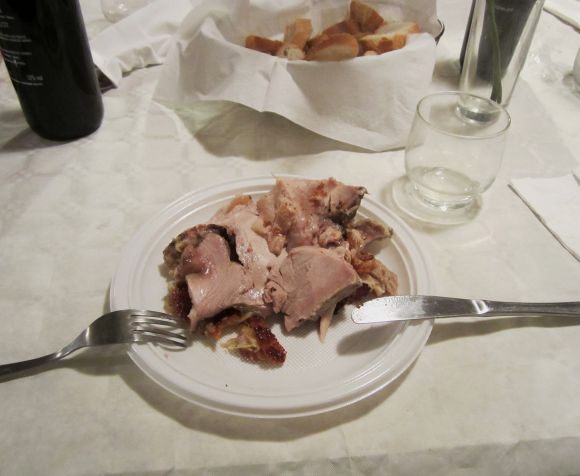
They planned a big dinner in their small clubhouse, invited Martino Vianello and Andrea Bertoldini, who had finished fourth this year, and uncrated two gigantic roasted whole pigs, ordered from somewhere in Umbria where the art of roasting pigs has reached the sublime.
If you’re a vegetarian and still reading (unlikely, I admit), you might want to stop now.
We spent several hours gorging on one, and the other was given to the pair, who didn’t anticipate any trouble at all in dividing and consuming it. Just like the old days, but better.
Because, as Andrea Bertoldini explained it to me, a live pig was really a problem. He’s been racing for at least 20 years, and has finished fourth in other editions of the Regata, so he has had first-hand experience of what being awarded a baby pig really means.
It’s not just taking care of it for months (you generally give it to somebody who’s already got the sties and the feed and the mud and all). It’s that you start to become attached to it, like Fern Arable; you feel sorry for it, and so everything gets derailed in the Natural Order of Things.
So Andrea was perfectly fine with dispensing with the tradition and moving on to something new, and easier to handle.
Better yet, he and Martino were each awarded a plaque which proclaimed them to be a “Principe del Porchetto” (Prince of Roast Pork). This was not only original, and cleverer than the old joke, but a play on the term “Re del Remo” (King of the Oar), which is given to the couple which wins the Regata Storica five years in a row.
Andrea and Martino have finished fourth in various years, but this the second year in a row they did it, and so the title of “prince” implied that if they were to come in fourth for the next three Regatas, they could be called King of Roast Pork.
Maybe you had to be there.
In any case, you’d have loved it. You never had to look into the creature’s soulful eyes, and you got as much as you wanted of the tender, herb-infused meat encased in dark greasy skin that was insanely crunchy. If you were to shut your mind about what you were eating, it wouldn’t have been because the animal inspired pity. It would be because you refused to think about what the food was going to do to your arteries.
If those two really do become Kings of Roast Pork, they’re going to have to spit-roast an entire herd of swine to supply the celebration. I’ve already got my plate and fork and cholesterol medicine ready.