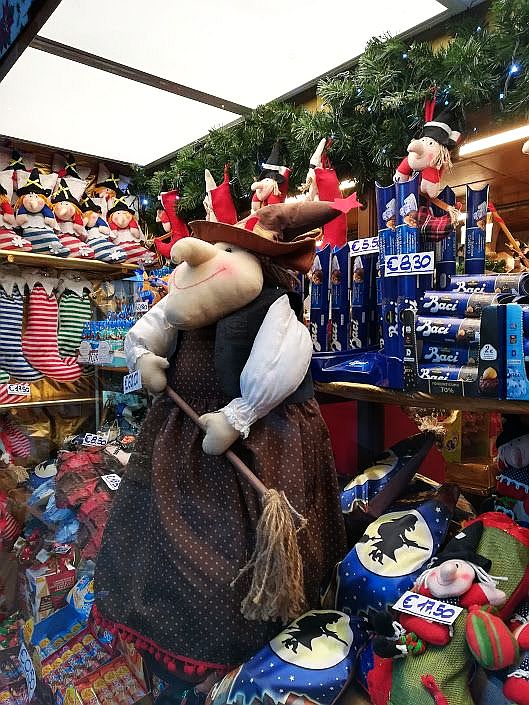
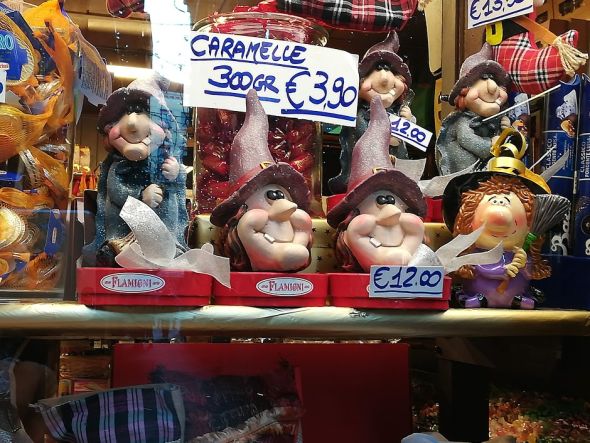
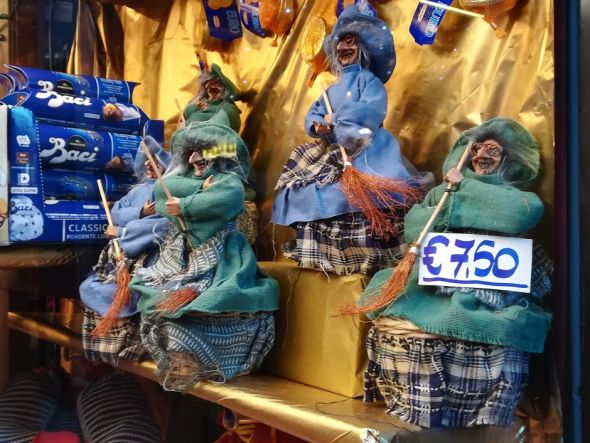
The once-terrifying snaggly old crones are becoming cuter by the year. It’s almost like a competition by now, and if it keeps up like this the Befana is going to end up looking like a golden retriever puppy.
January 6 is the Feast of the Epiphany, which puts an end to the Christmas holidays (which seem to have begun in late August) by the sugar-laden nocturnal passage of the Befana. At some point in history, someone — probably two years old — mangled the word “Epiphany” and it became Befana (beh-FAH-nah) and so she has remained.
I entertain myself in two ways during this interlude.
The first is by conducting a completely unofficial census of the Befane that I see in bars, cafe’s, even supermarkets. There are so many of them you’d think that January 7 was officially going to be Take-a-Hag-to-Work day.
Would you accept candy from these women? Of course you would.This Befana hasn’t fully evolved from her original terrifying stage. But she’s on the right track.This is what the Ur-Befana is supposed to look like. That’s what makes her generosity with candy so wonderful — she looks like somebody who’d rather leave you some barbed wire. If the Befana is softened to the point of resembling your favorite stuffed toy, the essential frisson is lost.And speaking of candy, the tradition is that if you’ve been a bad little person, she will leave coal in your stocking. Some blithe spirit, excited by having been able to make candy that looks like coal (carbone) has lost the plot because this year we now also have fake polenta and cheese. What child has ever been threatened with polenta or cheese for having been bad? If you must be creative, at least make the fake candy look like something unnerving — fried fruit bat, maybe, or jellied moose nose.
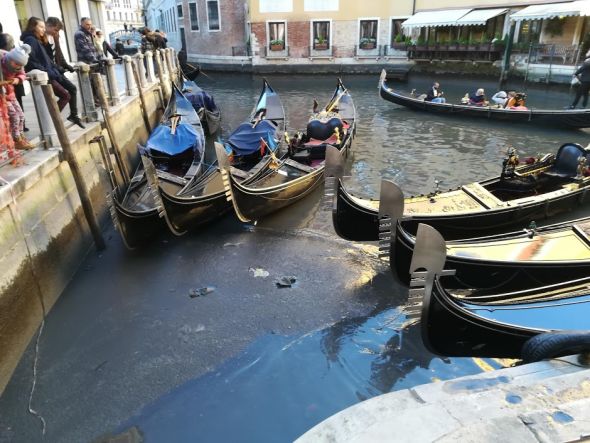
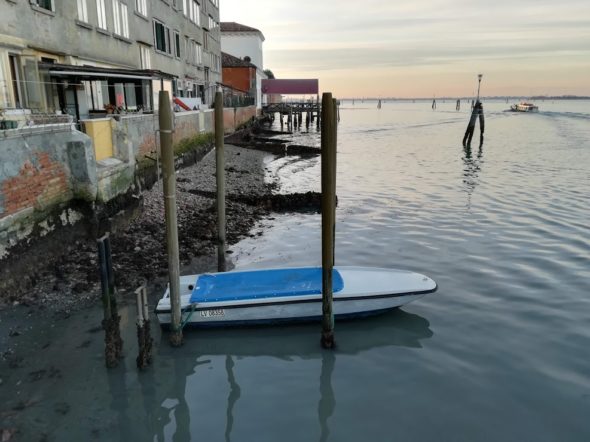
The second way in which I entertain myself in this period is by admiring the underpinnings of the lagoon, as revealed during the exceptional low tides which always occur about now. This is the completely predictable and normal phenomenon of late December-early January, and the exposed mudbanks are the seche de la marantega berola (the mudbanks of the little old Epiphany hag). The newspaper sometimes runs a big photo with an overwrought caption that leads the uninitiated to think that the world has come to an end. Venice without water in the canals? Man the lifeboats! Oh wait — there isn’t enough water to float them. While it’s easy to imagine the inconvenience caused by acqua alta, not many people (I suppose) pause to imagine the inconvenience inflicted by not enough water.
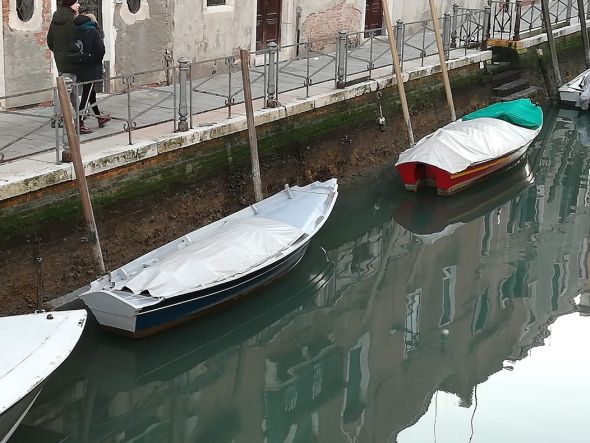
Or let’s say there’s enough water, technically speaking. But the distance between our moored boat and the edge of the fondamenta is so great that we either have to plan ahead and bring a ladder (made up, I’ve never seen this), or just schedule our activities in a different sequence. There have been plenty of times we’d have gone out rowing, but the prospect of having to disembark when the water is 21 inches below the normal mean level just spoils the whole idea.
As you see. Actually, plenty of people drive a big nail into the wall as a primitive but effective step up. We keep meaning to do it, but so far sloth has overcome good intentions.
But never fear. The tide will return to its normal levels, and the Befana will be back next year. I promise.
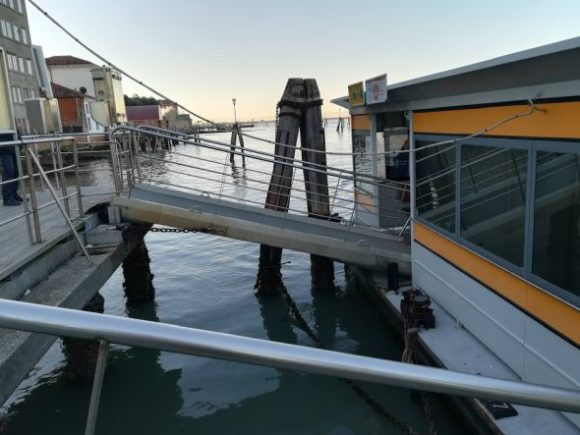
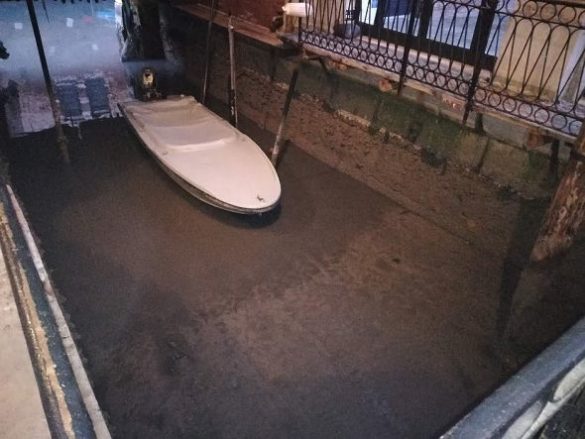
Even with your eyes closed you can easily tell that the tide was extremely low yesterday afternoon — all you have to do it walk up or down the gangway at the vaporetto dock. It may not look like it, but this was definitely a 45-degree angle, and if you were pushing someone in a wheelchair you’d definitely have to call for reinforcements.Up until two days ago I’d never seen mud in the Bacino Orseolo. Just pull your gondola up on the beach and have a barbecue.People sometimes ask me how deep the water is in the canals. I always inquire, “When the tide is in, or when it’s out?” You can see the range of options here on this exposed wall (the exposed bottom is also impressive, in its way. I’d certainly never seen it till two days ago). The lower, uniformly brown stretch of wall is almost always underwater. The upper layer is covered with green algae which flourishes with intermittent dunkings and dryings as the tide rises and falls.Yes, there is this moment at the turn of the year which makes one almost long for acqua alta. Do not quote me.
Contains information related to marketing campaigns of the user. These are shared with Google AdWords / Google Ads when the Google Ads and Google Analytics accounts are linked together.
90 days
__utma
ID used to identify users and sessions
2 years after last activity
__utmt
Used to monitor number of Google Analytics server requests
10 minutes
__utmb
Used to distinguish new sessions and visits. This cookie is set when the GA.js javascript library is loaded and there is no existing __utmb cookie. The cookie is updated every time data is sent to the Google Analytics server.
30 minutes after last activity
__utmc
Used only with old Urchin versions of Google Analytics and not with GA.js. Was used to distinguish between new sessions and visits at the end of a session.
End of session (browser)
__utmz
Contains information about the traffic source or campaign that directed user to the website. The cookie is set when the GA.js javascript is loaded and updated when data is sent to the Google Anaytics server
6 months after last activity
__utmv
Contains custom information set by the web developer via the _setCustomVar method in Google Analytics. This cookie is updated every time new data is sent to the Google Analytics server.
2 years after last activity
__utmx
Used to determine whether a user is included in an A / B or Multivariate test.
18 months
_ga
ID used to identify users
2 years
_gali
Used by Google Analytics to determine which links on a page are being clicked
30 seconds
_ga_
ID used to identify users
2 years
_gid
ID used to identify users for 24 hours after last activity
24 hours
_gat
Used to monitor number of Google Analytics server requests when using Google Tag Manager