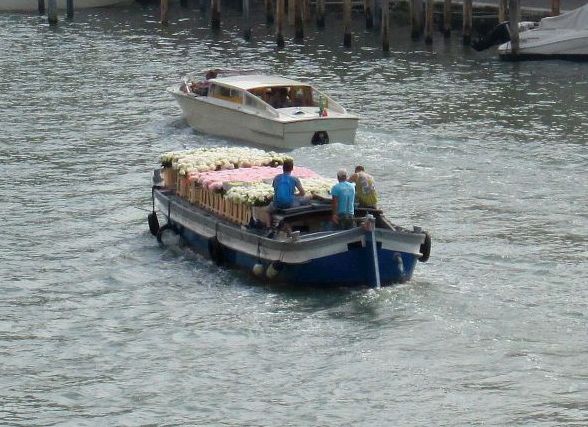
Most things have to get from A to B by boat here, at least for part of the trip. Here somebody’s garden is being taken down the Grand Canal. A garden, or one heck of a lot of windowboxes. Or centerpieces. Or corsages.
It’s not as if I have nothing to say — I’m sure I have, somewhere — but the summer heat has hit (upper 90’s, F) with humidity to match, and my brain is otherwise occupied in keeping my vital functions going.
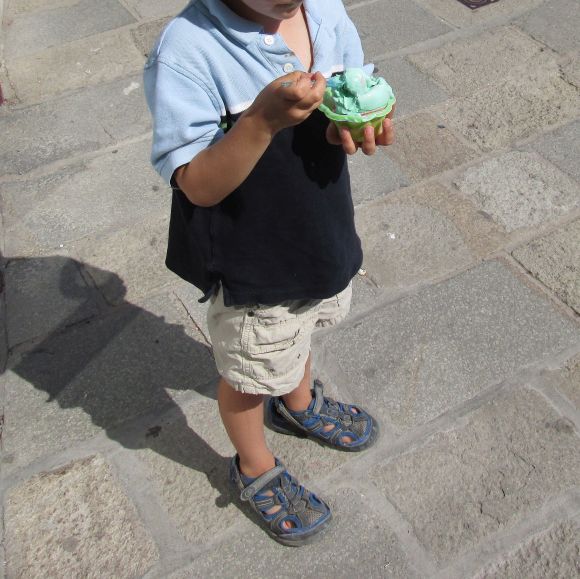
There remains one vital function I can manage on my own, and that is the devouring of ice cream. Happily, the newspaper publishes several articles each summer which not only state that ice cream is one of the best possible foods to consume in this heat, but that doctors confirm that it is NECESSARY to eat it, that it’s GOOD FOR YOU, that it’s PRACTICALLY A HEALTH FOOD. I don’t write these articles, but I could if asked to.
Just think, he could have been eating kohlrabi with kelp flakes, but he instinctively knew that ice cream was better for him. He’s obviously destined for a life of Ironman triathlons.
So here, having decided to avoid any brain-intensive topics, I am just going to give some of those glimpses of the sights (I spare you sounds) to be noticed when walking around the neighborhood. Just think, you’re also spared the temperature, which is just about the same inside as outside, except when inside is even hotter.
I’m going on vacation tomorrow, so will not be not making anything up for about six weeks. I intend to return totally bursting with wonders to relate, or at least bursting with the intention of doing so.
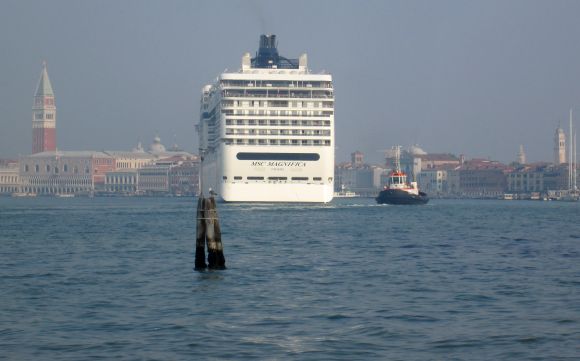
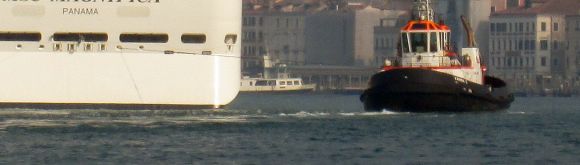
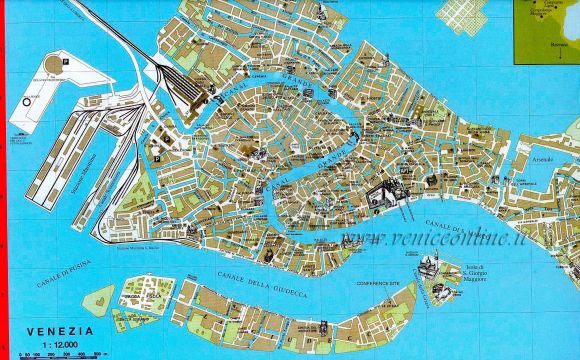
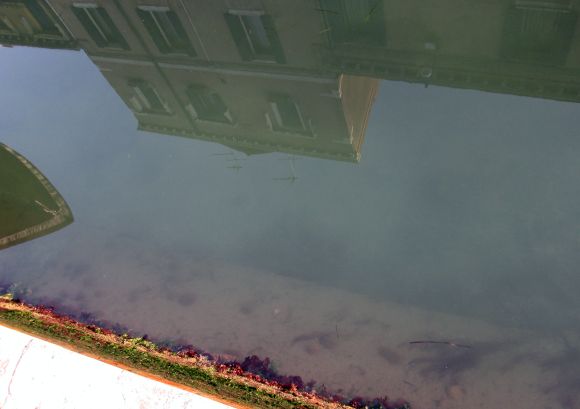
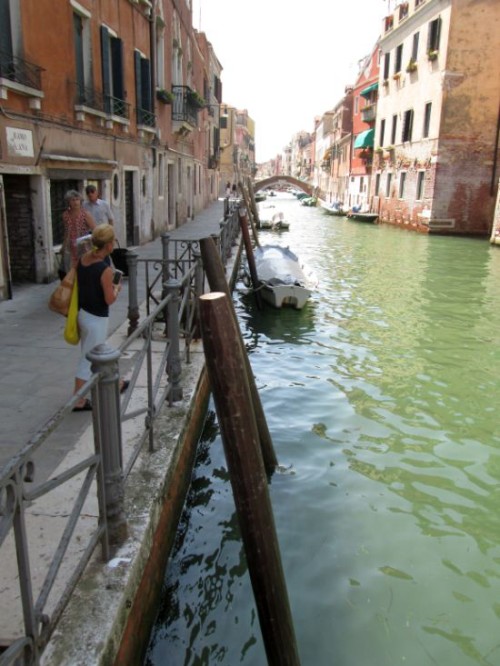
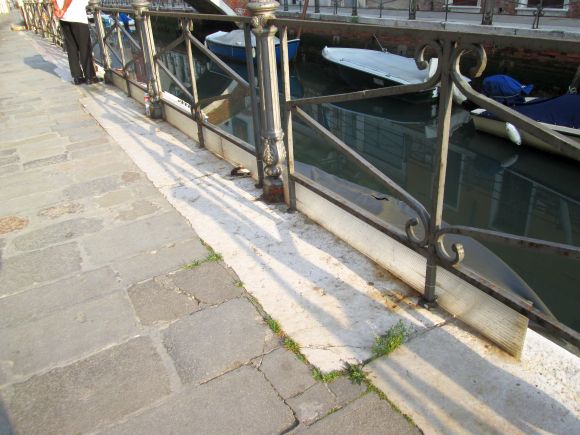
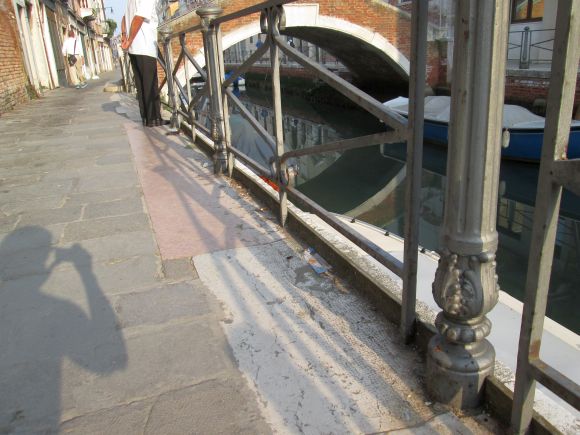
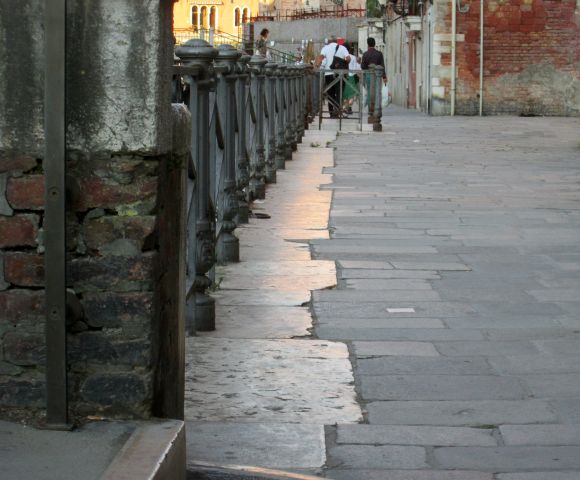
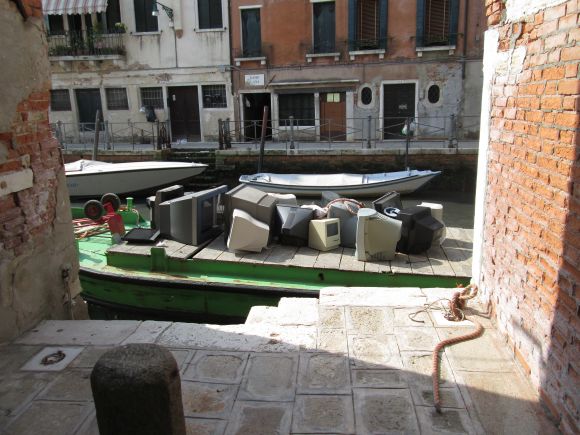
We all know that big cruise ships enter and leave Venice and that this bothers some people. But that’s not why I’m showing this picture. What interested me was the tugboat astern, which was directly behind the ship as it entered the lagoon. The ship is moving at the speed of a tired two-year-old, otherwise known as 6 knots maximum (6.9 mph/ 11 kmh, though this is a delicate calculation if the ship is going with the tide). In any case, at this point the ship needs to make a moderately sharp left turn to proceed up the Giudecca Canal, therefore the tug moves starboard and simply pulls the stern of the ship, turning it just enough to position the ship correctly for the home stretch.Perhaps you can see the taut line connecting the two vessels. I wonder if knowing that there is a tug at the bow and another astern might influence the general public’s notion of how far out of control such a ship might conceivably go?This maneuver is made in the wide space where www.veniceonline.it is printed. Just to give an idea of the geometry.In the rio di Sant’Anna, there are stretches of cement slabs underwater, slightly tilted down toward the center of the canal. This was a simple means of reinforcing the wall at whatever time the city realized that reinforcement was needed. No problem there, so far, except that the cement makes it impossible to drive a piling into the mud next to the wall, a piling to which you might wish to tie your boat. So therefore…..…the aforementioned pilings are driven in at a slant. Not a monumentally big deal, except that it means that the boats are floating more toward the center of the canal and less right along the wall. When the tide is low (which it is, twice a day) and sometimes very low (at certain periods in the year), the boats inch even further toward the center, which narrows the canal’s available space for traffic.And speaking of fondamentas — which we sort of were — you may have seen low rectangular panels of some material (here it’s plastic) attached to the metal fence by a canal. And you may have wondered what they were for. They’re to prevent anybody who may be sweeping the street nearby (the trashman? just maybe? or some really efficient domestic worker) from sweeping the dust and detritus into the canal or — oops — into your boat. It has happened often enough that individual boat owners have Taken Precautions.Here is another version, slightly further on. A couple of leftover laths work just as well. No more sweepage!Toward sunset I discovered yet another wonder about the very same few feet of fondamenta: the Istrian stone paving its edge. Not only is it beautiful (it’s Istrian stone, after all), but why was it laid in this extraordinary manner? Did the city run out of perfectly rectangular blocks? (Answer: Sure, I guess.) This has instantly become one of my favorite things in the neighborhood.The garbage collection organization will come and remove heavy, awkward objects if you phone and make an appointment. This usually means seeing things like refrigerators, old air conditioners, dead washing machines, outside the owner’s door with a sign attached saying when it’s forecast to be removed. Today I see that it’s collect-old-TVs-and-computers day just outside our door. That…that IS a computer, that little boxie-thingie in the middle?
Contains information related to marketing campaigns of the user. These are shared with Google AdWords / Google Ads when the Google Ads and Google Analytics accounts are linked together.
90 days
__utma
ID used to identify users and sessions
2 years after last activity
__utmt
Used to monitor number of Google Analytics server requests
10 minutes
__utmb
Used to distinguish new sessions and visits. This cookie is set when the GA.js javascript library is loaded and there is no existing __utmb cookie. The cookie is updated every time data is sent to the Google Analytics server.
30 minutes after last activity
__utmc
Used only with old Urchin versions of Google Analytics and not with GA.js. Was used to distinguish between new sessions and visits at the end of a session.
End of session (browser)
__utmz
Contains information about the traffic source or campaign that directed user to the website. The cookie is set when the GA.js javascript is loaded and updated when data is sent to the Google Anaytics server
6 months after last activity
__utmv
Contains custom information set by the web developer via the _setCustomVar method in Google Analytics. This cookie is updated every time new data is sent to the Google Analytics server.
2 years after last activity
__utmx
Used to determine whether a user is included in an A / B or Multivariate test.
18 months
_ga
ID used to identify users
2 years
_gali
Used by Google Analytics to determine which links on a page are being clicked
30 seconds
_ga_
ID used to identify users
2 years
_gid
ID used to identify users for 24 hours after last activity
24 hours
_gat
Used to monitor number of Google Analytics server requests when using Google Tag Manager