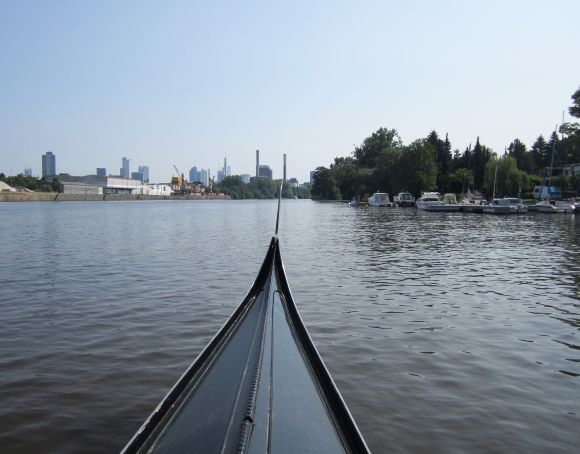
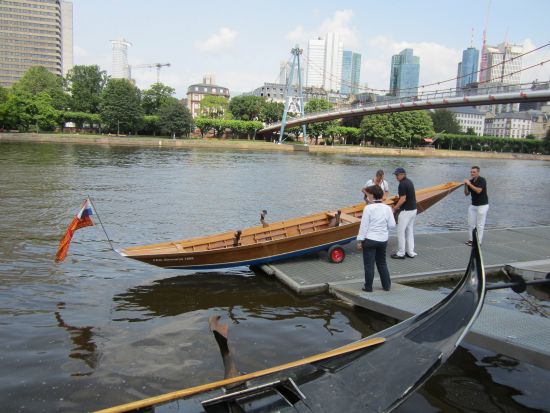
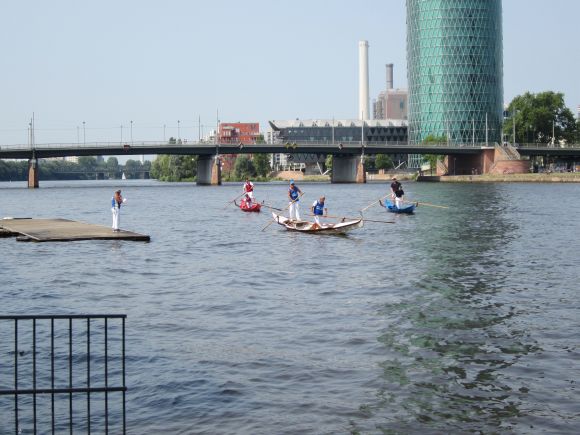
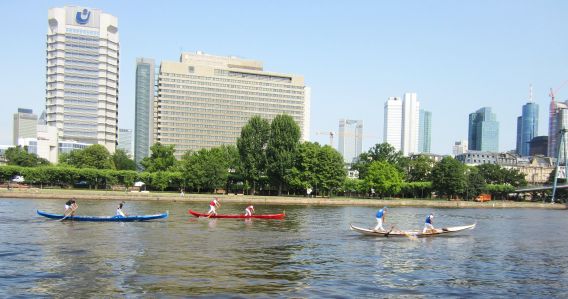
We joined Richard Winckler to row his gondola from the boat-launching area up the Main River toward Frankfurt. It’s not a bad combination: one of the oldest forms of boat in the world in a certified “alpha world city” which lives and breathes the future. Not only is Frankfurt a mere 40 kilometers (24 miles) west of the geographical center of Europe, it is the largest financial center in continental Europe, and the home of DE-CIX, the largest internet traffic exchange point on the planet. It’s also the tenth most expensive city in the world, though maybe that’s not something to be so proud of.
That title doesn’t actually mean “report on the hot dog,” though it would be easy to misconstrue.
Anyway, I made it up; I don’t know German. I studied it for a year, but it rejected me, as if I were a foreign body somebody had tried to transplant into the corpus of what is, in fact, a hugely expressive language.
However, you might be interested to know that “Frankfurt” means “the ford of the Franks,” therefore the various people who named their town Frankford, who I used to think were embarrassingly ignorant, totally nailed it.
There was a mixture of rowers who came for the three-day “Days of Venetian Rowing” on the Main River, organized by the Comitato Internazionale di Voga Veneta (CIVV). Some from France, some from Venice, some from Treviso and Padova, and some individuals from here and there around Germany, a few of whom brought their own boats. The rowing club at which the CIVV is based, the Germania Frankfurter Ruder Gesellschaft, provided a very glamorous and historic base of operations.
We went, we rowed, we ate, we basked in what we were assured was spectacularly unusually beautiful weather, and we saw some interesting things. Lino drank beer, I drank enough apfelsaft (apple juice) to drain all of upstate New York. It was the simplest non-alcoholic option: cheap, ubiquitous, easy to pronounce.
Here are a few snaps of what went on, and who went on with it. I’d have made many more, but that would have cut into my eating, drinking, and seeing-interesting-things time. Choices have to be made, and they were.
Soon I will return to your regularly scheduled Venice.
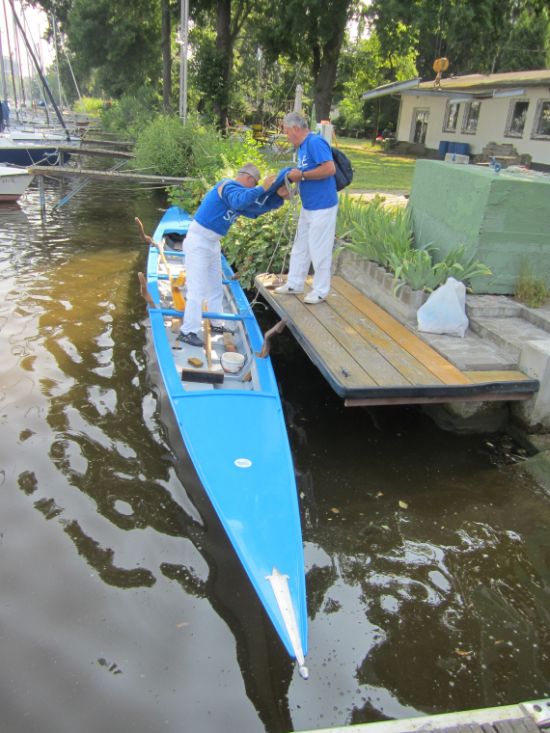
The Canottieri Sile from Treviso brought a gondolino and this unusual craft, a four-oar s’ciopon.Launching and pulling the boats out of the water was simplified by the roller on the dock. Unfortunately, then we had to pull the boat across the park, up a ramp, and across a two-way street.
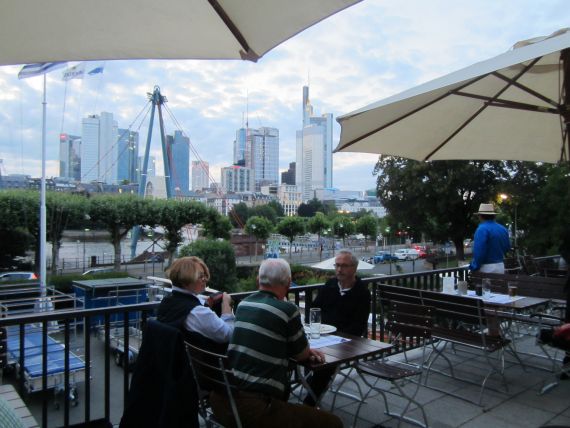
This view from the terrace of the Germania Frankfurter Ruder Gesellschaft club, our home base, ought to give some glimpse of the distance we had to cover taking the boats to the river every day. It’s not that it was so far, it was just more complicated than one normally expects. Even if one normally expects things to be complicated.
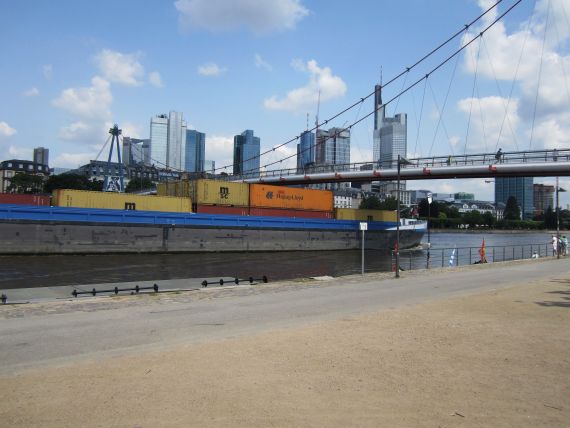
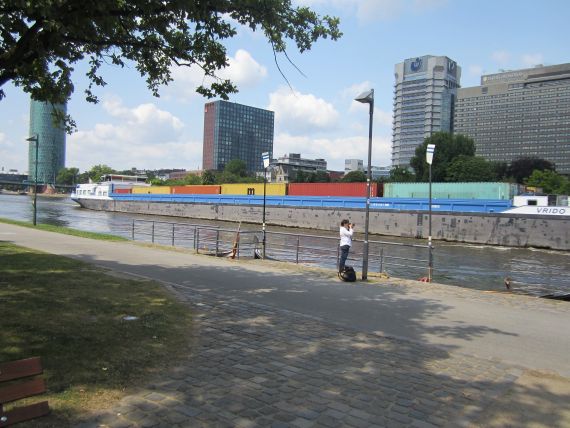
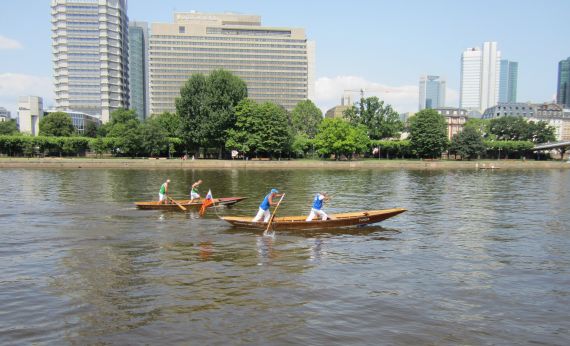
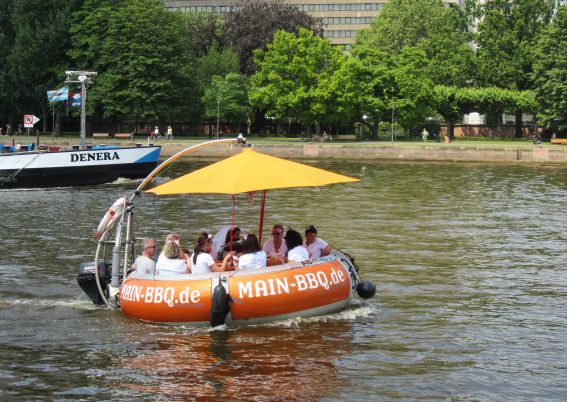
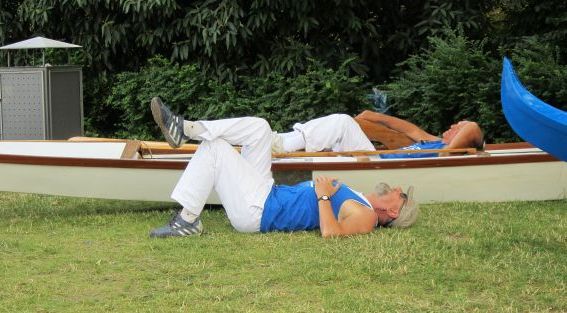
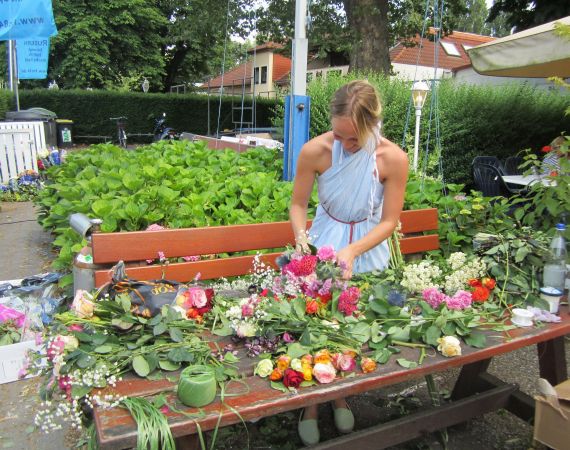
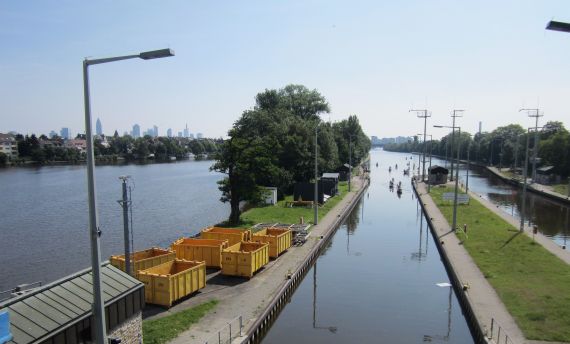
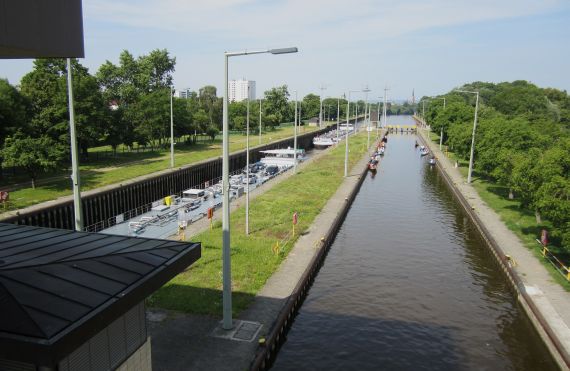
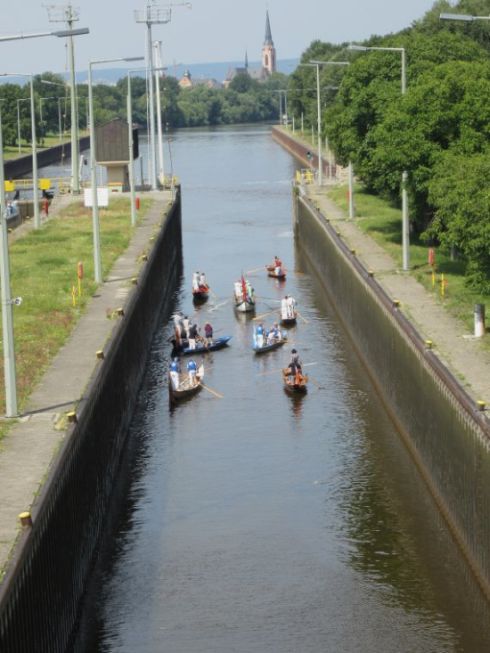
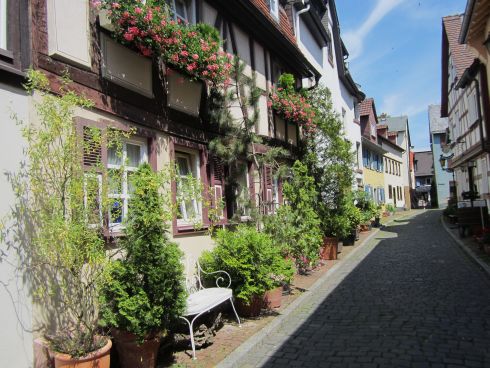
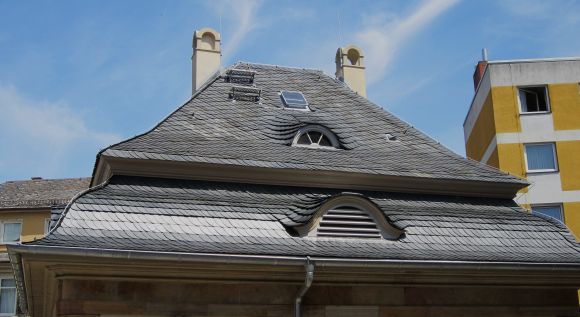
We were also earnestly urged to keep our ears open for the sinuous sound of one of these barges which might very well be coming up behind us; their braking capacity is measured in miles. This picture shows the first half of the vehicle.This is the second half. This would be the nautical version of the 500-pound gorilla: Wherever it wants to sit…We had a surprising three gondolinos, perfect for a race. Getting the boats lined up takes time, though.Two minutes after the start, we could see how the boats were going to finish. Rowing upstream means that the boat closer to the shore will almost certainly do better than the others. Victory to the white gondolino of the Canottieri Sile; the red was second, and the blue was third.Having only two mascaretas meant holding a series of quarter-finals, semi-finals and the final. Here the rule about being closer to the shore also applies, added to the fact that the boats were not equal. The longer boat would have gone faster in any case. Luck of the draw was taken to new heights out here.This jaunty little coracle took the serious edge off the proceedings. It’s a floating barbecue, the food being cooked in the middle.Comment would be superfluous. Or however you say it in German.We rowed up the river to another rowing club where we sat and rehydrated. This young woman told me the flowers weren’t for any particular event; just prettying up the place. I’d certainly say so.The locks at Griesheim handle 60 honking big barges every day. They made room for our jaunty little fleet, rowing down to Hochst for lunch on Sunday morning.Just to show the comparative length, beam, and tonnage of our respective vessels. I was told that the lock-keeper (automated, somewhere else) was going to empty our lock verrry slooooowly, so that the force of the outrushing water wouldn’t hurl the boats to kingdom come. I freely translate from the German, which I don’t speak but which looking at the lock I could completely understand.And as you see, it worked.Hochst is like a three-dimensional postcard.Jurgen Hoh, a geography teacher from Bamberg and a good rower, as well, explained that one amazing thing about the slate roofs (and even walls) of many houses is that this stone isn’t local; historically, that has all sorts of importance. Me, I just kept thinking about how much the whole thing weighs.
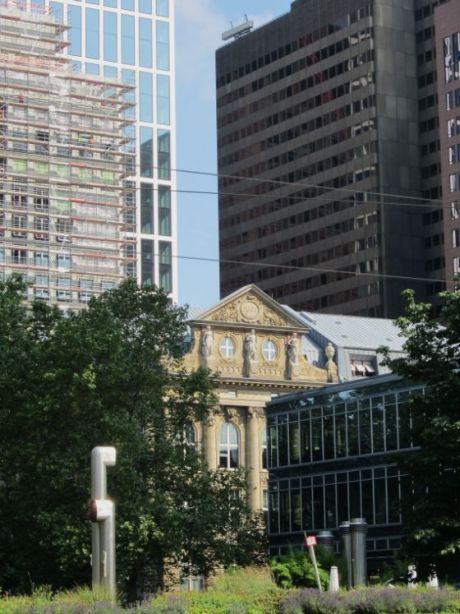
The financial center retains a few 19th-century buildings which survived bombing in World War II.
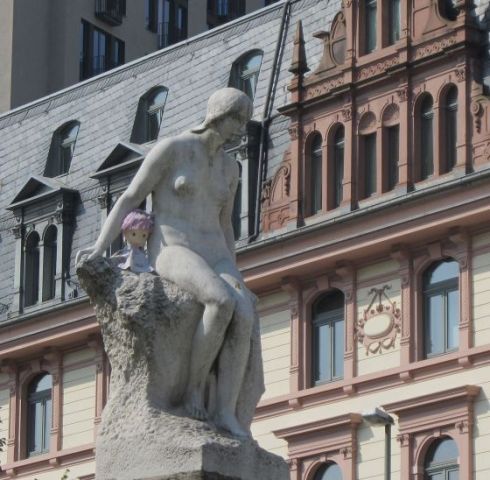
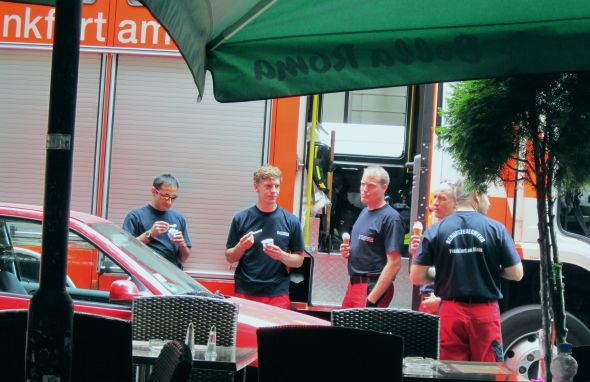
And who says Germans have no sense of humor? Unless some heartless non-Teutonic person went and stole that doll from its innocent little owner.So farewell, Frankfurt. Your airport’s spectacular and your history is first-class, but my happiest memory may well be the firemen on their mid-day ice-cream break.
Contains information related to marketing campaigns of the user. These are shared with Google AdWords / Google Ads when the Google Ads and Google Analytics accounts are linked together.
90 days
__utma
ID used to identify users and sessions
2 years after last activity
__utmt
Used to monitor number of Google Analytics server requests
10 minutes
__utmb
Used to distinguish new sessions and visits. This cookie is set when the GA.js javascript library is loaded and there is no existing __utmb cookie. The cookie is updated every time data is sent to the Google Analytics server.
30 minutes after last activity
__utmc
Used only with old Urchin versions of Google Analytics and not with GA.js. Was used to distinguish between new sessions and visits at the end of a session.
End of session (browser)
__utmz
Contains information about the traffic source or campaign that directed user to the website. The cookie is set when the GA.js javascript is loaded and updated when data is sent to the Google Anaytics server
6 months after last activity
__utmv
Contains custom information set by the web developer via the _setCustomVar method in Google Analytics. This cookie is updated every time new data is sent to the Google Analytics server.
2 years after last activity
__utmx
Used to determine whether a user is included in an A / B or Multivariate test.
18 months
_ga
ID used to identify users
2 years
_gali
Used by Google Analytics to determine which links on a page are being clicked
30 seconds
_ga_
ID used to identify users
2 years
_gid
ID used to identify users for 24 hours after last activity
24 hours
_gat
Used to monitor number of Google Analytics server requests when using Google Tag Manager