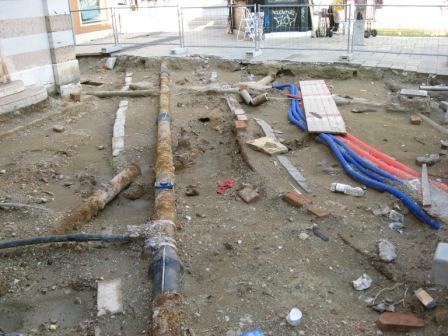
It’s obvious, once you know it — or even stop to think about it — that the pipes and cables carrying water, gas, electricity and so on are under the paving stones of the streets.
Work underway in Campo San Vio. The site looks remarkably like an archaeological dig -- the water pipe alone appears to be a relic of an early Iron age cult.
(When they have to cross a canal, they cling to the underbelly of the nearest bridge in a marsupial kind of way.)
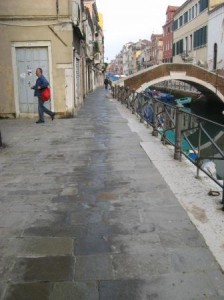
What happens with the water pipes is that they leave traces — not of the water itself, but of the condensation they cause because of the difference in temperature between the water in the pipe and its surroundings.
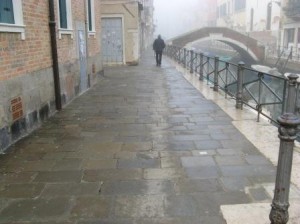
Example: It’s deeply hot now in Venice, the days are dazzling with heat and sun, though the air, thank God, isn’t very humid. At night, things cool down somewhat, and in the early morning, this appears on the fondamenta near our house:
In the winter, the opposite phenomenon occurs, as you see:
Nothing revolutionary here, I just find it diverting.
The last few days the atmosphere here has been roiled by the development of the latest chapter in the saga known as: A Woman Gondolier.
Summary: A woman has just passed the first test, for the first time in 900 years of 100% male gondoliering, to be admitted to gondolier school and get the chance to take more tests and then hopefully to become a certified gondolier.
Then she kind of stepped on a rake in the dark. So now the story isn’t that she passed the test, it’s whether she’s going to be able to find a way to get back on the boat (so to speak) after having fallen so spectacularly into a channel of her own making. Or whether her miscalculations will have provided her opponents with a reason to keep the guild in male hands, if only till the next girl gives it a shot. Or how much penance she’s going to have to do in order to make it all right again.
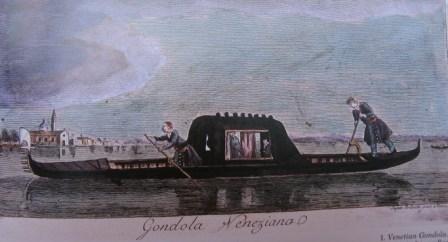
In the 18th century the gondolas, and at least some of the gondoliers, were different.
(Full disclosure: I am not opposed to women being gondoliers. I am opposed to women doing stupid things, especially in public. Men too.)
Her name is Giorgia Boscolo, and no, she’s not the first woman to try. At least one other Venetian girl took and failed the last test a few years ago, though only by a very few points. At least a few people saw this as a positive step, in the sense that if a woman gondolier were to be inevitable, at least her being Venetian would mute the pain.
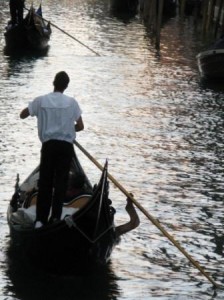
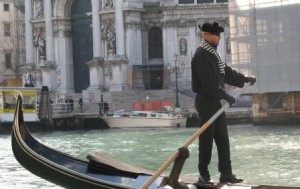
The gondolier's life looks so romantic as he rows at sunset toward the Bridge of Sighs.
Meanwhile, over the past decade or so, a German woman named Alexandra Hai tried and failed four times. I think that’s a record, not only for Attempts but for Lack of Self-Knowledge and Willful Ignorance of the Terrain. Hers is a tale for a completely different post, so I’ll merely remark that her lack of success wasn’t due to being a woman — how very simple that would be, and how very easy to refute, deny, or ignore — but more the result of her fantastically obnoxious self-promotion and the insufferably Prussian way she went about trying to crush all obstacles in her path. I think it’s fair to say while she was the first to turn the dreaded subject of a female gondolier from a diverting theory into a credible possibility, she also created more antipathy to the idea than was ever needed; not only did she fail to crush the existing obstacles, she left a few new ones in her wake over which the next candidate(s) had to struggle. Thanks for the solidarity, babe.
Much of the day, however, is spent either waiting for work or dealing with the hassles of what comes along. Hot, tiring, monotonous -- what's not to like?
Back to Giorgia. She is nowhere near being the first woman gondolier — yet. What she did was to pass the first rowing test, which involves rowing in the bow position of a gondola with another gondolier rowing astern. Yes, you can screw up even something so incredibly simple, at least in theory, but
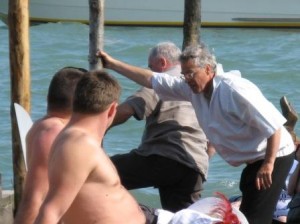
Getting your clients ashore safely -- not really part of the glamor.
she squeaked through, placing last in the list of 22 available spaces for aspiring gondoliers. Squeaking is fine, but she also tied with someone, a man, as it happens. But fortunately for people who might tend toward the sexist (pick her because she’s a woman, don’t pick her because she’s a woman) they can fall back on ageism, as the regulations specify that in case of a tie, the younger candidate passes. She’s 23 and the other guy, well, isn’t.
Her plusses:
She’s Venetian.
She’s young.
She’s married and the mother of two small boys (well if she’s 23, they’d better be small!).
She’s attractive, in a blonde, slightly zaftig way, the kind of girl you could picture coming from a farm in Wisconsin.
Her father is a gondolier.
Each item on this list comes with the sound of a key turning the deadlock toward the “open” position.
Her minuses:
She’s not actually 24-karat Venetian; “Boscolo” is a very common last name in Chioggia, a town at the southern end of the Venetian lagoon which many Venetians regard with scorn and derision. There are historical reasons for this viewpoint which go back at least 600 years.
She’s young. Lack of life experience has shown itself to be more important than one might have thought.
Her father is a gondolier. This is only a fraction of a minus; some unkind observers might have thought this gave her an unfair advantage. In my view, it gave her a fair advantage in the sense that she was able to have unlimited access to a gondola and to expert rowing advice.
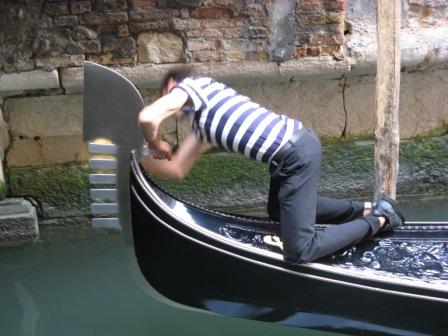
If you want to get ahead, you sometimes have to do the scutwork for real gondoliers, such as cleaning and setting up the boat for the day.
So what went wrong? The day after the grades were in, a tsunami of publicity swept over her. Blogs and the press went crackerdogs. The First! A Woman! Blonde! Venetian! And so on.
Did I mention the press? It turns out that she forgot/didn’t know to ask the Ente Gondola, the gondoliers’ association, for permission to give all those interviews and pose for photographs. But there it is, clearly spelled out in the by-laws, a rule that states that any talking to the press by anybody about anything needs to get the prior approval of the officers.
Not only did she make that error, going full-steam ahead on her own authority, she also made a few extra missteps which were reported (perhaps not completely accurately, but the damage was done) such as having referred interview requests to her agent, and requiring payment to pose for pictures.
Agent? PAYMENT??
For virtually all its history, Venice (by which I mean Venetians, naturally) has had a fathomless aversion to self-promotion, conceit, and generally not getting over yourself. It doesn’t mean that nobody ever says another person is great — they do, actually — it just means that a person can’t say it about himself without encountering some kind of consequences.
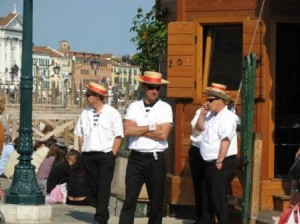
There are still some gondoliers who dress perfectly, down to the traditional beret with pompom. Until the Sixties, gondoliers always wore a black wool beret in the winter, and a white cotton version in summer. The now-ubiquitous straw hat -- once normally seen on farmers gathering snails - is now worn year-round, from blazing summer heat to winter fog, rain and snow.
So now the consequences for her are that she may have risked her still-new position. If the Ente Gondola finds her importantly in the wrong, I’m not sure what the by-laws stipulate. If I were her, I’d be worrying, despite her copious meaculpas and explanations in the paper today. (Actually, she didn’t admit she’d made a mistake. She said, “If I made a mistake, I apologize.” If this job doesn’t work out, she could always run for public office.)
But let’s say that she succeeds in rowing herself across this flaming lake of fire and gets safely to the other side. (Her list of plusses, as above, ought to be of help.) She still has a lot of work to do before she can say she’s passed to the next rung of gondolierdom. The system works like this:
The aspiring gondolier who has passed the first rowing test must attend a series of courses of at least one foreign language, and Venetian history and art. Then comes another test, given by the Veneto region. He/she eventually also has to pass another rowing test, this time much more important and difficult: Rowing alone astern, as a regular gondolier must do. And this test doesn’t take you up the middle of the Grand Canal, but through the small side canals around all sorts of diabolical corners. If the wind is gusting and you’re going with the tide, it gets even better.
At that point, the successful aspirant must serve a sort of apprenticeship with a licensed gondolier for at least six months. Then he/she qualifies as a substitute, and will continue as a substitute for whichever gondolier needs someone to stand in for him for whatever reason until a license becomes available. Which isn’t often.
So before we get all emotional about the first woman gondolier, we should keep in mind that she has a very long road ahead of her, traveling which she will almost certainly find herself burdened with a fardel of mistrust and bad feeling which could make the going hard. Memories are long here and everybody pretty much watches everybody else with the eyesight of the great horned owl. And gondoliers especially tend to settle accounts their own way, even if it takes years.
Updates as they come in.
P.S.: You will have understood that I have not shown any photographs of our heroine because of her restrictions, as well as copyright on the pictures already taken. You’ll just have to imagine her for a while.
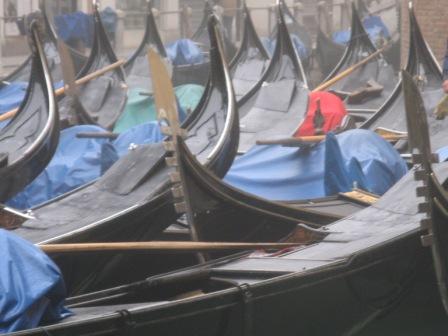
If only people were as elegant, strong, responsive, versatile and trustworthy as this boat.
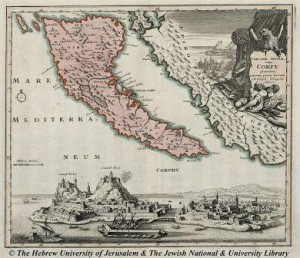
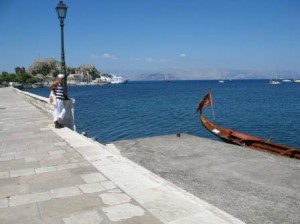
Our week in Corfu (known to the Greeks as Kerkyra) with the club’s gondolone (8-oar gondola) was interesting, entertaining, diverting — I pause before applying the word “fun,” though it was certainly much more fun than a slap across the belly with a wet fish.
Venice ruled Corfu -- the door, hinge, and key to the Adriatic -- from 1501 to 1797, and held it against three Ottoman sieges. Corfu was the only part of Greece which never fell under Turkish domination.
I’m using generic terms, though, because it was sort of a generic experience. We’ve been to Greece with the boat for other events, so I have some means of comparison.
The basic outline was to load the boat onto a truck (the truck travels on the ferry with us); we departed at 2:00 PM and arrived in Corfu at 1:30 PM the next day.
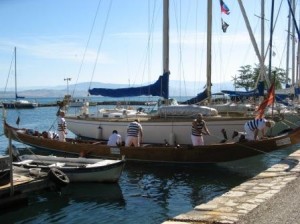
Then we unloaded the boat and rowed it to its base camp in a small marina under the flank of the Old Fortress.
Getting ready to go to work.
The marina had a good bar, too, with excellent lemonade. These things matter.
The occasion for all this was a long weekend labeled “Italian Days,” a collection of cross-cultural events more or less arranged around the finish of the Brindisi-Corfu yacht race. It was as good a reason as any to choose the second weekend of June.
Apart from the yachts, the program concentrated on the many links binding Venice and Corfu over the centuries — a bond which was
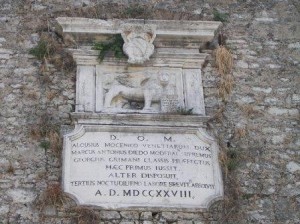
A plaque on an external wall of the New Fortress records in Latin that the work of fortification was completed in 1728 by Marco Antonio Diedo and Giorgio Grimani, under Doge Alvise III Mocenigo. The winged lion of San Marco makes it official.
maintained for the almost 500 years in which Venice essentially owned the island. A few links that weren’t acknowledged much were the commercial, political, and military ones, which only left Links Lite such as literature and art. (By “commercial link” I mean things like the fact that most of the 3 million olive trees on the island were planted by the Venetians, whose interest obviously was not landscape gardening but the olives and their oil.) There were also lectures and concerts and exhibitions and so on.
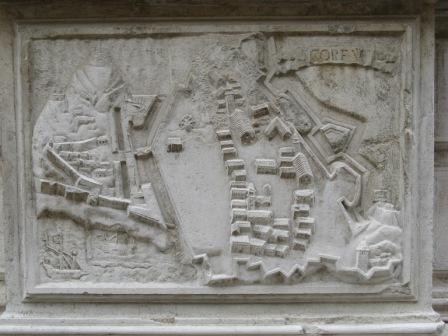
A relief carving of the town and Old Fortress (at the time, the Only Fortress) of Corfu, affixed to the facade of the church of Santa Maria del Giglio in Venice. It is one of six depictions of places at which Adm. Antonio Barbaro served the Republic. In the lower left corner is the faint outline of an L-shaped breakwater which created a small harbor (helpfully demonstrated by the outline of the galley). Now used by a local boating club, this harbor is where we stowed the boat at night.
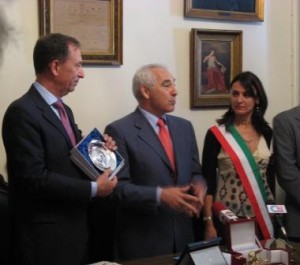
There was also an official press conference in the mayor’s office, with the usual speeches and exchanges of shiny official dust-gatherers.
(L to r) H.E. Giampaolo Scarante, Italian Ambassador to Greece, the mayor of Corfu, and the President of the City Council of Venice.
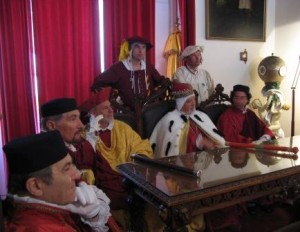
(L to r, foreground) Two procurators of the Venetian Republic, whose red tunic indicates they are of the Lower Chamber; a Capitan da mar, the general admiral in time of war, distinguished by his inverted-cone hat; the doge, also distinguished by his headwear, called the "corno"; another procurator. (L to r, second row) Two fanti da mar, members of an infantry regiment assigned to ships of the Venetian navy. All costumes are accurate for the first half of the 1500s.
The scene was completed by a contingent of “figuranti,” or historic-costume/re-enactors from the “Serenisimo Tribunal de l’Inquisithion,” the Venice chapter of an organization known as CERS, the Consortium of European Re-enactment Societies. Among the various characters represented with great accuracy is, naturally, a doge. The doge in this group is a great guy, he’s a retired fire chief. Bedecked in all his regalia, he has a way of appearing both imposing and ingratiating, not an easy trick and something I doubt any real doge ever tried.
Our boat was probably the most Venetian element of all, especially considering how much pounding she’s taken and how little maintenance she’s ever been given. Being pounded and neglected being two of the primary aspects of Venice today, I mean.
Our job was to be at the prescribed place at the prescribed hours to offer free boat rides to anybody who wanted to be rowed in a gondola (even a big one) for a few minutes.
Here’s my quick scorecard:
The plus side:
The trip on the overnight Minoan Lines ferry from Venice to Corfu. Leaving Venice on a ship — in fact, going anywhere on a ship — is the best. It was fun the first time because it was strange and new; it was fun the seventh time because it was familiar.
Hanging out with my friends, a very eccentric bunch with curious bits of personality flapping around like untied shoelaces. In the un-eccentric contingent I place His Excellency Giampaolo Scarante, the Italian Ambassador to Greece, and his effervescent wife, Barbara, who are two total mensches and our guardian angels. It’s due to them that we are invited to join these frolics.
Being in Greece. It’s never bad. It’s impossible for it to be bad. Greece, however touristic it may have become, never disappoints me. On the contrary.
The sun. I love the sun and this is one sun that means what it says. You walk out the front door and you feel like you’ve just been thrown face-down on a skillet. I like this for short periods; then what I really like is sitting in the shade sipping a frappe, or iced coffee. The cafe offered us little ice-cream bonbons, too, which was a novelty — perfect in the heat, but only if you ate them within 18 seconds of their arrival. Which was not a problem for me.
The food. I love Greek food, though some of my Venetian cohorts reserved judgment (mostly) because many of them are unapologetic food fascists who think the only fodder worth ingesting is Italian.
The rowing, what little of it we ever eventually got to do. The wind in the afternoon made the return to base camp extremely diverting, not to mention the waves from the many passing ferries and hovercraft.
Seeing the Venetian fortresses, the Old and the New. Both are stupendous constructions, which resist admiring adjectives as effectively as every missile the Turks hurled at them in three failed sieges.
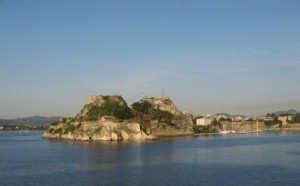
The Old Fortress, on the site of a Byzantine fort, was built, enlarged, and re-fortified between the 13th and 16th centuries. It now provides office and other space for various departments of the city government, as well as for the University of the Ionian.
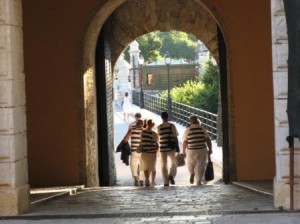
We had to pass through the Old Fortress four times a day and it just got more amazing each time, not to mention rounding the very point of the peninsula where the fort looms in order to get to our rendezvous point. If nothing else, looking at the fort from whatever distance or perspective made you realize in a visceral way how important Corfu was to the Venetian Republic, and how seriously the Venetians intended that the island should not fall into Ottoman hands, which would have been the End of Everything. And they succeeded. I know they were bandits but they really got the job done.
The crew, having clocked out, leaves the Old Fortress.
The minus side:
Lack of customers. Unfortunately, the heat, lack of publicity, and disastrous location of our boat worked against the hoped-for mass of passengers. The few that wandered past were more or less like stragglers from the Retreat from Caporetto.
Our hours, which were 10-1 and 5-8. Looks good on paper, but not so good when you’re tied up next to an esplanade that qualifies as the concrete equivalent of the Nefud Desert, the one Lawrence of Arabia had to cross at night, otherwise they’d all have died. 8-10 AM would have been perfect, as far as the climate is concerned, because the early morning is heavenly, but no Greek (or tourist) in his right, or even totally deranged, mind, would ever be up at that hour. So our window of opportunity was really from 10-10:15. Of course we were good soldiers and waited, till even we couldn’t take it anymore. Ditto the afternoon. After about 6:30 a person can begin to imagine going out on the water, but by then we had lost whatever desire to perform that we might have had, and any potential passengers were thinking of showers, drinks and dinner.
In the organizers’ defense, however, I can’t think of any other embarkation point that would have been even slightly feasible. So there you are.
Lino thinking Corfiote thoughts, in the center of the Sun's Anvil. The Old Fortress makes a nice touch.
Dinner. Not the food, which was fine, organized in restaurants which had set out long tables for our contingent, the figuranti, the assorted politicos and their assorted consorts who had tagged along, etc. etc. The problem was the hour, which was usually toward 10 PM, which meant finishing toward 1:00 AM. This is a stretch of time which God intended for sleeping, not eating. Or if eating, not to be followed immediately by sleeping, which some of us were on the verge of even as our jaws continued to grind. Hard on the old internals.
But now we’re back, and I’m sorry it didn’t last longer. Of course I would do it all again tomorrow.
This is just one of my random musings; they usually come when I’m doing hard labor, of which there is plenty every day.
It’s the old idea of imagining what certain historical personages would do or say if they found themselves thrown together at, say, some cocktail party in a trendy loft in the meatpacking district. The kind of gathering where you realize you know absolutely no one but the host, who has long since disappeared in the scrum.
So I was washing the dishes when suddenly Copernicus came into my mind. He seemed lonely. I cast around for somebody who could keep him company till at least the next tray of canapes came past, and I thought, Baby June. Already this party is looking up.
So I needed more. George Burns is staring out the window — odd, I know, even I have trouble picturing him standing still — so I sent him Marie Curie. There. He’ll make her smile, which I think she probably hasn’t done since she fainted from hunger in her freezing little garret as a student in Paris. And she’ll give him a leg up on something really important about the subatomic world, which you have to admit is a subject that has always been lacking in his shows.
So we throw out a batch of models and a few publicists and screenwriters and street artists to make space for some more happy couples. I think Nikola Tesla and Edith Wharton would be smokin’. I know he would be pretty far out along the edge of the envelope for her, the edge of the flap that cuts your tongue, but I believe that she could talk with anybody. That’s what real sophistication and real manners means and real intelligence means. I have no doubt that by the end of the evening he’d be thinking how smart she was and a little less about his own scintillating brain.
Then I got to imagining Enrico Dandolo and Mary Anderson (you know, the woman who invented the windshield wiper). He was one of the most pragmatic people ever born, and I think he’d have liked her. Or at least understood her. I’m serious. Because I don’t think many people understood him, either.
Joan of Arc and George Clooney.
Ernest Hemingway and Marian Anderson.
Captain James Cook and Wilma Rudolph.
Margaret Sanger and Hereward the Wake.
Vitale Bramani and St. Hilda of Whitby.
None of these really working for you? Okay, how about this:
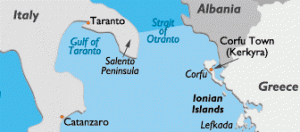 Our week in Corfu (known to the Greeks as Kerkyra) with the club’s gondolone (8-oar gondola) was interesting, entertaining, diverting — I pause before applying the word “fun,” though it was certainly much more fun than a slap across the belly with a wet fish.