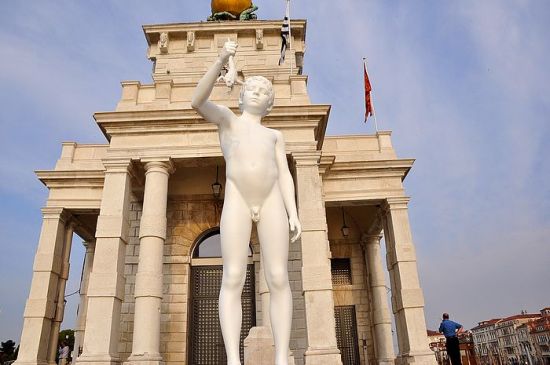
Prepare to be stunned. The big news in today’s Gazzettino comes as a thunderstrike from the blue, at least to me who doubted that I or my non-existent great-grandchildren would ever see the departure of the “Boy with a Frog” from the Punta della Dogana.
He’s leaving.
The “Boy with a Frog” photographed by Pierre (www.venicedailyphoto.com) on August 21, 2009. At the time, he was still the new kid in town and hadn’t yet begun to wear out his welcome.
One might recall that we signed a petition on November 21, 2011 to remove the statue and replace it with the long-beloved and historically valid lamppost. There was also a Facebook group organized with the same purpose, and while the time has been long and toilsome, perhaps they both had some effect on this happy outcome.
Tourists flocked to take photos of his appendages, but many Venetians looked at him and saw only what wasn’t there anymore, and what they wanted to have back. Including Lino, and also me.
There were so many protests of various sorts, including occasional calls to arms to destroy it, that the museum owner, Francois Pinault, paid for a transparent protective box to cover it every night, and an armed guard around the clock. A guard who, a recent article recounted, was required to work a 12-hour shift without anywhere to sit, keep warm, eat, or go to the bathroom. You don’t get to be a billionaire by feeling sorry for people.
But perhaps the “vehement letter” from Franco Miracco, ex-councilor of the Ministry for Cultural Treasures (“beni“) was what was finally needed. He wrote, the story reports, asking the city and the local Superintendency for Artistic and Architectural Treasures “whatever happened to the authorization to leave (the statue) there.” As in: The jig is up.
So the news is that on March 18 the work will begin to remove the lad and replace the lamp.
The city is congratulating itself publicly for its concern to replace the old lamp with a perfect replica, made from the mold (1860’s vintage) at the foundry in Mantova which had made the original lamp. I too congratulate them. I also wonder whatever happened to the lamp that was there until 2009, but there must be a sort of “don’t ask, don’t tell” injunction on that question. Works of art and history get lost in warehouses all the time. Cut up, sold, melted down, and so on.
In case you might wonder how this feat is being accomplished by a municipality which has made a cult of having no money, it’s being paid for by a group of companies which supply public lighting.
So is this the last we’ll ever see of the eight-foot stripling? Maybe not. The city has only said that “Its future at the moment is uncertain. The sculpture could find a new space in Venice, but might also leave the city.”
I’m seriously considering planning a going-away party for the little guy. It would be like a baby shower — we could all give him clothes. Underpants. Shearling coats. Collegiate hoodies. Compression running tights. Mukluks.
If I ever hear of a reason why this decision was made, I’ll pass it along. Of course, you don’t get to be a billionaire by explaining why you do things.
For now, I’m filing it under “The Fullness of Time.”
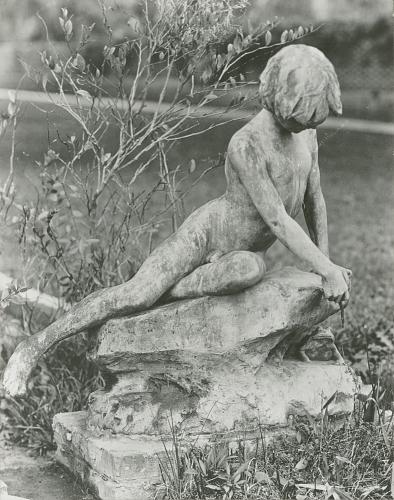
I wish someone would explain the fatal attraction of pre-pubescent boys and frogs. This “Boy and Frog” won a bronze medal for American sculptor Elsie Ward Hering at the 1904 St. Louis Exposition. Copies are in Brookgreen Gardens (South Carolina) and the Denver Botanic Gardens.
Update from the innards of the hapless marine creatures who keep us alive.
You may recall my heartfelt ode to the fish inside the fish which will never see daylight again (either one of them). Evidently this ode is going to have to be put on a continuous loop.
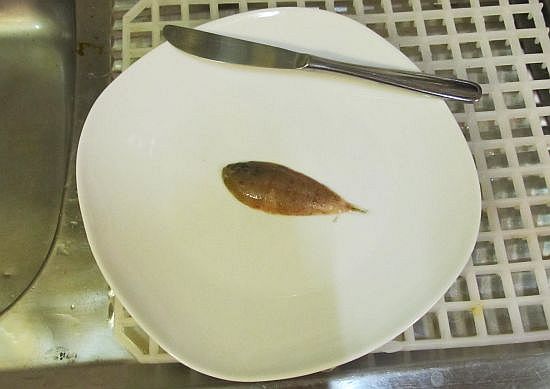
Lino was cleaning some hyper-fresh seppie not long ago, and I heard the clarion call from the kitchen: “Hey, look at this.”
One seppia’s last hors d’oeuvre was a minuscule sole.
This tiny sole made a seppia happy at least for a little while.
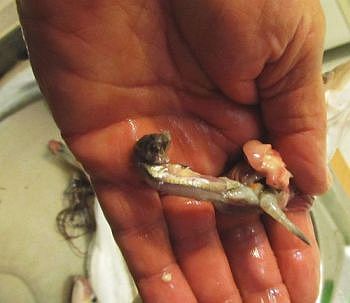
Then there was the day we bought a batch of moli, as they’re called here, otherwise known as blue whiting, or Melu’ or Micromesistius poutassou.
They’d been having a real feed, wherever they’d just been.
One of the moli had really hit the buffet — an anguela on the left, and a shrimp, too. Ignore the pink thing. It was never a fish.
I suppose I’ll have to stop this now. It’s no news that smaller fish are eaten by bigger fish. It’s just that… I don’t know. Maybe it’s because they’re swallowed whole. But then again, would I expect them to be ground to paste and spread on crackers?
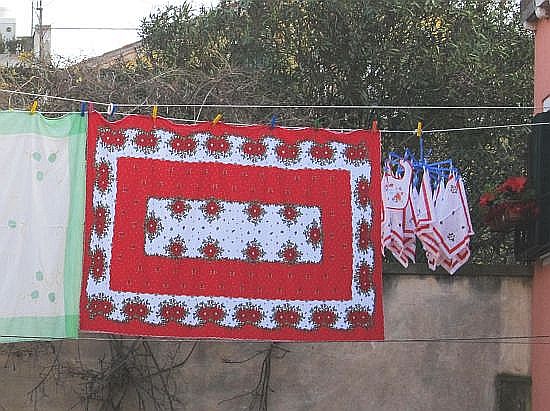
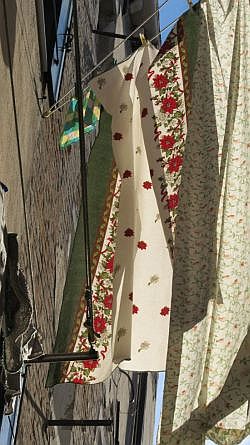
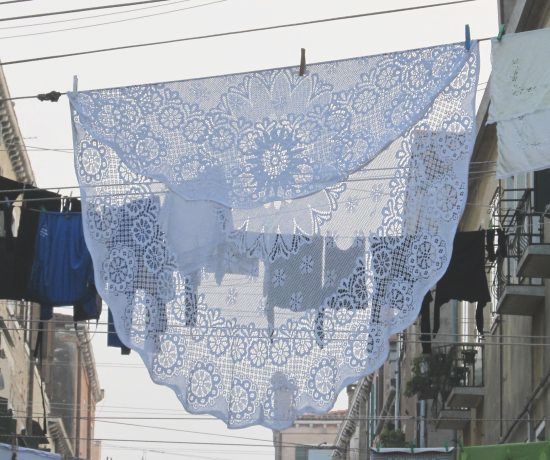
A touch of Christmas spirit, hung out to dry. Festive photographs are added to this post to mitigate the rantage.
I can’t resist — well, I don’t know if I can’t, because I haven’t tried — recounting the latest arabesques from the ACTV. And lest you think I am obsessed with the public transport system here, let me defend my little manias by saying that it’s not so much the ACTV that I’m obsessed with so much as I am with absurdities and preposterosities. They have a fatal fascination for me. My father was the same way. And the ACTV is the Venetian equivalent of Old Faithful, gushing an unfailing flood of reckless absurdity over the the lives of innocent, unoffending travelers who have paid their money to go somewhere and have found themselves instead on the road to the looney bin.
Christmas Day. I thought everybody knew that the entire world has important plans which involve some sort of travel. But if you were to have been so ill-starred as to need to go between the Lido and Tronchetto (d/b/a/ the mainland) on the morning of our Saviour’s birth, you’d have spent all morning praying in your car. A car almost certainly loaded with children, gifts for relatives, and perhaps foodstuffs not packed for long-term transport.
Poinsettias (known here as “stella di Natale,” or “Christmas star”) are always a good theme for a tablecloth. They’re so pretty. And they don’t have to be watered.
According to the report in the Gazzettino, the reserved spaces for cars on the ferryboats for Christmas Day had been sold out almost a week earlier. Which meant that — not to put too fine a point on it — the ACTV had time to prepare reinforcements, because it is obvious to anyone who has ever been alive on Christmas Day that masses of people who needed to travel but hadn’t managed to book a space would just show up. And so it was: On the morning of one of the busiest travel days in the year, hundreds of cars were lined up, at the Lido and also at Tronchetto, just waiting.
This was Olympics-level waiting, waiting on the grand scale. Because the ACTV had put only two (2) ferryboats into service that morning. One (1) going each way.
The two “flagships” (“Lido di Venezia” and “San Nicolo'”) were out of service for scheduled maintenance work. Not emergency maintenance, which would be moderately excusable, but work that had been scheduled by some large intellect for the holiday period. Not only does this border on madness from the public-service point of view, it’s also insane because who would be working over Christmas? Except, I mean, in an emergency capacity.
The enraged would-be passengers began a surge of protest on Facebook and (I suppose) Twitter. The ACTV, roused by this from its torpor, launched extra boats — the two smallest ferries, “Marco Polo” at 12:05 and “Ammiana” (no heating, but who cares at this point) at 12:20. For someone who might have had a two-hour trip ahead of them, this wouldn’t translate as “Way to go, ACTV, you’ve saved the day,” but “Thanks, ACTV, you’ve dismembered my Christmas.”
Note: Due to the “excellent work” of Mauro Minio, may his tribe increase and all go to work for the ACTV, the “Lido di Venezia” was sufficiently repaired in order to begin service that afternoon at 4:00 PM.
All this needs no comment from me, but why should that stop me? The ACTV isn’t expected to stop the war in Syria. It isn’t expected to eradicate malaria. It isn’t expected to adopt Ukrainian orphans. It isn’t expected to anything but provide the means, for payment, by which the public may go from here to there. But that seems to be too much to expect. Pay, yes. Transport you to where you’re going? In the immortal words of Jack Benny, they’re thinking about it, they’re thinking about it.
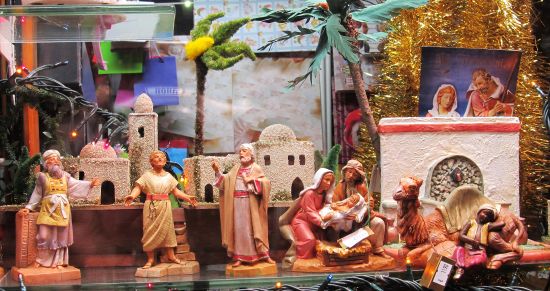
Must keep foremost in mind the reason for all this wild activity. My vote goes to this scene; I’ve never seen a fuzzy pipe-cleaner palm tree before, but next year I want an entire oasis made of them.
Breaking news: The ACTV has announced a severe crackdown on scofflaws who ride for free. Naturally there are people who skip the ticket-buying process. The company makes cheating irresistible, what with gouging the passengers with the price of tickets and then not bothering to maintain any system of checking them (I cannot remember, even if you promised me a house in Aspen, the last time a ticket-checker appeared).
Furthermore, ever since the new, computerized system of electronic tickets replaced the old paper version, you’re required to “beep” your ticket on a little machine before climbing aboard. Even if you have a month’s pass, you’re required to “beep.” Anyone caught with an un-beeped ticket is counted as someone who didn’t pay.
No one has ever understood why a person with a once-beeped monthly pass has to keep beeping it or be punished. The ACTV says it’s to get accurate statistics on ridership.
For a while, the ACTV put posters up in the vaporettos and buses complimenting themselves that the percentage of freeloaders had dropped from 8.20 percent to 1.16 percent under their intense vigilance. But the numbers conceal an unpleasant fact, which is that the directors’ bonuses are directly linked to the percentage of deadbeats they catch. In the real world, that would make sense. Prizes are supposed to be given for performance. But wait.
Davide Scalzotto wrote about this in the Gazzettino a month ago, headined (I translate): “The mystery of onboard evasion, and the mystery of the company’s bonuses.” It was inspired by the press conference held to announce the new program to install turnstiles on the docks (there already are some in operation) and buses, turnstiles which are going to stop freeloaders forever. But the company didn’t give specific numbers to delineate the dimensions of the problem, making it impossible to know how efficient they actually have been and, more to the point, how necessary these expensive turnstiles really are.
The only reason to go anywhere by any means of transport is to eat and drink. And wash up.
As Scalzotto points out, the ACTV is stuck. If they admit that evasion is high, they don’t have any basis for awarding bonuses. But on the other hand, if they say evasion is low (“We did it!”), they don’t have any basis for justifying the new turnstiles.
The data provided by the ACTV shows that in 2009 (one year after the electronic, or IMOB, system was instituted), the rate of evasion on the vaporettos was 0.49 percent, and on the buses was 1.72 percent. In 2011 the rate was 0.64 percent on water and 2.12 on land.
The limit below which bonuses are automatically awarded is fixed at 0.70 and 2.0 percent. This is extraordinary: The numbers given for diminished evasion are just a squeak under the limit which permits the bonuses. I’m not sure how they got around the 2.0 ceiling, but bonuses to the ACTV are like rain in Cherrapunjee, India: Inevitable.
Now a city councilor, Sebastiano Costalonga, has opened an inquiry which will seek to obtain the certifiable passenger/evasion numbers from 2010 to today, and discover the parameters which are used to determine the bonuses.
But keep this in mind. The ACTV has declared that they’re 8 million euros in the red. The turnstiles will cost around 5 million euros. Apart from the fact that these turnstiles will create a sack of problems, as we say here, for the passengers, how can the ACTV keep raising ticket prices because they’re broke, if at the same time they’re so ready to spend money they don’t have?
For something which — if their own numbers are to be believed — isn’t necessary in the first place. Because if they really have driven down the percentage of cheapskates with hardly any turnstiles, what’s the point of adding more turnstiles?
I promise to change the subject in 2013. Not for the entire year, but at least for a little while.
Happy New Year.
Wishing everyone a year full to the brim with everything wonderful.
More time has passed since my last post than I ever anticipated. If anyone other than I has noticed, this telegraphic communication is to assure you that I have not abandoned Venice, my blog, the ship, or you.
I’m out of the country for a month, for one thing. For another, I have to buy a new computer when I return to the-most-beautiful-city-in-the-world.
Consider this a sort of excuse note signed by a cosmic, or electronic parent. I’d sign it myself, but the teacher always knows it’s a fake.