
Most of the journalism about Venice, either print or TV, points out tourism as Venice’s main defining characteristic, which is about as simple a discovery to make as that water fills the canals. Apparently the appeal is eternal to the average journalist and editor looking for a story which is immediately sensational and not at all hard to do. A story on tourism here practically writes and photographs itself.
In doing so the reporters universally bewail it, to one degree or another, in the same way one would bewail any uncontrollable natural disaster such as grasshopper swarms, tornadoes, avalanches. You’d almost think that tourists come to Venice deliberately to wreak havoc on an innocent, helpless, unsuspecting, undeserving victim. The lines in these stories are usually pretty clear: City Good, Tourist Bad.
Pictures of mass tourism at its most intense are the easiest images in the world to take, the journalistic equivalent of hitting the bull’s-eye from one foot away. Anybody can do it — I’ve done it myself. You don’t even have to open your eyes to take impressive pictures of the worst aspects of mass tourism. In fact it’s probably better if you don’t.
But there is much more to the situation than the simple outlines sketched by the just-passing-through journalists.
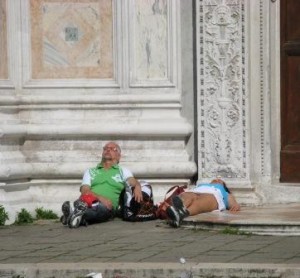
I am not defending the behavior of large segments of the mass tourist population. These are generically labeled “turisti da culo,” which literally means ass-tourists, but generally conveys a wide range of rude, thoughtless, generally sub-civilized behavior. There is never any lack of examples, especially in the summer. This race of tourist is horrifying, demoralizing, offensive, depressing. I could tell you stories. And yes, of course there are too many of them.
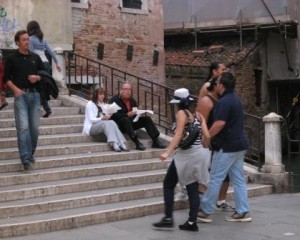
But I want to pause for a moment in mid-cliche’ to regard the situation from two important points of view which are rarely addressed as everyone is busy wailing and gnashing their teeth.
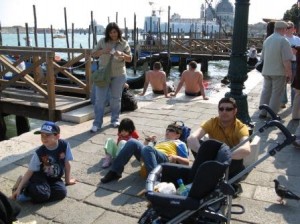
First, the city officials who have been assigned the role of City Councilor for Tourism over the years are politicians. They are not trained in the industry of tourism, an industry as demanding and complex as making steel or developing drugs. Further, it is the nature of the political breed to be cautious and easily swayed by conflicting demands, which makes planning, and then executing any plan, hugely difficult. And unappealing. Politicians on the whole tend to avoid “difficult” and “unappealing.” So a lot of tiny, disconnected actions are undertaken to minimize, if not solve, whatever is the most pressing problem of the moment.
The current Councilor for Tourism, a native Venetian lawyer named Augusto Salvadori, is famous for his impassioned oratory on behalf of his beloved city, the need to protect her and defend her and nourish and cherish her. It’s like the wedding vow. He is often on the verge of weeping before he finishes. People have come to expect it.
But he has no program, he has only little temporary fixettes. My favorite was the recent day to promote Decorum (yes, that’s the word they use for clean, tidy and polite), one of whose more publicized aspects was that the city offered to donate geraniums to anybody who wanted them, in order to brighten up the windowsills. If he had thought of donating the same number of large trash bins to be distributed far and wide to mitigate the incessant leaving of garbage on said windowsills because no alternative is to be found, the city wouldn’t need flowers in order to look better. You can walk from the vaporetto stop at San Pietro di Castello as far as the Bridge of the Veneta Marina (a straight shot of about 20 minutes, if you dawdle) without finding one (1) trash bin of any size whatsoever.
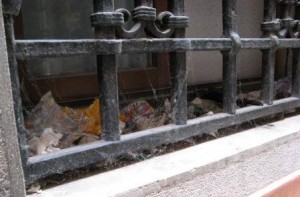
There aren’t many people who are willing to walk around town indefinitely with their empty soda can, beer bottle, or plastic ice-cream cup in their hand, searching for a place to dispose of it.
So: Point One is that the persons in charge of tourism here are unprepared for anything other than Making Suggestions. Which isn’t the same as Having Ideas.
Tourism is Venice’s only source of income. Yet it is inexplicably and profoundly — even stubbornly — even proudly, it sometimes seems — mishandled. The individuals charged with managing this important, complicated, potentially destructive resource could be compared to a person hired as director of a mercury mine whose previous job had been, say, as the Judges and Stewards Commissioner of the International Arabian Horse Association.
“We need some truly visionary people,” professor Fabio Carrera told me the other evening. “There’s no long-range thinking. It’s very short-range.” A few months ago there was tremendous blowing of trumpets and waving of banners to publicize “VeniceConnected,” the next big step in tourism management here: One-stop online booking. Carrera snorts. “All these ideas that were good maybe five years ago, like VeniceConnected online. We should be doing ten times better in the future. But they think ‘We’re innovating’ by doing this crap.”
The fact that there is chaos at the top naturally leads to chaos all the way down to the poor bastard trying to find a place in the shade to have some kind of lunch that won’t cost a fortune. Bathrooms — can’t find them. Open late, close early. Vaporettos — confusing. Signage — random and often homemade. 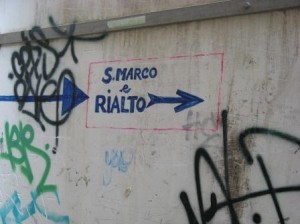 Street vendors — insistent and vaguely disturbing. Which leads to Point Two.
Point Two: Nobody ever takes the trouble to report on what is demanded of a tourist here. I see it every day and even as it repels me it also inspires something like pity. It must be the vacation equivalent of the Ranger Assessment Phase at Fort Benning, especially if you’ve got kids. I once stopped to help a family of three standing at the foot of a bridge with their eight suitcases (I counted them), unable to figure out where they were, much less how to get to their hotel. They had been standing there for a while.
Visiting Venice in the summer will almost certainly be hot, tiring, baffling, occasionally even upsetting, and it can cost far too much. A one-ride ticket on the vaporetto costing 6.50 euros ($9) is far too much. Two euros ($2.80) for a half-liter (two cups) bottle of water is far too much. Disposing of the result of the water you drank, if you avail yourself of one of the few but very clean municipal bathrooms costs 1.50 euros ($2), which is far too much. But cheaper than the original bottle of water, true.
I am not defending or excusing the type of tourist of which one sees way too many here: Oblivious, rude, loud, and often, yes, ugly. The garb, the behavior, the everything is impossible to defend. When people leave home, many evidently leave their manners at the kennel with the dog. (The fact that there can also be rude, loud, ugly Venetians is noted by the court, but doesn’t have any bearing on this case.) But to be a tourist here, enchanting as the city is, must be debilitating.
Still, that doesn’t explain why they have to shuffle around the narrow streets like wounded water buffalo, stopping with no warning and blocking your passage, or to ride the vaporetto with 60-pound packs on their backs, nonchalantly laying waste to everyone around them as they turn this way and that, admiring the view.
So let’s sum up the situation: The city puts up with aggravations and discourtesies and even damage, large and small, all day, every day, and also at night, but it gets money. And the tourist struggles around a bewildering, overloaded bunch of Baroque/Renaissance/Veneto-Byzantine-laden islands, but gets lots of pictures of canals and belltowers.
I don’t know. Something is definitely missing from these equations.
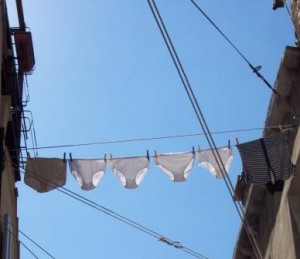
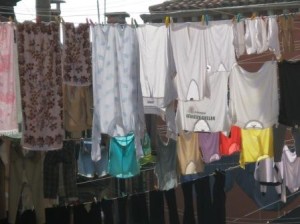
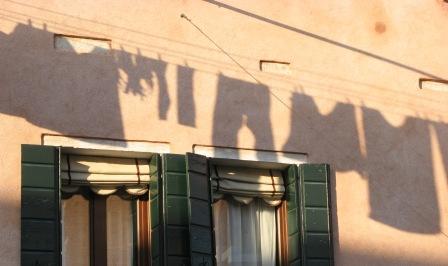
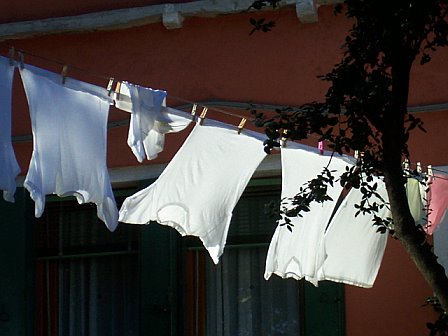 Clotheslines, fluttering with their victorious domestic banners, are like daily bulletins, footnotes in the ongoing family story. Plenty of people walk around Venice snapping pictures of laundry, I suppose because by now it’s something you don’t see very often back home. I can tell you that when I see people photographing my laundry, it annoys me. I don’t regard it or myself as either quaint or picturesque.
 This week is a case in point. We have been having a stretch of dream weather: breezy, sunny, dry, cloudless. It’s weather which inspires rational people — and there are more of them than I imagined, judging by the troop transports which are the overloaded vaporettos heading to the Lido — as I say, rational people to obey the seductive call, “Beeeeeeeeeaaaaaaaach.”
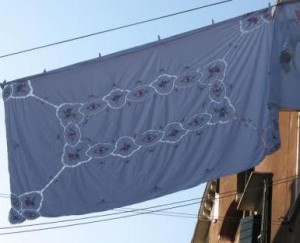 If you have ever tried to dry anything on a winter day of chilly fog, or even those few days when it’s so cold your underwear literally freezes solid (I did not make that up), you don’t need to be reading this, because you know. Also, I think laundry is beautiful.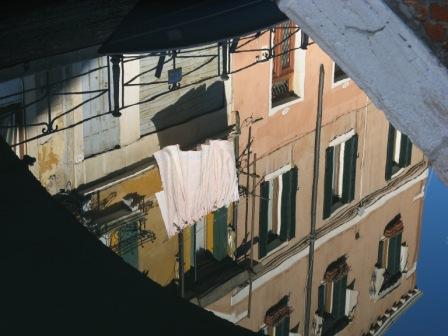
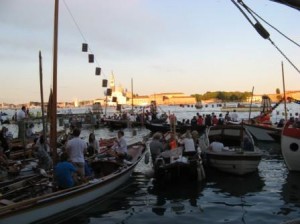 Man: “Remember when we used to decorate the boat with the frasche (small leafy tree branches), and the paper lanterns with candles in the them. That was really beautiful.” (The yet older man ahead of him chimed in, “Really beautiful.”)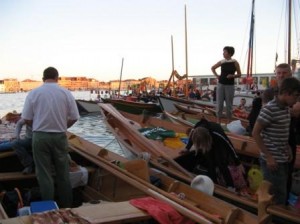
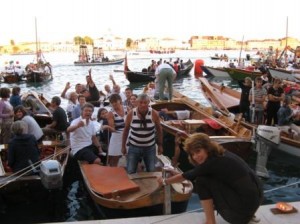
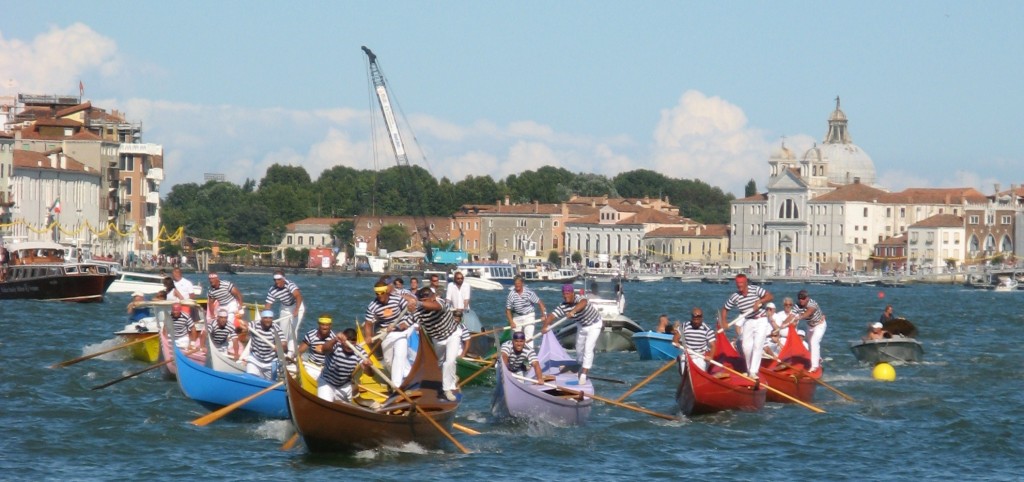 Of the three races, the One that Counts is the third: gondolas raced by pairs of men. Back in the barely rememberable past the racers were all men who were not exactly athletes; in fact, the broad sash each rower wears (matching the color of his boat) originally functioned as a sort of truss, I think you’d have to say. Nowadays the competitors train in a seriously focused way, and so instead of having a race in which the battle lasts for the first five minutes, and then everyone just stays where he is till the finish, as it once was, now you have battles to the death all the way through. Especially between two specific pairs of men whose rivalry has reached a level not far from blood feud. I refer here to the brown gondola (Ivo Redolfi Tezzat and Giampaolo D’Este) and the yellow (Rudi and Igor Vignotto).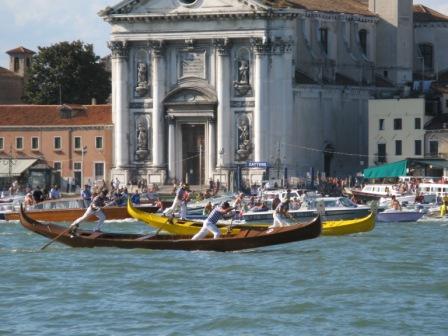
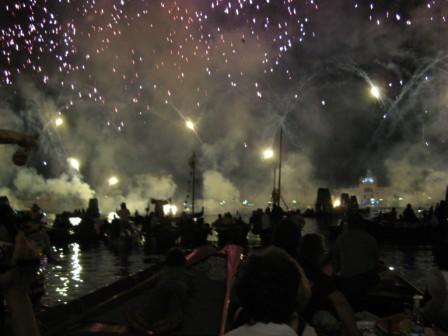
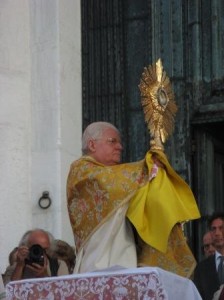 and Pope John Paul 1st (“Papa Luciani”), when this was their humble parish task, took the ciborium containing the consecrated Host and walked to the middle of the votive bridge and intoned the benediction first facing the San Marco side, then turning and facing upstream. One can debate the various merits of each approach if one wishes. One can debate anything, but the old way was more beautiful and more appropriate. I have spoken.