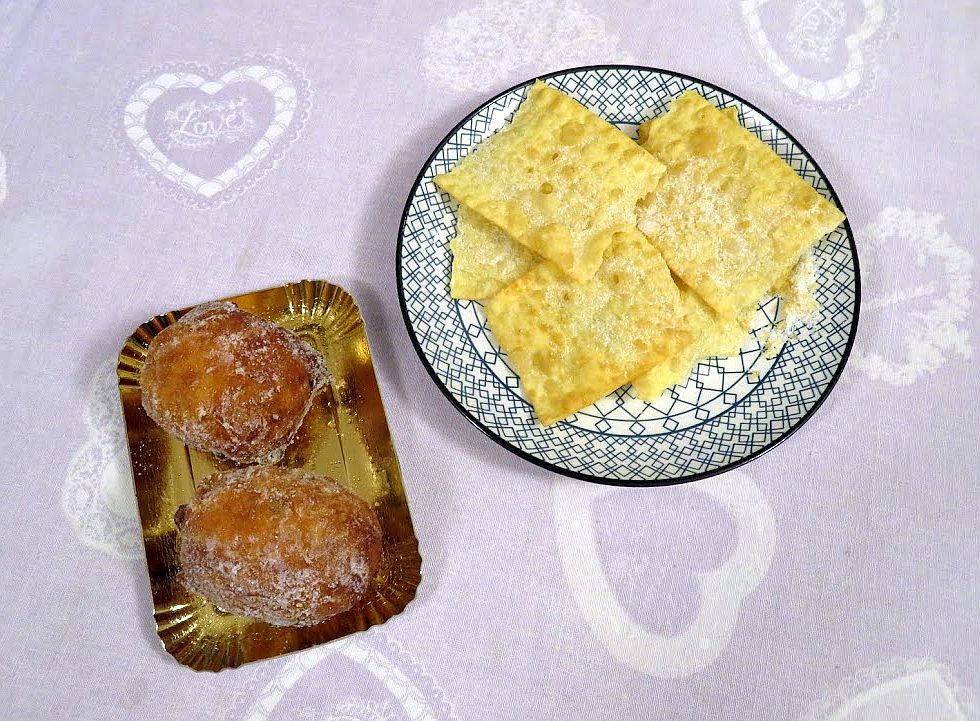
Down to the fundamentals.Venetian frittelle (left) and galani. The staff of life for the next two weeks.
My response to Carnival, after all these years, has gradually diminished to what apparently is now the barest of minimums. (Minima, I know. Thank you to my internal pedant, who never sleeps.)
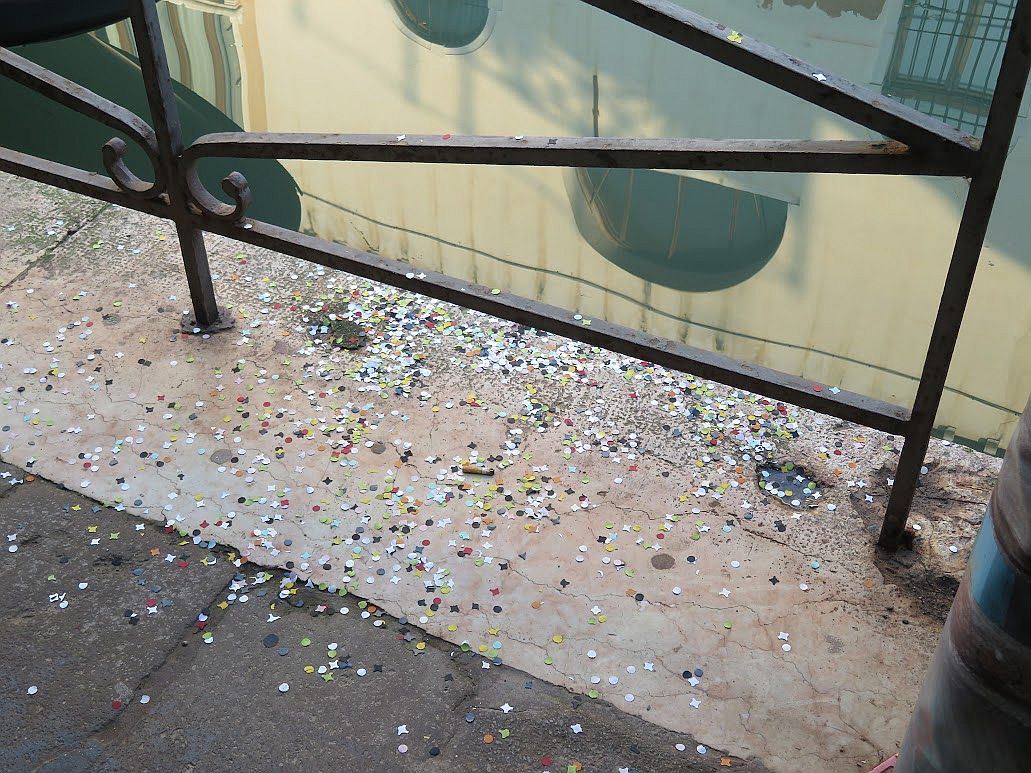
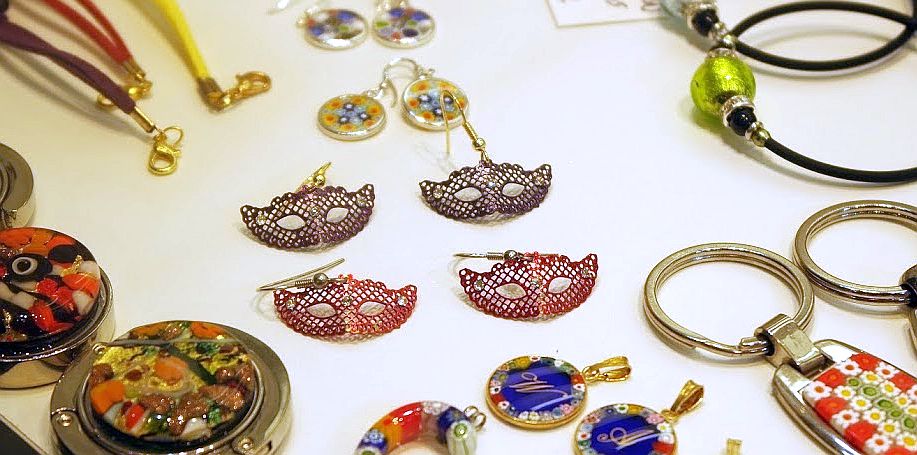
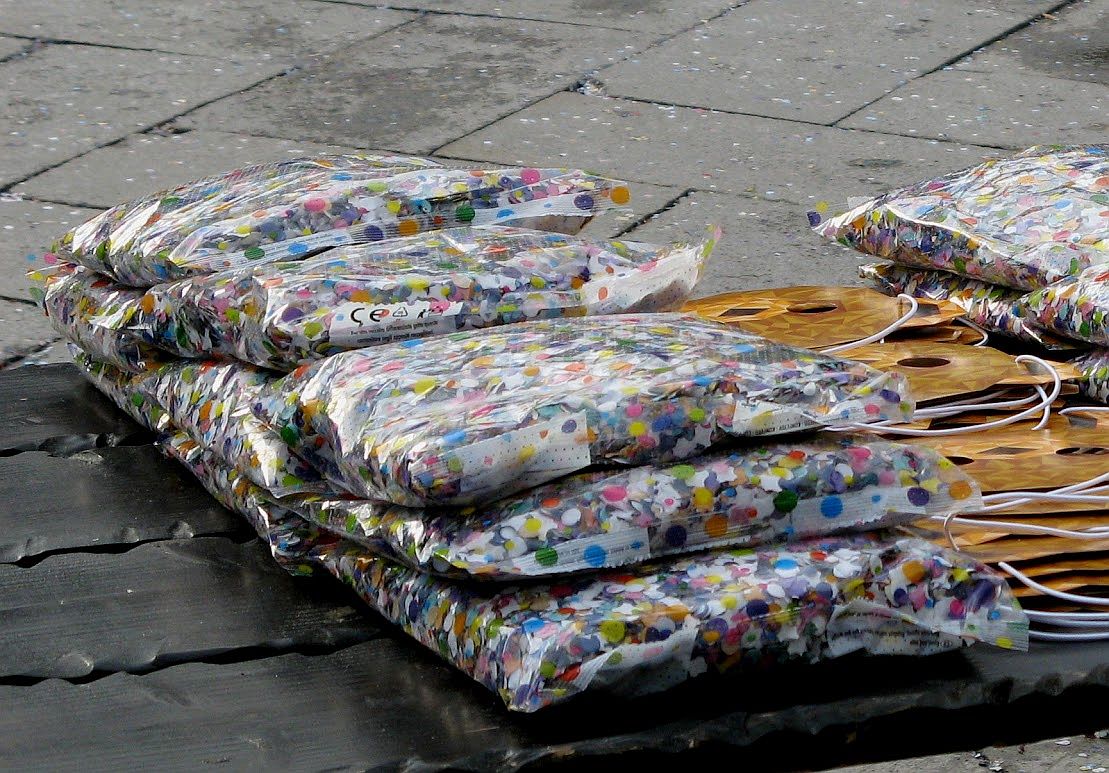
The basics are: Confetti — here known as coriandoli — masks, or some element of disguise, however small — galani and frittelle. And although the official opening day is tomorrow, about which more later, the premonitory signs have been accumulating. I enjoy those little signs almost more than any of the real events themselves. They give a pleasant sense of the overture being played before the curtain rises. Some blithe and whimsical overture, obviously, nothing Wagnerian, though now that I think of it, a doom-laden session of Wagner might be an amusing soundtrack to the surface frivolity. Which would be better? You decide.
I have written various postsover the yearsabout Carnival, as well as an article on the history of this phenomenon for Craftsmanship magazine. More posts can be found stretching back to the frayed edges of time, so I suggest that if you feel like it, just put “carnival” in the search field and search away.
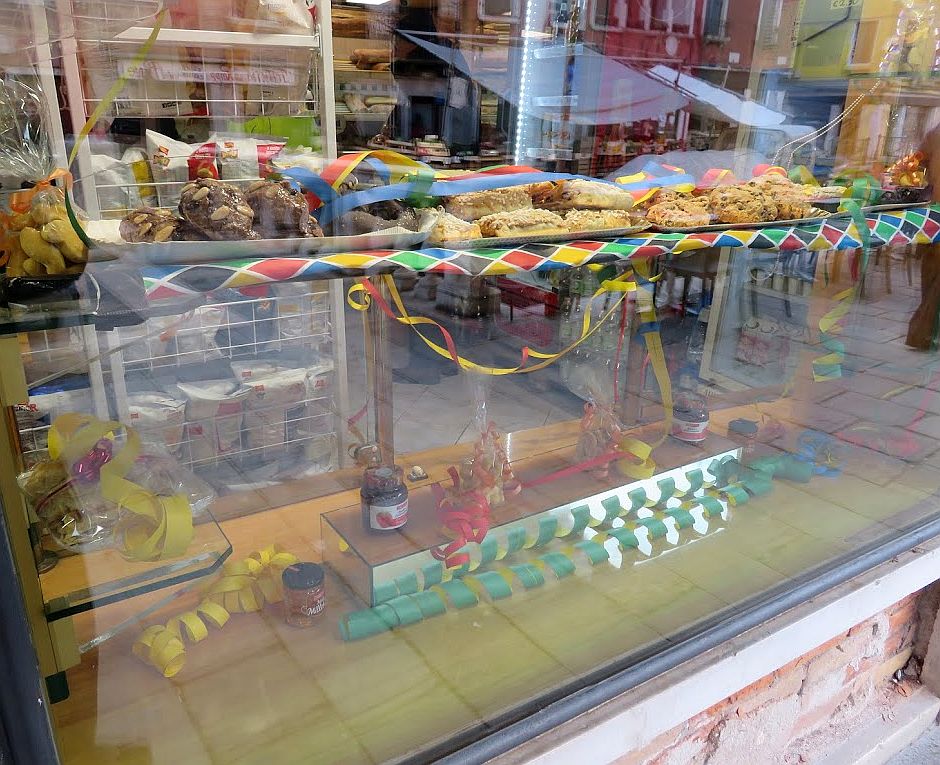
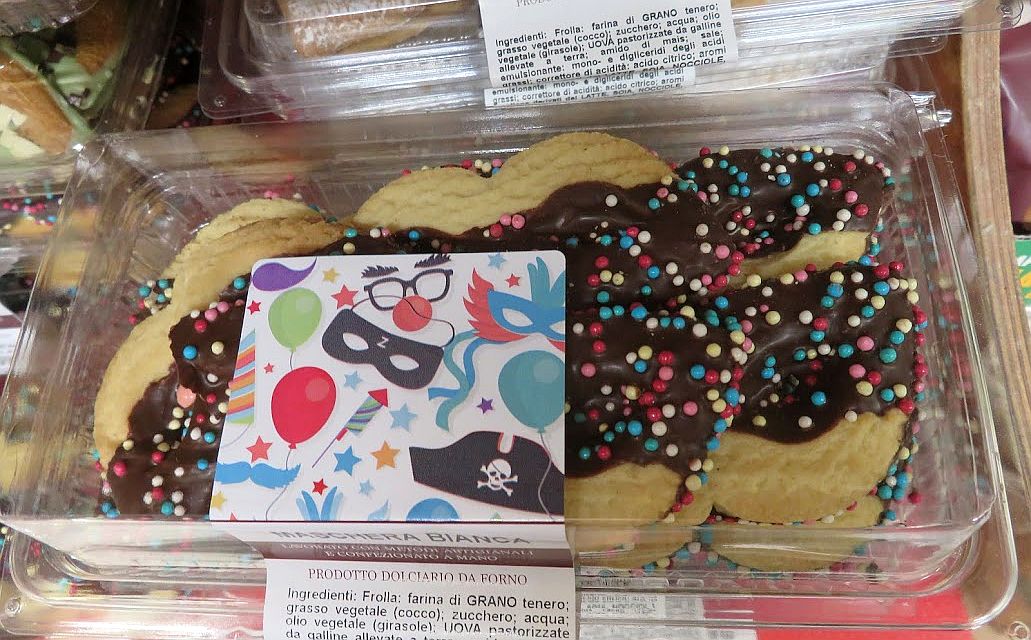
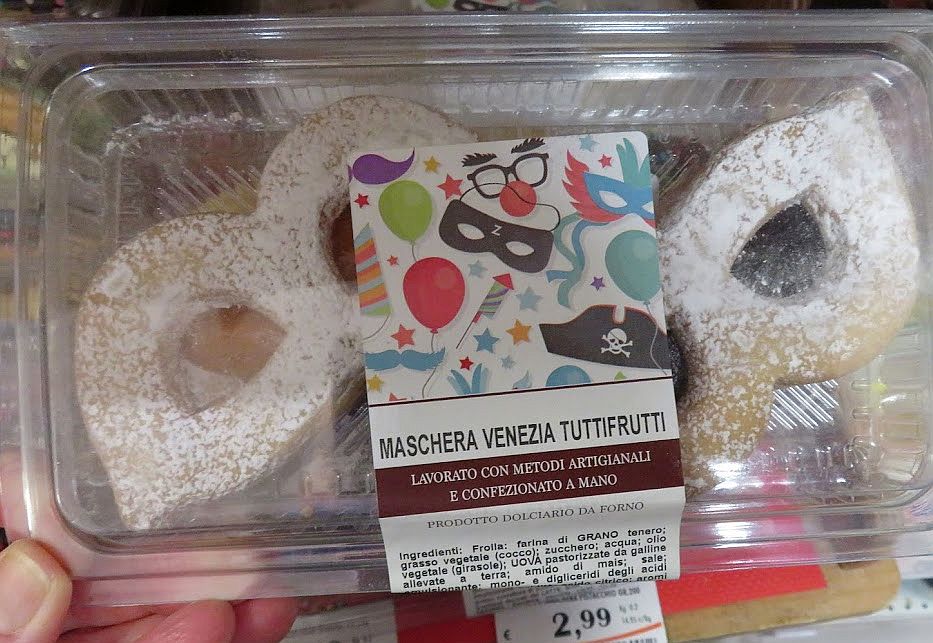
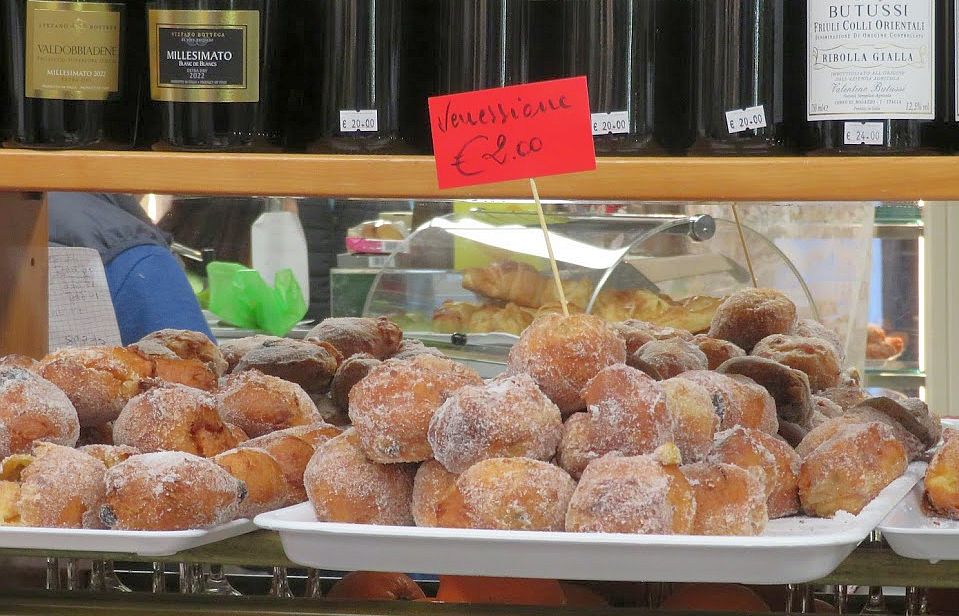
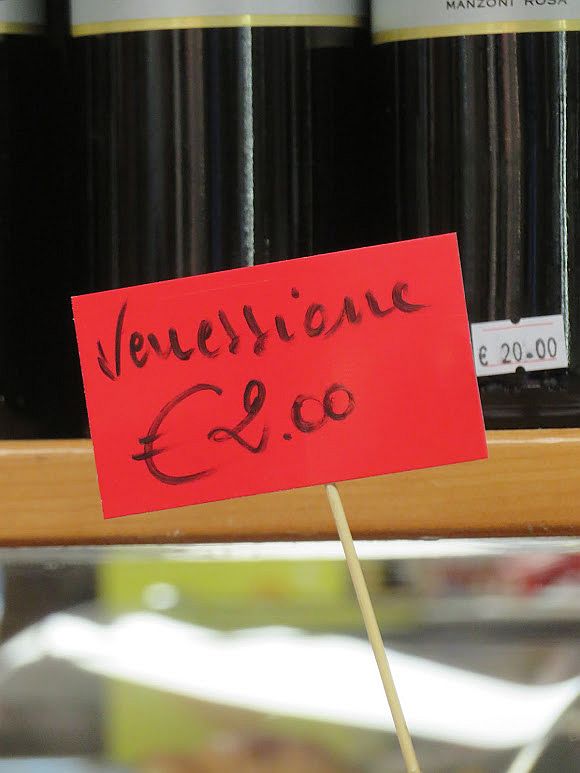
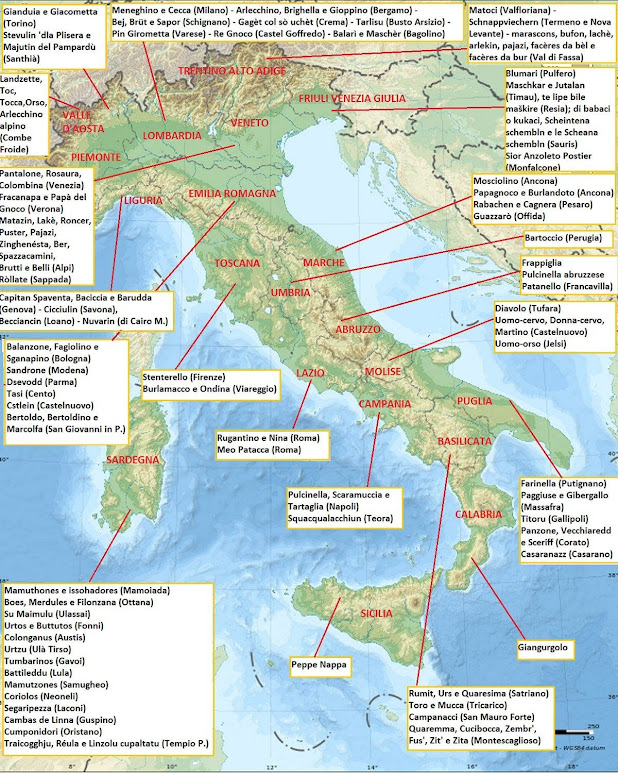
Festoons of ribbons and harlequin-patterned things are strewn in shop windows, restaurants, grocery stores, hair salons…. I challenge you to open your eyes and look in any direction without seeing something carnivalesque.Now the supermarket is getting into the act. Did we need cookies shaped like carnival masks? Need? We don’t NEED any of these things. Bring them on!You prefer munching your mask filled with raspberry jam? The CONAD supermarket chain is ready to bring joy and plaque to your heart.One cannot be sure of finding genuine Venetian frittelle — the fads have overwhelmed the classic form, forcing pastry-makers to fill them with cream, zabaione, chocolate, and other ungodly ingredients. But Pasticceria Chiusso in Salizada dei Greci can be counted on to do the Right Thing. These scrumptious spheres remind me of those neat pyramids of cannonballs set up by cannons on battlefields. Not only does the delectable aroma of deep-fried dough greet you halfway down the street, but Maria, the owner’s wife, has helpfully labeled them as Venetian….…in Venetian: “Venessiane.” Perfect.Italy is seething with carnival characters, very ancient, and very specific to their region and history. Here are the main ones.
If you feel you must have a mask, you could buy these. Masks for your ears.
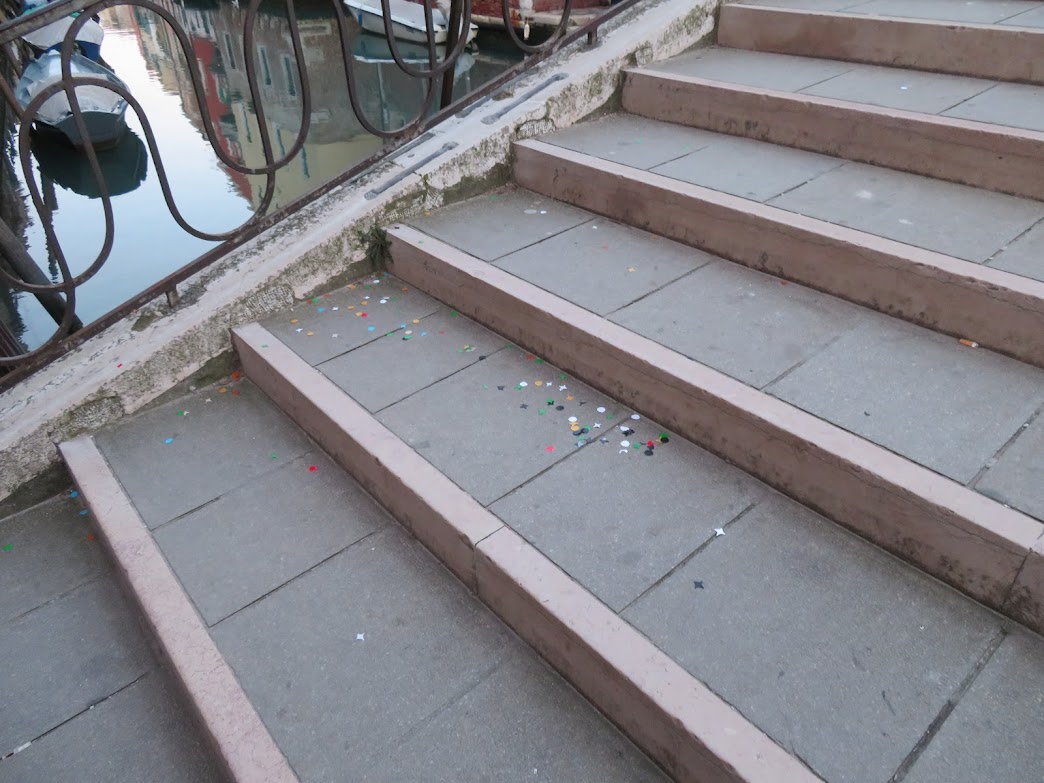
I suppose I’ll be checking back on the Carnival circuit before it’s over. Meanwhile, let the chips fall where they may.
Chips, specifically made to fall. Do not use them wisely, you’ll spoil the fun.
Worth protecting? Pretty sure we can agree on that.
May it be far from me to herald the new year with a broken string or rusty trombone, but although I have almost completely lost interest in reporting on Venice’s daily misadventures, I can’t resist this one. I should, but I can’t, because what happened seems like it ought to raise at least a chuckle. Instead, I think it’s more deserving of a resounding raspberry.
You have heard of the Great Man theory of history? I propose the unfortunate incident of January 6 as an example of the theory, yet to be named, of the phenomenon by which is is almost guaranteed that the simplest task will also prove to be the most important, and the easiest to forget at the moment of crisis. Or put it this way: If something is going wrong, the office tasked with providing measures against wrong-going will be closed for the holiday weekend, call back on Monday.
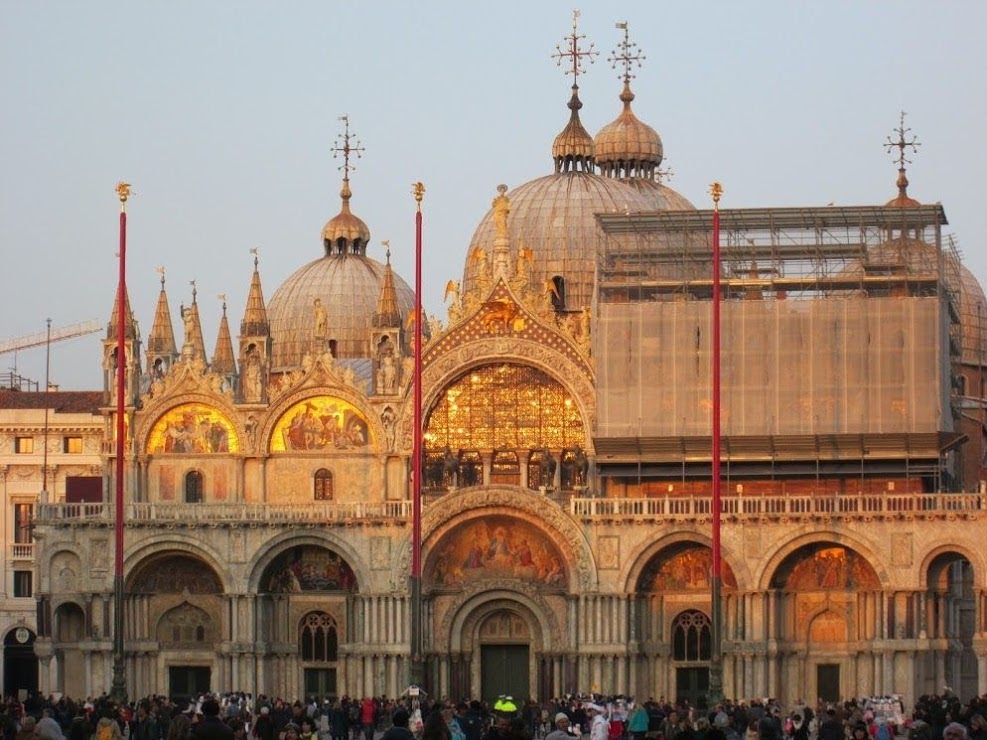
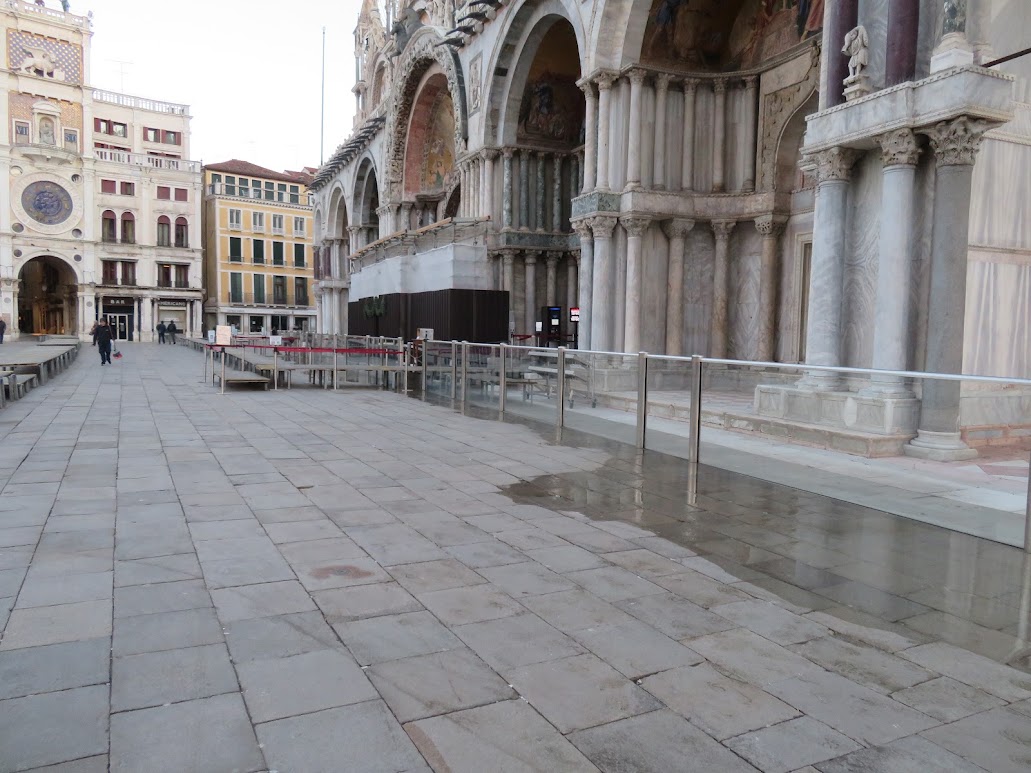
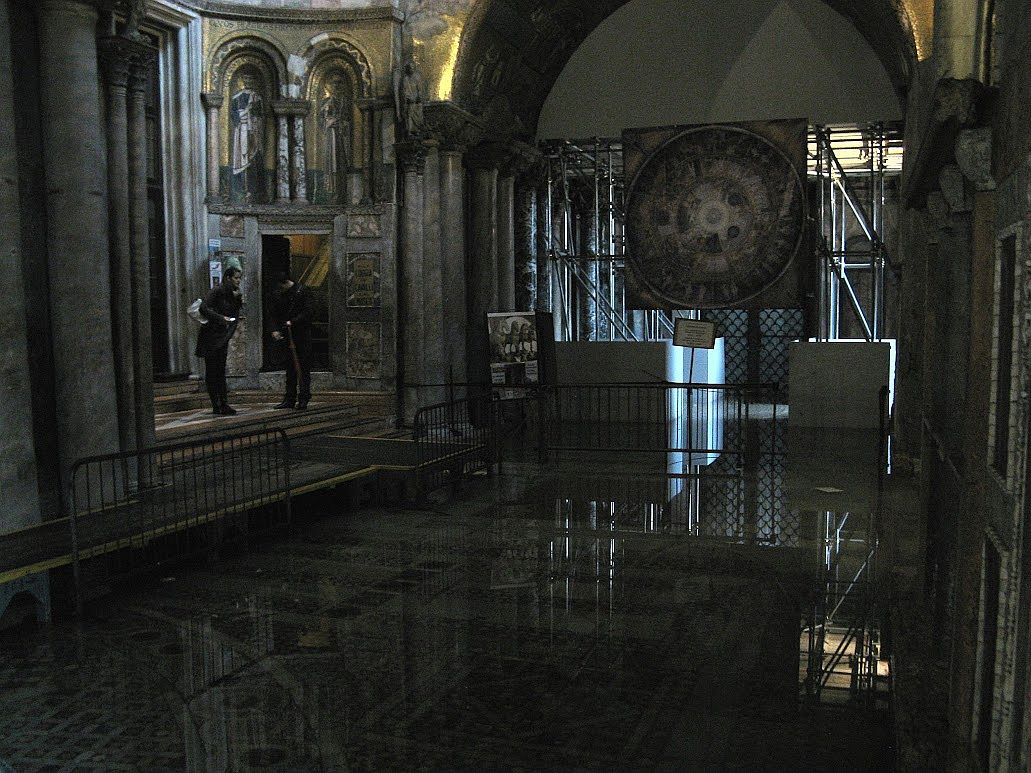
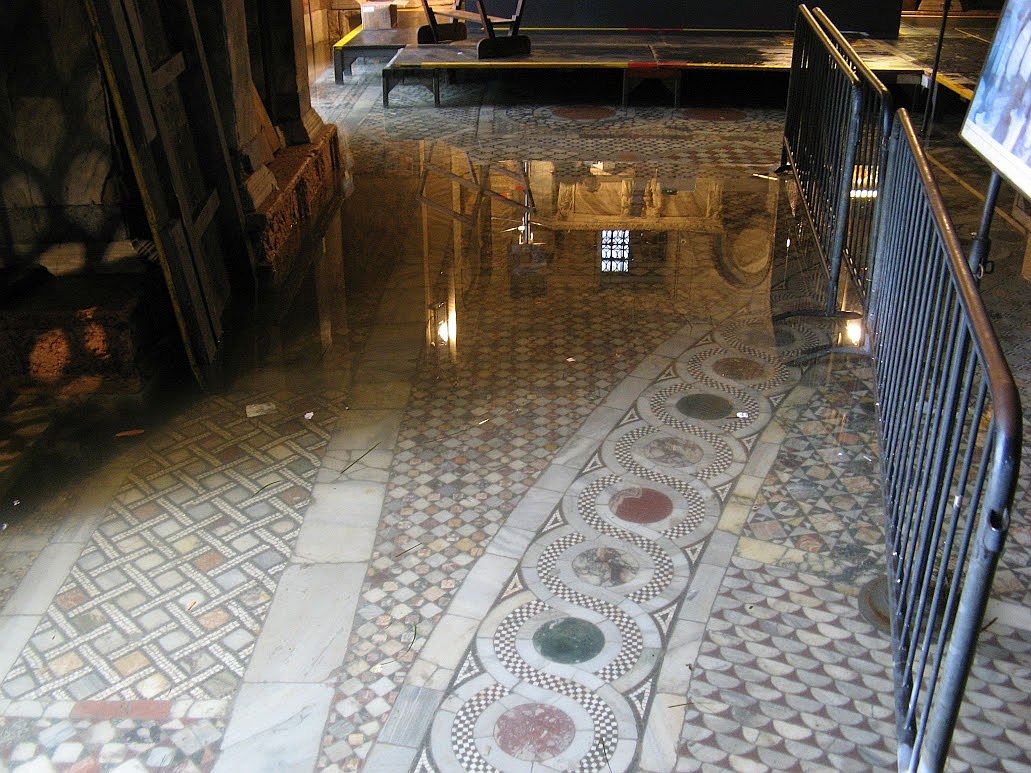
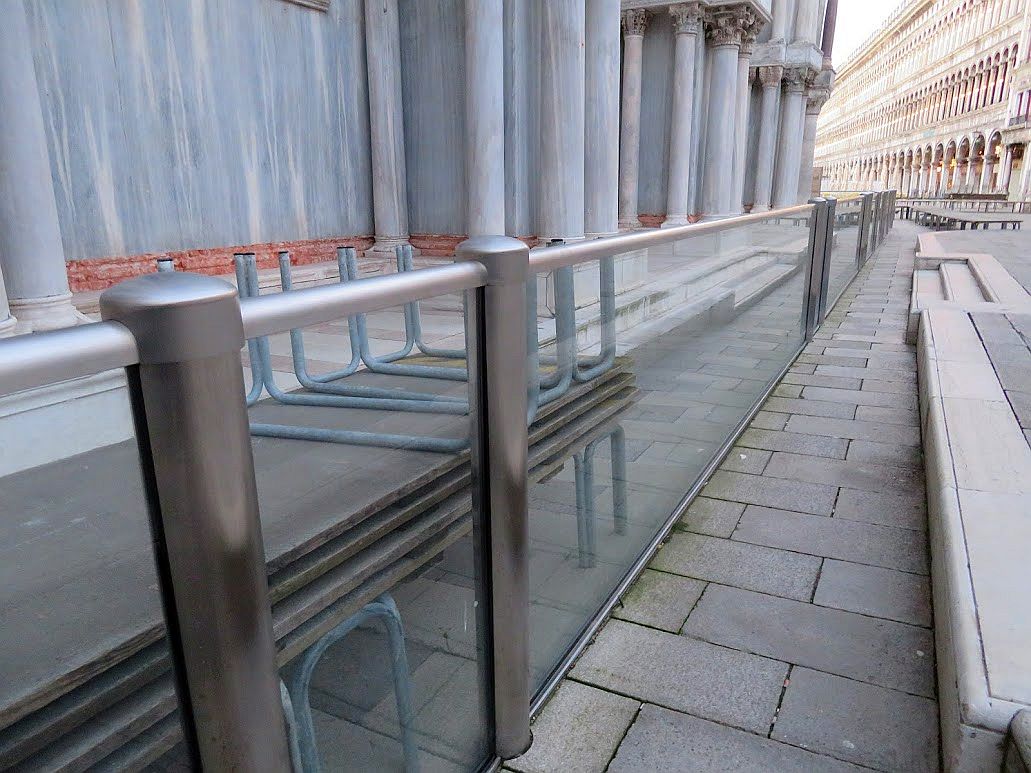
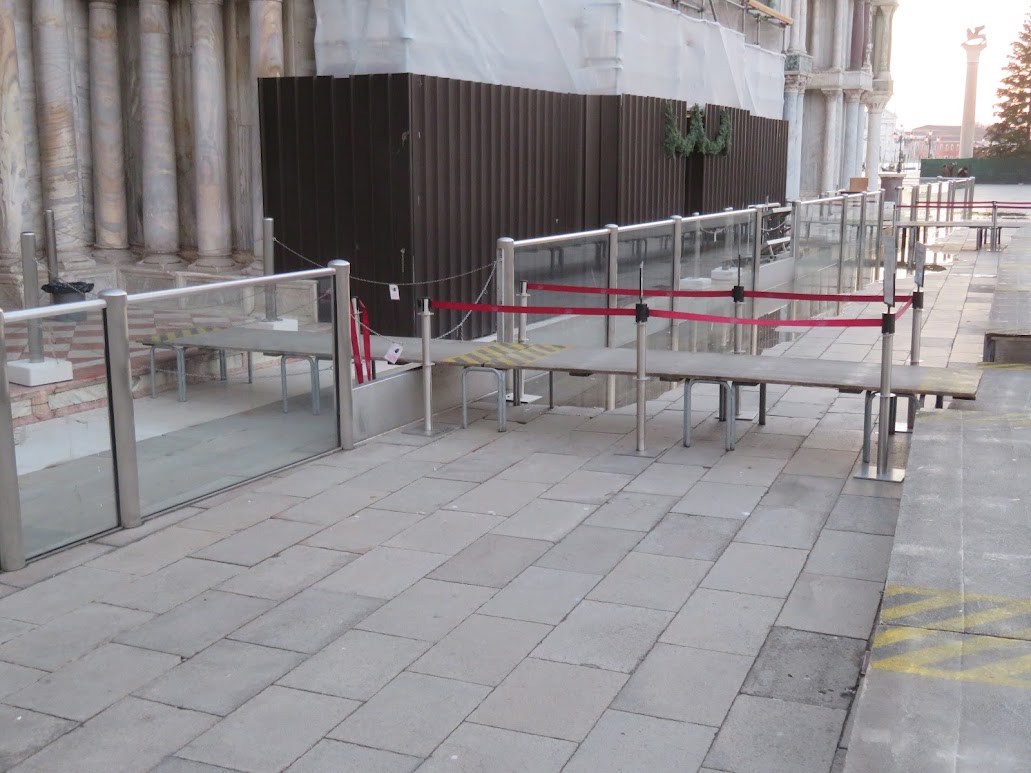
Brief context: Vast work was completed in November 2022 to encircle the basilica of San Marco with a glass wall to defend it from acqua alta. Too many years, rounded off to the nearest century, of saltwater soaks have damaged the mosaics and marble columns of the narthex, damage I have seen with my own eyes.
Although the MOSE system had finally become functional by then, the lagoon barriers were intended to be raised (it was said) only when the tide was predicted to reach 140 cm above mean sea level. It costs hundreds of thousands of euros each time to raise the floodgates, and they are only useful for a few hours, so the deciders have to decide if the expected height of the water justifies the cost. That is a very tricky calculation to make, as you can imagine.
Water outside, dry stones inside. Seems like the problem has been solved, yet this is only a temporary measure. A mastodontic project to raise the Piazza itself is being discussed, in which case the glass wall will be removed. Then again, this temporary construction may well follow the Accademia Bridge into the category of “temporary forever.”
Of course, as soon as that level was stipulated as raising-gates time there came wails and shrieks from all sides, people objecting to the (to them) unreasonably high limit. So the city rapidly backtracked, and the likely level for floodgate-raising dropped by tens; it went down to 130, then 120, then 110, then even 100. It was like an auction in reverse where the bids are decreasing. In any case it appears that the cutoff height seems to be slightly negotiable.
The Piazza San Marco stands at 85 cm above mean sea level, so it is destined to be damp even with the most modest inundations. And the basilica couldn’t be expected to tolerate small water on the stone while waiting to be protected from big water. Therefore the highly excellent idea of protecting the basilica alone was mooted, and budgeted, and scheduled, and accomplished.
Nobody thought they were ever going to see this again. This was the morning of December 11, 2008.I thought this was beautiful when I saw it, it made me think of Atlantis. But now I know better. Or worse, if you want to put it that way. Much worse.
And yet, on the morning of January 6, water rose to a mere 97 cm in the Piazza; not enough to require MOSE to be activated, by any means, but enough to drench the narthex of the basilica just as it had in 1859 (made up. Could have put 1759. 1620. 1492.) The very thing that 5 million euros had been spent to prevent just up and happened all by itself.
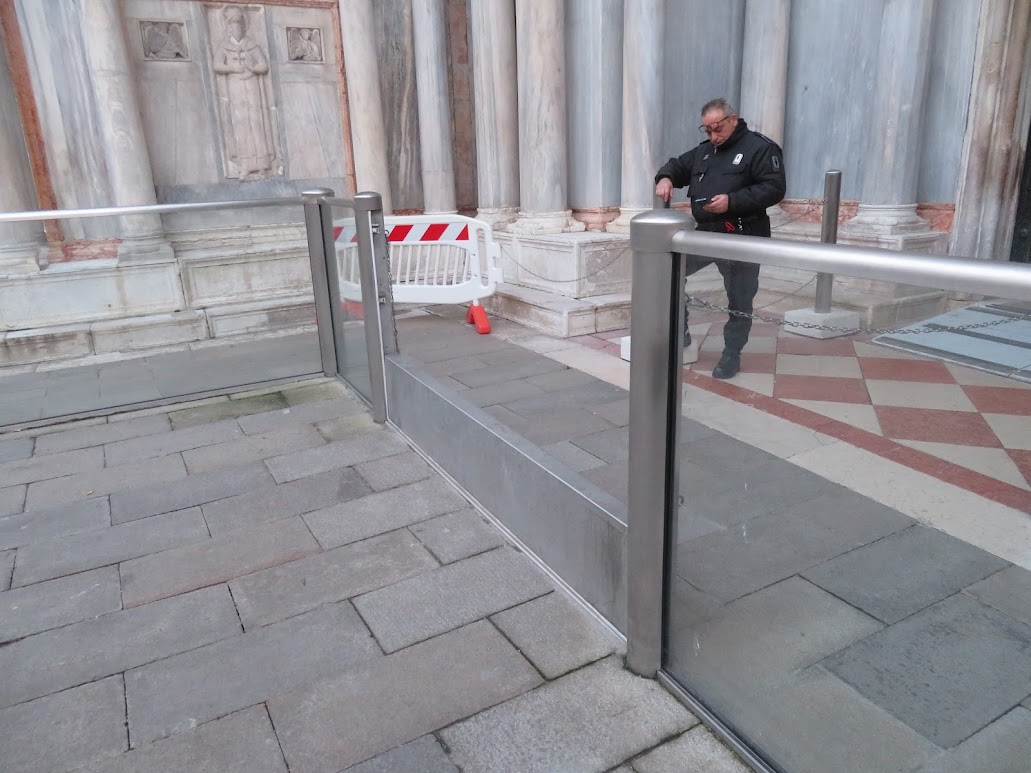
Because there are openings in the glass barrier wall to permit people to enter the church. Those openings must be closed with the typical metal barrier, otherwise there’s no point in having the wall. Workers (usually from the two construction companies involved) have to put up the barriers. And somebody has to tell them to do it. But if you haven’t got the workers because they’re all off duty for the holiday weekend, does it matter who is responsible for ordering all hands on deck? Of course it does.
Sensible, simple, and easy. The lower metal barrier makes the whole arrangement perfect. Amazing how ineffective the glass wall is when the metal barrier isn’t there.It’s not Hadrian’s Wall, but it’s impressive. Too bad it’s all just for show if those little metal rectangles are missing.
Not made up. The workers were absent. The person who provides for emergency interventions somehow did not check the tide forecast, even though everybody in Venice does it about ten times a day. Perhaps that person didn’t check because he/she/they were also away somewhere. In any case, for anybody to have usefully been on tide-watching duty they’d have had to be at the basilica before 6:00.
Please recall that January 6 was Epiphany, and a Saturday, so plenty of workers and employees of all sorts were probably still enjoying the Christmas holidays.
By the time that personnel at the basilica realized that nobody was coming to insert the barriers to block the tide, the church was taking on water like H.M.S. Indefatigable after striking the reef. The narthex was flooded.
Whoever left the barn door — I mean, basilica-gate — open must have spent a lively interlude in somebody’s office on Monday morning attempting to explain. Anyone listening at the door might well have heard one phrase shouted for 15 minutes: “You had ONE JOB.”
This is how it looks when all the pieces are in place. You see the entrance walkway passes neatly over the metal barrier. If the water were to rise higher, an extra metal barrier would be placed on top of the first one. Or maybe MOSE would be activated. Or something. All that’s needed is people to actually make it all happen…..“You had ONE JOB.”
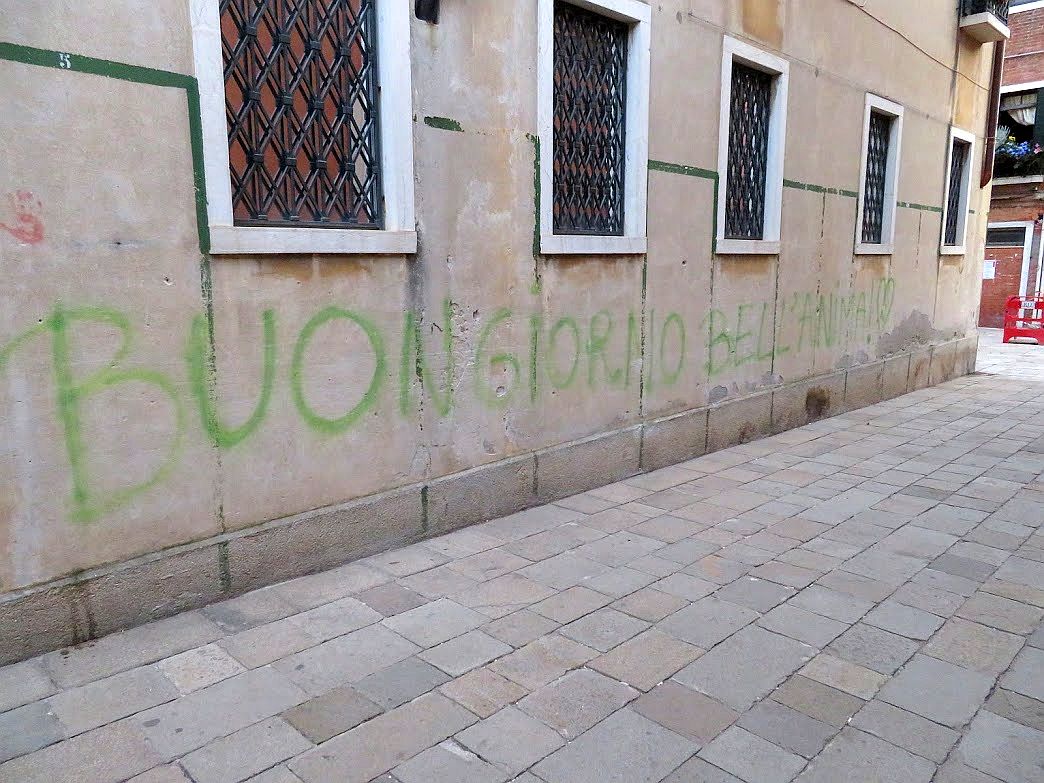
“BUONGIORNO BELL’ANIMA!!” Good morning, beautiful spirit! This ebullient greeting been up for several years, and it always gives me a boost, although I’ll never know how this relationship developed. The two persons involved know who they are. I do hope they’re happy.
There are 20,000 entries under “Venice” on amazon.com. (I’d have thought there were more, actually.) But that’s only the English-language site. Amazon Japan lists “over 6,000.” In any case, whatever your language, Venice is going to be there somehow. Histories, novels, travel guides, poetry, cookbooks, memoirs and, for all I know, limericks and postcards and old flight boarding cards.
Add to that mighty flood the tributary streams of academic studies and research and theses, the reports from national and international committees, the torrents of daily news and opinion pieces and blogs. Anyone during the past millennium with a brain and a pencil seems to have written something about Venice and there is no end in sight. It would appear that you cannot be a warm-blooded, live-young-bearing creature that is alive who has not written something about Venice.
But within this Humboldt Current of ideas and facts and fantasies there are plenty of other thoughts and feelings that flow through daily life here. Letters to the editor are fine, but it’s much simpler (and cheaper) for the vox populi to make itself heard through signs. These come in all sorts of ways, but they’re everywhere.
There are the personal messages from the heart. The heart above is in wonderful shape, but there are many that aren’t.
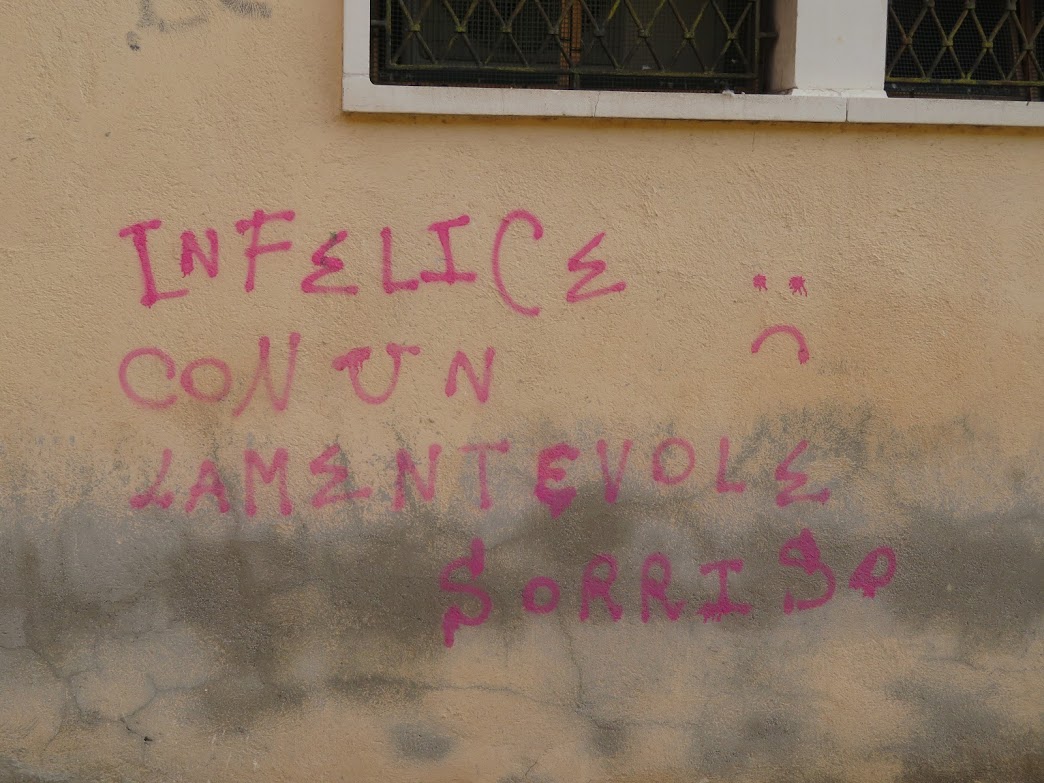
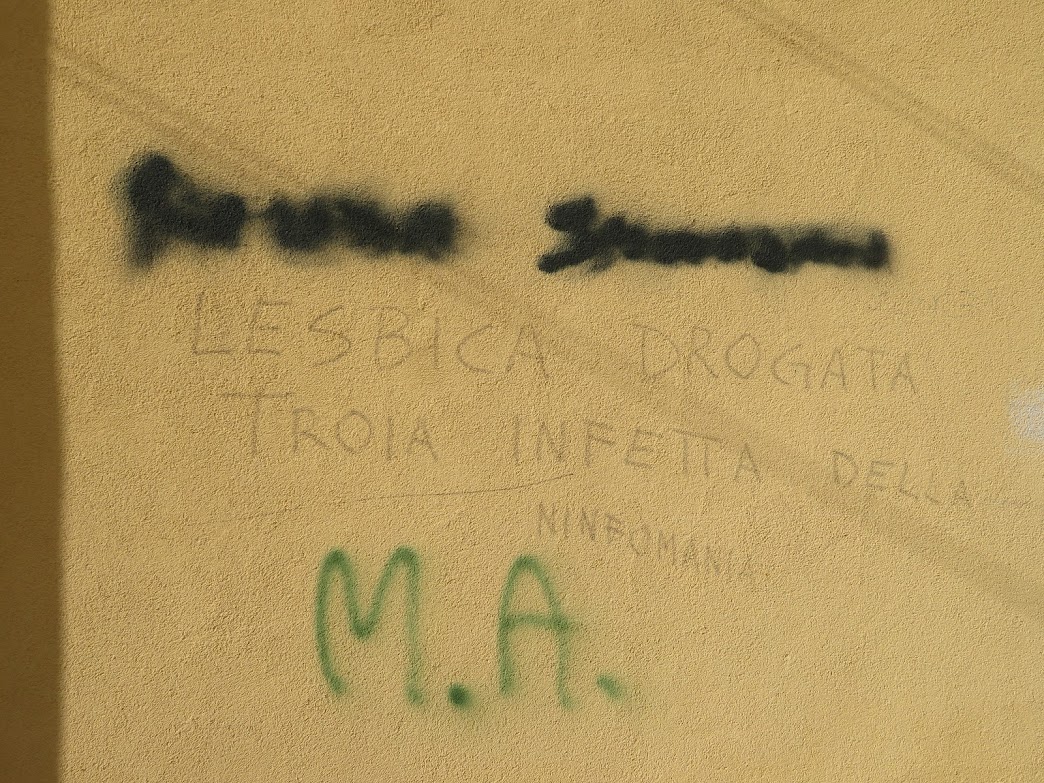
“Unhappy with a lamentable smile.” I wonder if the smile is easily identifiable as lamentable, or if it’s a cheerful smile hiding a broken heart (thus qualifying as even more lamentable). Cue the music: “Take a good look at my face, you see my smile is out of place, if you look closer it’s easy to trace the tracks of my tears…” Thank you, Smokey Robinson. It would be hard to get all that on a wall, so we’ll hope this person’s smile has improved.On a much less poetic note comes this rage-graffito that has been on this wall for a few years now. “Drug-addicted lesbian slut infected with nymphomania.” I wonder if it made him feel better. I can only hope so. Wow.
Neighborhoods bubble with exasperated reminders of some basic rules of civility, in varying degrees of sharpness. One eternal theme is dog poop.
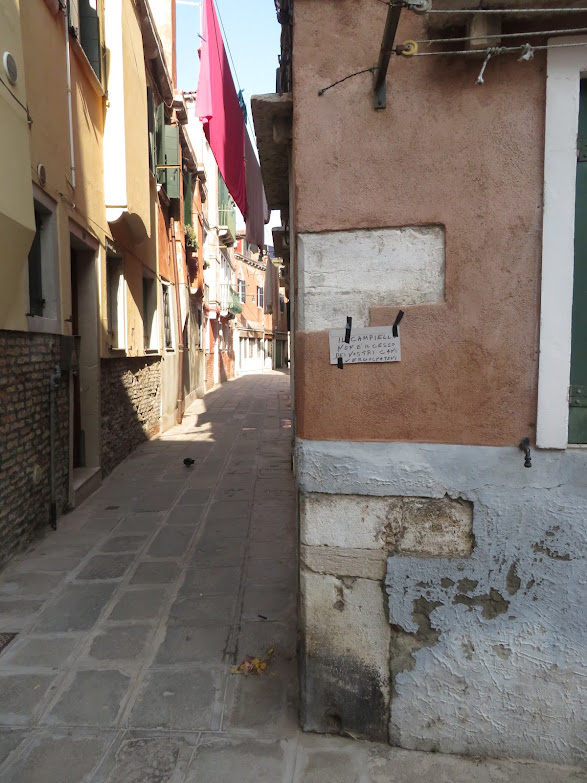
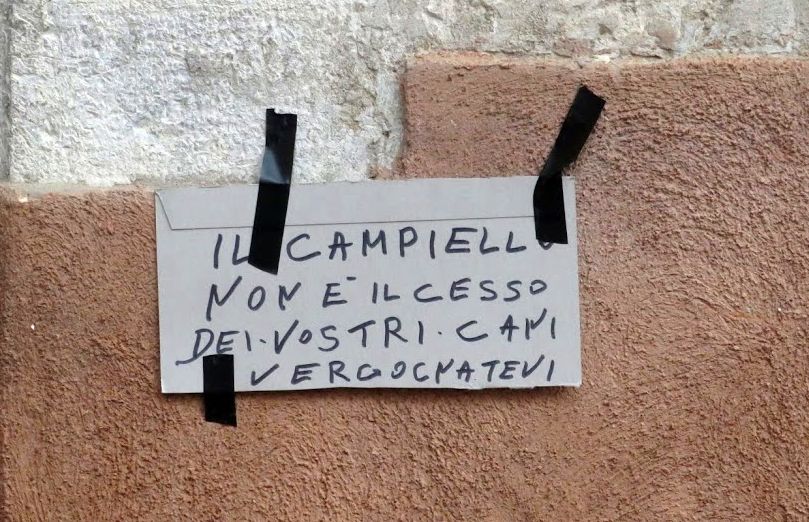
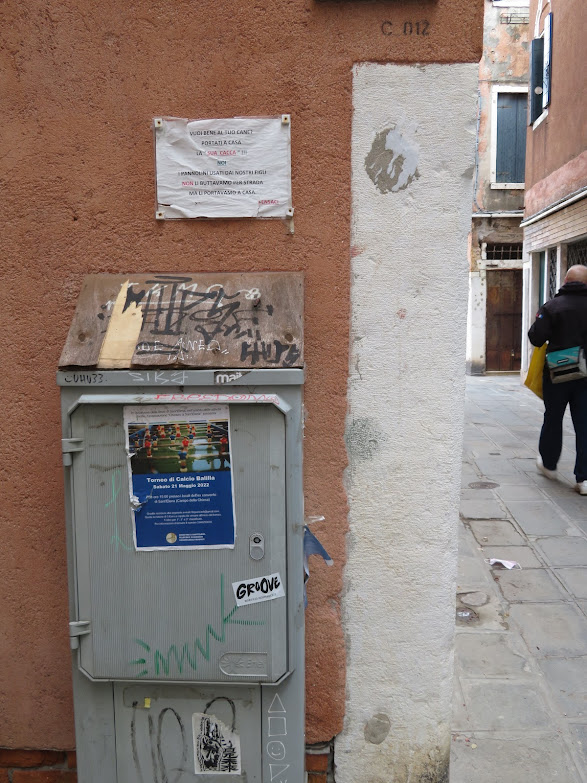
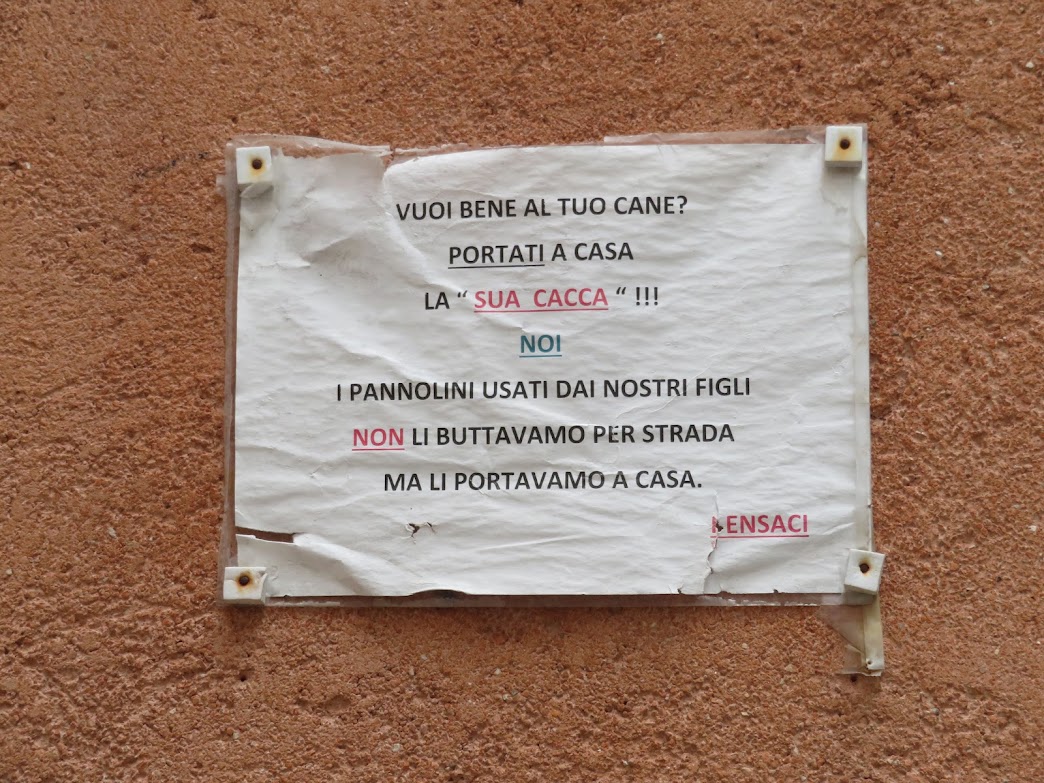
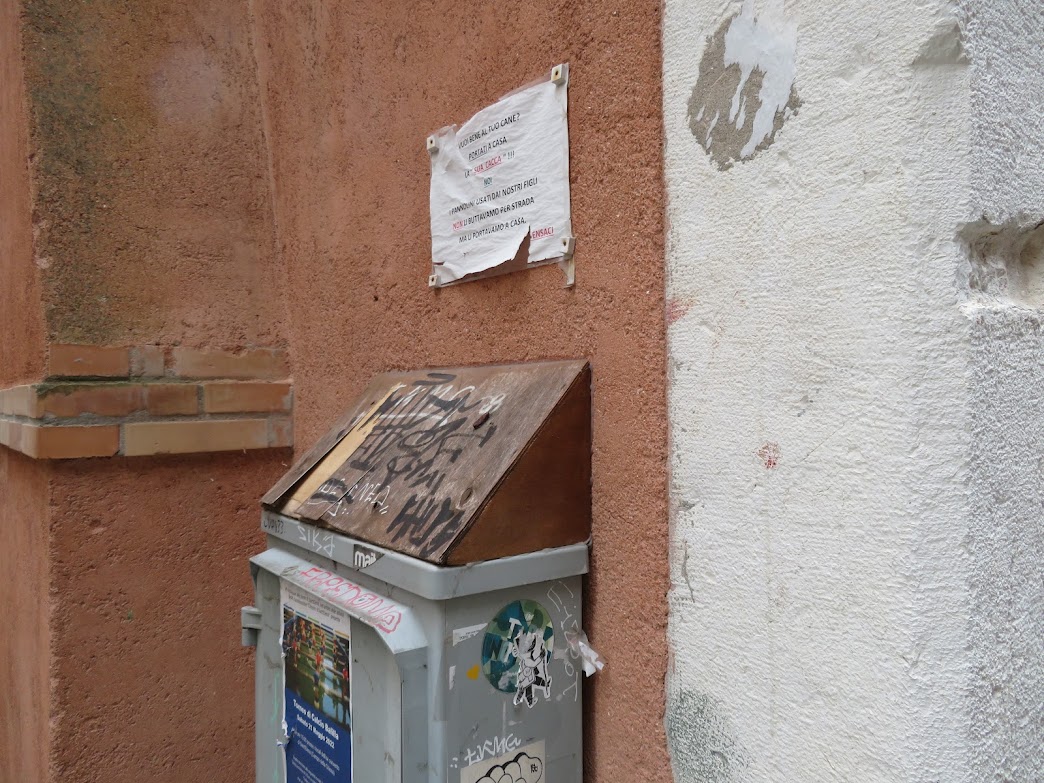
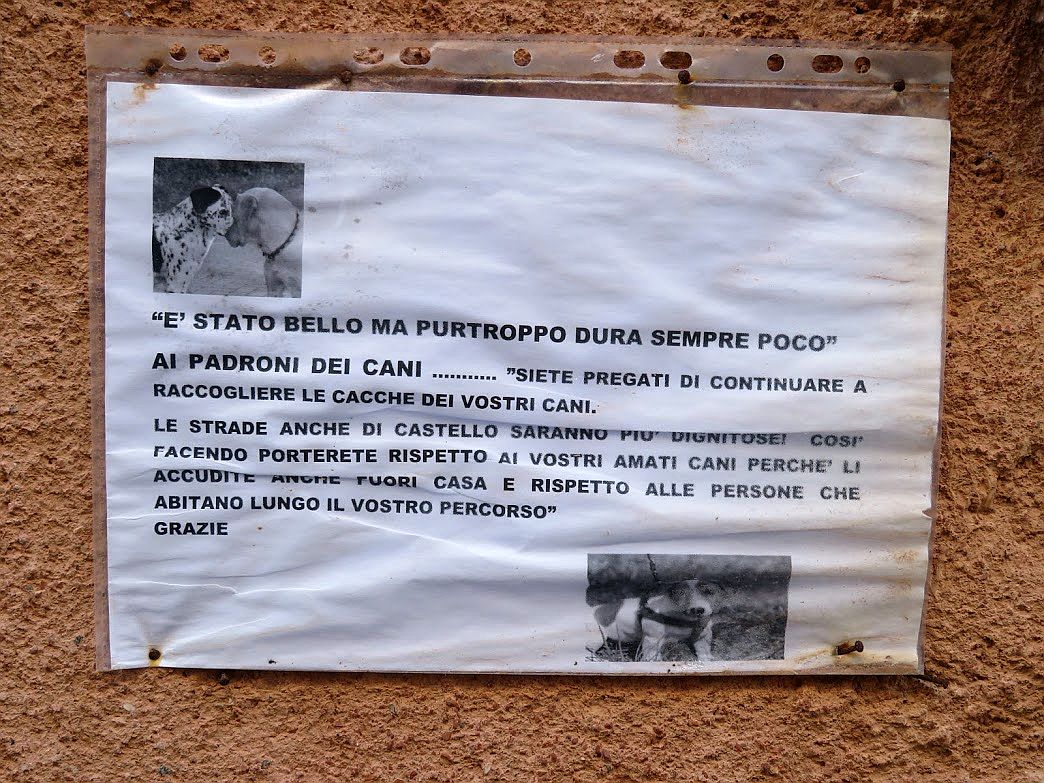
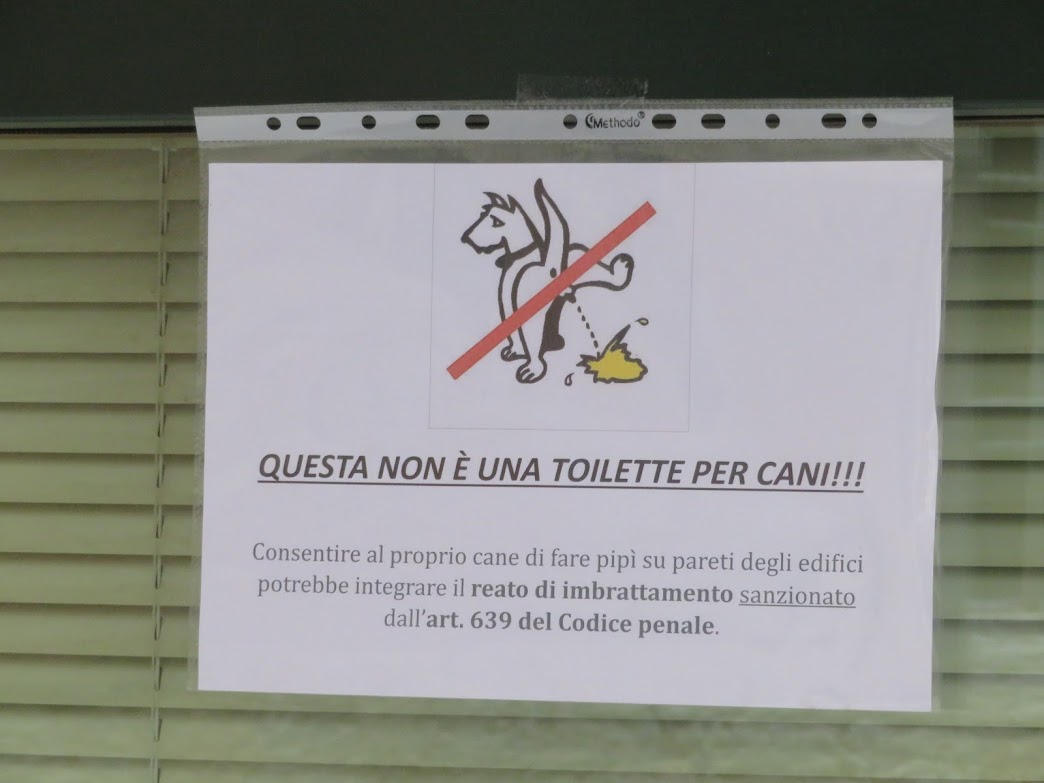
The offended party has put this where everybody walking north (or, briefly, east) is sure to see it.“The campiello is not your dogs’ toilet. Be ashamed.” A common complaint, always heartfelt, always futile.Same problem expressed a little more elegantly here.“Do you love your dog? Take his crap home. We didn’t throw our kids’ used diapers on the street but we took them home. Think about it.” It seems odd to equate love for your dog with basic politeness to humans; the dog certainly doesn’t equate love and poop. But the emotion is the point and yes, it’s true, it would be just as bad to dispose of diapers in a similar way. But, unhappily, here public spaces don’t belong to everybody, they belong to nobody, so the good times keep rolling. Note also that this neatly printed message has been inserted into a sort of thick plastic envelope that has been nailed to the wall. Not for this person a few strips of tape — this reprimand is intended to last.The notice-leaver has made an equally eloquent point by creating and installing this wedge of wood. It needs no sign to get its message across: “This surface is no longer flat because if it were it would immediately become a mini-garbage heap.” I can promise you that if it were available, it would be stacked with abandoned Coke bottles, gelato-cups, crumpled napkins, half-empty cans of beer, maybe some squashed juiceboxes, a couple of candy wrappers, and whatever else could be made to fit until it fell over. The guardian of this space isn’t appealing to your better angels here, he/she/they are just getting the job done.It just never ends. “It was beautiful but unfortunately it lasted only a little while,” the notice begins. Evidently the previous appeal had some effect, but not for long. “To the owners of dogs … You are prayed” (literally — it’s like “prithee”) “to continue to collect the turds of your dogs. The streets also of Castello will be more dignified! Doing this will bring respect to your beloved dogs because you care for them even outside your house and you also respect the people who lived along your route. Thank you.” And just when you thought that defecation was the dog’s only transgression, just wait.The ladies who have taken our previous doctor’s space for their studio/workshop are also not amused by canine functions. And their approach leaves the homespun “Be ashamed” far behind as they prepare to throw the book at the guilty: “This is not a toilet for dogs!!! To permit your dog to piss on the walls of buildings could qualify as the crime of soiling (public walls) that is punishable under Article 639 of the Penal Code.” That’s quite a cannonball to fire at a dog-owner. The crime referred to here is the one usually committed by hooligans with spray-cans of paint, so yes, one could conceivably draw a certain parallel. But I have to stick up for the dogs here. Where are they supposed to go? I can understand owners needing to carry away their dog’s poop, but must they race to get their pooch to the nearest tree? The normal resolution of the dirty-wall situation is a bucket of soapy water, reinforced with bleach, if you want. I think the Penal Code has bigger problems to solve. Get a life, ladies. And a bucket, like everybody else.
On to the hazards of maintaining a small earthly garden in the street.
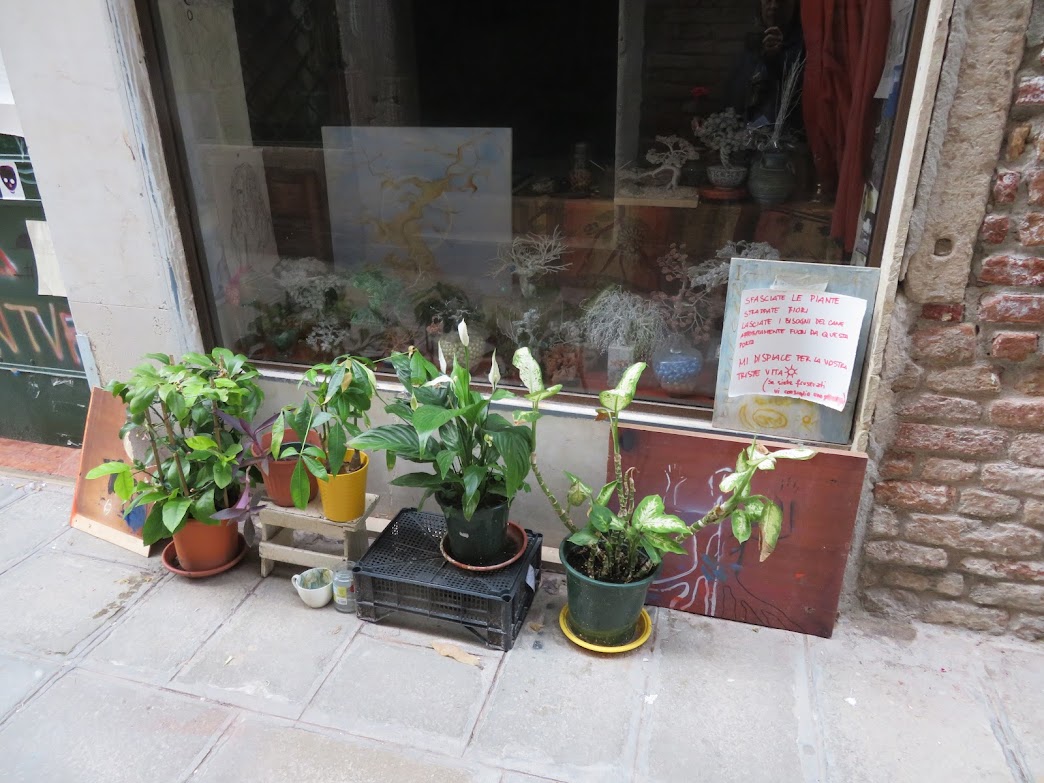
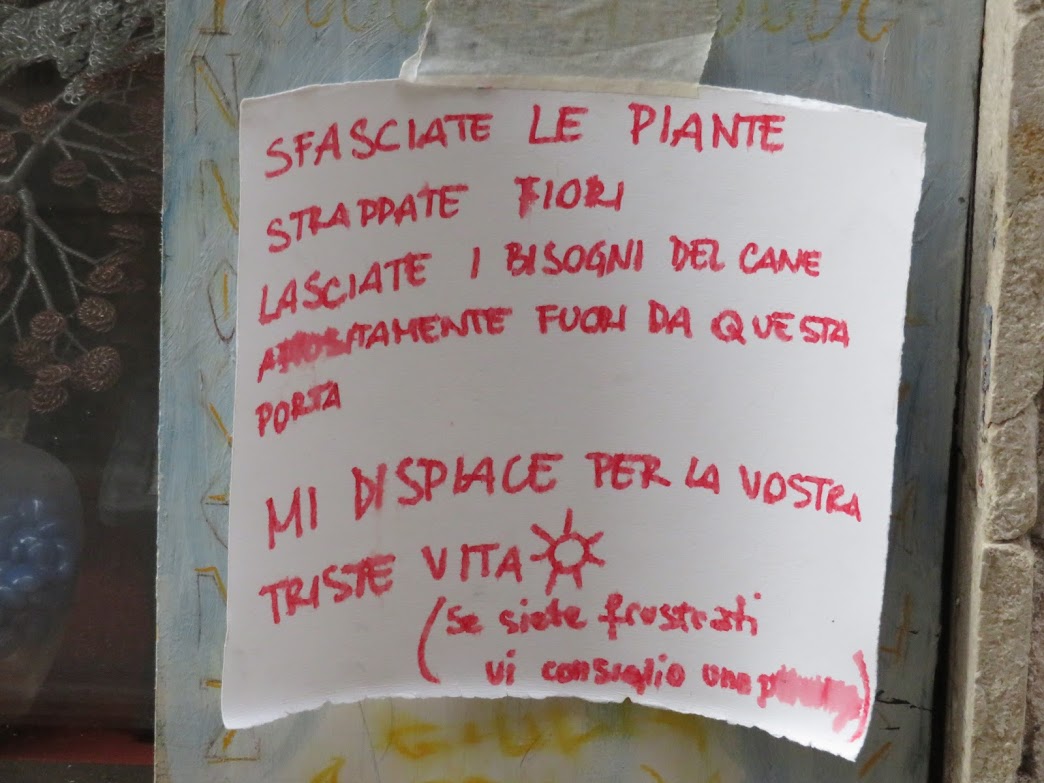
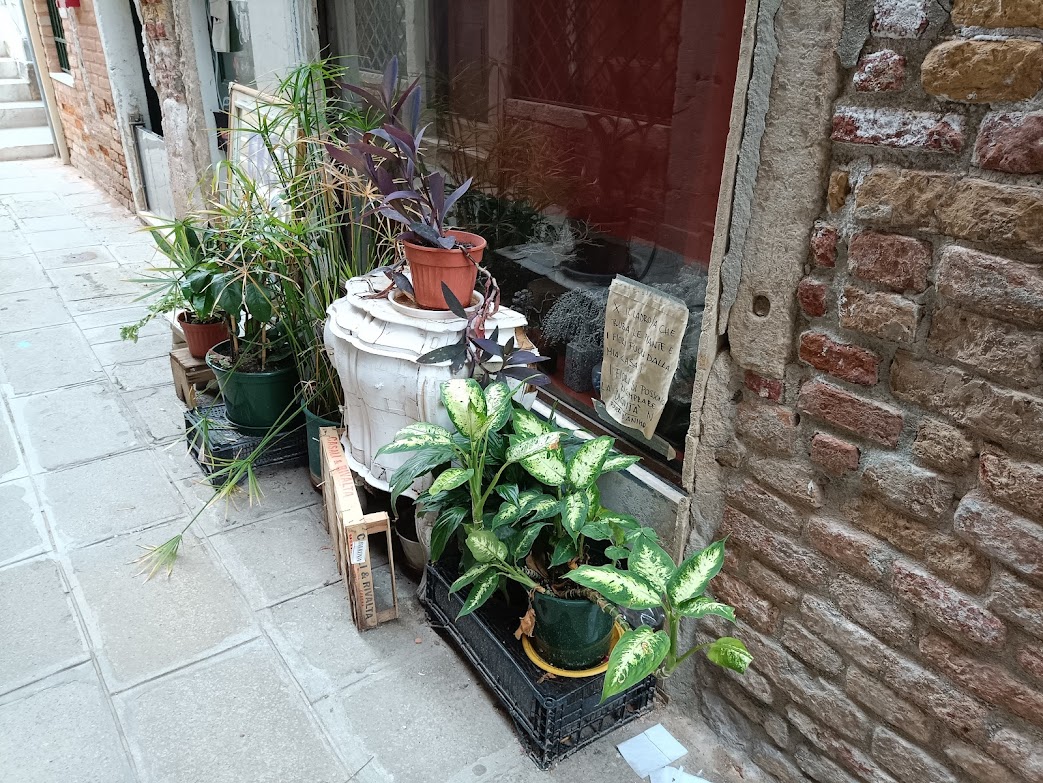
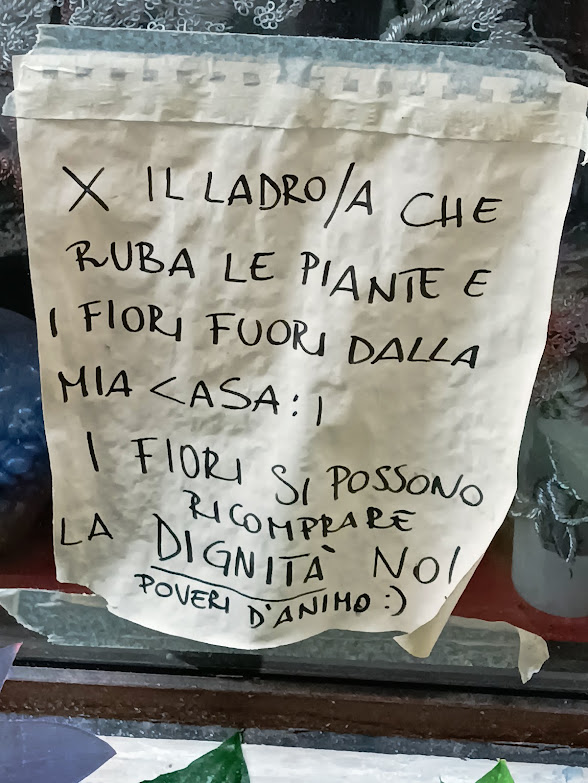
Did you know that plants can also create problems? Or rather, the people around the plants. It has not been a good day at the oasis.“Wreck the plants, tear off the flowers, leave the dog crap on purpose outside this door, I feel sorry for your sad life. (If you’re frustrated, I advise you to see a psychologist.”) Too bad the crap had to remain on the list of infractions, but there’s just no getting away from it, even in a dismembered conservatory.These little doorway groves have, not to put too fine a point on it, broken several ordinances, but “live and let live” has been the operating philosophy here for quite a while. Until one day, it wasn’t. Somebody didn’t want to let live.“For the thief (feminine or masculine forms of the word, just to be comprehensive) that steals the plants and flowers outside my house: The flowers can be replaced, but dignity NO! (You are) persons whose spirits are poor” (as in threadbare). I regret the flowers, but at least this time dogs aren’t involved.
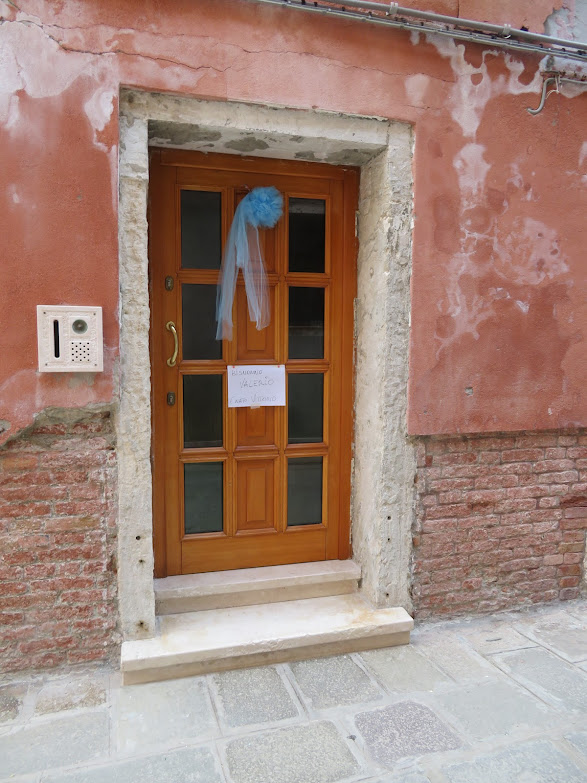
On a happier note, there is a little old man named Valerio who continued to work in his carpentry shop for decades, or perhaps eons, considering how extremely old he looks. But he kept at it until one day…
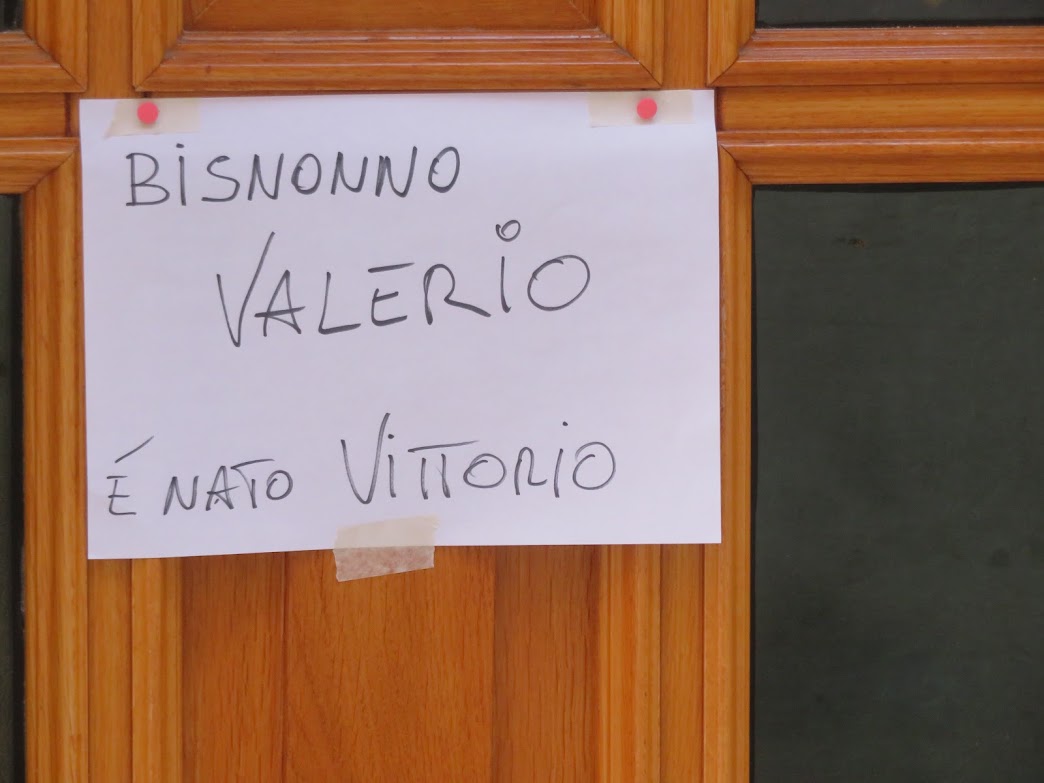
A telltale blue ribbon appeared on his door, next to his workshop. A baby boy!It simply says “Great-grandfather Valerio Vittorio is born.”
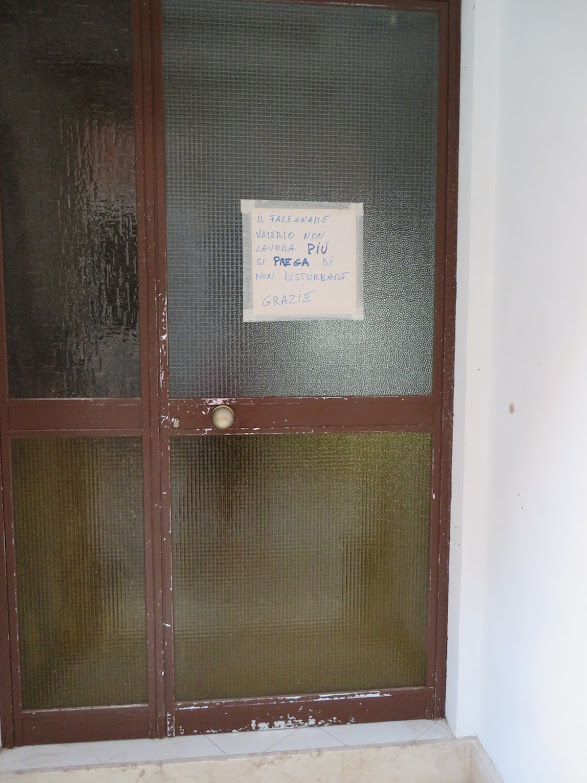
Not many days later, a sign appeared on the workshop door:
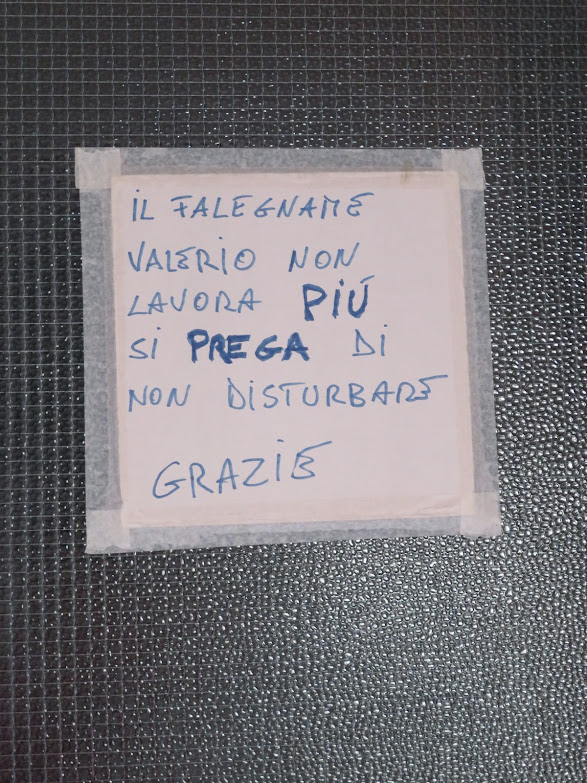
“Carpenter Valerio is no longer working. PLEASE (literally, “one prays”) do not disturb. Thank you.” Yes, Vittorio was the signal that it was time to clean out the workshop and put away the tools. And Valerio has been doing just that. Great-grandfathering is a full-time job.
Tourists do not pass unobserved.
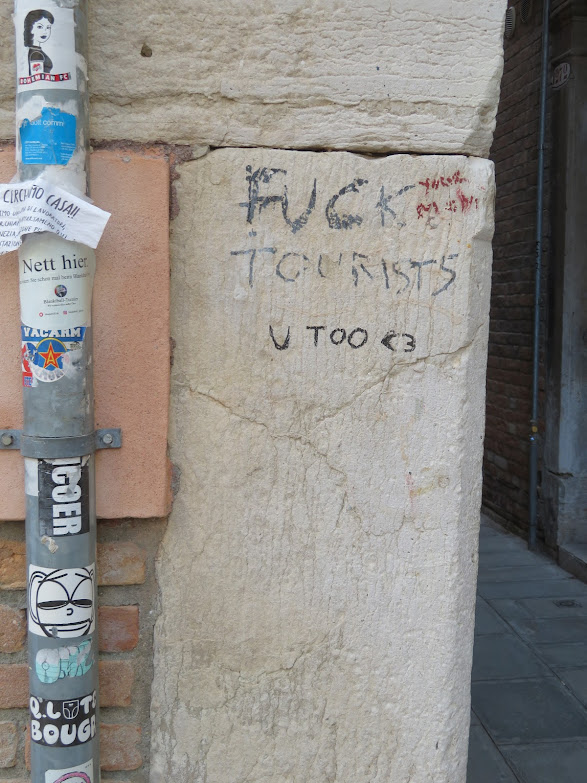
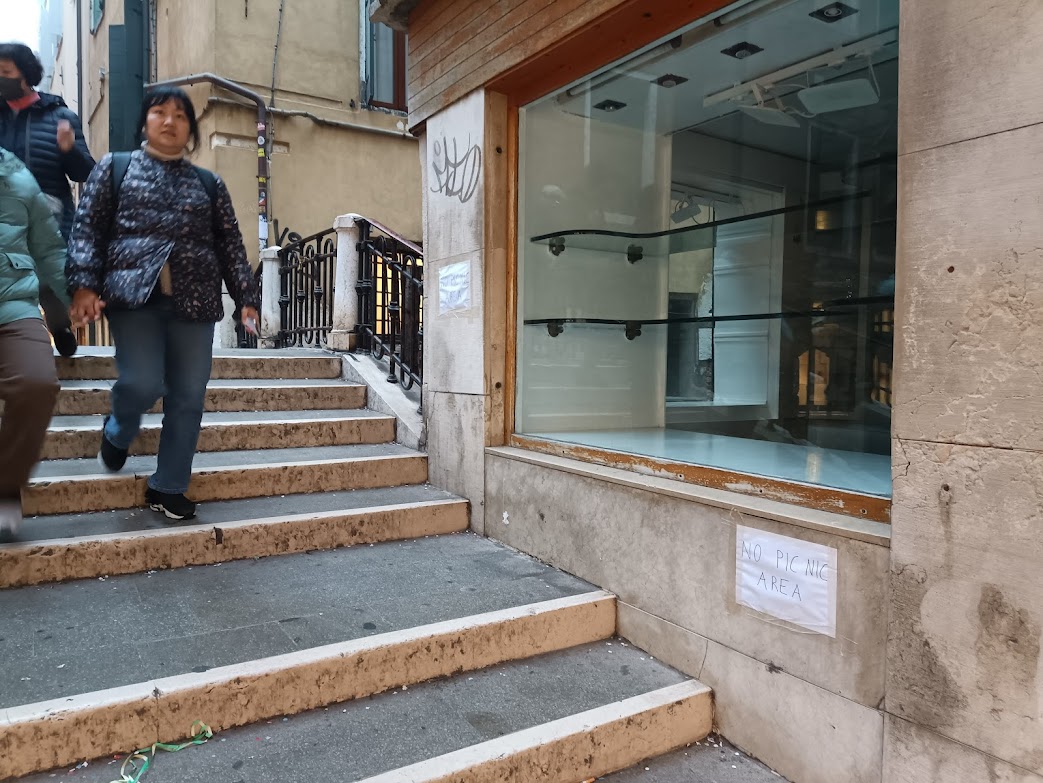
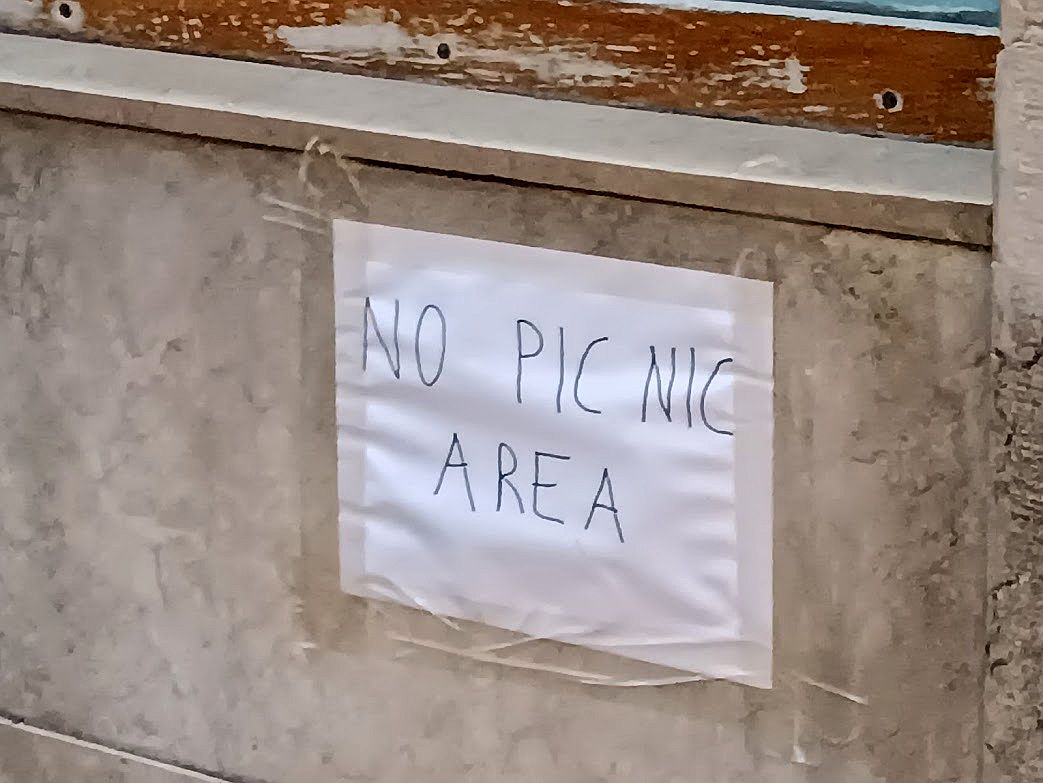
Not far from the train station is this remark, followed by two rejoinders. It’s probably a political statement of some kind. I can tell you that no one with a hotel, bar, cafe, restaurant, or shop selling anything would be likely to express this thought, especially after the months of pandemic lockdown. But free speech is thriving.If the tourist doesn’t know not to sit on a bridge to eat, this shop will make it clear. “No Pic Nic Area.”The fundamental problem is that there is are too few places except the 436 bridges on which to sit to munch your slice of cold pizza or assorted carry-out comestibles from the supermarket. It is true that many (not all) campos have at least a few benches, though it is also true that bridges are the ideal perching places. But you’re blocking the traffic, for one thing, and for the other, you look like vagrants, huddled on the steps wrestling with prosciutto slices and bags of potato chips.
So much for signs for tourists. For locals, almost no details are necessary for communication:
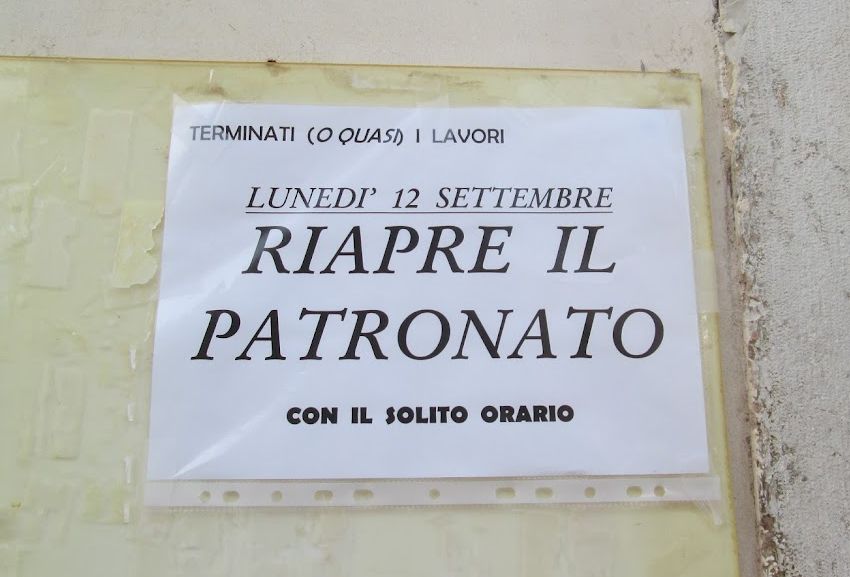
A few years ago this was posted at the door of the church of San Francesco de Paula. “Finished (or almost) the repair/restoration work. Monday 12 September the patronato reopens at the usual time.” That’s right: The usual time. If you don’t know when that is I guess you don’t belong there. Note: The patronato is what you might call the parish hall/playground/sports area of the parish. Every church has one, and scores of activities take place there for the children of the congregation. Not to have the patronato available after school is a major problem, so this is good news.
On a similar neighborhoodly note:
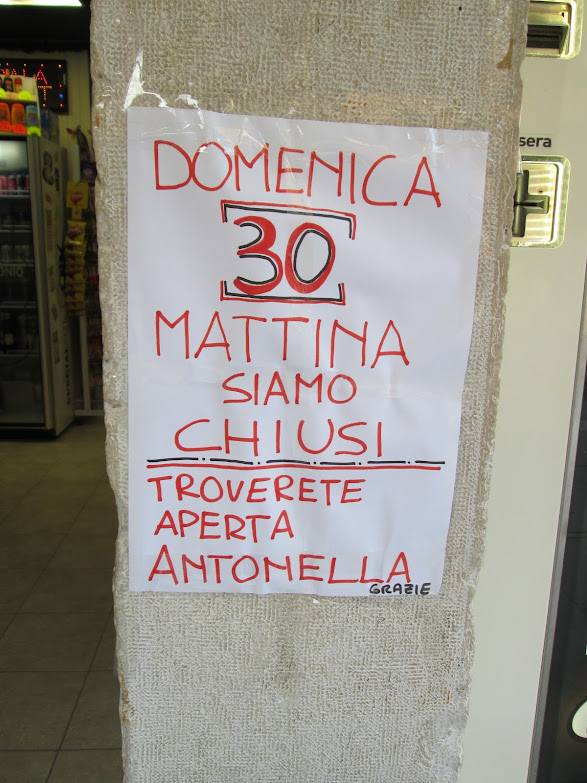
“On Sunday 30 morning we’re closed. You’ll find that Antonella is open.” There is no sign outside her tobacco shop that says “Antonella.” You just have to know.
Moving into the realm of city government, or lack thereof, the Venetians in our neighborhood (and others, I can assure you) have plenty to say. The comments tend to run along the following lines (and I’m not referring to clotheslines):
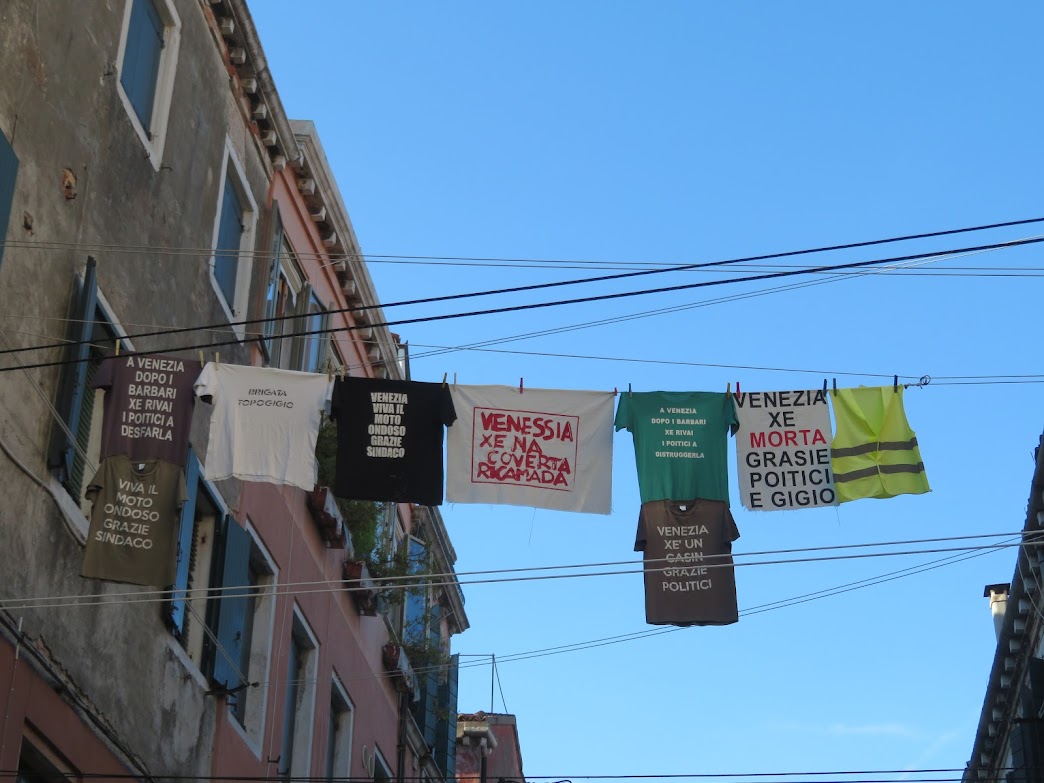
I have seen a man wearing a few of these; I am assuming he also made them. All hung out to dry together, they make quite a screed. Written in Venetian (L to R): “After the barbarians came to Venice the politicians arrived to destroy her.” “Long live motondoso thank you mayor.” “Topo Gigio Brigade.” You may recall the little puppet named Topo Gigio who appeared several times on the Ed Sullivan variety TV show. Gigio is the nickname for Luigi, which also happens to be the name of the current mayor, Luigi Brugnaro. He has no fans in Venice, let me just put it that way.Being compared to either a rat or a children’s toy is not what most mayors aspire to, I’m pretty sure.
Continuing with the runic messages delivered by T-shirt: “Venice is an embroidered bedspread.” This one is complicated and I have no hope of clarifying its evidently metaphorical significance. I do know that there is a song that begins “Il cielo e’ una coperta ricamata” — the sky is an embroidered cover, which is lovely. Is the intention to say that Venice is as beautiful as an embroidered cover? I think there is some irony here, but it eludes me. Maybe I’ll run into this person again (I saw him at the fruit-vendor one afternoon) and I can just ask him. Meanwhile, on we go.
“Venice is a casin thanks politicians.” A casin (kah-ZEEN) is a brothel, where gambling also went on, and sooner or later tumult ensued. And not tumult of any polite, Marquess of Queensberry sort. It’s now the usual word for any situation that entails chaos, perhaps danger, racket and rudeness. It appears to many that Venice is speeding downhill with no brakes (again, motondoso comes to mind) and nobody at the wheel. Some people also refer to the city as “no-man’s land.” Literally everybody is doing whatever they want, and the result is pure casin.
Lastly, “Venezia is dead Thanks politicians and Gigio.”
While we’re talking about citizens’ discontent….
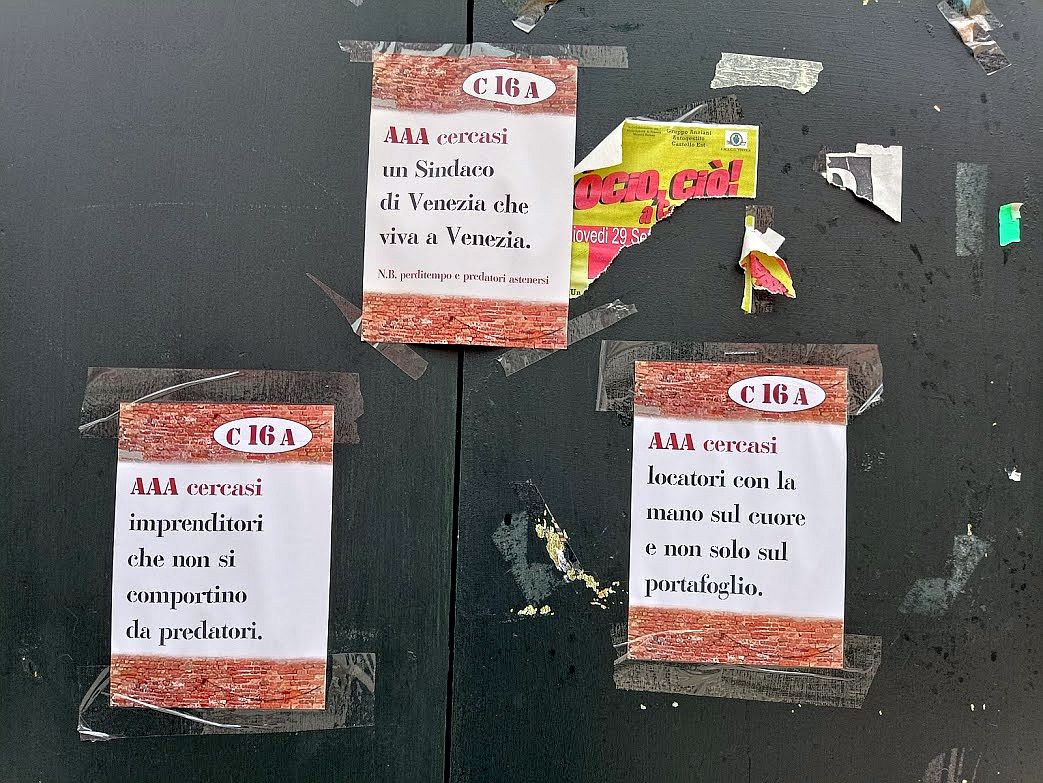
A group calling itself C 16 A (abbreviation of Coordinamento 16 Aprile) was formed to condense the general consensus of thoughts regarding the problems of the city. This was in preparation for a vast gathering planned for 16 April this year on the occasion of the 50th anniversary of the Special Law for Venice. The common goal was identifying the myriad ways in which the city has wasted its opportunities since then. “AAA cercasi” is the customary code for when you want to place a notice seeking something or someone at the top of an alphabetical list. These notices are looking for: “A mayor of Venice who lives in Venice.” (Luigi Brugnaro lives in Spinea, on the mainland.) “Businessmen who don’t behave like predators.” “Landlords with their hand on their heart and not only on their wallet.”
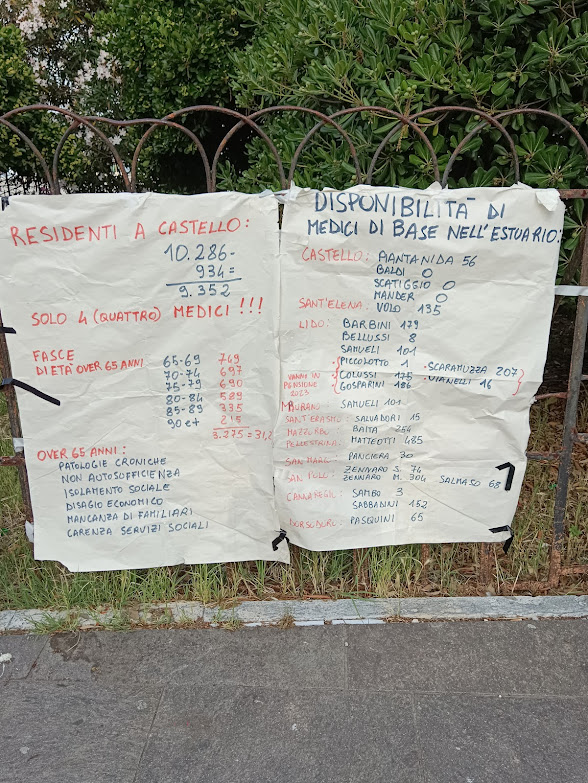
And this handwritten cri de coeur summarizing the profound crisis in the public health system. The people of lower Castello are persevering in their apparently hopeless struggle to obtain a reasonable supply of doctors:
Residents in Castello: “9354 and only 4 doctors. Age groups over 65 years old. (Note that there are 215 residents who are 90 or older.) People over 65 years old have chronic pathologies, are not self-sufficient, suffer from social isolation, economic distress, lack of family members, defective social services.” There are not enough “basic doctors.” The basic doctor is assigned to you by the public health service and is paid by it. Many doctors are retiring, so a huge hole is opening up in the near future. Let me say that there is a reasonable number of doctors, but the number of those that want to practice for the public health system is too small. A doctor with 1,500 patients assigned to him/her (it’s the case with our doctor) earns roughly 52,500 euros ($56,000) per year. They also usually have private practices, but still. One can see the lack of incentive. Meanwhile, the aging population needs more care than it’s getting. The city is trying to encourage doctors, I don’t know how, to stay on even after they turn 70 years old.
There are also signs without words that hint at approaching events or persons.
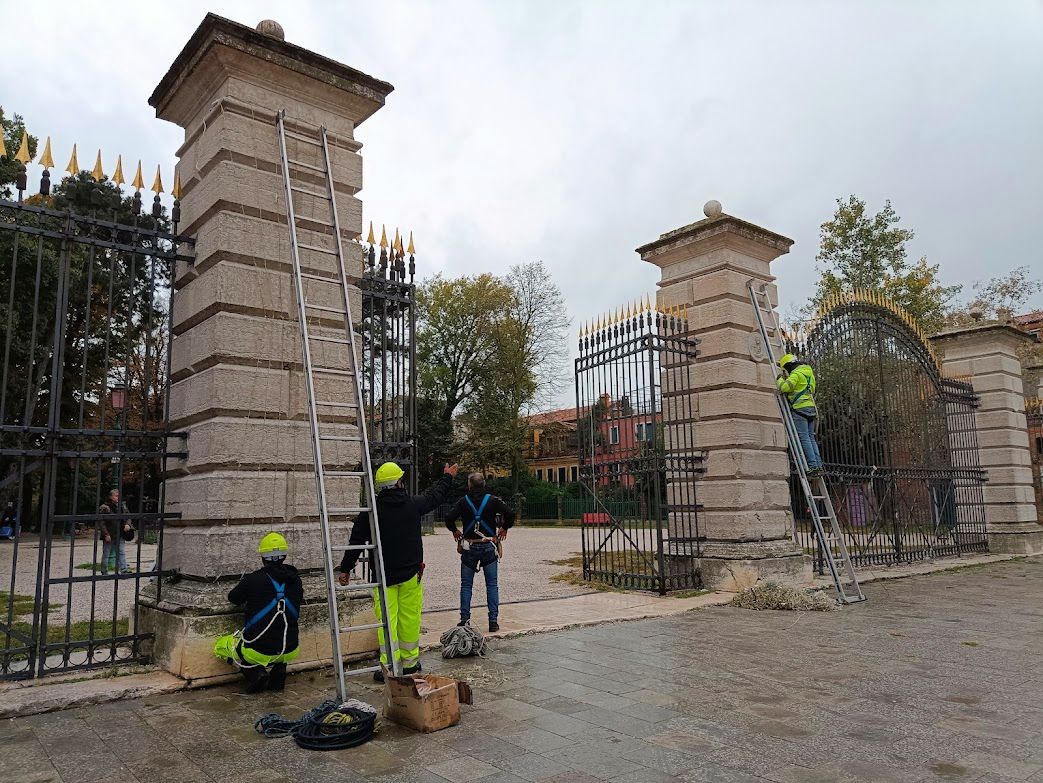
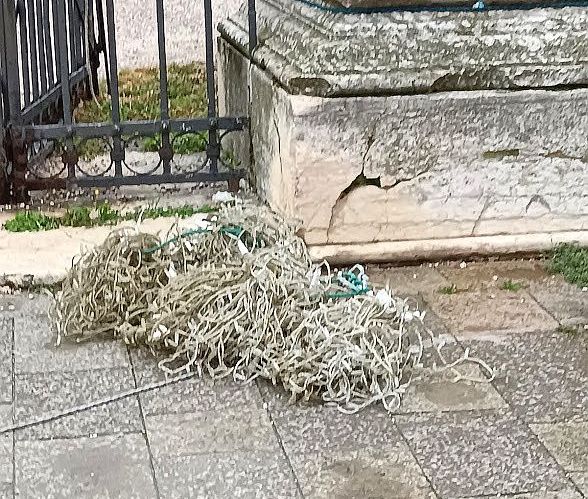
In a word: Carnival. It started early last year by the eager tiny hand of a tiny person.Did you know that Christmas is coming? These men know it, because this morning they began to string the holiday lights in via Garibaldi and environs. Exactly two months in advance seems like a lot of time, but if there are only four men assigned to it, better get going early. (If you don’t make them out, the strings of lights are being drawn down the surface of the stone gatepost in a triangular Christmas-tree pattern.)The strings of lights are another reason for the early start. You thought the tangled mass that lives in your basement or attic is an irritating start to the holiday season? These men have quite the little assignment facing them.
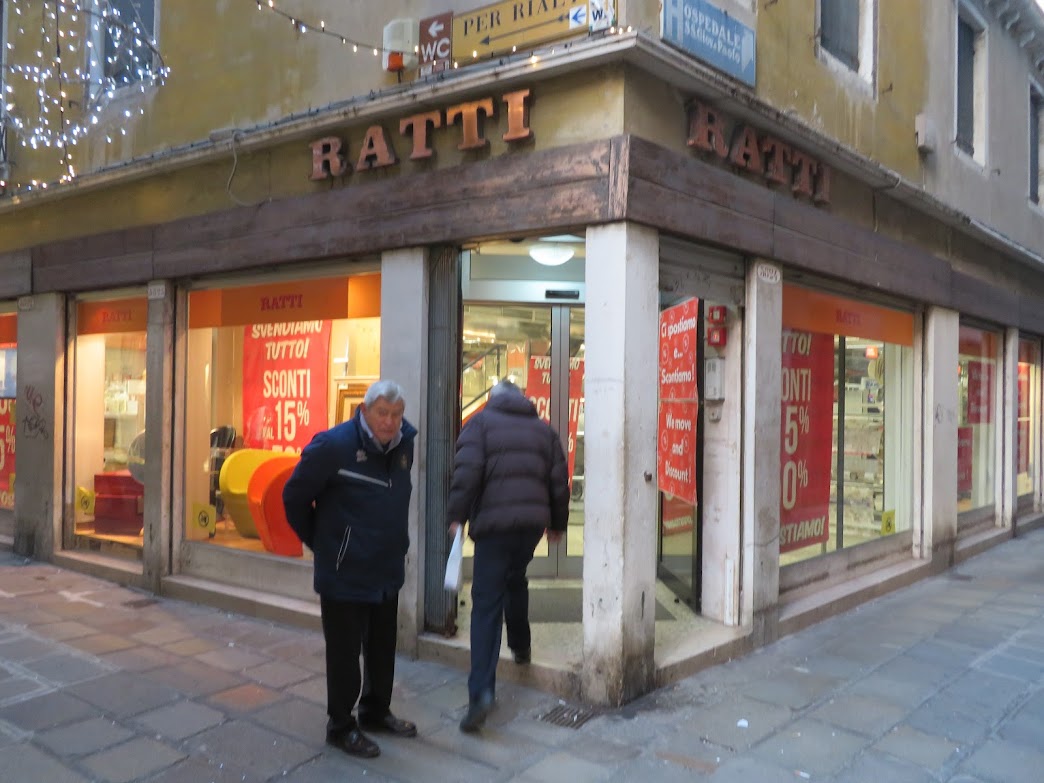
An approaching event I never thought I’d see. The city’s greatest housewares/hardware store having its final sale before closing. They tried to keep going after Covid. They stayed open all day (as opposed to closing in the early afternoon, like every reasonable store used to do). Then they stayed open all week. Unheard-of. It wasn’t enough. I can’t tell you how bad this is. I haven’t gone by recently to see what’s taking its physical place; not much can replace something so great. It used to be that useful stores (butcher shop, fruit and vegetables, etc.) would suddenly begin to sell masks or Murano glass. Now they will be either a restaurant or bar/cafe’. That’s my bet for the once-great Ratti.
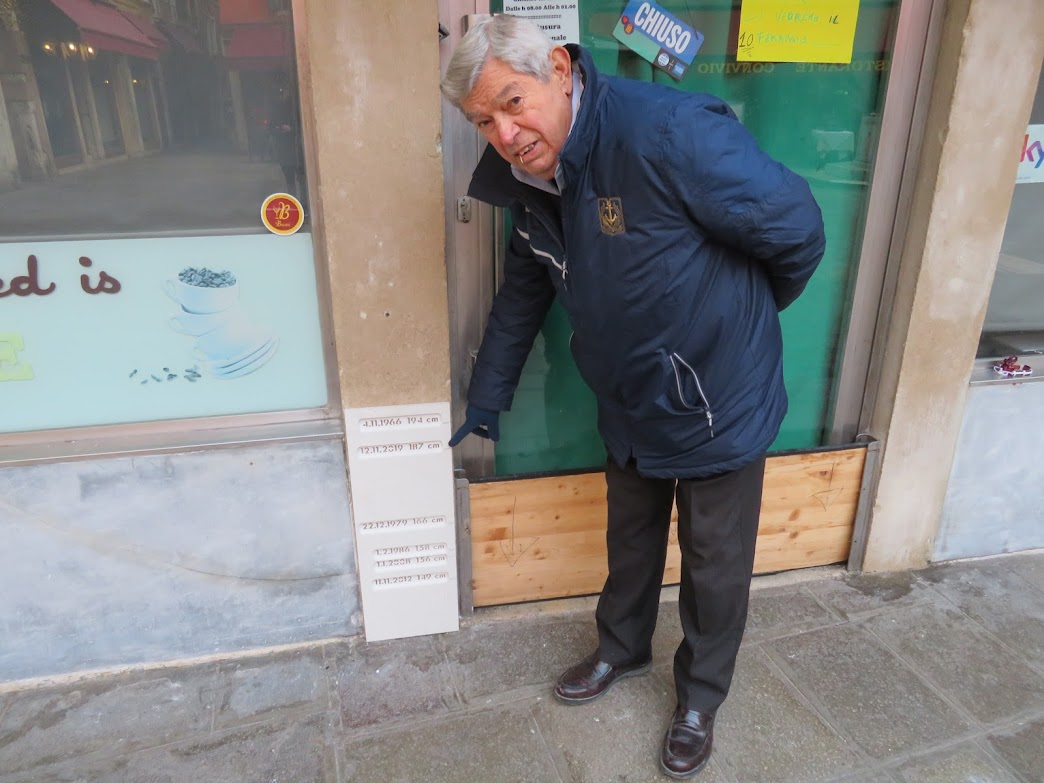
“Selling everything! Discounts!” They make it sound like something wonderful. It was more wonderful without the “closing” posters. I have been informed by sharp-eyed readers that Ratti has reopened in not one, but two locations not far from the Rialto Bridge. This is news of a goodness one doesn’t receive every day, so I am really glad to know they have found a way to keep going. And yes, I should make a point of buying something there, otherwise all my glad words aren’tt worth the electrons they’re written with.The bar/cafe’ “Magna e Tasi” in Campo SS. Filippo e Giacomo near San Marco used to draw these lines on the wall with a Sharpie. They decided to make these indications of acqua-alta calamity more legible, and elegant. And waterproof.
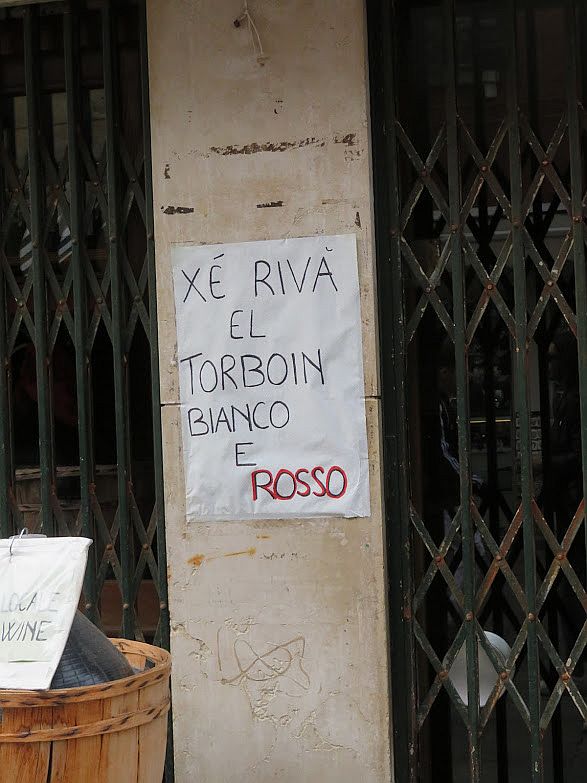
The arrival of certain foods are reliable harbingers of seasons or events, though seeing clementines for sale in October is not normal. But this is absolutely the moment for torboin (tor-bo-EEN).
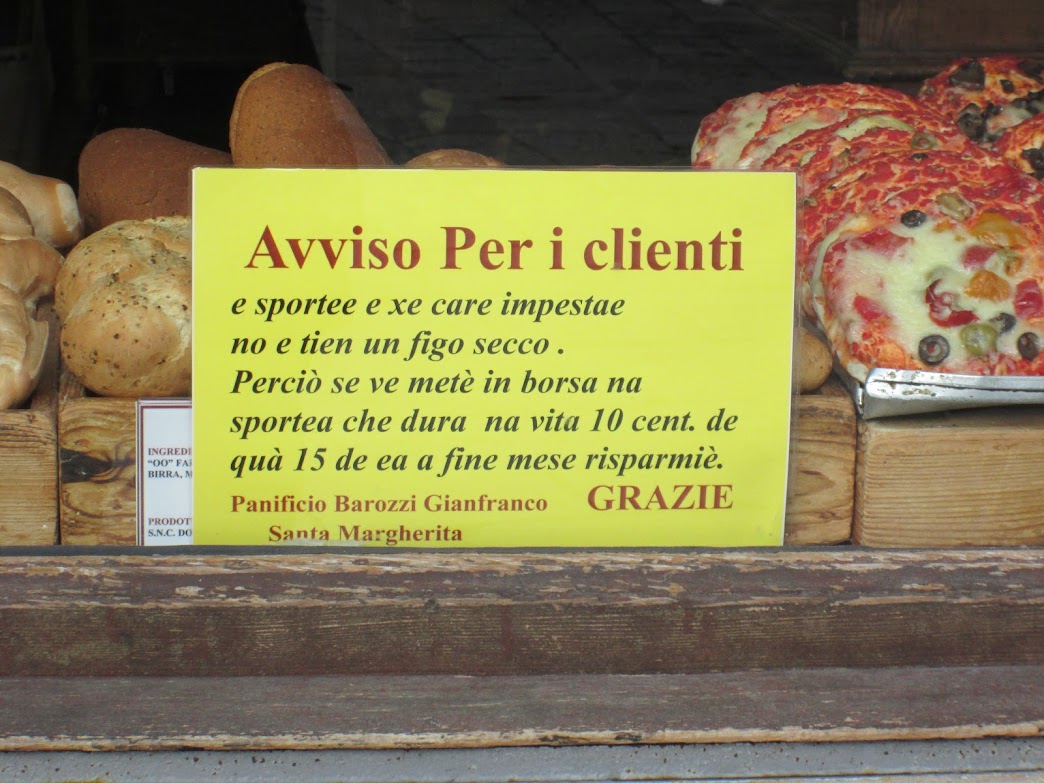
This is Venetian for “The torbolino has arrived white and red.” In Italian it would be “E’ arrivato il torbolino.” This is a sign of the progress of autumn, as demijohns arrive from Sant’ Erasmo loaded with the first drawing-off of the new wine (otherwise known as “must”). One expert explains that “It is usually from white grapes, not completely fermented, turbid, lightly sparkling and amiable.” It is the classic accompaniment to roasted chestnuts. So it’s good news!One of my all-time favorites was this sign in a window of a bread bakery in Campo Santa Margherita. The owner is making this retort in Venetian to his cranky customers who annoy him with complaints that he (like many merchants) had begun to charge a pittance for the once-free plastic shopping bag for carrying their purchase. “Notice to my clients: “The shopping bags are terrible-as-the-plague expensive and don’t hold up worth a dry fig. So if you put in your purse a shopping bag that lasts a lifetime, 10 cents here and 15 cents there at the end of the month you’ve saved (money). THANK YOU.”
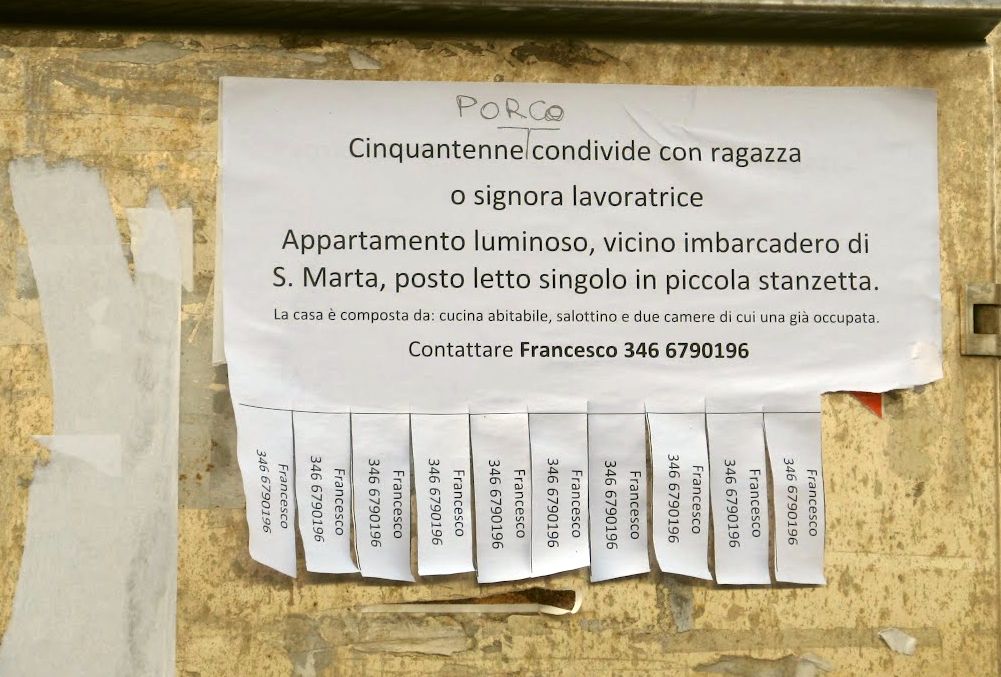
In a class by itself is this astoundingly inappropriate offer of a room with perhaps an undesirable view.
“A 50-year-old man will share with a girl or working woman a sunlit apartment near the Santa Marta vaporetto stop, a single bed in a small room. The place is made up of a liveable kitchen” (meaning large enough to eat in), “a little living room and two bedrooms of which one is already occupied. Contact Francesco…”. Cringe! Unless you’re a student and really, really need to be near the University of Architecture, which may be what Francesco is counting on. Someone has added the word “porco” — pig. Went without saying but it’s still good to see. I wonder if he just forgot to mention a bathroom, or if it’s down the hall. Of the building next door.
Above the chorus of voices on the walls there come a few magical notes from mysterious poetic souls.
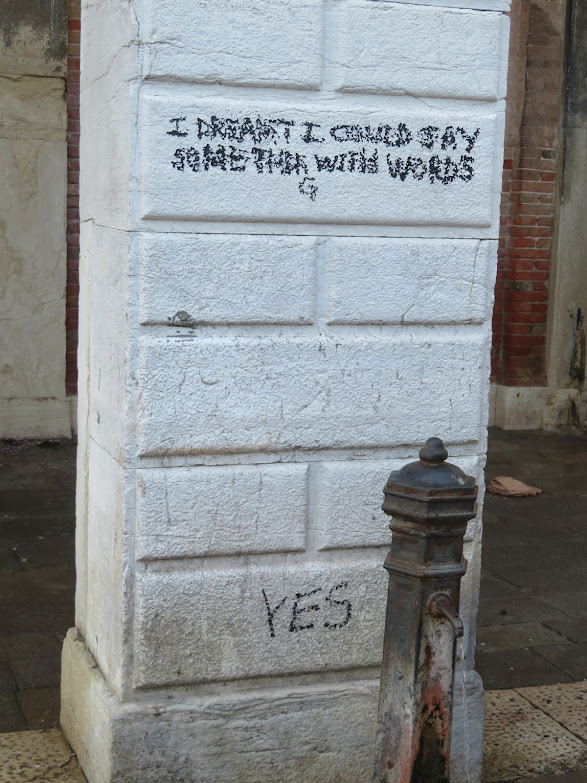
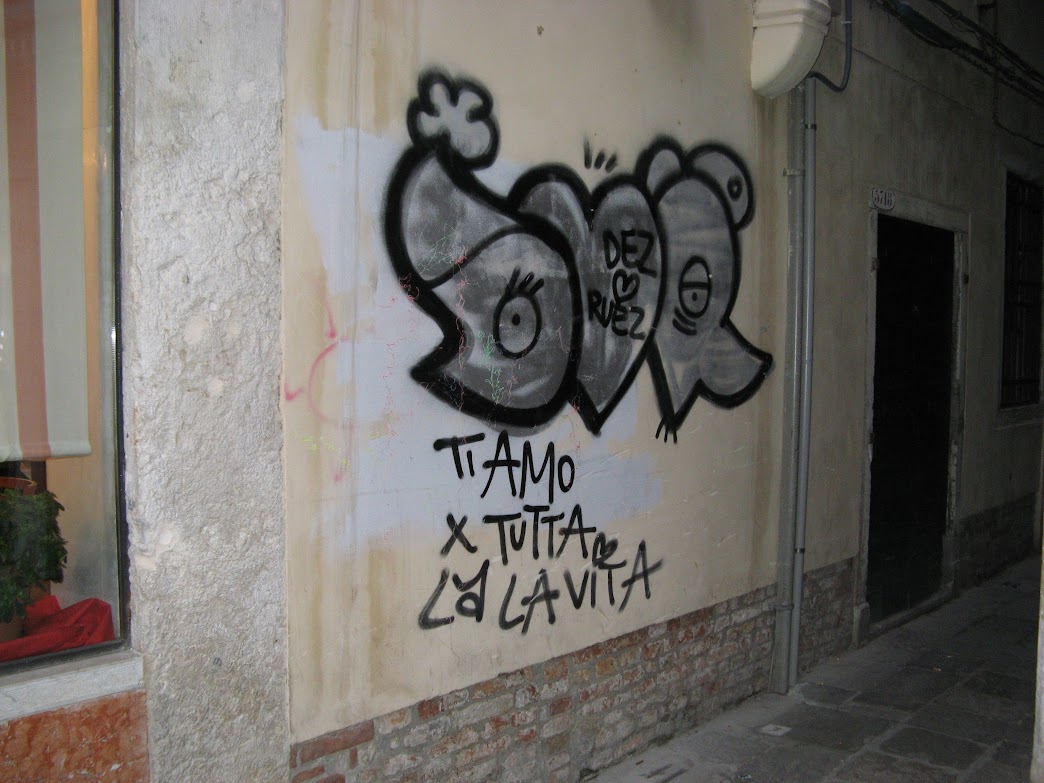
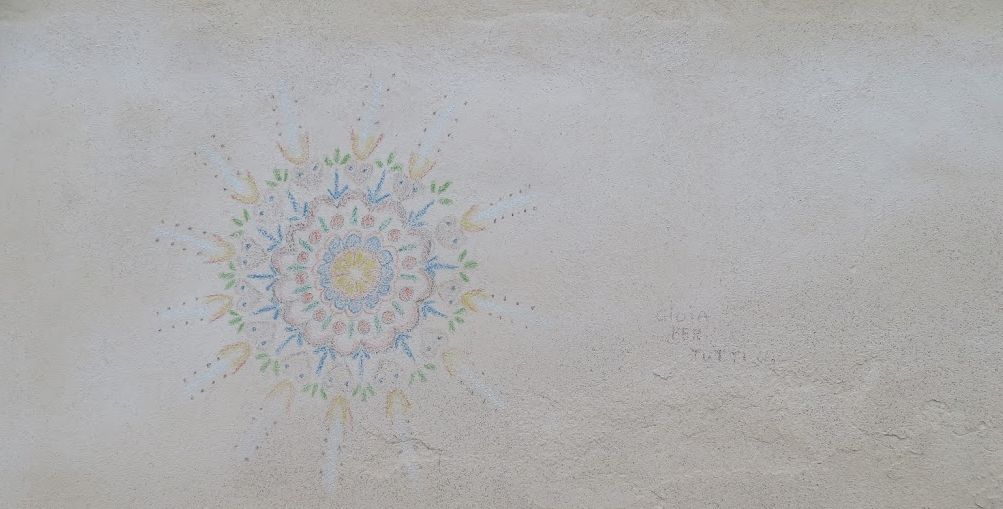
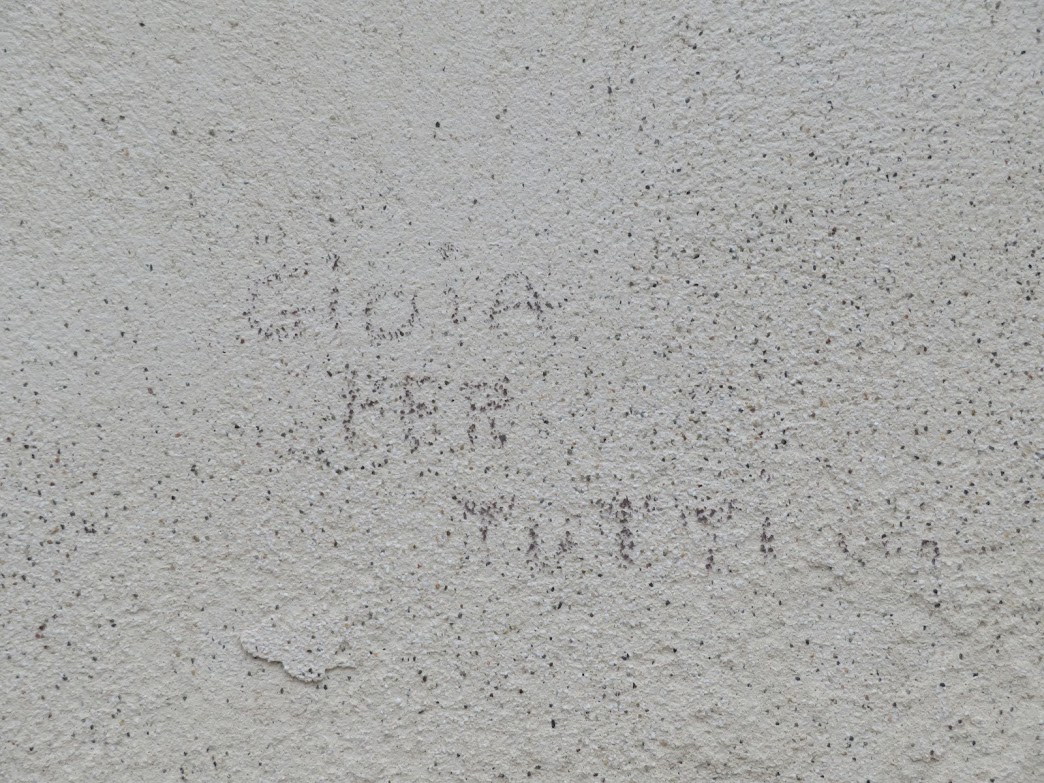
“I dreamt I could say something with words,” wrote someone who either is from England or was taught by someone speaking the King’s English. The answer is strangely poignant. “Yes.” I love this person as much for having to squeeze in the last-minute “g” as I do for the response. One sometimes wonders why certain places are chosen for these messages. Behind a fountain at the Rialto Market doesn’t immediately suggest poetry, but fish and mushrooms don’t seem to clash.“I love you for all of my life.” Dez and Ruez plighted their troth near the Rialto Bridge and while graffiti aren’t to be encouraged, this is really nice. Far better than the “Bomb the multinationals” sort of thing that students like to spread around.On a wall near the church of San Isepo. Not quite this faint in real life, but pretty near. And to the right of the design you can barely make out an important three-word message.“Gioia per tutti.” Joy for everyone.
So by all means stroll through Venice looking at palaces and canals. Just don’t forget the walls.
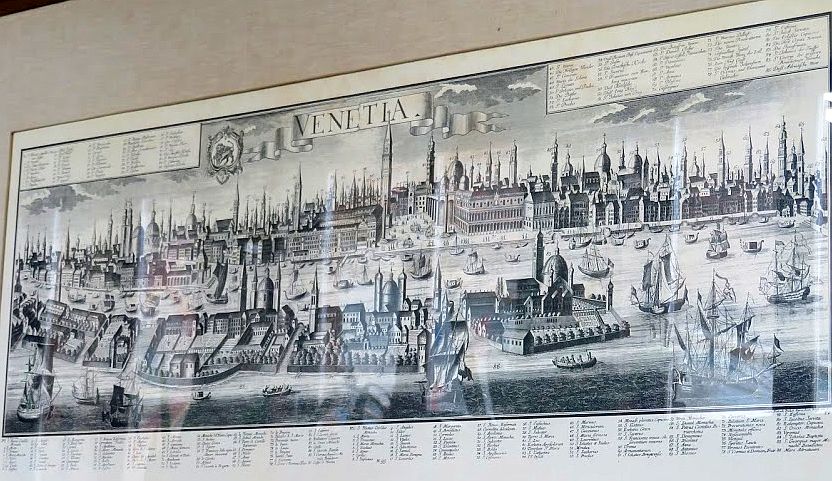
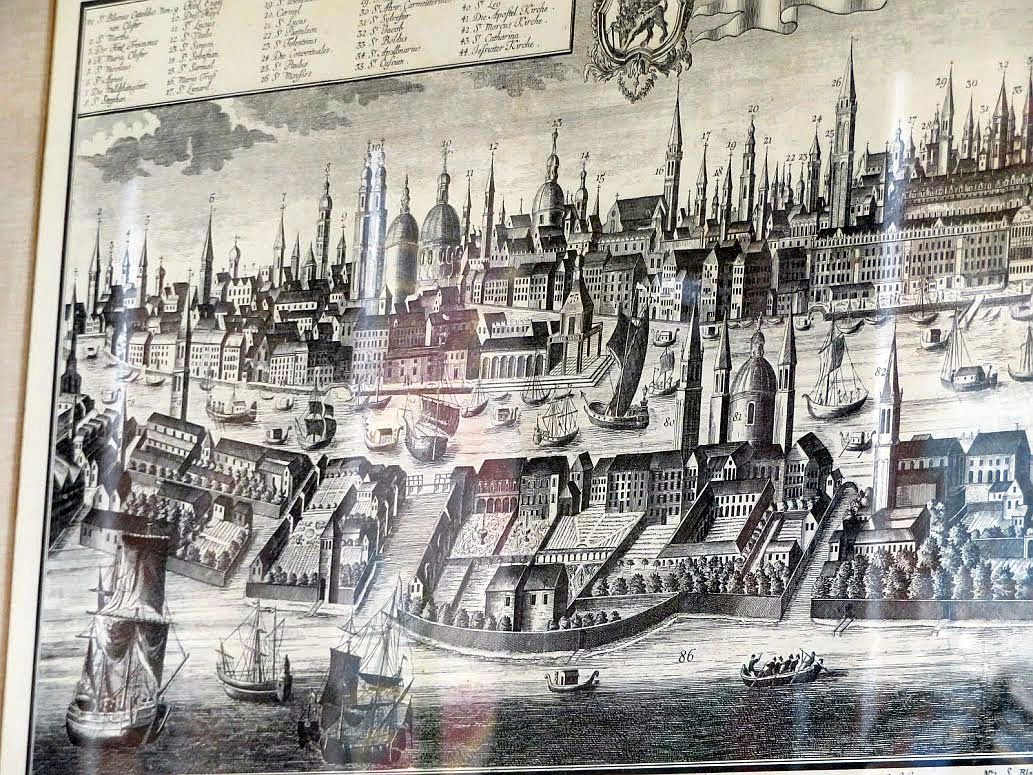
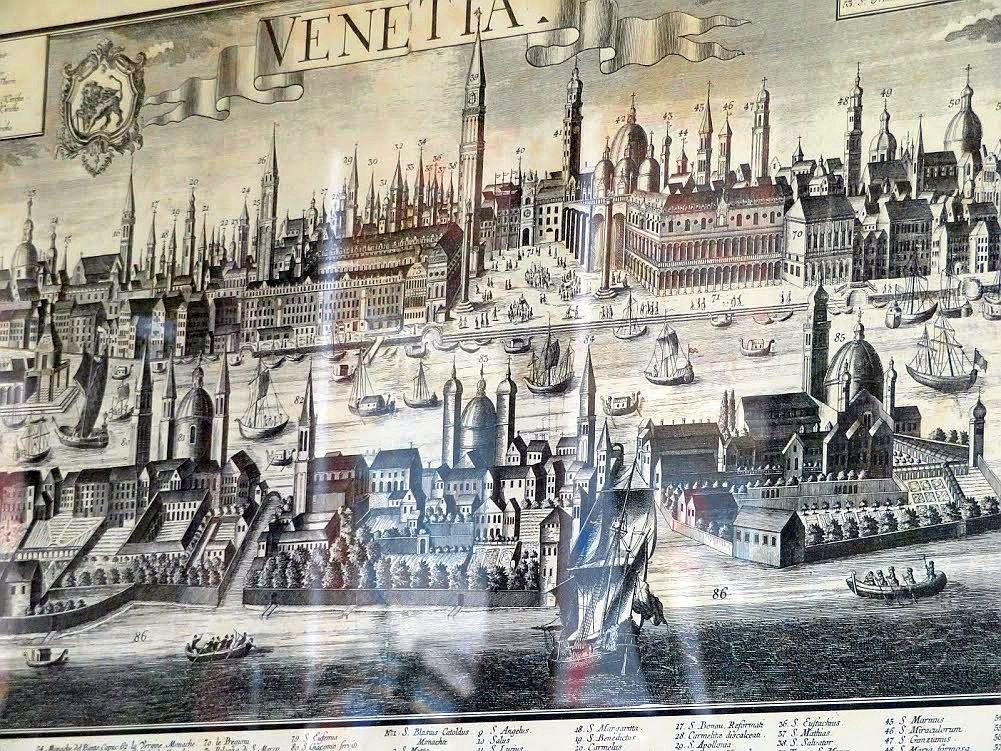
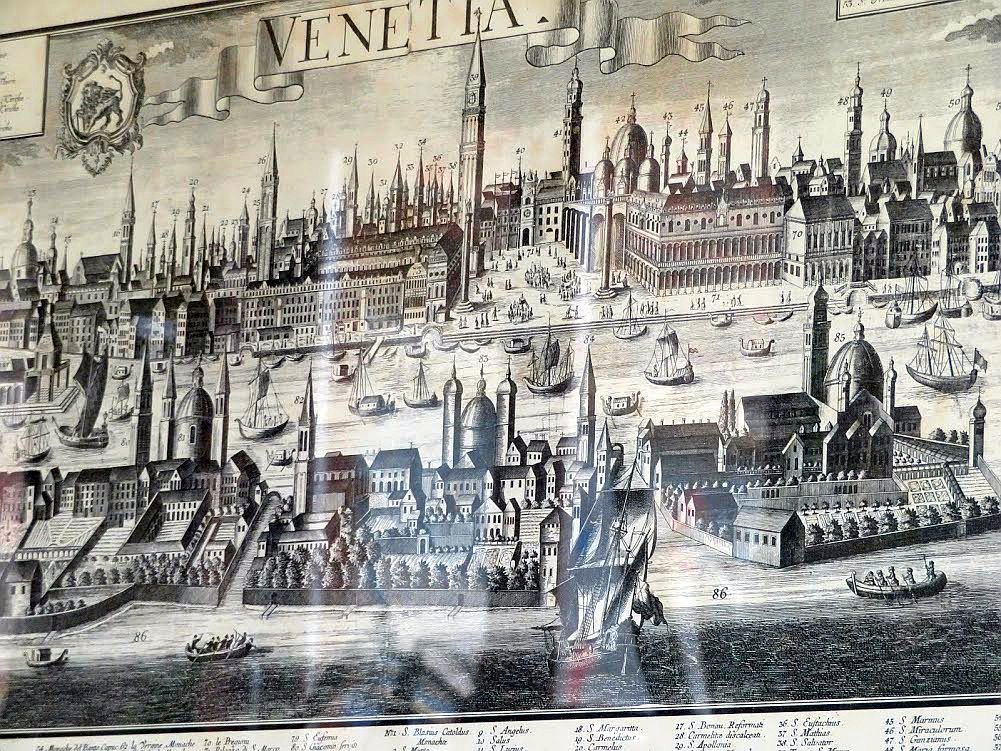
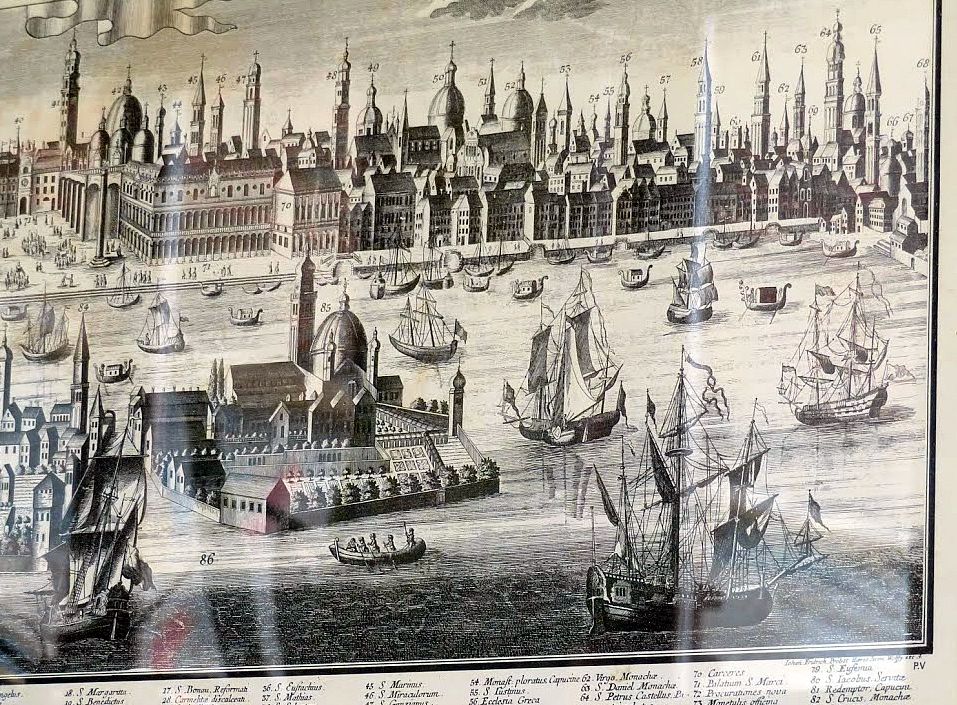
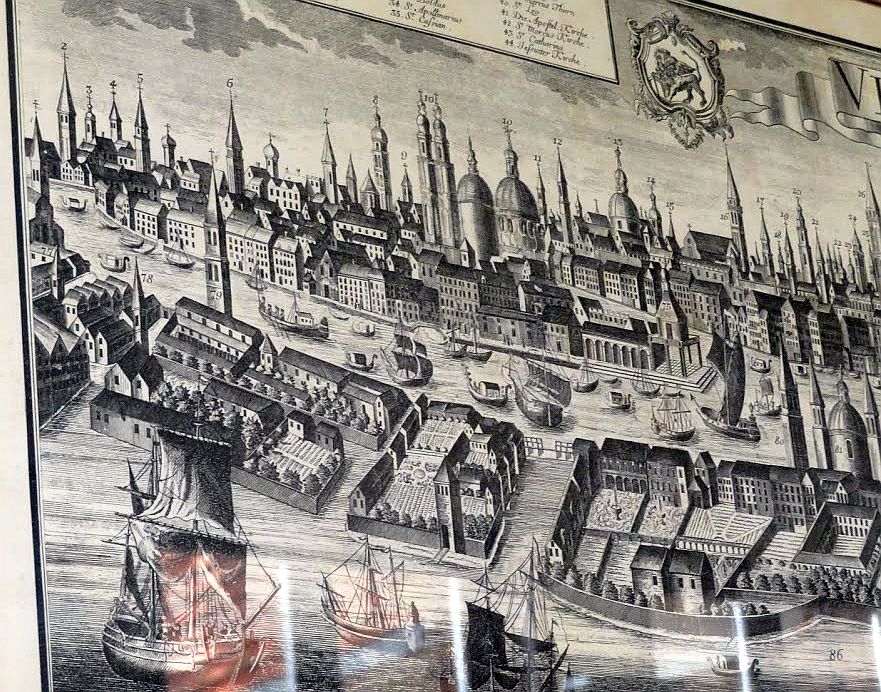
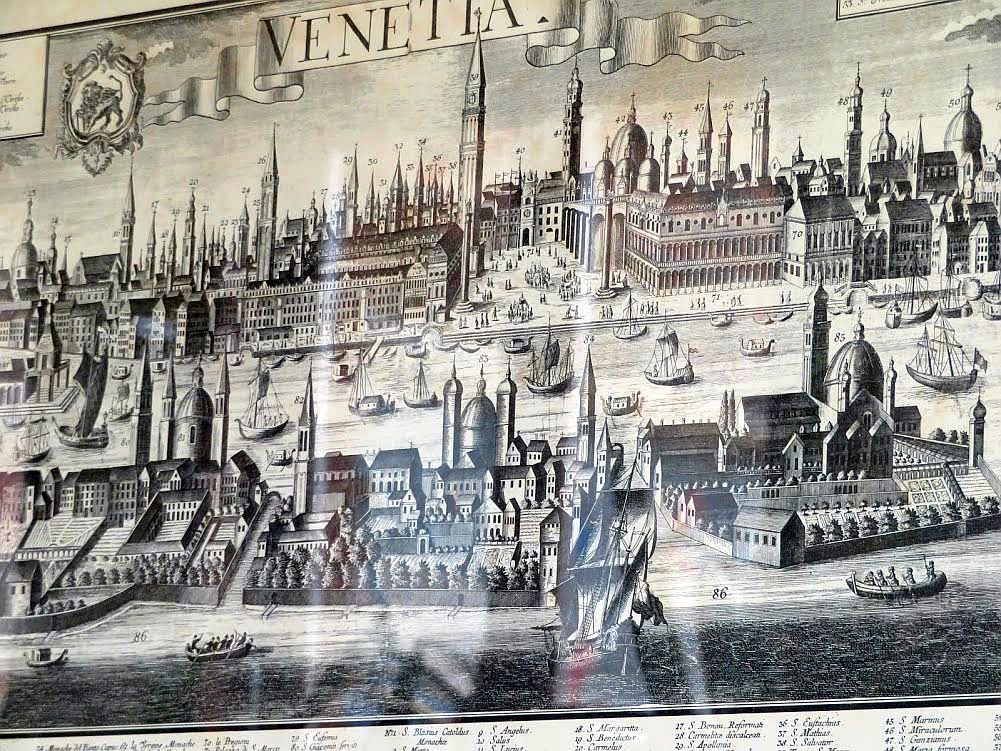
Venice, as drawn by Friedrich Bernhard Werner in 1730. This engraving is part of a large assortment of similar city-views produced by German printers. For the record, these are two conjoined sheets printed in Augsburg by Johann Friedrich Probst in about 1750. Interesting to see that Werner managed to squash some of the more eastern churches into the background on the right-hand edge of the engraving. Inexplicably missing, though, is the church of Sant’ Elena, or rather, its tower, which had been standing there since 1558. Napoleon deconsecrated the church in 1810 and tore down the tower. The regrettable replacement that we see today was built in 1920.
When you think of Venice, you think of canals. I take that as a given. But unless you are a maniac for old maps, you may not have noticed how many towers punctuate the city.
Many (most?) medieval cities in Europe were spikier than a drove of porcupines, and the Venetian skyline in the 1730 engraving can still be discerned. I was all set to blame Napoleon for any that are missing, but he was focused primarily on despoiling churches, not dismantling towers.
The prime destroyer was lightning. It took Venice a surprisingly long time — i.e., more than one disaster — to address the problem of lightning’s propensity to ignite a disastrous fire, but eventually lightning rods were installed on many belltowers. (Along the same lines, gunpowder was originally stored in the Arsenal, and strange to say it took more than one lightning bolt for the administrators to grasp the importance of storing it on neighboring islands. One such island is called San Angelo delle Polvere — Saint Angelo of the Powder. The wisdom of storing gunpowder outside the city was confirmed on August 29, 1689, when lightning struck the island and all 800 barrels exploded.)
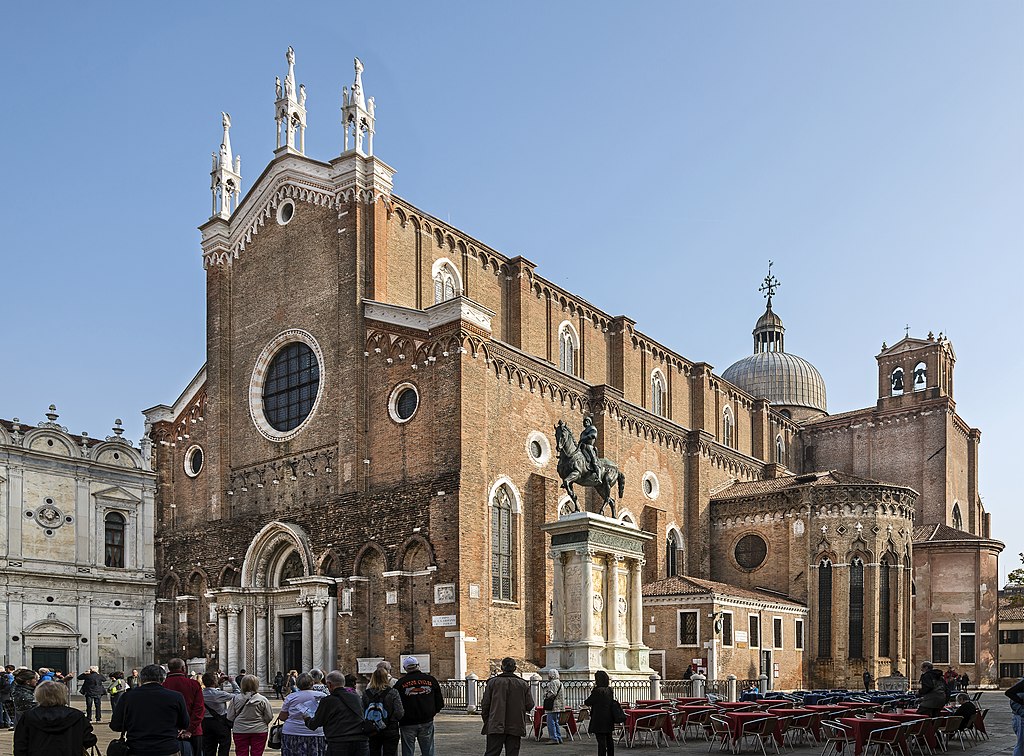
Back to towers. There are a few churches whose bells (or budget) didn’t even merit a tower. Exhibit A: The magnificent basilica of SS. Giovanni e Paolo.
Take whatever time you need to locate the bells. Rockstar church, roadie belltower. This certainly never had a chance to feature on the engraving. (Credit: Didier Descouens, own work, CC BY-SA4.0, Wikipedia).True, this is not the same perspective as the engraving above. I put this picture here just because I like it. Someone who had come to Venice specifically to draw the skyline, however, might have had second thoughts on seeing this.On closer inspection, the newcomer would discover that there are plenty of towers, as we see here. It’s just that only a few stick up in any noticeable way. The artist solves that little problem by simply stretching them all skyward, making the city look pricklier than a pincushion.Venice buffs can amuse themselves by identifying the towers. No fair looking at the engraving.
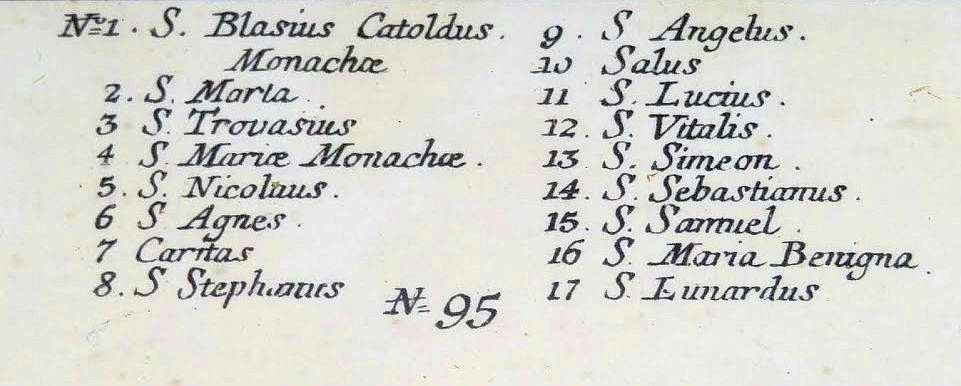
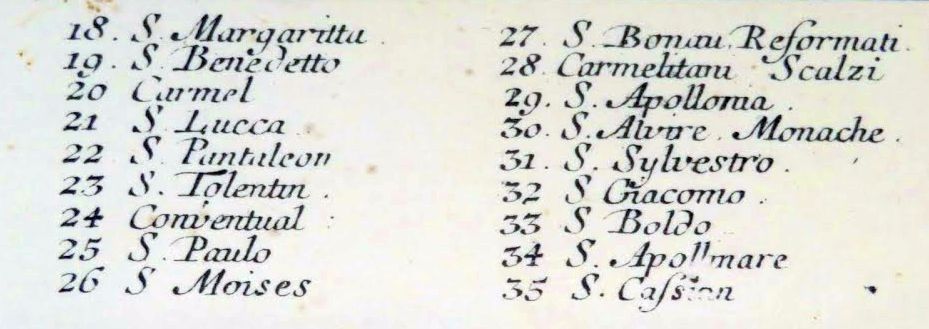
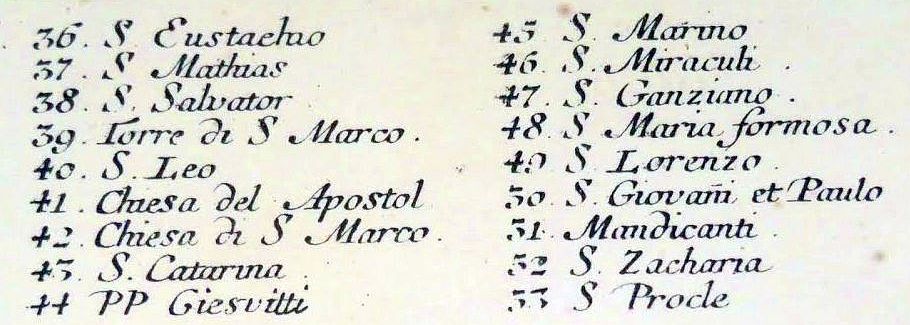
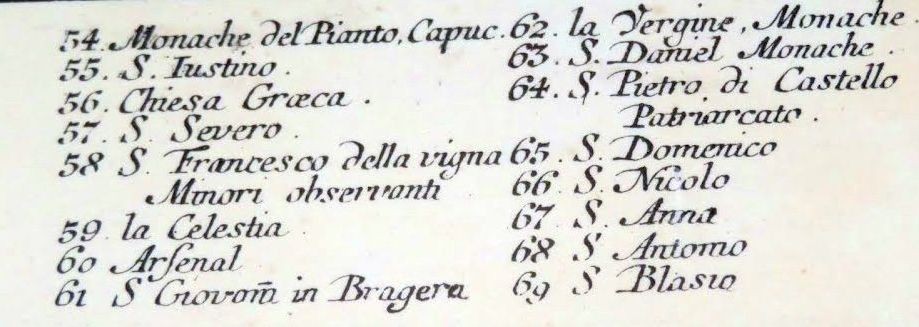
Indulge me as I conduct roll call. I will follow the sequence of church names printed in Latin below the engraving, but I’ll translate them into the common Italian versions we know. The German names, printed above the towers, will be left for you to decipher for whatever weird crossword you may be working that actually asks for this information.
Bear in mind that the image shows three dimensions, so don’t think the churches are all lined up like the Rockettes at Radio City Music Hall, meaning no disrespect. To churches or Rockettes.
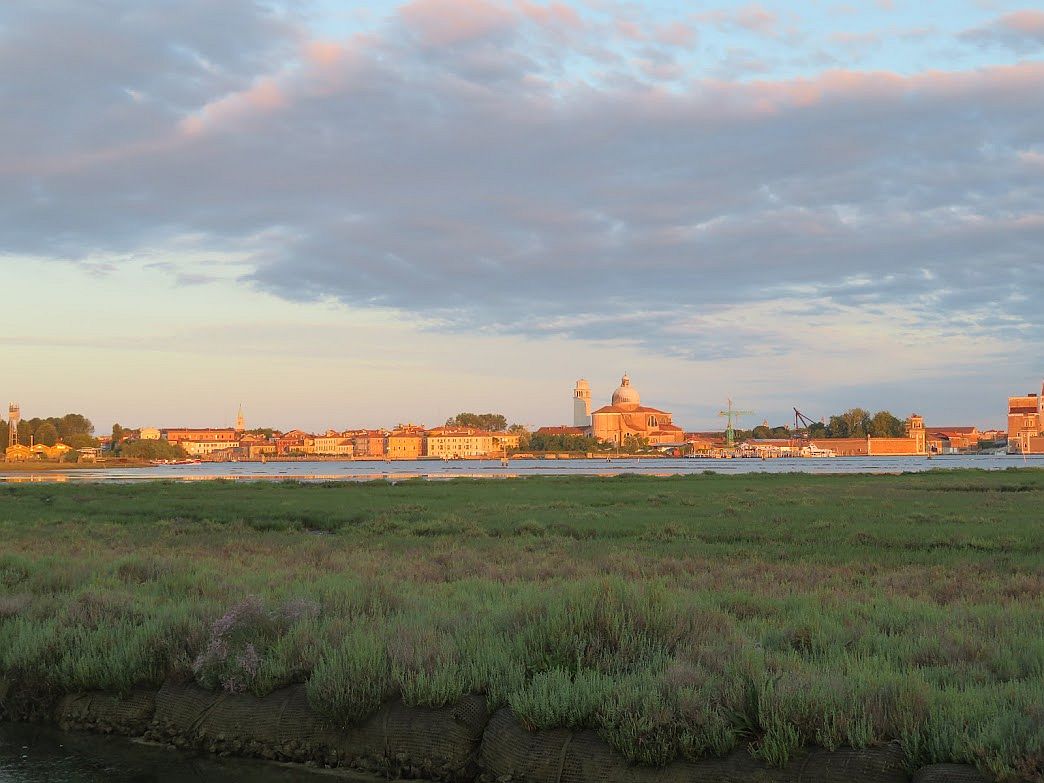
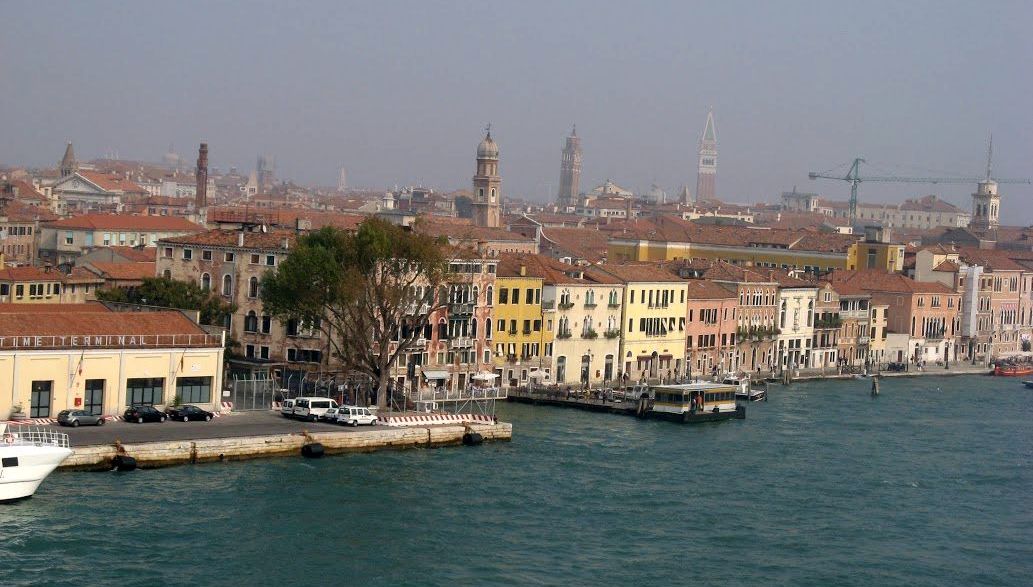
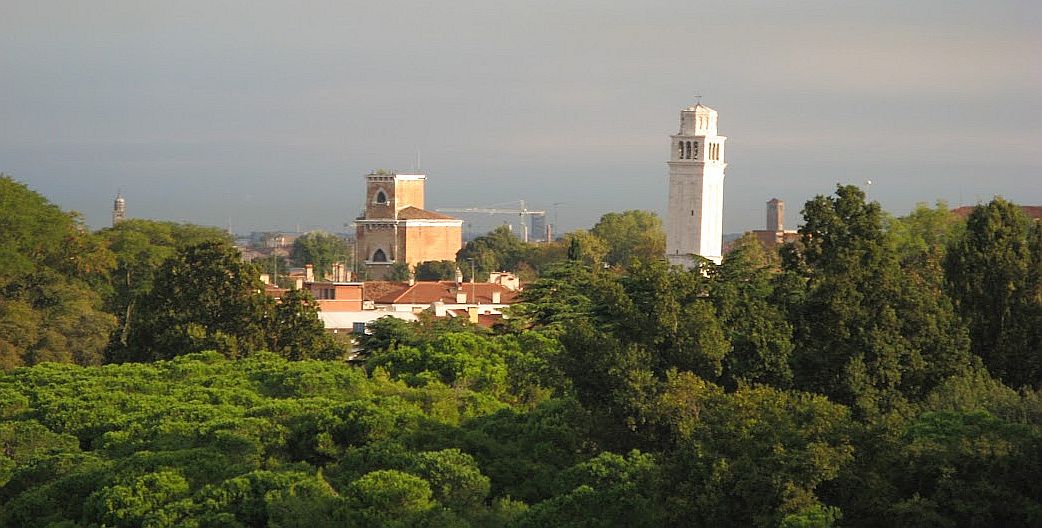
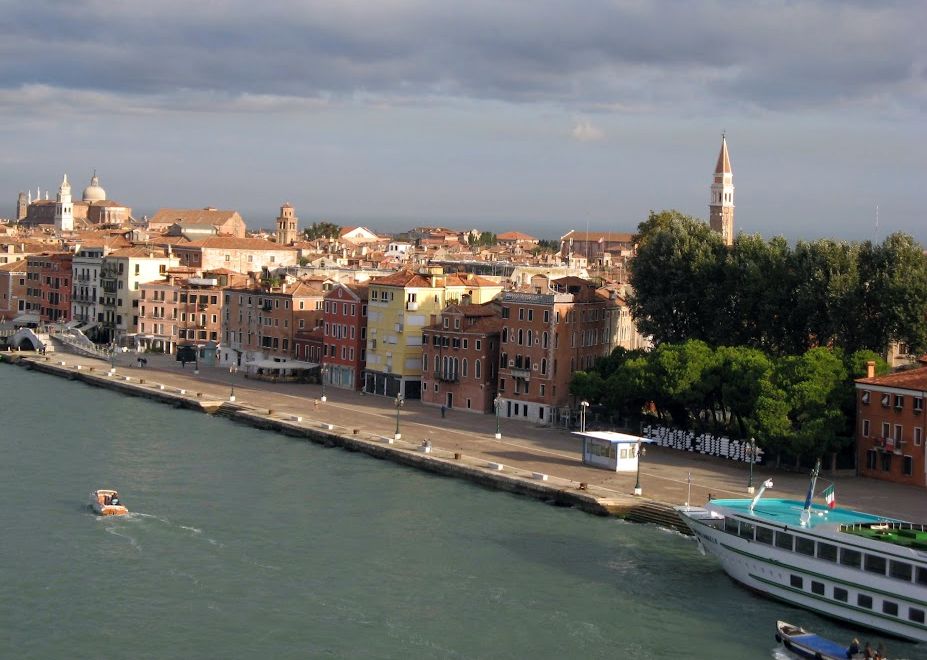
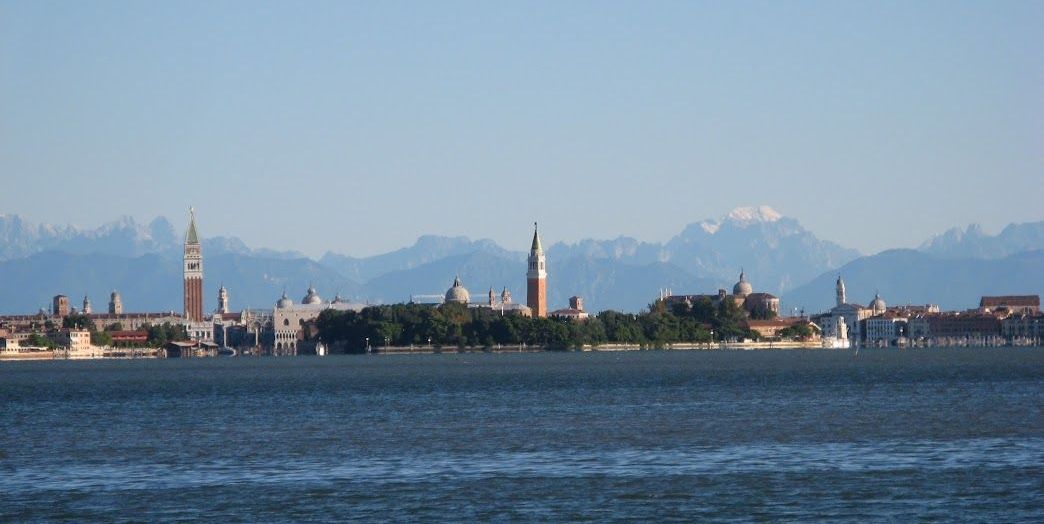
1. San Biagio and Cataldo nuns (on the Giudecca, if it isn’t clear). The Blessed Catholdus of Eichstatt was a 7th century Benedictine monk. All that remains of the church is a very worn plaque in Latin on the wall of the present church of Santa Eufemia. 2. SantaMarta 3. San Trovaso 4. Santa Maria Maggiore nuns 5. San Nicolo’ (dei Mendicanti, I am supposing by the location) 6. Sant’ Agnese 7. SantaMaria della Carita’. The belltower fell into the Grand Canal on March 27, 1744, crushing two houses and causing such a huge wave that the nearby gondolas were thrown onto the street. The church is now part of the Accademia Gallery. The belltower is nowhere to be seen. 8. Santo Stefano 9. Sant’Angelo 10. La Salute (Salus is Latin for “health”). 11. San Lucius (a 13th-century shepherd and patron saint of cheese-makers. The church no longer exists). 12. San Vidal 13. San Simeone (doesn’t indicate “grande,” which is small, or “piccolo,” which is large) 14. San Sebastiano 15. San Samuele 16. Santa Maria Benigna (I am still seeking information about this lovely-sounding church, but I am not feeling optimistic). 17. San LeonardoFour towers to rest your tired eyes. (L to R): Far left: The tiniest tower, just visible above the trees, belongs to the church of San Cristoforo on the cemetery island of San Michele. Center left: Torre di Porta Nuova, at the eastern water entrance to the Arsenale; built in the early 19th century for masting ships, it fell into disuse not long afterward due to changing naval engineering. It is occasionally open to visitors. The interior has been redesigned for various uses as a cultural center, but a visit is well worth it if only for the view from the top. Center right: The white belltower of San Pietro di Castello. Yes, it is leaning slightly, but please remain calm, everything is under control. Far right: The brick tower of the church of Santi Maria e Donato on Murano.
18. Santa Margherita 19, San Beneto 20. Carmini 21. San Luca 22. San Pantalon 23. San Nicolo’ dei Tolentini 24. Conventual (Frari). 25. San Polo 26. San Moise’ 27. San Bonaventura Riformati (Franciscan Minor friars from S. Francesco del Deserto) 28. Carmelitani Scalzi 29. Sant’ Apollonia 30. Sant’ Alvise nuns 31. San Silvestro 32. San Giacometto 33. San Boldo 34. Sant’ Aponal 35. San Cassian
36. San Stae 37. San Mattia 38. San Salvador 39. Torre di San Marco 40. San Lio 41. church of the Apostoli 42. church of SanMarco 43. Santa Catarina 44. Padri Gesuiti (the Jesuit fathers) 45. San Marino 46. Santi Miracoli 47. San Canciano 48. SantaMaria Formosa 49. San Lorenzo 50. SS. Giovanni e Paolo 51. “Mandicanti” San Lazzaro dei Mendicanti 52. San Zaccaria 53. San ProvoloThis one’s fun because the zoom has tried to confuse things. But intense cross-checking reveals (L to R): The Madonna dell’Orto, the dome of SS. Giovanni e Paolo, the white belltower of San Giorgio dei Greci, San Martino, San Francesco della Vigna.
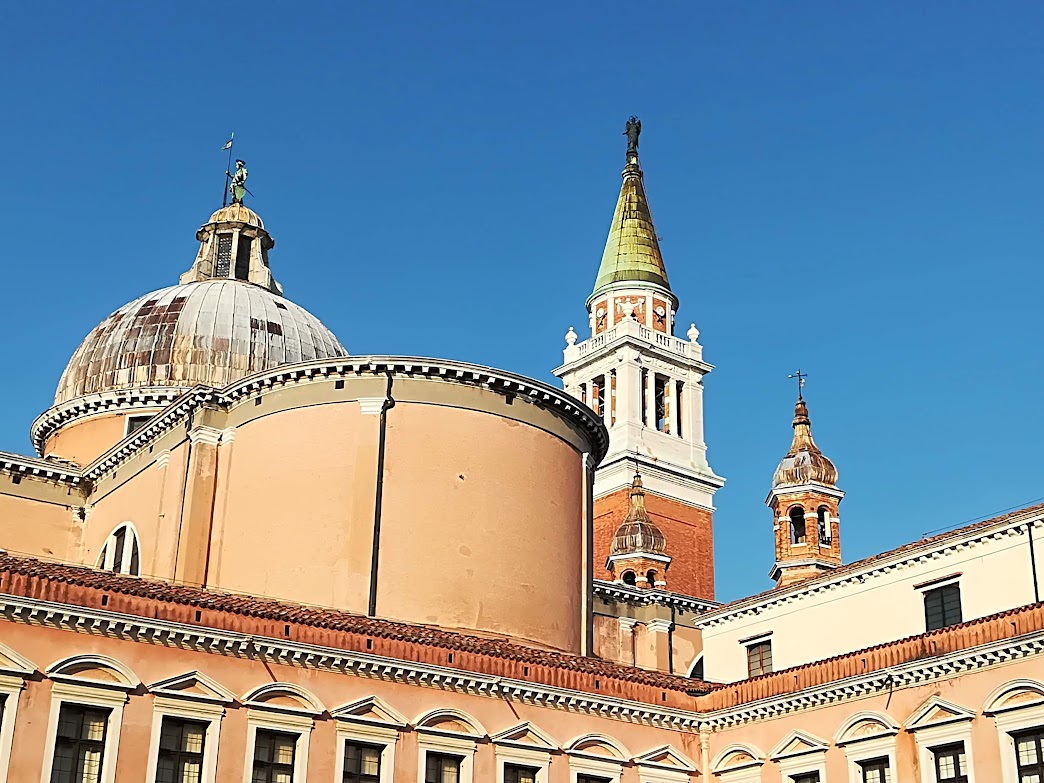
54. The Capuchin nuns of the church of the Madonna of the Weeping. Napoleon closed it in 1810; in 1814 it was divided into two floors. The upper floor was a little theatre and the ground floor was a factory making pots and pans. Not made up. It was reopened as a church in 1851, but after other vicissitudes, such as the departure of the last nun in 1970, it was definitively closed. You can see its melancholy outlines standing behind SS. Giovanni and Paolo 55. Santa Giustina 56. San Giorgio dei Greci (“Greek church“) 57. San Severo 58. San Francesco della Vigna, the Minor Observant Franciscan friars 59. Celestia. A church and convent dedicated to Santa Maria Assunta in Cielo — St. Mary Taken Up to Heaven, founded in 1119. The usual sequence of events follow, including destruction by a violent fire that began in the nearby Arsenal, rebuilt several times, till 1810, when Napoleon, the Great Suppressor and Closer of Religious Establishments, gave the complex to the navy. Eventually the church was demolished. Many thanks to Herr Werner for leaving us a glimpse of its belltower. 60. Arsenal 61. San Giovanni in Bragora 61. Santa Maria delle Vergini, nuns. Founded in 1224, rebuilt after two fires, the second in 1487. It was given to the Navy in 1806 and used as a prison. Demolished in 1844 and the area dug as a careening basin of the Arsenal. 63. San Daniele, nuns. The buildings have been converted to an apartment complex for Navy officers and their families. Lots of greenery (nice) hosting armies of mosquitoes at summer twilights (not so nice). 64. San Pietro di Castello, patriarchate (at that time the seat of the patriarch, or bishop, of the diocese of Venice). 65. San Domenico. Church and convent gone, demolished by The Little Corporal to make space for the Public Gardens (Giardini). There are some Dominican nuns lodged in a modern building on the earlier land. 66. San Nicolo’ Demolished to leave space for the Giardini. 67. Sant’ Anna As with many convents in Venice, unwilling girls were sent here to remove them from the complications (and cost) of being married off. The 17th-century protofeminist Sister Arcangela Tarabotti minced no words in her famous books The Patriarchal Tyranny and The Monastic Hell. Fun fact: Two of Tintoretto’s daughters were nuns at Sant’ Anna. 68. Sant’ Antonio 69. San BiagioThere used to be a notable quantity of gardens on the Giudecca. Many of them are gone, along with the fabulous boats and ships. Speaking of gardens, not indicated here is the much later women’s prison on the Giudecca. The ladies have been cultivating a vegetable garden since 2001, and also produce a line of natural cosmetics using their flowers and herbs.San Giorgio Maggiore.
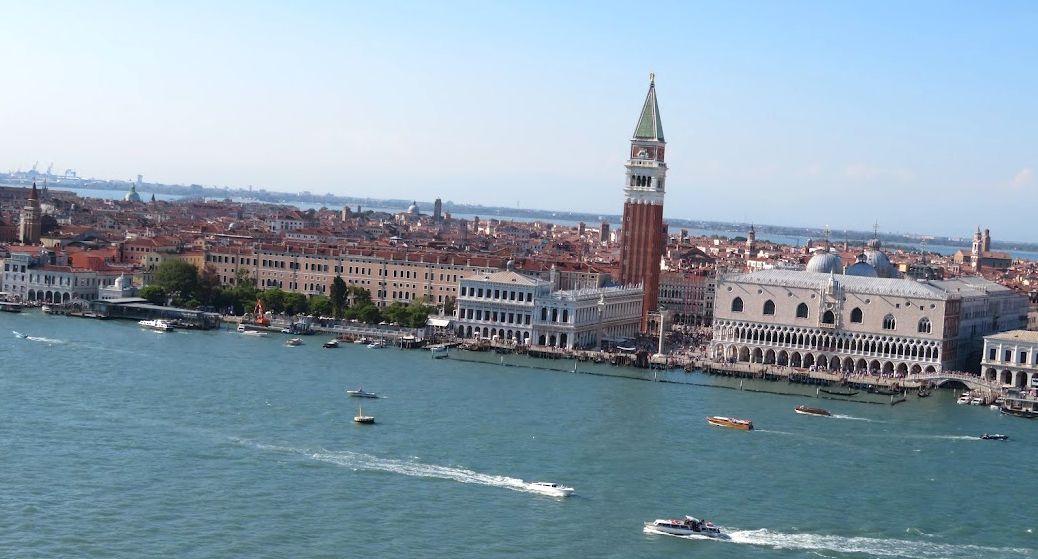
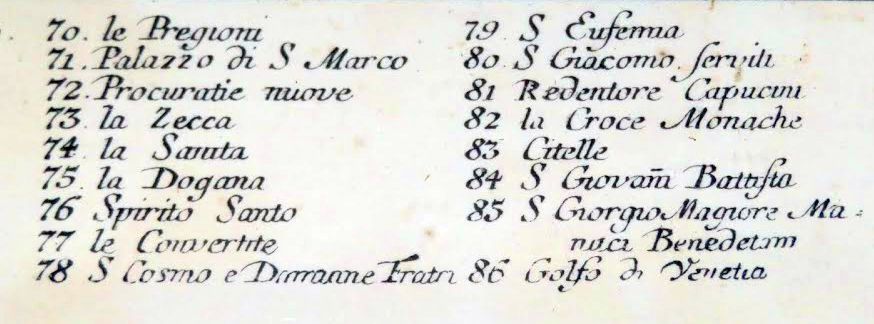
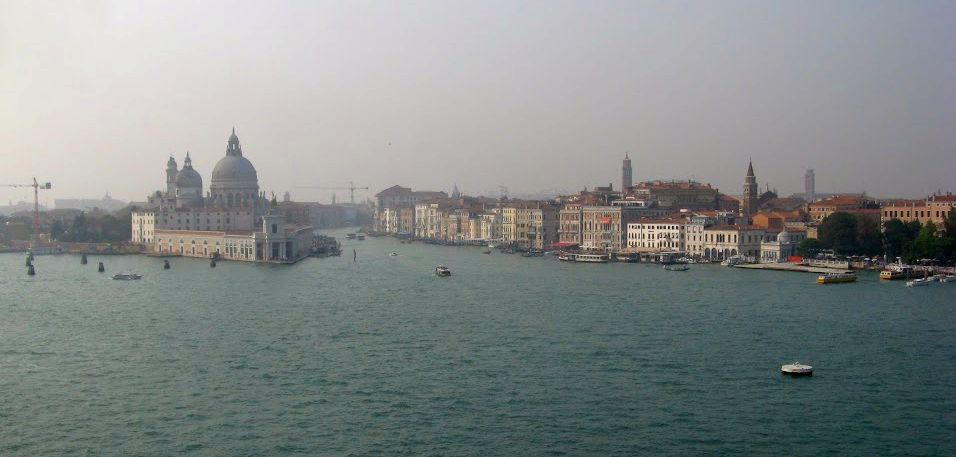
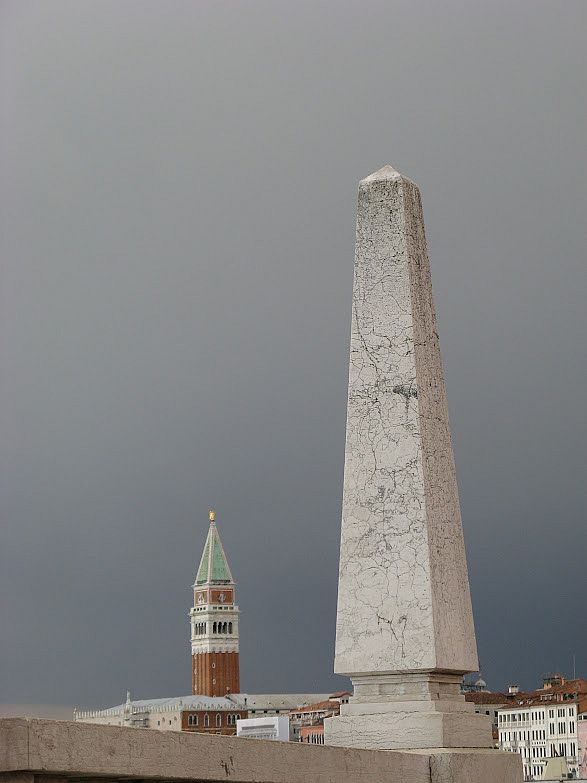
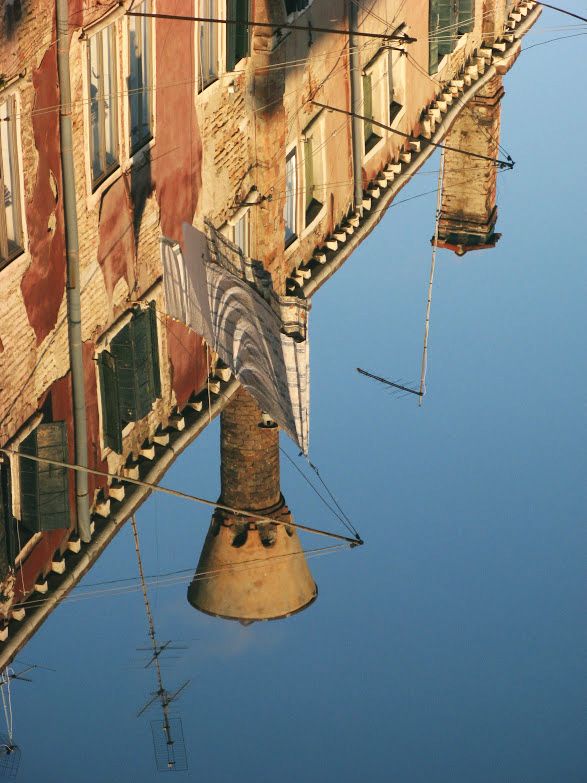
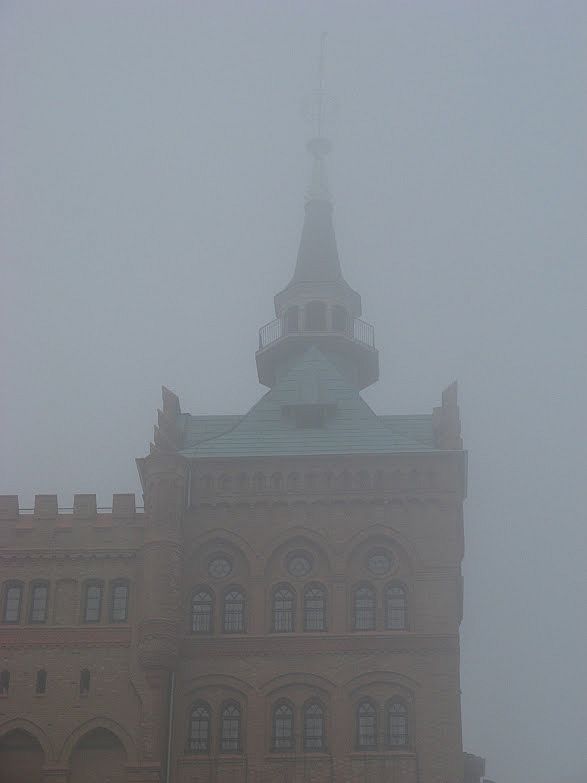
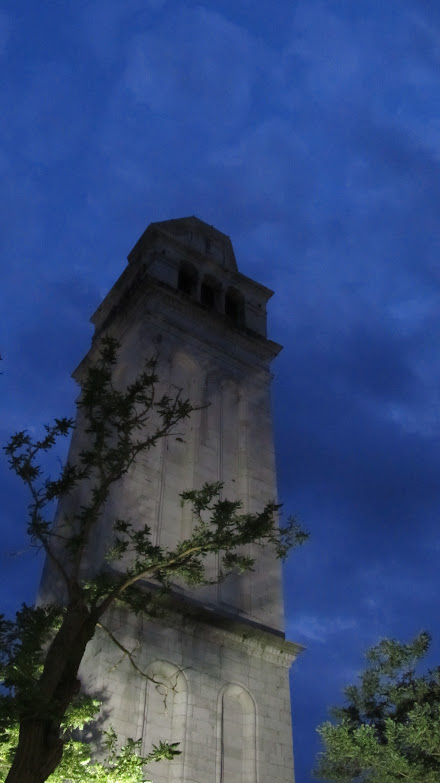
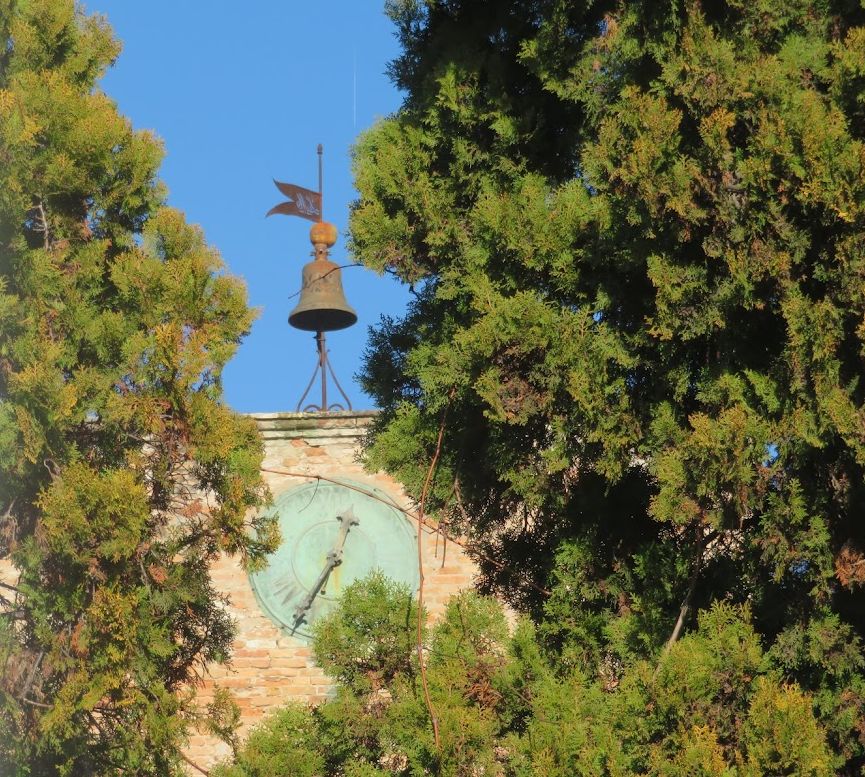
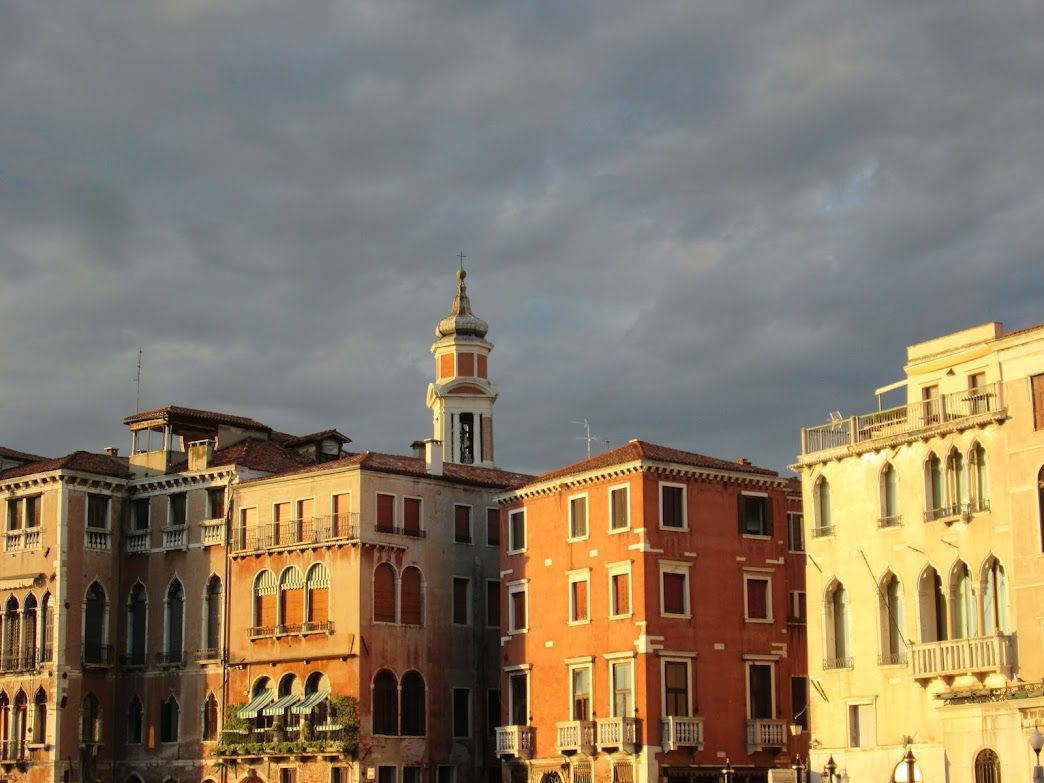
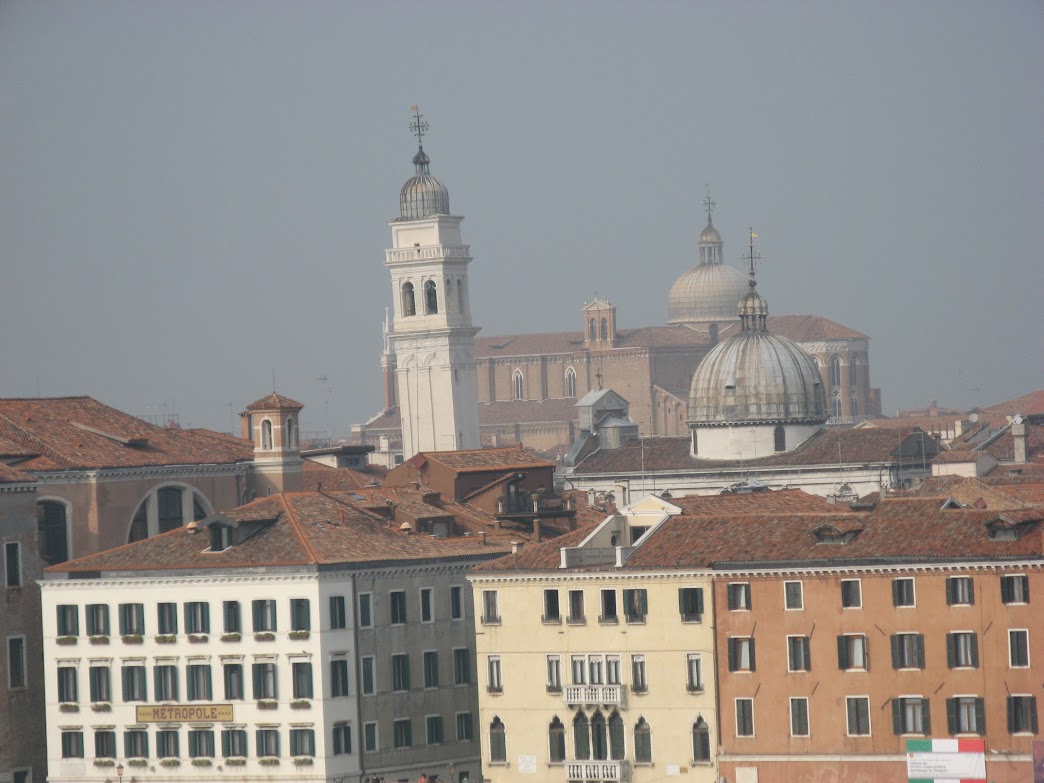
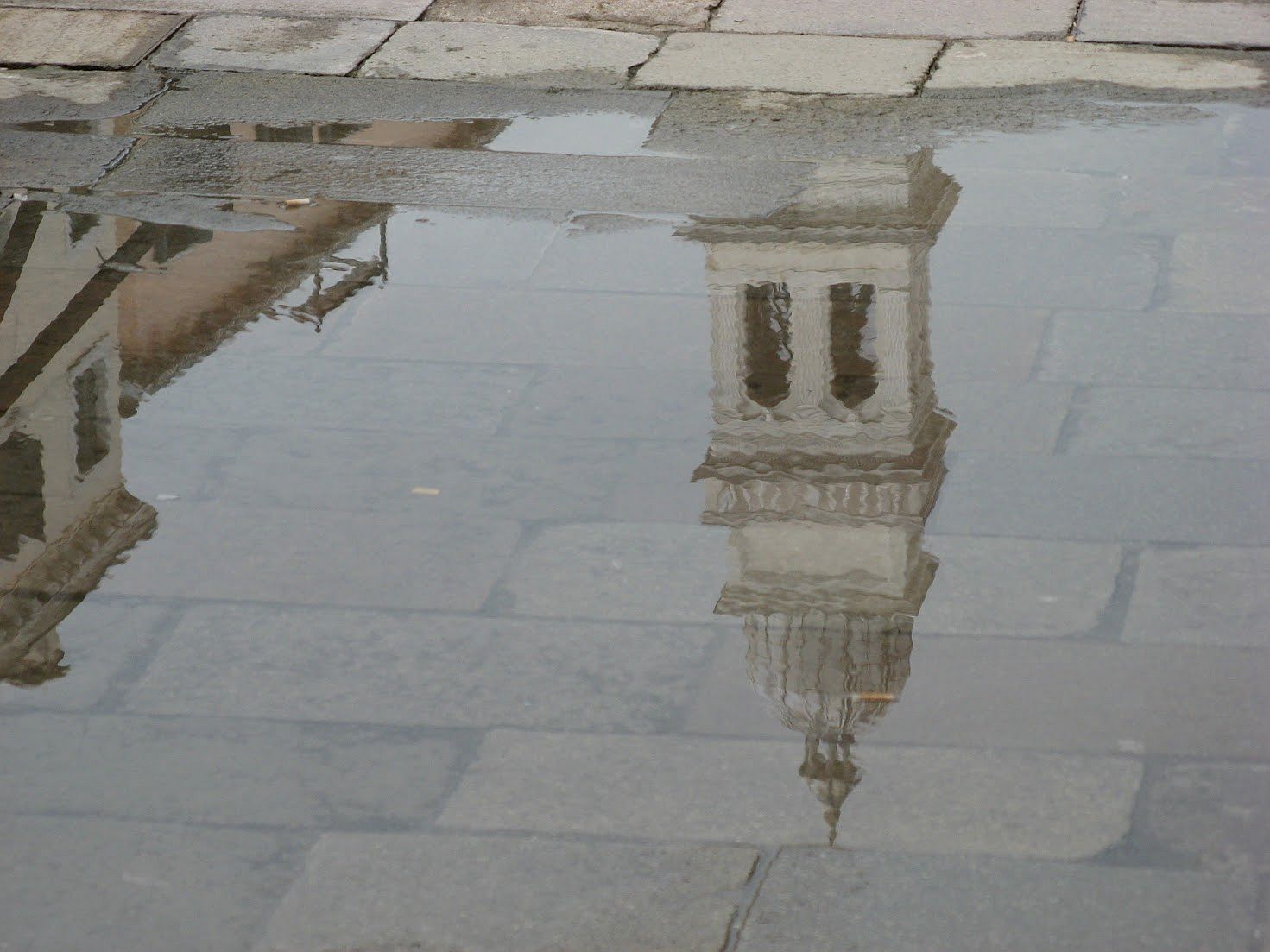
70. Le Prigioni 71. Palazzo Ducale 72. Procuratie Nuove 73. La Zecca (the Mint). The first mint, in the 9th century C.E. was at the Riva di Ferro (Embankment of Iron) near the Rialto Bridge. The name refers to its iron coins. The mint was transferred to San Marco in 1277, to make it easier for the Great Council to oversee its work. This mint continued under the Austrians, and was closed only in 1870, shortly after Venice joined the new Republic of Italy. 74. La Sanita’ 75. La Dogana 76. Spirito Santo 77. Le Convertite 78. San Cosmo eDamiano friars 79. Santa Eufemia 80. San Giacomo Serviti 81. Redentore Capuchin friars 82. La Croce nuns 83. Zitelle more nuns 84. San Giovanni Battista 85. San Giorgio Maggiore Benedictine monks 86. Gulf of Venice. The “Gulf of Venice” more typically referred to the Adriatic sea, but Herr Werner had to save space and opted to use the bacino of San Marco as a symbolic stand-in. It is somewhat justifiable to call the lagoon part of the Adriatic, but seems a little forced.The more I look around, the more I admire Herr Werner’s ability to list them all, not to mention fit them onto two small pieces of paper.Of course it’s merely an obelisk, but it certainly looks towerish. The obelisks seen atop important palaces indicate that one of the family’s sons had been elevated to the rank of capitano generale da mar. He was the supreme commander of the Venetian fleet in times of war. Chatting aimlessly with a little Venetian boy years ago, I asked if he would like to become a capitano da mar one day and he didn’t hesitate even one second. “No,” he said, quite firmly, as if it didn’t even need thinking about. And why not? He was ready for that one too. “Troppo faticoso,” he stated. Too tiring.Chimneys evidently want to be towers, so I said fine. Upside down? Also fine.The Molino Stucky, imposing even as it is dissolving.San Pietro di Castello. Summer dusk and festival lighting are perfectly happy together.San Marcuola: It’s a bell, it’s up in the air. They threw in a clock, too. Who needs to add a stack of bricks?Santi Apostoli.San Giorgio dei Greci, with SS. Giovanni e Paolo in the background. Forget the towers — this is the battle of the domes. San Giorgio wins, having placed a dome atop the tower.
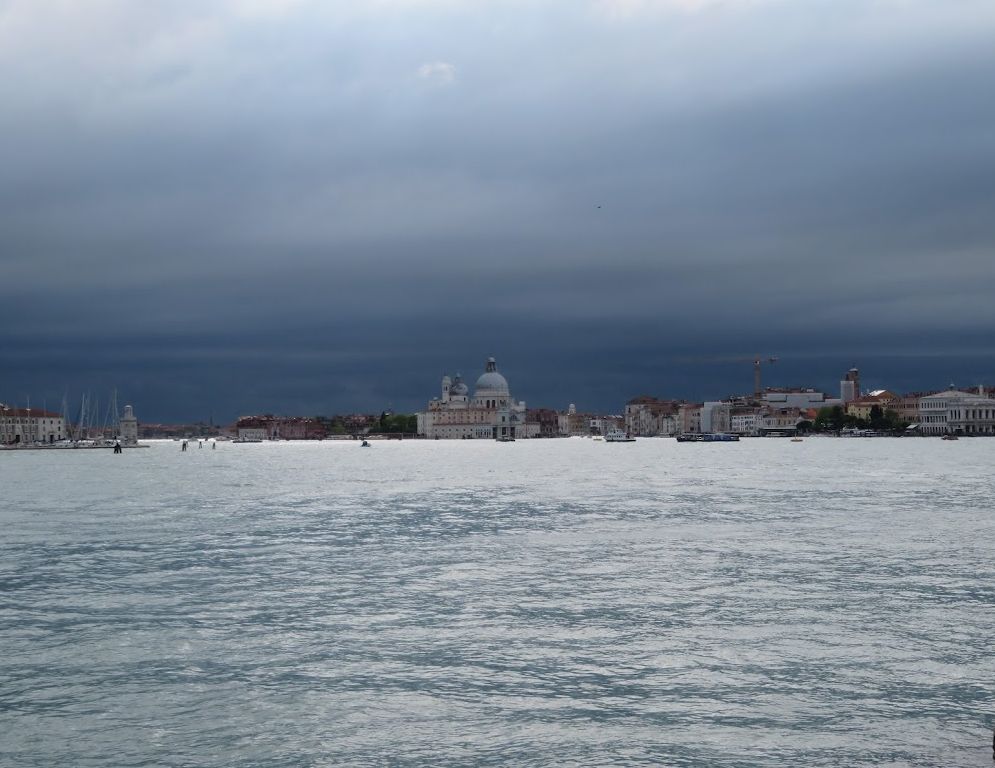
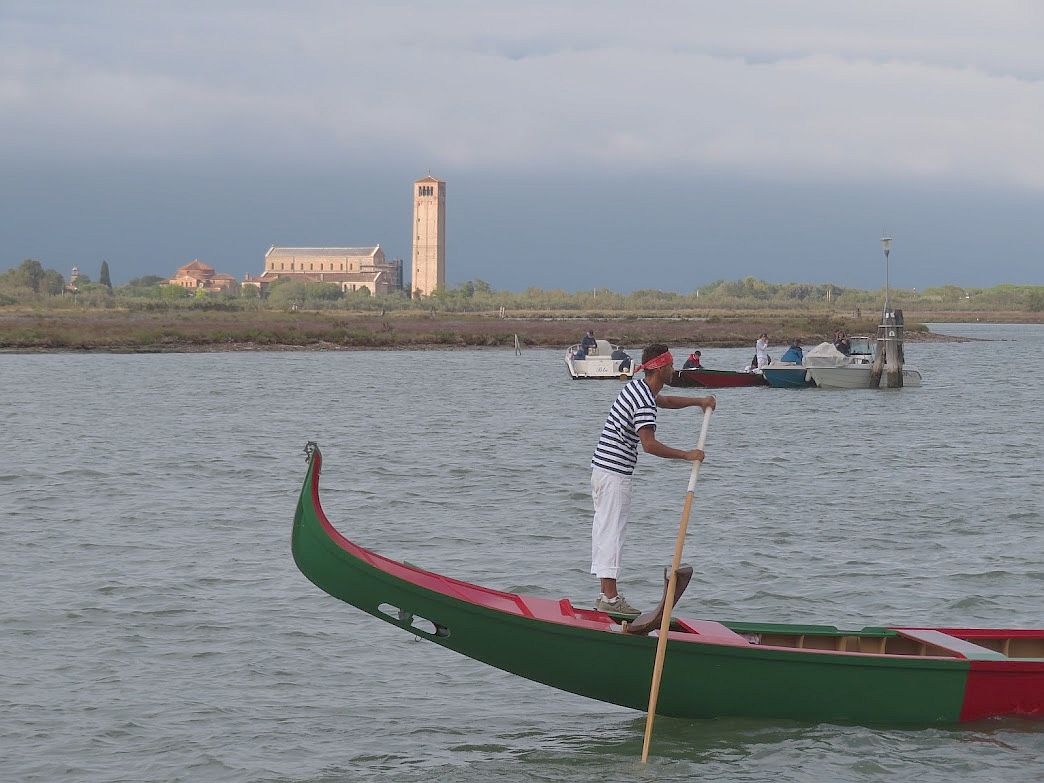
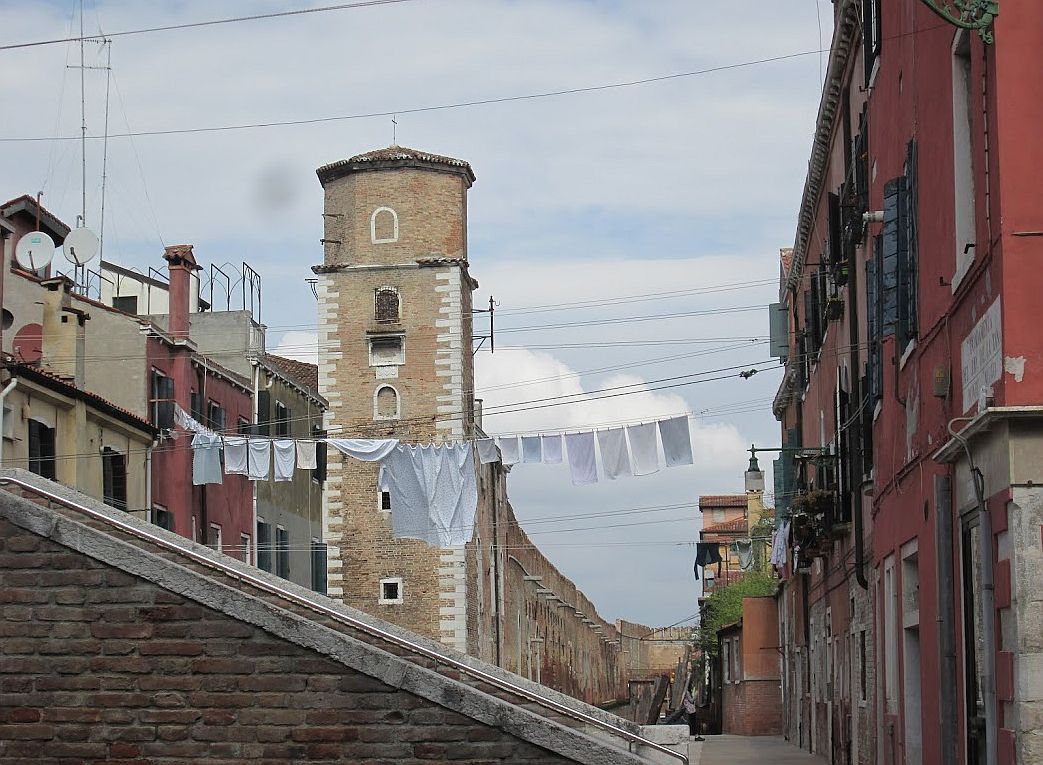
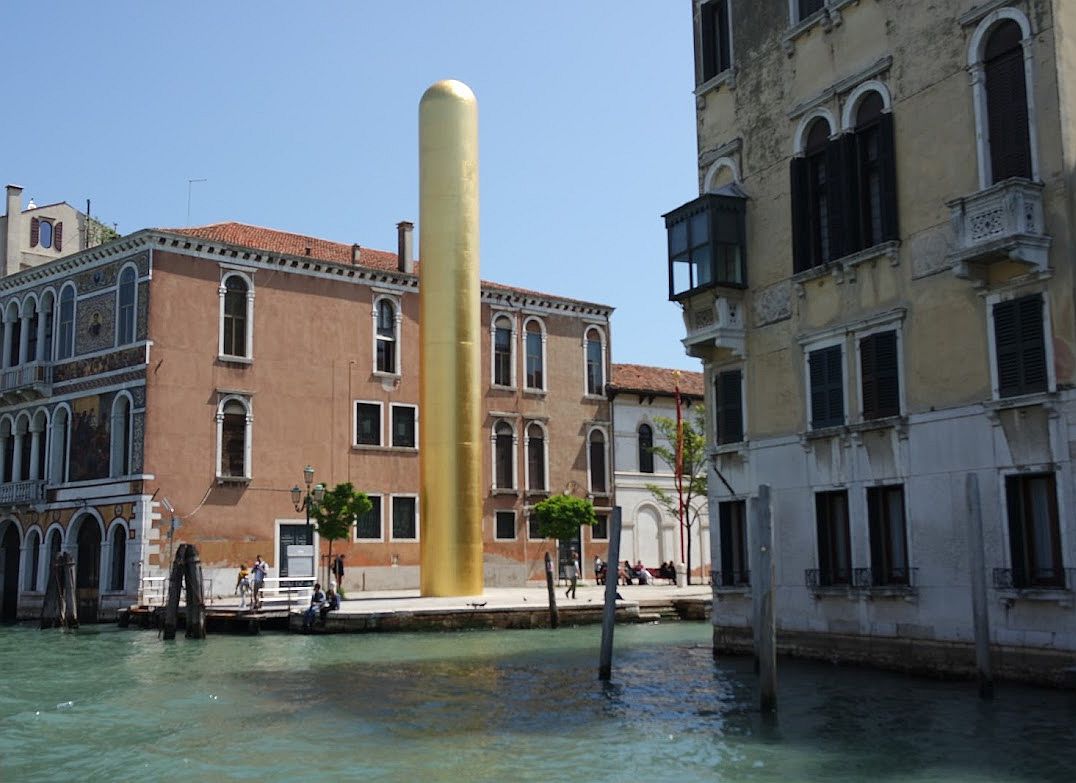
The worse the weather, the better the belltower at Torcello appears. This view is looking from Burano during the last Venetian-rowing race of the official season. I realize that Herr Werner didn’t range far afield from Venice, but I think we need to add this.One of the Arsenal watchtowers, now standing guard over the drying laundry. Also a worthy occupation.Obviously not a tower. It’s a work of art, created by somebody for the Biennale a few years ago to represent something. Not what you think, but something ethereal and conceptual. Belltowers are beautiful and useful, while this is neither. It does take courage to install something that you present as beautiful or meaningful in Venice, which is already so full of creations that are both, so I suppose this artist gets a few points for that.I take my towers where I find them.
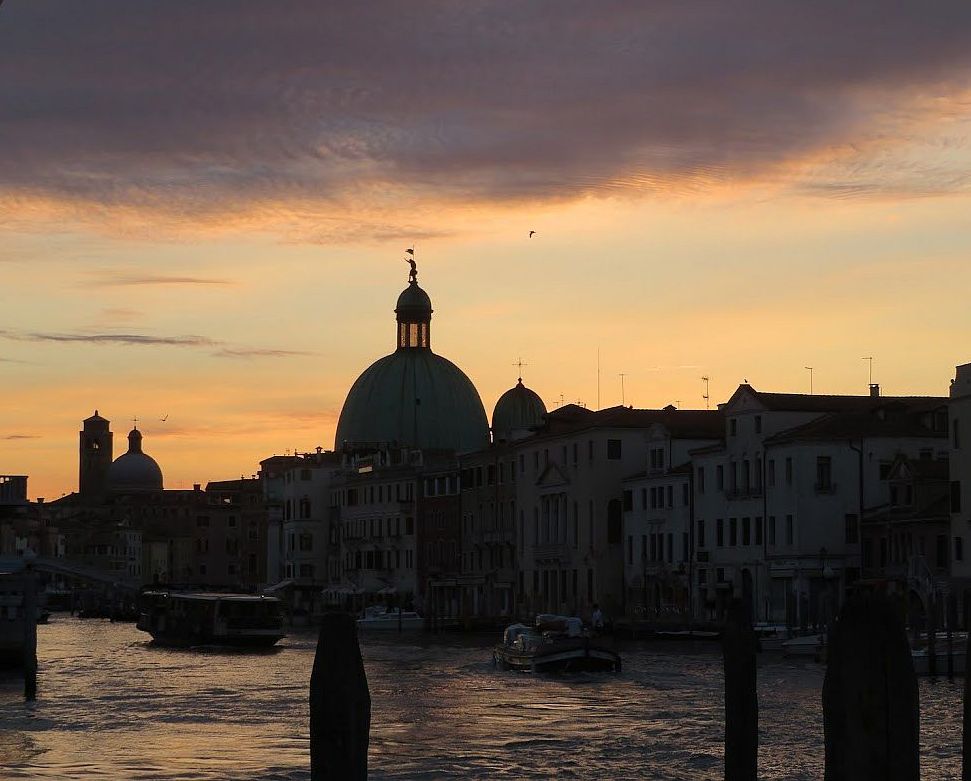
It’s easy to remember the central church’s name — San Simeon Piccolo — simply because it is so big. (Irony alert: “Piccolo” means “small.”) The dramatic disproportion between the building’s elements is its main claim to fame. Napoleon, on seeing it for the first time, is reported to have quipped “I’ve seen plenty of churches with a dome, but this is the first time I’ve ever seen a dome with a church.”Come back, Herr Werner. The towers are waiting for you.