Archive for February, 2010

Feb
24

Overheard

Posted by: Erla Zwingle | Comments (4)

One of the great things about staying pretty much in one neighborhood is that as I walk around doing the eternal mundane little things of life — which are just as mundane here as anywhere else, I’m sorry to say – I sometimes have the sensation of being carried along on a gentle current of badinage.  Sometimes it’s complaining, sometimes not, but the art of quip and banter has been honed here to a comfortable edge that doesn’t draw blood.  It depends on your tone of voice.

It’s a skill you’d expect to find developed in any small area where people have known each other for a long time (convent, factory, school, office, etc.) and can’t really avoid each other.
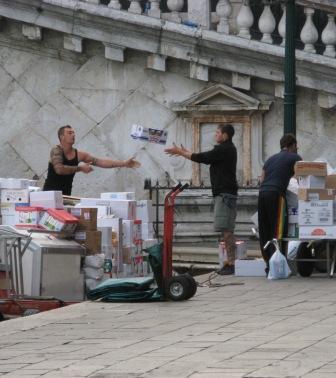
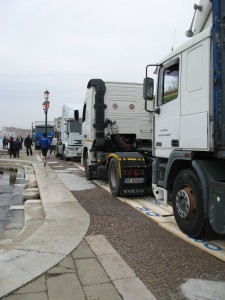
Truckers and haulers -- which is what Queequeg and his friends here are -- are famous for their repartee in most parts of the world, except when they have to concentrate.

Truckers and haulers -- which is what Queequeg and his friends here are -- are famous for their repartee in most parts of the world, except when they have to concentrate.

This morning we went into the pharmacy; someone was there  to get something for a strained muscle.  After some conversation about this item or that, he decided, paid, and turned to leave.  “I don’t know,” grumbled the client/patient, somewhat loudly, “it seems like I’ve got just one pain after another.”

Filippo the pharmacist has undoubtedly heard this far too many times.  “Pains are like money,” he bounced back:  “The more you’ve got, the more you keep.”  Was that comforting, or did laughing just make the person feel better?   I wonder if they teach you these witticisms in pharmacy school.  I hope not.  I’d rather think he made it up.

We moved on to the butcher shop, where the ever-smiling Marcello was doing his usual micro-surgery on shapeless masses of meat.  It’s kind of hypnotic to watch him work, using just the right knife of just the right length and shape and sharpness, deftly stripping away strata of fat and dislodging inappropriate pieces of bone. 

He smiled at us.  “By now the knife can do it all by itself,” he said, smiling at our fascination. 

“Well, you need hands that know what they’re doing,” Lino remarked.

“Sure,” Marcello replied.  “But after 50 years, it’s like there are little eyes on the point of the knife.”  A self-guiding butcher knife; a knifebot.  I like it.

Then there are plays on words.  I realize this may be hopelessly hard to explain, but I heard it just yesterday, and not for the first time — a minor quip that was probably funny the first ten times or so, back in 1329.  You might need to have already had a few to find it amusing anymore.  Here goes:

La porta” means “the door.”  “La” also means “she,” or “you” addressed to a female.  “Porta” can also mean “bring” or “carry.” 

So on the vaporetto, it is happening more and more often that someone entering or leaving doesn’t shut the sliding door.  In the winter, this is rude and also kind of dumb (is it not obvious that these doors aren’t automatic??  Does the freezing wind somehow not touch that person?).  These will be the same people — or their relatives — who, when we are suffocating with heat and humidity in the depths of July, will make a point of closing the door.  

But it’s winter, and the door’s open, and sometimes a person (Venetian) near the door will just get up and close it.  Or sometimes an exasperated passenger will call out to the offending party:  “La porta!”  (The door!)

To which someone else (Venetian), feeling frivolous, might respond: “Un litro!”  (A liter).  Saying this has instantly shifted the scene from a frigid, real vaporetto to a warm and stuffy imaginary osteria, where the men clustered around a table playing cards would be very likely utter the same exclamation, but in this case “A liter” means “Bring us a liter of wine.”

Maybe I’ve crushed the humor, but thought I’d give it a try.  I think it’s funny.

Then there was the other morning.  I was standing in line at the cash register at the little super-low-price supermarket wedged back into a corner of the campo behind and beyond us, a remote locale not far from the geographical frontier past which there are only sea monsters, just before you drop off the edge of the world. 
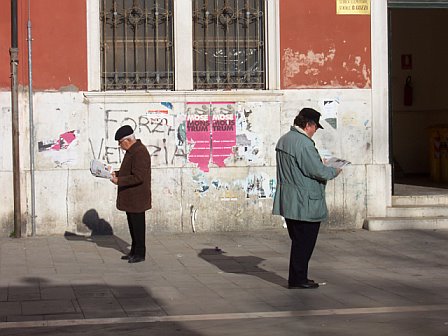
Then you eventually reach the point where you don't even have to talk anymore.

Then you eventually reach the point where you don't even have to talk anymore.

The man in front of me, a grizzled, generic sort of retired working-class dude, had put his few items on the conveyor belt and the young man at the cash register had picked up one of them, a small plastic bottle of honey.  I tuned in at the moment when the cashier had decided (I don’t know why) that he needed to explain how the nozzle-top worked.  Perhaps the man had inquired, though he didn’t look like the type that would even have noticed it had a nozzle.  Or cared.

“So you just take off the top, like this,” the cashier was saying, “and turn it over, and squeeze, and out comes just however much you need,”

“Oh this isn’t for me,” the man replied.  God forbid anyone should think he had degenerated to the point of eating honey.  “This stuff is for my wife.”

“So you don’t eat anything calling for honey in the morning?” the cashier confirmed in a friendly way.

“God no,” the man said.  “I have a mortadella sandwich and a glass of red wine.”

This makes me smile.  First, because it’s kind of a distinctive breakfast concept (I’m guessing it would be the “Canal-Dredger’s Special” on the coffeehouse menu).  And second, because it sounded normal.  Not good, not healthy, not to be recommended under any circumstances – but totally normal.  Not only do I know that this is absolutely what he would have been expected to have in the morning (mortadella, being probably the cheapest cold cut you can get, sometimes goes by the nickname of the “plasterer’s prosciutto”).  I don’t even see anything … how can I put this … wrong with it.  I mean, I wouldn’t have it — but I wouldn’t not have it, either.

When you can look at something and grasp it as being both weird and normal, you’ve been wherever you are for too long.  If I were a police officer they’d long since have rotated me out, sent me somewhere on the dark side of Sardinia.  But here I am.
Categories : Venetian-ness
Comments (4)
Feb
19

Carnival: mopping up

Posted by: Erla Zwingle | Comments (0)

You thought Carnival was over with the sprinkling of the ashes on penitential hairdos?  Not quite.

Carnival doesn’t slink away under cover of darkness when the marangon, the basso profundo bell in the campanile of San Marco, tolls midnight on Martedi Grasso.  Two things have to happen for it to really be over — in my opinion, that is.  Two things which are more predictable than the swallows returning to Capistrano. 

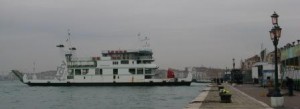
One of the regular car ferries is engaged for the carnival trucks.

One of the regular car ferries is engaged for the carnival trucks.

The first is the pulling apart and hauling away of  the traveling amusement park (what they generically call a “Luna Park” here) which has been gracing the Riva dei Sette Martiri since — I believe — early December. 

These people (as in much of the world) are almost exclusively families which have dedicated many generations to the setting up, operating, pulling down, and rolling on to the next location of their ride or concession stand. 

After three months, I’m going to miss the smell of the hot-doughnut-frying-oil and the screeching of the children.  It was fun strolling along the waterfront late every afternoon to mingle and kibitz.  And I am convinced that as long as there is at least one small child walking home carrying a small plastic bag containing water and a goldfish, the world will not come to an end.

All this concentrated traffic is a lot to ask of a stretch of walkway which is made of small stones atop packed damp sand.

All this concentrated traffic is a lot to ask of a stretch of walkway which is made of small stones atop packed damp sand.

Anyway, the men start work early on Ash Wednesday morning, and by Thursday morning the funfair is gone.  The only sign they’ve ever been here are the patches of new cement filling the holes in the pavement where their big rigs (or something) went astray.

Speaking of itinerant carnies, I went to the small town of Bergantino a few years ago when I was working on a story about the Po River (National Geographic, May, 2002).  This former farming town has, since the Twenties and much more since the Sixties, become dedicated to the design, construction, and (eventually) operation of carnival rides –  merry-go-rounds, bumper cars, etc.  Despite the town’s modest size — it’s really just a village of some 2,000 people, when they’re all there, I mean, and not out on the road —  they’ve carved away a heavy slice of this international industry for Italy.  One of the major markets for their inventions is the USA.

Well, wherever they’ve gone, I’m already missing them.

The second element of the end of  Carnival is the orgy of articles, editorials, and letters in the Gazzettino reviewing, celebrating, and vilifying the festivities just concluded.  I can tell you without even having opened the paper that there will have been too many people for this fragile city to support; that the managing of this predictable overload will have shown inexcusable organizational flaws and failures to resolve the most elementary large-event necessities (toilets, in a word); that the money taken in doesn’t justify the stress and expense to the city; that it will have lacked originality and creative genius, and that for the residents and shopkeepers of Campo Santa Margherita, the ten days just concluded have been nothing less than at least six of the nine rings of hell. 

And every year, the apex of all the claims and counter-claims:  That this event would be (or ought to have been, or next year definitely will be) the “Carnival of the Venetians.”  I saw Venetians having a fine time carnivalizing in their own modest way in various neighborhoods of the city, but not in the Piazza San Marco.  I’d have given you a cash prize if you’d found any Venetians besides Lino in the Piazza San Marco. 

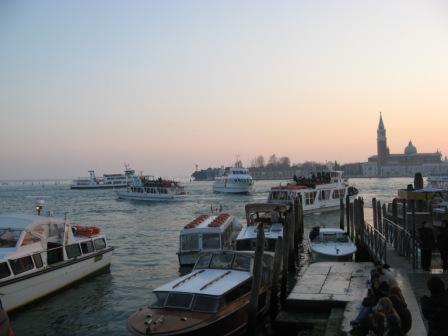
Going-home time near San Marco.  I count eight launches ready to load up and head back to the mainland, and this picture is only one third of the traffic panorama.  This traffic is not composed of Venetians.

Going-home time near San Marco. I count eight launches ready to load up and head back to the mainland, and this picture is only one third of the traffic panorama. This traffic is not composed of Venetians.

So when this wish to involve Venetians is mentioned, as if it were obviously a good thing, I ask myself  if the speaker believes that a “Carnival of the Venetians” would have the slightest probability of pouring the millions of euros into the municipal strongboxes that all those tourists do.  After all, Venetians don’t spend money on hotel rooms, restaurant meals, fancy masks, or whatever else makes Carnival matter.  So frankly, what would be the point of spending money to organize a ten-day carnival for the few remaining locals?  Just wondering.

Let’s go to the videotape (so to speak).  Here is a smattering of the Gazzettino’s  overview of Carnival 2010, as published yesterday:

The organizers claim that 150,000 people came the first Sunday; 250,000 the second Sunday (let that sink  in…) and 40,000 on Martedi Grasso.  Altogether, they say a total of 800,000 people came to Venice during Carnival.  Perhaps not much compared to Rio, but for a city that covers a mere three square miles, not bad.

IMG_8030 carnival compThey estimate that each visitor spent 50 euros, for an exciting total income of 40 million euros.  Not sure where this number came from; a professor of the Economics of Tourism at the University of Venice says that the “bite and run” day-trippers spend an average of 30 euros each day, while the more solid tourist spends 150.  In any case, let’s not quibble over a million more or a million less.  Restaurants and hotels certainly made money, not to mention the ACTV and their spectacularly expensive vaporetto tickets.
One new comment is by the businesspeople (especiallythose of  restaurants and cafes) in the Piazza San Marco — they don’t want a maxi-stage there anymore.  I’m not sure why, but I imagine it’s because it takes up too much space which needs to be available for them to put out their tables and chairs. 

I could go on, but it’s probably not that interesting.   These few days following Carnival are mainly spent in a sort of emotional and mental scrubbing and disinfecting. 

I am going to miss this, though.

I am going to miss this, though.

The summary is fairly concise.  Apart from numbers, claims, and counter-claims as to success or failure, as one reporter wrote, “Now the Venetians can give a deep sigh of relief and put their hands on their foreheads and say, “‘Once again we’ve lived through it.’”

Categories : Events, History, Problems, Tourism
Comments (0)
Feb
17

Ash Wednesday

Posted by: Erla Zwingle | Comments (0)
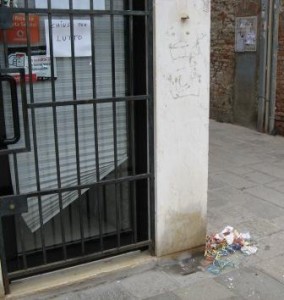
Carnival was definitely over early for the family who owns this tobacco shop; the sign on the door says they're closed for mourning.  The blind left askew on the door emphasizes the point.  And all that cheerful confetti has been swept up by the trash squad and left right here.  Still feel like partying?

Carnival was definitely over early for the family who owns this tobacco shop; the sign on the door says they're closed for mourning. The blind left askew on the door emphasizes the point. And all that cheerful confetti has been swept up by the trash squad and left right here. Still feel like partying?

It’s not as if the city goes into mourning when Carnival is over (the merchants are too busy with their calculators to feel sad), but if you had gone out with me for a walk this morning, you wouldn’t just feel that something was missing (like, say 100,000 people).  You would have the distinct sensation that you were at the bedside of a patient whose fever had finally broken and was sleeping peacfully. 

A tranquillity comes over the city that is nothing less than miraculous.  All that’s left to do is to clean the room and change the sweat-drenched sheets. So to speak. (I do hear some desultory sweeping going on outside.)  And now we can see the simple, austere, monochromatic 40 days of Lent stretching before us.

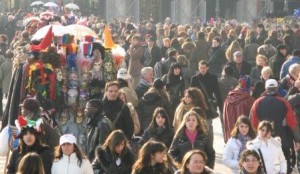
Here’s what I won’t miss:  The mighty force of the touristic masses being sucked into the city’s gullet as if through some colossal straw.  The wall of humanity blocking entire streets, a good number of which had to be organized as strictly one-way.  The incessant rumble of the launches hauling and re-hauling loads of countless people from the mainland to San Marco, not to mention the choking poison of their engines’ exhaust as they idle by the Fondamenta degli Schiavoni waiting for the next batch.

Here’s what I will miss:  The neighborhood in full frivolity, the kids of all sizes in all sorts of costumes, their entourages of relatives, doting or beleaguered as they may be.   And — you know what I’m going to say — the fritole and galani.

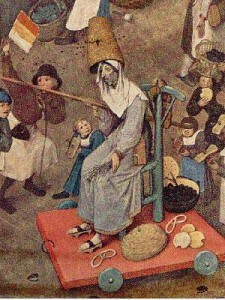
Lent personified during Carnival; detail from "The Battle between Carnival and Lent (Pieter Brueghel the Elder, 1559).

Lent personified during Carnival; detail from "The Battle between Carnival and Lent (Pieter Brueghel the Elder, 1559).

Food seems to be the standard by which every human experience is measured here, and now we’re supposed to get serious.  The list of (technically) forbidden goodies for the next month and ten days is well known and can be fairly detailed.  But I narrow the “forbidden” list to two items: Fat and sugar, which means no more fritole or galani (sob). And you are expected (technically) to pretty much give up on meat, at least on Ash Wednesday and Fridays.

In this officially Catholic country where hardly anybody (it is said) goes to church anymore, today the butcher shops are closed.  You’re supposed to eat fish.  Or nothing, I suppose — maybe you get extra points for fasting, which wouldn’t hurt anybody after the gorge-fest we’ve been through.

We stopped by Marcello the butcher yesterday, looking for a cheap steak to eat before the culinary window slams shut on our fingers.  He was busy doing brain surgery on a batch of chicken breasts so we watched his deft slittings and peelings and trimming while waiting our turn.  Now that I think of it, it’s not so much brain surgery as couture tailoring.

Lino said, “I’ve always loved watching butchers work on meat.  It’s a real art.”

“All the work that artisans used to do were arts,” Marcello replied.  ”I used to love watching the baker making bread.  He could twist and tie and arrange it in all sorts of shapes.   You don’t see that anymore — now it’s all stamped out by some kind of form.  I’d stand there for hours to watch him.”

“You going to be closed tomorrow?” Lino asked, not having noticed the handwritten sign in the window saying “Closed Tomorrow.”

“Yes,” said Marcello.  “It used to be that on Ash Wednesday all the butchers would be closed.  The butchers, and the salumieri [butchers who work only with pork], and the pastry-makers.  Those were the only ones to close, and we still respect that.”

No need to have mentioned the pastry-makers: it’s obvious.  They are the CENTCOM of fat and sugar.  They also must be worn out by now.

Even if nowadays anybody can go to the supermarket on Ash Wednesday and buy chops and ground beef and veal brains and so on, it wouldn’t really be in the spirit of the day.  We’re hanging tough with vegetables, mostly.  So healthy, so spiritually fortifying.

While we’re thinking of food, have you ever noticed that fasting, instead of clearing the mental decks for you to contemplate matters of the soul, usually has the opposite effect?  That’s something to meditate on when you run out of repentance.

Meanwhile, we ate seppie in their ink tonight with polenta made the old-fashioned way (40 minutes of constant stirring).  The seppie were so fresh that they practically smiled at us from their plastic bag — Nardo the fisherman had struck again, and we scored his last two.  Technically the menu was well within the Ash Wednesday rules, but we totally violated their spirit — it was outrageously good. 

I’m not sure whether I’m supposed to repent of that too.

Comments (0)
Feb
16

Carnival: time to go home

Posted by: Erla Zwingle | Comments (0)
The entire Piazza San Marco was spangled with confetti.  It was like laughter all over the ground.

The entire Piazza San Marco was spangled with confetti. It was like laughter all over the ground.

I’m writing this on Martedi Grasso (Fat Tuesday) but I feel the hot breath of Lent on my neck.  People with suitcases heading toward the train station and airport have been filling the vaporettos since this morning, even as the tourist launches continue to haul their loads of fun-seekers from Punta Sabbioni (where their big buses don’t have to pay any fees) back and forth across the Bacino of San Marco to the Piazza San Marco.

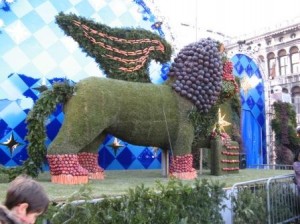
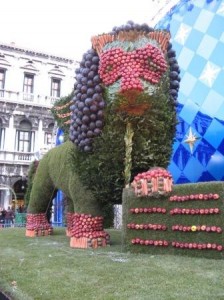
We went to the Piazza this afternoon to watch the official presentation of the Maria who won first prize, blue ribbon, grand cru, or whatever they give her.  It was boring.  What was more amusing were some of the costumes, as well as the massive lion of San Marco, complete with requisite book under upraised paw, made entirely of plant material — fruit, vegetables, leaves and fronds and huge lashings of imagination. 

This fantastic lion of San Marco is composed of red apples, purple cabbages, laurel leaves, and carrots.  He's also wearing a red-apple mask, which is kind of cool.

This fantastic lion of San Marco is composed of red apples, purple cabbages, laurel leaves, and carrots. He's also wearing a red-apple mask, which is kind of cool.


IMG_6283 carnival piazza comp


An example of the standard, often rented, luxury costume. Nice, but not very imaginative.

An example of the standard, often rented, luxury costume. Nice, but not very imaginative.

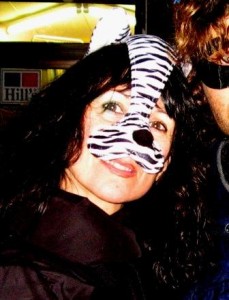
I don't have any idea if she made this or bought it, but it's one of the best masks I've ever seen.

I don't have any idea if she made this or bought it, but it's one of the best masks I've ever seen.


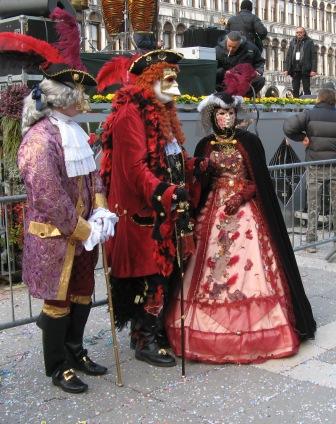
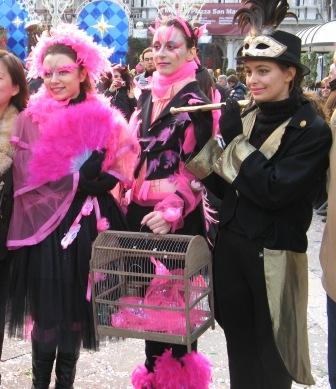
Infinitely more fun: Somebody's version of Papageno (center), Papagena (left) and I can't remember exactly who, carrying the magic flute.

Infinitely more fun: Somebody's version of Papageno (center), Papagena (left) and I can't remember exactly who, carrying the magic flute.


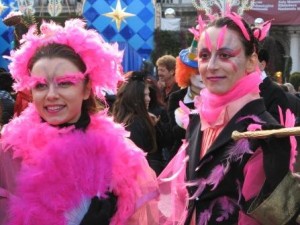
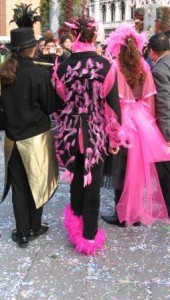
I'm dazzled not only by their imagination, but their patience.  I'd never take the time to stick all those feathers onto my clothes, much less in my hair.

I'm dazzled not only by their imagination, but their patience. I'd never take the time to stick all those feathers onto my clothes, much less in my hair.

 IMG_6311 carnival piazza comp


Then we were back in via Garibaldi for the free fritole and galani that local restaurateur and personality Lucio Bisutto arranged for some local club to give out.  That old saying, “Build it and they will come”?  Here, it’s “Put free food on a table and they will come.”  The little old ladies are always the first; they’re like circling buzzards who can sense dying prey.

Categories : Events, Food, Tourism
Comments (0)
Feb
15

Carnival farrago, part 2

Posted by: Erla Zwingle | Comments (0)
During Carnival nowadays, anybody who normally sells anything lays on a batch of souvenirs -- masks, capes and other stuff.

During Carnival nowadays, anybody who normally sells anything lays on a batch of souvenirs -- masks, capes and other stuff.

Here are a few more morsels of lore about Carnival back in the Old Days: 

Laws:  I realize that the Carnival motto is “anything goes,” which makes the idea of laws somewhat incongruous.  But “anything” could — and did — lead to enough dangerous and unstable behavior over time that the adults supposedly supervising this city-wide party were forced to set some ground rules.  Their significance is pretty obvious.   For example: 

  • Face painting is beautiful and fanciful, both important for Carnival, though one can't say it's the best approach if you were to want to remain anonymous.

    Face painting is beautiful and fanciful, both important for Carnival, though one can't say it's the best approach if you were to want to remain anonymous.


  • It was forbidden in 1703 to wear the bauta in the ridotti,  or gambling houses.   The government was apparently the last to realize (after centuries of Carnival) that being completely disguised was a great way to hide from your creditors.  So, no hiding behind masks and capes for any nefarious purpose, because they were also …
  • … a great way to conceal your identity as you lurked around stealing things and killing people.  On February 11, 1720, the government decreed that the capo, or head, of each neighborhood was to patrol his territory with eight men every night of Carnival; there had to be some effort made to limit, if not completely prevent, the mayhem and murder that seemed to be the natural consequence of fun and frolic.  It must have been a great time to settle scores. 
  • It was forbidden to wear masks during a plague.
  • It was forbidden to carry weapons if you were masked.   Duh.
  • It was forbidden to dress up as a priest and it was most especially forbidden for men to dress up as nuns.  If they did either of these things, it was just too easy for them to enter convents or churches and debauch the sisters.  Not that the nuns cared, especially; a large percentage of them didn’t want to be Brides of Christ in the first place, and plenty of them absolutely made the most of Carnival anonymity. I’m presuming that women had also been making the most of voluminous Carnival coverings to visit the monasteries. 

Just to make sure there was a stop to this particular bit of chicanery, on January 24, 1458 it was decreed that nobody wearing a mask would be permitted to enter a church, convent, or any other sacred place. Period.

One you really get into the Carnival groove, you start to look at everybody differently.  Like these two individuals.  Who are they really?  And what an amazing costume they've put together -- they look just like two little old ladies from the neighborhood.

Once you really get into the Carnival groove, you start to look at everybody differently. Like these two individuals. Who are they really? And what an amazing costume they've put together -- they look just like two little old ladies from the neighborhood.

The Carnival Calendar:  

You couldn’t wear masks just any time you felt like it.  It was like hunting season, with fairly specific dates:

It started in October, when everybody came back from summer vacation in their country villas, and the theatres began to open.  At its height, Venice had 17 theatres, an extraordinary number for a city in those days.  And Carnival continued, with a brief interruption for Christmas, until Ash Wednesday ushered in Lent. 

Masks were also allowed to be worn during the two weeks of the feast of the Ascension and its phenomenal market, which filled the Piazza San Marco with vendors from all over the Mediterranean basin and beyond. 

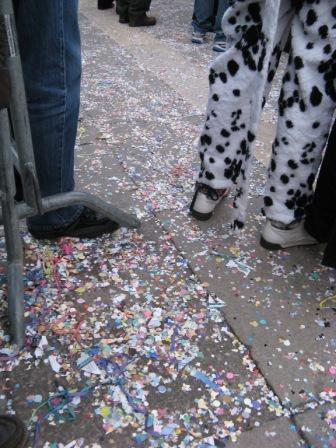
You know it's Carnival when there's confetti (sorry -- coriandoli) literally everywhere

You know it's Carnival when there's confetti (sorry -- coriandoli) literally everywhere

And then there was the convenient clause of  ”and whenever appropriate” (as I think of it).  Masks could be permitted by special decree for very special occasions.  For example, masks were allowed during the celebrations of the victory of the Battle of Lepanto (1571).  Among the countless public festivities was a parade of allegorical floats: “Christianity” was represented in the act of crushing a chained dragon; “Victory” vaunted itself over the vanquished; and “Death” was triumphant, complete with sickle.  It was all party, all the time for several weeks, and that could only mean break out the masks. 

In any case, in good times or bad, one unassailable rule was that Carnival could not be interrupted.  When doge Paolo Renier died on February 13, 1789, they didn’t report the death until March 2.

Party on!!

Comments (0)
Feb
15

Carnival farrago, part 1

Posted by: Erla Zwingle | Comments (0)
A couple in full bauta regalia: mask, hat and mantle (Giovanni Grevenbroch, 18th century).

A couple in full bauta regalia: mask, hat and mantle (Giovanni Grevenbroch, 18th century).

There are just too many curious things about the way Carnival was back in the Great Days, so I’m only going to tell you a few of the ones I think are interesting.  Anyway, it’s not as if they have any relevance now. For all the roar of media coverage today, what goes on here is a hoarse whisper compared to the cacophony that was Carnival before 1797. 

And Paris must be deserted; there are nothing but French people in town.

For many centuries, Carnival here was primarily a Venetian phenomenon, which is to say an integral part of Venetian life and culture.  But when Vasco da Gama reached the Spice Islands by means of a daring new route round the Cape of Good Hope (1497), Venice’s monopoly of the spice trade collapsed virtually overnight, dragging the city’s economy down with it.

Struggling to get the city back on its feet, somebody began to put the word out that the Venice Carnival was one heck of a thing to see.  Yes, Venice could discern its potential for tourism even before the invention of bullets and parachutes, and the Venetian merchants, staring into their now-empty coffers, were quick to make the most of it.

  • Costumes:  People would dress up as virtually anything, from a classic character such as Pulcinella (from Naples) or Arlecchino (from Bergamo) to plague victims, blind people, cripples, Jews, Turks, lepers, peasants from Friuli, men dressed as women.  These were known as “Gnaga” ( NYAH-ga) and had their own particular mask to go with their feminine clothes.  The mask was meant to resemble a cat, and the person would meow instead of talking.  (It must have looked great on a person with a beard.)  The gnaga also carried a little cat in a basket, or sometimes even a tiny baby, or he/she’d be accompanied by men dressed as babies.  Don’t ask me.
    A "gnaga" with a suspiciously empty basket (Giovanni Grevenbroch, 18th century).

    A "gnaga" with a suspiciously empty basket (Giovanni Grevenbroch, 18th century).

The wildly absurd and equally wildly obscene elements which so many favored (I refer to behavior as much as garb) were not simply a crucial social safety valve (keeping in mind that the patricians lived with loads of restrictions, too — it wasn’t just the salt of the earth that needed a break).  It appears that people have always exploited the absurd and the obscene as a way of exorcising their dread of death and the demonic, and Carnival was the Olympics of spitting in the face of fear, as well as in the face of manners and rules and occasionally, I imagine, other people.

Sir Thomas More famously stated that “The devil, a proud spirit, cannot endure to be mocked,” so the broader, sharper, and deeper the derision, the better.   That went double for the rude and the lewd.  So really, unless you were putting somebody life or savings in danger, there was no such thing as too wild, too crude, too raunchy– too anything.  They organized races for boats rowed by dwarfs, or the blind. 

  • Masks:  There is a universe of lore about their meaning, their function, etc.   Did you know that…
  • bauta larva compThe white mask often called a bauta is more correctly termed Volto (face) or “Larva.”  Sounds repellent, but it comes from the Latin meaning ghost, specter, minor evil spirit.  Its extraordinary shape resolves several important concerns: First, it completely hides the face; second, it leaves space for the wearer to eat and drink; third, its shape alters the speaker’s voice, thereby acting as a kind of vocal, as well as visual, disguise. 

morettaw1 moretta crop compI think my favorite is the “Moretta,” or “Servetta Muta.”  It’s so strange it could only have come from France (it did), and it started out, at least, as something to be worn by women when they went to visit a convent.  It was usually made of black velvet, and wasn’t attached by ribbons; you kept it on your face by biting down on a small button attached to the faceward side.  (Hence the term “mute.”) 

I can see what the appeal would be for men, but if you couldn’t speak, why would you go visit someone in a convent in the first place?  To give the nuns a chance to talk?

A detail from "The Rhinoceros" by Pietro Longhi shows the "moretta" mask out and about.

A detail from "The Rhinoceros" by Pietro Longhi shows the "moretta" mask out and about.

Comments (0)
Feb
11

Carnival: Fat Thursday

Posted by: Erla Zwingle | Comments (0)
I love a sign like this -- sounds more like a command than an invitation.

I love a sign like this -- sounds more like a command than an invitation.

As if we needed any excuse — or permission — to gorge on food loaded with fat and sugar, today it’s take no prisoners.  I haven’t found any special dispensation that promises that the fat and sugar consumed today will do less, or no, damage as they make themselves comfortable in their new home on your hips and in your arteries.  But we can pretend.  It’s Carnival, after all. No rules.

So the short version of today’s amusement can be summed up as: Fritole and galani.  Venetians say that “El Zioba Grasso tute le boche lica” (”On Fat Thursday everybody licks their mouth”).  More broadly translated: gorge, scarf, devour.  Or my new favorite, “englut.”  Makes me feel slightly sick without having eaten anything.

But even eating ten kilos of fritole and galani can’t match the excitement that was reserved for today back in the Olden Days.

The Venetian Republic made a fetish of commemorating important events in its life — every single victory, it would appear, and even some defeats.  It all worked to keep Venetians united in their Venetian-ness and reinforce how very special, important, and amazing that was.  And naturally any people who regard themselves and their city/nation/world in that light is bound to enjoy really laying it on when recalling certain events.

1181307672889O5j bull compTake that little business of Ulrich of Treffen, Patriarch of Aquileia.  No need to lose ourselves in the maze that was Venice’s relationship with ecclesiastical power; let’s just say that for centuries religious disagreements were more commonly (and certainly clearly) expressed in political and military terms.  Or, conversely, political and military projects almost always involved some highly placed representatives of the Prince of Peace.

So the Patriarch of Aquileia, after a decisive battle in 1162, was taken prisoner and carried off to Venice along with his 12 canons.  They offered an unusual ransom for their freedom: A bull and 12 fat pigs, which they promised would be provided every Fat Thursday for 200 years.  And so it was.

1152850747mk69y5 pig compThus every Giovedi Grasso, to recall this glorious victory/humiliation, the public festivities involved the slaughter of the bull (the patriarch) and the fat pigs (the canons).  Nice!  I’m not referring to the aspect of blood, I’m referring to the aspect of insult.  And everybody enjoyed it so much that it continued even after the 200 years were up.

In the early days of this entertainment, the bull was killed by the doge, and the pigs by the senators.  (No comments, please.)  Eventually Andrea Gritti (doge from 1523 to 1538), he of the palace which has become famous as a luxury hotel, decreed that the pigs be killed by members of the Butchers’ guild, while the bull would be dispatched by “the most robust member of the Ironworkers’ guild” with a single blow of a massive sword, a titanic decapitation in which the sword wasn’t allowed to touch the ground.

Even today, a common Venetian way of saying “Let’s get to the point” is “Tagliamo la testa al toro” — let’s cut the head off the bull.  I hazard that “cut the bull” might be an Anglo-Saxon relative of the phrase and its meaning, but let’s move on.

So what did the doge and Senators do while the gore was flowing?  They took clubs in hand and attacked 12 towers and a church made of marzipan, which they bludgeoned to smithereens.

IMG_6155 frit compMe, bludgeonless, I went to the Societa’ di Mutuo Soccorso dei Calafati e Carpentieri for their fritola-fest this afternoon.  This mutual-aid society, formed by the erstwhile Caulkers and Carpenters of the Arsenal, makes a specialty of  sometimes organizing little neighborhood parties, almost exclusively intended for the kids.  Although — from what I’ve seen — each kid seems to arrive accompanied by a phalanx of voracious relatives, none of whom appears starved for fat or sugar, and with the phrase “Me First” invisibly tattooed on their foreheads.  

When we walked out the front door at 4:45, the voluptuous perfume of just-fried fritole suffused our little street.  Looking around, we discovered that they were being turned out in the taverna two steps away.  A taverna here isn’t anything like in Greece; here the word connotes somebody’s (usually a guy, often old) haven that’s something like a cross between a garage and a rec room, usually with some kind of primitive kitchen set-up.  Evidently one of the caulkers was frying up a fresh batch for the refreshment table. 

IMG_6142 frit compIt was a wonderful little interlude, out in via Garibaldi.  The fritole were the best I’ve ever had, delectable little blobs, not too big, containing just the right amount of candied fruit and covered with a little more than the right amount of sugar.  The galani were heavenly, shards of deep-fried dough thinner than onionskin, under clouds of powdered sugar.  If there’d been more of a crowd I’d certainly have gone back for thirds, and fourths, and fifths.  But I didn’t want the guys to start thinking, What — her again?

What I really want to know, though, is where the leftovers ended up.  I want to go there and help dispose of them as nature intended.

IMG_6125 frit comp crop

IMG_6159 frit comp

Comments (0)

One of a couple of events which the organizers of Carnival have revived after rummaging around in Venetian history is a beauty pageant which is based on one of the more dramatic exploits in the city’s entire life story.  And a beauty pageant.

It is called the festa delle Marie (ma-REE-eh), which is plural for Maria.  There were 12, actually or temporarily named Maria, and what happened to them was not only an exciting demonstration of the fledgling republic’s developing power, but a great way to add a party to the calendar.

The long parade from San Pietro di Castello to San Marco is composed largely of history re-enactors from all over Italy.

The long parade from San Pietro di Castello to San Marco is composed largely of history re-enactors from all over Italy.

The story begins around the year 943, though documented accounts date from 1039.  Some details remain open to scholarly debate, but the outline of the episode goes like this:

On the annual feast of the Madonna Candelora (February 2, also known as the feast of the Purification of the Blessed Virgin Mary), Venetians not only went to mass, they also organized an entertainment disguised as an act of municipal and Christian charity.  Or vice versa.  In any case, they were very good at this, I want to say without sarcasm – a skill that civic leaders today might consider acquiring.

Taking the established custom of blessing girls who were newlyweds on February 2, somebody thought it would be wonderful to choose 12 poor girls and include them in the event. 

The Marias line up, waiting to board their wooden platform (one is leaning against the wall in the background) borne by four hardy young men.

The Marias line up, waiting to board their wooden platform (one is leaning against the wall in the background) borne by four hardy young men.

These twelve damsels had to be poor (otherwise the charitable part of the operation would be meaningless), obviously had to be engaged, and of course they had to be divinely beautiful — or at least more beautiful than any other poor engaged girl in their district.  

The patrician families in their respective districts took up a collection to provide them with dowries; the doge lent them masses of jewelry of gold and precious stones from the state treasury, and they went in a procession of boats to the church of San Pietro di Castello, where they were blessed by the bishop in a sumptuous ceremony in the presence of the doge himself and all the noble families (on February 2, obviously). 

The girls then resumed their procession, going to the Doge’s Palace (which it’s entirely possible they had never even seen; until recently, life here was generally limited to your own little neighborhood), where they were the centerpiece of a magnificent reception.  Then everyone climbed aboard the Bucintoro, the doge’s ceremonial barge (in those early days it did not resemble the elaborate final version made famous in paintings by Canaletto, but still — the doge’s barge) and, followed by innumerable boats, went up the Grand Canal to the Rialto, then down the canal of the Fondaco dei Tedeschi to Santa Maria Formosa, where more solemn ceremonies awaited them in the church. 

She's up, and she's off. The Marias commence their stately procession; the men commence to ask themselves why they said yes.

She's up, and she's off. The Marias commence their stately procession; the men commence to ask themselves why they said yes.

Things had gone along like this to general rejoicing until the year 943, when a crew of pirates — led by a certain Gaiolo, an Istrian pirate notorious for stealing Venetians and making slaves of them — burst into the church with his trusty marauders and made off with the girls.  The Marias may have had a certain commercial value, but their jewelry must have been utterly amazing.

The doge – Pietro Candiani III — hastily organized a band of hardy men (I am not making this up) and they went racing off in hot pursuit, doge included.  They caught up with the pirates near Caorle, slew them to a man, and carried home the brides (and their jewelry) in triumph.

If there had been a festa before, from this point it became ever more elaborate; not only to celebrate the 12 girls (as before), but now to commemorate the daring rescue of the 12 girls.  Each February 2 the chosen girls were temporarily re-baptized with the name Maria, they were invited to all sorts of parties and receptions and balls and even mass in the major churches of the city.  Venetians considered it good luck merely to be able to get near them.  All this went on for nine days.

IMG_5871 marie compBut it’s hard to keep anything up at that level of organization, cost, enthusiasm — whatever it is that makes festivals work.  By 1272 the 12 girls had been cut back to four, then to three, because the cost had become annoying to the state as well as the noble families who were funding the event.  There was also a big and expensive war going on with Genoa, the War of Chioggia.  Can’t do everything.  Can’t pay for everything, either.

At that point somebody conveniently decided that it was wrong for people to have become fixated on this festival as a great way to ogle some beautiful babes when they should have been focusing on the religious aspect of the day. 

So they eliminated the girls altogether and substituted figures made of wood — specifically, large slabs of wood cut out along the silhouette of a beautiful poor girl.  Think paper dolls. 

People hated it, and threw stones and vegetables at the wooden Marias when they passed.  So the government passed a law, in 1349, forbidding the throwing of stones and vegetables at the wooden Marias.  But the festa was obviously destined to die, and in 1379 it was suppressed altogether.  

I'm not saying our girls today are more beautiful than the originals, but I know they have better teeth.

I'm not saying our girls today are more beautiful than the originals, but I know they have better teeth.

But not everywhere.  The reviled wooden stand-ins, called “Marione de tola” in Venetian (big Marys made of planks), were taken up by the French in reduced form, and before you can say zut alors, they had become known as Marionets or petits Marions, and then marionette.

Now it’s Venice, February 7, 2010, and the Marias are back.  For the past few years, part of the opening festivities of Carnival has been the Festa delle Marie, a procession of costumed re-enactors accompanying 12 beautiful girls which wends on foot from San Pietro di Castello to San Marco.  The girls are chosen by a jury from many, many applications, and I doubt that they have to be either poor or engaged anymore.  But they do need to be beautiful. 

For a few years, back in the Nineties (I seem to recall 1996), there was another element: the Regata delle Marie.  Rowing races were historically part of any important Venetian festivity, and this one was intended for pairs of women rowing mascaretas.  The idea was that both women (or girls) had to be amateurs, rowers who had never participated in the official city races. 

IMG_5879 marie compI joined in either the first or second edition, with an Argentinian girl named Magdalena.  We were all nobodies; it was great.  The starting line was just on the other side of the church of San Pietro, in the Canale delle Navi.  We raced along somewhere toward Sant’ Erasmo — I wasn’t paying too much attention to the landmarks, especially after the purple boat veered across our bow and we kind of ran into it. 

But we disentangled ourselves and rowed like Istrian pirates being pursued by an angry doge, and back up into the rio di Quintavalle to the finish line in front of the church.  After all that, we actually came in fourth, which meant we won a pennant, which is all that matters.  I also remember that experience because the second we crossed the finish line, Magdalena said, “I’m never racing again.”  I never asked her why.

The race did well enough for a couple of years, then people began bending the rules into all kinds of weird shapes till the participants were basically the same people on the official roster.  So the race, like the original festival, fizzled out, at least as part of Carnival.  It’s now held in June, in honor of San Pietro.  Nice thought, but nothing to do with pirates and doges.

IMG_5881 marie compBut back to Carnival.  The procession of happy, heavily costumed Marias is fun, at least when the sun is shining.  Where else can you dress up and be carried for a mile on a wooden platform by gondoliers while thousands of people take your picture? 

And it’s fun for the onlookers too, because — some things never change — they get to look at beautiful girls in fancy clothes.


IMG_5877 marie comp

IMG_5875 marie compIMG_5883 marie 2 comp

Categories : Events, History, Tourism
Comments (0)
Feb
09

Carnival, the first stage

Posted by: Erla Zwingle | Comments (2)

I’m not a big fan of Carnival in Venice.  The only bigness I can evince where this annual demolition derby is concerned is a jumbo-size package of the old Aristotelian pity and terror.

Last year there was a sort of dancing metal raptor to give the crowd at the Piazza San Marco some sensation of movement.

Last year there was a sort of dancing metal raptor to give the crowd at the Piazza San Marco some sensation of movement.

That’s not completely true: I don’t feel pity.

But this year I decided to take a different approach.  When Carnival erupted last Sunday (after several premonitory tremors) I thought I’d imagine it was something that could be fun, amusing, diverting, worth the trip.  Not for me — I’ve figured out how to make it fun for me but it doesn’t involve costumes or the Piazza San Marco — but just going with the idea that it could be entertaining for the thousands upon thousands of people who come to Venice expecting to enjoy themselves, at least, if not enjoy everybody else. 

By which I mean, enjoy being squashed like a grape in a winepress by your fellow humans.

So far, it’s working.  I had a fine time on Sunday afternoon.  But that’s because I made a point of not going to the Piazza San Marco.  The Gazzettino reported that some 90,000 people were there.  They certainly didn’t need me, even if there had been room.

The first years I was here I did go, at least a few times, to the Piazza San Marco, the gravitational center of the festivities.  It was all so new and strange, and memory reports that there weren’t  quite so many thousands.  Memory may be lying but it was fine anyway.  Perhaps the novelty of the situation carried me over the crush, as it may well do to people today.

I dress up, I walk around, I pose, therefore I am.  It doesn't exactly cry out "whirl of gaiety."

I dress up, I walk around, I pose, therefore I am. It doesn't exactly cry out "whirl of gaiety."

Then there was a hiatus, partly because I didn’t enjoy the winepress experience and also because what was going on there seemed strangely unfestive: Loads of people in costume (95 percent of which seemed to be identical), walking around just looking at each other, striking attitudes, or taking pictures of each other with or without tourists posing next to them.  The nadir is occupied by the people in costume who charge money for allowing themselves to be photographed with your cousin or your kid.  And they can make a bundle. 

Another exciting moment.

Another exciting moment.

The details are sometimes lovelier than the whole costume.

The details are sometimes lovelier than the whole costume.

Dressing up as an ancient monument deserves a tip of the hat, or whatever she's got on her head.

Dressing up as an ancient monument deserves a tip of the hat, or whatever she's got on her head.


Then we came to Castello and I discovered something of the way Carnival was, decades ago, before the event was trampled by the tourism behemoth.  Kids and families and dogs, and relatively few tourists.  And did I mention the kids?

A princess, a fairy with gauzy green wings, and an animal I still haven't identified.  This is more like it.

A princess, a fairy with gauzy green wings, and an animal I still haven't identified. This is more like it.


Put an aristocrat behind the wheel and just get out of the way.

Put an aristocrat behind the wheel and just get out of the way.


 Perhaps I’m going senile, or perhaps it’s because the confetti-throwing and occasional Silly String-spraying and strolling around have no evident commercial focus, but I think the downtown version of Carnival beats San Marco in straight sets.   Here, if you see somebody taking a picture of a person in costume, it’s almost certainly a besotted relative.

Still trying to get the hang of how to make it spray.

Still trying to get the hang of how to make it spray.


Still trying to get the hang of how to make it spray.

A costume, a large bag of confetti, and a parental equerry to carry it for you as you perfect your bestrewing technique. He's having more fun than ten photographers.

Dressing your kid as a skunk (probably Bambi's friend Flower) doesn’t seem like a compliment, but when he's this cute it probably doesn't matter what you put him in.

Dressing your kid as a skunk (probably Bambi's friend Flower) doesn’t seem like a compliment, but when he's this cute it probably doesn't matter what you put him in.


Just a little bit of face paint, artfully applied by one of the many artful appliers in and around San Marco. But it's enough.

Just a little bit of face paint, artfully applied by one of the many artful appliers in and around San Marco. But it's enough.


I


If you start to look around, you begin to notice how little it really takes to dress up and play Carnival.  There were people who were looking great with only a hat, or a wig, or a moustache or whiskers scribbled on with a black marker– even the simplest mask imaginable just barely covering the eyes.  No plumes, no sequins, no layers of painted papier-mache.  It really works.


Or just a mask, and never mind the fancy garb. This is a version of the classic mask of a Zanni, the clever and/or foolish servant in comedies of the Commedia dell'Arte.

Or just a mask, and never mind the fancy garb. This is a version of the classic mask of a Zanni, the clever and/or foolish servant in comedies of the Commedia dell'Arte.

The first Sunday of Carnival (February 7 this year) was Opening Day, one of the maximum moments, as you can imagine.  The others are Fat Thursday (Giovedi’ Grasso), and Fat Tuesday (Martedi’ Grasso).  And the weekend between them.  If the weather is beautiful — as it was on Sunday — it can feel like a party even if you don’t do anything special.  If it’s really cold, overcast, windy or rainy, obviously the merriment becomes shredded and forced.  This isn’t Rio.

Next chapter: I’ll be tossing out a few festive fistfuls of  history, gathered from a large bag of brightly-colored bits of trivia. 

Here’s a sample.  “Confetti” here refers to the sugared almonds which are given to wedding guests.  What speakers of English (and French, German, Spanish, Swedish and Dutch) call confetti  – brightly-colored bits of paper — here are called coriandoli  (ko-ree-AN-dolee).   Why? 

Because back in the Olden Days, Carnival revelers would toss all sorts of things around or at or on each other — eggs full of rosewater was one hugely amusing toy to everybody except the women who were on the receiving end.  People would also toss various tiny edibles, particularly coriander seeds, which were used in pastries.  Then they became bits of sugar pretending to be coriander seeds.  Only much later — in 1875 — did flakes of paper begin to be used instead, which is an entirely different story.  People who had always called the flying fragments of food “coriandoli” merely transferred to term to the newer-fangled form.

Categories : Events, History, Kids, Tourism
Comments (2)
Feb
05

Chase those winter blues

Posted by: Erla Zwingle | Comments (0)

I’m not complaining about the weather this winter (or even today), although I could.  Other places and people have had it much, much worse.

But I’m not sure how many other places could offer you the blithe little experience I had a few days ago.

It had snowed.  The wind was blowing, it was cold and gray — as you can see.  We got off the vaporetto at the stop for the City Hospital because it was closest to where we were going.  So far, so banal.

IMG_5773 casket compTwo men emerged from the hospital through an unidentified door and began walking down the fondamenta with us.  Somebody was with them.  Somebody who was going — in fact, had already gone — in a radically different direction.

Just what we needed on a dismal sodden morning, a jolt of the old memento mori, the “Caesar too must die,” whatever fragments of macabre poetry by Edgar Allan Poe might have remained stuck between your mental molars, and any similar lugubrious injunctions that could be really helpful if we were ever to take them seriously.

Seesawing up over the bridge -- this is quite a little perambulation.

Seesawing up over the bridge -- this is quite a little perambulation.

But you know how it is.  Instead of running to confession and giving all our goods to the poor, we went and drank coffee with our friends.  I can only hope that our anonymous confrere would have done the same in our place.


And down the other side.....

And down the other side.....

The voyage continues....

The voyage continues....


Soon we stop at another unidentified door....

Soon we stop at another unidentified door....


End of the line for today, and perhaps even until the funeral.  We kept going.

End of the line for today, and perhaps even until the funeral. We kept going.

Categories : Venetian-ness
Comments (0)