Archive for January, 2010
Motondoso, Part 4: The lagoon’s-eye view
Posted by: | CommentsQuick review so far: Who or what does motondoso hurt? You’re going to say “Buildings and sidewalks.” It’s obvious.
Buildings are what people care about — logical, since no buildings, no Venice. Some Venetians have told me that they don’t believe anything will be done to resolve motondoso till an entire building collapses, a notion that once seemed idiotic until I came to realize that it could happen. A building collapsing, I mean, not that it would lead to any meaningful action, though one can always dream.
So perhaps some structure really will have to be sacrificed, like an unblemished white heifer, for the benefit of the tribe. The idea has a romantic, mythic quality to it that’s almost appealing.
You could also say “People,” about which I haven’t said much, if anything, and you’d be right again. The most obvious hazard that waves present is the risk of capsizing; every so often you read about some tourists in gondolas who have gone into the drink. There was even a traghetto (gondola ferry that crosses the Grand Canal) that got blindsided by an anomalous wave and the whole cargo of passengers went overboard. I seem to recall that a small child got caught beneath the overturned boat, but one of the gondoliers pulled him out in time. Some years ago an American woman drowned. Fun.
Erosion caused by the waves continually sucking soil out from under and between stones means the stones collapse, but sometimes a person collapses with them. It happened to a woman walking along near the Giardini one day — she put her foot on a stone, it gave way, and faster than you can say “Doge Obelerio Antenoreo” she fell into a hole higher than she was. Nobody in the neighborhood was surprised; they’d been sending complaints to the city for months to no avail.
Then there was the child playing on a stretch of greensward at Sacca Fisola facing the Giudecca Canal when a hole suddenly opened up beneath him. If a man with quick reflexes hadn’t grabbed him, the child would long since have gone out to sea. Events such as these — and may they be few – no longer inspire surprise.

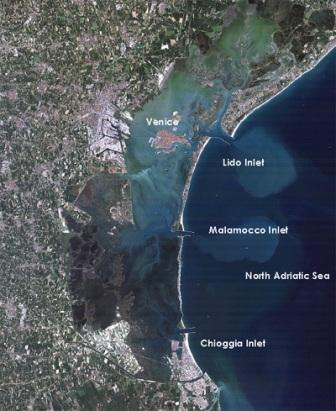
This satellite view of the Venetian lagoon gives a general hint of the variations in depth. These variations are part of what make it a lagoon and not, say, Baffin Bay.
But what if you weren’t a human? This question may not often cross your mind, but Venice looks radically different to its other fauna, and not a few flora, as well. And waves are not their friend.
What really makes Venice so special is its lagoon, which covers 212 square miles. Without the lagoon and its concomitant canals, Venice would merely be a batch of really old buildings — beautiful or not, depending on your taste — which could just as well be sitting on the outskirts of Enid, Oklahoma.
I will be expatiating on the lagoon on another occasion. (A Venetian word, by the way: laguna). The witness (that would be me) is instructed (by me) to stick to the topic at hand, which is waves.
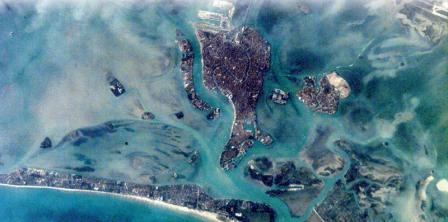
A more detailed view of the lagoon immediately surrounding Venice gives a better idea of how the area is shaped. These shallows, though, are not barene. (Photo: oceana.org)
The Venetian lagoon is a silent but intimate partner in Venice’s fate. Not only are the waves undermining the foundations of the city, they are scouring away the foundations of the lagoon. And while damage to buildings is certainly important, there is arguably even more damage being done to its waters. And they’re going to be a lot harder to fix than a palace.
So if you haven’t got time to watch what waves can do to buildings, you should take a look at what they do to the lagoon — specifically to the barene (bah-RAY-neh), the marshy, squidgy islets strewn about out there. Venice was built on 118 of them.
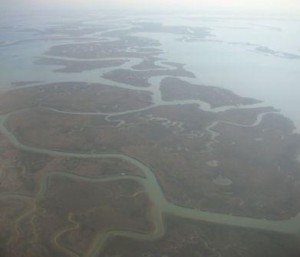
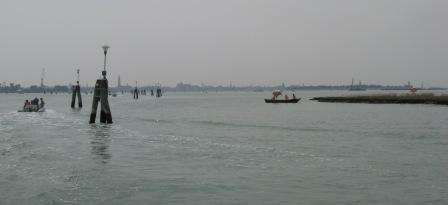
These are barene. Looks like lots, but 60 years ago there were half again as many. That was a real lagoon.
Barene are the building blocks of the lagoon. They form 20 percent of its total area, and are crucial to everything in it: microorganisms, plants, animals, birds, fish and, till not so long ago, also people.
Let’s say you have less than no interest in ecosystems and their inhabitants, at least the inhabitants smaller than humans. Barene, along with their myriad meandering capillary channels, are perfect for slowing down the speed and force of the incoming tide. They act as a built-in assortment of natural barriers which, if they could remain where they were, would already be limiting the force and the quantity of acqua alta in good old Venice.
But over the past 60 years, half of the lagoon’s barene have been lopped away by waves. The World Wildlife Fund estimated, several years ago, that at the current rate of erosion (erosion caused by motondoso), in 50 years there would be no more barene left.
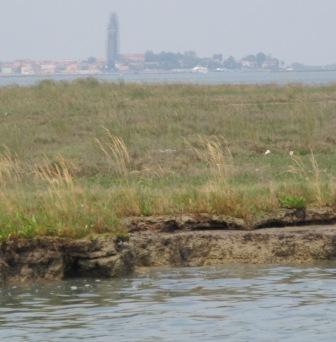
A cross-section of a barena near Burano. If you were an endangered bird, or even just a really tired one, this patch of mud would be more beautiful to you than twenty Titians.
Why do we care? Even if all we’re really interested in is buildings, we care because as the barene diminish, the tide can reach the city faster and ever more aggressively. The natural brakes, so to speak, are being taken out.
And we also care because, as I have probably said before, whatever a wave can do to a batch of mud it can and will eventually do to bricks and marble.
Part 5: Solutions?
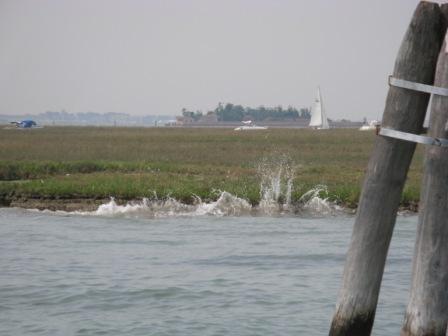
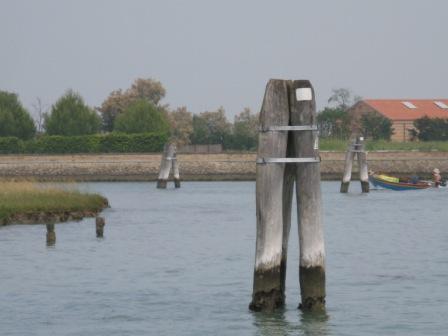
Waves are as destructive to wetlands as they are to buildings, but the wetlands can’t even put up a fight.

The large pilings were put in ages ago, to mark the line between the channel and the barena. As you see, the waves have shrunk the barena, so the large pilings are only sort of symbolic. As a bonus, we see the remnants of the wall of smaller pilings which was installed to prevent any further erosion of the barena.

The distance between pilings and barena here is just another of many examples of the very simple effect of waves.

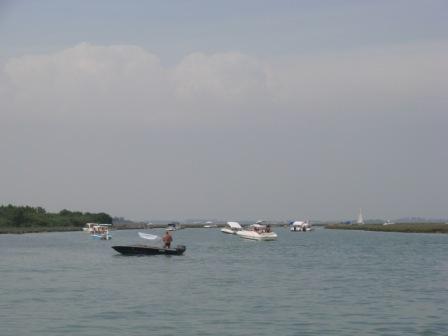
I remember when this channel was only half this wide. Most of these boats belong to people from the mainland who come all this way so they can just sit. Lovely, admittedly, but they bring waves and take away part of the lagoon when they go home.


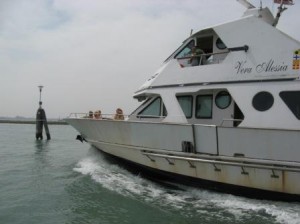
Tourist launches of all sizes offer day trips around the lagoon.

Taxis are always in a hurry, especially on airport runs. (Photo: Italia Nostra)

Ordinary working barges at Sant' Erasmo on a Sunday afternoon. Their owners are almost certainly out in smaller motorboats, but tomorrow it will be back to work with all of these.
January sensations revised
Posted by: | Comments(I discovered too late that my previous version needed some weeding at the end. This has been cleaned up. Apologies.)
January is a first-class month here (I’ll let you know if I think of one that isn’t).
Nothing against gray. Gray can also be beautiful here, often more beautiful than blue.I say this for two reasons. First, the end of the month — or more or less starting now — is composed of the so-called “giorni della merla,” or days of the blackbird. Specifically, the female blackbird, which isn’t black at all, but never mind, and who is commonly believed to be busy building her nest right now for her imminent new brood. This is the only intimation, however remote, of the eventual coming warmth.
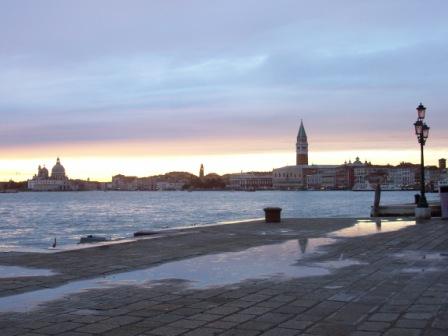
Gray actually has a lot of points in its favor.This designation isn’t limited to Venice; our little interlude goes by the same name all over Italy. This brief span of days — specifically the last three of the month – are famous for being really cold; in fact, they used to be fairly dependably the coldest of the winter. Perhaps they’re not as cold now as they may once have been (though they’re plenty cold just the same), but if we didn’t get a sudden drop in temperature in late January I would be extremely upset. Just so you know.
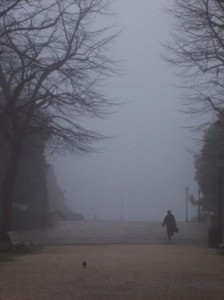
Those more inclined toward literature than ecology may recall that this frigid period strikes just about on St. Agnes’ Eve, or January 20. John Keats’s eponymous poem, “The Eve of St. Agnes,” sets the mood:
“St. Agnes Eve — Ah, bitter chill it was! / The owl for all his feathers was a-cold; / The hare limp’d trembling through the frozen grass / And silent was the flock in woolly fold: / Numb were the Beadsman’s fingers, while he told / His rosary…” And so on. Odd that I can still remember that from high school.
Unless you don’t like humidity, in which case gray is not your color.So “days of the blackbird” is just a more attractive way of saying “cold snap,” though at the moment we’re in more of a gray snap. Between fog, snow sputters, and generally heavy overcast, the only light on the horizon is the dimly perceptible gleam of Carnival — a gleam not caused by the sun so much as by merchants’ smiles glinting off loose change.
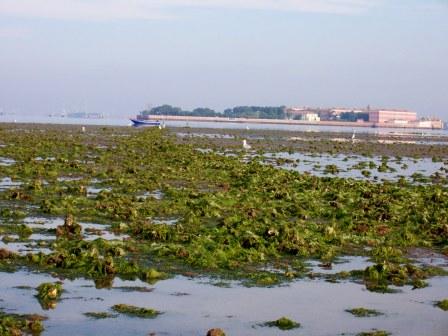
The second reason I love January leads me to ask: Have you ever wondered where all the water of the acqua alta goes when the tide turns? There is a phenomenon which is particularly Venetian and again, I notice, dedicated to a female figure. In these few weeks, when the water gets let out of the lagoon it reveals the “seche de la marantega barola” (SEKK-eh deh la mah-RAN-tega ba-RO-la), or the exposed mudbanks of the shriveled old hag. The Befana, they mean, even though she went home two weeks ago.
I suppose they could have called them the seche of St. Agnes, but it just isn’t the same. From what I gather, it would have to have been rendered as the “exposed mudbanks of the young virgin martyr.” Not bad, but still.
The lagoon is particularly beautiful in two ways when the year begins. First, with real cold, the water becomes utterly pellucid. Peering down from the bridge over our canal, I can easily make out all sorts of debris in perfect detail, down to the number on a lost license plate settling into the mud. Out in the lagoon, the water has an amazing Caribbean/Greek island transparency.
Second, and just as beautiful as the water, is what you see when the water goes away. The “seche de la barola” are startling prairies of luxuriant emerald algae emerging from the shallows, replacing the usual water with verdant swathes worthy of Nebraska.
I love this, not only because it’s so strange (the first time, anyway), but because it shows in one of countless ways how alive the lagoon is. As the late-January twilight briefly weaves itself into the fading sky with soft skeins of mist, the tide silently turns and this extravagant greensward begins to imperceptibly sink beneath the water again. Imperceptible to me, perhaps, but not to the feeding waterbirds tiptoeing delicately among the soggy tussocks, seeking one last little morsel.
In the city, you may notice that the boats are very low at their moorings. One year I even saw boats sitting on bare mud along the shores of the Grand Canal. That was exciting. It was like being in Fowey, or one of those other little ports in Cornwall where the tide leaves fleets of pleasure boats sprawled yards and yards from the water’s edge.
Oddly, this low tide happened at dawn in June a few years ago, rather than dusk in January. But you get the idea.The seche de la barola are well-known to the municipal tide office, which publishes the daily tide predictions on its website and also in the Gazzettino. One symptom of how the tides have gone haywire in general this winter isn’t so much (to my mind) the high water, though that makes such entertaining pictures. It was how the anticipated low tides refused to go low. They just refused. You can see it here:
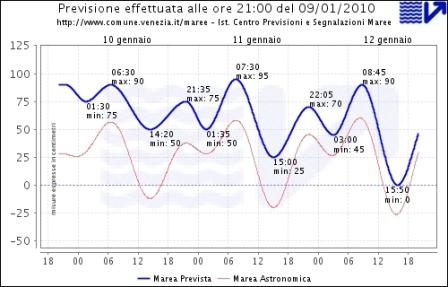
The lower line indicates the previously forecast high and low tide levels. The upper line traces what is really happening. Quite a difference. And this went on for days.To give you an idea of what I mean by “low,” here are some numbers on the seche a year ago.
|
Istituzione Centro Previsioni e Segnalazioni Maree |
||||||
|
Minimi di marea <-50 cm Punta della Salute – anno 2009 |
||||||
|
Estremali <-50 cm |
||||||
|
N° |
Data |
Ora solare |
Valore |
|||
|
1 |
09-Jan-09 |
16.20 |
-52 |
|||
|
2 |
10-Jan-09 |
16.35 |
-57 |
|||
|
3 |
11-Jan-09 |
17.25 |
-58 |
|||
|
4 |
12-Jan-09 |
18.05 |
-59 |
|||
Minus 59 centimeters is 23 inches below the median sea level. Just so you know.
So come visit sometime in January, and see what the Befana left behind. She’ll be back next year to do it all over again.
Getting ready to party
Posted by: | CommentsYou can have your first robin of spring — yesterday I detected the very first signs of Carnival .
The official Carnival celebrations this year will be running from February 6 to 16. Does ten days sound like not very many? Unless you’re a hotel owner, or a street cleaner in need of overtime, they’re more than enough, because each day will be filled with many, many tourists. In the sense that the Serengeti migration involves many, many wildebeest.
But in our little corner of the city, the signs are more appealing:
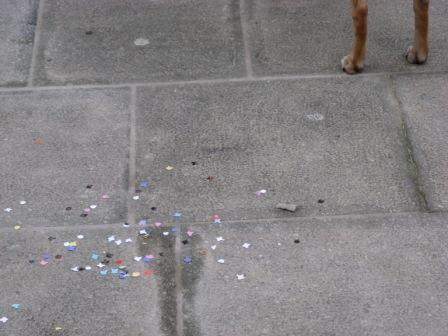
The first sprinkles of colored paper, thrown at random by small-to-smallish children. They haven’t even put on their costumes yet; for them, it’s enough to have a bag of confetti and an adult who is looking somewhere else.

The dog is looking somewhere else because evidently confetti has no discernible odor.
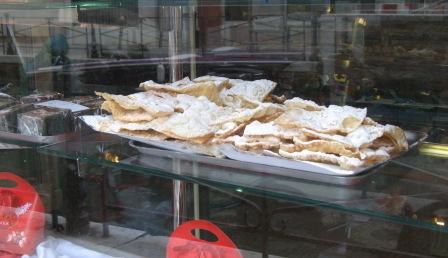
And pastry!! Specifically, frittelle (free-TELL-eh) or, in Venetian, fritole (FREE-to-eh), and galani (gah-LAH-nee).

Crunchy, full of fat, loaded with sugar -- what's not to like?
Our neighborhood pastry-shop (above) makes what I used to think were the best galani in the universe (if you will disregard their lavish use of powdered sugar, which is wrong). That was until I tried making them myself.
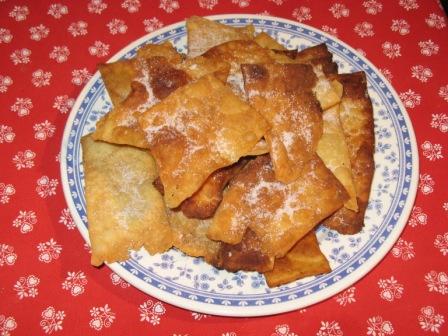
For the cost of a few fundamental ingredients and a couple of hours, you have a high probability, as a scientist would say, of producing something like this:

The day I made these, they were so good (the entire batch heaped six plates like this one) that we sat down and just started eating. We didn't eat them all, but that turned out to have been dinner.
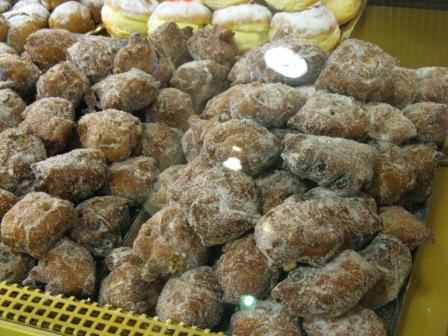
Fritole are another matter. As something to eat, they are less thrilling than galani (they trade the crunch factor for the dense-and-spongy factor), and as something to make, they’re even more work, though real Venetian housewives will deny it. I make no comment, I only observe that these women have had decades of a head start on me.

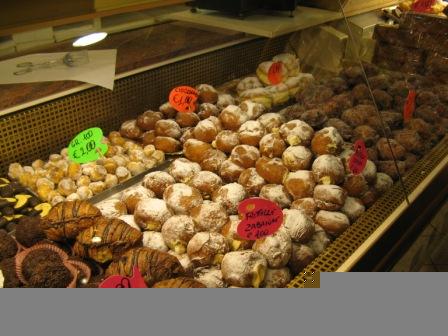
Not only does this bakery/pastry shop offer classic Venetian fritole in abundance, they drive home the point by writing "normal frittelle" on the price card. They assume you know what "normal" means.
Fritole involve yeast, and substantial quantities of hot oil, neither of which appeals to me — speaking as the maker, I mean, not the consumer.
Classic Venetian fritole contain bits of raisins and/or candied fruit, are covered in normal (again, not powdered) sugar, and are both crunchy and soft, in just the right proportions. I can’t tell you what those are — you’ll know them when you taste them.
Venetian fritole are becoming so rare that shops will put up a sign announcing they have them. Evidently the same impulse (culinary, commercial, cultural) which has turned the simple Christmas fugassa into a panettone that’s become a cross between a pinata and a myocardial infarction has also struck this classic Carnival treat.

Here you see the entire line-up of fritole, filled with cream, or zabaione (as they spell it), and now even chocolate.
Now you get fritole filled with thick cream or zabaglione, and covered with powdered sugar. These are, as the Good Book puts it, an abomination and a hissing. But they sell, and I’m not sure what the Good Book has to say about that.
As a bonus, I mention the unheralded but modestly good castagnole (kas-tan-YOLE-eh), which are essentially doughnut holes. They’re much easier to fix than fritole, if the recipes I found can be believed, and they are also approved (by me) for Carnival authenticity.
Here are the essential recipes, taken from my own culinary good book, my trusty “Cento Antiche Ricette di Cucina Veneziana” (One Hundred Ancient Recipes of Venetian Cooking):
GALANI
Ingredients: 1/2 kilo (1 pound) flour, 2 eggs, 30 grams (1 oz) butter, 10 grams (1/3 oz) “vanilla’d sugar” (zucchero vanigliato) or a few drops of vanilla extract, a pinch of salt, and a small glass of rum or other liqueur. Oil for frying (peanut is good; I use sunflower. They say you can also use lard. I’ll stand back.)
Mix all ingredients (your hands are the only effective option), divide the dough into portions about the size of a baseball (or bocce ball, if you wish).
Roll out on a floured surface with a rolling pin till the dough is about as thick as a sheet of paper. I’m serious about this. I know it’s a lot of work — the dough becomes more elastic and resistant to being rolled the more you keep at it — but if you fudge on this part you’ll never get the result you want. The first time I made these I stopped rolling when the dough was the thickness of carton, and they were a spectacular disaster. So just make up your mind to it.
Cut the PAPER-THIN sheet of dough into strips that are somewhere between a square and a rectangle, no longer than the span of your hand. (”One Hundred Recipes” says to tie each into a knot, but I’ve never seen them like this.) I say cut them into whatever shape you want as long as it’s not too big.
Lay them, a few strips at a time, in the extremely-hot-but-not-boiling oil. Watch them turn brown. (No need to turn them.) Remove quickly — they are born with an innate desire to burn and turn black — and put on paper towels.
Sprinkle with sugar. If you want to use powdered sugar, go ahead. You’re the one who’ll be eating them, and I won’t be there to check up on you.
Unfortunately, as fabulous as these are when they’re just made, they stay almost as good for days. So don’t feel you must consume them all at one go. Then again, it’s Carnival, so the rules have been disabled. Live it up.
FRITOLE
Ingredients: yeast, flour, raisins, pine nuts, candied lemon, one or two small glasses of some liqueur. Cooking oil (or lard).
I’m sorry I can’t be more precise; “One Hundred Recipes” sometimes falls back on the old-fashioned “you’ll know it when you see it” approach to quantities.
Dissolve the yeast in a little warm water with a little flour in a wooden bowl and place it near a source of warmth.
When it begins to rise, add the raisins, pine nuts, and liqueur. Mix “forcefully,” they say.
Add more flour, but make sure the mixture remains semi-liquid.
Cover the bowl with a cloth and put it back in the warm spot till the yeast has completely risen. (”You’ll know it when you see it.”)
Take soup-spoon-sized portions of the dough and drop in the hot oil. They say boiling oil — you’re on your own here.
Cook till done (ditto). Sprinkle with sugar.

The humble castagnole await you at what appears to be a higher price, weight-to-euros, than its bigger cousins. Perhaps it's the cost of labor.
CASTAGNOLE
Ingredients: 300 grams (10 oz) flour, 60 grams (2 oz) sugar, 50 grams (1 1/2 oz) butter, 2 eggs, 1 envelope of yeast (no quantity of contents given, hm…), two soup-spoons of rum or grappa, a pinch of salt, grated rind of one lemon or orange, Alchermes, powdered sugar, oil for frying.
Mix all the ingredients except the powdered sugar, oil, and Alchermes.
Let the dough “rest” for half an hour.
Make little balls (size of golf balls) of the dough and fry in the oil for about 15 minutes.
Take out and place on paper towels. While they’re still hot, pour a few drops of the Alchermes on each and sprinkle with the powdered sugar.
ALCHERMES
This is a bonus for all of you who want to go the distance, and to have something unusual (and probably delectable — I haven’t tried this. Yet.) in the house. It sounds good enough to rate being included in almost every recipe I can think of: pot roast, lasagne, creamed chipped beef on toast, Waldorf salad…
I am making a moderately educated guess that it’s pronounced Al-ker-MESS.
350 grams (12 oz) grain alcohol, 350 grams (12 oz) sugar, 500 grams (17 oz) water, 5 grams (1/10 oz) stick cinnamon, 1 gram (a pinch, I’d say) each of cloves,cardamom, and vanilla, 60 grams(2 oz) rosewater (the cooking, not the cosmetic, variety) and 4 grams (a few drops) carmine, otherwise known as Red Dye E 120.
My source gives no procedure at this point, so I’m going to suppose that you mix it all together, pour it into a container which closes tightly, put it somewhere dark, and don’t take it out for a while. Perhaps a long while.
Interesting historical note: You will already have assumed that this potion has Arabic roots because of the first syllable “al.” It’s a concoction once popular in Southern Italy and Sicily (where there was a notable Arab influence). It was customarily given to children to calm them whenever they were stricken with fear, profoundly shocked, moderately upset, slightly annoyed… Actually, I believe it was mainly administered in extreme situations, which in a region subject to earthquakes and eruptions aren’t completely theoretical.
If I were a southern Italian child, though, I’d make a point of evincing drastic distress every once in a while just to be able to taste this elixir. I imagine that life as a southern Italian child could be rife with possibilities to evince distress even without extreme natural events. Sunday lunch with the relatives comes to mind.
More on Carnival along the way.
Motondoso: Suck it up
Posted by: | CommentsThe dynamics of waves aren’t so hard to understand — anybody who’s ever gone to the beach remembers the thump of the wave that has just arrived. (Am I the only person who’s ever noticed how much that sound resembles the slamming of the car doors as your family arrives for a visit?).
We don’t really notice what the thump does to the sand because an infinite series of them has already created the sand. It’s not a bad idea, though, to recall that the sand was once a hefty piece of mountain.
What isn’t so obvious, and maybe is even less obviously disturbing, is the hissing sound the wave makes as it departs. It is caused by a force called “risucchio,” (ree-SOOK-yo) which literally means “re-sucking,” though I suppose “undertow” is close enough for Anglophones. And it’s the force that tears asunder what was once clearly put together by God, man, or whatever’s in between.

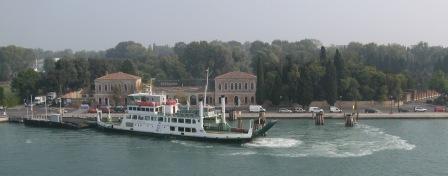
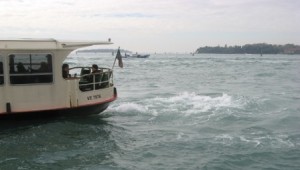
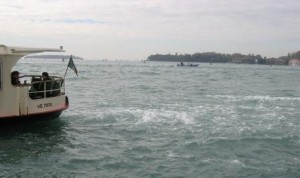
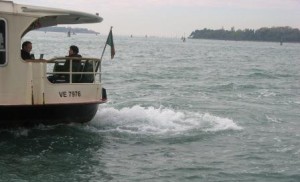
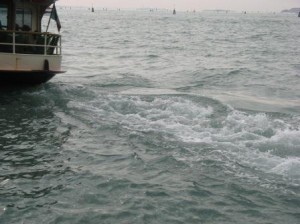
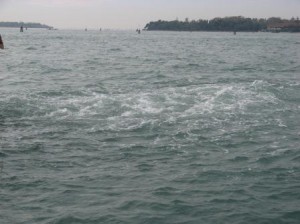
This is the ferryboat which carries wheeled vehicles to and from the Lido. When it approaches the landing stage, the captain throws the engines into reverse to slow and stop the boat, then keeps the engines grinding in reverse in order to maintain tension on the lines. This is considered necessary for safety. The result is an impressive vortex of spinning water..

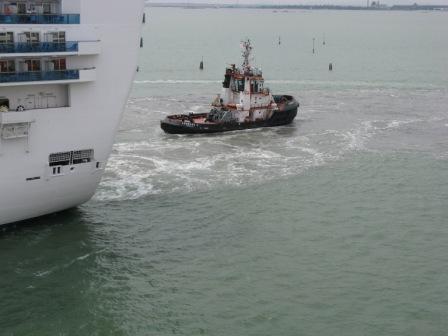
Cruise ships create the same effect when they are maneuvering out of their berth. Here, the "Ruby Princess" is on its way out. In high season there can be as many as seven cruise ships in the Maritime Zone.
Even natural waves caused by the wind, aided and abetted by the retreating tide, will do some of this work of demolition. But then there are the big public boats — and I’m thinking specifically of waterbuses. They come in several versions here, but the highest number are the vaporettos.

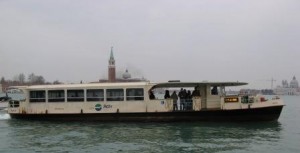
A standard vaporetto.
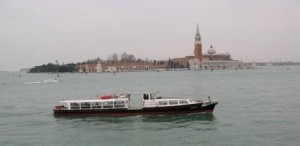
The vaporetto is a specific type of boat, and the public-transport company, which goes by its acronym ACTV, operates 52 of them. Sometimes called “battello,” the vaporetto has a regularly scheduled cousin correctly called a “motoscafo,” though it gets called “vaporetto” too for convenience. It sits lower in the water and carries fewer people, though you might not believe it if you try to get on one at rush hour.

A motoscafo.
At this moment, the ACTV website informs us that the company operates “about 152″ waterborne vehicles. (”About”? You mean you don’t know?) They break it down thus: 52 vaporettos, 55 motoscafos, 10 “single agent motoscafos,” which I can’t interpret for you just now, 16 bigger vaporettos that travel the lagoon (”vaporetti foranei”), 9 motonavi, and 8 ferryboats.

A motonave.
Naturally all of these vehicles cause waves, but what compounds the effect is the undertow they create when they stop at one of the 100 or so bus stops (city and lagoon) to drop and pick up passengers.
It’s pretty simple. Here is an illustration of what happens every time one of these craft comes and goes:

The vaporetto approaches the next stop. The captain may not have noticed whether he is going with or against the tide; if he's going with it, he'll probably arrive faster than he meant to and have to hit the reverse really hard to break the momentum and get back into position to tie up.

He reverses the engines to stop the boat; the mariner throws a rope and ties the boat to the dock.

The captain revs the engine in order to bring the boat parallel to the dock. The water shows the effect of the earlier reverse and the subsequent forward.

To keep tension on the line while loading and unloading passengers, the captain keeps the engines at a very high rate of rpm's.

Everybody's aboard; the mariner unties the boat and the captain begins to reverse again. This maneuver enables him to turn the boat slightly to starboard, which puts him the ideal position to throw the gears into "forward" and move on to the next stop. So: Back in reverse we go.

And wham! We're starting to move forward again.

And off we go. On to the next stop, where the same sequence of maneuvers will be repeated. If this looks even slightly disturbing out here in the open water, imagine it happening virtually constantly all along the Grand Canal. All day.

Trailing clouds of glory in our wake.
On September 15, 1881, the first vaporetto (”Regina Margherita”) began regular service in the Grand Canal. The imminent arrival of this creation caused tremendous distress and revolt among the gondoliers, who foresaw their doom. Their turmoil is the focus of a marvelous film, “Canal Grande” (1943), starring several then-well-known Venetian actors, such as Cesco Baseggio, plus a number of real gondoliers. Too bad it’s all in Italian.
The first vaporetto was soon followed by a fleet of eight, run by a French company, the “Compagnie des bateaux Omnibus.” Nothing against that noble nation, I merely note that Napoleon Bonaparte, who conquered and devastated Venice in 1797, was also French.
In 1890 the Societa’ Veneta Lagunare began service between Venice and assorted lagoon locations. And so it has gone.
Lino remembers when there were still very few vaporetto stops in the Grand Canal; they were at San Marco, Accademia, San Toma’, Rialto, the railway station, and probably Piazzale Roma, though he won’t swear to it. In what was still a flourishing local culture, the Venetians could find almost everything needed for daily life in their own little neighborhoods.

This is a bus stop, essentially a dock called a "pontile," to which the vaporetto is tied while exchanging passengers.
There are now 17 stops on the Grand Canal. They were not installed as something useful to the residents, as noted above, but for the transport of tourists. Shops have begun to close (I don’t lay this fact at the feet of the wave-and-sucking-causing public transport), so as the population has dropped, and the number of tourists has risen, the locals have had to range further afield to find forage, so to speak, and at the same time have had to use public transport which is usually overstuffed with tourists and their luggage. During Carnival, most Venetians do their utmost to stay the hell at home.
The city recognizes that there aren’t enough vaporettos most of the year; during the summer (and Carnival) extra routes and supplementary vehicles are laid on. But eventually some crisis point will be reached where the number of bodies requiring to be moved and the available space in which to do it will collide. To use a term which nobody in the navigation business wants to hear.
Zwingle’s Fifth Law states that “You can get used to anything.” You may quibble, but I can attest that you can definitely get used to this roiling and churning and sucking of many waters. This isn’t good, but neither can you travel all day in a constant state of rage and anguish.
You can give yourself an interlude of relief by going for a little stroll. Ignoring the roaring of motors and the shattering of waves, you can really relax in the city which is extolled for having no cars. I think people who say that must merely mean ”no traffic.”

Before too much longer, the Grand Canal is going to resemble Runway 3 at O'Hare. At the moment, it's only like I-95 from Washington to Richmond.
Motondoso, Part 3: The How
Posted by: | Comments“Motondoso” has very clear, and essentially simple, causes and effects. Anything moving in water, even eels, will create some kind of wake. The wake is the visible, surface part of the turbulence made by whatever is moving — in the present case, the motor’s propellers. The waves spread out in two directions until they dissipate.
In the case of motorboats in Venice, this fact is exacerbated by:

If it floats, it has to have a motor. This appears to be the only rule that is universally obeyed. Here is an increasingly common scene in the Grand Canal. (Photo: Venice Project Center)
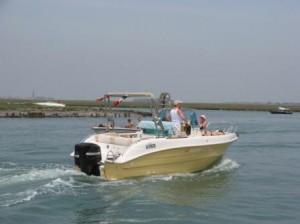
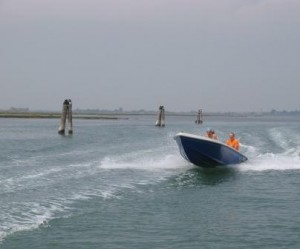
The number of boats: There are thousands of registered boats in the city of Venice. There are also many which are unregistered. This number spikes every year in the summer when trippers from the hinterland come into the lagoon to spend their weekends roaming around, often at high speed but always with many horsepower, in motorboats of every shape and tonnage. Teenage boys, particularly from the islands (by which we mean Sant’ Erasmo, Burano, Murano, are especially addicted to roaming at high speed at all hours with their girlfriends and boomboxes.
On a Sunday in July a few years ago, a squad of volunteers from the Venice Project Center spread out at observation posts across the lagoon, from Chioggia to Burano. Their mission was to count the number and type of boats that passed their station. Whether it was a million boats passing once or one boat a million times, it didn’t matter. They came home with quite a list: every kind of small-to-smallish boat with motors ranging from 15 to 150 hp, hulking great Zodiacs, large cabin cruisers, ferries, vaporettos, tourist mega-launches, hydrofoils from Croatia, taxis, and more. After 11 hours, from 8:30 AM to 7:30 PM, they analyzed their data. Result: A motorboat had passed somewhere, on the average, every one and a half seconds.
And if weekday traffic is heavy, weekend traffic is three times greater.
The types of boats: In the last 20 years, motor-powered traffic has doubled; at last count 30,000 trips are made in the city every day; 97 percent of these trips are in boats with motors. (There are currently 12 projects in the works for marinas which will add 8,000 more berths.) Of these 30,000 trips, a little over half are made by some sort of working boat.
More than 10,000 daily trips are by taxis or mega-launches, and more than 8,000 are by barges carrying some kind of goods (bricks, plumbing supplies, cream puffs, etc.). Studies have shown that if there is one category that over time causes the most damage, it’s not the taxi (I would have bet money on that). It’s barges. And they are everywhere. It’s all barges, all the time.

This is the milk truck.

Appliances and furniture.

There have always been large heavy boats moving materials in Venice, but when they were propelled by oars, the backing-and-forthing needed to negotiate spaces and corners didn't involve creating heavy vortexes of water.

When a heavy boat runs into a wall, it can leave quite a calling card. Here is a popular place to tie up your barge while unloading cargo. Who did this? Everybody and nobody.

Toilet paper, detergent, and other household supplies come ashore with the flick of a few buttons. Life is good, unless you're an old and fragile city.

- I know they’re heavy, but all this boat to carry a few watermelons?

This is a peata, the mega-barge that built and maintained Venice well into the 20th century. It was usually rowed by two people, with one of them also at the tiller. Now we require motors to do the same thing because we have to have speed.

These men knew and understood the lagoon, its tides and currents and winds, as no one ever will again, and they exploited them rather than fighting against them.
Traffic patterns: The problem isn’t merely the number and type of boats, but where they are. Obviously, the more boats you have, the more waves they will create, and where space is limited (most canals in Venice) these waves quickly accumulate into a roiling mass that dissipates with extreme difficulty. They are forced to go back and forth, hitting anything they come into contact with, until they finally wear themselves out and die.
There are canals where the waves don’t expire for hours: the Grand Canal (unfortunately), the Rio Novo, the Rio di Noale, the Canale di Tessera toward the airport, the Canale delle Fondamente Nuove, and above all, the Canale della Giudecca.

This map makes it clear why the Giudecca Canal is fated to carry virtually every boat that wants the shortest route from the Maritime Zone/Tronchetto to and from San Marco.
This broad, deep channel has become Venice’s Cape Horn. It is a stretch of water 1.5 miles long [2 km] and 1,581 feet [482 m] wide, and is the shortest and fastest way to get from the Maritime Zone (cruise ship passengers, tourist groups from buses at Tronchetto, barges delivering goods of every sort) to the Bacino of San Marco. One study revealed that the biggest waves in the Lagoon are here; an even more recent survey, conducted with a new telecamera system installed by the Capitaneria di Porto, provided some specific numbers: 1,000 boats an hour transit here, or 10,000 in an ordinary workday. In the summer, there are undoubtedly more, seeing that an “ordinary workday” includes masses of tourists.
One reason there are so many boats is due to the large number of barges, rendered necessary by an exotic system for distributing goods. If you are a restaurant and need paper products, they come on a barge. If you need tomato paste, it comes on another barge. If you need wine, it comes on another barge. In one especially busy internal canal, the amount of cargo and number of barges was analyzed, and it turns out that the stuff on 96 barges could have fit onto three. But never forget the fundamental philosophy: “Io devo lavorare” (I have to work).
The types of boats: Their weight and length. The shape of their hulls. Their motors (horsepower and propeller shape). All these factors influence the waves that they create.
A number of intelligent and effective changes have been proposed over time, most of which that would not be particularly complicated, but which would cost money. So far no one has shown that they consider these changes to be a worthwhile investment.
Example: The original motor taxis (c. 1930), apart from being smaller than those of today, positioned their motors in the center of the boat. When the hulls (and motors) became larger, everyone moved the motor to the stern, which immediately creates bigger waves. But subsequent improvement in motors and their fuels means that today it would be feasible to maintain the current size of the taxi while moving the motor to the center once again, thereby immediately minimizing its waves. Feasible, but no one is interested.

Boats this large made of metal may be necessary for certain kinds of heavy labor, but they are hazardous to the city's foundations. Although they don't create noticeable waves in the smaller canals because they are going slowly, they contribute to the wave damage in several ways. One is by the chunks they take out of walls if they mistake a maneuver, thereby opening the pathway to waves from smaller boats. Another is the force of their motors during maneuvers, especially at low tide, which can suck the earth out from under the sidewalks. Or the force can push the canal sediment up against the underwater walls of buildings where they plug up sewer outflows. Blocked sewers cause accumulations of corrosive chemicals inside the building walls, which eventually also damage the structure.
Speed: This is utterly fundamental. Speed limits were introduced in 2002 to confront the already serious problem of the waves; the average legal range, depending on what canal you’re in, is between 5-7 km/h. But tourist mega-launches, barges, taxis — almost every motorized boat in Venice has the same need: To get where they’re going as quickly as possible.
This need has been imposed by the demands of mass tourism, which involves moving the maximum amount of cargo (people, laundry, bottled water, etc.) often many times during the day. Everyone makes up a timetable which suits them and then makes it work.
Studies by the Venice Project Center have revealed several speedy facts in crisp detail.
- The height of the waves increases exponentially as speed increases. A small barge traveling at 5 km/h would produce a wake about 2 cm high. The same boat going at 10 km/h produces a wake of nearly 15 cm. (Multiply the speed by 2, multiply the wake by 7.)
- Virtually all boats exceed the speed limit. The average speed on all boats in all canals was 12 km/h, which is more than 7 km/h over the maximum speed limit.
- Therefore, reducing the speed of the boats would drastically decrease the size of their wakes.
Speed limits would have a positive effect (if they were obeyed) but only if certain laws of hydrodynamics were taken into account, such as the one governing the wake produced relative to the weight of the boat. Here the speed limits have been adjusted to permit the vaporettos (waterbuses), among the heaviest daily craft, to go — not slower, which would be correct — but as fast as the timetable requires.
You can change the laws on speed limits all you want – you’ll never change the laws of physics.
Oh yes: there will be waves.
Next: Part Four: The lagoon experience
Motondoso, Part 2: The Why
Posted by: | CommentsRead Part 1: The What; Part 3: The How; Suck It Up; Part 4: The lagoon’s-eye view
If civilization has reached the stage where most people generally agree that it’s wrong to strike a woman, a child, even a dog, it’s not easy to explain, much less excuse, why an entire city should have to submit to this kind of abuse, a city which depends as much (or more) on its people than the people depend on it.
But then again, it is easy to explain. Sloth, egotism, and a resistance to contradiction tougher than corrugated iron induce almost all the people with motorboats of whatever size or purpose either to deny that they are creating waves, or say that other perpetrators are far more guilty, or accept it with Zen-like resignation.
All of these put together foster a situation in which a recent newspaper article could make a serious reference to the “numerous reports (to the police, of excessive traffic/waves) by Venetians who when they go out in their motorboats have to work miracles to avoid ending up in the water because the waves are so strong.”
People in motorboats complaining about waves. Let me stop and think about that for a minute.

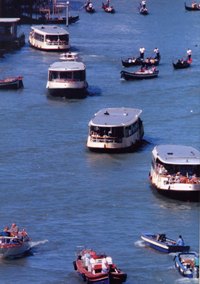
You'll find virtually any kind of boat with a motor in the Giudecca Canal, usually in a huge hurry. Here we have taxis, a tourist launch, one of countless barges, the Alilaguna airport waterbus, and a hotel launch. What's missing here at the moment, strictly by chance, are (among others) the garbage scows, innumerable private motorboats of all sizes, as well as the vehicles of public transport: vaporettos, motoscafos, and the ferryboat carrying cars to and from the Lido.
Waves don’t really care who causes them or why, but each one acts as a hammer hitting anything it reaches. A study more than 10 years ago revealed, via sensors in the Grand Canal, that a wave hit a wall every 1 1/2 seconds. One pauses to imagine what the public response might be in a city — say, Rome — in which a heavily loaded truck ran into a building, especially a monument, every 1 1/2 seconds. Zen-like resignation doesn’t come to my mind.
For some reason, waves just don’t sound that bad. But they are. And even though they’re right out there in plain view, solutions — and many have been proposed, and re-proposed — have the doomed allure of the classic New Year’s diet: feasible, yet somehow impossible.
One reason is a lethargy at City Hall of spectacular dimensions caused, among several factors, by the lack of ability or desire on the part of the city’s administrators to resist the inevitable shrieking and ranting from any sector which feels threatened by any suggestion of limits. Example: The recent succumbing to pressure by the taxi drivers, and the awarding of 25 new taxi licenses. These will not be taxis which do not create waves, but they will be taxis traveling the same routes which already are suffering the most devastation.
These licenses were granted by the same officials who in other situations solemnly invoke the “battle against motondoso.” Hard to get anywhere with a battle when most of your officers are collaborating with the other side.

One of many signs in the lagoon notifying boaters of the speed limit, here in the Canale delle Scoasse along the Lido. Note that the speed is given in kilometers (not knots) per hour. If anyone is going this slowly it's either because he's just spotted a policeman up ahead, or his motor has died and he's being towed.
Of course there are laws — plenty of them. But they are only sluggishly enforced, especially those concerning speed limits. There are sporadic police “blitzes” which snag a certain number of offenders (it’s like shooting fish in a barrel), but these blitzes change nothing, not even for the people who have been handed fines. Taking your chances is part of the Mediterranean worldview, and laws are meant to be ignored. Fines are part of the annual budget for many waterborne enterprises. Confiscate your taxi? We’ve got more. One taxi owner invited some city politicians to the launching of his new one.
Down here at the waterline, I can tell you that one of the biggest obstacles to reducing waves is contained in three words: “Io devo lavorare” (Literally, “I have to work.” Figuratively, “Get off my back, do you want my wife and children to be thrown out onto the street to beg?”)
This phrase is lavishly used, on the assumption that it’s a free pass to whatever the person speaking it feels like doing. And when gondoliers stage one of their periodic protests, which are always dramatic because gondolas are inherently harmless, the little red “Danger: Irony” light starts to flash. Gondoliers spend all day carrying people around through waves that range from “unpleasant” to “dangerous” to “life-threatening” (not an exaggeration; occasional passengers have risked drowning, and some have succeeded). But several gondolier cooperatives do a very lucrative business owning and operating a fleet of mega-tourist launches.
My favorite little moment was when two gondoliers went to a meeting of Pax in Aqua, the citizens’ group committed to combating motondoso. They went in a motorboat.
It’s not that they should have swum there. I’m just saying.

The gondola race at Murano is one of the most important Venetian-rowing races ever. Here is a small part of the motor-driven horde, lovers of the oar, which turns out to cheer on their friends and relatives. Some of these fans will also be gondoliers.
I’ll tell you when I gave up. It wasn’t the Sunday afternoon we barely made it back alive rowing our little Venetian topetta from Bacan’, one of the most popular lagoon summer spots to hang out in boats, which means motorboats. The waves were heavy, frantic, aggressive; they came from every direction as boat wakes smashed into each other. So: No more Bacan’ for us. We can just stay home and take up paper-making. Problem solved.
No, I could hear the air seep out of my capacity to hope on another Sunday afternoon in 2002, I think it was, when we were walking along the rio di San Trovaso — a very narrow canal which is always busy because it’s one of the shortest cuts between the Giudecca Canal and the Grand Canal.
For weeks, maybe months, long warning strips of red and white tape had been strung along parts of the fondamenta bordering the canal because it had become so unsafe to walk on. The waves from the constant traffic had done their inevitable work weakening the sidewalks’ foundations, in which you could easily see cracks, cracks that were widening thanks to the waves rushing in and out, pulling the soil from beneath the paving stones. The whole walkway was ready to cave in.
In that period, the then-mayor Paolo Costa had tried a novel approach to the problem: He had appointed himself Special Commissioner against Motondoso, which gave him extraordinary powers to deal with the deteriorating situation and also — well, why not? — get an extra paycheck.
His idea was that the bureaucracy had proved incapable of dealing with the waterborne anarchy which is obviously destroying the city, and the police hadn’t been noticeably effective in enforcing the laws (which you could understand, seeing that there are so few police and so rarely are any dedicated to monitoring speed limits). Therefore a sort of instant dictator would have to step in to impose order.

Even classic Venetian boats, such as this Burano-type sandolo, almost always have a motor clamped onto them. It might be only 15 hp, but that's irrelevant. A motor there must be.
The resulting special decree (Ordinanza n.09/2002, prot. 38/2002, February 21, 2002) outlines speed limits, and boat specifications, and canals name by name, to a degree which makes it clear that if every regulation were to be obeyed wars would cease, hunger would disappear, and illness and poverty would become but an ancestral bad dream. I’m sorry it’s only in Italian, it makes genuinely inspiring reading.
Suddenly we saw a motorboat come screaming down the canal, faster than any boat I’d ever seen here, hurling walls of white water against the trembling embankments. We stopped, stunned. Everybody walking along had stopped. Then the boat stopped. We heard voices. A few people on the sidewalk were talking to the people in the boat. And then it became clear.
They were filming “The Italian Job,” and this was just one of many sequences the city was to witness over the next few days or weeks (I can’t remember). Boats were racing up and down canals in a way that not even taxi-drivers could have dreamed of. Of course, if a taxi driver were to go this fast, he’d have to go to jail, or hell. For a movie, though — that’s something else entirely.
And who gave the permission for this film and these high-speed chases, and these walls of white water? The mayor. Excuse me, I meant the Special Commissioner against Motondoso.
I wish I could say I made that up, but I didn’t.
Motondoso: Waves Gone Wild, Part 1: The What
Posted by: | Comments
Just one of the countless waves (here, the Giudecca Canal lands a left hook on the Zattere) which are reducing Venice to rubble.
Slapping. Punching. Thudding. This is the sound of what things have come to. For 1,795 years, Venice celebrated Ascension Day with a ceremony in which the doge threw a golden ring into the sea and intoned the words: “Desponsamus te, O Mare, in signum veri perpetique dominii.” (”I wed thee, O Sea, in sign of true and perpetual dominion.”) In this case he was referring to the Adriatic, and possibly even the Mediterranean, and the Venetians did an excellent job of this for a long time. But the Venetian lagoon is a body of water which resists domination. It is not a happy marriage.

The gondoliers at the Molo, on the Bacino of San Marco in front of the Doge's Palace, finally installed a breakwater at their own expense. It's not the perfect solution, but it's better than nothing.
Over the past 50 years, the complex rapport between land and liquid, hitherto marred by only occasional bickering — an engineering misunderstanding, say, or some meteorological outburst — has now reached the stage of open battle.
But contrary to the general impression the world has of Venice’s rapport with its waters, the most serious problem does not involve acqua alta, or high tide. It is motondoso (sometimes moto ondoso), or the waves caused by motorboats, which is literally killing the lagoon’s erstwhile spouse. And unlike other forms of pollution or pressure, waves are a little hard to keep secret. The sight and sound of crashing water has become nearly constant.
Venetians routinely refer to motondoso as “the cancer of Venice.”
If you’re not impressed by the roiling high seas surrounding the city (try stepping between the leaping and plunging dock and vaporetto after the motonave — or better yet, the Alilaguna, the yellow airport “bus” — has just passed), give a glance at any canal at low tide.
You’ll see walls with chunks of stone and brick gone, stone steps fallen askew, cracks and fissures snaking up building walls from the foundation to the second floor, and even higher. It doesn’t take many canals before you begin to wonder how the city manages to stay on its feet. There are palaces on virtually every canal which have holes in their foundations bigger than hula hoops – dank caverns stretching back into the darkness. I have seen them with these very eyes. And if I’ve seen them, so has everybody else. But it just keeps getting worse.
Several years ago the fondamenta on the Giudecca facing the eponymous canal was finally completely repaired. Years of pounding waves were causing it to literally fall into the canal. But the waves continue as before — on the contrary, they’re increasing. The force, the height, the frequency, pick what you will. It’s all bad. (One study has stated that the highest waves in the entire lagoon are in the Giudecca Canal.)
Therefore the fondamenta is beginning to weaken again in the same way, which you can check by looking at the point at which a building is attached to the fondamenta. Cracks are opening up. Again.
So fixing — or saying you’ve fixed — a problem doesn’t count for much if you haven’t, you know, actually fixed it.
![]() The constant spray from the waves creates the ideal environment for a type of algae which is spectacularly slippery. And in the winter, spray turns to ice. You're on your own. |
![]() Low tide here is an appalling revelation. One of the primary causes of this damage are enormous iron workboats. If one bumps into a wall even slightly, it opens a crack (or hole) which the waves keep eroding. Hey, it's not their wall. (Photo: Italia Nostra) |
![]() This is one version of the intermediate stage, here on the Riva dei Sette Martiri facing the Bacino of San Marco. The waves have been pushing and pulling underneath and gravity has begun to take over. Just imagine if this were happening under your house. And yet, this is normal by now. There are no warning signs or barriers, no indication whatever that anything is happening here. This silent catastrophe is just sitting here peacefully in broad daylight as people wander by. |
![]() Waves working night and day will eventually produce a result like this ruined fondamenta facing the Canale di Santa Chiara just behind Piazzale Roma. The former walkway looks like a dead parking lot because it’s undergoing renovation, work almost certainly necessary because the pavement was giving way due to the pounding waves in the canal. The fondamenta will eventually be new, but the waves will continue – not only is the canal narrow, it is a major route for vaporetto and barge traffic. |
Next: Part 2: The Why
Part 3: The How
The Befana, racing
Posted by: | CommentsOut in the countryside you may only need some twigs, a match, and a jug of wine to make a party, but in Venice you’ve got to have boats. Boats that race, to be precise. And before she finally moves on, the Befana has to get rowing.

Last year we rowed from the Lido to Venice with a strictly regulation street-sweeper's broom attached to the bow of our six-oar caorlina. Just to blend with the decor, so to speak.
Ever since darkest antiquity sacred festivals have included some form of athletic competition. The Olympic Games spring to mind, but even the tiniest hamlet lost in the mountains may still organize a foot race, or horse race, or something else, when their saint’s day comes around. In ancient Greece some events, such as the funeral of a woman, would require a race reserved for women.
On Epiphany they held the 32nd edition of the Regata de le Befane, the race of the Befanas, in the Grand Canal. It’s fun to watch, doesn’t take long, there are free refreshments — they even hang an enormous calza caena, filled with only God and they know what, from the Rialto Bridge. In fact the only people who take it seriously in any way are the five Befanas.
Who are these hags? Men over 50, members of the Bucintoro rowing club, who have passed the eliminations for a place in the five-boat line-up. The event is limited to five because more can’t fit abreast in the Grand Canal. It’s just a sprint; the official schedule allots fifteen minutes to the race, but it really only takes about five. Maybe eight. But they are minutes filled with drama, at least for the participants.
The boats: Mascaretas, each rowed by one person with one oar.
The course: The aforementioned Grand Canal, from the major curve in the Grand Canal (the “volta de Canal”) at the Palazzo Balbi between the Accademia and Rialto Bridges to just before the Rialto Bridge.

Last year's victor, Giovanni Rossi, known as "Specene'." He finished second this year. Even Befanas aren't immune to disappointment.
The garb: Strictly Befana, the men decked out in wigs and Dogpatch skirts and crocheted shawls, with scraggly brooms and weird teeth (often their own).
It takes a while to get them reasonably lined-up — it’s a “flying” start, which means each keeps inching forward while waiting for the starting gun. This gambit often means a longish wait as the judge attempts to make them stay even, at least for a second. They also have to wait for a break in the vaporettos coming and going, which isn’t so easy nowadays considering how many there are at any given point/moment.
They’re off! The tide was going out — good, in a way but, as with all Venetian races, the luck of the draw which determines the positions in the starting line-up was a powerful factor in the outcome. Because while they were all rowing against the tide, due to the shape of the canal some had more of it against them than others. The man closest to the shore, if you will, had to confront slightly less current than the ones rowing more toward the middle (and, in fact, he’s the one who won).

It's harder than it may appear to get five boats lined up straight and ready to race.
But closer to the shore means that you have to work your way around the San Toma’ and San Silvestro vaporetto docks while the others are trying to get as close as possible to the left as well. Sure it seems like a doofwit little diversion, five guys in costume flailing away with their oars like Mixmasters, but they take it as seriously as rowers take any race here. Simmering rivalries, some having nothing to do with rowing but with club/personal/childhood events, can also heat up the competition. Small world — long memories.

And they're off!
What I like best about all this isn’t so much the race itself as wandering around the Grand Canal in our boat waving to and trading badinage with our friends. It may seem like a touristic event (and certainly there are plenty of bemused tourists and their kids lining the fondamentas and jamming the Rialto Bridge, enjoying the free drinks and galani and hard candies) but like many rowing events it has a pure neighborhood vibe. Everybody knows everybody — everybody has always known everybody here — and even slight changes in rowing partners can excite comment, as can everything in a neighborhood.
And unlike tennis, or chess, or sumo wrestling, you don’t have to know anything about it to enjoy it. That Befana — she’s quite a girl. Or, you know, whatever she is.

The free refreshments are overseen by a phalanx of Befanas.
The Befana: Panevin tonight
Posted by: | CommentsThe Befana, that bountiful old beldam, has more work to do than just to bring goodies to the kids and carry away the holidays.
On January 5 (the eve of the feast of the Epiphany — the eve being the day on which the profane elements of a festival are usually celebrated) several ancient rituals are observed in Italy going under various names. In the Veneto these customs are knotted together under the generic term panevin (pan-eh-VEEN). And the focal activity isn’t bread and wine — though there are naturally comestibles — but to brusar la vecia (broo-ZAR ya VEH-cha). Burn the old woman.
If you were to be in Venice on the night of January 5 and smelled smoke, you might want to check with someone before calling the firemen. Tonight, in fact, if the wind is from the east, I will be able to step outside and smell the smoke coming from bonfires along the lagoon’s farming coastline.
Technically speaking, this sort of agricultural festival would more appropriately be observed toward March, closer to the beginning of the annual cycle of cultivation, and not during what is still pretty much the dead of winter. In a few communities they do wait till the exact mid-point of Lent to “burn the old woman.” I suspect it’s because by then they’re desperate for some kind of festivity.
The central element of panevin is a bonfire composed of pieces of dead wood (from grapevines, olive trees, or anything else you have pruned or otherwise dismembered to encourage its growth), and atop this bonfire, tied to the stake which holds the mass of leftover wood together, is the effigy of an old woman, the Befana. Yes, she too is intended to go up in flames.

This photograph, not taken by me, shows the size of the bonfire in Novoli as well as the beginning of the blaze, which is set from within this mountain of wood. The burning figure is of St. Anthony Abbot.
Then again, in some towns, such as Novoli, the people burn their bonfire, a phenomenal ziggurat 36 meters [118 feet] high of dead vine branches, on January 17 in honor of St. Anthony Abbot, a major agricultural deity — sorry, I mean saint. I have my own memories of being there in 2003 researching “Italy Before the Romans” (National Geographic, January 2005). They let me climb to the top, the first woman — and an American, no less — ever to be permitted to do this. The next night the fire fizzled almost completely and I got out of town early, to avoid any recriminations of having brought bad luck. But back to the vecia.
Naturally any custom that strikes roots down to this level of antiquity contains several aspects, some contradictory, and not easy to confirm. But the general consensus is that bonfires played a central role in the ancient rituals of the Celts, who left other marks on the Veneto; the fire evoked, if not incited, the return of the sun from the solstice and the gradual lengthening and warming of the days. In the Christian religion, Epiphany was the day on the Julian calendar which coincided with December 25 on the Gregorian. (I know that December 25 is not the winter solstice, but I didn’t invent these customs.) And then the idea was planted/grafted/germinated spontaneously to hold the bonfire on Epiphany in order to light the way to Bethlehem for the Three Kings, who had traversed a bit too afar and gotten lost.
So we have to have fire, partly to represent/propitiate the sun, and partly because we’ve got loads of dead wood and other useless stuff that has to be incinerated anyway. Lino remembers when people would improvise their own bonfires right here in the city, in the neighborhood campos. As you can imagine, the firemen eventually put a stop to that.
Somebody or something has to serve as the sacrificial figure — deities require sacrifice — and an old human easily represents the old year, the old sins, the old crud and detritus and misfortune of the year just past. Some theories posit that the figure represents winter. Throw it all on there; all this stuff needs to be destroyed and fire in itself, besides being impressively effective in the destruction department, contains large amounts of symbolic meaning focused on purification.
Why does the figure have to be a woman? I’m still seeking the reason(s) for that one. One of the few I’ve found so far says that the female figure represents the Celtic priestess. There is also the point that Strenia (or Strenua), a Sabine goddess of strength and endurance adopted by the Romans, was venerated at the beginning of the year (one custom was the exchange of gifts; a Christmas gift is still called a strenna). Hence a woman. Let’s move on.
So we’ve got a fire, therefore naturally we’ve got smoke. And sparks. There will be a breeze. Now we come to the core of the ceremony, which is to study the direction the sparks are blown in order to predict how this year’s crops will fare.
The video above was made in Vittorio Veneto, a town about 80 km [50 miles] from Venice, toward the mountains. One hint are the men with the single black feather in their wool hats who are distributing the refreshments; these are members (or ex-members) of the Alpini, the mountain regiment of the Army. I’m sorry about the fruity TV music — it isn’t anything you would hear played at this event.
There are versions of the prognostication formula in scores of regional dialects, but the one I hear around Venice goes like this: “Se le falive (fa-EE-veh) va a marina/tol su saco e va a farina/se le falive va a montagne/tol su saco e va a castagne.” “If the sparks go toward the sea (east), take your sack and go to make flour (wheat); if the sparks go toward the mountains (west), take your sack and go gather chestnuts.”
Thus: Eastward-blowing sparks mean a good year is coming. If they head west, you’re going to be reduced to making your flour (bread, sustenance) from chestnuts, which is pretty much your last resort before starving. The fact that some not-bad dishes can be made with chestnut flour doesn’t change the fact that wheat is much, much better.
Let me note that the formula of divination in some areas, while being essentially the same, carries the opposite meaning: East is bad, west is good. So don’t blame me if your sparks don’t turn out to have told the truth.
Naturally all this burning and auguring is an excuse for a party (very few things here are not). We went one year to a small town on the mainland to celebrate the panevin, and after we had studied the sparks and coughed a while from the smoke, we went to the makeshift tables where vin brule’ (hot spiced wine) and pinza were being offered.
Wine needs no justification, and drinking it hot in sub-zero darkness is a great thing. If you haven’t got alcohol you haven’t got a party, and you can find easily find vin brule’ all winter.
But this is the only time of year you’ll get pinza. It is essentially the traditional winter-Veneto-panevin fruitcake, the only difference being that people actually eat pinza. This was the classic Christmas sweet before panettone horned in; it involves cornmeal, wheat flour, dried figs, anise seeds and bits of candied fruit. My trusty cookbook of old Venetian recipes includes raisins, sugar, pine nuts, and two eggs. Other recipes invoke walnuts, fennel seeds, and grappa. (Traditional offerings to Strenia were figs, dates and honey). However it’s made you won’t want a big wedge, it’s got a specific gravity rivaled only by mercury.
I hope you have a superb 2010, no matter where your sparks blew.
Make way for the Befana
Posted by: | Comments
For most of us, New Year’s Day represents the end of the holiday season. Not here. We still have the Epiphany to celebrate (January 6), and it comes swooping through, not so much in the person of the Re Magi (Three Kings) whom we recall brought gold, frankincense and myrrh to the infant Jesus, but instead in the person of a broom-borne hag called the “Befana,” a name that got squeezed out of Epifania (Eh-pee-FAH-neeyah).
In Venice she is also sometimes referred to as the marantega barola (ma-RAHN-teh-ga ba-RO-la), or wizened old crone. In ordinary life you might hear a particularly obnoxious busybody referred to as a marantega, regardless of her age, though the implication of decrepitude would add an extra fillip of insult to a younger person.
But despite the unpleasant connotations of hagdom, the Befana is all smiles, a benevolent old biddy who flies by night and comes down the chimney (or through the keyhole) to fill with candy and little toys the stockings the children have left attached to the hearth mantelpiece or some other convenient place. (Bad children, at least in theory, will get pieces of coal, but bad children seem to have become only a holiday myth.)
Her imminent arrival explains all the Halloween-like witches you will have seen cluttering pastry-shops, bakeries, bars and cafes, supermarkets, and anywhere else someone with small people might be likely to pass. Sometimes, but not always, she will be tied or stapled to a stocking already stuffed with assorted chocolates, chewing gum, hard candies, and any other little item that could send you into sugar shock.
This stocking — once a genuine article of clothing, now usually acquired prepackaged – is called a calza caena (KAL-za ka-EYN-ah). “Calza” means stocking, and “caena” is Venetian for catena, a word usually used to mean a chain, but which is also used in knitting.
“La Befana vien de note,” goes the local version of her classic little doggerel, “co le scarpe tute rote/vestita a la romana/viva viva la Befana.” (The Befana comes at night, with her shoes all falling apart, dressed like a Roman woman, long live the Befana.) The shoes are in tatters because she’s obviously poor, and she’s dressed like a ciociara, a woman not literally from the Eternal City but from an area of the Roman hinterland called the Ciociaria, where the farmers’ wives wore crude leather sandals, big skirts and a scarf tied around their head. (No pointed hats, thanks anyway.) Why characterize a universal character as coming from the fields of Lazio? I’ll have to get back to you on that. She just is.
The fact that Father Christmas, Saint Nicholas, and assorted other gift-givers have already come through town hasn’t made a dent in this old custom, and so Venetian children today can, at least theoretically, scorch the holiday earth from December 6 to January 6. The term “enough,” let alone “too many,” has never been known to apply to presents.
It bears repeating: All this bounty is a fairly recent phenomenon. Children of Lino’s vintage would get nuts in their stocking, and an orange was always stuffed down into the toe. He says some children really did get bits of coal. Homely simple items, mainly things that were good for you.
But the children were hospitable — they left out refreshments for the flyby Befana: A plate of pasta e fasioi (pasta and beans) and a glass of red wine, just the thing to warm an old lady stuck out in the cold all night. The plate and glass were empty the next morning, thereby confirming her existence, but eventually any child began to make some calculations. If this Befana eats beans at every house, then (A) how does she avoid death by explosion and (B) how the hell does she get manage to get airborne?
I don’t know — though I sort of doubt — that kids leave out the beans and wine anymore. Maybe the Befana is watching her cholesterol by now. But as for the coal, never fear: Some shops sell a confection that looks like coal but is basically sugar darkened with something innocuous. Mustn’t upset the kids.
So fill up that calza caena, brace yourself for the last little holiday rampage, then you can finally put away the decorations, throw out that desiccated tree, and intone the appropriate incantation: L’Epifania/tute le feste porta via (Epiphany carries away all the holidays.)