Archive for December, 2009
Holidays, the end is in sight
Posted by: | CommentsTechnically speaking, the holidays aren’t over yet; the long trajectory of festivities ends here on January 6, the Feast of the Epiphany, which I will tell you about in another post. But the end is in sight.
Here we hopscotch through December from saint to saint: St. Nicholas (Dec. 6), St. Lucy (Dec. 13), Christmas, St. Stephen (Dec. 26, known as Boxing Day in the Anglo world) and now today, St. Sylvester, or New Year’s Eve. Though the first two only get noticed by people who bear those names (or in the case of Lucy, have eye problems), the last three get more attention. At first it seems odd to refer to New Year’s Eve as “San Silvestro,” but you get used to it.
New Year’s Eve and/or Day are referred to as Capodanno, or “head” — or perhaps “boss” — “of the year.”
Christmas as we observe it is a fairly recent invention, developed (if not created outright) by people who want to sell things for the benefit of people who have extra money. Christmas cards and/or trees, Tiny Tim, Rudolph, even Santa would be undecipherable to our forebears, at least if they’re Venetian.
Like many events here, Christmas and New Year are the offspring of prosperity, and people of Lino’s vintage notice the difference. Not that they were more pious, though perhaps they were, but because for a long time the vicissitudes of life (such as two world wars) limited the common perception of what the holiday could entail. They stuck to the basics, and these did not include presents.
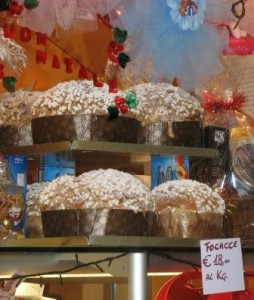
The simple "focaccia" isn't your best option if you want to save money, as they're hand-made in small numbers by local pastry wizards. Eighteen euros a kilo works out to $12 a pound.
“What presents?” Lino snorted. “Who had presents?” Christmas Eve? An ordinary night like any other. Christmas Day? You went to the special mass at 9:00 AM, then the entire family — and in those days that easily reached double digits — squeezed around the table and feasted on food that was at least slightly out of the ordinary. Tortellini (handmade by his mother and sisters) in slow-simmered meat broth was often the star. In the evening, roast veal and polenta, traditions we continue except for the “handmade” part. Lots of family racket, but pretty low on novelties, frivolities, or anything that required batteries or assembly.
Panettone? “It didn’t exist,” Lino stated. “It’s an invention that came after the war,” like so many things. His sisters might have made a “fugassa,” or focaccia — a simple raised cake full of butter and eggs. He doesn’t remember.
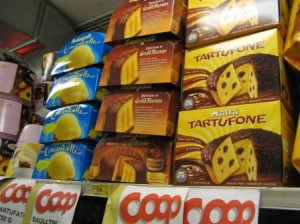
If you want panettone, you've got almost too much choice -- if such a concept exists anymore. Filled with candied fruit, or chocolate, or Grand Marnier, or Limoncello -- one local ice-cream vendor was offering to stuff your panettone with ice cream.
He does remember one particular Christmas Eve, somewhere in the late Sixties or early Seventies. (Obviously his childhood was long gone.) He was sitting at dinner that evening at home when they began to hear ships’ whistles blowing. A lot. Finally he said, “Let’s go out and see what’s going on.”
They walked out to the Zattere and there, in the Giudecca Canal, was a tugboat shining its spotlight on the mast of another tug which was almost completely underwater. The light was to aid in the rescue attempt (fruitless) and also to warn other boats to keep clear.
There are two theories about the accident. Either the tug was towing a ship and the tension on the towline slackened somehow, causing the ship to run into the tug, or somehow the tension wasn’t kept steady and a sudden jerk of the line caused the tug to capsize. In any case, by Christmas morning the two victims still hadn’t been recovered.
As for New Year’s, Eve and Day, they passed virtually unremarked by anyone. At a certain point in history the midnight moment began to be marked by all the ships in the port of Venice blowing their horns (that must have sounded totally great). Fireworks? Special dinners out? Champagne? They got here tomorrow, as the saying goes. People had plain old dinner and went to bed. Me, I’d be just as glad to return to that approach; I hate having to pretend to celebrate, especially when I have no clue as to what, exactly, we’re supposed to be celebrating.
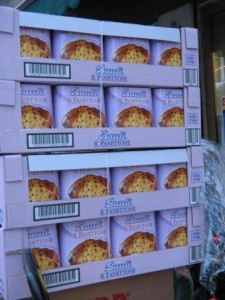
Or you can just take home several hundred of the classic sort.
For those who might want to imagine a festive New Year’s Eve dinner in Venice, too bad you’re missing out on what Arrigo Cipriani is laying on at Harry’s Bar. The newspaper was reporting on the general markdowns being offered by restaurants around the city even on this special meal, and made a point of noting that even Harry’s was giving a discount. This year the repast is costing a mere 500 euros [$716.66} per mouth, as opposed to last year's 1000. Very high into the yikes zone even if the economy hadn't burned up on re-entry.
For that little fistful of euros, diners will engulf champagne, caviar, truffle ravioli, tournedos, and the "dessert of the house," which at that price ought to be garnished with whipped flakes of gold. I assume it won't be Floating Island.
Despite my stated aversion to compulsory celebration, I have to say that I spent the most unforgettable New Year's Eve of my life here in Venice. (You may say "Well sure -- most beautiful city in the world," etc. etc. That is a comment which does not take into account how repellent mass events can be in a city this small, especially when the mass is mainly composed of atrociously drunk people who think they're having fun. Smashing glass bottles is almost as entertaining as setting off firecrackers. It would appear.)
It was the fateful passage between millennia, the last night of 1999 and first morning of 2000. We had dinner at home with two friends, Sarah from Washington and Caroline from London, then we bundled up and climbed into Lino's little wooden topetta.
They sat in the center, while we rowed to the Bacino of San Marco. There was a surprising number of boats out (it wasn't especially cold), but I guess it was that millennium aspect that drew them. As it drew us, because it's the only time we've ever done this.
The fireworks began their aerial onslaught; I thought it was great to be right under them till I discovered that falling bits of blazing incendiary material are essentially little bombs. Moving down-range, we counted down to midnight, then we popped the bubbly -- a large bottle of Veuve Clicquot, which Lino kept referring to as "French spumante," no matter how many times I tried to straighten him out. I wish I could remember what kind soul had given it to us.
But this far I could have anticipated much of this. Being on the water at night is always special, ditto fireworks and friends. But I hadn't anticipated what came next.
We were done with the toasting and the pyrotechnics. Time to go home. But we didn't take the shortest route -- Lino headed us toward the Piazza San Marco where the mobs were in full cry. Lights! Action! Barf and pee! Scream and hurl hard breakable things! Fling firecrackers and see if you can really damage something!
We rowed slowly past the Piazza and up the rio de la Canonica, past the Doge's Palace, slipping apprehensively under the Ponte de la Paglia which was jammed with people who might have thought it would be fun to throw something (bottles, garbage, themselves) down into our boat.
As the sound of rioting faded behind us, we threaded our way along the network of dark, empty canals; the canals became darker and quieter as we moved deeper into the city. We glided between looming, slumbering palaces, and the only sound was the delicate Plff. Plff. of our oars and the barely perceptible melody of the water slipping under the boat. The silence seemed like something alive, like whatever remains inside a huge bell that's still vibrating even when the tone has disappeared.
Venice seemed like an entirely different place, a shadow city hidden within the blare and clang of day. It was as if the city was lifting a veil as we passed, letting us discern, however faintly, the power and the grandeur that are concealed in a place that when the sun comes up is reduced to postcard cutouts. It was an elegant, seductive sort of gesture -- if an entity so magnificent could evince anything so intimate. I could feel the veils being lowered, one by one, behind us. Nobody spoke.
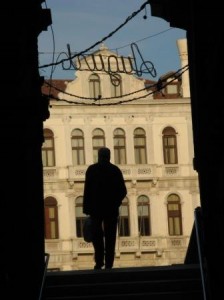
Sometimes I'm not sure that it's not us that are the shadows here.
We came out into the Grand Canal, back to lights and noise and now. Much as I may hate the touristic mayhem, even on ordinary days, I’m not quite as upset by it as I once was, because I know that Venice has managed to elude our grasp. I won’t say that she’s waiting to come out again — we probably make that impossible.
It’s enough for me to know she’s still in there.
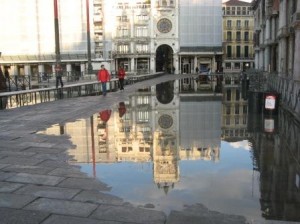
A Christmas Story
Posted by: | Comments
The following was not written by me, nor is it set in Venice; it was written by a friend whose gifts far outstrip the recognition they have received. And because this small but perfect jewel has become part of my own personal Christmas tradition, I am giving it to you here. Happy Holidays to all.
THE LATECOMER
by George S. Nammack
It was after 10 o’clock on Christmas Eve and I was 12 and wearing my first long trousers. I never had been permitted to attend midnight mass, but I knew that 10:30 was the latest one could be sure of seating at St. Mary, Star of the Sea in Far Rockaway [NY]. After that, you hurried across the dark schoolyard to claim a folding seat in the Lyceum, actually the school’s auditorium, where you would participate in what was perceived to be a somehow second-cabin rite known as The Overflow Mass.
Mother had made her traditional pronouncement that those who chose to go to midnight services were in a state of less rectitude and grace than were those clear-eyed parishioners who led their scrubbed and shining families to the front pews on Christmas morning. My father, splendid in the swallowtail coat that he wore as well to medical society meetings, paced before the fire. He lectured and charmed in favor of the late mass and, finally, prevailed.
It was five minutes before midnight when we were shown to our seats. Mr. Phelan, a huge detective who looked like the legendary John L. Sullivan and was certainly the heavyweight champion of Far Rockaway, was ushering. He smiled at my father and leaned in to speak. “Gee, Doc, you’re just under the wire. Sorry about the seats.”
“That’s all right, Eddie,” my father said. “Even the kings were late.”
The altar was centered on the stage, its snowy linens seeming to move in the dancing candlelight. On a raised platform of red and green two-by-fours, James O’Brien, known as far away as West Hempstead for his rendition of “Bill Bailey, Won’t You Please Come Home,” was playing “Silent Night” on the small organ. Jockey-size and florid of complexion, he was blessed with a golden tenor.
At four minutes past 12, the popular veteran priest, Father Shine, commenced the celebration of midnight mass. Following communion and the Special Christmas Collection — “I trust we’ll have a lovely soft collection…I don’t want to be hearing any silver!” — Mr. O’Brien launched into his showstopper, Adolph Adam’s beautiful “O Holy Night.”
We sang along, but softly, because it was Mr. O’Brien’s moment. As he reached the somewhat imperative line about falling on your knees, the back door of the Lyceum opened to admit a javelin of frigid wind and, right behind it, Mr. Mitt Gaffney, who lived in an unheated bungalow near the beach and on handouts from saloon keepers, the kitchen ladies at the hospital and the limited largesse of Long Island Rail Road commuters, many of whom had been his classmates in better days.
He stood there for a moment, listening to Mr. O’Brien and filling the already close atmosphere with the unmistakable aroma of cheap muscatel. Mr. Phelan’s neck was turning purple as he looked at Mitt Gaffney’s head. It was covered with a drooping red Santa Claus cap, the peak of which terminated in a once-white pom-pom that fell across the left shoulder of his stained Army overcoat like a medal awarded for congenital innocence.
Mr. Phelan whispered as only a 300-pound man can when he needs to make a point but doesn’t want to disturb the world at large. He said, “Mother of God, Mitt, you’re late and mass is nearly over, and you got a helluva bun on and take off that damned hat in church!”
“Go easy, Eddie, easy,” smiled Mitt, removing his droll topping and stuffing it into a pocket. “We’re not in church, we’re at The Overflow and I just overflowed in for a peek.”
Mr. Phelan said, “I’ll give you a peek and more, Mitt, if you don’t shut up and behave yourself. Now hush!”
The latecomer managed to balance himself behind the last row. As the last lingering note rose in the accepted direction of Paradise, Mitt Gaffney stepped into the main aisle and acknowledged Mr. O’Brien’s tour de force. “Bravo, Jimmy! Bravo! You sounded just like an angel! Honest, kiddo, an angel! A real angel!”
Mitt was teetering from side to side, applauding his friend, his enormous freckled hands crashing into each other. Mr. O’Brien stood and stared through his rimless glasses at this display of uninvited support. His expression was akin to the kind you see at the zoo, when a child sees a rhinoceros for the first time. I believed he was about to faint.
The stunned faithful turned as one to fix the speaker with glares, and Mr. Phelan was puffing back from the front of the auditorium. My father reached out and gently but firmly navigated Mr. Mitt Gaffney into the only empty seat in our row.
The glares gave way to head-shaking, then to snickers, which built to a great wave of relieving laughter. My father put a protective arm around the old Army overcoat and told its frail occupant to be quiet.
Father Shine took a deep breath and spoke. His brogue was as soft as rain on pebbles, and his large blue eyes seemed to hold all of the light. “All right, then, settle down all of you.
“Given the fact that I found his somewhat-demonstrative approbation a bit unusual, given the fact that in these parts we’re not given to applauding the sacred music, I must say that I wholeheartedly concurred with Mr. Gaffney’s apreciation of Mr. O’Brien’s divinely inspired performance. You did sound just like an angel, Jimmy. And Mitt, if you’re to clap and bellow again in church — and you’re in church, Lyceum or not — I’ll have Mr. Phelan cart you off to the hoosegow. Now then, the mass is ended. Go in peace. God bless you all, and drive safely.”
On the way home, my mother said that the interruption was disgraceful, but my father said that things don’t happen unless they’re supposed to and that Mr. Mitt Gaffney had brought a unique gift to midnight mass. Not only that, but he had caused everyone to open it and share it right there at The Overflow, and pity those over at the main church who missed out.
Later, in bed, I thought about the red Santa cap and its almost-white pom-pom, and Mr. O’Brien’s facial expression, and Father Shine’s forgiving eyes, and my father. I gazed out into the starry night and wondered if Mr. O’Brien would sing one day as an angel in Heaven and if Mr Mitt Gaffney would be there to applaud him, and I thought that their chances were pretty good.

Cell phones save lives
Posted by: | CommentsWhen I was first living in Venice, back when dinosaurs still roamed the earth, cell phones were just beginning to catch on. It seems strange — insane — to think of it now, but there were still few enough to justify making passing comments such as “Buy! Buy!” when someone ostentatiously walked by, talking into this little gimcrack.
Now, of course, we can’t even metabolize simple sugars without them.
One night, in those distant years, we were walking home along the Fondamenta San Basegio. All at once we were startled to hear a woman’s voice suddenly, very loud, right behind us.

Mothers: omnipotent, omniscient, omni everything, even before they got cell phones. It used to be sorcery; now it's just electronics.
“Cominciate a mangiare,” she stated firmly, striding past us. “Fra due minuti saro’ a casa.” ["You all start eating, I'll be home in two minutes."] She turned down the Calle de l’Avogaria and was gone.
We went left, over the bridge.
“Wow,” I said. “Good thing she had the cell phone. What would have happened if we were still back in the old days, when people couldn’t phone to say they were almost home?”
“The family would have starved,” Lino answered immediately. “There they are, all sitting around the table, with their knives and forks ready. But Mom isn’t home! What should we do? Should we wait? Should we start? Where is she? What’s gone wrong?”
He was in full sail now. “The police will finally break in, but it will be too late for most of them. The grandfather will already be dead, because he’s the weakest. He couldn’t hold out. The little boy will be barely alive, but that’s only because he was sneaking bits of pasta on the side. The rest of the family will be strewn about the table, unconscious.
“‘What happened?’ the police will cry.
“‘We couldn’t start eating,’ somebody will gasp out, barely able to talk. ‘Mom wasn’t home yet.’
“Thank God she had the phone.”

Fathers are also good. Somebody gets two extra points for giving their little boy a hobbyhorse and then letting him ride it to wherever they were going. I didn't know they still even made them.
Snow Day
Posted by: | CommentsWe got snow! While I realize that our little meterological adventure was nothing compared to what the East Coast of the US has gone through, not to mention northern Europe (stories of the trains trapped under the Channel inspire a special kind of shudder), it still was enough to jolt us out of our midwinter torpor.

This was our wake-up call.
Even here, flights were cancelled, or delayed, and I have no doubt that stories of catastrophes on the mainland will be coming in.
But for us, the situation was more beautiful than distressing, if you don’t count our miscalculation on getting home before the acqua alta was high enough to mostly cover our feet. (Yes, we were warned: two tones on the sirens. But I didn’t take it seriously.) Sorry about my Timberland hiking boots; hope I can salvage something from the effects of salt water.
We usually get at least one severe cold snap each winter, though it seems to want to wait till just after Christmas. So this year we got it early. For the past few days it’s been at or below freezing and Saturday morning we woke to the double-whammy of snow and acqua alta.

Two hours later, the scene had changed. One good thing about acqua alta is that at least it removes the snow.
When Lino was a lad, as soon as the flakes began to fall, men would present themselves at the central office of the Vigili (a sort of local police) to pick up a shovel and make some extra money cleaning the streets and bridges. He says you could hear them out on the street, talking, as early as 4:00 AM, waiting to get to work. Intensely intelligent and also effective and probably didn’t cost the city all that much. All good reasons why they don’t do it anymore.
Our faithful trash collectors were scarce to invisible this morning. Any tiny deviation from the norm throws the squad into total disarray. No snow shoveled, no garbage collected — I can’t believe that every sanitation worker in the city had to be in the Piazza San Marco to set up the high-water walkways. Perhaps they were all clustered in a doorway (more likely it was a warm bar somewhere) drawing straws to determine who’d be the one who had to go out and actually work.
I have some happy, if highly eccentric, memories of a real cold snap here. One winter morning a number of years ago, when the cold had come down from Siberia like the wolf on the fold, we went out rowing. Yes, of course we’re mentally unstable.

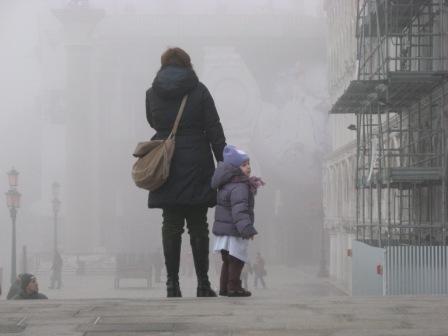
This time it wasn't fog that made the city look like this. Blowing snow is also pretty effective for blurring the scenery.
Here’s what I remember: Rowing down a canal and our oars slicing neatly (once in, once out) through the forming ice. What a fun little crunching sound it made. What wasn’t quite so fun was the wind blowing so hard that the spray from the waves froze in the bottom of the boat. I spent the entire time we were rowing back imagining that my shoes were nailed in place, because it was like standing on a skating rink. If I’d slipped just once, I’d never have gotten my footing back. I took my mind off this problem by trying to imagine if it would be possible to row on my knees.
But that was nothing. There was the famous — make that “epic” freeze of February, 1929: people were walking across the lagoon from the Fondamente Nove to San Michele. Impressive. Of course, one reason that happened (and probably could never happen again) isn’t just the factor of the degrees below zero. There wasn’t the constant maelstrom of waves back then that we have today, which would prevent any rational water from freezing. If you’ve got a really low temperature, few or no waves, plus only the tiniest tidal variation (twice a month, when the moon is exactly half, the tide scarcely moves, which would help the freezing, obviously) it’s almost inevitable that ice will form. I have to say I’m glad we didn’t reach that point. Delicate little skins of ice covering the water is one thing, but not this polar purgatory.
So on the whole, we made out really well. The snow came, and then, when the tide turned in the early afternoon, the sun came out and we were fine. Except, I mean, for the bags of garbage which will lie out there till Monday.

The lions in front of the Arsenal were not amused. "Remind me again how we ended up here, surrounded by water? Oh, right: spoils of war. Great."

As long as you don't have to drive, scenes like this are really beautiful.

The guys who run the bumper cars at the temporary amusement park on the Riva dei Sette Martiri have to clean up the old-fashioned way: physical exertion.

Eventually at least a couple of ecological operators, as they're called, had to get out and do something. The Barbie-sized wheelbarrow appears to contain enough salt for exactly one bridge.

All the gondoliers who didn't come to work in the Bacino Orseolo are just going to wait for it to melt, then bail.
Turkish not-so-delight
Posted by: | CommentsThere are many things, I admit it, that deeply fascinate me about Turkey and one of them is its complicated linkage over the centuries with Venice. Polar opposites, one might think, until one begins to look closer.
As I was expatiating on this theme recently, I neglected to mention a few of the manifestations of this linkage lurking here. And one of them does not show Venice in her best light.
First: Two steps from Campo San Barnaba is a short, narrow street (with bridge) named the Calle (and Ponte) de le Turchette. If you were to guess, based on your elementary Italian, that this means “Street of the Little Turkish Girls,” you would be right.
Tradition maintains that in the era before the Casa dei Catechumeni was established to accommodate instruction in the Roman Catholic faith, there was a house here where Turkish women (”Turchette”), taken prisoner in assorted battles, were kept. Their time was spent mainly in being converted to Christianity. Or not. No word on the rate of conversion, or whether conversion was considered optional, or what the consequences were for not converting, at least not by the point where I stopped seeking information.
According to the estimable Giuseppe Tassini, writing in Curiosita’ Veneziane, a document in the Scuola di San Rocco states that the confraternity possesses a house in the parish of San Barnaba, “in Calle Longa, where the Turchette are housed.” That’s all I can tell you about this, though every time I pass this way I admit that images of exotic females, enclosed in another sort of harem, wander through my mind.
Second: An even more intriguing Middle-Eastern, let’s say, element is a mute patera (PAH-teh-ra) affixed to the side of a house behind the former hospital of the Incurabili. (These “incurables” were mostly syphilitics, if you’re wondering.)

This patera is very easy to miss, being so uncharacteristically high. Looking up is always a good idea when walking around in any city, especially here.
Patere were typically circular plaques carved in low relief on Istrian stone, often showing animals, which were placed on buildings generally from the 10th to the 12th century, though a few date till the 15th. These images were intended to ward off evil.
The one that fascinates me, though, has a very different vibe. It shows a cross, whose base is in the suggested form of a sword, standing upon a crescent.
The conclusions one might draw from this are fairly obvious, but that’s what annoys me — because so often the obvious turns out to be excitingly wrong. There is also the curious factor of the points of this crescent not being identical. So far, however, I haven’t been able to learn anything about it. But there it is.

A small digression on Turkishness: Ever since maize began to come to Italy from the Americas in the 1500’s, it has borne the name granoturco, or Turkish grain. There are various hypotheses for this, none of them definitive, but one of the more credible ones refers to the custom of lumping all sorts of foreign things together under the generic label “Turkish.” A relic of this habit applies here today regarding the Slavic women who come from Eastern Europe to work as caretakers of the elderly; even though they may come from Ukraine, Romania, or Moldova, I’ve heard at least a few Venetians refer to them as “Turche.”
Now we come to a longish street whose official name is “Barbarie de le Tole,” but which I think of as the “Street of the Kebab Joints.” And here the theme of Turkishness becomes less attractive.
There are some 20,000 students in Venice, a total of the enrollments in the two universities (Ca’ Foscari, the University of Venice, and the I.U.A.V., or University of Architecture). There is also a noticeable number of immigrants in the city, some from the Middle East or North Africa. And there is also a growing group of tourists who are getting by on a squeaking budget. These are all people who typically seek nourishing and/or good food at a very small price. So from pizza-by-the-slice (Italian, even if not very civilized), the choice has broadened out to include doner kebab, or what in the U.S. is often called by its Greek name, gyros. Foreign. Suddenly this changes things.

Whether or not you read Turkish, the image itself translates as "good cheap food."
Doner kebab was invented in Erzurum, eastern Turkey, and since the Seventies it has become a common and familiar fast food in most European countries. The making and selling of it are virtually always in the hands of Turkish individuals.
But all of a sudden Venice isn’t happy with these little places. I can’t say whether the kebabs’ precursors were available in the declining years of the Venetian Republic, but considering the spectacular variety of ethnicities and creeds which were to be found milling around the streets and markets and waterfronts of Venice back in the Old Days, it wouldn’t surprise me.
In the past decade or so, the subject of immigration (to Europe, not only to Venice) has become an increasingly tormented one politically, economically, and socially. Considering the multi-cultural foundation of this town, any anti-foreign sentiment is in some ways difficult to justify – not that one can’t understand it. This is a theme which I will dissect at another time.
But on December 4, the Gazzettino announced that the mayor has signed an ordinance forbidding the granting of any new licenses for kebab joints until 2012. The reasons given for this are many; they bob like ornaments hanging on a tree which has been hollowed by termites. The reasons as stated are:
- The proliferation of these establishments and the consumption of their product on-site contribute to the “impoverishment” of the typical local places, as well as of the architectural and environmental quality of the city “due to the particular nature of their furnishing and equipment,” and
- The “incompatibility” of the opening of new pizza/kebab joints with the “conservation of the artistic patrimony” and the “typicality” (if there is such a word) of the historic center, and
- Opening such places in certain points in the city conduces to the “maximum vulnerability of the cultural and touristic profile” of the city (whatever that might mean), and
- That anyway there are already enough such places to satisfy the demand, so no need for more.
And who proposed this extraordinary measure? Not any of the assorted Superintendents of the Artistic/Historic/Cultural/Archaeological Heritage; nor the director of the Academy of Fine Arts, nor the Guggenheim Collection, nor anyone from the battalions of professors of art, history, or even tourism, if you will, though any of those protagonists might be able to make a reasonable case. Not a voice from the syndics of the Venice Atheneaum. Nobody from any sphere or stratum of the cultural or artistic universe here. Not even a wail from Augusto Salvadori, the City Councilor for Tourism and Protection of Traditions and Decorum.
Despite its being couched in cultural and historic and artistic terms, the proposal was in fact made by Giuseppe Bortolussi, the plain old City Councilor for Productive Activity and Commerce. Therefore one can interpret these cultural concerns in economic terms, in favor of the small businessmen who are the competitors of the kebabists.
And the decree will cover 13 of the 24 most important touristic points of the city, including the Rialto, the area of San Marco (where there is already a flourishing McDonald’s), the train station, and the Accademia. They might just as well have said “everywhere,” considering that they have stated that there are already enough such places to satisfy the demand.
I thought capitalism posited that the consumers, not the city councilors, were the ones who get to decide which businesses live and which die. And if it’s possible to determine at what point there are “enough” kebab joints, it ought to be possible to determine at what point there are “enough” shops selling glass and Carnival masks, which a stroll around the city reveals as being somewhere around 249,327. Enabling infinite choice in souvenirs (good!) doesn’t seem to translate into infinite choice in foodstuffs (not good!).
This ordinance looks strangely like an effort to protect the restaurateurs, not the city, from impoverishment. To herd the wandering tourist seeking sustenance back into the trattorias and restaurants where the prices can sometimes go so high, at least compared to the value received, that they practically glow in the dark.
But I’d like to close this little cultural pilgrimage with the observation that hypocrisy evidently provides more fertile terrain than volcano slopes after an eruption if you want to grow a bumper crop of contradictions. All those affirmations of protecting the artistic and historic nature of the city? One hardly knows where to start to list the examples of how that concept has been violated.
I’ll provide just a few random snaps, chosen mainly by their convenience. Anyone who can explain why these alterations are permissible (I’ll spare you the details of the laws designed to “protect” the artistic and architectural nature of the city) is eagerly invited to enlighten me.

The "Danieli Excelsior" (center) was built in the 1950s as an addition to the Danieli Hotel, and wedged between the hotel, formerly a palazzo of the Dandolo family (late 1400s) and the New Prisons (1589-1616).

Somebody thought these balconies would be just the thing on this already unattractive modern residence, right next to the church of the Santo Spirito (1506).

Then there is this construction, housing the University of Venice's Department of European and Post-Colonial Studies, next to the Gothic palace now housing the Capitaneria di Porto (Port Authority).

Tramontin and Sons (1884) is one of the few squeri still building gondolas in Venice, and it shows the traditional setup, from the wooden-chalet workshop to the ramp sliding down into the water.

Right next door to Tramontin is the squero Daniele Bonaldo, which used to be its identical twin. I watched its inexplicable transformation from the traditional layout (he kept the wooden chalet workshop) into a major boatyard for motorboats. The cement platform covers the beaten-earth ramp, the hydraulic winch was unknown to his forebears, and of course the boats have nothing at all to do with gondolas.

This is the headquarters of the Cassa di Risparmio di Venezia (Venice Savings Bank) in Campo Manin. It's called Palazzo Nervi-Scattolin (1972), not for conjoined noble families but for the two architects, who stated openly that they didn't intend to create a "false antique." They succeeded.
Winter perfume
Posted by: | CommentsYesterday I crossed another of the myriad little stepping-stones of life here that form my path across the seasons, things that are wonderful the first time partly because they’re surprising, then become more wonderful as I anticipate their annual return.
Yesterday I was given a flower. And not just any flower: two slim branches of calicanthus (Chimonanthus fragrans), with their small yellow blossoms and — supremely important — their fragrance. You hardy gardeners out there probably take it for granted (”a spiny shrub from Japan related to Carolina allspice”), but its common name, wintersweet, hardly begins to do it justice.
I grew up in Upstate New York, where winter comes with multiple personalities, most of whom are not in the mood for jokes. It snowed from October to April, for starters. Skiing, skating, sledding — all great for kids with some free time. Frozen locks, icy streets, whiteout conditions on the Thruway, chilblains — not so great for anyone responsible for anything or anyone.
So winter in Venice, with its heavy, grey skies and lacerating northeast winds and films of ice on the immobile water of the canal — or even its dazzling, diamond-cut dawns or scintillating, frost-encrusted trees — brought out the primitive, Protestant, life-is-real-life-is-earnest-and-the-grave-is-not-its goal side of my spirit. Winter isn’t just something to survive: One must prevail.
Then I was walking down a street one rigid day; the Calle de le Pazienze, to be precise, not far from Campo Santa Margherita. It’s not so different from most streets: narrow, stony, lined with solid objects (in this case, houses on one side, a brick wall on the other), and I was just passing through.
Suddenly I inhaled a waft of music, a delicate little caress, an aroma so warm and so sweet that it made me stop in my tracks. What? Where? And more to the point, how? Winter doesn’t smell like chiffon steeped in sunrise; winter smells like a constructivist experiment, all angles and sharp points and edges.
I looked up and saw a mass of branches rising from behind the brick wall, and (I am not making this up) the sun was shining behind them, turning the tree into a huge bouquet of tiny, glowing yellow blossoms.
Tears came to my eyes but they didn’t fall because I was too entranced by how something so blithe could be so compelling. A philosophical point which I will attempt to resolve some other time.
And so, every December, I manage to snag a few branches. Of course the thrill of discovery is gone, but in its place is the knowledge that winter has a heart that isn’t made of titanium. My Protestant forebears must be pretty pissed that I’ve found that out.
Olympics: higher, faster, more ironic
Posted by: | CommentsAs you recall, poor old Venice got dragged out into the middle of the stage a few weeks ago and forced — not to recite poetry or sing a comic song in front of all the relatives — but to present itself as a plausible candidate for the Summer Olympics of 2020.

There's no question that Venice could make an amazing Olympics poster. It's a start.
You might also recall that Rome intends to make a serious bid for the same candidature. And that Italy only gets to field one.
There was a flurry — a small hurricane, actually — of fevered activity/ verbiage from a group of people here who all had clear and present interests in snagging the nomination and, eventually, the Olympics themselves, for Venice. There was also an equal amount of either rebuttal or silence (a more potent form of rebuttal) from non-believers. The cads.
But the dream is probably dead, though its proponents aren’t ready to admit it. (They’re like that person I read about a while ago who went to pick up the pension check for his just-deceased friend. Obviously without having revealed that the check-worthy individual was just-deceased. Obviously with the purpose of using the money himself. When the person was told that the friend had to come in person, he propped his dead buddy in a wheelchair and wheeled him to the pension office. Too bad it didn’t work.) The Venice Olympics people are still wheeling the idea around, but they’re not much more credible than the aforementioned dude at this point.
CONI (the Italian Olympic Committee), in the person of its president, Gianni Petrucci, had what must have been a fairly vivacious meeting the other day with mayor Massimo Cacciari, who is also a professor of philosophy. Everyone likes to point that out, I don’t know why. Maybe to emphasize that he isn’t just a boring old politician, but a genuine intellectual, which ought to be an impressive thing if you didn’t notice that the two qualities are seem to be mutually exclusive.

Unfortunately, sometimes just being beautiful isn't enough.
Mr. Petrucci was pretty clear when the meeting was finished. “As the philosophers say,” he began, “reality is that which is, and not what we would like it to be.” Nice one! “And I’m a realist: What will count is what is.”
What “is,” in this case, is a raft of sports facilities which are already up and running (or jumping, or throwing) — and not a list of facilities which are all going to have to be built new from the ground up.
“I was a realist with Prof. Cacciari,” Petrucci went on. “CONI wants to win, therefore we want to present a really strong candidate.”
These remarks were met with a random barrage of retorts — kind of like those moments when the embattled citizens on the parapets begin desperately to launch whatever they can get their hands on — rocks, wagons, donkeys — over the edge to stop the enemy advance.
“Venice would be something new,” was one retort. The Northeast is a region that “gives much and receives little” (translation: you owe us) is another. “They treat us like provincials.” And so on.
Giancarlo Galan, the president of the Veneto Region – in whose head dreams of a shiny new Veneto full of big new projects paid for by somebody else had been dancing — decided to object, not to the message so much as to the manner of its expression.
“I don’t think you’re capable of ironizing (it’s a verb in Italian, very useful) about philosophers,” he huffed in a letter to Petrucci. “It shows that you haven’t understood two things: The fact that the Olympics serve to transform the infrastructure and change an entire territory. (I never knew that. Is that why the athletes cry when they hear their national anthem?) The second is that you don’t know the Northeast and what we’re able to accomplish. Venice and the Veneto deserve this recognition because we’re among the most advanced in the world.” (I didn’t know that either. We may have reached the stage of launching a Jeep Cherokee over the ramparts.)
Petrucci was unfazed by this predictable range of objections. (You don’t love us, you don’t understand us, you don’t care…..) He replied, “Everybody knows his own world best. Galan knows the Northeast well, and I know the Olympics well.”
While this was going on, the mayor of Rome was off in London, busy bagging mayor Boris Johnson’s future vote for the Eternal City.
Maybe he’s the one who’s actually got the right philosophy for this situation.
Folpo and friends
Posted by: | Comments
Each is easily munchable in one bite, assuming you have even the slightest desire to consume it. Folpi have the interesting property of becoming tougher, not more tender, the more you cook them.
This is apropos of absolutely nothing, but as I was discussing the folpo the other day, it occurred to me that even with my impressive powers of description, a picture of the creature after its refreshing plunge into boiling water might be in order. So here are four of the little honeys, ready for immediate annihilation.
The great thing about fishy creatures– most of which were so familiar to Venetians in days gone by that they could have been members of the family– is that they make excellent synonyms for non-fishy things. The folpo, for example, provides the ideal code word for a person (of either sex) who is overweight — not grossly, but noticeably — in a formless, galumphing sort of way. You might hear someone say, “Look at that folpo” as an individual goes by who looks as if he/she might be more comfortable (and attractive) submerged than walking on land.
A very close relative of this mollusc, in biological but especially metaphorical terms, is the zottolo (ZAW-toh-lo, or zotolo, in Venetian: SAW-to-yo). Official name: Todarodes sagittatus. It’s another one of those tentacly creatures, related to the seppia and the folpo. You may not notice them in the fish market but you might well get a batch of their babies (totani) in a mixed fishfry here. Little crunchy deep-fried objects somewhat bigger than your thumbnail that don’t look like they ever were anything.
The reason I’m telling you this isn’t the animal itself, it’s because “zotolo” is also a common and highly useful way to describe a certain kind of person. In fact, there are people who can’t be characterized as anything other than zotoli because of their particularly unfortunate assortment of mismatched traits.

Why a zotolo would be considered less attractive than a folpo is a mystery.
A person who can — and even must – be described as a zotolo would be someone who would be not only physically unattractive in a way that might be mitigated or even overcome if he or she were to care (heavy, scrawny, uncoordinated, slouchy, clumsy, perhaps also pimply or with neglected teeth), but would dress and/or behave in only a marginally civilized way.
Your zotolo could be the person who comes to the office Christmas party (evening, trendy bar) wearing a slightly frayed shirt and/or torn jeans. Or maybe he or she dresses just fine, but who can be counted on to say or do something that’s just that little bit cringeworthy. In other words, a person who gives the impression of being upholstered, physically or mentally, with the old slipcover from the divan in the basement rec room.
Can also be used as a term of endearment.
Welcome home, Istanbul
Posted by: | CommentsPower-walking to the Piazza San Marco two days ago, what should I see but a new mega-piece of publicity covering the facade of the Biblioteca Marciana. And it’s not for Swatch or whoever else has recently benefited from what must be one of the more valuable pieces of billboard space in a major town.
Nope: It’s advertising Istanbul.

In an exceptionally elegant and simple design — with the added allure of a black-and-white photograph that makes the former capital of the Byzantine and Ottoman Empires look like Rita Hayworth swathed in Blackglama mink — the world is being advised not only that Istanbul in 2010 is going to be a European Capital of Culture, but that it is “the most evocative city in the world.” The world. It says so right there.
Not a bad choice of words, considering that Venice seems to have a lock on the phrase “most beautiful city,” though the echo is a little unfortunate. And defining itself as “European” is pretty cool, considering that much of Europe is doing everything it can to make sure only it knows the combination to the lock into the EU. I suppose that the fact that part of Istanbul sits on the European side of the Bosporus could technically make this term admissible.
In any case, something worked.
What struck me first as I went striding past was a bracing blast of irony. (I seem to be unusually susceptible to these, like some people are to drafts or mold.) Between 1463 and 1718 Venice was involved in eight major wars with the Ottoman Empire, and a war isn’t some little let’s-agree-to-disagree. Countless Venetians died in all sorts of ways, especially their commanders — Marcantonio Bragadin was flayed alive, Paolo Erizzo was sawn in half — enduring epic sieges, making phenomenal sacrifices, and even achieving one of the great naval victories of history, October 7, 1571, at Lepanto.
And now we have its capital, the Sublime Porte, the epicenter of enmity, looking all sorts of gorgeous and up in the Piazza San Marco, no less.
But on the other hand, what about the Fontego dei Turchi up on the Grand Canal? For centuries there was a thriving Turkish business community right here, which was allowed to have its own headquarters, just like the Germans, Persians, Arabs and many others. This type of establishment was known as a fontego (in Italian, fondaco, from the Arabian fonduk, meaning “inn”) and these establishments usually contained storerooms, strong-rooms for cash, meeting rooms, even bedrooms. (In the case of the Turks, their fontego also contained a hammam and a mosque.)
For a foreign merchant doing business in Venice, having a home base was extremely helpful. It was no less helpful to the Venetian government, considering that keeping ethnic groups corralled simplified surveillance. Simply put, scimitars may have flashed elsewhere, but here Turkish traders were just another part of the immense and complicated commercial reality that sustained Venice’s seemingly effortless glamor.
So that’s what struck me second: That in fact there isn’t any irony at work here at all. Venice had constructed so many trade connections, treaties, and other means of coexistence with the Muslim world — Egyptian Mamluks, Ottoman Turks, and so on — that it’s almost as if the wars occurred on another plane from the daily/yearly business of business. Your Venetian, whether patrician merchant or grimy artisan, was never in doubt as to the need to cultivate and maintain clients; whenever the Pope occasionally placed bans on trade with Them over There, Venice just kept going, trading as usual except by way of Cyprus and Crete.
In fact, Ottoman markets were crucial to Venice’s prosperity, being insatiable customers for Venetian luxury goods: heavy fabrics of silk (especially velvet) and wool, glass, books, and china. Venetians also exported work in gold, especially filigree, which was famous throughout Europe. As one historian puts it, “Without trade with the Muslim world, Venice would not have existed.”
Yes, this is actually how my brain works as I’m cantering around Venice trying to get assorted things done: buying fish, picking up dry cleaning, replacing the battery in my watch, collecting shoes from the man who calls himself a cobbler but who evidently isn’t able or interested in doing anything other than replacing heels. Try to get him to stitch a torn strap on a handbag and he goes all helpless on you, as if the machinery (one hand, one needle, one piece of heavy string) hadn’t been invented.

"Venice receives from Juno the doge's hat (corno)" by Paolo Veronese, in the Room of the Council of Ten, Doge's Palace. He makes it fairly clear that Venice and gold coins were born for each other.
So while I’m involved in the daily drudgery, dealing with all those little tasks that breed in dark corners at night and produce litters of new little tasks every day, I’m also meandering around mazes of history. I really like living in a city that gives you so many centuries and points of view all knotted up together.
And from what I keep noticing about Venice’s history, I think they really hated having to get involved in all those wars (and not just with the Ottomans, either). Put aside the possibility of death or dismemberment; wars with anybody are so bad for business, so distracting, so disrupting. How much more tempting is the clinking of coins, so warm, so musical. Except, of course, that the wars were intended to make more clinkage possible, otherwise there wouldn’t have been much point in bothering.
So here’s my conclusion: What better place than Venice to publicize Istanbul? That huge billboard practically amounts to the Return of the Native.