Archive for November, 2009

Nov
30

Acqua alta: business as usual

Posted by: Erla Zwingle | Comments (3)

As you may already have noticed, the world didn’t end last night. 

First, it didn’t rain.  So much for the Deluge from Hell.  This is also a Good Thing because when there’s lots of rain it not only irritates me, it can also aggravate the acqua alta — not so much because of precipitation precipitating into the lagoon directly, but into the streams and rivers which then, overloaded, empty into the lagoon. 

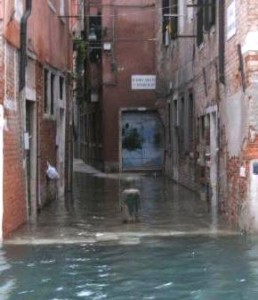
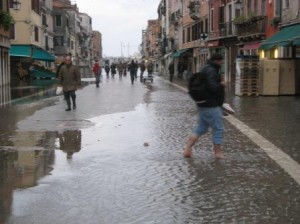
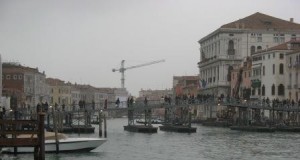
Our street as seen from across the canal at 7:45 AM.  The tide is still rising but there is still an island (shrinking) of dry pavement.

Our street as seen from across the canal at 7:45 AM. The tide is still rising but there is an island (shrinking) of dry pavement.

At 5:00 AM the sirens sounded, and I waited to count the tones.  There were three.  I enjoyed two seconds of relief, then checked myself because of the clearly demonstrated unreliability of the forecast.  (It hasn’t rained yet.)  But where the sirens are concerned, it wouldn’t have been the first time that one message arrived, to be followed by a revision.  It’s better not to be too quick to heave those sighs of relief.

So I lay there in the dark, listening for clues to the water’s progress.  I heard someone walking by the window: Normal footsteps.  No water yet.   Before long, I heard someone else pass making plk-plk-plk noises: Water only an inch or two.  Not long after that, I began to hear sloosh-SLOOSH-sloosh-SLOOSH.  Water deep enough to require shuffling instead of stepping.  Oh well.

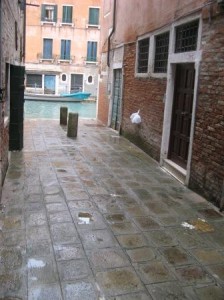
This is a beautiful thing to see: water that hasn't risen beyond our first step.

This is a beautiful thing to see: water that hasn't risen beyond our first step.

At 7:45 the water was still rising, which was to have been expected.  I went out to get the newspaper.   At 8:30 it had peaked and was still well within manageable limits.  Excellent!  What would I have called this on the official warning scale?  Code Mauve?  Code Robin’s-Egg Blue?


Water all gone.  Now let's think about lunch.

Water all gone. Now let's think about lunch.

At 10:00 the tide was noticeably falling, and by 11:00 the streets were no longer, in Benchley’s famous phrase, full of water. 

The scirocco wind, however, has been fairly strong (they said “moderate”) all day, and is predicted to increase to “strong” right about now.  Then we’re supposed to have a thunderstorm, then everything should return to normal.

Speaking of normal, one thing which always happens here with acqua alta is that various people put out their bags of garbage for the garbagemen to collect, even though they must know that the men are not going to be collecting because they’re all supposed to be working like crazed beavers setting up and taking down the temporary walkways.  So the bags sit there until the rising water lifts them from the pavement and eventually floats them away, out to sea. 

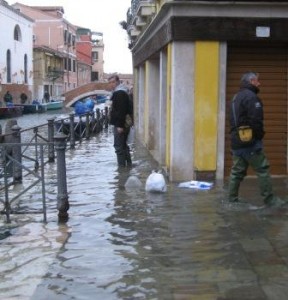
Floating bags of garbage: Just one of many unsung aspects of acqua alta.

Floating bags of garbage: Just one of many unsung aspects of acqua alta.

Floating bags of garbage are NOT acts of God, no matter what their owners may think.  Oh wait — the bags don’t have owners.  As soon as a bag is on public soil, it suddenly becomes mystically orphaned, anonymous, invisible.  Except to me, the maniac foreigner, who watches these plastic spheroids bobbing around and sees a big neon sign above each one flashing
“BRAIN DEAD.”

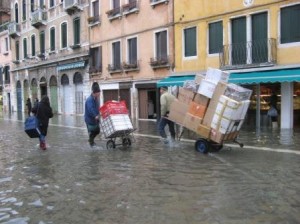
The show -- the bread, the detergent, the whatever --  must go on.  And someone must go with it.

The show -- the bread, the detergent, the whatever -- must go on. And someone must go with it.

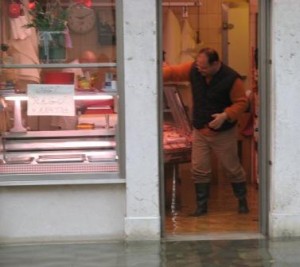
The people out on the street were pretty much moving along with Monday morning as usual.  Shops which are likely to be awash were indeed awash; their owners were pumping them out.  Some others, like two different butchers, were letting nature to take its course while they got on with business. Evidently neither snow nor rain nor dead of night nor high water can stay these men from the swift completion of their appointed pork chops.

The floor is ankle-deep in brackish water and he is cleaning the plexiglass covering the case of meat.  I didn't ask.

The floor is ankle-deep in brackish water and he is cleaning the plexiglass covering the case of meat. I didn't ask.

I ran into Paolo, the bank teller, out on via Garibaldi. 

“No work today,” he told me.  “Those idiots from Bergamo [owners of the bank] didn’t listen to us when they were designing the interior.  We told them, ‘Put the electric outlets up high.’  They said, “What the hell do you guys know?’  So now all the electric outlets are under water and if we turn on the computers, everything will go poof.  All they needed to do was put the outlets higher, but nooooooo…” 

For the record, his plan for the day wasn’t altered all that much, because I went past a few hours later when the water had begun to subside and there he was at his teller’s window, working away.  High water — unfortunately, if you really want the day off — does not last forever.

Like virtually all Venetians, he took it all in stride.  If he has time to think about the street, he clearly isn't worried about his house.

Like virtually all Venetians, he took it all in stride. If he has time to think about the street, he clearly isn't worried about his house.

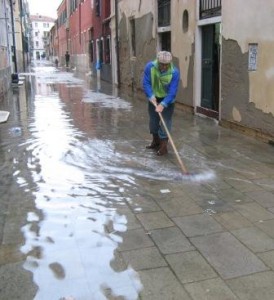
Walking back to the house, I passed a man who was sweeping the water toward the canal.  I paused.  He was sweeping the pavement of a large street which was still very much under water — hence the water was not being removed, only shifted.  This required investigation.

“Dogs,” he said briskly, smiling.  “High water is really a good thing for Venice.   It doesn’t hurt anybody.  And it takes away the smell so dogs don’t go looking for someplace where another dog has ever pooped.”

I recalled having heard a similar comment from Arrigo Cipriani (of Harry’s Bar) when I interviewed him years ago.  A native Venetian, he too wasn’t especially impressed by high water.  “It’s a great way to get the streets clean,” he declared. 

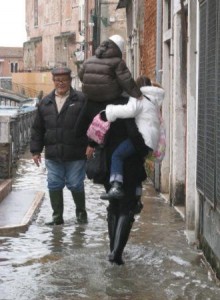
Back in the old days nobody's mother would have carried any child who could walk.  Here's a woman thanking God that she stopped at having two.

Back in the old days no mother would have carried any child who could walk. Here's a woman thanking God that she stopped at having two.

“High water was a delight for us when we were kids,” Lino has told me more than once.  “But it never made any sense — we’d be in school and the teachers would say ’There’s high water!  Everybody go home!’  And so we’d walk home in the high water; you can imagine what kind of state we were in by the time we got there.  Soaking wet right up to here.”  (He indicates his collarbone.)  “What sense did that make, sending us home because there was high water?  In just another hour, the water went down anyway.”

No boots in the old days, either.  ”Boots?  Who had boots?  Boots are a newfangled thing that began to come in after 1966.  We went home barefoot, carrying our shoes.”

Clearly a few people can still figure out how to get where they're going without boots.

Clearly a few people can still figure out how to get where they're going without boots.

I too, may I note, have walked home barefoot in high water.  More than once.  I can’t understand people who stand there at the water’s edge looking trapped and helpless like lemurs on a raft in the middle of the ocean.  Just take your shoes off and get going!  Besides, I can attest that the water is virtually always warm (if that helps to convince you.)  The scirocco wind is warm, and we haven’t even had a real cold snap yet.  How cold could the water be?  Get a grip, people.

Note:  If you subscribe to my blog, please take a moment to list it in your e-mail address book or Preferences.  Otherwise it may float out to sea with the rest of the junk.  Thank you.

Categories : Venetian-ness, Water
Comments (3)
Nov
29

Bad weather coming ashore

Posted by: Erla Zwingle | Comments (4)

We’re sitting here holding a sort of tense little domestic vigil awaiting the end of the world, which is predicted to reach Venice some time tonight. 

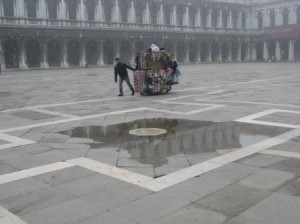
Acqua alta doesn't necessarily have to come pouring over the battlements.  As here in the Piazza San Marco, it often comes up through the drains.

Acqua alta doesn't necessarily have to come pouring over the battlements. As here in the Piazza San Marco, it often comes up through the drains.

Briefly, a huge weather system is moving across Italy and will be bringing high winds, torrential rain, and acqua alta, or high water, sometime tonight.  I say “sometime” because Things Might Change (at least slightly — maybe the wind won’t settle into the southeast after all, for example) but we’re going to be getting wet.  Just how wet is the question that is keeping the lights burning in our little hovel.

The tide is going to turn and begin to rise about 3:00 AM.  Which means we can expect to hear the municipal high-water warning sirens begin to wail not very long after that. 

The tide forecast is: Maximum at 9:30 PM tonight at 75 cm [29 inches above mean sea level] ; minimum at 2:25 AM at 45 cm [17 inches]; maximum at 8:35 AM at 130 cm [51 inches]; minimum at 3:40 PM at 20 cm [7 inches].   

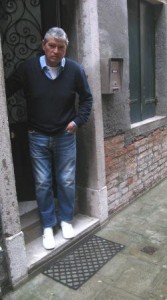
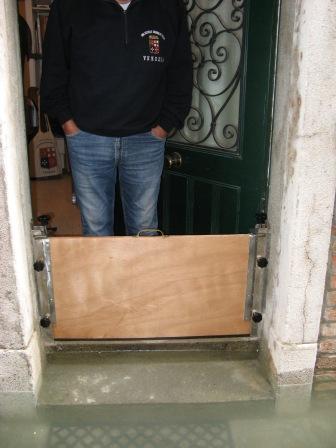
This is Lino on December 1 last year, watching the tide rising outside our front door.  This is me, taking the picture, still hoping that the tide will stop here.  It didn't.  And the barrier didn't do anything useful to keep it out.

This is Lino on December 1 last year, watching the tide rising outside our front door. This is me, taking the picture, still hoping that the tide will stop here. It didn't. And the barrier didn't do anything useful to keep it out.

My only hope and prayer at this point is that the tide will only reach the three-tone level, because that means we’re still dry.  We discovered last December 1 that when we hear four tones, we’re basically doomed. 

We had water in our very own domicile; what was unnerving wasn’t so much its height (I guess it never exceeded an inch on the floor) as its inexorability.  I can’t recall a sensation to compare it to: The realization that you can’t do one single thing to stop it.  I suppose going into labor might be something similar.

I can tell you that the garbagemen are working an extra shift right now, setting up the temporary walkways in the parts of the city which will certainly be submerged to some extent, especially around the Piazza San Marco, the lowest point in the city.

There is also absolutely no doubt that Paolo Canestrelli and his band of hardy forecasters are working the lobster shift at the Tide Center, refining their predictions probably minute by minute.  What they really, really hate is to turn out to have gotten the numbers wrong.  People may snicker at them when the tide doesn’t rise as high as they thought it would, but people rage and snarl and shriek when they estimated too low.  Not a job I’d be at all interested in having.

For the record, a normal tide (measured in height above mean sea level) is between -50 cm and +79 cm  [minus 19 - plus 31 inches.]   One siren tone.

Code Yellow (”sustained tide”) is between +80 and +109 cm  [31 - 42 inches.]  Two tones.

Code Orange (”very sustained tide”) is between 110 cm and 139 cm  [43 - 54 inches.]  Three tones.

Code Red (”exceptional high tide”) is over 140 cm [55 inches.]

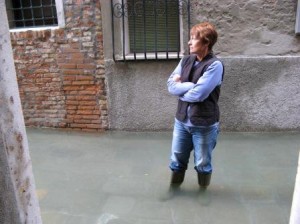
Here I am standing in our little street, contemplating the mysteries of the universe, still not convinced that the water was going to rise any further.  Shortly after this, we stopped taking pictures and started bailing.

Here I was last year, standing in our little street and contemplating the mysteries of the universe, still not convinced that the water was going to rise any further. Shortly after this, we stopped taking pictures and started bailing.

In case anyone has heard about the MOSE floodgate project (perhaps to be operational in 2012), intended to block high tide from reaching the city, I want to point out that it is intended to be used only in the case of Code Red.  Which means that for 3/4 of the high-tide events, we’re still going to be pulling on our wellies. 

Another point: The numbers don’t really tell you much because Venice is not uniformly level.  So a number in one place isn’t going to signify the same experience in another — sometimes even just 50 yards down the street.

More tomorrow, at some point.  Going back to doing laps around the rosary.

Categories : Uncategorized
Comments (4)
Nov
24

Worse than NAPLES???

Posted by: Erla Zwingle | Comments (2)

There was a story in the Gazzettino a few days ago of a very interesting, even if amazing, inconceivable, really embarrassing revelation:

Cheating the State: The Brunetta Report Shows that the Veneto is Worse than Naples

Renato Brunetta (Venetian, as it happens, and touted as a new contender for the next mayoral election) is currently toiling away in Rome as the Minister of Public Administration and Innovation, which also concerns itself with financial transparency.  I sense the urge to make a disquisition on the ongoing bulletins from the Guardia di Finanza (the Finance Police) which, among other things, is always on the hunt for tax evaders.  They are bulletins from a quest compared to which the search for the philosopher’s stone is as nothing.  But I’ll just stick to this story; it’s enough for you to know that tax evasion is ubiquitous.  Shocking, I know.

There may be nothing new under the sun, but as it continues to rise and set I wonder if there might not be some surprise, even a tiny one, somewhere on earth.

There may be nothing new under the sun, but as it continues to rise and set I wonder if there might not be some surprise, even a tiny one, somewhere on earth.

You should also know, if you  haven’t intuited it, that any place south of Rome (Naples, Sicily, etc.) is generally scorned by those in the North as being a quagmire of corruption, where waste and crime cling to each other like doomed lovers on a cliff.  At the same time, people in the North (especially those belonging to the political party, the Northern League, who have made a religion of decrying the South) are convinced that only Northerners embody the best traits of any Italian groupage — industrious, independent, no nonsense, no slacking, real workers with real results.

The fact that a northern Region could be worse than Naples is pretty hard to grasp.  But the numbers don’t lie.

Here are some details of the research over the past five years:

Worst: Sicily.  Better not to comment, I’ll merely observe that this did not come as a surprise to anyone.

Next worst: Veneto. 

Next worst: Lombardia.  (A second blow to the North, it being the Region next door to Veneto and home to Milan, a city which some people believe was stolen at birth from Germany or Switzerland, in terms of attitude.)

In descending order from there: Campania and Puglia (South), Piemonte (oops, North again), and Calabria (South).

The Veneto’s sins are of the private-entrepreneur type:   773 fraud, 32 corruption, 27 bribery, 264 abuse of authority, and 65 misappropriation of funds (I think that’s also called embezzlement).  All transgressions which could be interpreted as “Well nobody actually got hurt.” 

While we’re on the subject, here’s the rest of the rundown:

Puglia: Most cases of embezzlement.

Campania (Naples): Most cases of abuse of authority.

Lombardia (Milan): Most cases of corruption and bribery.

Grand totals over 5 years:  More than 20,000 crimes scattered liberally across the Boot.  Fraud: 6,000 cases.  Embezzlement (of State as well as EU funds): 3,000,  Abuse of authority: 5,700. 

I don’t know if any of this strikes anyone but me as droll — I mean, that the North shares just about equal dishonors with everybody else here in the Cradle of the Renaissance.  I suppose the ordinary Venetian on the street would have assumed that anyone who gets the chance is going to cut a corner, but would have thought Northerners were at least more clever in concealing it.

In any case, the thought of somewhere in the North outranking Naples is pretty startling.  Now all I need to do is find out how the news has struck the Neapolitans.  If I were them I’d be laughing like crazy.

I wanted to pass along this information because I think it’s useful to recalibrate one’s stereotypes every so often.

Categories : Problems
Comments (2)
Nov
23

La Madonna della Salute

Posted by: Erla Zwingle | Comments (4)


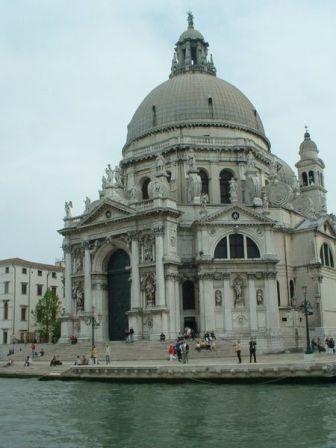
As a thank-you gift, the church of La Madonna della Salute ranks as one of the greatest anywhere.

As a thank-you gift, the church of Santa Maria della Salute ranks as one of the greatest anywhere.

If I were to tell you (which I am) that another important holiday has just been upon us, you would be correct in asking me — before the history, the rituals, the weather — what we’re eating.  As I write the house is full of an extraordinary aroma, which is only to be found during one or two days each year.  If I were to try to describe it, you’d never want to eat it.

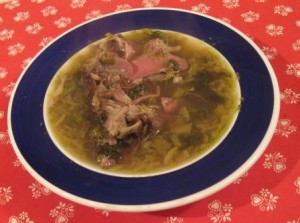
The feast-day (specifically November 21) is in honor of La Madonna della Salute, or Our Lady of Health.  The nutriment is called castradina (kah-stra-DEE-nah) and it’s not for the faint of palate.  Unlike frittelle at Carnival and bigoli in salsa at Redentore, this is not a dish that one finds made at home very much anymore — an American woman in the butcher shop who overheard me ordering the main ingredient told me that she wouldn’t have the “courage” to try making it. (Courage?  It’s not like you  have to club it to death.  Besides, with something this strange, how would anybody know if it had gone wrong?) 

Cabbage belongs with cured meat -- it's just one of those mystic marriages.

Cabbage belongs with cured meat -- it's just one of those mystic marriages.

Most important, it’s a dish that would be impossible to make at any other time of year because the principal component appears at the meatmongers only in mid-November and disappears even before the bridge is taken down at midnight and it will not be obtainable anywhere for another year ”not even for ready money,” as the butler put it to Lady Bracknell.  So even if you hate it, there is something appealing about its rarity, like one of those small creatures that are born, live, and die in the course of a single day.  I happen to love it, but you know me.

Castradina is leg of mutton which has been dried, salted, smoked, and smeared with every spice which is black and odoriferous, and left to fester for only God knows how long.  Hanging in the butcher shops they look like small prosciuttos which have just dragged themselves out of some basement apartment in Haight-Ashbury. 

Under the Venetian Republic this product came from the flocks grazing the rocky heights of Dalmatia; today, much of it comes from the area of Sauris, in northeastern Italy next-door to Slovenia.   Traditionally this meat — which obviously was treated in this intense way to withstand everything from ocean voyages to long-range bombardment — needs long, slow cooking.  More than skill (or even courage), it requires time.   And cabbage.  I forgot to mention the verze sofogae, the suffocated cabbage.

I will give the recipe below, but I feel the need to move on to describe the feast-day itself.  I find it very comforting because as there is Thanksgiving in November (with meat) in America, here there is thanksgiving in November (also with meat).  So I don’t feel I’m missing any important element of the late autumn in all its dank, grey glory. 

To understand why a church of the magnitude of Baldassare Longhena’s baroque basilica was built, we need to grasp, even slightly, the magnitude of the disaster it commemorates.

In 1630, Venice was hit with one of  the worst plagues in her plague-ridden history.  A mere 50 years earlier (1575-76) the city had managed to survive the scourge which inspired the church of the Redentore and its yearly festival of gratitude.   Now, before the city had really recovered, the plague was back and it was even worse than before. 

In that year plague had already been roaming around northern Italy, brought by German and and French soldiers fighting the Thirty Years’ War.  They infected some of the Venetian troops, who took it to Mantova, where soon the disease had eliminated almost the entire city. 

A hearse -- at the moment without any casket -- passes Lazzaretto Vecchio, one of several plague quarantine islands.

A hearse -- at the moment without any casket -- passes Lazzaretto Vecchio, one of several plague quarantine islands.

Venice was understandably cautious about contagion and was a pioneer in the business of quarantine, sequestering arriving ships, their crews and even their cargo for 40 days.  The islands of Lazzaretto Vecchio and Lazzaretto Nuovo were dedicated to dealing with these cases, as well as some islands which have disappeared.  For those unable to resist the romanticism of the idea of Venice sinking, I offer for pure, unadulterated melancholy the vision of an island (actually two: San Marco in Boccalama and San Lorenzo in Ammiana) which sank beneath the lagoon waves still containing the skeletons of the hundreds of poor bastards who were sent there to die.  If Thomas Mann had known — or cared — about this, his famous novel with the irresistible title would not have had anything to do with a doomed infatuation at an expensive hotel but something much harsher in every way.

The situation in Venice was under control until an ambassador arrived from Carlo Gonzaga-Nevers, duke of Mantova.  As everybody knew Mantova was already hugely infected with plague, the ambassador and his family were promptly quarantined on the island of San Clemente (now the site of the San Clemente Palace Hotel).  All would have been well except that somebody thought it would be a good idea to send a carpenter over to see about some renovations that needed to be made to the ambassador’s quarters.  Nothing wrong with that, but they let him go home.  He brought the plague to San Vio, his neighborhood, and thence to the entire city.

By the time the epidemic was finally over 18 months later, 46,490 deaths had been recorded (some estimates go as high as 80,000) in a population of 140,000.   The  catastrophe was made even worse by the disproportionate number of pregnant women who died, and the fact that an epidemic of smallpox was also raging.  So many people were dying each day that it was impossible to remove them all quickly; dead bodies simply lay about the streets, spreading contagion and panic.

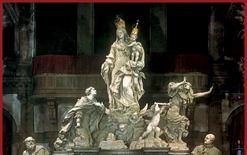
This magnificent composition by Belgian sculptor Giusto Le Court (1627-1679) tells the story: (Left) the city of Venice, as a beautiful noblewoman, begs the Virgin Mary for deliverance.  (Center) The Virgin accepts her plea.  (Right) The plague, as a hideous hag, is driven out.

This magnificent composition by Flemish sculptor Giusto Le Court (1627-1679) tells the story: (Left) the city of Venice, as a beautiful noblewoman, begs the Virgin Mary for deliverance. (Center) The Virgin accepts her plea. (Right) The plague, as a hideous hag, is driven out.

Desperate, the Doge and Senate, the Patriarch of San Marco and the people of Venice gathered  in San Marco to pray for deliverance; they performed a solemn procession throughout the entire city for 15 successive Saturdays, carrying the miraculous icon of the Madonna Nicopeia which the Byzantine Emperor used to carry into battle at the head of his army.   And the Senate made a vow to build a church to the Virgin, swearing that the people would go there every year to give thanks till forever, if she would intercede to save the city.  

In November, 1631 the plague was declared officially ended, and they kept their promise, though it took 50 years to fulfill.  In  November, 1687, Longhena’s masterpiece was complete.

So every November 21 since 1631, Venetians have honored the Senate’s vow to give thanks and have gone to offer their thanks to the Madonna della Salute, Our Lady of Health, and to ask for her protection or intercession.   A friend of mine makes a point of telling his doctor that the two euros he spends on a votive candle that day is the best money he spends on his health all year.  I think he’s joking but I’m not sure.

IMG_4771 Salute bridge compA temporary bridge is installed over the Grand Canal between S. Maria del Giglio and San Gregorio — roughly the path of the normal gondola traghetto.  In the beginning it was set up on boats, big cargo-hauling peatas, which Lino remembers.  Eventually, though, the demands of traffic outranked piety and now the bridge is a suitably high section of the one used in July for the feast of the Redentore.

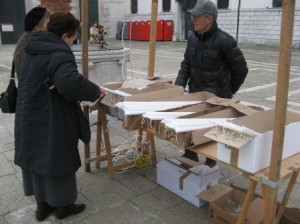
Temporary stalls are set up around the area in front of the church’s steps where vendors sell candles from delicate to dangerous.  You buy your candle, take it into the church, and wait amid the throng until you’ve inched close enough to the candle-offering stations to give your candle to the harried, wax-spattered boys who are lighting new candles and blowing out old ones at a pretty steady clip.  Not many candles stay lit for very long, but try not to let that matter to you.  It’s the thought that counts.

A fairly modest stall compared to some of the others, but still doing a steady business in votive candles.

A fairly modest stall compared to some of the others, but still doing a steady business in votive candles.

Masses are being said at intervals in the various side chapels, and also at the high altar.  We manage to shuffle past the altar to the choir behind, and sit in some of the heavy carved wooden stalls for a while to watch the people leaving through the sacristy.  As Lino says, if you stay there long enough you’ll see everybody go by.  This is one day nobody wants to miss.

Especially the ladies in their fur coats.  For many and various reasons, Venice in winter is one place where mink still reigns supreme.  One night on the vaporetto I counted eleven (I did not make that up).  Shearling and wool are fine, and down parkas abound.  But women of a certain age and ilk are going to be in fur.  If it can’t be mink, it’s going to be as damn close to it as they can manage. 

November 21 appears to be the unofficial opening day of the mink-coat season.  I think it’s because — as mentioned above — everybody is going to be at the basilica, hence it’s the ideal moment and place to present yourself in all your furry splendor.  I have seen women in mink coats on the big day when the sun was shining and the temperature in the mid-50s.  Sweat?  Sure.  Take it off?  Never!  I have a friend who refers to this as the feast of Our Lady of the Fur Coat.

Before we leave the subject of this brief but glorious holy day, I need to stress that all is not candles and sacred vows.  Yes, children are brought by their relatives, and they go through the drill.  But it’s going to be quite a few years before the Salute connotes sanctity to them and not cotton candy.  Because behind and beside the church, along the rio tera’ dei Catechumeni, a series of stalls are set up which you can smell long before you see them.  It’s fat-and-sugar Elysium: deep-fried frisbees of dough (think flat funnel cakes) slathered with Nutella, candied peanuts, big fat doughnuts, long ropes of that weird pinkish soft stuff that looks like a thread of marshmallow DNA, and cotton candy sticking to everything.  Noise!  Lights!  Sugar shock!  And lots of balloons of cartoon characters, close to — and sometimes just past – bursting with helium.  All day long the town is scattered with kids trudging home with floating Spongebob Squarepants or Nemo and Marlin or Dalmatian dogs tied to their wrists. 

I have no idea what little Venetian kids in 1690 might have been given after they trudged out of church with their parents, but I would bet (I would hope) that it was something with absolutely no nutritional value whatsoever. 

CASTRADINA   Prepare two days in advance.

Part One:  “Suffocated cabbage” or Verze sofogae (VER-zeh so-fo-GAH-eh)

Buy a medium-sized cabbage, preferably the kind that has crinkly purple leaves.  Why?  Because it looks better.  Otherwise, any cabbage.

Slice it into really thin strips, not too long.  Put it in an anti-stick pot along with a modest amount of extra-virgin olive oil, a few knobs of garlic, a sprig or two of rosemary, a little salt.  Mix to coat well.  Put it on low heat and cover.  Stir occasionally.  Eventually the cabbage will reduce itself to one-third of its previous volume, and have become soft and almost velvety.  Don’t try to help it along by adding water.  Be patient.

Remove the garlic.  Set aside till tomorrow (in the refrigerator, or even leave it on the stovetop if the kitchen isn’t too warm.)

Part Two:  The castradina itself.

Buy a piece of castradina — half a leg is plenty for three people.  A pound, more or less. 

Put it in a large stockpot filled with cold water.  Bring to a boil.  Simmer for half an hour.  (Considering what’s been done to it, it’s not like you have to actually cook it.) 

Put the pot on the windowsill, or somewhere else that is reliably cool and leave it to cool down completely.  It will probably be overnight.

The next morning:  Skim off the congealed grease which has formed a soft layer on top of the liquid. 

Add the cabbage.  Bring to a boil and simmer for an hour or so.

To serve:  You can either serve the soup first, then a piece of the meat, or you can put them all together in the bowl.  I haven’t heard of any myth, etiquette, or rule governing this.  Just make sure it’s steaming hot.  That’s part of its gestalt. 

The reason why it has to be hot is because back in the centuries when castradina was a normal thing to eat, before it became a semi-exotic semi-relic, people ate it all winter long for the simple reason that it was one great way to warm up.  You might like cocoa, or even mulled wine, but for a typical Venetian winter day/night you used to need to bring out the heavy culinary guns.  Blastingly hot castradina was born for this.

Comments (4)
Nov
18

Catch of the day

Posted by: Erla Zwingle | Comments (0)

Nardo the fisherman was drinking his usual after-work spritz at Bar Mio when we stopped in at 2:00 the other day for an espresso.  A spritz, by the way, is the standard/classic/what-else-would-you-be-drinking aperitivo of Venice.  The size of the glass can vary, but the proportions don’t: one-third white wine (or Prosecco), one-third colored flavoring agent (Campari, Cynar, Aperol, Bitter, Select), one-third sparkling water.  As you can imagine, it is refreshing at any time of day, especially before (or instead) of meals.

Nardo (right) sometimes has help, which is a good thing because straightening out this much net is not what I'd call fun.

Nardo (right) sometimes has help, which is a good thing because straightening out this much net is not what I'd call fun.

He was knocking off for the day, so naturally he needed rehydrating.  He goes out virtually every day (or night, or whenever the best fishing is going to be), and sometimes comes to roost in our canal, selling his catch to passersby.  The fact that he can do this in front of the fish-shop leads Lino to surmise that he sells part of his catch to them.  Sea bass, cuttlefish, gilthead, striped seabream, you know they’re all going to be sparklingly good. 

“I’ve got two folpi,” he volunteered.  “You want them?  I’ll give them to you.  My wife says she’s afraid of them.”  The fact that he has a wife is kind of interesting.  If he’s always out fishing, they must have a lot to talk about on Christmas and Easter, probably the only two days he’s home all year. 

Lino says, “Sure.”  (I wanted to say “Never look a gift folpo in the mouth,” but I’m not real clear on whether they have a mouth.  They must, of course, but only God and Lino know where it is or how it works.  Anyway, don’t bother attempting humor about fish with a fisherman.)

We were heading toward places other than home, so, as per agreement, he left them at Bar Mio for us to pick up on the way back.   I thought they’d have been stowed in some kind of fridge, but they were just sitting in a plastic bag on a chair.

As Lino went into the kitchen to start preparing them, he said “If they’re not fresh, we’re just going to throw them out.” 

Your folpo is technically known as Octopus vulgaris.  As they boil, their tentacles curl up like fiddlehead ferns.  Those are the best bits.

Your folpo is technically known as Octopus vulgaris. As they boil, their tentacles curl up like fiddlehead ferns. Those are the best bits.

Were they fresh?  “Hey, look at this!” he said, peering into the sink where he’d just dumped them.  “They’re still alive!”  This is great from a culinary point of view, obviously.  From a human point of view (with which I am occasionally encumbered) it’s a little too bad.  It’s true that they were strangely revolting as they lay there, tentacles slithering wetly in every direction.  But they’re here now, and there’s only one end to this story.

I put on a big pot of water to boil, threw in what turned out to be too much salt, and went to the living room while Lino got to work.  Then I had a thought.  I went back into the kitchen.

“Are you going to kill them before you clean them?” I asked, feeling a tiny frisson of compassion.  “Oh sure,” Lino said without pausing, picking up the second one (live) and ripping the knife neatly into and up along its stomach in a very straight and very fatal line. 

I felt sort of dumb.  I mean, what had I been thinking?  That he was going to hear their confession?  Give them a last meal?  Cigarette?  Phone call?  They’re headed for the pot: First they’re alive, then they’re not.  Gosh, I think I just made a rhyme.

Sorry, little folpi.  It’s not my fault you got caught.  The best I can do now is tell you how delicious you were.

Categories : Food, Venetian-ness
Comments (0)
Nov
18

It’s all about the money

Posted by: Erla Zwingle | Comments (0)

No ghe xe schei” (No ghe zeh skay).  It means ”There is no money,” in Venetian, and it’s a phrase one hears all too often.

If Venice were to have a soundtrack, it wouldn’t be the shimmering arpeggios of Vivaldi or Marcello, it would be this monotonous lament.  The statement obviously refers to the state of the municipal coffers, but it’s an extremely versatile and handy tool.  It can be used either as a weapon of attack or defense, and is also useful as an accusation.  It’s as much a political as a financial remark, because it explains, excuses, and removes from discussion any problem, decision, action or inaction.  “No ghe xe schei” will be the reason why something was done, or why it was not done, or how it was done, or by whom, or when.  Whatever happens, it will be because there are no schei.

Two recent campaign posters. (Upper) "Independent and loaded with money," written in Venetian; (lower) "With independence we're rich," in Italian.

Two recent campaign posters. (Upper) "Independent and loaded with money," written in Venetian; (lower) "With independence we're rich," in Italian.

Schei is an old Venetian word from the period between 1797 and 1866, when the Austro-Hungarian Empire ruled the once-independent Venetian Republic.  There was an Austrian coinage called “Scheidemunzen” (a generic term indicating that the coin was legally worth more than the metal it was made of), clearly a word that was born looking for a nickname.  So the Venetians chopped off the first bit and pronounced it their own way.  One scheo (SKAY-o) was one cent, that is, one one-hundredth of a Scheidemunze.

You will also still hear people use the term “franchi“ to mean money.  (If you were to earn some extra money, you’d tell your friends you’d “ciapa’ un franco,” grabbed some money, in the casual way we would refer to doing something on “my dime,” even if actually cost $40,000.) 

The franchi don’t refer, as I once assumed, to francs circulated during the brief period when the French were the rulers here, but rather to the coinage of their successors, the Austrians.  In that period there was another Austrian coin in circulation which carried the Latin name of the Emperor Franz Josef, i.e. Franciscus Iosephus.  With the passion for diminutives that is one of Venetians’ more endearing traits, the money became “Franks.”  So spending ”franchi” would be like spending a batch of Abes or Georges today for the newspaper or a pack of gum. 

While I’m off the track here, you also occasionally hear an older person refer to spending lombardi

A one-cent lombardo, 1822

A one-cent lombardo, 1822

That goes back to the period  of the Kingdom of Lombardy-Venetia (1815-1866), a sort of subset of the Austrian dominions about which I will tell you nothing more because life is short, but I will mention that Lino told me he has, somewhere in his impedimenta, at least one genuine lombardo.  Very cool. 

Venetians buy and sell in euros now, a word which is hopeless for fantasy, but it’s used here only in specific situations, such as paying the gas bill or pricing products.  Peaches would cost four euros (not schei) a kilo, but the shopper would put them back because they cost “massa schei.”  Too much money.   But back to the budget.

How much money does Venice need to live on?  And why does it keep coming  up short?  (And why do the lights blaze on all night on every floor of the Palazzo Balbi, in the offices of the Veneto Region??)  The numbers, as reported in the press, don’t seem to match up, and studying the documents on the city’s website gave me the staggers, so I can only sketch some broad outlines. 

As with any entity, the city has Income and Expenses.  You need to increase (A) or decrease (B), or both, to keep going.  Even I know that.  And there has been a terrifying drop in (A) recently, the fiscal equivalent of the effect suffered by non-seat-belted passengers on a plane which suddenly hits one of those invisible air pockets.   Furthermore, the world economic implosion has meant fewer tourists, and those who do come are spending much less.

Conversely, the increase in (B) has been relentless.  

So while the larger world worries about water rising in Venice, the mayor is fixated on the ebb and flow of funds.  That sound you hear is the city government squeezing 7 million euros out of this year’s budget.  There’s plenty of pain to go around. 

Income, some major sources of:

  • The Casino.   It pays half of its profit every year to the city; in 2007 and again in 2008 the city received 108 million euros from it.  But the economic crisis has been hard on the Casino, too, and the projection for 2009 was a drop of 10 million euros from last year’s contribution.  This has created a severe ripple effect on all sorts of groups who benefited from sponsorship by the Casino, which is regrettable.  But for the city it has been a real body blow.
  • The Port of Venice (cargo and cruises).  Happily, in 2008 the Port experienced increases in both categories; Venice is now the #1 port in the Adriatic for Ro-Ro and container traffic (take that, Trieste).  As for cruises, Venice is the #2 homeport in the Mediterranean and #4 in Europe.  Last year Venice reached a historic maximum of 1,216,088 million cruise passengers, each of which pays a 157-euro port fee.  This comes to 190,925,816 euros. 
On a Sunday morning in high season, you can count six of these mammoths, trunk to tail, entering (and later, departing) the city.

On a Sunday morning in high season, you can count six of these mammoths, trunk to tail, entering (and later, departing) the city.

  • Passenger numbers are projected to increase in 2009, despite the general economic gloom.  Therefore, appalling as the sight of these pachyderms may be as they lumber past San Marco (I refer to the ships, of course, not their passengers), to the city they are bags of money floating in on the tide.
  • The Special Law for Venice, the instrument by which national funds are allocated annually for a wide range of activities.  This used to be a very deep pocket for Venice to reach into, but now there’s more hole than cloth.  Only about 5 million euros can be expected to come from Rome, and it’s not clear if the city will even get them all, or exactly when.
  • Historic buildings.  In the past five years, the city has been selling whatever historic buildings it can, realizing some 400 million euros.   (The sale of the former Pilsen brewery, for example, netted 40 million euros;  it is destined to become yet another hotel.)   The anticipated income from the next batch of buildings (if they were all to occur) is 98 million euros.   But eventually there will be no more buildings left to sell, so it may be better not to count too much on this for long.
  • Taxes.   It’s not so much that there need to be  more; there need to be more people paying the taxes which are already required.  Many, many people all over Italy are known to evade paying  tax on their real income.  (Shocking, I admit.)  Those who can manage it declare only the minimum income required by law, and the city has become involved in its own fiscal version of a land war in Asia in the effort to get the tax money it’s due on the real income made.  This effort has led to many battles with, so far, not much result.   
  • Sponsors.  This is a highly desirable source of money but, being impossible to predict or estimate, can’t be listed or quantified in any serious budgeting efforts.

Expenses:

These are all the unromantic elements of keeping a city alive, if not well, and the budget has to cover not only the historic center of Venice, but its municipal partner, Mestre, which has its own particular problems.  The struggle to resolve the very different demands of the two entities —  dredge a canal or build a parking lot? – is never going to let up.  But whereas people come to the historic Venice and spend money (and even respond to appeals for donations for same), it’s unlikely that the same amount of money would be forthcoming from appeals to help Mestre avoid becoming a souvenir.  So there is tension.  Unfortunately for historic Venice, Mestre has twice as many voters.

  • Sanitation
  • Canal dredging
  • Restoration of monuments
  • Schools
  • Public transport
  • Hospitals
  • Housing
  • Anything imaginable which I have left out, including the unforeseen disaster such as the storm of September 26, 2007 which merely drenched Venice but submerged large tracts of Mestre — garages, basements, etc.  The damages claimed by the residents have left a big black bruise on the budget.  And there was the resolution of a festering conflict between the city and the croupiers at the Casino (the city is the Casino’s largest shareholder) concerning the declaration of their tips (taxable, naturally); the croupiers sued the city and the court found in their favor, so the city will have to pay them 11 million euros in settlement.   This hadn’t been listed in the budget for 2009, one can imagine.  I have no doubt that the city has a fund to absorb a certain amount of shock, but there can’t be much left anymore.

To sum up: The city budget currently shows 546 million euros in income, and the same amount in expenses.  467 million of those expenses are for operating costs: 134 million for personnel, and 79 million for the various departments.  Welfare (a general term for various social costs) is 44 million.  The police get all of 2 million.  I won’t go on.  Not much left over, as you can see, for the restoration of monuments and other more visible concerns of the most beautiful city in the world.

Mayor Massimo Cacciari could see trouble coming a year ago (even before the roof caved in on the economy of the Milky Way galaxy):

“TO SAVE VENICE REQUIRES 70 MILLION EUROS,” the Gazzettino headline read, beginning its report on the mayor’s unproductive trip to Rome, where he discovered that the Special Law had allocated Venice a mere 5 million for 2009.  This is depressing, not only in itself, but because in a situation this dire, the need for money will tempt the city to give all sorts of waivers and exceptions and permissions to do things which are prohibited by various  laws.  The wild call of the schei, especially when it’s looking for a mate, is more unnerving than the cry of the migrating sandhill cranes at dawn.

“I explained to the Ministers that Venice needs annual refinancing of at least 60 million euros on the basis of the Special Law,” Mayor Massimo Cacciari said at the subsequent press conference.  “Otherwise it will be difficult to guarantee — on the contrary, they could be blocked — projects tied to the maintenance of the city, of the dredging of the canals, to the restoration of the private buildings of the patrimony, to interventions for the socio-economic revitalization of the city, to the restructing of the government buildings.” 

This billboard was affixed to the Accademia Galleries for a while, visible to anyone near the Accademia Bridge.  Its appeal -- "Would you let Venice become only a souvenir?" is heartfelt but possibly a bit inscrutable to a tourist who doesn't know the whole context. Many tourists ask their guides "What time does Venice open?"  Also, it asks for money without giving any hint as to where it's ever going to go.  Paying the electricity bill of Palazzo Balbi, perhaps.

This billboard is currently affixed to the Accademia Galleries, visible to anyone either crossing the Accademia Bridge or even passing on the vaporetto. Its appeal -- "Would you let Venice become only a souvenir?" is heartfelt but possibly a bit inscrutable to a tourist who doesn't know the whole context (many tourists ask their guides "What time does Venice open?"). Also, it asks for money without giving any hint as to where your well-meant contribution is ever going to go. Paying the electricity bill of Palazzo Balbi, perhaps.

Anyone who has seen the swarms of summer tourists naturally assumes that they are all thickly padded with money, but this is not the case.  On the contrary; tourism imposes more demands on maintenance (money out) than it gains from its wildly assorted visitors, most of whom — the merchants confirm — carry very little spare change these days.

Over time, the city has hazarded various proposals to increase income (and limit the number of tourists at a time, thereby controlling the maintenance problem, at least somewhat).  One idea was to charge one euro from each tourist who stayed overnight (most tourism is of the “bite and run” sort, as they put it).  This raised shrieks from the hoteliers, who saw it as punitive to the very people who were already actually spending money in the city.  Another idea that keeps coming up is to sell an admission ticket to the city, but apart from conflict over its philosophical justification, no one has yet come up with a way to actually make it work.

So “Let’s find a sponsor” has probably surpassed “Let’s have a drink” in frequency, if not in popularity.  Last year the mayor was wooing the German government for money; the movie stars who attended the Venice Film Festival were snagged as spokespeople more or less soliciting contributions; Elton John donated a bit of his music as a cell phone ringtone, the proceeds of which would go to the city. 

Certainly something is better than nothing, but many of these maneuvers do have a sort of tin-cup aspect to them.

The billboards on the Doge's Palace and the New Prisons have left the Bridge of Sighs gasping for air.

The billboards on the Doge's Palace and the New Prisons have left the Bridge of Sighs gasping for air.

Then there are billboards, another form of sponsorship.  The most overwhelming at the moment are in the Piazza San Marco area, covering the facades of the Marciana Library, part of the Doge’s Palace, the Bridge of Sighs, and the New Prisons.   The aesthetic impact of these monstrous advertisements blatantly contradicts the notion that the sponsor is paying because he/she/it is sensitive to beauty and historic value.  The cost of restoration has increased, and the funds have shrunk, to the point where these swathes of space are now regarded as the perfect commercial space for rent.  Not a revolutionary idea in itself, but pretty subversive in a town which is also a UNESCO World Heritage Site.

There is one more aspect of the budget situation here that requires mentioning, and that is the Parris-Island-obstacle-course which an entrepreneur with a good idea has to attempt to run, from bureaucracy to high taxes to entropy, all exacerbated by the normal political parry and thrust which require time and attention too.

One such entrepreneur is yacht broker Stefano Tositti, director of BWA Yachting, and he maintains that there is much more to be earned from the luxury-yacht business than has yet been asked.  “Luxury yachts is a sector that brings Venice about 10 million euros,” he told the Gazzettino; “it’s a lot of money when you consider that the work focuses on only 15 moorings used mainly in the summer.  It’s not enough.  There needs to be a marina adapted to the needs of people who come to Venice; here we’re not able to furnish certain services which our clients normally expect.”

In 2008, 173 of these peerless vessels adorned the embankments at the Punta della Dogana, the Riva dei Sette Martiri, and the Riva San Biagio.  Some of these berths can cost 10,000 euros a day, presumably for mega-yachts such as Paul Allen’s “Octopus”

100 1030 compressed web pages Its all about the money

"Rising Sun" in Stockholm

"Rising Sun" in Stockholm

Larry Ellison’s “Rising Sun,” and Barry Diller’s “Eos,” the world’s largest sailing yacht, all of which put in to Venice from time to time.  In the case of “Rising Sun,” it’s not easy to find berths it will fit into. 

800px yacht eos dartmouth feb 2008 Its all about the money

"Eos" in Dartmouth harbor

Tositti says that there are investors ready to support a marina project, and that an investment of 250 million dollars could bring earnings of 30 per cent within five years.  He claims that the city could earn another 10 million euros if there were a structure for off-season storage.  “The problem here is unfortunately bureaucracy,” he told the Gazzettino.  “It seems as if the city doesn’t want to pay any attention to this niche market.  In fact, very few berths are dedicated to this type of boat — there are very few services for yachts in general, and marinas are completely lacking in the historic center. ”

Happily, on July 2 it was reported that Moody’s had reviewed Venice’s books and awarded the city a rating of AA2, which is just below AAA and AA1.  It is heartening to see that the city’s finances still pass muster.  But with an eye on the drop in income from the Casino, Moody’s has also given Venice a friendly heads-up.

It appears that, at least for the near future, the margin between money made and spent in Venice will continue to be so narrow that you couldn’t even slip the average “suspension of service” notice through it.  Yet still, schemes are proposed from time to time, such as the idea (since abandoned, or at least not mentioned) of installing turnstiles on all the vaporetto docks, which the city inexplicably is able to afford.   This kind of maneuver only deepens the chasm between fiction and fact in this fairytale city.  Yesterday the city couldn’t afford to pay more ambulance drivers, yet somehow money has materialized to install turnstiles? 

It doesn’t do to dwell on these things.   They only make you tired and unhappy.

Problems

Venetian-ness

Categories : Problems, Venetian-ness
Comments (0)
Nov
17

Exodus but no promised land

Posted by: Erla Zwingle | Comments (0)

Esodo.  (EH-zo-do.)  It means “exodus,” but this simple term — like “Fort Sumter” or “potato famine” — is freighted with history and emotion.

When a Venetian refers to the Esodo, he or she is referring to a  Gordian convolution of elements of which the Mother Strand which is knotting up everything else is this: Everybody’s leaving.  Not all at once, obviously, but at a fairly steady rate of 1,500 a year.  This has been going on for decades.

In 1981, the population of the "historic center" was just below 95,000.  On December 31, 2008, it was touching 60,000.  (Source:  Statistics and Research Service, Comune di Venezia.)

In 1981, the population of the "historic center" was just below 95,000. On December 31, 2008, it was touching 60,000. (Source: Statistics and Research Service, Comune di Venezia.)

In 55 years (1951-2006), the “historic center” (”postcard Venice,” as I put it) has lost 65 percent of its population.  It shrank from 171,808 residents to 63,925.   At this writing, the population is 60,311 and still falling.  I’ll pause to let that sink in.

If “exodus” seems to be a dramatic word, calling to mind haggard refugees plodding toward the horizon, the reality it connotes is not less dramatic, and potentially fatal to the city’s future.   “‘Save Venice’  is passe’,” professor Fabio Carrera, a Venetian, told me, only slightly in jest  – “ We need ‘Save the Venetians.’”

The reason the city doesn’t look like the desolate wasteland it is becoming is partly because the casual visitor doesn’t miss what he/she/they never knew.  If you’re just walking around for a day, everything looks fine.  Self-suggestion is a powerful force, and if you believe that Venice is inhabited by Venetians, you probably won’t notice much to contradict that idea, even though it’s mostly tourists who are filling up the empty spaces, both on the streets and in the apartments.

Economic pressures generated and intensified by the steady increase in tourism (3 per cent a year, till this year), have conspired to cause something resembling forced migration.  Venetians have been packing up and moving out for many reasons: Lack of jobs here (businesses closing, even as you read this, due to rents which keep rising, and competitivity which keeps falling), the exaggerated cost of housing, the general cost of living, and even the nature of ordinary daily life (”fatiguing,” demanding,” “inconvenient,” even diehard Venetians will admit).

Over the past 20 years, the proportion of families in the historic center made up of only one person (most often a widow) has reached almost half of the total.  Not a factor conducive to a long and prosperous municipal future.  (Source: Statistics and Research Office, Comune di Venezia.)

Over the past 20 years, the proportion of families in the historic center made up of only one person (most often a widow) has reached almost half of the total. Not a factor conducive to a long and prosperous municipal future. (Source: Statistics and Research Office, Comune di Venezia.)

To consider each of these points more closely, let’s look at the last first.  Living in Venice, beautiful and fascinating as it may be, is not for everyone.  Living here is a vocation, like being a priest, and it too involves sacrifices (and rewards).   Considering how heavy — and even impossible — some of those sacrifices have come to be, I can understand why the city can’t keep its kids at home.  Not everyone wants to walk five miles a day shlepping the shopping, wedging themselves and their kids onto vaporettos crammed with tourists and their inconceivable luggage, paying prices for even the simplest items which you know cost half as much on the mainland.

Leaving Venice — apart from being carried out in a pine box — has usually meant a move to the mainland towns.  First it was Mestre and Marghera, then the territory of Venetian exiles expanded to a series of smaller sub- and exurbs such as Zelarino, Chirignago, and Favaro Veneto.  I think of it as Venice’s “near abroad,” the way Russia refers to its former republics.  Except some of these settlements were mere wide spots in the country roads winding through fields till the Esodo began.

Mestre and Marghera have been part of the municipal entity known as the Comune di Venezia since 1926.  In 1951, the proportion of inhabitants between Venice and its mainland component was 55:21.  In 2006, it was 23:66.

Second point: Cost of housing and of living.  Here again, the pressure of tourism works against the city’s ultimate well-being (as a city, I mean, not as a theme park).  There is very little residential space for rent (for many reasons, one of which is laws which heavily favor the tenant), and the passion which non-Venetians have for buying a place here has led to phenomenal real estate speculation, pushing prices so high a normal Venetian can’t even spell them, much less pay them.  The Giudecca has replaced Tuscany as your well-off Briton’s favorite Italian place for a second home.

The future of a real Venice needs to have many more of these.

The future of a real Venice needs to have many more of these.

Depending on the neighborhood, a modest dwelling can cost up to $5,000 per square meter (or 10 square feet).  For the same amount of money (assuming you might have that much), or even less, you could get a place on the mainland that was multiple times larger, in better condition, with an elevator, and a garage, and a garden, and so on.  If you’re a young family on a budget, you’re going to delete “romance” from your list of domestic requirements and go west.

And finally, the first point: Lack of jobs.  Until the middle of the last century, Venice was a city that worked.  The Arsenal was still going strong, repairing ships; the colossal Molino Stucky was making pasta, from grinding the wheat to boxing and shipping the final product; there were 20 printing presses; there were factories in Venice and on the Giudecca making cigarettes, cotton thread, asphalt, clocks, pianos, fireworks, beer, and luxury fabrics.  I’m probably leaving something out.  If you needed work, you’d have had to stay in bed to avoid finding it.

The cost of everything has not only forced out families, but also businesses.  They keep closing, or moving, taking their jobs with them.  Now, some 20,000 people commute to work on the mainland every morning.

So while “esodo” is what everybody calls it, I’d compare it more to a Class III hemorrhage, caused perhaps by several events but which, taken together, damage the vital functions and left unaddressed will probably kill you.

I know a number of ex-residents — they would still call themselves “Venetians” — who have moved to Mestre.  (If you’re a native of Mestre, you’re referred to as a “Mestrino/a.”  If you go anywhere outside the Veneto region, though, you will almost certainly tell people you’re from Venice.  Technically, it’s not a lie, but your listener will be imagining you in a gondola and not stuck in traffic on the way to the airport.)

The older these exiles are, the less willing they were to make this move.  One of them, a guy I know who belongs to a boat club over there, makes a point of rowing over here with his buddies as often as he can.

They stopped in the canal outside one afternoon and rang my doorbell.  We had a little schmooze, but he ignored his three companions’ pleas to get going because he had to — HAD TO — show me something.  Because his grandparents used to live in our building, and when he was born — he dragged me around the corner — his grandfather immediately took him to this very canal (he showed me the very steps going down into the very water) and dunked him three times.  “This red bandanna,” he pointed to his neckerchief, “means I’m from Castello.”  His friends were rolling their eyes, but to him it was something utterly crucial about him, about the city, about the world the way it used to be, a world that doesn’t and can’t and won’t ever exist on the mainland.

I’ve met ex-Venetians who come over from Mestre on Sunday afternoon just to stroll around, just to be here.  Like going back to the old home place.  On a personal level, it is pure pathos, which doesn’t primarily mean “sad,” it means “suffer.”  I don’t know if I’ve ever heard a transplanted Venetian say, “Life is so much better since we left Venice.”  I have heard some say, “We really, really miss it.”  The emotional reality of this erases much of the importance of factors such as cost of living, crowded vaporettos, and all those other drawbacks I mentioned above.

In many ways, Venice is an excellent town for older people; lots of human contact, and you are compelled to walk, whether you feel like it or not.  But as the shape of families changes, more of the elderly are living alone.

In many ways, Venice is an excellent town for older people; lots of human contact, and you are compelled to walk, whether you feel like it or not. But as the shape of families changes, more of the elderly are living alone.

The city government is not oblivious to what’s going on.  There are spasmodic attempts to get a grip on some appendage of this monster, and a recent recalculation shows that the departures have slowed, if not stopped.  New apartments built or renovated to be made available at advantageous prices to Venetians was an excellent idea, then it was discovered that there were Venetians buying them in order to re-sell them.  Jobs?  Nobody seems to  know where more might be found.  I think I saw one around here the other day, but I can’t remember where.

I sometimes wonder what it would be like to be the mayor of Venice and go abroad to some big international conference of mayors.  And someone asks, “So, how are things in your city?”  (I overlook his probable first response which would be “Fine, except that the people are morons.”)  I imagine him saying “Fine,” period.  Or maybe, “Well, could be better.”  Or maybe, “We’re evaluating some exciting new projects,” or however mayors phrase it.

It would be much harder to have the nerve to admit, “There are a lot of great things about my city, except that nobody can live there.  I’m mayor of a city in which it is becoming literally impossible to live.”  What response could anyone give to that statement?  It would be like asking a ship’s captain about his vessel and hearing him say, “She’s in great shape, except for that large hole in the hull.”  Nor would it make much sense for him to say, in effect: “Hey! At least we’re still floating!”

In the end, there may not actually be any compelling reason to halt this hemorrhage.  Mestre is big and modern and loaded with taxpayers with disposable income.  Venice is little and decrepit and not really self-sufficient.  If I block the emotional component, it may make more sense to just keep the patient on life support (tourists, sponsors, etc.) than attempt to return it to health and vigor.

It bears some thinking about.  In fact, now that this radical  thought has occurred to me, it’s going to be bothering me a lot.

Categories : History, Problems
Comments (0)
Nov
16

Funeral of Venice?

Posted by: Erla Zwingle | Comments (0)
This is Adam and Eve after paying for their Venetian abode.

This is Adam and Eve after paying for their Venetian abode.

On Saturday a moderately publicized event was staged here which was billed as the “Funeral of Venice.”  It was organized by a local group/social site called venessia.com.  (This is the way Venezia is spelled in Venetian.  Disclosure: I’m signed up but I hardly ever visit.)  I didn’t attend but I was aware of the drumbeats leading up to it and cast my eye over the assorted coverage in its wake.

The event consisted of loading a fuchsia-tinted casket onto a six-oar balotina and carrying it, followed by a sort of funeral cortege of boats, down the Grand Canal from the train station  to Ca’ Farsetti, or City Hall, by the Rialto Bridge.  There was also an enormous floral wreath with the traditional ribbon from the bereaved donor: “Venetian Citizens,” it read. 


The casket was carried into the atrium and a sort of funeral oration was declaimed.   Then some people kicked the casket to pieces and a flag with the symbol of the phoenix (rebirth, hint hint) was taken out.   At least they didn’t dig a grave somewhere out along the sidewalk and bury the thing.  All this was moderately covered by the local press, it being Saturday and evidently a slow news day. But it was covered more extensively by the foreign press, perhaps being tired of covering the usual stories of death and dismemberment from around the world.  So they came for a different story of death and dismemberment, the municipal variety.

The motivation for this moderately unusual gesture was to draw the world’s attention — or if not the world, the city government —  to the fact that the population of the city had just dropped below 60,000.  Of course the city government already knew that but didn’t interpret it in the same way as the protesters.   I’m not sure the government interpreted it at all. 

San Marco gets hit with sticker shock.

San Marco gets hit with sticker shock.

What’s so significant about 60,000?   Because this is the number at which a settlement is defined as a “city.”  Therefore, having fewer, Venice has now become a town.  After which a village, I suppose, then a hamlet, then a hermit’s refuge.

“The city doesn’t want to resign itself to becoming a modern Pompei,” said actor Cesare Colonnese as part of his oration, to the assembled multitude of foreign reporters — according to the Gazzettino, there were four taxis full of journalists, and a barge with somebody playing the piano.  “Danse Macabre” would have been a good choice.  (Actually he was playing “Funeral March” by Chopin.)  All in all, the account as given sounds more like something concocted for Carnival than anything else.  Needless to say, no politicians showed up. 

At a mere two days’ distance it’s hard to make a judgment on the impact this event might have had on public policy and the future of the city.  If discernible, it too would be moderate, I’d guess.  It mostly had the aroma of the sort of wailing and gnashing of teeth that goes on here for almost any reason you can come up with, said wailing and gnashing being totally justified and virtually always ineffective.  And not really all that satisfying, I believe, because like anything else it can become a habit and therefore loses much of its pleasure. 

In any case, the city government has never responded to wailing and gnashing.  Where mere citizens (and not economic sectors) are concerned, it is wail- and gnash-proof.

Lino, who belongs to the class — Venetians born and bred — which some believe ought to be first on the barricades, was massively uninterested.  Not that the fate of his city doesn’t interest him, but scenarios like the casket seem to come with futility and foolishness already installed, making them useless for any serious work that has to be done. 

This price does not indicate a luxury dwelling at $895 per square foot.

$939,362 for 1,035 square feet does not indicate a luxury dwelling.

First of all, he noted that of the people who responded, a large contingent were foreigners.  No disrespect intended, but when a call to arms, however well-meant, comes more from without than within, it’s a symptom that something is already out of kilter.  If the city government doesn’t respond to its own citizens, who presumably have a long-term stake (fancy way of saying ”pay taxes”), it’s unlikely that it will respond to those who mostly don’t.

But the story is simpler than all this.  Lino ran me through it:

“A lot of the Venetians who moved to the mainland used to live in cellars,” he stated.  Venice doesn’t have cellars, but it’s as close as I can come to the real word he used — magazzini — those humid, moldy street-level areas never intended as dwellings because of their propensity to flood, but which are universally useful as storage space for anything that isn’t bothered by humidity or mold.  But people lived in them all the same because they didn’t have anywhere else — this large cohort not being nobility, obviously, or even the middle class, but what once was a large working class and whoever is below that.

Many Venetians of his era –say, from before World War II to something like ten to 15 years after it — remember how much miseria there was.  “Miseria” is a very useful word because it not only connotes poverty, but everything physical and emotional that goes along with it, which could also be called “misery.”  A friend of mine remembers the family that lived upstairs, who sometimes came down to their apartment to get warm.  His mother would occasionally give them meat.  He remembers houses that smelled of “cold ashes.” 

This jewel only "needs refreshing" of its 2 bedr, 1 bath, living room, eat-in kitchen, 1000 square feet for a mere $1,043,735.  Why not take two?

This jewel only "needs refreshing" of its 2 bedr, 1 bath, living room, eat-in kitchen, 1000 square feet for a mere $1,043,735. Why not take two?

“It was a dirty, provincial, poverty-stricken backwater,” Time magazine noted in a review of an exhibition in 1936.  The unnamed reporter was referring to the city in the 18th century, but not so very much had changed by the 20th.   In 1900 a cholera epidemic broke out; not difficult in a city surrounded by water, but a classic threat to those weakened by malnutrition and general crud.  “Death in Venice” was written not long afterward(1911), and although the title reeks of romance, the death itself merely reeks.  It was cholera, a disease which has no aesthetic component whatever even if the protagonist was staying in a fancy hotel on the Lido

In reporting on the 1836 epidemic, a British medical journal said this:  “The proportion of cholera patients in the poorest to those in the wealthiest parishes in Venice is 100 to 15,” it stated.  People who were especially susceptible were “persons of irregular habits and diet… using bad food…affected with chronic complaints…poor…over-worked…dirty.”

Lino remembers children with lice, scabies, typhus.  Not that the city was some huge slum, but it wasn’t exactly an autoclave, either.

“When people got the chance live in something better, of course they took it,” he went on. 

It’s common knowledge now, as it has been for decades, that the cost of real estate in Venice is fabulously high and just keeps going higher.  So if anybody had the slightest opportunity to trade up, they took it.

“For what they would pay for a small magazzino here, they could get a big apartment on the mainland, with a garage and garden and elevator and everything.”  But they didn’t count on the emotional element, and he says that many of these transfers had the chance to come back, they’d do it in a flash.

So why don’t they?

Here we have 650 square feet for $700,794 -- 2 bedrooms, 1 bath WITH WINDOWS, but also a balcony and a storeroom.  Not bad, but still pretty steep.

Here we have 650 square feet for $700,794 -- 2 bedrooms, 1 bath WITH WINDOWS, but also a balcony and a storeroom. Not bad, but still pretty steep.

“The plain fact behind all this is that the cost of real estate has now reached a level which is unattainable for most people,” he said.  “And don’t forget” –  here it comes — “it’s also Venetians who are the cause.  If someone has an apartment to sell, he’s obviously going to put the highest possible price on it.  A price which only a foreigner could pay, even if they only come here a few days or weeks of the year.  Just walk around — there are so many houses that are shut up.”

This is true; it’s not uncommon for people to ask me what’s up with all the closed shutters.   

Venetians, knowing all this, are at a loss to find a handhold on the situation.  But this Saturday-morning ceremony was a worthy attempt and it did make for a moderately dramatic interlude at City Hall.  The city intermittently devises some new plan to address this situation, but as they say here, “The law is made, the loophole is found.”  A number of those new apartments on the Giudecca a few years ago that were supposed to be reserved for Venetians?  Certain conditions weren’t imposed on the terms of sale, so Venetians were buying them — and then reselling them at inflated prices. 

The Councilor for Housing, Mara Rumiz, had the grace to hold a press conference at which she discussed some initiatives to confront the housing situation.  I feel that ought to be acknowledged. 

Cesare Colonnese, an actor who gave the discourse, had this to say on his website (in Italian and at the end in Venetian):  “…I don’t want to get into discussing politics and I don’t know if talking about responsibility is always correct.  I think in this case the responsibility should also be on the part of all of us.   It’s also up to us to do something for Venice, it’s also up to us to set a good example…. We Venetians shouldn’t always present ourselves as complainers and never content.  Each one of us, from the artisan to the glass-maker, from the baker to the pizza-maker, has a craft in his hands and the potential to show themselves and others that Venice is a strong city that’s capable of being reborn.  Venice doesn’t have to lose its characteristics and traditions.  We have to raise our children teaching them to love these customs and traditions because they will be the future of this city [Note to Cesare: Are you going to stem the mania for celebrating Halloween here, which nobody has any idea what it is except some new fad the kids insist on pursuing?  I'd vote for starting here with the old defend-our-traditions project].  It’s useless to leave with our tails between our legs, because by leaving we lose contact with this reality as well as, in my opinion, the right to complain.   Who says that Venice is dead?  It’s time to quit this talk while just sitting around.  So get up!  Get up!  You too, go and do something!”  Like what?  SOMETHING.  I’ll get right on it!

The Gazzettino reported a smattering of comments across the spectrum of onlookers.  One 70-year-old Venetian man said, “Nobody has worked right down to the bottom on the issue of residentiality for Venetians,” he said.  “We need to bring Venetians back to the city and this should be the work of a good administration.”  Affordable housing, in two words.

“I think it’s silly,” remarked a young Venetian woman who moved to Mestre.  “I’d never move back to Venice.  I come here to work, but it’s better to stay away from the city, which at this point has more disadvantages than luxuries.”  Points for candor.

“I’d never have thought we could reach this point,” commented a retired grocer — “a demonstration about being able to live in Venice.  I’d like to put the politicians in the casket.” 

A jeweler who lives on the mainland thought it was a joke.  “The destiny of Venice is the same as all the ‘art cities,’” he said.  “It’s a world in evolution.”  And in fact I have heard this from others — that many of Venice’s problems are also problems in Florence, and elsewhere.  The residents are under siege wherever tourism has unhinged the economic equilibrium. 

Well, at least this time the story about Venice sinking isn’t about water or tourists.  What would it be sinking beneath?  Just about everything except gluttony, although when the ceremony was over there were refreshments.  As everyone is fond of observing, “All the psalms finish with the Gloria.”  The happy ones, the tragic ones — whatever is going on, make sure you’ve got snacks.  Oh, and drinks.  They had Prosecco, naturally.  No point in suffering needlessly.

Categories : Events, Problems
Comments (0)
Nov
12

San Martino: the Ur-cookie

Posted by: Erla Zwingle | Comments (2)

As I was waxing lyrical about the cookies shaped in the silhouette of San Martino on his horse with his sword, I neglected to include a photograph of the most extraordinary version I’ve seen this year, or any year.  It isn’t that big — just about an adult hand’s-breadth (how often do I get a chance to use that word) — but if you can discover anything about it resembling a saint, horse, or sword, please let me know.  It’s like the cookie version of Charles Laughton as Quasimodo.

So I’ve decided this must be the primeval Ur-cookie, the formless plasma from which all other Sammartini have developed over the eons.  I would gladly have bought it but I don’t think I would have had the courage to eat it.  It is so completely and fundamentally cookie that if I were to destroy it I have no idea what species would die off and go extinct.  Maybe Girl Scout cookies would be first, followed by Famous Amos — do those still exist, or did he join a death pact with Mrs. Field? — and then Oreo would go, and on and on down through Scottish shortbread to ginger snaps to nameless oatmeal-raisin disks to the last holdout, the Petit Ecolier, whom not even his chocolate shield could save.

So just look at it, don’t even touch it.  It would be the end.

IMG_4457 s martin cookie comp

Categories : Food
Comments (2)

I realize that a mere ten days have passed since we officially festivized All Saints, which to my literal mind means we’re good for another year with everybody who has ever been beatified or canonized.  But of course that isn’t the case, at least not here. Happily, saints often come not only with their often inscrutable life stories, but — as you may have noticed — with their own particular provender.

St. Martin in his greatest moment, here in a relief sculpture on the facade of the eponymous church near the Arsenal.

St. Martin in his greatest moment, here in a relief sculpture on the facade of the eponymous church near the Arsenal.

November 11 is the next case in point: It’s St. Martin’s Day (that would be St. Martin of Tours, if you’re looking for him — not the Caribbean island).  And even though you may feel as if what’s left of the year is unspooling in a meaningless way — let’s just get to Christmas — there are several milestones on the way and he is one of the most important.

The man himself (316 to 397 A.D.) was born in what is now Hungary, and although he was drawn to Christianity at the age of ten, he followed his officer father and joined a Roman unit of heavy cavalry.  He was pious but that didn’t seem to interfere with the performance of his duties, whatever those might have been.   So everything was going along in a normal Roman-cavalry-unit sort of way until one day, near his base at Amiens, France, he had a life-changing experience, followed by a vision, which has become the most famous (usually only) thing which we remember about him.  I refer to the Episode of the Cloak.

In the words of his hagiographer, Sulpitius Severus, “In the middle of winter, a winter which had shown itself to be more severe than ordinary, so that extreme cold was proving fatal to many, he happened to meet at the gate of the city of Amiens a poor man destitute of clothing.  He was entreating those that passed by to have compassion upon him, but all passed the wretched man without notice, when Martin…recognized that a being to whom others showed no pity, was, in that respect, left to him. 

A child's version of events painted on a plate which says "Viva San Martino" (long live St. Martin).  I think he might have liked this blithe little version of events.

A child's version of events painted on a plate which says "Viva San Martino" (long live St. Martin). I think he might have liked this blithe little version of events.

Yet, what should he do?  He had nothing except the cloak in which he was clad, for he had already parted with the rest of his garments for similar purposes.  Taking, therefore, his sword with which he was girt, he divided his cloak into two equal parts, and gave one part to the poor man, while he again clothed himself with the remainder.  Upon this, some of the bystanders laughed, because he was now an unsightly object, and stood out as but partly dressed.  Many, however, who were of sounder judgment, groaned deeply because they themselves had done nothing similar.  They especially felt this, because, being possessed of more than Martin, they could have clothed the poor man without reducing themselves to nakedness.”

The first time I heard this story, I was slightly perplexed by the fact that he hadn’t given the man his entire cloak, him being such a good person, and then I figured he’d miraculously be given a new one (or something).  Cutting it and keeping half seems so intelligent — hard to believe he became a saint with that approach to problem-solving.

But obviously I don’t know my saint.   “In the following night” (Severus continues) …Martin…had a vision of Christ arrayed in that part of his cloak with which he had clothed the poor man…he heard Jesus saying with a clear voice to the multitude of angels standing around — “Martin, who is still but a catechumen, clothed me with this robe.” 

Martin immediately went to be baptized, and two years later he left the army to begin a lifetime of good works and miracles.  Many of his reported exploits seem somehow generic — no disrespect intended, I have no doubt these occurred or ought to have occurred (converting a robber to the Faith, restoring someone who had been strangled, destroying heathen temples and altars, casting out devils, curing the sick, preaching repentance to the Devil).  He wouldn’t have been a saint if he hadn’t done at least two of those things.  But clearly others also recognized his intelligence and made him  Bishop of Tours, and then he became a national saint of France and also of soldiers.  (I think that’s a fine thing to remember on Veterans’ Day.)  But what remains fixed in millions of art works, and in most garden-variety minds, is the cloak-and-beggar story.

A wineshop announces (in Venetian) the happy news: The torbolino has arrived!

A wineshop announces (in Venetian) the happy news: The torbolino has arrived!

I can remember much of this because everyone here refers to that brief pause in the oncoming winter weather (known elsewhere as Indian Summer) as “St. Martin’s Summer.”  It is underway even as I write, having arrived two nights ago, girt with smiling sunshine, after three days of ferocious cold, wind and rain.  I also remember much of this because the kids go a little crazy.

This is an important date (unrelated to Martin, as such) because this is when anyone who made wine in September begins to decant the first stage, or “must,” a barely fermented fluid which here is called torbolino (tor-bo-LEE-no) because it’s turbid, and is born to be consumed with roasted chestnuts.   And while the adults may be swallowing turbid wine and burning their fingers, the children head straight for sugar and noise.

The kids appear in approximately organized groups, and go up and down the street banging whatever they've got to bang on or with and wearing certain costume elements.  I don't know why the crown is considered an important attribute of St. Martin, but anybody wearing it certainly feels like celebrating.

The kids appear in approximately organized groups, and go up and down the street banging whatever they've got to bang on or with and wearing certain costume elements. I don't know why the crown is considered an important attribute of St. Martin, but anybody wearing it certainly feels like celebrating.

The tradition is for children to go around the neighborhood banging and clanging on pots and pans with spoons or something, and carrying a small bag (sacco — sack.  Sachetin — little sack.  Sa-keh-TEEN).  They sing at least the lilting refrain of a little song whose verses variously request any adult they stop to give them some kind of treat, and specifying the revenge they wish to see visited on anyone who refuses.  “Pimples on your butt” is the best one.  These are innocent little maledictions — nothing anyone could actually inflict, unlike Halloween tricks.

The correct term for this activity is “battere San Martino,” or “to beat St. Martin.”  This simply means going out to make a racket in his honor.  The refrain: “E co nooooooostro sachetiiiiiiiiin, Cari signori xe San Martin.”  (And with our little sack, dear sirs it’s Saint Martin’s Day.)

Obviously this kid has reached a whole new layer of cool.  Nice to get the horse involved, too.

Obviously this kid has reached a whole new level of cool. Nice to get the horse involved, too.


The littlest contingent was the only one which wore something resembling cloaks.

The littlest contingent was the only one which wore something resembling cloaks.


They go in and out of whatever shops may be open — this is a late-afternoon/early-evening project — and may well score some kind of small candy or even bits of money.  They are usually accompanied by squadrons of mothers.

Then there are the cookies called “Sammartini.”  This is a newfangled post-war invention which played no part in the lives of children of Lino’s vintage.   The dense buttery cookie dough is cut out by metal forms of various dimensions in the silhouette of a man on horseback holding his sword aloft.  Then the pastry-makers go into a sort of frenzy decorating him with icing of various colors and sticking pieces of candy onto it before it dries.  The price of these cookies varies according to size but also, I imagine, according to the elegance of the candy.  An M&M is one thing, a Perugina chocolate is another.  And then they add up the cost of the ingredients and multiply by, oh, a thousand.  For the first time, I just saw some in the ordinary old supermarket, a triumph of economy over romance. It was bound to happen.

Speaking of economy, don’t worry too much about how much money the pastry-bakers could be losing on their unsold cookies the day after.  They break them up into pieces and sell them by weight.  That is really the triumph of economy over romance and I’m all for it.  You know what?  Fragments of saint taste just like the whole saint. 

A pretty nice "Sammartin," it's true.  But 28 euros?  That's $40!  If Saint Martin found out you had that much extra income to do something in his honor, I'm going to step up and say he wouldn't want it to be a cookie.  My view of saints is that they're fine with fun, but not with insanity.

A pretty nice "Sammartin," it's true. But 28 euros? That's $40! If Saint Martin found out you had that much extra money to spend on something in his honor, I'm going to step up and say he wouldn't want it to be a cookie. My view of saints is that they're fine with fun, but not with insanity.

This was my cookie and it was excellent.  I think all horses should have M&M's for hooves.

This was my cookie and it was excellent. I think all horses should have M&M's for hooves.


For the first time the neighborhood hired a local man who put on quite a puppet show.  It didn't have anything to do with St. Martin, but it did involve lots of hitting and rude remarks, all in Venetian.  The kids loved it.

For the first time the neighborhood hired a local man who put on quite a puppet show. It didn't have anything to do with St. Martin, but it did involve lots of hitting and rude remarks, all in Venetian. The kids loved it.


The Venetian backdrop was nice too.

The Venetian backdrop was nice too.


Back in the days when children were still made to memorize poetry, they were taught “San Martino” by Giosue Carducci ( Nobel Prize for Literature, 1906).  It’s a bucolic little ode to this autumnal interlude — nothing about cloaks, saints, or sacks, small or otherwise — but naturally the new wine works its way into it with no trouble at all. 

The poem comes rolling out of Lino’s memory even after all these decades; he just started reciting it yesterday as we were walking over the bridge on the way to the vaporetto.  It’s more a hymn to the season than anything related to saints or miracles and it reminds me, in a way, of those lines from  Stephen Vincent Benet’s “John Brown’s Body” (”Fall of the possum, fall of the ‘coon/And the lop-eared hound-dog baying the moon./Fall that is neither bitter nor swift/But a brown girl bearing an idle gift/A brown seed-kernel that splits apart/And shows the Summer yet in its heart…”).  It’s a season that definitely brings out something in poets, maybe even more than spring.


La nebbia agli irti colli/piovigginando sale,/e sotto il maestrale/urla e biancheggia il mar;

Ma per le vie del borgo/dal ribollir de’ tini/Va l’aspro odor de i vini/l’anime a rallegrar.

Gira su ceppi accesi/lo spiedo scoppietando:/sta il cacciator fischiando/sull’uscio a rimirar

Tra le rossastre nubi/Stormi di uccelli neri/Com’esuli pensieri/Nel vespero migrar.

The mist on the bristly hills/rises drizzling/and under the northwest wind/the sea whitens and howls.

But in the village streets/from the fermenting tubs/Comes the pungent odor of the wine/to cheer the spirit.

Above the burning logs/the spit turns, popping;/the hunter whistling in the doorway/takes aim again

Among the russet clouds/flocks of black birds/like exiled thoughts/migrate at vespers.

By the way, Carducci was born in a Tuscan mountain village called Valdicastello (now Valdicastello Carducci, pop. 1000), so he wasn’t some urban creature sitting downtown inventing some fantasy out of the Georgics.  He heard and saw (and smelled) what he was writing about.  That’s why I like it.  I wonder how old he was when the idea of “exiled thoughts” came to him.

Signing off for the Daily Saint and Cookie.

The men in the fish shop thought all this was wonderful.

The men in the fish shop thought all this was wonderful.

Categories : Events, Food, Venetian-ness
Comments (2)