Archive for July, 2009

Most of the journalism about Venice, either print or TV, points out tourism as Venice’s main defining characteristic, which is about as simple a discovery to make as that  water fills the canals.      Apparently the  appeal is eternal to the average journalist and editor looking for a story which is immediately sensational and not at all hard to do.   A story on tourism here practically writes and photographs itself.

In doing so  the reporters  universally bewail it, to one degree or another, in the same way one would bewail any uncontrollable  natural disaster such as grasshopper swarms, tornadoes, avalanches.   You’d almost think that  tourists come to Venice deliberately  to wreak havoc on an innocent, helpless, unsuspecting, undeserving  victim.   The lines in these stories are usually pretty clear: City Good, Tourist Bad.

Pictures of mass tourism at its most intense are the easiest images in the world to take, the journalistic equivalent of  hitting the bull’s-eye from one foot away.  Anybody can do it — I’ve done it myself.   You don’t even have to open your eyes to take impressive pictures of the worst aspects of mass tourism.   In fact it’s probably better if you don’t.

But there is much more to the situation than the simple outlines sketched by the just-passing-through journalists.  
1x1.trans Besieged    a word about tourism

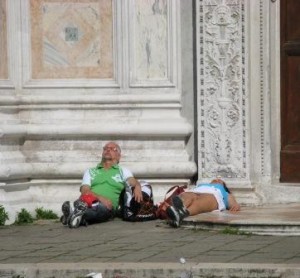
Catching some rays at the entrance to the church of San Zaccaria.

I am not defending the behavior of large segments of the mass tourist population.   These are generically labeled  ”turisti da culo,” which literally means ass-tourists, but generally conveys a wide range of rude, thoughtless, generally sub-civilized behavior.   There is never any lack of examples, especially in the summer.   This race of tourist is horrifying, demoralizing, offensive, depressing.   I could tell you stories.   And yes, of course there are too many of them.


1x1.trans Besieged    a word about tourism

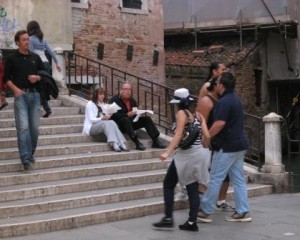
A bridge, the narrower the better, is always a useful place to have lunch.

But I want to pause for a moment in mid-cliche’ to regard the situation from two important points of view which are rarely addressed as everyone is busy wailing and gnashing their teeth.


1x1.trans Besieged    a word about tourism

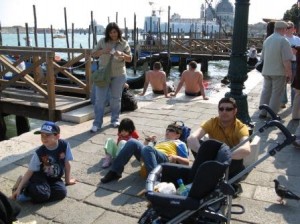
And you bivouac the troops wherever you find a space.

First, the  city officials who have been assigned the role of City Councilor for Tourism over the years are politicians.   They are not trained in the industry of tourism, an industry as demanding and complex  as making steel or developing drugs.   Further, it is the nature of the  political breed to be cautious and easily swayed by conflicting demands, which makes planning, and then executing any plan, hugely difficult.   And unappealing.   Politicians on the whole tend to avoid “difficult” and “unappealing.”   So a lot of tiny,  disconnected   actions are undertaken to minimize, if not solve, whatever is  the most pressing problem of the moment.  

The current Councilor for Tourism, a native Venetian lawyer named Augusto Salvadori, is famous for  his impassioned oratory on behalf of his beloved city, the need to protect her and defend her and nourish and cherish her.   It’s like the wedding vow.   He is often on the verge of weeping before he finishes.   People have come to expect it.

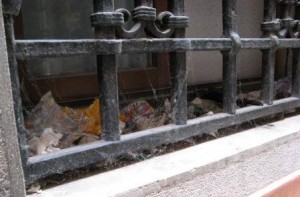
But he has no program, he has only little temporary fixettes.   My favorite was the recent day to promote Decorum (yes, that’s the word they use for clean, tidy and polite), one of  whose more publicized aspects was that the city offered to donate geraniums to anybody who wanted them, in order to brighten up the windowsills.   If he had thought of donating  the same number of large trash bins to be distributed far and wide to mitigate the incessant leaving of garbage on said windowsills because no alternative is to be found, the city wouldn’t need flowers in order to look better.   You can walk from the vaporetto stop at San Pietro di Castello as far as the  Bridge of the Veneta Marina (a straight shot of about 20 minutes, if you dawdle) without finding one (1) trash bin of any size whatsoever.  
1x1.trans Besieged    a word about tourism

Speaking of decorum, this little midden is two steps from City Hall. It's been here so long that cobwebs have begun to cover it.

There aren’t many people who are willing to walk around town indefinitely with their empty soda can, beer bottle, or plastic ice-cream cup in their hand, searching for a place to dispose of it.  

So: Point One is that the persons in charge of tourism here are unprepared for anything other than Making Suggestions.   Which isn’t the same as Having Ideas.  

Tourism is Venice’s only source of income.   Yet it is inexplicably and profoundly — even stubbornly — even proudly, it sometimes seems  –  mishandled.   The individuals charged with managing this important, complicated, potentially destructive resource could be compared to a person hired as director of a mercury mine whose previous job had been, say, as the Judges and Stewards Commissioner of the International Arabian Horse Association.

“We need some truly visionary people,” professor Fabio Carrera told me the other evening.   “There’s no long-range thinking.   It’s very short-range.”   A few months ago there was tremendous blowing of trumpets and waving of banners to publicize “VeniceConnected,” the next big step in tourism management here: One-stop  online booking.   Carrera snorts.   “All these ideas that were good maybe five years ago, like VeniceConnected online.   We should be doing ten times better in the future.   But they think ‘We’re innovating’ by doing this crap.”

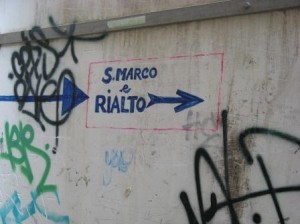
The fact that there is chaos at the top naturally leads to chaos all the way down to the poor bastard trying to find a place   in the shade to have some kind of  lunch that won’t cost a fortune.   Bathrooms — can’t find them.    Open late, close early.    Vaporettos — confusing.   Signage — random and often homemade.   1x1.trans Besieged    a word about tourismStreet vendors — insistent and vaguely disturbing.   Which leads to Point Two.
Point Two: Nobody ever takes the trouble to report on what is demanded of  a tourist here.   I see it every day and even as it repels me it also inspires something like pity.   It must be the vacation equivalent of the Ranger Assessment Phase at Fort Benning, especially if you’ve got kids.   I once stopped to help a family of three standing at the foot of a bridge with their eight suitcases (I counted them), unable to figure out where they were, much less how to get to their hotel.   They had been standing there for a while.  

Visiting Venice in the summer will almost certainly be hot, tiring, baffling, occasionally even upsetting, and it can cost far too much.   A one-ride ticket on the vaporetto costing 6.50 euros ($9) is far too much.   Two euros ($2.80)  for a half-liter (two cups) bottle of water is far too much.    Disposing  of the  result of the water you drank, if you avail yourself of one of the  few but very clean  municipal bathrooms costs   1.50 euros ($2), which is far too much.   But cheaper than the  original bottle of water, true.  

I am  not defending or excusing the type of tourist of which one sees way too many here: Oblivious, rude, loud, and often, yes, ugly.   The garb, the behavior, the everything is impossible to defend.   When people leave home, many evidently leave their manners at the kennel with the dog.   (The fact that there can also be rude, loud, ugly Venetians is noted by the court, but doesn’t have any bearing on this case.)   But to be a tourist here, enchanting as the city is, must  be debilitating.    

Still,  that doesn’t explain why they have to shuffle around the narrow streets like wounded water buffalo, stopping with no warning and blocking your passage, or to ride the vaporetto with 60-pound packs on their backs, nonchalantly laying waste to everyone around them as they turn this way and that, admiring the view.  

So let’s sum up the situation:  The city puts up with aggravations and discourtesies and even damage, large and  small, all day, every day, and also at night, but it  gets money.   And the tourist struggles around a bewildering, overloaded bunch of Baroque/Renaissance/Veneto-Byzantine-laden islands, but gets lots of pictures of canals and belltowers.

I don’t know.   Something is definitely missing from these equations.
Categories : Problems, Tourism
Comments (2)

Now I’m going to reveal something that I have confided in only a few people:   my passion for laundry.   Not just mine, everybody’s.  It’s more than a mere passion, it’s more like a  fixation, really.   A mania.

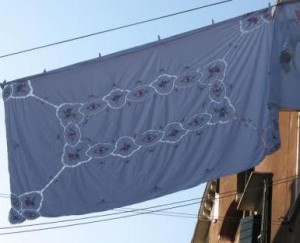
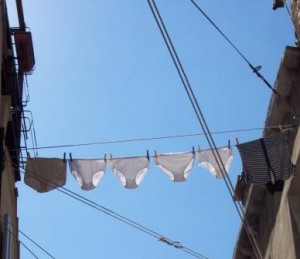
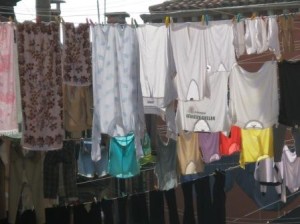
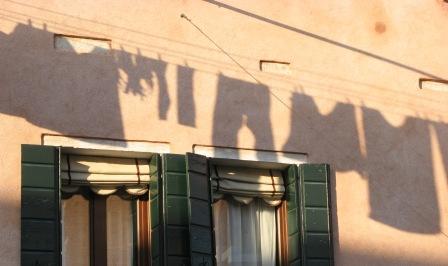
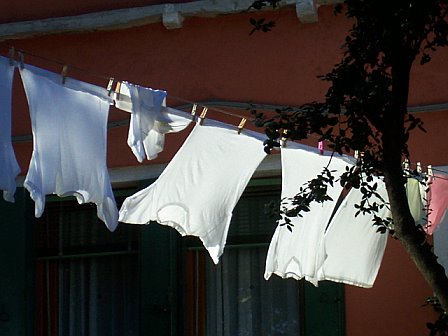
1x1.trans Laundry, one of the unsung wonders of VeniceClotheslines, fluttering with their victorious domestic banners, are like daily bulletins, footnotes in the ongoing family story.   Plenty of people walk around Venice snapping pictures of laundry, I suppose because by now it’s something you don’t see very often back home.   I can tell you that when I see people photographing my laundry, it annoys me.   I don’t regard it or myself as either quaint or picturesque.
 But why do I love it so much, in my own secret connoisseur’s heart?   It’s not the laundry itself, but the drying thereof, because that is the linchpin of the entire domestic enterprise.   Not having a clothes dryer (I only know one person here who has one, and she uses it about twice a year, in the winter), you develop, quickly or slowly, a sense about the weather and its capacity to dry your garments that you’d never have imagined possessing   in more appliance-laden towns.   It’s a jungle-lore sort of skill.

1x1.trans Laundry, one of the unsung wonders of VeniceThis week is a case in point.  We have been having a stretch of dream weather: breezy, sunny, dry, cloudless.   It’s weather which inspires rational people — and there are more of them than I imagined, judging by the  troop  transports  which are the overloaded vaporettos heading to the Lido  – as I say, rational people to obey the   seductive call,  ”Beeeeeeeeeaaaaaaaach.”

But I, and I think I’m not alone, look out the window and think “Laundry!!!”   Because with this perfect concatenation of elements you feel invincible, capable of drying anything, and by the look of the clotheslines around this part of the neighborhood this weather inspires a sort of primal instinct (cue the voice of David Attenborough), an irresistible urge to wash heavy cotton terrycloth bathrobes, double-bed-size comforters, vast thick beach towels, all sorts of blankets.   Mattress covers.   Sweatshirts (Go Big Red!).   Many pairs of jeans.

 1x1.trans Laundry, one of the unsung wonders of VeniceIf you have ever  tried to dry anything on a winter day of chilly fog, or even those few days when it’s so cold your underwear literally freezes solid (I did not make that up),    you don’t need to be reading this, because you know.   Also, I think laundry is beautiful.  
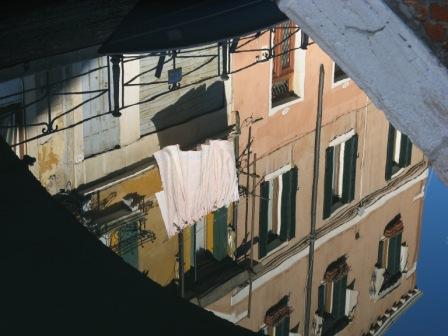
So what happens is that I am not only in love with the texture and fragrance of the socks and T-shirts as I gather them in (is that really what sunshine smells like?), I can’t resist looking at other women’s laundry.   How’s it going?   What time did she start the washing machine to have it out already at this hour?   How can one family have so many black undergarments?   This is an irrefutable sign of going bush.

Speaking of mysteries, there was a person living in the top floor corner apartment on the west side of Campazzo San Sebastian who every day hung out a man’s medium-blue dress shirt.   I became fascinated with this, not because it was happening but why.   Does he have only one?   And more to the point, where is the rest of his garb?   In ten years I never saw any other item of clothing, for man, woman, or beast, hanging out there over the street.   It almost reached the point where I was ready to ring his doorbell to find out.   But then I realized that I was enjoying  wondering  more than I would knowing.1x1.trans Laundry, one of the unsung wonders of Venice

My friend, Cristina, who has the clothes dryer, told me this: When she and her husband and twins moved into their new apartment in a very unprocessed part of Dorsoduro called Santa Marta, she accepted that as newcomers they would be under round-the-clock surveillance by the other women in the neighborhood.   Everybody pretends nothing is going on, but they  see everything.  

She  already knew that a certain type of housewife — I use the term not in a sociological but technical  sense, because here housewifery still a respected full-time occupation,  as respected as being an airplane mechanic — cadres of such women inspect  the hung-out laundry with  a  terrific list of parameters.   They draw numerous conclusions about you, your mother, your ancestors,  how many languages you speak, whether you’ve ever read Proust, not so much according to what you hang out to dry (there’s only so many items a family uses) but how you do it.  

1x1.trans Laundry, one of the unsung wonders of Venice

An excellent example of the Right Way to do it.

Socks hung out at random?   Say, colors not matching, or thrown in with the briefs or bras?   Bad.   Do you hang your husband/son/uncle’s  shirt out by the hem, or by the shoulder?   (Ditto any kind of trouser — there are two distinct schools of thought on  whether hanging them by the waistband or the leg-hems is more effective, aesthetically pleasing, appropriate, etc.   Pantyhose also falls in this category.)   Matching items grouped together in perfect sequence are what you want to aim for, as they bespeak scrupulosity, forethought, and a commitment to doing things the Right Way.   (I am not making this up.)

But Cristina happened to be  using her dryer in  those early days  and therefore not hanging out any laundry at all.   The neighbor women couldn’t stand it.  Eventually one of them stopped her on the street and asked her, point-blank, where her laundry was.   “I don’t know what they were thinking,” she told me, “like maybe we never washed….”  

1x1.trans Laundry, one of the unsung wonders of Venice

It can look just as good wet as dry.

All you need is sun, at least for a little while (we get it in our courtyard for approximately an hour), no humidity, and a certain kind of breeze — not so strong (though of course it’s gratifying to watch your laundry thrashing around outside), but steady.   Today it’s perfect, a sturdy, efficient little zephyr that has  kept going all day.   I feel such a sense of triumph when I bring in the heavy stuff, all dry, that I have to remind myself that I get absolutely no credit for either  the sun or the wind.

Daily trivia: The common word here for laundry is bucato.   This literally means “holed,” as in, having holes in it.   Not holes that it came with, holes that were caused by countless washings, which until not so long ago was still accomplished with a washboard and tub.  

More trivia:   The washboard was the perfect tool by which to teach your kid how to swim.   Generations of Venetian children learned how to swim by hanging onto their mother’s washboard.  

So all those people photographing laundry on the line might as well be photographing Neolithic rock art.   They know what it looks like, but they have no idea what it means.  

I am convinced that when the Last Trump blows on Judgment Day, there will be at least one woman in the world who is too busy hanging out socks to even hear it.

1x1.trans Laundry, one of the unsung wonders of Venice

Categories : Venetian-ness
Comments (4)
Jul
28

Those sticky little fingers

Posted by: | Comments (0)

One of the fundamental elements of Venice’s national mythology was that her government was just, equitable, and fair; that the law was equal for all, and that corruption, corner-cutting, re-interpretation of  certain inconvenient clauses, and other such variations on the theme of smashing all ten commandments, would not only not be tolerated, they should be virtually unknown.   Hence the elegant figure of Justice depicted in prominent places (including the campanile of San Marco; perhaps a little hard to appreciate from her perch atop two lions at 324 feet high, but all the more imposing for that), complete with blindfold, scales and sword.

However, human nature being what it is/was/and evermore shall be, there were occasional individuals who fell off the bandwagon.   Self-interest is a powerful force, even when it turns out that whatever you did  actually  accomplished  the opposite of your goal.    Like poaching.

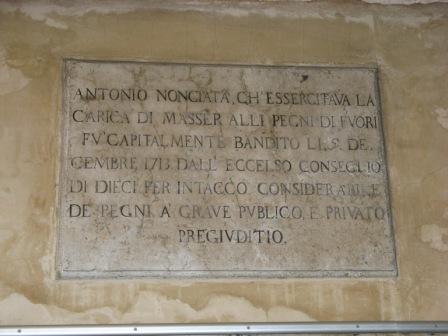
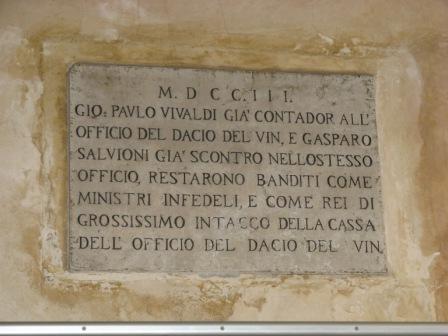
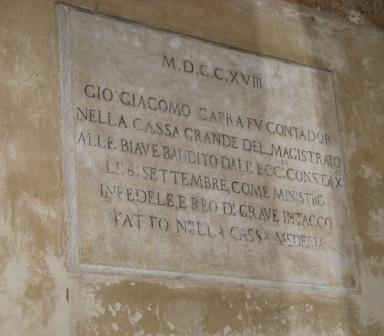
There are several plaques in the entryway to the Doge’s Palace.  I don’t know if these were their original positions; on the one hand I’d tend to think so, because certain kinds of news really needed to be made public.   That was part of the punishment, even though at the time  everybody already knew the story, but seeing it there, incised in stone, must have added to the general unpleasantness.   For the perp, I mean, not for the government (very pleased with itself) or his enemies and/or victims (glad to extremely glad).   But the wear these plaques have suffered leads me to suspect they were placed outside, exposed to the elements for a longish time, which would have increased their publicity value.

You will notice that the commandment that has been smithereened at least four times in Venetian history is #8.

I will let them  speak for themselves:

1x1.trans Those sticky little fingers

ANTONIO NONCIATA WHO EXERCISED THE OFFICE OF STEWARD OF THE EXTERNAL SECURITIES WAS CAPITALLY BANISHED DECEMBER 5, 1713 BY THE MOST EXCELLENT COUNCIL OF TEN FOR A CONSIDERABLE EMBEZZLEMENT OF THE SECURITIES TO GRAVE PUBLIC AND PRIVATE PREJUDICE.


1x1.trans Those sticky little fingers

1703 GIOVANNI PAOLO VIVALDI FORMERLY CASHIER OF THE OFFICE OF THE EXCISE OF WINE, AND GASPARO SALVIONI FORMERLY ACCOUNTANT OF THE SAME OFFICE, REMAIN BANISHED AS DISLOYAL MINISTERS AND MISDEMEANANTS FOR AN ENORMOUS EMBEZZLEMENT OF THE FUNDS OF THE OFFICE OF THE WINE EXCISE.

1x1.trans Those sticky little fingers

1718 GIOVANNI GIACOMO CAPRA WAS THE CASHIER OF THE GREAT TREASURY OF THE MAGISTRACY OF PROVENDER BANISHED BY THE MOST EXCELLENT COUNCIL OF TEN ON SEPTEMBER 6, AS A DISLOYAL MINISTER AND GUILTY OF GRAVE EMBEZZLEMENT OF ITS FUNDS.

 While we’re on the subject of Crime and Banishment,  it wasn’t as heavy a penalty as it sounds, because it almost never lasted for very long.   It certainly didn’t last forever.    Like various family fights, it often became clear after a while that it would be better for all concerned just to get on with things.   In the meantime, however, because they had been “bandito,” that is, banished, they were, in fact,  bandits.        

Provender: Otherwise known as biade, or biave.     The biavaroli sold cereals and legumes — dried beans, split peas, chickpeas, spelt, and so on — and were subject to strict public regulation, to wit: First, the members of the guild had to swear an oath that they wouldn’t cheat by putting better wheat on top of inferior moldy skanky wheat.     So far, so good.

Then, the product had to be registered before it could be sold, in the registry maintained in the public fondaco, or warehouse,  at Rialto.   The vendors were forbidden (of course, there’s nothing simpler than forbidding, but I’m just reporting here) to suggest to their retailers that they charge any price which would vary from the officially established figure.   Their shops were state property.   Those who sold wheat were forbidden to sell barley and NOBODY was allowed to keep merchandise acquired from two different suppliers.

But as we see by the plaques  above, laws and decrees are only as good as the people who carry them out.   Or not.

Before we move on, you should know that near the Doge’s Palace there was a garden; in Venetian, called a brolo.   In Italian, broglio.   Here the senators would find themselves before a vote in the Great Council, in order to do a little horse-trading with their votes.   Hence the word “imbroglio,” which has about 30 different meanings nowadays ranging from bunko and chicanery and flimflam to fraud, hoax and swindle.    These were the men who were making these dramatic decrees.

I’d like to write a book about human nature, if I could find the time.   And if I could figure out what to say.

Categories : History
Comments (0)
Jul
23

Redentor — how it went

Posted by: | Comments (1)


1x1.trans Redentor    how it went

The festival day actually started the evening before, with a huge storm.   (Everyone agreed, obviously, that it was better to have had it Friday night than Saturday night.)   It was inevitable; we’d spent the whole week under a  hot, wet woollen blanket of weather, one of those classic  mid-summer heat waves that makes you hold very  still and concentrate on breathing.

At around 7 — actually, earlier — a large swath of gray-black clouds began to draw itself across the sky and the breeze picked up, but we knew the storm would (couldn’t, in fact) hit until the tide turned.   So we were inside, around  8:00, when the first raindrops began.   Big, heavy, aggressive raindrops, smashing into the pavement one by one.   Then the rain really hit.   And then it turned to hail.    I love the hail, it hits the canal so hard the water looks like it’s boiling.   The bits of ice blew and cracked and bounced against the Venetian blinds.   And the air turned cool and we could breathe again.

Lino said, “Anybody who’s out on the water in  a boat right now is a coglion (male anatomical part which is commonly referred to when needing to  describe  a person who is a dangerous mixture of stupidity and  incompetence at a level which can  create  inconvenience or even danger to  those around him.)    This storm had been threatening since 4:00 and   Lino has very little patience with people who can’t take care of themselves on the water due to ignorance of what, to him, are the most elementary elements of    survival.   Kind of like somebody who might sit down to read “War and Peace” who wasn’t too  steady with the alphabet.  

Saturday morning, the Big Day, 8:30 AM: I went to the cut-rate supermarket behind our place to get some last-minute supplies.   I wasn’t the only person who had thought of getting a head start on the day; there were at least five people in line ahead of me.

As it happened, the late- middle-aged man in front and the attractive middle-aged woman behind me knew each other, so they were schmoozing over and around me, in a friendly sort of way.

1x1.trans Redentor    how it wentMan: “Remember when we used to decorate the boat with the frasche (small leafy tree branches), and the paper lanterns with candles in the them.   That was really beautiful.”   (The yet older man ahead of him chimed in, “Really beautiful.”)
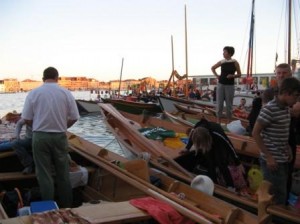
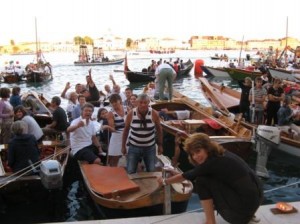
Man: “One year when we were boys we went and rented a boat to go out to watch the fireworks.”   That was still the era when the late, lamented affittabattelli were in business.   “There were about five or six of us.   And we had bought fireworks, too, which we stashed under the prow of the boat.”

1x1.trans Redentor    how it went

Tied up next to us were several sampierotas, so named because they originated in San Pietro in Volta.

The boat was something like a sampierota, whose prow is covered;   it  makes  a very useful storage place, which  is precisely why it’s made that way.   I guess you have to be a 12- or 13-year-old boy to understand the point of bringing fireworks to a fireworks display.

“Then we saw a man on the fondamenta in a tuxedo.   He asked, ‘Hey, I’m late to get to the galleggiante — can you ferry me over?”   “We said, Sure.   So he got on and sat down  on the prow.”

(“The galleggiante” literally means “floating thing,” and specifically referred to  a large heavy platform which years ago on the night of the Redentor  moved slowly around the Bacino of San Marco, festooned with lights, carrying a band playing music.   They have attempted a version of it the past two years, but I think it may have lost its true  beauty when everybody became capable of bringing their own music aboard their boats.   Or maybe it cost too much.   Remember: No ghe xe schei.)

The story continues: So the boys were rowing across from here to there and somehow  all the fireworks under the prow ignited.   Which means “exploded.”      I never heard what set them off, but once they start, that’s it.

“The man in the tuxedo had to jump in the water and swim,”  our guy continued.   “In fact, we all did.   It was like a powder magazine going up. The boat pretty much caught on fire and just kept burning.  

“It took us two years to pay off that boat,” he concluded.   “We’d go by and pay the boat-renter 5 franchi, 10 franchi, whatever we had.”

What did your parents say? I had to ask.

“Oh we never told our parents,” he answered.  

This was a fantastic start to my day.

The rest of the festa went pretty much as anticipated:  

1x1.trans Redentor    how it went

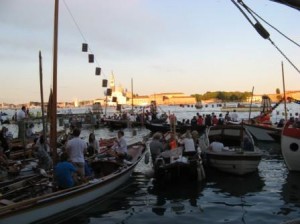
Our own little ship of fools, ready to party down.

Beauty.   Merriment.   Friends — some 14 of them, assorted.  Food: the strictly traditional bigoli in salsa (whole-wheat spaghetti with anchovy sauce), sarde in saor (fried sardines in sweet-sour onion sauce), and bovoleti (tiny snails in oil and garlic).   Some non-traditional meatballs, too.   Lots of wine.   And shortly before the fireworks began, we slaughtered the watermelon — there must be watermelon, it’s non-negotiable.    The next morning  you can still see shards of watermelon rind floating around.  

The fireworks started 15 minutes late.   This put a serious brake on the merriment, which is emotionally calibrated to the start of the uproar.   At least I personally am so calibrated.    Fifteen minutes is too long to keep your anticipation at its peak, especially if it’s practically midnight.  

1x1.trans Redentor    how it went

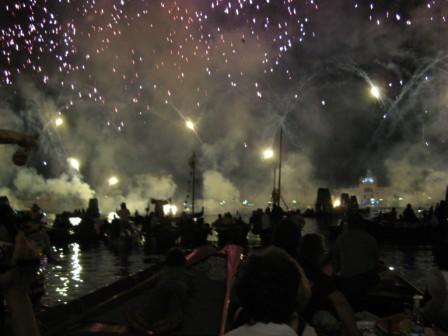
One of the most beautiful things about the spectacle isn't the fireworks themselves, but the panorama of all the boats on the still water, and all the silent people looking upward in the bursts of light, entranced, like the animals who come out of the forest when they hear the magic flute.

I will say that while there are no bad fireworks, there are those which are great and those which aren’t.   These were not great.   The Gazzettino reported the next day that they were “probably the best there had ever been,” which is preposterous.   Last year they were the best that there had ever been, and ever will be.   This year we had lag, and long pauses, and repetitions.   I can say they were louder than usual, but I don’t give points for loud.     The hailstorm the night before was much more exciting.

We rowed the caorlina back across the dark lagoon, as other homeward-bound boats chugged past us.   Put the boat away,  policed up the campground, so to speak (many bottles and other detritus to dispose of), and then home.   Which on the Lido means waiting for the night bus, which is not frequent, and then the night vaporetto, ditto.

It was a fine Redentor, but I wouldn’t put it up in my top five, if anyone is keeping  score.   Apart from last year, the only other truly unforgettable one was the year we heard that a friend of ours had just  ”come off,” as climbers put it, a mountain in the Dolomites the afternoon of the  Redentore.   I’ll never forget  sitting in our little mascareta that night, not eating,  the fireworks all blurry, throat hurting.    Poor Giorgio.   I think of him every year.  

1x1.trans Redentor    how it went

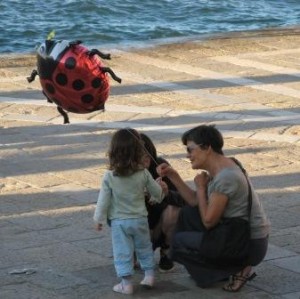
The doge's vow didn't mention anything about balloons, but it's obvious that without them this would be a pretty puny festa.

But the next day happiness reigns once again, as the sun pours itself all over the city and down on the three afternoon regatas, and the stands in front of the church  selling balloons and candies in alarming colors, and then the solemn mass and blessing of the city by the patriarch.

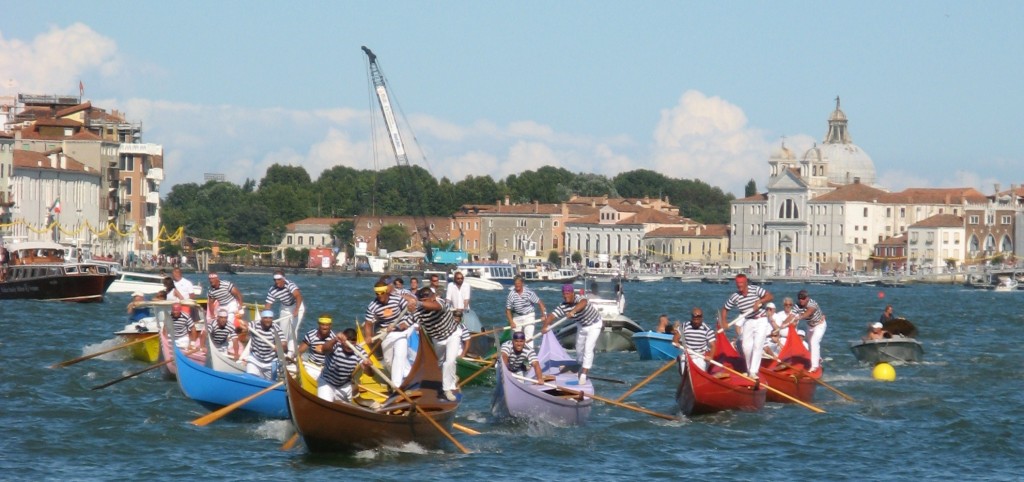
1x1.trans Redentor    how it wentOf the three races, the One that Counts is the third: gondolas raced by pairs of men.   Back in the barely rememberable past the racers were all men who were not exactly athletes; in fact, the broad sash each rower wears (matching the color of his boat) originally functioned as a sort of truss, I think you’d have to say.   Nowadays the competitors train in a seriously   focused way, and so instead of having a race in which the battle lasts for the first five minutes, and then everyone just stays where he is till the finish, as it once was, now you have battles to the death all the way through.   Especially between two specific pairs of men whose rivalry has reached a level not far from blood feud.   I refer here to the brown gondola (Ivo Redolfi Tezzat and Giampaolo D’Este) and the yellow (Rudi and Igor Vignotto).
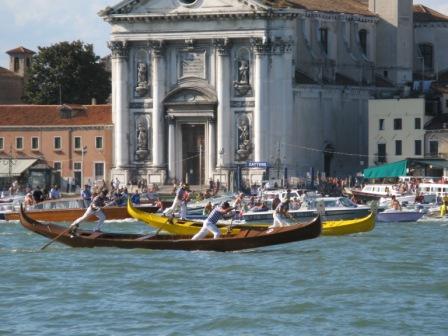
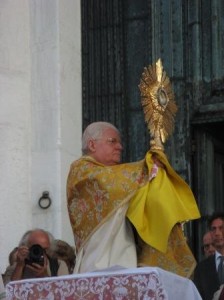
1x1.trans Redentor    how it went

Two minutes till the finish and any joking is over. (The brown boat won.) (Unfortunately.)

The patriarchal  blessing   is bestowed on the city  from an ecclesiastical station assembled at the entrance to the church of the Redentore.   The current patriarch, Angelo Cardinal Scola, seems to like the vantage point.     But there are plenty who remember other patriarchs of Venice, who were also cardinals, then popes, then saints, who did it differently.  

Both Pope John 23rd (“Papa Roncalli”) 1x1.trans Redentor    how it wentand Pope John Paul 1st (“Papa Luciani”), when this was their humble parish task, took the ciborium containing the consecrated Host and walked to the middle of the votive bridge and intoned the benediction first facing the San Marco side, then turning and facing upstream.   One can debate the various merits of each approach if one wishes.   One can debate anything, but the old way was more beautiful and more appropriate.   I have spoken.

Categories : Boatworld, Events, Food, History
Comments (1)

One of my friends was telling me about what was probably  his favorite Redentor, and it had nothing to do with the fireworks.  

1x1.trans Redentor    redemption by fireworks

The church of the Most Holy Redeemer and the votive bridge stretching across the Giudecca Canal.

“Redentor” means “redeemer” in Venetian.     (“Redentore” in Italian.)    But what it really means is one of the great all-time festivals still walking the earth, and while the sacred day is always the third Sunday in July, the mega-party is the  night before.

The third Saturday  in July, therefore, is what history has come to know as “la note famosissima,” the most famous night, and this  celebration has been made every year since 1577.      Boats!   Food!   Fireworks!   But behind all the festivity is a black and horrific story.

On June 25, 1575, someone in the parish of S. Marziale died of plague.   Not uncommon in Venice, it being a major seaport, and some epidemics had already been terrible.   In this case, the infected rat, so to speak, was later identified as having been a man from Trento who was visiting a certain Vincenzo Franceschini.   In a little less than two years, 51,000 people (some accounts say 70,000) had died, more than one-third of the entire population.   It was a hecatomb.

In that era pestilence was regarded as a form of divine punishment, so on September 21, 1576 — after having spent a year watching their city begin to disappear before their eyes — the Venetian Senate approved the proposal of doge Alvise I Mocenigo to make a solemn vow: If the Lord God Almighty would remove this scourge from them, they would build a church ” which their descendants would solemnly visit…in perpetual memory of the blessing received.”  

When you study this phrase,  you grasp that they weren’t merely promising a church, which the Lord presumably already had plenty of, though another one is always nice, but eternal gratitude expressed in a tangible way forever.   That’s different.

The church — more correctly termed a votive temple — would be dedicated to the Most Holy Redeemer, and would be built on the Giudecca.   The commission was given to Andrea di Pietro della Gondola, otherwise known as Palladio, who was the chief architect in the service of the Republic, and the seriousness of their intention was shown by laying the first stone on May 3, 1577, when the plague was still raging.     They had made a vow and they were going to stick to it.

Only a few months later, on the third Sunday of July, doge Sebastiano Venier declared the city free of plague.     A temporary wooden church was hastily constructed for the celebrations, and a bridge was laid across a line of boats stretching across the Giudecca Canal — like the one today, it was roughly 1,082 feet long.     This bridge enabled the doge and the Senate to arrive in solemn procession at the church for the big ceremony.

And so it has gone, every year since 1577, and every doge and mayor has been there with the exception of doge Leonardo Dona’ in 1612.   He snubbed the ritual because the city was mad at him and I gather he shared the sentiment, but staying away didn’t help him much because then people started going  around saying, “The day’s going to come when he’d like to go to church, and he won’t be able to.”   It makes an annoying little rhyme in Italian.   He was an amazing doge, actually; I’m sorry they couldn’t all get along.

1x1.trans Redentor    redemption by fireworks

Temporary pilings anchor the votive bridge.

I myself wouldn’t consider it Redentor without walking across the bridge at least once.   They’re working to get it finished even as I write.      Not many days left.   Seeing the bridge slowly take form (after boats, they switched to pontoons, and a few years ago a new system was adopted by which the sections are impaled on pilings) adds a great deal to the sense of anticipation.  

The bridge is officially opened with a modest ceremony at 7:00 PM on Saturday, and closed at 10:00 PM on Sunday.   The life-span of a fruit fly, essentially, which makes it all the better.  

Back to that favorite episode of this epic-yet-homely  tradition.   It  took place somewhere  back in time, because he went to Nino at  Campo San Boldo  to rent a boat.   There are no more affittabatelli (boat-renters)  in Venice, but when he was a lad, and even up till  the Sixties, the city was full of places where you could rent a Venetian boat — sandolo, mascareta, caorlina, even a peata — for whatever task was at hand, something like the Zipcar of its time.  

1x1.trans Redentor    redemption by fireworksSo he rented a batela a coa de gambaro (“shrimp-tail boat”), which is the second clue that we’re in the fairly distant past, because now there is only one, which I occasionally see being rowed around by two girls.   Lino says it was made by the legendary late boatbuilder “Nino” Giupponi, who devised the framework by studying a painting, perhaps by Canaletto, who was great with boats.    In any case, it’s not like the original  ones.   For one thing, it’s smaller, which you can well believe if the group in question numbered more than ten.

Then he and his friends constructed the customary framework to support a kind of temporary roof made of assorted branches.   And they strung the usual paper lanterns along it.   The lanterns swing and bob  with the motion of the boat in a very cheerful way.

1x1.trans Redentor    redemption by fireworks

Twilight is almost the best moment of all, with the church of San Giorgio in the background.

Then they set up a table in the middle of the boat, the ladies brought the food, and of course wine, and they were good to go.    

The evening took its usual course, which it will also take this year: You row (or motor)  in your boat to whatever spot looks good to you, as long as it  generally corresponds to the official map which divides areas according to the size of the boat.   The Venetian boats (those which are rowed, I mean)  have been awarded a spot near the Punta della Dogana, where we all cluster together in our own little world.  

1x1.trans Redentor    redemption by fireworks

Yo'd be amazed how many boats can fit into the colored spaces. The important thing is not to get too close to the fireworks barges. The police and firemen are out patrolling; they'll be sure to tell you if you're too close.

As you see, an open space of about 650 feet is maintained around the fireworks-laden barges.   You throw the anchor, or tie up to another boat.   The aquatic pilgrimage begins in the early afternoon, as big fishing boats from down-lagoon places like Pellestrina and Chioggia chug in, loaded like third-world ferries with hordes of people who have clearly made the most of their time in transit getting started on the party.

We go out around 6:00, row across the lagoon from the Lido. and about 7:00 we  get to the Punta della Dogana (Customs-House Point, the tip of Dorsoduro where the Grand and Giudecca Canals meet).   We tie up and pull out the vittles.

You eat, you drink — some people swim, because it’s usually pretty hot — eat,  drink, and repeat as necessary.   1x1.trans Redentor    redemption by fireworksYou laugh and sing, if you’re in the mood, or if somebody near you starts it.   You wave to your friends and call out remarks.     This goes on for hours.

At 11:30 PM, when you’ve been out long enough for an evening chill to begin to suggest itself and sleep is washing up against you like the water around the boat, the fireworks start.   Some years they’re great, some years they’re actually kind of boring; last year they were astonishingly gorgeous, brilliant, dazzling; they were so thrilling  that they actually brought tears to my eyes.  

Good or otherwise, they  explode overhead for a solid half-hour.   That may not sound like much,  but it’s  the visual equivalent of an opera by Wagner.   It just goes on and on.     1x1.trans Redentor    redemption by fireworksAt the stroke of midnight  the holy day begins, which means the party’s  over,  the bar’s closed, go home.   Which we do.   Carefully.   Because when thousands of boats operated by people who have been eating and drinking for hours (or maybe not so much eating) start to move around in the dark, occasionally faster than they need to, it can be tricky.  

So the shrimp-tail boat was ready and so was everybody else.   “Me and the family, and some friends — there were 13 of us, including the  parish priest and his brother.”  

“After the fireworks,  we rowed to the Lido and went swimming.”   (Technically, this also is part of the tradition, but not many people still do it anymore.)   Of course it was great, except that “You never get dry after you swim in the sea at night.”

“Then along toward dawn we began to head home.   I remember it as if it were now — the guys would alternate to  row in the prow, I was rowing astern, and by now we   all groggy” (he closes his eyes almost all the way and mimics languid, somnolent rowing, as if each stroke is the last one before you stop completely).  

“All the women and kids and everybody was sprawled all over the table, their heads on their arms, sleeping, or dozing, anyway.    A few were sort of singing a little bit under their breath.   The tide was coming in, and as the sun came up we just sort of drifted back to the city.”

By now I’ve heard this story fairly often, usually in July.   It’s one of a number of his reminiscences that I  love to hear  just as much as I did the first time around.     It’s not only because it’s such a beautiful scene and I wish I’d been there, but because every time he tells it, he looks really happy.

He occasionally also refers to the way Redentore was in general, when he was a boy.   And this account does not make him look happy, because like so many things here, what once was almost completely Venetian has mainly become just another thing to lure the tourists.

First of all, when he was a   boy the fireworks weren’t over the Bacino of San Marco, but upstream, over the Giudecca Canal, near San Basilio.   Up in the nabe, where people lived, as it were.    And it seemed like everybody came out in their boat (as per today) but “everybody” meant 3/4 of Venice, which meant 3/4 of the people you knew.  Now most of the boats are big motorized vehicles with people from somewhere else, back in the hinterland.  

“You could walk across the Giudecca Canal on the boats,” he told me.   When the fireworks were shifted downstream, that was the first sign that Something had Changed.   And change, here, is usually away from something that’s fine the way it is and toward, well, Something Else.

As for the songs and the food that are both optional and required for this event, I’ll tell you about those next week, when I recover.

Categories : Boatworld, Events, History
Comments (0)
Jul
13

Demanding dolls

Posted by: | Comments (2)

One of the things I love about our neighborhood is that there are children here.   Lots and lots of them, of every size and attitude.   Shoals of them, migrating herds of them, like the wildebeest on the Serengeti.  

If you walk down Via Garibaldi at around 6 on a summer evening, you will realize that this is one corner of Italy in which the word “birthrate” isn’t associated with “falling.”

But  an unusually perceptive person would already have known all  that from the scene  I noticed  outside one of the tobacco/candy/lottery ticket/toy stores  here.

1x1.trans Demanding dolls

What these three alarmingly pink doll-size strollers  reveal is:

  • That there are little girls living nearby.  
  • That there are lots of them, enough  to create an important market for toys, especially those  designed for  little girls, a market that requires  serious  inventory.
  • That  they are extremely demanding customers, who require choice in the products they insist their relatives buy them, whichever relative has recently shown a weak spot that can be exploited.
  • That  any color is good, as long as it’s  pink.  

I hope I’m here when they grow up, I really want to see how they dress.

1x1.trans Demanding dolls
Categories : Venetian-ness
Comments (2)