Archive for Venetian-ness
Papal visit leads to gondolier smackdown
Posted by: | CommentsPerhaps your local gazette hasn’t mentioned it yet, but Pope Benedict XVI is planning a big trip soon. He’ll be touring Northeast Italy, and will be in or around Venice on May 7 and 8.

"King Henri III of France visiting Venice in 1574, escorted by Doge Alvise Mocenigo and met by the Patriarch Giovanni Trevisan," by Andrea Micheli "Vicentino." This is the kind of welcome everyone had come to expect.
Venice has a long and prodigious history of state visits — King Henry III of France and Poland, in 1574, was one of the more famous guests, just one of a seemingly infinite procession of princes, ambassadors, potentates, emperors and, of course, popes coming to see the sights, visit the doge, and usually ask for some favor, like money or soldiers. Reading the list of deluxe visitors over the centuries gives the impression that the main business of Venice was hosting foreign notables, while other activities such as running an empire filled the random empty moments, kind of like a hobby.
Yet His Imminence has aroused not only joy and excitement among the faithful, but tension and recrimination and a series of increasingly regrettable remarks among the city’s gondoliers concerning who is going to get to row him the approximately five minutes it takes to row from San Marco to the church of the Salute, and in what boat. By a mystic coincidence, gondoliers are also known as pope (POH-peh), because they row on the stern (poppa) of the gondola. I have no idea what this might portend.

"The reception of Cardinal Cesar d'Estrees 1726," by Luca Carlevaris. Just all part of a normal day.
Don’t suppose that the battle to transport the pontiff is any particular evidence that gondoliers are so pious. A pious gondolier would be a distant cousin to a pious illegal-clam fisherman, or a pious doctor of a cycling champion. I’m not saying it’s impossible, just kind of unusual. But they do like to be the center of attention and, in fact, they’re used to being regarded as some sort of star. At least to the damsels they may be so fortunate as to row around the canals.
Popes aren’t supposed to cause dissension, they’re supposed to resolve it. But Benedict has unwittingly set off a sort of collective seizure.

Pope John Paul II being rowed in the city's balotina by four "re del remo" in 1985; high astern is the legendary Gigio "Strigheta."
First: Luciano Pelliccioli, vice-president of the gondola station heads (and a gondolier) offered to join Aldo Reato, president of the gondola station heads (and a gondolier) to row His Sanctity in Luciano’s extremely elaborate and glamorous gondola.
No!! The cry went up. Why should those two men profit by their position and crowd out equally (I mean, more) deserving gondoliers? Why, indeed?
Furthermore!! Champion racer Roberto Busetto, never at a loss for an opinion (he isn’t a gondolier, but that’s a detail), objected on the grounds that if Luciano should ever think of selling his gondola, he could easily make a huge profit by marketing it as the gondola that had carried the pope. Busetto gets five bonus points for crassness, though that doesn’t mean he’s wrong.
Anyway, Luciano withdrew his offer of his gondola and himself. Reato also withdrew, but the incessant calls have continued. There are 425 gondoliers and by now probably each of the remaining 423 has called him at least once. Some of them have fantastic reasons to be chosen: “Padre Pio came to me in a dream and said you should pick me,” said one. Another person suggested Giorgia Boscolo, the first woman gondolier. That idea burnt up on reentry into reality.
Then somebody suggested the “Strigheta” brothers, Franco and Bruno, sons and heirs (and gondoliers) of one of the greatest racers/gondoliers of all time, Albino “Gigio” Dei Rossi, known as “Strigheta.” (He rowed not only one, but four popes in his day.) They’re loaded with credentials and nobody hates them, which helps.
Then somebody suggested a four-rower gondola, rowed by the current racing champions, the Vignottini and D’Este and Tezzat. I think the idea was that rowing the pope could somehow magically bring peace to these two savagely feuding pairs, though somebody else opined that it wasn’t appropriate to expect the Holy Father to resolve every little neighborhood squabble. In any case, the four men have declared their willingness to row the Pontifex Maximus together, which is already a big step forward.
Then somebody asked: Why should it be a gondola? Excellent question, considering that the city of Venice owns a more capacious gondola-type boat called a balotina, on which Pope John Paul II was borne along the Grand Canal in 1985.
Then some daring person suggested using the “disdotona,” or 18-oar gondola, which belongs to the Querini rowing club, and which in my opinion is not only the most spectacular boat in the city, by far, but would provide 18 men the chance to Row for Holiness.
Naturally, this idea got nowhere, because nobody thought one club should be given preference over another. We’ve all got great boats, the thinking goes — why them and not us?

Even when it's not doing anything, the "disdotona" is impressive. I think the pope would look splendid seated in the bow, what with the velvet drapery trailing in the water and all.
I’m surprised nobody has yet suggested using the “Serenissima,” the huge decorated bissona with a raised stern, making the pope easy to see plus providing space for his entourage and some trumpeters, if that seemed appropriate. But so far no mention of this little coracle.
Which brought up the next question: Why should the rowers be gondoliers? Another useful point. In the olden days, a visiting potentate — such as John Paul II — would be rowed by the necessary number of “re del remo,” men who had won the Regata Storica five years in succession. There aren’t many of them, because it’s fiendishly hard to do. That would instantly reduce the number of candidates to something manageable.
And by now there has been at least one practical joke. Someone purporting to be Aldo Reato (president of the gondola station heads) called the Gazzettino and said the matter had been settled: Luciano’s fancy gondola was going to be used after all, rowed by Franco Girardello, a retired gondolier who goes by the nickname “Magna e dormi” (eat and sleep). This fantasy was quickly dispelled by all concerned except the anonymous prankster.
The most recent bulletin is that the matter will be put to a secret vote among the gondoliers. The mind rather reels. Busetto thinks the papal gondola is going to cost the moon at resale? How much is a gondolier’s vote going to be worth, at this point? No checks, no credit cards.
Comments from bemused readers of the Gazzettino run from “The pope doesn’t care who rows him” to “What a farce” to”Actually, Padre Pio came to ME in a dream and said I should do it.”
A certain Riccardo made the following suggestion:
“Requirements for candidacy:
Never to have blasphemed; Never to have used foul language; Never to have spoken in a coarse tone of voice. In the case of more than one valid candidate (doubtful), preference will be given to the one who has a good knowledge of the principles of Catholicism, and/or who has read at least one of the 16 chapters of the Gospel of St. Mark, patron saint of our city.”
This pastoral visit has been in the planning stages for at least three months — probably more — and yet here we are, at the last minute, dealing with the frenzied bleating of the flock.
Meaning no disrespect, I think it would have been better for everybody if they had given a crash course in rowing to a Rastafarian and a dervish. I can’t think of a gondolier who could possibly be cooler than that.
Easter in Venice breathing down our necks
Posted by: | Comments
However you may have been observing the past six weeks of penitence, Easter is now steaming into port with the pilot onboard and will be here in three days.
Special Spring Bonus: Click here (11042001) if you would like to hear a small soundtrack of the blackbird chorus outside the window every morning before dawn.
Older Venetians remember a bit of rhyming versification which highlighted each Sunday of Lent by attaching it to one of the miracles of Jesus.
I have no information whatever on how this started, who came up with it, or anything else other than its now-fading existence. By doing some random research (fancy way of saying “asking around”), I discover that children are no longer taught this bit of lore. In fact, so far I haven’t been able to nab anyone of any age in this neighborhood who’s ever heard of it, so perhaps it’s a relic of life in long-ago Dorsoduro.
Therefore this missive may be one of the few places to acknowledge this fragment of tradition before the last traces are gone.
It goes like this: Uta, Muta, Cananela/Pane e Pesce, Lazarela/ Oliva/Pasqua Fioriva.
It is pronounced: OO-ta, MOO-ta, Canna-NAY-a/ PAN-eh eh PEH-sheh, YA-za-RAY-ah/oh-YEE-va/PAS-kwa fyoh-REE-va.
The significance of these gnomic utterances is as follows:
Uta: I don’t know. This is a bad start, but I am still researching this curious word by means of any elderly Venetians and/or priests I can find. It hasn’t been easy, which only proves that this verseology is on its last legs. Perhaps “uta” refers to one of the many healing miracles: bleeding, or blindness, or demon-possession, or paralysis, or dropsy. You can take your pick until further notice.
Muta: The healing of the man mute from birth (Mark 7: 31-37).
Cananela: My sainted sister-in-law (age 82) maintains that this refers to the meeting of Jesus with the Samaritan woman at Jacob’s well (John 4: 4-26). She is very firm on that, even though it wasn’t technically a miracle, but seeing as the reading for the Third Sunday is, in fact, that passage, I think we can consider the matter settled.
Pane e Pesce: “Bread and fish,” clearly a reference to the Feeding of the Multitude (Matthew 14: 13-21; Mark 6: 31-44; Luke 9: 10-17; John 6: 5-15; Mark 8: 1-9; Matthew 15: 32-39).
Lazarela: The resurrection of Lazarus (John 11: 1-46). Makes a nice rhyme. Also worth remembering for its own self.

The raising of Lazarus, in a mosaic of the basilica of Sant' Apollinare Nuovo in Ravenna (6th c. AD).
Oliva: “Olive.” Although here, as in many other places, they call the Sunday before Easter “Palm Sunday” (Mark 11: 1-11; Matthew 21: 1-11; Luke 19: 28-44; John 12: 12-19), or “Domenica delle Palme,” the fronds distributed in church aren’t palm, but olive. This is very lovely, considering the ancient link between the olive branch and peace, and the various Gospel accounts only agree on the fact that clothes were spread on the ground before Jesus’ feet. Obviously nobody has ever thought of calling it “Clothes Sunday,” so I’m just going to leave that alone. We get olive twigs, take it or leave it. In Latvia they use pussy willows.

At the entrance to the church of San Francesco di Paola (as in most, if not all, the other churches here), olive branches are set out in two forms: wild and natural, or small and packaged. One keeps the branch till next Palm Sunday; in the old days, to treat a really serious wound or illness you would have burned the branch and used the ashes as prescribed by your neighborhood wonderworker.
A bit of meteorological magic holds that “Se piove sulle olive/ Non piove sui vovi” (If it rains on the olives, it won’t rain on the eggs). Meaning that if it rains on Palm (excuse me, Olive) Sunday, it won’t rain on Easter. Much as it distresses me to give any credence to this sort of thing, I have seen it turn out to be true something like 95 percent of the time. I can’t explain it.

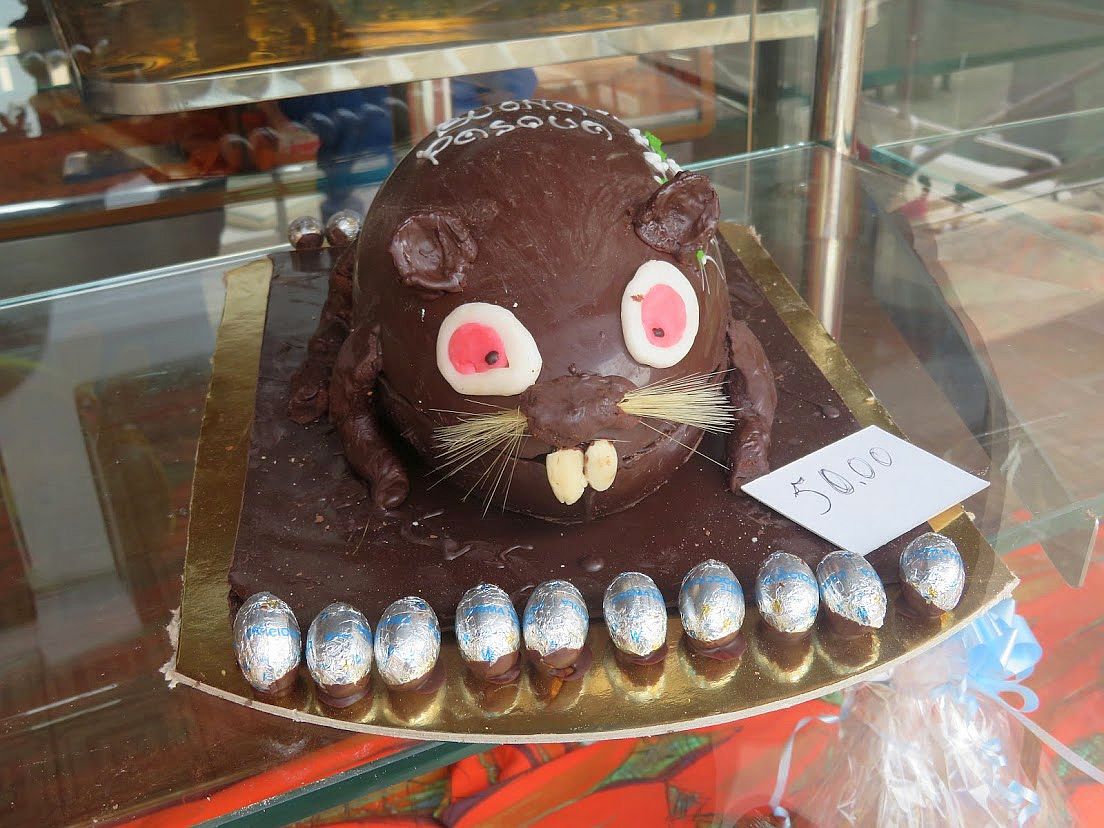
Our neighborhood is a veritable Easter menagerie. Here, an existentialist Easter bunny who looks apprehensive and somehow estranged from his fellow furry harbingers.

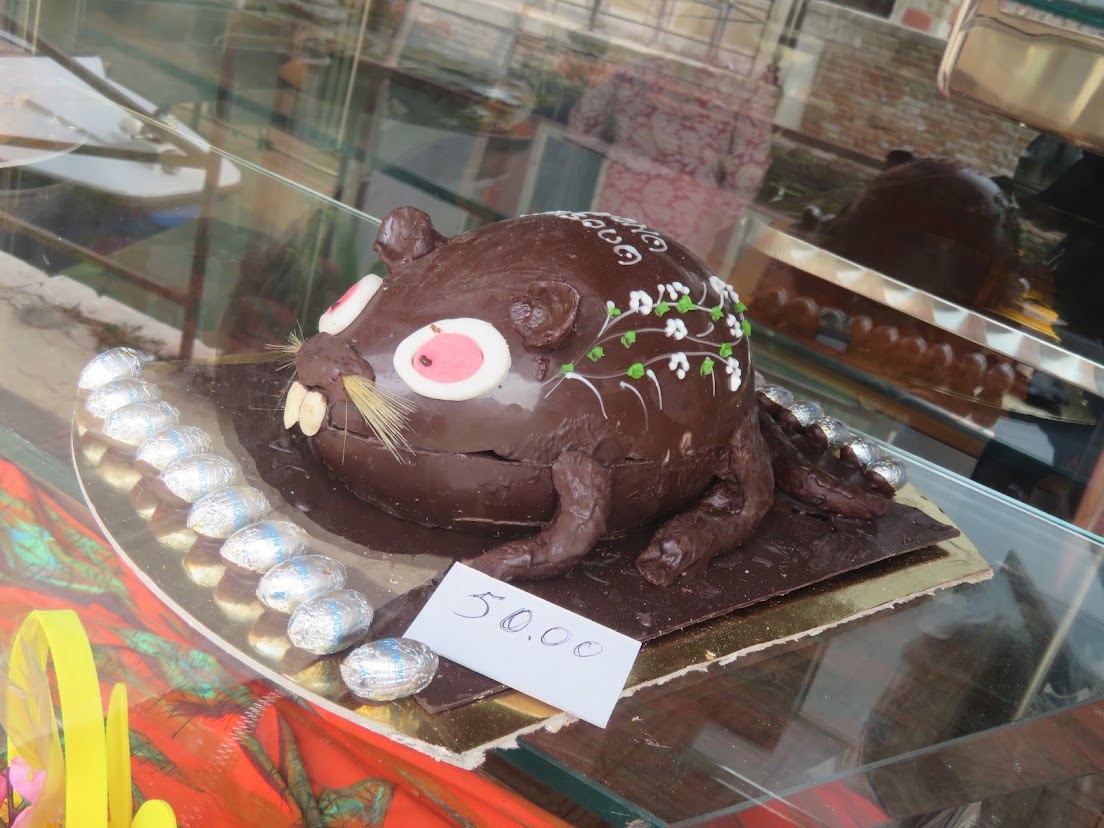
Children nowadays don't know how lucky they are. When I was a kid, Easter frogs hadn't been invented. I think frogs themselves hadn't been invented.

I discern a link between milk chocolate and an Easter cow. But what is an Easter squirrel bringing to the table? Easter acorns?

I wonder how many Venetian children risk being traumatized by devil-spawn Persian-green rabbits clutching their tiny progeny?

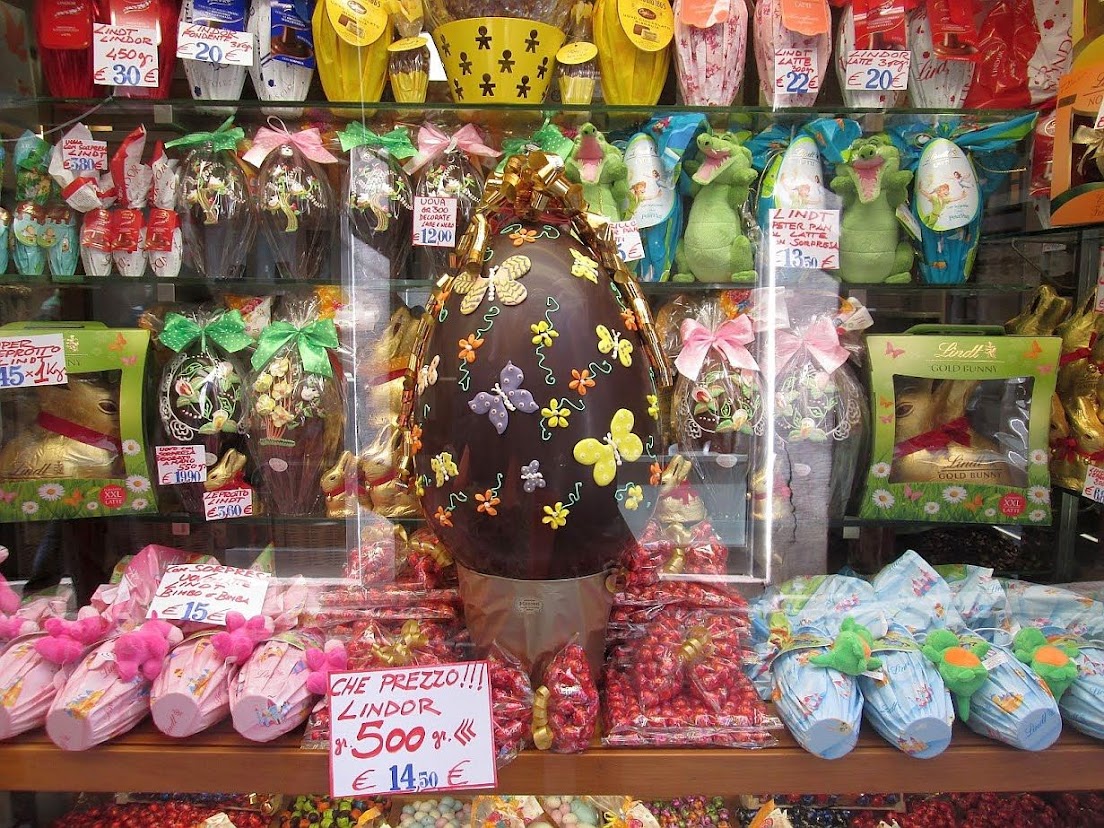
Let's get back to something we can all agree on: Chocolate. And no squabbling over "dark" versus "milk." The Ur-hen is ambidextrous. Anyway, there are enough sugar-flowers here to send everybody into shock.
Venetian papa who?
Posted by: | CommentsEven if you were to speak Venetian, you may have occasionally overheard an expression being used that expressed almost nothing to you:
“No ti xe gnanca sangue da papalina.” (No tee zeh NYANG-ka sang-way da papa-EE-na.)
It literally means “You (or he, or they) don’t have even as much blood as a papalina.” It figuratively means, “There’s essentially no connection between us” — referring to relatives who are along the line of being a second cousin twice removed of the aunt of your stepsister. The underlying concept is that a papalina is so small that it contains perhaps two drops of blood, if that much.
So what, I hear you cry, is a papalina?
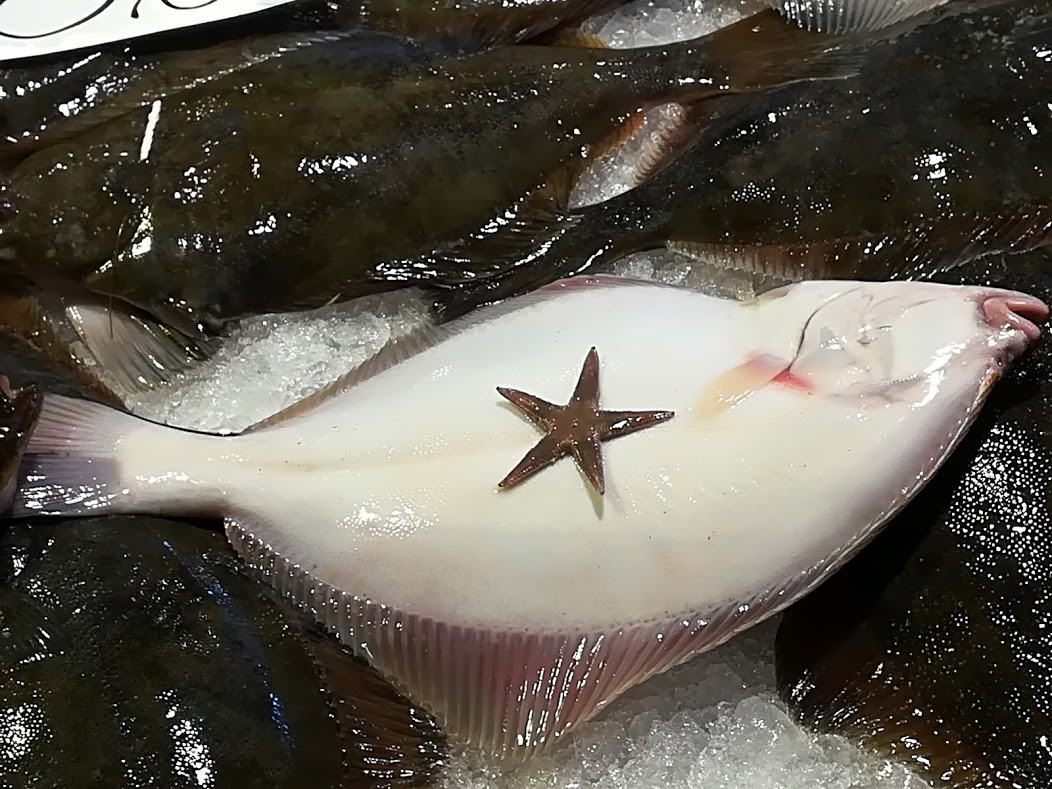
It’s a fish. It’s a member of the sardine family, and in English it’s called a sprat. If you like sardines (fresh, I mean, not canned), you will almost certainly love its modest but abundant little relative, if you can find it.
Because now that so many people have switched from the finny food of their childhoods to the fancy fins of today, it’s not easy to find papaline (the plural) in the fish market. They might occasionally be lying there on some intrepid vendor’s long icy counter, between their more glamorous cousins, the bigger sardines and the smaller sardoni, or anchovies. And besides being good, and good for you, they’re delightfully inexpensive. Mainly because hardly anybody wants them.
I’m writing this today because Lino’s quest was rewarded yesterday and he came home with a pound of the little critters. Lunch that day was an unprogrammed gorgefest.

These are papaline. Each is about three inches long and provides two enthusiastic mouthfuls. In our case, very enthusiastic.
There is only one truly correct way to eat them, and that is grilled. (You can do whatever you want, obviously — I’m just telling you.) And not merely grilled — you must eat them when they come right off the grill. Or, as the Venetians say, “a scotadeo” (ah scotta-DAY-oh). Literally “burning your fingers.”
Funny, they don’t say “scorching your tongue” or “searing your lips.” Venetians obviously reject the Japanese concept that if it’s too hot to hold (they’re referring to a cup of tea), it’s too hot to eat.
Unfortunately, the only place you’re ever likely to have the chance to incinerate your fingerprints will be at somebody’s house, or a picnic/party of some kind. You might find a few thrown anonymously into a mixed fishfry or even platter of mixed grilled fish at a restaurant. But it’s Not the Same.
There’s another comment which invokes this member of the Clupeidae family. It’s something only Lino says, and it comes from his heart: “You grew up eating papaline.”
He will utter this in an accusing way to the air as we pass the guilty individual. Sometimes he goes on, “You’ve forgotten when your nose ran all the time and you wiped it on your sleeve because you didn’t have a handkerchief.” Lino still sees some of this category of person around the neighborhood. “We were kids together,” Lino will tell me. “Now they’re eating LOBSTER and SOLE. But what can you say? They grew up eating papaline.”
He says this with a delicate blend of disdain and regret, because whoever he may be referring to has progressed far — too far — beyond his or her hardscrabble childhood, a life in which cheap fish and several tons of polenta were about all there was to keep you going till tomorrow.
Forgetting when you ate papaline means you’ve abandoned your roots, gotten above yourself, become mutton dressed as lamb. Rejecting papaline is the tertiary stage of voluntarily transforming yourself into something that may be real, but it’s phony. Kind of like Formica that looks like wood. It doesn’t have anything to do with how you dress, because there are plenty of people even in this neighborhood who have banished as many tokens of their past as they can. Their wives even have coats of some kind of fur. So it’s not about appearances, essentially, but attitude.
You get a pass because you never ate them in the first place, so you’re okay But if you should ever have the chance, I advise you to take it. Because in their own little way, the papaline are another Disappearing Venetian, like the itinerant knife-and-scissors grinder.
But tasting better.
Sensing Venice: Smell
Posted by: | Comments(To anyone who has just read the previous version, I apologize for sending it out before it was ready. You will have noticed its ragged edges. This is the version you’re supposed to read; please forget the other.)
I know what you’re thinking. You’re thinking of what immediately precedes a flushing sound.

This is a trick photo because it only looks like something that ought to smell. But it doesn't, or at least not much, and definitely not the way you probably expect. I just wanted to set the mood.

The tube leads to a "honey-boat," which carries the material to the water-treatment plant. This smell is one of the few things I've never heard somebody complain about. If they're past 60, they may be remembering how home sanitation worked when they were children, which was a lot more direct.
Furthermore, I invite you to consider some of the daily smells in your average mainland city: The perfume of imperfectly combusted diesel wafting from buses waiting at traffic lights, for instance, or your overflowing dumpster under the sun. I’m not saying I prefer the stench of sewage – there, I said it – I’m just saying there is no city that smells entirely of lavender potpourri.
And another thing. Before someone Beyond the Bridge starts imagining what the objectionable smells might be out here, they ought to include in that list the much more frequent AND PREVENTABLE odor that too many people — tourists or otherwise — emit from their underarms on crowded vaporettos and buses in the summer. The fact that many of them (usually men, sorry) are clinging for support to something overhead just makes it worse. Often their shirts have no sleeves.
Continuing our sensual tour of Venice — or, as I think of it, enjoying Venice with your eyes closed — I’m going to state that smell may well be the sense that gives me the most pleasure here. A random walk with your nose attuned will almost certainly awaken you to either an activity, or a product, or a season, or a plant, or something defying categorization that is something that makes Venice beautiful.
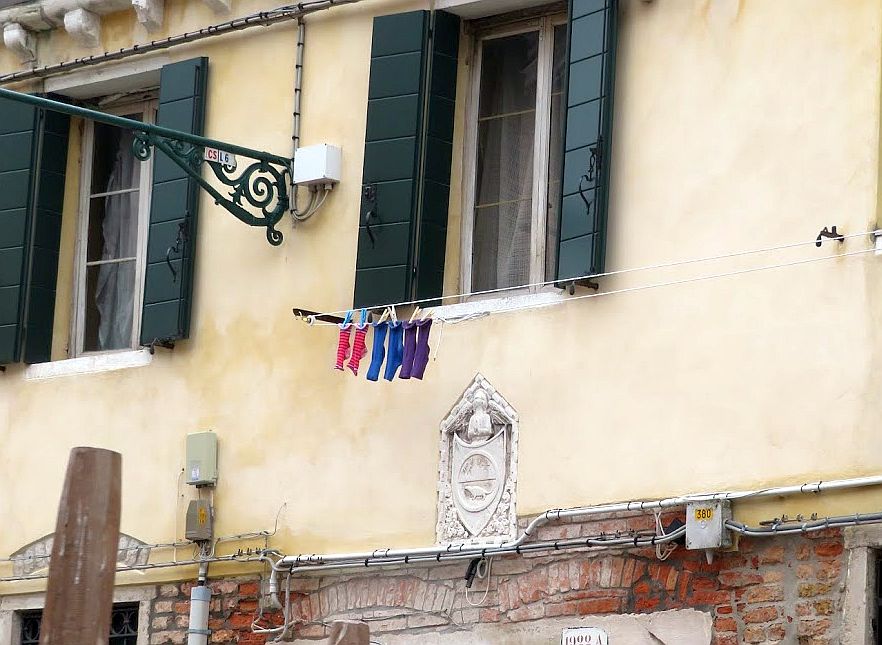
Clean laundry. I realize that anyone just walking around the city isn’t likely to be able to inhale this exquisite aroma (though one blithe spirit in Cannaregio was recently discovered at night stealing somebody’s laundry off the line, for reasons that were never very clear.) But if you are here in the summer and in a position to wash some piece of fabric and hang it out to dry, you’ll have the pleasure of inhaling the air of Venice toasted by the sun. There is no product you can put in a clothes dryer that could ever match the perfume created by the sun and the breeze, not even if it were something labeled “Venetian Sun and Breeze.”
Yes, it’s tiresome to have to calculate the time needed to dry your clothes outside on the line, especially because that time may not be quite enough to get the job done. Then you have a little psychological struggle to decide whether that sheet is really dry, or if you just wish, really hard, that it were, because it has to be. But those are details. This is one of the best smells in the world and I suppose one of the few Venetian ones you could replicate wherever you live, if your neighbors didn’t care, which they probably do.

One excellent reason to go out for a walk before dawn is to be able, in certain streets, to smell the bread coming out of the oven.
Fresh bread. If you have never, or not for a long time, walked into or past a bakery really early in the morning, when large batches of bread have just been taken out of the ovens, you might think that this is just another aroma, one of those few that humans are able to detect. (Bloodhounds, if you care, have noses that are ten- to one hundred million times more sensitive than a human’s. And bears are seven times more sensitive than bloodhounds. Just to give some perspective.) Is it the yeast? The flour? The profound need of nourishment that our primitive organism requires? Warm bread. The limbic system rejoices even if you don’t happen to be hungry.
There are 33 streets in Venice either named “baker,” “bakery” or “bakeries” (forner, forno, forni), the word denoting strictly bread, as opposed to eclairs or cake or muffins or anything else. (When I try to imagine what an average neighborhood in Venice smelled like in the year 1200 — apart from whatever the horses, humans, and roaming pigs contributed — I have to imagine the waftage from that many bakeries. Not so bad.) When First Crusader Godfreyof Bouillon set about founding the Kingdom of Jerusalem in 1099, he promised the Venetians that in exchange for their help in his little effort, in every city they conquered their merchants would have their own neighborhood containing “A street, a square, a church, a bath, and a bakery.” All the essentials, though I’d have started the list with a bakery.
One of my earliest encounters with this celestial aroma and its effect on me was in the dark of a winter dawn, when we were out rowing. We were headed south along the lagoon shore of the Lido, toward Malamocco, and my attention was mainly on the fact that there was so much fog that I could barely see where we were going. Suddenly I found myself in an invisible billow of warm-bread smell, drifting from a bakery somewhere behind the trees. It was beyond magical. And then it was gone, and we were back in the chilly, gunmetal gray world.
“Our daily bread” — it still means something here.
Pastry. Walk past certain corners early in the morning — especially Sunday morning — and you will pass through a delectable little cloud composed of the smell of warm butter and sugar. Come to think of it, I never notice any vanilla or almond or cinnamon tones, though you would expect them. It’s essentially just butter and caramelizing sugar that are doing the work and the aroma is as gorgeous as a bouquet of peonies. On a humbler note, you have an even better chance of smelling hot croissants just out of the oven of many bars and cafes — sweet, buttery, crusty. (I maintain that “crusty” is a smell.) Hardly anybody makes their own anymore; they buy them frozen. But the smell is delectable just the same.
Anything burning. Obviously I’m not referring to houses or boats here, though I think an incinerated plastic-resin boat (which I’ve seen from afar) must emit a smell that’s truly scary. And harmful.
Then there is the smoke from the motors on boats. This is, if possible, even more vile. There’s more of it, and it seems to contain 97 extra poisonous ingredients. Cruddy little boats backing up, big bruising barges stopping suddenly with a roar of the retro-rockets, and an assortment of geriatric motors belonging to men who grew up with the notion that it needs to “warm up” for ten or 15 minutes before departure. Like the old black and white TVs.

You have to imagine greasy gray smoke roiling around this object, which is also roaring away like a mammoth trapped in a tar pit.
And there are motors which have been removed from their boats. The man who lives across the street (about six feet away), conducted a late-autumn ritual the other day by putting his outboard motor onto a sort of metal trolley so he could clean it out by combusting all its fuel before putting it away for the winter. So the motor stood there for a good 20 minutes, roaring, excreting thick grey smoke. Of course this is against the law. I closed the windows.
I’ve often mentioned the allure of distant woodsmoke (another smoky smell that doesn’t make any fireman feel warm and cozy). I’m really thinking about food.
The aroma of cooking comestibles could be pork ribs over charcoal (at several saint’s-day festivals), or a batch of chestnuts (Lino does this at home, though I don’t detect anyone else doing it), or anything fishy –seppoline or grey mullet or sardines on the skillet. I’ve developed sufficiently to be able to tell the difference if I’m downwind of some intrepid cook. Mostly that would be Lino. I think people generally boil or bake fish because of the smell, though sometimes I walk through the cloud of somebody else’s imminent lunch or dinner.

This lady sells roasted chestnuts for a few weeks in the fall at the Lido, at the vaporetto stop. It's like the olfactory opening day of autumn.
When Lino was a lad, the smell of fish of any sort crisping up on a sheet of hot metal was one of the most normal smells around, so normal that people probably didn’t even notice it. Now it’s something that inspires comment, via voices like the ones I heard out the bedroom window from people passing in the street as we were scorching a batch of the little critters. If the people are past a certain age, their comments will be smoking with appreciation and desire. If not, the heck with them. Our onlycontribution to good will among men is to avoid cooking them when people have hung their laundry out to dry just above us, because we open the windows and much as I love fish, even I wouldn’t want my underwear to smell like foodsmoke.
The fish smells vary by season. Seppie (cuttlefish) are in the fall (migrating adults) and spring (their babies). Baby seppie (seppoline), as opposed to bass or shrimp, have some extra element that comes out on the griddle, maybe because they don’t have scales. I don’t know. It’s a slightly acrid, slightly salty, slightly bitter scent. It’s a fragrance that seems to connote a party, or at least a small but chaotic family gathering.

This long stretch of jasmine has such a powerful perfume that even though you love it at the beginning, after several weeks you can't wait for it to be gone. And it doesn't leave quickly, or willingly. By the time it's gone, you're saying "Thank God."
Flowers. In April and May Venetian flora goes berserk. Festoons of wisteria, then the magnolia blossoms, then dense bushes of jasmine andpittosporum saturate the air with a fragrance so powerful it verges on nauseating. (I said “verges.”)
Followed immediately, in early June, by the flowering of the lime, or linden, trees. I never knew this smell before coming here, and it is absolutely the most wonderful plant-perfume here (exception made for calicanthus).
I don’t need to see the linden blossoms, it’s enough for me to inhale their perfume, an exquisite mingling of delicate, not-too-sweet, utterly seductive elements. Somebody knows what they are and what they’re called, but I’m not interested. I just want to breathe it all in while I can. It doesn’t last as long as I’d like it to — maybe ten days. I’d willingly shift some of the time the jasmine hangs around and give it to the lime trees.

The lovely, creamy little blossoms of the pittosporum are actually lovely, creamy little perfume bombs. One is enough, no matter how much you may love it.

This is a lime-tree in bloom. I wish you could smell it. If I even tried to describe it, I'd destroy it.
- It had been so hot for so long that the rain had hardly begun to fall before we were walking through a Turkish bath.
Rain. The summer sun beats down on the masegni, or paving stones, day after day, and nobody notices until it rains. Especially if the rain isn’t very hard or heavy, the superheated blocks of trachyte release a mist of steam (usually invisible, though not always) that smells of equal parts water and stone. It smells of cool, it smells of relaxation. It must stimulate that little part of the brain that responds to the word “oasis” or “waterfall.”
- Fog definitely has its own smell. It’s something sharply clean and faintly metallic, something resembling wet iron. Being hot augments the rain smell; being cold augment
Coffee. In the 17th century, an Arab judge, Hadjibun di Medina, was instructed by the Ottoman sultan to settle some social controversy concerning the benefits of coffee. (There was one intrepid subject who felt about coffee the way I feel about smoke, which created some temporary controversy.) The good Hadjibun issued this statement: “Oh you men of open mind, drink coffee and don’t pay any attention to the detractors who with denigrate it with brazen lies. Drink it generously because its aroma banishes worries, and its fire reduces to ashes the turbid thoughts produced by daily life.”
As my thoughts are dangerously prone to becoming turbid it’s a good thing there’s so much good java around. Even a whiff as I pass certain cafes on my daily rounds is an ethereal encouragement. Which keeps me going till I pass the next cafe.
Follow-up photo
Posted by: | CommentsA few days ago I was expatiating on the nature of trash/biological refuse disposal here. Or lack thereof.
One reader who shares my outlook on many things was moved to send me the following photo she made of one means of poop-disposal left by a Neanderthal somewhere in her ambit. Not her back yard, I’m pretty sure.
We mustn’t begin to smile at these things. But then again.
Candlemas-hog Day
Posted by: | CommentsI see that Punxsutawney Phil has spoken, and the utterance (you have to imagine it) comes out as “Early spring.”
Here, on this Very Same Day, we also have prognostications. But we don’t consult just any old random mammal — we go for the Blessed Virgin Mary.
Seeing as February 2 is the Feast of the Purification of the aforementioned BVM (meaning no disrespect), and seeing that candles have somehow become involved in this observance over the centuries (I’d tell you why but I don’t have time to check right now), the day is also called Candlemas. Here, specifically, it’s called Candelora. It sounds like a detergent of some sort, but it’s not.
The Venetian doggerel of the day goes:
De la Madonna Candelora
del inverno semo fora
se xe piova o xe vento
del inverno semo dentro.
(It’s the Madonna Candelora and we’re out of winter; if there’s rain or wind, we’re still in winter. Hey, it rhymes.)
In other words, we’d be getting six more weeks of winter if the BVM doesn’t see her shadow.
Today, the sun is blazing down as if to say “Take that!” to everybody who has spent the last two months whingeing about fog, rain, and freezing cold.
I’ll take it! I’ll take it!