
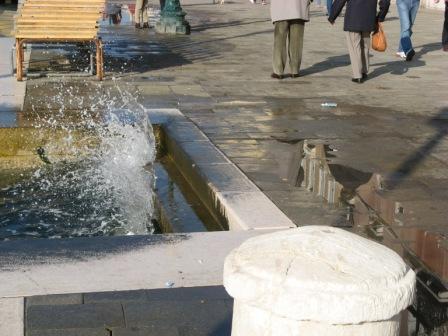
Slapping. Punching. Thudding. This is the sound of what things have come to. For 1,795 years, Venice celebrated Ascension Day with a ceremony in which the doge threw a golden ring into the sea and intoned the words: “Desponsamus te, O Mare, in signum veri perpetique dominii.” (“I wed thee, O Sea, in sign of true and perpetual dominion.”) In this case he was referring to the Adriatic, and possibly even the Mediterranean, and the Venetians did an excellent job of this for a long time. But the Venetian lagoon is a body of water which resists domination. It is not a happy marriage.
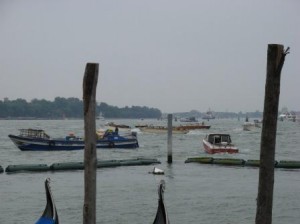
Over the past 50 years, the complex rapport between land and liquid, hitherto marred by only occasional bickering — an engineering misunderstanding, say, or some meteorological outburst — has now reached the stage of open battle.
But contrary to the general impression the world has of Venice’s rapport with its waters, the most serious problem does not involve acqua alta, or high tide. It is motondoso (sometimes moto ondoso), or the waves caused by motorboats, which is literally killing the lagoon’s erstwhile spouse. And unlike other forms of pollution or pressure, waves are a little hard to keep secret. The sight and sound of crashing water has become nearly constant.
Venetians routinely refer to motondoso as “the cancer of Venice.”
If you’re not impressed by the roiling high seas surrounding the city (try stepping between the leaping and plunging dock and vaporetto after the motonave — or better yet, the Alilaguna, the yellow airport “bus” — has just passed), give a glance at any canal at low tide.
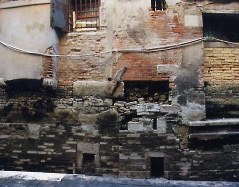
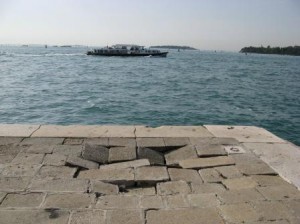
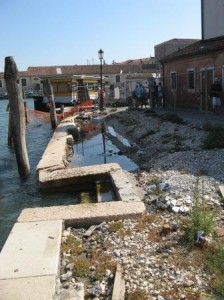
You’ll see walls with chunks of stone and brick gone, stone steps fallen askew, cracks and fissures snaking up building walls from the foundation to the second floor, and even higher. It doesn’t take many canals before you begin to wonder how the city manages to stay on its feet. There are palaces on virtually every canal which have holes in their foundations bigger than hula hoops — dank caverns stretching back into the darkness. I have seen them with these very eyes. And if I’ve seen them, so has everybody else. But it just keeps getting worse.
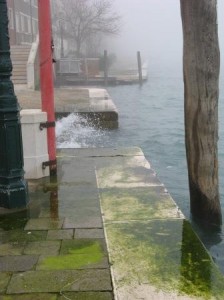
Several years ago the fondamenta on the Giudecca facing the eponymous canal was finally completely repaired. Years of pounding waves were causing it to literally fall into the canal. But the waves continue as before — on the contrary, they’re increasing. The force, the height, the frequency, pick what you will. It’s all bad. (One study has stated that the highest waves in the entire lagoon are in the Giudecca Canal.)
Therefore the fondamenta is beginning to weaken again in the same way, which you can check by looking at the point at which a building is attached to the fondamenta. Cracks are opening up. Again.
So fixing — or saying you’ve fixed — a problem doesn’t count for much if you haven’t, you know, actually fixed it.
 |
 |
 |
 |
Next: Part 2: The Why
Part 3: The How
1 Comment